Toward a Discourse Theory for Annotating
Causal Relations in Japanese
Kimi Kaneko
Ochanomizu University
[email protected]
Daisuke Bekki
Ochanomizu University
National Institute of Informatics
CREST, JST
[email protected]
Abstract
We present a revised discourse theory based on segmented discourse represen-tation theory and provide a method for building a Japanese corpus suitable for causal relation extraction. This extends and refines the framework proposed in Kaneko and Bekki (2014), and we evalu-ate our corpus and compare it with that work.
1
Introduction
In recent years, considerable attention has been paid to deep semantic processing. Many stud-ies, including Bethard et al. (2008), Inui et al. (2007), Inui et al. (2003), and Riaz and Girju (2013), have recently been conducted on deep semantic processing, and causal relation extrac-tion (hereinafter, CRE) is one of the specific tasks of deep semantic processing. Research on CRE is still progressing, and there are many ob-stacles that must be overcome.
In Inui et al. (2003), cause and effect pairs were acquired from Japanese texts by using keywords such as “node” and “kara”. In (1), for example, the antecedent ame-ga hut-ta (“it rained”) denotes an event taken as a cause, and the consequent mizutamari-ga dekita (“puddles emerged”) denotes an event taken as an effect.
(1) Ame-ga rain-NOM
hut-ta-node
fall-past-because
mizutamari-ga puddles-NOM
deki-ta. emerge-past
‘Because it rained, puddles emerged.’
However, antecedents do not always denote causes or reasons for consequents, as illustrated by the following example.
(2) Kesa this.morning
kubi-ga neck-NOM itakat-ta-node
have.a.pain-past-because
netigae-ta-no
strain.my.neck-past-attr daroo. may.
‘Because I had a pain in my neck this morning, I might have strained my neck while sleeping.’
In example (2), the antecedent kesa kubi-ga itakat-ta (“I had a pain in my neck this morn-ing”) is not taken as the cause of the consequent netigae-ta (“I strained my neck while sleeping”) but as the basis for the judgment expressed by the consequent. In this example, the consequent denotes the cause, and the antecedent denotes its effect. For a computer to automatically rec-ognize causal relations in text, it is important to distinguish cases like (2) from cases like (1). However, existing studies have not dealt with these kinds of problems.
We try to solve these remaining problems in K&B; toward that end, we propose a new method for building a Japanese corpus for causal relation extraction. In addition, we evaluate the validity of our method in terms of agreement and frequency, and analyze the results.
2
Previous Studies
In this section, we introduce some of the previ-ous studies on annotation of temporal, causal, and other relations, as well as some linguistic analyses of temporal, causal and discourse rela-tions.
Bethard et al. (2008) generated English data sets annotated with temporal and causal re-lations and analyzed interactions between the relations. In addition, these specialized data sets were evaluated in terms of inter-annotators agreement and accuracy. Relations were classi-fied into two causal categories (CAUSAL, NO-REL) and three temporal categories (BEFORE, AFTER, NO-REL). With regard to the evalua-tion, they pointed out that the classification was coarse and that reanalysis with finer relations would be necessary. Moreover, they reported that some event pairs have ambiguous tempo-ral relations. For (3), for example, it was diffi -cult for most annotators to judge which event of “was ahead from the start” and “don’t need to invite in competitive allies” precedes the other and how much the events temporally overlap.
(3) IBM established its standard to try to stop falling behind upstart Apple Com-puter, but NEC [EVENTwas] ahead from the start and didn’t [EVENT need] to in-vite in competitive allies.1
Inui et al. (2005) characterized causal expres-sions in Japanese text and built a Japanese cor-pus with tagged causal relations. However, us-ages such as that illustrated in (2) and inter-actions between temporal relations and causal relations were not analyzed.
Asher and Lascaridas (2003)’s segmented dis-course representation theory (SDRT) is a for-mal discourse theory that accounts for cases in
1This sentence was extracted from Bethard et al. (2008).
which discourse relations (rhetorical relations) interact with the truth-conditional meanings of sentences. Some of the discourse relations in SDRT have constraints on temporal and causal relations, so that we can calculate semantic con-tents that interact with them by means of se-quences of logical reasoning. Consequently, we can build a corpus for CRE in which we have considered the influences of discourse and tem-poral relations by annotating not only causal re-lations but also discourse rere-lations in SDRT into text. As examples of theories of discourse rela-tions, we mention especially rhetorical structure theory (RST) (Mann and Thompson, 1987) and cross-document structure theory (CST) (Radev, 2000). One of the problems that they equally share is the inability to exhibit sequences of rea-soning based on nonverbal information for speci-fying discourse relations. To solve this problem, exhibiting a process of sequences of reasoning should be possible.
K&B reframed SDRT by distinguishing be-tween discourse relations, temporal relations, and causal relations, and annotated Japanese texts with these three types of relations. These relations are assigned at two levels: the fact level, which describes the fact that is actually occurring in the real world, and the epistemic level, which describes what the speaker recog-nizes as the fact. Example (1) is annotated as in (4).
(4) Fact-level: [Precedence(π1,π3), Explanation(π1,π3),
CAUSE(π1,π3)],
Epistemic-level: [Precedence(π2,π4), Explanation(π2,π4),
CAUSE(π2,π4)],
π2π1Ame-ga hut-ta-node,
π4π3mizutamari-ga dekita.
Precedence(π2,π4) at the epistemic level. In the following example, by contrast, the causal and temporal relations at the fact level that hold between the main clause and the subordinate clause are reversed at the epistemic level.
(5) Fact-level: [Precedence(π3,π1), Explanation(π1,π3),
CAUSE(π3,π1)],
Epistemic-level: [Precedence(π2,π4), Explanation(π2,π4),
CAUSE(π2,π4)],
π2π1Kesa kubi-ga itakat-ta -node, π4π3netigae-ta-no-daroo.
Note that by distinguishing the two levels, the temporal constraints that discourse and causal relations impose are kept consistent. In (5), the temporal constraints Precedence(π3,π1) and Precedence(π2,π4) hold at different levels, so no contradiction arises here. In this way, K&B can handle examples, like (5), that involve an ap-parent mismatch between causal and temporal relations.
However, it is not clear whether this approach would also be effective for a large-scale corpus because the data sets built by K&B are rela-tively small. In this study, we follow the ap-proach of K&B and attempt to build a Japanese corpus tagged with discourse relations for CRE. In the course of doing so, we have discovered that the theory of K&B has the following prob-lems.
• The coverage of discourse relations is some-times insufficient. The balanced corpus of contemporary written Japanese (BCCWJ) (Maekawa, 2008) is designed as a corpus that contains texts of various styles, and further annotation has revealed that the set of discourse relations in K&B covers only some parts of the possible relations. • Annotating both fact- and epistemic-level
information for every pair of segments is re-dundant. As mentioned above, the distinc-tion between fact- and epistemic-level infor-mation plays an important role in K&B, but in most cases the information will coincide.
• Judging the temporal relation between the events is not an easy task; however, the “Narration” family can only be further clas-sified by means of the temporal relations. We can highlight the difficulty by the fol-lowing simple example (6).
(6) a. Nippon-no Japan-GEN
natu-wa summer-TOP
atui. be.hot Ippou-de,
on.the.other.hand
Nippon-no Japan-GEN huyu-wa
winter-TOP samui. be.cold
‘The summer is hot in Japan. On the other hand, the winter is cold in Japan.’
b. Fact-level: [Narration(π1,π3)?, Overlap(π1,π3)?]2,
Epistemic-level: [Narration(π2,π4)?, Overlap(π2,π4)?],
π2π1Nippon-no natu-wa atui.
π4Ippoo-de,π3Nippon-no huyu-wa samui.
One may tag this sentence pair with the “Nar-ration” label, which actually includes diff er-ent kinds of narrative relations, such as “Back-ground” and “Parallel” relations, depending on the temporal relation between them. However, both sentences of example (6) are generic, which means there is no temporal order between the things described. In other words, we can decide neither which fact occurred earlier nor which fact was recognized earlier.
One may additionally tag this sentence with the “Overlap” label described in K&B, but it is apparent that the times spanned by “summer” never overlap those spanned by “winter,” con-tradictory to what the “Overlap” label means. Because of this, the descriptive power of the la-bel set described in K&B is insufficient, and so we have to reconsider the label system.
This study aims to rearrange K&B’s theory on the basis of further reflections on SDRT as a means to rebuild an exhaustive theory of discourse relations for CRE. First, we propose
2In K&B, pairs of sentences are not tagged with causal
a new annotation scheme to solve the above-mentioned problems. Second, we focus on the first problem and annotate sentences with this new setting. Finally, we evaluate and analyze our annotation scheme and the data set.
3
Method
We extended and refined K&B and developed a new method for annotating the relation between the following segment pairs in discourse.
1. A discourse and a subsequent sentence
2. A main clause and its subordinate clause
(a) when the predicate of subordinate clause is in continuation form or “te”-form)
(b) when two clauses are connected by causal suffixes (e.g. “node”, “kara”)
3.1 Causal Relation
We distinguish two different kinds of ‘causal’ re-lations and annotate them separately. Expla-nationis a discourse relation, which is a relation between two linguistic expressions, andCause is a causal relation between two propositions.3
As a discourse relation,Explanationis a re-lation between two adjacent segments: in other words, it is a grammatical relation between two constituents. In contrast, Cause is a relation between facts and not restricted to two adja-cent segments. Cause(A,B) is the only causal relation that we adopt, as shown in Table 1. We use the tag only when there exists a causal rela-tion between a pair of proposirela-tions A and B; in other cases, no annotation is used.
The distinction between these two relations is essential because, on one hand, the causality may not be expressed linguistically and, on the other hand, a linguistically claimed causal rela-tion does not ensure actual causality.
As an example of the former case, consider (7), where John’s putting the banana peel is in reality a possible cause of Bill’s tumbling even
3A “proposition” in this paper is a tensed predicate
(e.g. “fall,” “have a pain,” and “strain” in (1)(2)) whose eventuality is either an event or a state, along with its arguments and modifiers.
though it is not linguistically marked. The dis-course relation between the two sentences here is Narration, which specifies only a temporal relation between them (as consecutive events).
(7) John-ga John-NOM
banananokawa-wo banana.peel-ACC yuka-ni
the.floor-LOC oi-ta. put-past
Bill-ga Bill-NOM koron-da.
tumble-past
‘John put a banana peel on the floor. Then, Bill tumbled.’
The latter case is exemplified by (8), where the speaker claims that John’s rain-making rit-ual caused the rain, by using a causal discourse relation, although nobody can tell whether it is in fact so.
(8) John-ga John-NOM
amagoi-wo
rain.making.ritual-ACC si-ta-node
do-past-cause
ame-ga rain-NOM
fut-ta fall-past noda.
epistemic.modal-pres
‘Because John performed a rain-making ritual, it rained.’
3.2 Without a Fact/Epistemic Level Distinction
Unlike K&B, we abolish the distinction between the factual and epistemic levels. We distinguish only whether a given segment is propositional or modal (including the segment with the causal suffix “node” and the epistemic modal suffix “noda”: the former roughly corresponds to the fact level, and the latter to the epistemic level). This decision substantially simplifies and re-duces the work of annotators. However, the dis-tinction between fact and epistemic levels is one of the core ideas in K&B used to avoid temporal contradiction, which we described in Section 1. Therefore, we have to show how our simplified setting is still free from that contradiction.
Level Description
Cause(A,B) The proposition A is a cause of the proposition B.
Table 1: Causal relation
(9) [Explanation(π2,π3), Cause(π1,π3)] π2π1Ame-ga hut-ta-node,
π3mizutamari-ga dekita.
a”. Temporal relation:
Precedence(π1,π3), Precedence(π2,π3)
(10) [Explanation(π2,π4), Cause(π3,π1)] π2π1Kesa kubi-ga itakat-ta -node, π4π3netigae-ta-no-daroo.
a”. Temporal relation:
Precedence(π3,π1), Precedence(π2,π4)
Both Cause(A,B) and Explanation(A,B) require that a temporal relation Prece-dence(A,B) holds4 since a cause must precede its effect (otherwise, it is not a cause–effect re-lation). The issue is determining whether these two relations impose contradictory temporal relations.
In (10), the antecedent part π2 of the con-ditional has the causal suffix “node”, which em-beds a propositional partπ1, and the consequent part π4 has the modal suffixdaroo, which also embeds a propositional partπ3.
BecauseExplanationis a discourse relation, it is a relation between a pair of adjacent seg-ments π2 and π4. As a result, it is a re-lation between two modal expressions, stating that “Realizing that I had a pain in my neck caused me to infer that I strained my neck,” which is as expected. The temporal requirement Precedence(π2,π4) is that realization of a pain precedes the inference of the strain, which is also as expected.
In contrast,Cause(π3,π1) in (10) is a causal relation between the propositions π3 and π1, namely, straining the neck is a cause of the pain. Here, the temporal requirement is Precedence(π3,π1), which states that the strain must precede the pain.
4For the sake of brevity, we do not discuss the details of temporal relations in this paper.
In this way, two different precedence relations, one at the fact level and the other at the epis-temic level, can be properly treated in this set-ting, without introducing fact and epistemic lev-els to every segment.
3.3 Discourse Relations
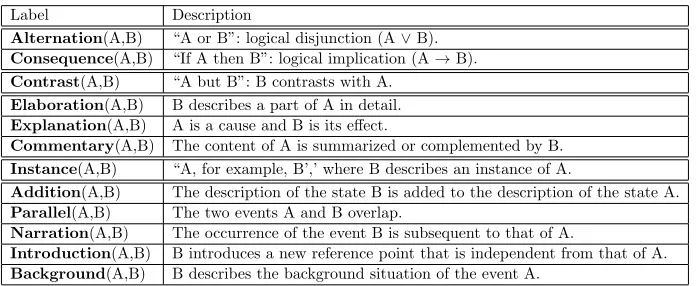
In addition toExplanation, we have the set of discourse relations, based on SDRT and K&B, shown in Table 2. It is also shown in Table 3 how discourse relations in our method correspond to those in K&B and those in SDRT. As Table 3 displays, discourse relations in our study inte-grate the temporal relations and discourse rela-tions of K&B.
Moreover, a procedure to identify discourse relations in our method is shown below.
Procedure:
1. First, judge the logical relation between the pair A and B to determine whether it is conjunctive, disjunctive, or conditional (by the standard truth-conditional tests):
(a) If it is disjunctive, tag it with the Al-ternationlabel.
(b) If it is conditional, tag it with the Con-sequencelabel.
(c) If it is conjunctive, proceed to 2.
2. Judge whether the relation is adversative or contrastive:
(a) If it is adversative, proceed to 3. (b) If it is contrastive, especially when
ex-pressions such as “sikasi”, “tokoroga” appear, tag it with the Contrast la-bel.
3. (a) If B describes an event that is a part of the whole event described by A, then tag the relation with theElaboration label.
5Temp rel(A,B) ≡
Label Description
Alternation(A,B) “A or B”: logical disjunction (A∨B).
Consequence(A,B) “If A then B”: logical implication (A→B).
Contrast(A,B) “A but B”: B contrasts with A.
Elaboration(A,B) B describes a part of A in detail.
Explanation(A,B) A is a cause and B is its effect.
Commentary(A,B) The content of A is summarized or complemented by B.
Instance(A,B) “A, for example, B’,’ where B describes an instance of A.
Addition(A,B) The description of the state B is added to the description of the state A.
Parallel(A,B) The two events A and B overlap.
Narration(A,B) The occurrence of the event B is subsequent to that of A.
Introduction(A,B) B introduces a new reference point that is independent from that of A.
Background(A,B) B describes the background situation of the event A.
Table 2: Discourse relation list
Ours SDRT K&B
Cause(A,B) Explanation(A,B) CAUSE(A,B)
Alternation(A,B) Alternation(A,B) Alternation(A,B)
Consequence(A,B) Consequence(A,B) Consequence(A,B)
Contrast(A,B) Contrast(A,B) Contrast(A,B)
Elaboration(A,B) Elaboration(A,B) Elaboration(A,B)
Explanation(A,B) Result(A,B) Explanation(A,B)
Commentary(A,B) Commentary(A,B) Commentary(A,B)
Instance(A,B) – –
Addition(A,B) Parallel(A,B) Narration(A,B)∧Overlap (A,B)
Parallel(A,B) Parallel(A,B)
Narration(A,B) Narration(A,B) Narration(A,B)∧Precedence (A,B)
Introduction(A,B) Narration(A,B) Narration(A,B)∧Temp rel(A,B)5
Background(A,B) Background(A,B) Narration(A,B)∧Subsumption (A,B)
Table 3: Correspondence among K&B, SDRT, and our method
(b) If A describes the basis of the judgment B, particularly indicated when an ex-pression such as “dakara”, “sitagatte”, or “yueni” appears, tag the relation with theExplanation label.
(c) If B is a summary, a restatement, or a complementary remark of A, especially when expressions such as “tumari” and “yoosuruni” appear, then tag the rela-tion with theCommentarylabel. (d) If A is a universal or generic sentence
and B is an instance of A, then tag the relation with theInstancelabel. (e) Otherwise, proceed to 4.
4. Judge whether the eventualities of A and B are events or states, and the reference points (in the sense of tense) of A and B:
(a) If both A and B are states, then tag
the relation with theAdditionlabel. (b) If both A and B are events and they
take place in the same time span (and overlap), then tag the relation with the
Parallellabel.
(c) If B is an event and B happens succes-sively to A, then tag the relation with the Narration label. Specifically, do so when B’s reference point is just after A’s reference point.
(d) If A is a state, B is an event, and B introduces a reference point that is in-dependent of A’s reference point, then tag the relation with the Introduc-tionlabel.
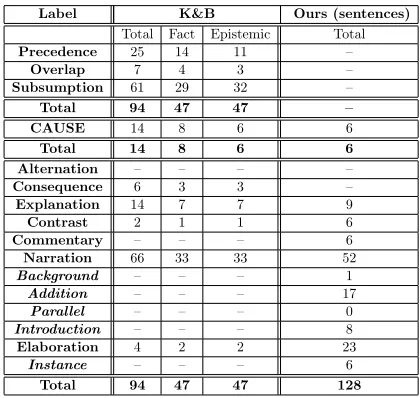
Fig-ground, Addition, and Parallel. “Elabora-tion” in K&B and SDRT includes Instance. WhileNarrationwas the most frequently used label, and so it was biased greatly in K&B, the frequency of each relation in our study is more balanced than that in K&B. Thus, the classifi-cation in our study is more appropriate for per-forming machine learning. However, whether our method is truly more appropriate than K&B should be judged by annotating segments with our relations and comparing those results with K&B.
We can see from Table 4 thatNarrationwas still the most frequently used label, and some labels, such as Alternation, never appeared. As a result, we can assume that frequent re-lations will be distinct from non-frequent rela-tions. So far, all relations are either frequent or non-frequent, although a larger data set should be analyzed to confirm this.
5
Discussion
We analyzed errors in this annotation exercise. First, under the current version of our anno-tation guideline, some judgments inevitably re-main ambiguous. We explain when and why this happens, in a mini-discourse example shown in Fig.2 (p.10). The annotators do not agree with the results of annotations forπ4 in the sentence (14): their results range overAddition(π1,π4)
(or Addition(π2,π4)), Commentary(π1,π4),
and Narration(π3,π4). The problem is that
this case may be actually ambiguous among these three cases, and none of the choices alone adequately explains the discourse relation.
The Addition label here breaks the
continu-ous structure fromπ1 toπ4 by skippingπ3 and directly connects to π1 or π2, which is due to the restriction that its first argu-ment must be a state but π3 is an event. However, this choice does not correctly cap-ture the struccap-ture of the discourse, in which the sequence of sentencesπ1 toπ4 seem to incrementally add information to the dis-course.
TheCommentarylabel currently covers
sev-eral heterogeneous cases: (1) the case that
the second argument is a summary of the first argument, (2) the case that the second argument is a restatement of the first ar-gument, and (3) the case that the second argument adds some supplementary com-ments (such as footnotes). Now, the third case applies toπ4; however, this is not dis-tinguishable from theAdditionlabel. It is necessary to separate the different uses of this label.
TheNarration label, which has a restriction
that the second argument must be a state, is reasonable if we assume that the verb with the aspect “teiru” (a perfect suffix) in π4 denotes an event. However, the refer-ence time of π3 is in the year 2004 while that of π4 is a speech time, which is a bit too long of a time span to considerπ3 and π4 to be sequential.
Second, there are problems in annotating non-assertive sentences, such as interjections, ex-clamatory sentences, and rhetorical questions. They appear not only in dialogue but also in monologue, which causes difficulty in making a judgment about their discourse relation to pre-vious sentences.
At present, we treat interjections such as “Ooops!” as if they are ellipses: for example, we may regard its full form as “I cried out ooops!” and judge their relations accordingly.
The cases of rhetorical questions such as “how do I know it?”, as in 15, can be treated in the same way; for example, here we regard it as an elliptical form of the full form “I wonder how I know it.”
(15) Dare-demo everyone-NOM
sorekurai-wa to.such.extent-ACC taiken-siteiru
experience-perf daroo may
to that souzou-siteiru
imagine-prog
noda-ga, I.know-but doudaroo.
how.do.I.know
However, it should be further investigated whether this method can be applied to all cases in a uniform and principled manner.
6
Conclusions
We proposed a method for discourse annotation based on a discourse theory that revises and ex-tends that of K&B as a means of building a more precise Japanese corpus for CRE. We have annotated 128 sentences in BCCWJ with dis-course relations and causal relations, and com-pared the annotations of 128 of these sentences with the annotations in K&B in terms of agree-ment, kappa coefficient, frequencies, and time needed for decomposition. We reported and an-alyzed the results and discussed some problems of our method. For future work, we intend to address the problems we described in Sections 4 and 5 by the further refinement of our discourse theory.
Acknowledgments
Our sincere thanks to Koji Mineshima and Maika Utsugi for many helpful discussions, and to the anonymous reviewers of PACLIC28 for insightful comments. This research is partially supported by JST, CREST and Data Centric Science Research Commons.
References
Asher N. and Lascaridas A. 2003.Logics of Con-versation: Studies in Natural Language Pro-cessing. Cambridge University Press, Cam-bridge, UK.
Bethard S., Corvey W. and Kilingenstein S. 2008. Building a Corpus of Temporal Causal Structure. LREC 2008, Marrakech, Morocco.
Inui T., Inui K. and Matsumoto Y. 2005. Ac-quiring Causal Knowledge from Text Using the Connective Marker Tame. ACM Trans-actions on Asian Language Information Pro-cessing (ACM-TALIP), Vol.4, Issue 4, Special Issue on Recent Advances in Information Pro-cessing and Access for Japanese, 435–474. Inui T., Inui K. and Matsumoto Y. 2003. What
Kinds and Amounts of Causal Knowledge Can
Be Aquired from Text by Using Connective Markers as Clues. The 6th International Con-ference on Discovery Science (DS-2003), 180– 193.
Inui T., Takamura H. and Okumura M. 2007.
Latent Variable Models for Causal Knowledge Acquisition. Alexander Gelbukh(Ed.), Com-putational Linguistics and Intelligent Text Processing, Lecture Notes in Computer Sci-ence, 4393:85–96.
Kaneko K. and Bekki D. 2014. Build-ing a Japanese Corpus of Temporal-Causal-Discourse Structures Based on SDRT for Extracting Causal Relations. EACL-2014 Workshop on Computational Approaches to Causality in Language, 33–39.
Maekawa K. 2008. Balanced Corpus of Con-temporary Written Japanese. In Proceedings of the 6th Workshop on Asian Language Re-sources (ALR), 101–102.
Mann W. C. and Thompson S. 1987. Rhetor-ical Structure Theory: A Theory of Text Or-ganization. ISI Reprint Series, ISI/RS-87-190, 1–82.
(11) π1:Bunkatyoo-bunkakooryuusi-zigyou-wa,
Agency.for.Cultural.Affairs’s.cultural.ambassador.project-TOP
nipponbunka-ni Japanese.culture-DAT tazusawaru
be.concerned.with-attr
hitobito-ni people-DAT
“Bunkakooryuusi”-tosite as.“cultural.ambassadors”
nipponbunka-wo Japanese.culture-ACC hiromete-moraukoto-wo
to.make.promote-ACC
mokuteki-tosite aim.for-cont
2003-nendo-kara from.year.2003
hazimeta start-attr
zigyou-desu. be.project-past
‘The cultural ambassador project of the Agency for Cultural Affairs is a project that started in the year 2003 with the aim of appointing people who are concerned with Japanese culture to promote Japanese culture, as “cultural ambassadors.” ’
(12) π2:“Bunkakooryuusi”-no-katudoo-niwa, “cultural.ambassador”’s.activity-TOP
(i)“kaigaihaken-gata”, “overseas.dispatching-type” (ii)“gentitaizaisya-gata”,
“immigrant-type”
(iii)“rainitigeizyutuka-gata”-no “visiting.artist-type”
3tu-no-ruikei-ga 3.types-NOM
aru. exist-pres ‘There are three types of “cultural ambassador” activities: (i) “the overseas dispatching type,” (ii) “the immigrant type,” and (iii) “the visiting artist type”.’
(13) π3:2004-nendo-wa, In.year.2004-TOP
“kaigaihaken-gata”-bunkakooryuusi-tosite
as.“overseas.dispatching-type”-cultural.ambassador
11-mei, 11-people “gentitaizaisya-gata”-bunkakooryuusi-tosite
as.“immigrant-type”-cultural.ambassador
4-mei, 4-people “rainitigeizyutuka-gata”-tosite
as.“visiting.artist-type”-cultural-ambassador”
4-kumi-no 4-teams-ACC
simei-wo appoint-ACC okonai-masi-ta.
execute-polite-past
‘In the year 2004, the Agency for Cultural Affairs appointed 11 people as “overseas dis-patching type” cultural ambassadors, 4 people as “immigrant type” cultural ambassadors, and 4 teams as “the type of artist who visits Japan” cultural ambassadors”.’
(14) π4:Nipponbunka-ni Japanese.culture-DAT
nazimino-usukat-ta unfamiliar.with-past
kuni country
ya and
tiiki-deno area-LOC
nipponbunnka-no Japanese.culture-ACC syoukai-wo
introduce-ACC
okonatte-i-masu. execute-prog-polite
‘Cultural ambassadors are introducing Japanese culture in countries and areas that were unfamiliar with Japanese culture.’