BOSNIAN JOURNAL OF BASIC MEDICAL SCIENCES 2011; 11 (1): 11-16
Abstract
Th e aim of this study was to investigate infl uence of the preparation based on barley and brewer’s yeast extracts with chromium (BBCr) and stevioside (S) on fasting glycaemia and glycaemia in mice after glucose, adrenalin and alloxan application. Th e animals were divided into three groups: glucose mgkg- (I); adrenalin . mgkg-(II) and alloxan mg kg- (III) and into subgroups according to the substance they received: stevioside mg kg- (I-S, II-S, III-S); BBCr mg kg-(I-BBCr, II-BBCr, III-BBCr) and saline ml/g (III-placebo). Glycaemia was measured before and after -day treatment with stevioside or BBCr in the following conditions: fasting, min after glucose load (I) or min after adrenaline load (II). In group III glycaemia was measured before and after -day treatment with S, BBCr or placebo and alloxan applica-tion (th, th and th days of treatment ). BBCr signifi cantly reduced fasting glycaemia in I and II groups and glycaemia values after the glucose load (I-BBCr: . ± . vs. . ± . mmol/L, p = .). Stevioside signifi cantly reduced glycaemia after the adrenalin load (II-S: . ± . vs. . ± . mmol/L; p = .). In the III-BBCr glycaemia values did not indicate the development of alloxan-induced diabetes and were signifi cantly lower than in the III-placebo (. ± . vs. . ± . mmol/L; p < .). In conclusion, BBCr caused a signifi cant decrease of fasting glycaemia, signifi cant reduction of glycaemia after glucose load and prevented onset of alloxan-induced diabetes. Stevioside caused the decrease of adrenalin-induced hyperglycaemia. © Association of Basic Medical Sciences of FBIH. All rights reserved
KEY WORDS: stevioside, barley and brewer’s yeast extract, alloxan, diabetes mellitus.
barley and brewer’s yeast based preparation
in the experimental model on mice
Vlada Cekic 1*, Velibor Vasovic 1, Vida Jakovljevic 1, Momir Mikov 1, Ana Sabo 1
1 University of Novi Sad, Faculty of Medicine, Toxicology and Clinical Pharmacology, Department of Pharmacology, Hajduk Veljkova 3,
21000 Novi Sad, Serbia
Introduction
Diabetes mellitus is a serious global health problem that signifi cantly aff ects quality of life and lifespan. Plants which are traditionally used in diabetes could become a source of new oral anti-hyperglycaemic compounds, or act as an adjunct therapy. The World Health Organization Ex-pert Committee on Diabetes has suggested an investiga-tion of the tradiinvestiga-tional methods for the treatment of diabe-tes []. Consequently, the discovery of antidiabetic factors contained in natural substances has been the subject of intense research. More than kinds of plants are re-ported to play a role in reducing the blood sugar levels []. The plant Stevia rebaudiana (Bertoni) Bertoni is used in the traditional treatment of diabetes among the Gua-rani Indians in Brazil and Paraguay. The diterpene gly-coside, stevioside isolated from Stevia rebaudiana (Ber-toni), exhibits a direct insulinotropic action in both
isolated mouse islets and the clonal beta-cell lines (INS-) [,] and possesses insulinotropic, glucagonostatic and anti-hyperglycemic effects in diabetic animals [,]. In experimental animals and clinical studies barley products have shown preventive and therapeutic antidiabetic proper-ties. In addition to conventionally malted barley, barley can be fermented using barley mixed with brewer’s yeast. Th e research into physiological activities of this material is just in the beginning stage []. Th e preparation based on barley and brewer’s yeast extracts enriched with organically bound chro-mium (BBCr) is an auxiliary medicine registered in the Re-public of Serbia in as a diabetic supplement in the treat-ment of insulin-independent diabetes mellitus. Th e supposed mechanism of its action consists of the activation of adeno-sine -monophosphate protein kinase (AMPK) which, via a series of chemical reactions, leads to an increased expression of the Glut- receptor on the membranes of muscle cells and increased take-up of glucose []. Organically bound chromi-um normalizes the permeability of cell membranes to glucose, regulates biochemical processes of its utilization and deposi-tion in the cells, and thus acts synergistically with insulin []. This study is concerned with the hypoglycaemic action of stevioside and BBCr in mice with glucose, adrenalin, or
* Corresponding author: Vlada Cekic; University of Novi Sad, Faculty of Medicine, Toxicology and Clinical Pharmacology, Department of Pharmacology, Hajduk Veljkova 3, 21000 Novi Sad, Serbia; Tel: +381 64 150 35 56; Fax: +381 21 6435 952; e-mail: [email protected]
BOSNIAN JOURNAL OF BASIC MEDICAL SCIENCES 2011; 11 (1): 12-16alloxan induced hyperglycaemia. Alloxan (,,,-tetra-oxypyrimidine; ,-dioxyuracil) is widely used to induce experimental, insulin dependent, diabetes in animals. The toxic action of alloxan on pancreatic beta cells is the sum of several processes such as oxidation of essential -SH groups, inhibition of glucokinase, generation of free radicals and disturbances in intracellular calcium homeostasis []. Th ere is limited number of published studies concerning the
investigation of the effi cacy of a combination of barley and brewer’s yeast extracts enriched with chromium in reduction of blood glucose levels in laboratory animals with experimen-tally induced hyperglycaemia. In this point of view, the aim of this study was to investigate and compare infl uence of auxil-iary medicine BBCr and stevioside on fasting glycaemia and to investigate their effi cacy in normalisation of glycaemia in mice with hyperglycaemia induced in three diff erent ways (after glucose load, adrenalin load and alloxan application).
Materials and Methods
Experimental animals
Experiments were carried out on NMRI-Haan laboratory mice of both sexes, body weight . - . g, more than months old. Th e animals had free access to food and wa-ter and a hour succession of light and dark periods at °C. Th e local University Ethic Committee at the Faculty of Medicine of Novi Sad approved all animal protocols. Labo-ratory animals were in human care in accordance with the criteria of the ‘Guide for the Care and Use of Labora-tory Animals’ prepared by the National Academy of Sci-ence and published by the National Institutes of Health [].
Chemicals
Glucose-anhydrous: a glucose dose of mg kg- was used
in the oral glucose load test. According to the long-standing experience of our laboratory, this glucose dose proved to be adequate in mice in testing the potential hypoglycae-mic action of medicinal herbs, because it indicates the ef-fectiveness of the tested drug in this regard [,]. Adren-alin-hydrochloride: a dose of . mg kg-, s.c. was used for
adrenalin induced hyperglycaemia. Alloxan: alloxan was administered intraperitoneally in doses of mg kg- each,
which were administered in the interval of h (between st and nd dose), i.e. h (between nd and rd dose) [].
Auxiliary medicines
Stevioside: prepared stevioside solution was administered by the oral probe in the dose of mg kg- ( ml/ g), i.e.
mg was dissolved in ml of saline solution (. solution). BBCr: the active ingredient of this product is a fermentation product of barley and brewer’s yeast (Glut plus - insulin
sen-sitizer) with the percentage of tablet composition of .. Th e product is enriched with organically bound chromium
in concentration of . ± mg/ g. Excipients are: man-nitol, starch, lactose, cellulose, microcrystalline, sodium stearyl fumarate, acesulfame, chocolate and coff ee fl avour. Prepared solution of BBCr was administered by oral probe in the dose of mg kg- ( ml/ g), i.e. mg was
dis-solved in . ml of saline solution. Th e doses of stevioside and BBCr were calculated according to the human dosage.
Apparatus
Accu-Check instrument (F.Hoffmann - La Roche Ltd., Basel, Switzerland): glycaemia was measured by means of test stripes, which contained specific glu-cose oxidase enzyme for detection of gluglu-cose present in the blood. Concentration was expressed in mmol/L.
Experimental procedure
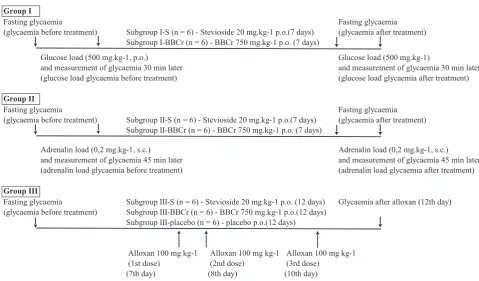
The animals were randomized into three main groups, ac-cording to hyperglycaemia induction (I group: glucose, II group: adrenalin or III group: alloxan). Th e groups were di-vided into subgroups with respect to the substance they re-ceived (stevioside or BBCr): subgroups I-S, I-BBCr; S, II-BBCr; III-S, III-BBCr and III-placebo (saline, ml/g p.o). Each subgroup consisted of animals and each animal was its own control in respect of glycaemia before and after the treatment with test substances, except for group III (al-loxan), which contained a placebo subgroup. Glycaemia in mice was measured in the drop of capillary blood, ob-tained by incision of the tail tissue near its top. Blood drop was placed on the indicator strip of the Accu-Check instru-ment and glycaemia value in mmol/L was read. While cap-illary blood from the tail was taken, mice were held care-fully, wrapped in a towel, and care was to minimise distress. Before beginning of the experiment the animals body mass and fasting glycaemia was measured and recorded in all three groups (glycaemia before treatment). After that, the animals of Group I were loaded with glucose ( mg kg- p.o.) and
glycaemia was measured min later (glucose load glycaemia before treatment). During the subsequent days subgroups I-S and I-BBCr received stevioside or BBCr, respectively. Af-ter -days of treatment, the animals of subgroups S and I-BBCr were tested again for fasting glycaemia and glycaemia after glucose load. The same experimental procedure was applied to the animals of Group II with the diff erence that these animals were loaded with adrenalin (. mg kg- s.c.)
BOSNIAN JOURNAL OF BASIC MEDICAL SCIENCES 2011; 11 (1): 13-16
After measurement of fasting glycaemia, the animals of Group III were treated with stevioside (subgroup III-S), BBCr (subgroup III-BBCr) and placebo (subgroup III-placebo) during days. Th e placebo subgroup was given perorally with ml/ g saline. After -days of treatment the animals of Group III received the fi rst dose of alloxan ( mg kg-)
and glycaemia was measured h after that. Th ese animals received another two doses (on the th and th day) of
al-loxan, and glycaemia was measured h later (Figure ) [].
Statistical analysis
Statistical analysis of data was carried out using paired samples t-test with the error level < and ANOVA test. All data are reported as the X ± SD.
Results
As presented in the table , in group loaded with glucose (group I), stevioside (subgroup I-S) signifi cantly changed the fasting glycaemia levels after the -day treatment (. ± . mmol/L vs. . ± . mmol/L; p = .). Stevioside did not reduce glycaemia in mice after the glucose load comparing with the values before treatment. Seven-day treatment with BBCr (subgroup I-BBCr) resulted in signifi cant reduction of fasting glycaemia levels (. ± . mmol/L vs. . ± . mmol/L, p = .). BBCr signifi cantly reduced glycaemia lev-els after the glucose load compared to the values before treat-ment (. ± . mmol/Lvs. . ± . mmol/L, p = .). As presented in the table , in group loaded with adrenalin
Results are presented as X±SD. Subgroup I-S: 7-day treatment with stevioside (20 mg kg-1, p.o.); Subgroup I-BBCr: 7-day treatment with BBCr (750 mg kg-1, p.o.)
*p<0.05 (statistically signifi cant diff erence in fasting glycaemia within subgroups I-S and I-BBCr before and after treatment with stevioside or BBCr, respectively) **p < 0.01 (statistically signifi cant diff erence in glucose load glycaemia values before and after treatment with BBCr)
Group I n = 12
Glycaemia (mmol/L)
Before treatment After 7 day treatment Fasting Glucose load Fasting Glucose load Subgroup I-S
n = 6 7.38 ± 1.02 7.73 ± 1.51 6.27 ± 0.15* 7.85 ± 0.99 Subgroup I-BBCr
n = 6 8.20 ± 1.07 9.20 ± 0.61 7.05 ± 0.76* 7.42 ± 0.59**
TABLE 1. The eff ects of stevioside and preparation based on
bar-ley and brewer’s yeast extracts enriched with chromium (BBCr) on hyperglycaemic response to glucose load (500 mg kg-1, p.o.)
in mice
FIGURE 1. Schematic presentation of the experimental procedure.
Results are presented as X±SD. Subgroup II-S: 7-day treatment with stevioside (20 mg kg-1, p.o.); Subgroup II-BBCr: 7-day treatment with BBCr (750 mg kg-1, p.o.)
*p < 0.05 (statistically signifi cant diff erence in adrenalin load glycaemia within sub-group II-S before and after treatment with stevioside and statistically signifi cant dif-ference in fasting glycaemia values within subgroup II-BBCr before and after treat-ment with BBCr).
Group II n = 12
Glycaemia (mmol/L)
Before treatment After 7 day treatment Fasting Adrenalin load Fasting Adrenalin load Subgroup II-S
n = 6 7.25 ± 0.94 13.45 ± 0.71 8.05 ± 0.63 11.65 ± 1.19* Subgroup II-BBCr
n = 6 7.10 ± 0.75 15.07 ± 2.56 6.58 ± 0.53* 14.17 ± 2.84
TABLE 2. The eff ects of stevioside and preparation based on
bar-ley and brewer’s yeast extracts enriched with chromium (BBCr) on hyperglycaemic response to adrenalin load (0.2 mg kg-1, s.c.)
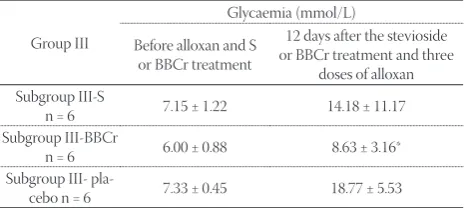
BOSNIAN JOURNAL OF BASIC MEDICAL SCIENCES 2011; 11 (1): 14-16(group II), stevioside (subgroup II-S) did not significantly change the fasting glycaemia after the -day treatment. Ad-ministration of stevioside resulted in signifi cant reduction of glycaemia after loading with adrenalin compared to the values before treatment (. ± . mmol/L vs. . ± . mmol/L; p = .). Seven-day treatment with BBCr (subgroup II-BBCr) resulted in signifi cant reduction of fast-ing glycaemia (. ± . mmol/L vs. . ± . mmol/L, p = .). BBCr did not signifi cantly reduce glycaemia levels after the adrenalin load compared to the values before treat-ment (. ± . mmol/Lvs. . ± . mmol/L, p = .). There were no significant differences in fasting glycaemia among the three subgroups, III-S, III-BBCr and III- placebo before alloxan application and S or BBCr treatment. Th e III-placebo subgroup of animals due to alloxan application, de-veloped experimental diabetes with the increase of glycaemia from . ± . mmol/L to . ± . mmol/L (p < ,). Af-ter the -day treatment with stevioside (III S), the increase in glycaemia caused by alloxan was not statistically signifi cant (from . ± . mmol/L to . ± . mmol/L, p = .). However, this increase in glycaemia due to alloxan was not statistically signifi cantly lower compared to the III-placebo subgroup (. ± . mmol/L vs . ± . mmol/L; p = .). In subgroup treated with BBCr (III-BBCr) for days glycaemia values did not indicate the development of artifi -cial diabetes (. ± . mmol/L before alloxan vs. . ± . mmol/L after alloxan; p = .) and were statistically signifi -cantly lower than in the III-placebo subgroup (. mmol/L ± . mmol/L vs. . ± . mmol/L respectively; p < .).
Discussion
Seven day treatment with stevioside resulted in statistically significant reduction of fasting glycaemia levels in group I, but did not influence fasting glycaemia levels in group II. Having in mind that glucose load (group I) and
adrena-lin load (group II) were done after glycaemia measuring in fasting conditions (Figure ), fasting glycaemia values be-fore and after tretment with stevioside, can be summarised in group I and group II (I-S + II-S; n = ). After summaris-ing, obtained data show that stevioside did not signifi cantly change the fasting glycaemia levels after the -day treat-ment (. ± . mmol/L vs. . ± . mmol/L; p > .). Th is is in accordance with the mechanism of stevioside ac-tion reported by some other researchers. Jeppesen et al. [] reported that insulinotropic effects of stevioside depend on the glucose concentration. Namely, the authors showed that stevioside ( mmol/L) potentiated insulin secretion at the glucose concentration exceeding . mmol/L. Th ey also observed that the insulinotropic eff ect was preserved in the absence of extracellular Ca+ and that stevioside
potenti-ated the insulin secretion from beta cell line INS- without aff ecting the activity of the membrane ATP-sensitive potas-sium channels and increase in the concentration of cyclic adenosine monophosphate (cAMP) in the islets. Ferreira et al. [] investigated the activity of stevia leaves ( mg kg- day-) and stevioside ( mg kg- day-) on glycaemia and
gluconeogenesis in rats after a -day application. They showed that a decrease in glycaemia and gluconeogenesis occurred after the treatment with stevia leaves but not with stevioside. To explore the effects of stevioside pre-treat-ment, Chen et al. [] exposed isolated mouse islets to low or high glucose for h after short-term ( h) or long-term ( h) pre-treatment with stevioside. Basal insulin secretion at . or . mM glucose was not changed after short-term pre-treatment with stevioside (- M). Th eir study suggests
that stevioside pre-treatment does not cause a stimulation of basal insulin secretion and does not desensitize beta-cells. In the present investigation, the glycaemia increase in the oral glucose load test was not signifi cantly lower after the -day application of stevioside (I-S subgroup) compared to the values before treatment (. ± . mmol/L vs. . ± . mmol/L). Lailerd et al. [] in their study on insulin-sensitive rats showed that stevioside did not diminish the area under the curve (AUC) for glucose in the OGTT, but it diminished the AUC value for insulin by and insulin index by . However, there is data supporting the hypo-glycaemic action of stevioside as evidenced by the OGTT. Chen et al. [] showed that glucose stimulated insulin secre-tion (. mM) increased dose-dependently after long-term pretreatment with stevioside at concentrations from - M
to - M. Th e eff ect of stevioside on lowering
hyperglycae-mia in the OGTT was also demonstrated in healthy rats []. However, the -day treatment of mice with stevioside re-sulted in a statistically signifi cant decrease of glycaemia in the adrenalin load test (II-S subgroup) compared to the values before treatment (. ± . mmol/L vs. .
Results are presented as X ±SD. Subgroup III-S: 12-day treatment with stevioside (20 mg kg-1, p.o.); Subgroup III-BBCr: 12 day treatment with BBCr (750 mg kg-1, p.o.);
Subgroup III-placebo: 12 day treatment with saline (1 ml/100g, p.o.)
*p < 0.05 (statistically signifi cant diff erence in glycaemia after alloxan application between subgroup III-BBCr and subgroup III-placebo).
Group III
Glycaemia (mmol/L)
Before alloxan and S or BBCr treatment
12 days after the stevioside or BBCr treatment and three
doses of alloxan Subgroup III-S
n = 6 7.15 ± 1.22 14.18 ± 11.17
Subgroup III-BBCr
n = 6 6.00 ± 0.88 8.63 ± 3.16*
Subgroup III-
pla-cebo n = 6 7.33 ± 0.45 18.77 ± 5.53
TABLE 3. The eff ects of stevioside and preparation based on
BOSNIAN JOURNAL OF BASIC MEDICAL SCIENCES 2011; 11 (1): 15-16
± . mmol/L, p < .). This effect of stevioside can be explained by the increased secretion and insulin utiliza-tion via the reducutiliza-tion of the expression of the gene for phosphoenolpyruvate carboxykinase (PEPCK) in the rat’s liver, slowing down the process of gluconeogenesis []. After the -day treatment with stevioside (III-S subroup),
the increase in glycaemia caused by alloxan was not sta-tistically significant (from . ± . mmol/L to . ± . mmol/L, p = .), which was not case with III- pla-cebo subgroup (from . ± . mmol/L to . ± . mmol/L; p < .). This result agreed with the report by Chen et al. [] which showed that stevioside reduced the hyperglycaemia after treating rats with streptozo-tocin (destroys the pancreas beta cells, similar to alloxan). The mechanism of stevioside action has not been fully ex-plained yet. It is thought that its oral application increases cell sensitivity to insulin in insulin-resistant rats and that it exhibits antihyperglycaemic, insulinotropic and glucagono-static eff ects in the type diabetic rat [,], the main ac-tion being insulinotropic. Stevioside also increases the utiliza-tion of glucose in the muscle tissue cells and lowers the liver gluconeogenesis [,]. Melis [] reported that stevioside reduced glucose reabsorption in the kidney tubuli. Lailerd et al. [] studied the glucose transport to the muscle tissue in vitro and found that the stevioside doses from . to . mmol/L did not change the basal transport of glucose to the muscle tissue in the insulin-sensitive rats. However, at a dose of . mmol/L stevioside increased insulin-stimulated transport of glucose to m. epitrochlearis by and to m. soleus by . At a dose exceeding . mmol/L the eff ect of stevioside was reversible. Similarly, in the insulin-resistant obese rats the basal transport of glucose to muscle tissue was not aff ected with stevioside doses between . and . mmol/L, but these doses caused an increase of the insulin-stimulated transport of glucose to m. epitrochlearis by and to m. soleus by . Th ese results indicate that glucose transport to the muscle tissue is one of the potential sites of stevioside action []. Regardless of the opposite opinions of the researchers concerning the mechanism of stevioside ac-tion, the majority of them agree that stevioside normalizes blood glucose level. Numerous studies reporting that stevia components showed signifi cant decrease of glycaemia in dia-betes and increase of the glycaemia in the state of hypoglycae-mia justify the need for experimental work in this area []. In contrast to stevioside, in an analogous -day treatment, the BBCr produced a signifi cant decrease of fasting glycaemia in I and II group compared to the values before treatment (I-BBCr subgroup: . ± . mmol/L vs. . ± . mmol/L, p = .; II-BBCr subgroup: . ± . mmol/L vs. . ± . mmol/L, p = .). Th ese results are in accordance with the results of Miljkovic and Pietrzkowski [], who showed that
the -day application of a preparation based on barley ex-tract decreased the fasting glycaemia by . It is thought that the hypoglycaemic eff ect of BBCr is in accordance with its insulin-independent mechanism of action, consisting in a direct activation of AMPK and via the e-NOS system, in-crease in the expression of the Glut- receptor on the sur-face of cell membranes and enhanced takeover of glucose. After the glucose load, the glycaemia increase was
signifi-cantly lower after the -day application of BBCr (I-BBCr subgroup) compared to the values before treatment (. ± . mmol/L vs. . ± . mmol/L mmol/L, p = .). Miljkovic et al. [] showed that the -day application of a preparation based on barley extract yielded a decrease of postprandial glycaemia by . Th is observation can be ex-plained by the insulinotropic action of the preparation and increased takeover of glucose in the cells due to increased expression of the Glut- receptor on the cell membrane. Th e -day application of the preparation BBCr did not produce a statistically signifi cant change of glycaemia after the adrena-lin load (subgroup II-BBCr) compared to the values before treatment (. ± . mmol/L vs. . ± . mmol/L). After the application of three doses of alloxan, no
hypergly-caemia increase was observed in the subgroup of animals receiving BBCr (subgroup III-BBCr) for days (glycaemia increased from . ± . mmol/L to . ± . mmol/L, p = .). Th is increase in glycaemia was statistically signifi cantly lower compared to that observed for the III-placebo sub-group (. ± . mmol/L vs. . ± . mmol/L, p < .). Th ese results may be explained by the insulinotropic action
of BBCr and enhanced glucose takeover in the cells, which is not insulin-dependent. Hong et al. [] studied the action of barley extract at a dose of . mg kg- in a -week
BOSNIAN JOURNAL OF BASIC MEDICAL SCIENCES 2011; 11 (1): 16-16thirst. Th e authors concluded that this eff ect may be ascribed to the high concentration of chromium []. It is thought that chromium accelerates the cascade of intracellular phospho-rylations and enzyme activation after binding to the insulin receptors, and increases expression of the Glut- receptors on the surface of cell membranes [, ]. Bearing in mind that the preparation BBCr is enriched with organically bound chromium ( ± ) the action on the translocation and the expression of the Glut- receptors on the cell membrane are enhanced, thus enhancing the glucose takeover, which is in agreement with the results of the present investigation.
Conclusion
BBCr caused a significant decrease of fasting glycaemia and significant reduction of glycaemia after glucose load. Stevioside caused only the decrease of adrenalin-induced hyperglycaemia. BBCr product prevented the onset of ex-perimental diabetes in mice caused by alloxan. Based on these results it can be concluded that BBCr has its role in the prevention and treatment of hyperglycaemia in mice. A long-term human study with diabetic patients should be done to verify these promising results in animal diabetes.
Declaration of interest
Authors report no confl ict of interest.
References
[] World Health Organization Expert Committee on Diabetes Mel-litus: Second Report on Diabetes Mellitus. Geneva, World Health Organization, (Tech. Rep. Ser. ).
[] Bailey CJ, Day C. Traditional plant medicines as treatments for dia-betes. Diabet Care ; : -.
[] Jeppesen PB, Gregersen S, Hermansen K. Stevioside and steviol stimulate insulin secretion from isolated mouse islets. Diabetologia ; A: .
[] Jeppesen PB, Gregersen S, Poulsen CR, Hermansen K. Stevioside acts directly on pancreatic beta cells to secrete insulin: actions independent of cyclic adenosine monophosphate and adenosine triphosphate-sensitive K+-channel activity. Metabolism ; : -.
[] Jeppesen PB, Gregersen S, Alstrup KK, Hermansen K. Stevioside induces antihyperglycaemic, insulinotropic and glucagonostatic ef-fects in vivo: studies in the diabetic Goto-Kakizaki (GK) rats. Phyto-medicine ; : -.
[] Jeppesen PB, Gregersen S, Rolfsen SE, Jepsen M, Colombo M, Ag-ger A., et al. Anti-hyperglycemic and blood pressure reducing ef-fects of stevioside in the diabetic Goto-Kakizaki (GK) rat. Metabo-lism ; : -.
[] Gorjanović S, Cvetković A, Suznjević D, Beljanski M, Vrvić M, Hranisavljević J. Isolation and characterization of highly ligan-ded protein from brewer's barley grain. Biosci Biotechnol Biochem ; : -.
[] Miljkovic D, Pietrzkowski Z, inventors; VDF Futureceuticals, Inc., assignee. Compositions and methods for treating NIDDM and other conditions and disorders associated with AMPK regulation. International patent application WO. Mar .
[] Wang ZQ, Zhang XH, Russell JC, Hulver M, Cefalu WT. Chro-mium picolinate enhances skeletal muscle cellular insulin signaling in vivo in obese, insulin-resistant JCR:LA-cp rats. Nutr ; : -.
[] Szkudelski T. Th e mechanism of alloxan and streptozotocin action in B cells of the rat pancreas. Physiol Res ; : -. [] Guide for the Care and Use of Laboratory Animals; Committee on
Care and Use of Laboratory Animals, National Research Council, Washington, D.C., U.S. Department of Health and Human Services, .
[] Raskovic A, Gavrilovic M, Jakovljevic V, Sabo J. Glucose concentra-tion in the blood of intact and alloxan-treated mice after pretreat-ment with commercial preparations of Stevia rebaudiana (Bertoni). Eur J Drug Metab Pharmacokinet ; : -.
[] Raskovic A, Jakovljevic V, Mikov M, Gavrilovic M. Joint eff ect of commercial preparations of Stevia rebaudiana Bertoni and sodium monoketocholate on glycemia in mice. Eur J Drug Metab Pharma-cokinet. ; : -.
[] Vogel HG, Vogel WH. Drug discovery and evaluation, Pharmaco-logical assays. Springer-Verlag, Berlin Heidelberg; , pp. -.
[] Jakovljevic V. Eksperimentalna farmakologija u naučno-istraživačkom radu. Alfagraf, Petrovaradin; , pp. -. [] Ferreira EB, de Assis Rocha Neves F, da Costa MA, do Prado WA,
de Araújo Funari Ferri L, Bazotte RB. Comparative eff ects of Stevia rebaudiana leaves and stevioside on glycaemia and hepatic gluco-neogenesis. Planta Med ; : -.
[] Chen J, Jeppesen PB, Abudula R, Dyrskog SE, Colombo M, Her-mansen K. Stevioside does not cause increased basal insulin secre-tion or beta-cell desensitizasecre-tion as does the sulphonylurea, gliben-clamide: studies in vitro. Life Sci ; : -.
[] Lailerd N, Saengsirisuwan V, Sloniger JA, Toskulkao C, Henriksen EJ. Eff ects of stevioside on glucose transport activity in insulin-sen-sitive and insulin-resistant rat skeletal muscle. Metabolism ; : -.
[] Chen TH, Chen SC, Chan P, Chu YL, Yang HY, Cheng JT. Mecha-nism of the hypoglycaemic eff ect of stevioside, a glycoside of Stevia rebaudiana. Planta Med ; : -.
[] Chang JC, Wu MC, Liu IM, Cheng JT. Increase of insulin sensitiv-ity by stevioside in fructose-rich chow-fed rats. Horm Metab Res ; : -.
[] Jeppesen PB, Gregersen S, Alstrup KK, Hermansen K. Stevioside induces antihyperglycaemic, insulinotropic and glucagonostatic ef-fects in vivo: studies in the diabetic Goto-Kakizaki (GK) rats. Phyto-medicine ; : -.
[] Melis MS. Chronic administration of aqueous extract of Stevia re-baudiana in rats: Renal eff ects. J Ethnopharmacol ; : – .
[] Singh SD, Rao GP. Stevia: Th e herbal sugar of st century.
Sugar-Tech ; : -.
[] Hong H, Jai Maeng W. Eff ects of malted barley extract and banaba extract on blood glucose levels in genetically diabetic mice. J Med Food. ; : -.
[] Schmid S, Koczwara K, Schwinghammer S, Lampasona V, Ziegler AG, Bonifacio E. Delayed exposure to wheat and barley proteins reduces diabetes incidence in non-obese diabetic mice. Clin Immu-nol ; : -.
[] Li J, Kaneko T, Qin LQ, Wang J, Wang Y, Sato A. Long-term ef-fects of high dietary fi ber intake on glucose tolerance and lipid metabolism in GK rats: Comparison among barley, rice, and corn-starch. Metabolism ; : -.
[] Mahdi GS, Naismith DJ. Role of chromium in barley in modulating the symptoms of diabetes. Ann Nutr Metab ; : -. [] Cefalu WT, Wang ZQ, Zhang XH, Baldor LC, Russell JC. Oral