SPECIAL ARTICLE
Setting the Stage for Success: Implementation of
Developmental and Behavioral Screening and
Surveillance in Primary Care Practice—The North
Carolina Assuring Better Child Health and
Development (ABCD) Project
Marian F. Earls, MD, FAAPa, Sherry Shackelford Hay, BSW, MPAb
aGuilford Child Health, Inc, and Department of Pediatrics, University of North Carolina School of Medicine, Greensboro, North Carolina;bABCD and Special Programs,
Office of Rural Health and Community Care of North Carolina, Raleigh, North Carolina
The authors have indicated they have no financial relationships relevant to this article to disclose.
ABSTRACT
Early identification of children with developmental and behavioral delays is im-portant in primary care practice, and well-child visits provide an ideal opportunity to engage parents and perform periodic screening. Integration of this activity into office process and flow is necessary for making screening a routine and consistent part of primary care practice. In the North Carolina Assuring Better Child Health and Development Project, careful attention to and training for office process has resulted in a significant increase in screening rates to ⬎70% of the designated well-child visits. The data from the project prompted a change in Medicaid policy, and screening is now statewide in primary practices that perform Early Periodic Screening, Diagnosis, and Treatment examinations. Although there are features of the project that are unique to North Carolina, there are also elements that are transferable to any practice or state interested in integrating child development services into the medical home. Included here are lessons learned and a listing of practical tools for implementation.
www.pediatrics.org/cgi/doi/10.1542/ peds.2006-0475
doi:10.1542/peds.2006-0475
Key Words
assessment and surveillance, quality of care, developmental care, clinical practice
Abbreviations
AAP—American Academy of Pediatrics ABCD—Assuring Better Child Health and Development
EPSDT—Early Periodic Screening, Diagnosis, and Treatment ASQ—Ages and Stages Questionnaire
Accepted for publication Apr 10, 2006 Address correspondence to Marian F. Earls, MD, FAAP, Guilford Child Health, Inc, 1046 E Wendover Ave, Greensboro, NC 27405. E-mail: [email protected]
E
ARLY IDENTIFICATION OFchildren with developmen-tal delays is important in primary care practice. Primary care providers are generally the best-informed professionals with whom families have regular contact over the child’s first 5 years of life, and the well-child visit provides for periodic evaluation of a child’s devel-opment in relation to the child as a whole.“About 16% of children have disabilities including speech and language delays, mental retardation, learn-ing disabilities and emotional/behavioral problems; however only 30% of children with disabilities are de-tected before school entrance.”1 “The prevalence of mental health problems is even higher among preschool children living in an environment of risk with estimates ranging from 17%–25%.”2 Developmental screening and surveillance at well-child visits is recommended as a key component of preventive care for children.3 Screen-ing is especially important as a way to facilitate early identification and referral for infants and children who need early intervention services.4,5 However, as evi-denced by the finding that only 30% of children needing services are identified by school age, primary care phy-sicians do not identify these needs in the course of well-child care, which underscores the need for systems in practice to integrate the use of formal, validated screening tools. In addition, the benefits of screening and surveillance are not limited to children with develop-mental and behavioral delays. Even for typically devel-oping children, families benefit by increased awareness of appropriate developmental and behavioral expecta-tions. Primary physicians benefit from using the screen-ing discussion as a template for anticipatory guidance. However, there are definitely perceived barriers to screening in practice, including time, staff needed, and inadequate reimbursement.6 The cost of a practitioner administering a developmental screen with a child was estimated by Dobrez et al7 to be greater than $7 per member per month for 0- to 3-year-olds, (but $0 for parent-completed tools). Physicians often take a “wait-and-see” approach, leading to an inappropriately high threshold for referral. For some there is the mistaken idea that screening may cause parental anxiety. When these factors are combined with an unfamiliarity with community resources, effective developmental surveil-lance is limited.5
Nevertheless, multiple authors have underscored the need for improved developmental services in primary care.8,9When the Promoting Healthy Development Sur-vey was completed with almost 1500 families, the results revealed a significant need for improvement in family-centered care and anticipatory guidance (ie, in eliciting parental concerns about development, discussing con-cerns, and connecting families with resources) in the course of well-child care.10
Physicians themselves, when surveyed, also reflect this need for improvement. In 2003, Sices et al11
re-ported results from their survey mailed to a random national sample of pediatricians and family physicians. Only approximately half of them used a formal screen-ing tool. There was great variability in screenscreen-ing and surveillance implementation in practices. The authors noted underuse of parent-completed tools. The 53rd American Academy of Pediatrics (AAP) Periodic Survey of Fellows6revealed that 71% of fellows used only clin-ical observation without a screening instrument to iden-tify children with a developmental delay. Only 23% reported using a standardized tool. Overall, 50% said they always or sometimes conducted the screening. Fur-thermore, screening is often not seen as needed for the general population of children. Many reported that they used a screen more often when the parent already ex-pressed a concern or the child was already at higher risk (very low birth weight, prematurity, known syndrome, etc).6,12
Although the implementation of developmental screening is variable, it seems that parents desire these services and express greater satisfaction when they re-ceive them. According to parent report from the Na-tional Survey on Early Childhood Health, only 57% of children aged 10 to 35 months ever received develop-mental screening by their primary care provider, but parents gave higher ratings for family-centeredness when screening did occur.13
The Assuring Better Child Health and Development (ABCD) Project was begun in North Carolina in August 2000, piloting formal developmental screening and sur-veillance for children receiving Early Periodic Screening, Diagnosis, and Treatment (EPSDT) services in pediatric and family practices. The project’s purpose was expressly to assist practices in implementing an office process for screening that would be efficient and practical, to pro-mote early identification and referral, and to facilitate practice ability to link to early intervention and other community services. The goal was to establish a sustain-able system for the entire state. The pilot began in 1 county and was replicated in 9 additional counties, and the process then became a statewide Medicaid policy in 2004. A formal screening (in most North Carolina prac-tices, using the Ages and Stages Questionnaire [ASQ]14 or the Parents Evaluation of Developmental Status15) is performed at the 6-, 12-, and 18-month or 24-, 36-, 48-, and 60-month visits. In 2 counties, the results of every screen, with referral information, were entered into a database and tracked (⬎20 000 screens by 2004).
PROJECT OVERVIEW
communities using a 2-tiered approach: (1) a “best-prac-tices” model for integrating developmental and behav-ioral screening and surveillance into primary care prac-tice was developed with plans for replication; and (2) a group of key state leaders who had the capability of making policy changes was convened. Key objectives of the project were to:
● develop and implement a model program for children that encompasses their health, social, and develop-mental needs;
● help parents understand developmental milestones/ behavior and ways to facilitate healthy development;
● identify and respond to provider concerns about de-velopmental screening and surveillance in local com-munities;
● identify and respond to family concerns; and
● monitor and track the impact of the model by imple-menting an evaluative process.
CHALLENGES
The state and nation face a list of challenges when de-veloping this type of model. Poverty increases the risk for developmental and psychosocial issues in young chil-dren. In North Carolina, 55% of the 1.9 million children are eligible for special health care programs or are un-insured. In addition, before initiation of the model across North Carolina Medicaid systems of care, children were getting screened, on average, only 15.3% of the time, and the number of children served by early intervention was low. A 1999 legislative study on early intervention services indicated that between 8% and 13% of the total population between birth and 3 years of age could qual-ify and benefit from early intervention services; how-ever, only 2.6% were served.
At the same time, the AAP was recommending formal screening and surveillance at well-child visits, but the most common and familiar developmental screening tool (Denver Developmental Screening Test) was unten-able in primary care practice.
INFRASTRUCTURE
The model builds on North Carolina’s “physician-driven” enhanced primary care case management pro-gram, Community Care of North Carolina. These com-munity networks are designed to better manage services for the Medicaid population. Many of the networks have also expanded services to other populations such as those in the State Children’s Health Insurance Program and the uninsured. The heart of the program is commu-nity providers taking a population-based approach to managing enrollee care by systematically identifying pa-tients-at-risk and then instituting the processes and sup-ports that are needed to manage the care.
The North Carolina ABCD Project was, by design, a
quality-improvement initiative, and it was piloted within the infrastructure of one of these networks called the Partnership for Health Management. At the time in Au-gust 2000, there were 9 networks with 114 practices in 37 counties. Currently, there are 14 networks with 1006 practices in 92 counties. Each network receives addi-tional money ($2.50 per member per month) from Med-icaid for providing care management staff to support the member practices in implementing disease manage-ment and preventive protocols (eg, asthma, diabetes, developmental and behavioral screening, reduction of emergency department usage). Each of the network practices also receives $2.50 per member per month for practice costs associated with instituting processes to better manage care.
PROJECT IMPLEMENTATION IN THE OFFICE
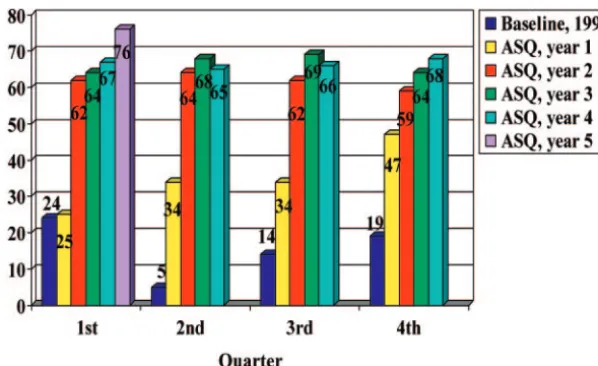
A key characteristic of this project is that it was physi-cian/practice driven. The process began with pediatri-cians exploring options for a screening process that would be compatible with a busy schedule, be satisfying to parents, optimize early identification of infants and toddlers who are at risk, and facilitate anticipatory guid-ance in promoting successful developmental outcomes. In choosing a screening tool, the factors that were con-sidered include the type of screen, staff required, time, and cost. Parent-completed tools required little staff time, were not costly, and could fit nicely into the office flow. Most importantly, these tools engage parents as experts on their child and recognize the provider-parent partnership in the care of the child. In addition, there was a choice of a few such tools that met sensitivity and specificity (70%– 80%), were available in other lan-guages (particularly Spanish), and had fourth- to fifth-grade reading levels. The pilot practices chose the ASQ. Use of PDSA (“plan, do, study, act”) cycles allowed for real-time modifications that were based on qualitative measures such as provider and parent surveys. Progress in the rate of screening was measured quarterly by tab-ulating the number of completed screens over the num-ber of well-child visits at the age intervals at which screening was to be done. Steady progress in the rate of screening was seen from quarter to quarter, because the practices were able to troubleshoot and improve flow procedures as experience was gained (see Fig 1). On the basis of the experience of the pilot and subsequent prac-tices that joined the project, the following key steps for the office process have been identified:
● Assess current office protocols.
● Identify a physician champion to maintain the initia-tive as a priority.
● Identify system supports (networking with commu-nity partners is key here).
● Conduct staff orientations; be sure to include nursing and office staff who will be instrumental in the office flow.
● Share process and outcome data at regular intervals with staff.
The key steps in the process are applicable at both the practice and state level. Many practices already have processes for some type of developmental screening and anticipatory guidance. During the project, practices found that replacing their existing processes with the use of a standardized tool and protocol made the workflow more efficient. Because practices are faced with integrat-ing numerous protocols, it is critical to identify a physi-cian who can keep it a priority and provide feedback to staff. There are several developmental screening tools that meet sensitivity and specificity needs, so identifying how the tool works in the individual practice is impor-tant. A list and description of those tools is available at www.dbpeds.org/articles/detail.cfm?TextID⫽539. Plan-ning for when the tool will be given to parents, who will score the tool, and other practice logistics should be outlined before initiating the process. It is important to involve key staff (to include, eg, front office and nursing staff) when mapping the workflow. A part of mapping the flow is identifying system supports that are both internal and external to the practice. For use with par-ents, age-specific and general developmental anticipa-tory guidance materials were designed and piloted. Through focus groups and surveys, parents assisted with the design of these materials. They were produced so that practices could personalize them and print quanti-ties of them for little cost. Necessary system supports external to the practice include community partners such as Early Intervention, Child Services Coordination, and the Family Support Network. Opportunities for
pro-viders to have face-to-face meetings with their commu-nity partners are key. By networking in this way, logis-tics of communication and referral can be identified. Practices that were a part of the process helped to design a “Getting Started” worksheet, which is available on request.
NETWORKING FOR FACILITATION AND REPLICATION
At the state level, the process of collaboration starts with medical and nonmedical providers, in conjunction with families, developing a relationship focused on under-standing their respective roles in caring for and treating children. A key success of developing this collaborative relationship has been the identification of a physician champion who actively participates on medical and non-medical committees that serve children. For example, the physician for our project participates on the North Carolina Interagency Coordinating Council, the mission of which is to respond to the needs of children from birth to 5 years of age who have or are at risk for disabilities and their families. This council was established in re-sponse to Public Law 99-457, and the membership is comprised of staff from state agencies that serve children in addition to state representatives and families. This physician champion also leads the ABCD state advisory group, which is comprised of medical and nonmedical providers represented by private practice, public health, Early Intervention, Smart Start, public instruction, men-tal health, and Medicaid. The advisory board helped to remove bureaucratic barriers as the project was replicat-ing.
This physician’s leadership in the medical community also extends to the Community Care of North Carolina quality-improvement committees, the state’s Medicaid physician advisory group, and the North Carolina Chap-ter of the AAP. As a result of these associations, chil-dren’s issues continue to be a top priority on the state’s official agenda.
FIGURE 1
The physician champion met with community part-ners who serve children through early intervention to establish a communication system. For example, the developmental screening tools being used in the prac-tices, the ASQ, Parents Evaluation of Developmental Status, and Infant Developmental Inventory, were se-lected not only because they are practical for primary care providers but also because these tools “speak the language” of early intervention around the 5 develop-mental domains.
The communication system was enhanced further by jointly marketing messages from the partners. The same language and logo (“Together We Grow”) are used on materials available to families and providers, which pro-motes name recognition, as well as learning. A provider curriculum on early intervention (ie, screening tools and services) was also developed in tandem with the state’s infant, toddler, and preschool programs and with par-ents, again in recognition of shared goals. Co-faculty for the physician trainings included early intervention staff, parents from the Family Support Network, physicians, staff from the Office of Research, Demonstrations, and Rural Health Development, and staff from the Division of Medical Assistance.
PROJECT IMPACT
Policy Change
Data from the initiative were shared with state agencies, which resulted in policy change. The first change oc-curred in 2003 and was made by the Division of Public Health, directing the local health departments to use standardized developmental screening tools in both community nursing and well-child clinics. Ongoing dia-logue with the Division of Medical Assistance led to a policy change with the state EPSDT (Health Check) re-quirements in 2004. One of the many components of a complete EPSDT visit is developmental screening includ-ing mental, emotional, and behavioral. The new policy requires practices to use a formal, standardized develop-mental screening tool at 6, 12, 18, or 24 months and 3, 4, and 5 years of age. The medical chart should contain screening results, and the Current Procedural Terminol-ogy code 96110-EP should be on the claim form.
Replication and Spread
North Carolina initially replicated the model in practices within Community Care of North Carolina, because these physicians are interested in all types of quality improvement, and the networks have care managers. Providers who were not affiliated with a community care plan, however, expressed interest as well. Practices within networks and those who were not in networks indicated that they want the “how-to” or “key ingredi-ents” for integrating screening and referral in their prac-tice. An office resource guide was developed to guide
practices through the process. In addition, a curriculum on the physician’s role in early intervention is being offered in local communities, and free continuing med-ical education is available to providers. It was developed as a collaborative effort with the North Carolina Chapter of the AAP, Academy of Family Physicians, Early Inter-vention, public health, and parents. The policy change facilitated replication statewide, and the project contin-ues to be a resource to practices and the Medicaid pro-gram.
The ABCD model was also promoted to practices by Smart Start (state early readiness program), Health Check (EPSDT), and Medicaid’s managed care consult-ants.
Pearls and Tools
Those involved with the North Carolina project have been contacted by other states with an interest in estab-lishing a similar initiative. Although there are features of the project that are unique to North Carolina, there are also elements that are transferable to any practice or state interested in integrating child development services into the medical home.
Pearls for a successful state project include:
● Identify a physician champion to lead project activity. ● Direct activity from a local level rather than at the
state level.
● Pilot activity before replicating.
● Replicate activities after data are collected and shared. ● Develop policies for “best practices” in well-child care
on the basis of the experience of local activity.
● Align goals with collaborating partners to help ensure active participation from partners.
● Identify care management resources in local commu-nities to support the practice and family rather than hiring additional staff.
Practical tools for the practice and family developed by the ABCD Project include:
● office resource guide (research and how-tos for imple-mentation in the office);
● curricula and workbooks (eligible for continuing med-ical education);
● anticipatory guidance by well-visit (available in En-glish and Spanish; can be personalized to the practice);
● talking guides for clinicians (steps in discussing devel-opmental screening with families);
● video and companion workbook for practice teams (rationale, billing, performance measurement, and a view into the office process).
REFERENCES
1. Glascoe FP, Shapiro HL. Introduction to developmental and behavioral screening. Available at: www.dbpeds.org/tutorial/. Accessed June 7, 2006
2. Squires J, Nickel R. Never too soon: identifying social-emotional problems in infants and toddlers. Contemp Pediatr. 2003;20:117–125
3. American Academy of Pediatrics, Committee on Children With Disabilities. Developmental surveillance and screening of in-fants and young children.Pediatrics.2001;108:192–196 4. Bear LM. Early identification of infants at risk for
developmen-tal disabilities.Pediatr Clin North Am.2004;51:685–701 5. King TM, Glascoe FP. Developmental surveillance of infants
and young children in pediatric primary care.Curr Opin Pediatr. 2003;15:624 – 629
6. American Academy of Pediatrics, Division of Health Policy Research. Periodic survey of fellows #53: identification of children ⬍36 months at risk for developmental problems and referral to early identification programs. Available at: www.aap.org/research/periodicsurvey/ps53exs.htm. Accessed June 7, 2006
7. Dobrez D, Sasso AL, Holl J, Shalowitz M, Leon S, Budetti P. Estimating the cost of developmental and behavioral screening
of preschool children in general pediatric practice. Pediatrics. 2001;108:913–922
8. Bethell C, Reuland CH, Halfon N, Schor EL. Measuring the quality of preventive and developmental services for young children: national estimates and patterns of clinicians’ perfor-mance.Pediatrics.2004;113(6 suppl):1973–1983
9. Regalado M, Halfon N. Primary care services promoting opti-mal child development from birth to age three years: review of the literature.Arch Pediatr Adolesc Med.2001;155:1311–1322 10. Bethell C, Peck C, Schor E. Assessing health system provision
of well-child care: the Promoting Healthy Development Sur-vey.Pediatrics.2001;107:1084 –1094
11. Sices L, Feudtner C, McLaughlin J, Drotar D, Williams M. How do primary care physicians identify young children with de-velopmental delays? A national survey. J Dev Behav Pediatr. 2003;24:409 – 417
12. Sand N, Silverstein M, Glascoe FP, Tonniges T, Gupta B, O’Connor K. Pediatricians’ reported practices regarding devel-opmental screening: do guidelines work? Do they help? Pedi-atrics.2005;116:174 –179
13. Halfon N, Regalado M, Sareen H, et al. Assessing development in the pediatric office.Pediatrics.2004;113(6 suppl):1926 –1933 14. Bricker D, Squires J.Ages and Stages Questionnaires: A Parent-Completed, Child Monitoring System. Baltimore, MD: Brookes Publishing Company; 1999
DOI: 10.1542/peds.2006-0475
2006;118;e183
Pediatrics
Marian F. Earls and Sherry Shackelford Hay
Assuring Better Child Health and Development (ABCD) Project
The North Carolina
−−
Screening and Surveillance in Primary Care Practice
Setting the Stage for Success: Implementation of Developmental and Behavioral
Services
Updated Information &
http://pediatrics.aappublications.org/content/118/1/e183
including high resolution figures, can be found at:
References
http://pediatrics.aappublications.org/content/118/1/e183#BIBL
This article cites 11 articles, 4 of which you can access for free at:
Subspecialty Collections
milestones_sub
http://www.aappublications.org/cgi/collection/growth:development_ Growth/Development Milestones
following collection(s):
This article, along with others on similar topics, appears in the
Permissions & Licensing
http://www.aappublications.org/site/misc/Permissions.xhtml
in its entirety can be found online at:
Information about reproducing this article in parts (figures, tables) or
Reprints
http://www.aappublications.org/site/misc/reprints.xhtml
DOI: 10.1542/peds.2006-0475
2006;118;e183
Pediatrics
Marian F. Earls and Sherry Shackelford Hay
Assuring Better Child Health and Development (ABCD) Project
The North Carolina
−−
Screening and Surveillance in Primary Care Practice
Setting the Stage for Success: Implementation of Developmental and Behavioral
http://pediatrics.aappublications.org/content/118/1/e183
located on the World Wide Web at:
The online version of this article, along with updated information and services, is
by the American Academy of Pediatrics. All rights reserved. Print ISSN: 1073-0397.