Psychology Research and Behavior Management
Dovepress
R e v i e w open access to scientific and medical research
Open Access Full Text Article
interpersonal psychotherapy for eating disorders:
current perspectives
Mario Miniati1
Antonio Callari1
Alessandra Maglio1
Simona Calugi2
1Department of Clinical and experimental Medicine, Section of Psychiatry, University of Pisa, Pisa, italy; 2Department of eating and weight Disorders, villa Garda Hospital, verona, italy
Background: Interpersonal psychotherapy (IPT) is a time-limited and affect-, life-event-, and
present-focused psychotherapy originally conceptualized for unipolar depression, and then adapted to the treatment of other disorders, including eating disorders (EDs). The purpose of this paper is to conduct a systematic review of studies on IPT for EDs.
Methods: The authors performed literature searches, study selection, method, and quality
evaluation independently. Data were summarized using a narrative approach.
Results: Of the 534 papers retrieved, 37 studies met the inclusion criteria, and 15 were
consid-ered for the systematic review (randomized controlled trials and long-term follow-up studies derived from the randomized controlled trials). Their analysis revealed six main findings: 1) no significant differences between IPT and cognitive-behavioral therapy (CBT) were found when administered as monotherapy to patients with anorexia nervosa; 2) when administered as monotherapy to patients with bulimia nervosa (BN), IPT had lower outcomes than CBT and its enhanced version; 3) patients with BN who remitted with IPT showed a prolonged time spent in clinical remission, when followed up on the long term; 4) IPT and CBT, with different tim-ings and methods, have both shown efficacy in the mid-term/long-term period in patients with BN; 5) CBT and its enhanced version produced rapid changes in the acute phase. IPT led to improvements occurring later, with slower changes that tended to maintain efficacy in the long term; 6) abstinence from binge eating with group IPT for binge eating disorder is stable and maintained (or further improved) in the long term.
Conclusion: IPT is a reasonable, cost-effective alternative to CBT for the overall ED spectrum.
Keywords: interpersonal psychotherapy, eating spectrum, bulimia nervosa, anorexia nervosa,
binge-eating disorder, treatment efficacy
Introduction
Rationale
The overvaluation of shape, weight, and eating control are core psychopathological features of eating disorders (EDs) and have negative effects on intimate relationships.1
Extreme concern about eating control and its expressions negatively affect mood and cognition, damaging education and vocational performances, with up to 20% of subjects no longer able to function independently 10–20 years after the illness onset.2,3 Features
of EDs can be directly maintained by interpersonal difficulties: both binge eating and dietary restraint tend to occur in the context of (or are exacerbated by) adverse inter-personal events. Several psychotherapeutic approaches for EDs encompass interper-sonal difficulties, stating that lifetime interperinterper-sonal dysfunctions could be precursors,
Correspondence: Mario Miniati Department of Clinical and experimental Medicine, Section of Psychiatry, University of Pisa, Pisa, via Roma 67, 56100, italy
email [email protected]
Journal name: Psychology Research and Behavior Management Article Designation: Review
Year: 2018 Volume: 11
Running head verso: Miniati et al
Running head recto: IPT for eating disorders: current perspectives DOI: http://dx.doi.org/10.2147/PRBM.S120584
Psychology Research and Behavior Management downloaded from https://www.dovepress.com/ by 118.70.13.36 on 26-Aug-2020
For personal use only.
Dovepress Miniati et al
prodromals, or sequelae of a full-blown ED.4 Interpersonal
psychotherapy (IPT) is a time-limited, affect-, life-event-, and present-focused psychotherapy that emphasizes the inter-personal context of symptoms. Mainly based on Sullivan’s interpersonal theory and Bowlby’s attachment model and originally conceptualized for unipolar depression, IPT has been adapted for the treatment of other disorders, including EDs.5–9 In contrast to cognitive-behavior therapy for bulimia
nervosa (CBT-BN), whose theoretical model was originally formulated in the 1980s, the adaptation of IPT to EDs derives from an empirically supported model.10,11 The rationale for
applying IPT to EDs is clinical rather than theoretical: inter-personal difficulties are common in patients with EDs; they may predate the onset of EDs or be consequential, but always maintain the disorder through a number of mechanisms, espe-cially during late adolescence and early adulthood. Patients become more isolated from the normalizing influence of their peers, and, as a result, their symptoms persist unchallenged.
As in the classical IPT for depression, the patient and the therapist define a central “interpersonal problem” or “treatment focus”, falling into one (or more) of the follow-ing categories: 1) lack of intimacy and interpersonal deficits; 2) interpersonal role disputes (a conflict, overt or covert, in an important relationship); 3) role transitions (an unsettling major life change); 4) complicated grief (a complicated bereavement reaction following the death of a loved one, with difficulty reestablishing satisfying interpersonal ties in the absence of the deceased); and 5) life goals (specific focus of IPT for EDs), namely, problems with future life plans interfering with interpersonal functioning.12
Despite the rationale supporting the adaptation of IPT to EDs, IPT has been modified for anorexia nervosa (AN) and bulimia nervosa (BN) to some degree to its disadvantage when compared with CBT, presuming an equivalence in target and techniques between AN and BN.13
Objectives
The main aim of this paper is to systematically review finding from clinical studies that tested IPT in EDs. We set out to systematically review the published literature on the topic in accordance with the PICOS process as follows: P— population: female and male patients of any age who met the diagnosis criteria for AN, BN, binge eating disorder (BED), and loss of control eating (LOC); I— intervention: individual or group therapy with IPT for EDs; C— comparison: patients with EDs before and after treatment with IPT, and matched groups treated with other forms of psychotherapy (such as CBT) or control groups
(when available); O—outcome: changes in body mass index (BMI) or number of binge-purge episodes, or number of episodes of LOC, however expressed (absolute value,
z- or t-scores standard deviations, increases in percentage
from baseline to follow-up); S—study design: we initially included randomized controlled trials (RCTs), cohort studies, case–control studies, follow-up studies, pilot studies, quasi-experimental studies, case series, or case reports. However, we decided to perform the systematic review only on RCTs and on long-term follow-up studies derived from the RCTs.
Materials and methods
We adhered to the Preferred Reporting Items for Systematic Review and Meta-Analyses (PRISMA) guidelines in comple-tion of this systematic review.14
Protocol and registration
This systematic review is not included in a research protocol.
eligibility criteria
We proceeded in two steps: First step: all studies published between 1990 and January 2018 using PubMed were included, provided that they met the following criteria: 1) written in English; 2) original articles on studies with a longitudinal design; and 3) prospective or retrospective, observational (analytical or descriptive), experimental or quasi-experimental, controlled or noncontrolled studies. Reviews and non-original articles (ie, case reports, editorials, Letters to the Editor, and book chapters) were not included. Second step: after this first selection, we decided to include in the systematic review only the RCTs and the long-term follow-up studies derived from the abovementioned RCTs.
information source and search strategy
The literature search was designed and performed indepen-dently in duplicate by two authors. The PubMed database was systematically screened using the following terms:
[Interper-sonal Psychotherapy] AND [Anorexia Nervosa] (n=112);
[Interpersonal Psychotherapy] and [Bulimia] (n=160);
[Interpersonal Psychotherapy] AND [Loss of Control Eating] (n=29); [Interpersonal Psychotherapy] AND [Binge-Eating Disorder] (n=93); [IPT] AND [loss of control eating] (n=13); [IPT AND [binge eating] (n=49); [IPT] AND [LOC] (n=6); [IPT] AND BED] (n=26); [IPT] AND [Bulimia] (n=35); [IPT] AND [Anorexia Nervosa] (n=11), leading to a total of 534 papers. Records after duplicates removed were 282; four (n=4) additional records were selected after a manual search was carried out to retrieve other articles that had not been identified
Psychology Research and Behavior Management downloaded from https://www.dovepress.com/ by 118.70.13.36 on 26-Aug-2020
Dovepress iPT for eating disorders: current perspectives
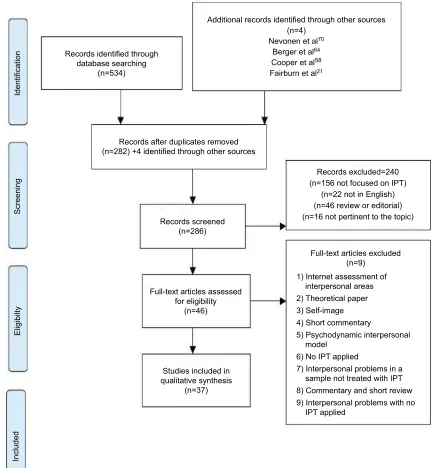
via the initial search strategy, leading to a total of 286 papers (for a detailed description, see PRISMA flow diagram).
Study selection
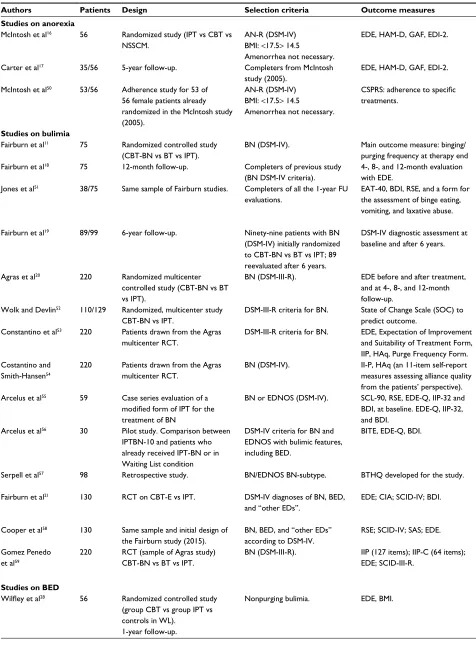
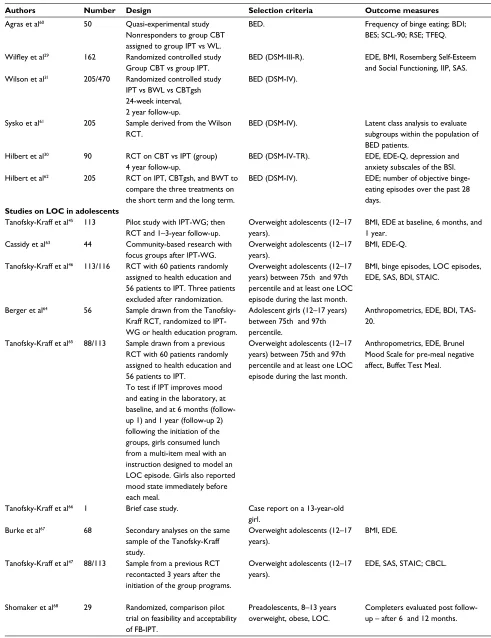
Two authors independently screened the resulting articles for their methodology and appropriateness for inclusion. Noncon-trolled studies as well as studies that did not consider treatment response as primary outcome were excluded from the sys-tematic review and summarized in Table 1. Quality appraisal of controlled studies was conducted according to the RCT of Psychotherapy Quality Rating Scale (RCT-PQRS) by Kocsis et al,15 a 25-item measure designed and tested in the context of
an assessment of the empirical psychodynamic literature, but applicable to all RCTs of psychotherapy. Consensus discus-sion was used to resolve disagreements between reviewers.15
Data collection process and data items
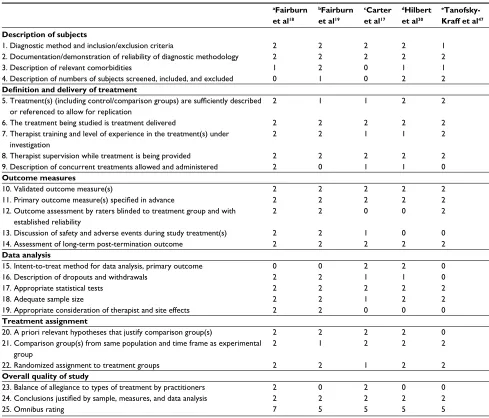
First, the title and abstract of each paper were assessed by two independent authors for language suitability and subject mat-ter relevance, and the studies thereby selected were assessed for their appropriateness for inclusion and quality of method. The first author, year of publication, design, sample age, duration of follow-up, intervention, and main findings are reported in Table 1. Quality score of each RCT that passed the two rounds of screening is summarized in Tables 2 and 3.
Risk of bias in individual studies
To assess the risk of bias of individual studies we utilized the RCT-PQRS.15 Results are summarized in Tables 2 and 3.
Data synthesis
Due to the lack of homogeneity among the resulting studies, a meta-analysis could not be performed. In particular, studies varied in terms of how improvements were measured. Hence, this systematic review is presented as a narrative synthesis.
Results
We found a total of 534 records (Figure 1). Records after duplicates removed were 282; four additional records were selected after a manual search carried out to retrieve other articles that had not been identified via the initial search strat-egy, leading to a total of 286 papers screened. Two hundred forty records were excluded: 156 papers because not focused on IPT, 46 reviews or editorials, 22 not written in English, and 16 not pertinent to the selected topics. Full-text articles assessed for eligibility were 46. Nine full-text articles were subsequently excluded for the following reasons: 1) Internet assessment of interpersonal areas but not IPT study; 2)
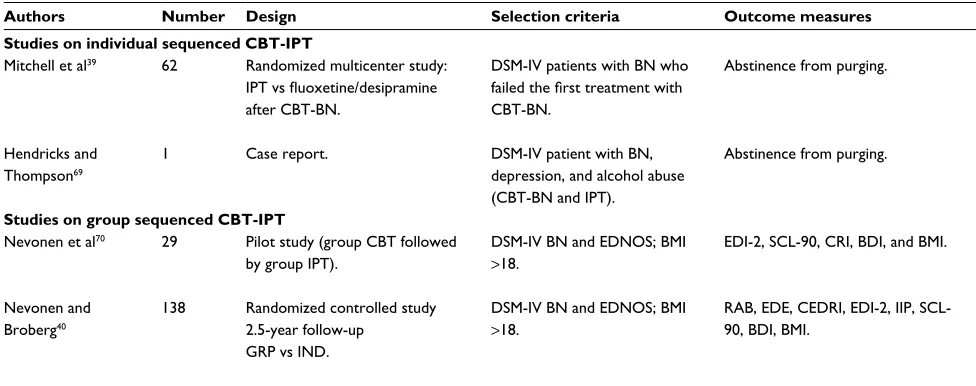
theo-retical paper; 3) study on self-image; 4) short commentary; 5) psychodynamic interpersonal model; 6) no IPT applied; 7) interpersonal problems in a sample not treated with IPT; 8) commentary and short review; and 9) study of interpersonal problems with no IPT applied. Finally, 37 studies (37/286; 12.9%) were included in the review, as summarized in Table 1. Three studies were on AN (8.1%), 14 on BN (37.8%), 7 on BED (18.9%), and 9 on adolescents with LOC (24.4%); 4 studies addressed the issue of the sequential (individual or group) treatment with IPT (10.8%). All studies were con-ducted on outpatient samples. Ten studies adopted an RCT methodology (10/37; 27.0%),11,16,20,21,28,29,31,39,40,46 five were
follow-up studies (5/37; 13.5%),17–19,30,47 eleven were based
on secondary analyses carried out on the same samples of RCTs (11/37; 29.7%),50–54,58,59,61,62,64,67 three were case series
or case reports (3/37; 8.1%),55,66,69 four were pilot studies
(10.8%),45,55,68,70 and four were studies with experimental
designs other than RCTs (retrospective,57
quasi-experimen-tal,60 community based,63 laboratory meal65 (4/37; 10.8%).
Qualitative synthesis was conducted only on RCTs and on the derived long-term follow-up studies, when available, namely on 15 studies.
The RCTs were all of good quality (mean score/SD of the RCT-PQRS omnibus rating: 6.1±0.9 points; see Table 2).
Summary of evidence
Randomized controlled trial with iPT for anorexia nervosa
We found one RCT with two follow-up points. In a 20-week RCT, 56 patients were randomized to IPT, CBT, or a control treatment called “nonspecific supportive clinical manage-ment”, based on educative-nutritional advice and supportive psychotherapy principles.16 Patients were females diagnosed
with AN according to the criterion of a BMI <17.5. Amen-orrhea was not an inclusion criterion. A chronic, refractory course of AN was an exclusion criterion. Two patients taking antidepressants were included. Therapy, in each modality, consisted of 20-hour-long, manual-based sessions conducted over a minimum of 20 weeks. Each participant completed assessments after the 10th therapy session and after the final session. Thirty-five patients (35/56; 62.5%) attended at least 15 of the 20 therapy sessions. At the end of the study, IPT was the least effective of the three treatments. The explanations included the relative lack of symptom focus, the long time taken to decide the problem area, and a substantial lack of symptom reactivity to specific interpersonal events. However, no additional explanation on the difficulties for the prob-lematic area choices was provided. The authors speculated
Psychology Research and Behavior Management downloaded from https://www.dovepress.com/ by 118.70.13.36 on 26-Aug-2020
Dovepress Miniati et al
Table 1 Studies on iPT for eating disorders
Authors Patients Design Selection criteria Outcome measures Interventions Results
Studies on anorexia
Mcintosh et al16 56 Randomized study (iPT vs CBT vs NSSCM.
AN-R (DSM-iv) BMi: <17.5> 14.5
Amenorrhea not necessary.
eDe, HAM-D, GAF, eDi-2. Twenty sessions conducted over a minimum of
20 weeks.
iPT was found to be the least effective of the three treatments.
Carter et al17 35/56 5-year follow-up. Completers from Mcintosh study (2005).
eDe, HAM-D, GAF, eDi-2. Patients receiving vs not receiving any treatment
for eating difficulties over the follow-up period.
Participants initially randomized to iPT (who had the poorest global outcome rating at posttreatment) showed the “best global outcome rating” at long-term follow-up. Mcintosh et al50 53/56 Adherence study for 53 of
56 female patients already randomized in the Mcintosh study (2005).
AN-R (DSM-iv) BMi: <17.5> 14.5
Amenorrhea not necessary.
CSPRS: adherence to specific
treatments.
Twenty sessions conducted over a minimum of 20 weeks. Selection of three sessions, across the three therapy phases.
The three forms of psychotherapy were distinguishable by blind raters. Subscale scores were higher for the corresponding therapy than the other therapy modalities.
Studies on bulimia
Fairburn et al11 75 Randomized controlled study (CBT-BN vs BT vs iPT).
BN (DSM-iv). Main outcome measure: binging/ purging frequency at therapy end
eighteen manual-based sessions conducted over 19 weeks.
CBT-BN significantly more effective in reducing “dysmorphophobic symptoms” and “resorting to
overly drastic diets” than iPT. Fairburn et al18 75 12-month follow-up. Completers of previous study
(BN DSM-iv criteria).
4-, 8-, and 12-month evaluation with eDe.
No administration of therapies. No differences between CBT-BN and iPT over the 8 months following treatment. Jones et al51 38/75 Same sample of Fairburn studies. Completers of all the 1-year FU
evaluations.
eAT-40, BDi, RSe, and a form for the assessment of binge eating, vomiting, and laxative abuse.
No administration of therapies. early decrease (weeks 1–4) in the frequency of binge eating in all three treatments. in iPT, there was little change thereafter, whereas in BT and CBT the decrease continued until around week
8 and then the rate stabilized. Statistically significant improvement in self-esteem over time. No
clues as to the mechanism of action of iPT. Fairburn et al19 89/99 6-year follow-up. Ninety-nine patients with BN
(DSM-iv) initially randomized to CBT-BN vs BT vs iPT; 89 reevaluated after 6 years.
DSM-iv diagnostic assessment at baseline and after 6 years.
No administration of therapies, except for patients with severe needs.
Forty-six percent of the sample still satisfied DSM-IV criteria for an ED. Patients who received
CBT-BN or iPT were doing markedly better than those who had received BT.
Agras et al20 220 Randomized multicenter controlled study (CBT-BN vs BT vs iPT).
BN (DSM-iii-R). eDe before and after treatment, and at 4-, 8-, and 12-month follow-up.
Twenty weeks of treatment; 1-year follow-up.
CBT-BN was found to be superior to iPT at the end of treatment. By 8–12 months open follow-up, the two treatments were equivalent.
wolk and Devlin52 110/129 Randomized, multicenter study CBT-BN vs iPT.
DSM-iii-R criteria for BN. State of Change Scale (SOC) to predict outcome.
Nineteen sessions of treatment. SOC was a weakly significant predictor of improvement only for IPT. No significant association
was found for CBT-BN group. Constantino et al53 220 Patients drawn from the Agras
multicenter RCT.
DSM-iii-R criteria for BN. eDe, expectation of improvement and Suitability of Treatment Form, iiP, HAq, Purge Frequency Form.
Twenty weeks of treatment; 1-year follow-up.
Relationship between specific patient characteristics and the development of the alliance. In
CBT, baseline symptom severity was negatively related to middle alliance. in iPT, more baseline interpersonal problems were associated with poorer alliance quality at mid-treatment. Costantino and
Smith-Hansen54
220 Patients drawn from the Agras multicenter RCT.
BN (DSM-iv). ii-P, HAq (an 11-item self-report measures assessing alliance quality from the patients’ perspective).
Twenty weeks of treatment; 1-year follow-up.
early and middle alliance negatively associated with interpersonal distress and positively
associated with interpersonal affiliation. Middle alliance was related to treatment group interactions with rigidity, affiliation, and control. Alliance growth was higher in IPT than in CBT.
Arcelus et al55 59 Case series evaluation of a
modified form of IPT for the
treatment of BN
BN or eDNOS (DSM-iv). SCL-90, RSe, eDe-Q, iiP-32 and BDi, at baseline. eDe-Q, iiP-32, and BDi.
Sixteen weekly 45 minutes sessions. evaluations at middle and treatment end.
By the middle of therapy, improvements in terms of reductions in eDe-Q scores, binging and self-induced vomiting, interpersonal functioning and depression.
Arcelus et al56 30 Pilot study. Comparison between iPTBN-10 and patients who already received iPT-BN or in waiting List condition
DSM-iv criteria for BN and eDNOS with bulimic features, including BeD.
BiTe, eDe-Q, BDi. Ten 45 minutes sessions, usually conducted on a
weekly basis.
No significant difference was found between the groups for the presence of binging and vomiting,
and not on any of the eDe-Q scales when comparing iPT-BN10 and iPT-BN.
Serpell et al57 98 Retrospective study. BN/eDNOS BN-subtype. BTHQ developed for the study. One session: participants asked to answer to
BTHQ.
No useful information of iPT: only three patients were treated with this psychotherapy. Fairburn et al21 130 RCT on CBT-e vs iPT. DSM-iv diagnoses of BN, BeD,
and “other eDs”.
eDe; CiA; SCiD-iv; BDi. 20–50 minutes sessions; review 20 weeks after
treatment; then, 60-week follow-up.
Changes significantly greater for CBT-E. 75.5% of CBT-E patients achieved remission, compared with 37.7% of IPT patients. Posttreatment differences between CBT-E and IPT were no longer statistically significant at 60 weeks.
Cooper et al58 130 Same sample and initial design of the Fairburn study (2015).
BN, BeD, and “other eDs” according to DSM-iv.
RSe; SCiD-iv; SAS; eDe. Potential predictors and then moderators
identification.
At 60-week follow-up, patients with low levels of self-esteem at baseline responded better to CBT-e than to iPT.
Gomez Penedo et al59
220 RCT (sample of Agras study) CBT-BN vs BT vs iPT.
BN (DSM-iii-R). iiP (127 items); iiP-C (64 items); eDe; SCiD-iii-R.
Focus on interpersonal problems at baseline as predictors of purge at 12 months after completion.
The more baseline problems were relevant the more patients were likely to recover when treated with iPT vs CBT.
Studies on BED
Wilfley et al28 56 Randomized controlled study (group CBT vs group iPT vs controls in wL).
1-year follow-up.
Nonpurging bulimia. eDe, BMi. Twelve weeks treatment with group CBT
12 weeks treatment with group iPT.
Both group CBT and group IPT had a significant improvement in reducing BED but not for WL. BED significantly below baseline levels for both treatments at 6-month and 1-year follow-up.
Psychology Research and Behavior Management downloaded from https://www.dovepress.com/ by 118.70.13.36 on 26-Aug-2020
Dovepress iPT for eating disorders: current perspectives
Table 1 Studies on iPT for eating disorders
Authors Patients Design Selection criteria Outcome measures Interventions Results
Studies on anorexia
Mcintosh et al16 56 Randomized study (iPT vs CBT vs NSSCM.
AN-R (DSM-iv) BMi: <17.5> 14.5
Amenorrhea not necessary.
eDe, HAM-D, GAF, eDi-2. Twenty sessions conducted over a minimum of
20 weeks.
iPT was found to be the least effective of the three treatments.
Carter et al17 35/56 5-year follow-up. Completers from Mcintosh study (2005).
eDe, HAM-D, GAF, eDi-2. Patients receiving vs not receiving any treatment
for eating difficulties over the follow-up period.
Participants initially randomized to iPT (who had the poorest global outcome rating at posttreatment) showed the “best global outcome rating” at long-term follow-up. Mcintosh et al50 53/56 Adherence study for 53 of
56 female patients already randomized in the Mcintosh study (2005).
AN-R (DSM-iv) BMi: <17.5> 14.5
Amenorrhea not necessary.
CSPRS: adherence to specific
treatments.
Twenty sessions conducted over a minimum of 20 weeks. Selection of three sessions, across the three therapy phases.
The three forms of psychotherapy were distinguishable by blind raters. Subscale scores were higher for the corresponding therapy than the other therapy modalities.
Studies on bulimia
Fairburn et al11 75 Randomized controlled study (CBT-BN vs BT vs iPT).
BN (DSM-iv). Main outcome measure: binging/ purging frequency at therapy end
eighteen manual-based sessions conducted over 19 weeks.
CBT-BN significantly more effective in reducing “dysmorphophobic symptoms” and “resorting to
overly drastic diets” than iPT. Fairburn et al18 75 12-month follow-up. Completers of previous study
(BN DSM-iv criteria).
4-, 8-, and 12-month evaluation with eDe.
No administration of therapies. No differences between CBT-BN and iPT over the 8 months following treatment. Jones et al51 38/75 Same sample of Fairburn studies. Completers of all the 1-year FU
evaluations.
eAT-40, BDi, RSe, and a form for the assessment of binge eating, vomiting, and laxative abuse.
No administration of therapies. early decrease (weeks 1–4) in the frequency of binge eating in all three treatments. in iPT, there was little change thereafter, whereas in BT and CBT the decrease continued until around week
8 and then the rate stabilized. Statistically significant improvement in self-esteem over time. No
clues as to the mechanism of action of iPT. Fairburn et al19 89/99 6-year follow-up. Ninety-nine patients with BN
(DSM-iv) initially randomized to CBT-BN vs BT vs iPT; 89 reevaluated after 6 years.
DSM-iv diagnostic assessment at baseline and after 6 years.
No administration of therapies, except for patients with severe needs.
Forty-six percent of the sample still satisfied DSM-IV criteria for an ED. Patients who received
CBT-BN or iPT were doing markedly better than those who had received BT.
Agras et al20 220 Randomized multicenter controlled study (CBT-BN vs BT vs iPT).
BN (DSM-iii-R). eDe before and after treatment, and at 4-, 8-, and 12-month follow-up.
Twenty weeks of treatment; 1-year follow-up.
CBT-BN was found to be superior to iPT at the end of treatment. By 8–12 months open follow-up, the two treatments were equivalent.
wolk and Devlin52 110/129 Randomized, multicenter study CBT-BN vs iPT.
DSM-iii-R criteria for BN. State of Change Scale (SOC) to predict outcome.
Nineteen sessions of treatment. SOC was a weakly significant predictor of improvement only for IPT. No significant association
was found for CBT-BN group. Constantino et al53 220 Patients drawn from the Agras
multicenter RCT.
DSM-iii-R criteria for BN. eDe, expectation of improvement and Suitability of Treatment Form, iiP, HAq, Purge Frequency Form.
Twenty weeks of treatment; 1-year follow-up.
Relationship between specific patient characteristics and the development of the alliance. In
CBT, baseline symptom severity was negatively related to middle alliance. in iPT, more baseline interpersonal problems were associated with poorer alliance quality at mid-treatment. Costantino and
Smith-Hansen54
220 Patients drawn from the Agras multicenter RCT.
BN (DSM-iv). ii-P, HAq (an 11-item self-report measures assessing alliance quality from the patients’ perspective).
Twenty weeks of treatment; 1-year follow-up.
early and middle alliance negatively associated with interpersonal distress and positively
associated with interpersonal affiliation. Middle alliance was related to treatment group interactions with rigidity, affiliation, and control. Alliance growth was higher in IPT than in CBT.
Arcelus et al55 59 Case series evaluation of a
modified form of IPT for the
treatment of BN
BN or eDNOS (DSM-iv). SCL-90, RSe, eDe-Q, iiP-32 and BDi, at baseline. eDe-Q, iiP-32, and BDi.
Sixteen weekly 45 minutes sessions. evaluations at middle and treatment end.
By the middle of therapy, improvements in terms of reductions in eDe-Q scores, binging and self-induced vomiting, interpersonal functioning and depression.
Arcelus et al56 30 Pilot study. Comparison between iPTBN-10 and patients who already received iPT-BN or in waiting List condition
DSM-iv criteria for BN and eDNOS with bulimic features, including BeD.
BiTe, eDe-Q, BDi. Ten 45 minutes sessions, usually conducted on a
weekly basis.
No significant difference was found between the groups for the presence of binging and vomiting,
and not on any of the eDe-Q scales when comparing iPT-BN10 and iPT-BN.
Serpell et al57 98 Retrospective study. BN/eDNOS BN-subtype. BTHQ developed for the study. One session: participants asked to answer to
BTHQ.
No useful information of iPT: only three patients were treated with this psychotherapy. Fairburn et al21 130 RCT on CBT-e vs iPT. DSM-iv diagnoses of BN, BeD,
and “other eDs”.
eDe; CiA; SCiD-iv; BDi. 20–50 minutes sessions; review 20 weeks after
treatment; then, 60-week follow-up.
Changes significantly greater for CBT-E. 75.5% of CBT-E patients achieved remission, compared with 37.7% of IPT patients. Posttreatment differences between CBT-E and IPT were no longer statistically significant at 60 weeks.
Cooper et al58 130 Same sample and initial design of the Fairburn study (2015).
BN, BeD, and “other eDs” according to DSM-iv.
RSe; SCiD-iv; SAS; eDe. Potential predictors and then moderators
identification.
At 60-week follow-up, patients with low levels of self-esteem at baseline responded better to CBT-e than to iPT.
Gomez Penedo et al59
220 RCT (sample of Agras study) CBT-BN vs BT vs iPT.
BN (DSM-iii-R). iiP (127 items); iiP-C (64 items); eDe; SCiD-iii-R.
Focus on interpersonal problems at baseline as predictors of purge at 12 months after completion.
The more baseline problems were relevant the more patients were likely to recover when treated with iPT vs CBT.
Studies on BED
Wilfley et al28 56 Randomized controlled study (group CBT vs group iPT vs controls in wL).
1-year follow-up.
Nonpurging bulimia. eDe, BMi. Twelve weeks treatment with group CBT
12 weeks treatment with group iPT.
Both group CBT and group IPT had a significant improvement in reducing BED but not for WL. BED significantly below baseline levels for both treatments at 6-month and 1-year follow-up.
(Continued)
Psychology Research and Behavior Management downloaded from https://www.dovepress.com/ by 118.70.13.36 on 26-Aug-2020
Dovepress Miniati et al
Authors Number Design Selection criteria Outcome measures Interventions Results
Agras et al60 50 Quasi-experimental study Nonresponders to group CBT assigned to group iPT vs wL.
BeD. Frequency of binge eating; BDi;
BeS; SCL-90; RSe; TFeQ.
12 weeks group CBT. 12 weeks group iPT.
IPT/CBT both reduced binge eating and weight significantly more than the WLC. No further
improvement with iPT for patients who did not improve with CBT.
Wilfley et al29 162 Randomized controlled study Group CBT vs group iPT.
BeD (DSM-iii-R). eDe, BMi, Rosemberg Self-esteem and Social Functioning, iiP, SAS.
Twenty weekly 90 minutes group iPT sessions and three individual sessions.
Similar outcomes in remission rates (64% vs 59%), at the end of treatment and at 1-year
follow-up. Dietary restriction improvement more rapid in CBT. wilson et al31 205/470 Randomized controlled study
iPT vs BwL vs CBTgsh 24-week interval, 2 year follow-up.
BeD (DSM-iv). individual 50–60minutes long sessions (except
for the first, which lasted for 2 hours).
Nineteen sessions during 24 weeks.
No differences on the eDe subscales or for BDi or self-esteem scale. BwL >iPT and CBTgsh on BMi, and >CBTgsh in increasing dietary restraint. At 1 year, no significant differences were seen.
Sysko et al61 205 Sample derived from the wilson RCT.
BeD (DSM-iv). Latent class analysis to evaluate subgroups within the population of BeD patients.
individual 50–60 minutes sessions; 19 sessions during 24 weeks.
DSM-IV criteria may not sufficiently address the heterogeneity within this diagnosis.
Hilbert et al30 90 RCT on CBT vs iPT (group) 4 year follow-up.
BeD (DSM-iv-TR). eDe, eDe-Q, depression and anxiety subscales of the BSi.
Twenty weekly 90 minutes group sessions and three additional individual sessions.
Abstinence from binge eating stable over the follow-up period in the IPT group; significant
tendency to relapse among patients in the CBT group. Hilbert et al62 205 RCT on iPT, CBTgsh, and BwT to
compare the three treatments on the short term and the long term.
BeD (DSM-iv). eDe; number of objective binge-eating episodes over the past 28 days.
24-week period; assessment both at post treatment, and at 6, 12, 18, and 24 months.
Rapid response in 70% of study participants (145/205); no differences among the three treatment
groups. Rapid responders in BwL did not differ from non-rapid responders in CBTgsh and iPT. Studies on LOC in adolescents
Tanofsky-Kraff et al45 113 Pilot study with iPT-wG; then RCT and 1–3-year follow-up.
Overweight adolescents (12–17 years).
BMi, eDe at baseline, 6 months, and 1 year.
individual 1.5-hours pregroup meeting; 10–12 group sessions (75–90 minutes).
IPT-WG associated with a significant decrease in binge eating and effective in preventing excessive
weight gain over 1–3-year follow-up. Cassidy et al63 44 Community-based research with
focus groups after iPT-wG.
Overweight adolescents (12–17 years).
BMi, eDe-Q. Focus Group and general reactions to iPT-wG. Program generally well accepted by both adolescents and parents.
Tanofsky-Kraff et al46 113/116 RCT with 60 patients randomly assigned to health education and 56 patients to iPT. Three patients excluded after randomization.
Overweight adolescents (12–17 years) between 75th and 97th percentile and at least one LOC episode during the last month.
BMi, binge episodes, LOC episodes, eDe, SAS, BDi, STAiC.
individual 1.5-hours meeting followed by 12 consecutive weekly 90 minutes group sessions. He was based on the HeY-Durham manual for high-school students.
Decreases in BMi gain, age-adjusted BMi metrics, symptoms of depression and anxiety, and frequency of LOC eating over 12 months FU with no group differences. in follow-up analyses, iPT
was more efficacious than HE at reducing objective binge eating at the 12-month follow-up.
Berger et al64 56 Sample drawn from the Tanofsky-Kraff RCT, randomized to iPT-wG or health education program.
Adolescent girls (12–17 years) between 75th and 97th percentile.
Anthropometrics, eDe, BDi, TAS-20.
iPT-wG group sessions vs a health education program.
Relationship between adolescent girls’ interpersonal problem area and depressive symptoms was not entirely accounted for by individual differences in alexithymia.
Tanofsky-Kraff et al65 88/113 Sample drawn from a previous RCT with 60 patients randomly assigned to health education and 56 patients to iPT.
To test if iPT improves mood and eating in the laboratory, at baseline, and at 6 months (follow-up 1) and 1 year (follow-(follow-up 2) following the initiation of the groups, girls consumed lunch from a multi-item meal with an instruction designed to model an LOC episode. Girls also reported mood state immediately before each meal.
Overweight adolescents (12–17 years) between 75th and 97th percentile and at least one LOC episode during the last month.
Anthropometrics, eDe, Brunel Mood Scale for pre-meal negative affect, Buffet Test Meal.
individual 1.5 hours meeting followed by 12 consecutive weekly 90 minutes group sessions. He was based on the HeY-Durham manual for high-school students.
iPT did not change total intake at the test meal and was associated with reduced snack-food intake.
There was no significant group difference for changes in total intake relative to girls’ daily energy
needs.
Tanofsky-Kraff et al66 1 Brief case study. Case report on a 13-year-old girl.
iPT-wG group sessions. Successful example of iPT-wG for the prevention of excessive weight gain and for the prevention of BeD.
Burke et al67 68 Secondary analyses on the same sample of the Tanofsky-Kraff study.
Overweight adolescents (12–17 years).
BMi, eDe. Adapted version of iPT or a He comparison
group.
Older patients in iPT with the lowest 3-year BMi gain compared to younger ones in both conditions and older girls in He. Non-white girls in iPT-wG more likely to abstain from LOC eating at 3 years.
Tanofsky-Kraff et al47 88/113 Sample from a previous RCT recontacted 3 years after the initiation of the group programs.
Overweight adolescents (12–17 years).
eDe, SAS, STAiC; CBCL. Approximately 3 years following the initiation of
the group programs, girls were recontacted with an additional assessment.
No main effect of group on change in BMi/adiposity. Among girls with high self-reported baseline social adjustment problems or anxiety, iPT, compared with He, was associated with the steepest declines in BMi. For adiposity, girls with high or low anxiety in He, and girls with low anxiety in iPT experienced gains, while girls in iPT with high anxiety stabilized.
Shomaker et al68 29 Randomized, comparison pilot trial on feasibility and acceptability of FB-iPT.
Preadolescents, 8–13 years overweight, obese, LOC.
Completers evaluated post follow-up – after 6 and 12 months.
Twelve weekly, 45 minutes sessions delivered to parents and children vs He program.
FB-iPT was well accepted by both patients and relatives.
Table 1 (Continued)
Psychology Research and Behavior Management downloaded from https://www.dovepress.com/ by 118.70.13.36 on 26-Aug-2020
Dovepress iPT for eating disorders: current perspectives
Authors Number Design Selection criteria Outcome measures Interventions Results
Agras et al60 50 Quasi-experimental study Nonresponders to group CBT assigned to group iPT vs wL.
BeD. Frequency of binge eating; BDi;
BeS; SCL-90; RSe; TFeQ.
12 weeks group CBT. 12 weeks group iPT.
IPT/CBT both reduced binge eating and weight significantly more than the WLC. No further
improvement with iPT for patients who did not improve with CBT.
Wilfley et al29 162 Randomized controlled study Group CBT vs group iPT.
BeD (DSM-iii-R). eDe, BMi, Rosemberg Self-esteem and Social Functioning, iiP, SAS.
Twenty weekly 90 minutes group iPT sessions and three individual sessions.
Similar outcomes in remission rates (64% vs 59%), at the end of treatment and at 1-year
follow-up. Dietary restriction improvement more rapid in CBT. wilson et al31 205/470 Randomized controlled study
iPT vs BwL vs CBTgsh 24-week interval, 2 year follow-up.
BeD (DSM-iv). individual 50–60minutes long sessions (except
for the first, which lasted for 2 hours).
Nineteen sessions during 24 weeks.
No differences on the eDe subscales or for BDi or self-esteem scale. BwL >iPT and CBTgsh on BMi, and >CBTgsh in increasing dietary restraint. At 1 year, no significant differences were seen.
Sysko et al61 205 Sample derived from the wilson RCT.
BeD (DSM-iv). Latent class analysis to evaluate subgroups within the population of BeD patients.
individual 50–60 minutes sessions; 19 sessions during 24 weeks.
DSM-IV criteria may not sufficiently address the heterogeneity within this diagnosis.
Hilbert et al30 90 RCT on CBT vs iPT (group) 4 year follow-up.
BeD (DSM-iv-TR). eDe, eDe-Q, depression and anxiety subscales of the BSi.
Twenty weekly 90 minutes group sessions and three additional individual sessions.
Abstinence from binge eating stable over the follow-up period in the IPT group; significant
tendency to relapse among patients in the CBT group. Hilbert et al62 205 RCT on iPT, CBTgsh, and BwT to
compare the three treatments on the short term and the long term.
BeD (DSM-iv). eDe; number of objective binge-eating episodes over the past 28 days.
24-week period; assessment both at post treatment, and at 6, 12, 18, and 24 months.
Rapid response in 70% of study participants (145/205); no differences among the three treatment
groups. Rapid responders in BwL did not differ from non-rapid responders in CBTgsh and iPT. Studies on LOC in adolescents
Tanofsky-Kraff et al45 113 Pilot study with iPT-wG; then RCT and 1–3-year follow-up.
Overweight adolescents (12–17 years).
BMi, eDe at baseline, 6 months, and 1 year.
individual 1.5-hours pregroup meeting; 10–12 group sessions (75–90 minutes).
IPT-WG associated with a significant decrease in binge eating and effective in preventing excessive
weight gain over 1–3-year follow-up. Cassidy et al63 44 Community-based research with
focus groups after iPT-wG.
Overweight adolescents (12–17 years).
BMi, eDe-Q. Focus Group and general reactions to iPT-wG. Program generally well accepted by both adolescents and parents.
Tanofsky-Kraff et al46 113/116 RCT with 60 patients randomly assigned to health education and 56 patients to iPT. Three patients excluded after randomization.
Overweight adolescents (12–17 years) between 75th and 97th percentile and at least one LOC episode during the last month.
BMi, binge episodes, LOC episodes, eDe, SAS, BDi, STAiC.
individual 1.5-hours meeting followed by 12 consecutive weekly 90 minutes group sessions. He was based on the HeY-Durham manual for high-school students.
Decreases in BMi gain, age-adjusted BMi metrics, symptoms of depression and anxiety, and frequency of LOC eating over 12 months FU with no group differences. in follow-up analyses, iPT
was more efficacious than HE at reducing objective binge eating at the 12-month follow-up.
Berger et al64 56 Sample drawn from the Tanofsky-Kraff RCT, randomized to iPT-wG or health education program.
Adolescent girls (12–17 years) between 75th and 97th percentile.
Anthropometrics, eDe, BDi, TAS-20.
iPT-wG group sessions vs a health education program.
Relationship between adolescent girls’ interpersonal problem area and depressive symptoms was not entirely accounted for by individual differences in alexithymia.
Tanofsky-Kraff et al65 88/113 Sample drawn from a previous RCT with 60 patients randomly assigned to health education and 56 patients to iPT.
To test if iPT improves mood and eating in the laboratory, at baseline, and at 6 months (follow-up 1) and 1 year (follow-(follow-up 2) following the initiation of the groups, girls consumed lunch from a multi-item meal with an instruction designed to model an LOC episode. Girls also reported mood state immediately before each meal.
Overweight adolescents (12–17 years) between 75th and 97th percentile and at least one LOC episode during the last month.
Anthropometrics, eDe, Brunel Mood Scale for pre-meal negative affect, Buffet Test Meal.
individual 1.5 hours meeting followed by 12 consecutive weekly 90 minutes group sessions. He was based on the HeY-Durham manual for high-school students.
iPT did not change total intake at the test meal and was associated with reduced snack-food intake.
There was no significant group difference for changes in total intake relative to girls’ daily energy
needs.
Tanofsky-Kraff et al66 1 Brief case study. Case report on a 13-year-old girl.
iPT-wG group sessions. Successful example of iPT-wG for the prevention of excessive weight gain and for the prevention of BeD.
Burke et al67 68 Secondary analyses on the same sample of the Tanofsky-Kraff study.
Overweight adolescents (12–17 years).
BMi, eDe. Adapted version of iPT or a He comparison
group.
Older patients in iPT with the lowest 3-year BMi gain compared to younger ones in both conditions and older girls in He. Non-white girls in iPT-wG more likely to abstain from LOC eating at 3 years.
Tanofsky-Kraff et al47 88/113 Sample from a previous RCT recontacted 3 years after the initiation of the group programs.
Overweight adolescents (12–17 years).
eDe, SAS, STAiC; CBCL. Approximately 3 years following the initiation of
the group programs, girls were recontacted with an additional assessment.
No main effect of group on change in BMi/adiposity. Among girls with high self-reported baseline social adjustment problems or anxiety, iPT, compared with He, was associated with the steepest declines in BMi. For adiposity, girls with high or low anxiety in He, and girls with low anxiety in iPT experienced gains, while girls in iPT with high anxiety stabilized.
Shomaker et al68 29 Randomized, comparison pilot trial on feasibility and acceptability of FB-iPT.
Preadolescents, 8–13 years overweight, obese, LOC.
Completers evaluated post follow-up – after 6 and 12 months.
Twelve weekly, 45 minutes sessions delivered to parents and children vs He program.
FB-iPT was well accepted by both patients and relatives.
(Continued)
Psychology Research and Behavior Management downloaded from https://www.dovepress.com/ by 118.70.13.36 on 26-Aug-2020
Dovepress Miniati et al
Authors Number Design Selection criteria Outcome measures Interventions Results
Studies on individual sequenced CBT-IPT
Mitchell et al39 62 Randomized multicenter study:
IPT vs fluoxetine/desipramine
after CBT-BN.
DSM-iv patients with BN who
failed the first treatment with
CBT-BN.
Abstinence from purging. Twenty sessions over 16 weeks. The dropouts were frequent: of the 62 patients randomized to the second-line treatment, 37 completed while 25 dropped out or were withdrawn. The abstinence rates for subjects assigned
to both second-line treatments were low: 16% for IPT and 10% for those assigned to medication
management. Hendricks and
Thompson69
1 Case report. DSM-iv patient with BN,
depression, and alcohol abuse (CBT-BN and iPT).
Abstinence from purging. Four stages of treatment (iPT at stage iv). The patient stopped binge eating, but she continued to vomit.
Studies on group sequenced CBT-IPT
Nevonen et al70 29 Pilot study (group CBT followed by group iPT).
DSM-iv BN and eDNOS; BMi
>18.
eDi-2, SCL-90, CRi, BDi, and BMi. Twenty sessions over a period of 20 weeks.
1-year follow-up.
Self-ratings showed significant differences between pretreatment and follow-up. Compared with pretreatment, a significant decrease in the 1-year follow-up scores was found on interpersonal
distrust, social insecurity, and interpersonal sensitivity. Nevonen and
Broberg40
138 Randomized controlled study 2.5-year follow-up
GRP vs iND.
DSM-iv BN and eDNOS; BMi
>18.
RAB, eDe, CeDRi, eDi-2, iiP, SCL-90, BDi, BMi.
Sequenced GRP: Twenty-three 2-hour sessions over a period of 20 weeks.
Sequenced iND: 50–60 minutes weekly for 23 weeks.
The 2.5-year follow-up intention-to-treat analysis showed a stabilized recovery rate for GRP and increased recovery from the 1-year to the 2.5-year follow-up for iND. Logistic regression
analyses showed no significant effects of medication on recovery between IND and GRP at
posttreatment or follow-up assessments.
Abbreviations: AN, anorexia nervosa; BDi, Beck Depression inventory; BeD, binge eating disorder; BeS, Binge eating Scale; BiTe, Bulimic investigatory Test edinburgh; BMi, body mass index; BMS, Brunel Mood Scale; BN, bulimia nervosa; BSi, Brief Symptom inventory; BTHQ, Bulimia Treatment History Questionnaire; BwL, behavioral weight loss; CBCL, Child Behavior Checklist; CBT-BN, cognitive-behavioral therapy for bulimia nervosa; CBT-e, enhanced version of cognitive-behavioral therapy; CBTgsh, guided self-help based on cognitive behavior therapy; CeDRi, Clinical eating Disorder Rating instrument; CiA, Clinical impairment Assessment Questionnaire; CRi, Coping Resources inventory; CSPRS, Collaborative Study Psychotherapy Rating Scale; eDe, eating Disorder examination; eDe-Q, eating Disorder examination Questionnaire;
EDI-2, Eating Disorder Inventory-2; ED-NOS, eating disorder not otherwise specified; SCID-IV, Structured Clinical Interview for DSM-IV; GAF, Global Assessment of
Functioning; GRP, sequenced group treatment; HAM-D, Hamilton Rating Scale for Depression; HAq, 11-item self-report measures assesses alliance quality from the patients’ perspective; iiP, inventory of interpersonal Problems; iiP-32, Short version of the inventory of interpersonal Problems; iND, sequenced individual treatment; iPT,
interpersonal psychotherapy; IPT-WG, IPT weight gain; LOC, loss of control eating; NSSCM, nonspecific supportive clinical management; RAB, Rating of Anorexia and Bulimia
interview; RCT, randomized controlled trial; RSe, Rosemberg Self-esteem and Social Functioning; SAS, Social Adjustment Scale; SCL-90, Symptom Checklist-90; SOC, State of Change Scale; STAiC, State-Trait Anxiety inventory for Children-A Trait Scale; TAS-20, Toronto Alexithymia Scale; TFeQ, Three-Factor eating Questionnaire; wL, waiting list; wLC, waiting list condition.
Table 1 (Continued)
that the presence of high rates of obsessive personality traits among AN patients might be related to the scarce response to CBT. Surprisingly, they did not consider that a sample of patients with obsessive traits might be too inwardly focused to pay attention to their external environment, including the interpersonal issues of IPT. A study limitation was repre-sented by the heterogeneity of the sample with an age range between 17 and 40 years. Moreover, the same therapists delivered the three therapies, raising questions on allegiance.
Completers from this RCT were subsequently included in a 5-year follow-up.17 Patients were classified according to
whether they received any treatment for eating difficulties over the up period (yes/no). At the end of the follow-up, patients initially randomized to IPT (who had the poorest global outcome rating immediately posttreatment) showed the “best global outcome rating”, with a “lag” effect for IPT over time. Study limitations included the small sample size and the enrollment of patients with mild or subthreshold AN.
Randomized controlled trial with iPT for bulimia nervosa
individual treatments
Fairburn et al published two RCTs of IPT for patients with BN.11,18 The first study was on 75 patients randomized to
cog-nitive-behavioral therapy for BN (CBT-BN; n=25), behavioral therapy for BN (BT; n=25) or IPT (n=25).11 The treatments
consisted of at least 18 manual-based sessions conducted over 19 weeks. The sessions were held twice weekly for the first month, weekly for the following 2 months and every 2 weeks during the final 6 weeks. Six experienced therapists administered all three treatments. No psychopharmacologi-cal treatment was allowed. CBT-BN was significantly more effective than IPT in reducing some key features of BN, such as “dysmorphophobic symptoms” and “resorting to overly drastic diets”.
The same sample entered a second study, a “closed” 12-month follow-up, with no concurrent psychopharmaco-logical treatments, except for patients who showed severe clinical needs. Patients were evaluated at 4, 8, and 12 months posttreatment. The initial differences between CBT-BN and IPT disappeared over 8 months, because of further improve-ment in the IPT group. The behavioral version of CBT-BN was least effective overall, with substantial posttreatment relapse. IPT was slower acting acutely than CBT-BN but similarly effective in the long term.18
Patients enrolled in the two previous studies were then fol-lowed up in a 6-year prospective study.19 Eighty-nine patients
underwent a diagnostic reassessment by interview. Patients
Psychology Research and Behavior Management downloaded from https://www.dovepress.com/ by 118.70.13.36 on 26-Aug-2020
Dovepress iPT for eating disorders: current perspectives
Authors Number Design Selection criteria Outcome measures Interventions Results
Studies on individual sequenced CBT-IPT
Mitchell et al39 62 Randomized multicenter study:
IPT vs fluoxetine/desipramine
after CBT-BN.
DSM-iv patients with BN who
failed the first treatment with
CBT-BN.
Abstinence from purging. Twenty sessions over 16 weeks. The dropouts were frequent: of the 62 patients randomized to the second-line treatment, 37 completed while 25 dropped out or were withdrawn. The abstinence rates for subjects assigned
to both second-line treatments were low: 16% for IPT and 10% for those assigned to medication
management. Hendricks and
Thompson69
1 Case report. DSM-iv patient with BN,
depression, and alcohol abuse (CBT-BN and iPT).
Abstinence from purging. Four stages of treatment (iPT at stage iv). The patient stopped binge eating, but she continued to vomit.
Studies on group sequenced CBT-IPT
Nevonen et al70 29 Pilot study (group CBT followed by group iPT).
DSM-iv BN and eDNOS; BMi
>18.
eDi-2, SCL-90, CRi, BDi, and BMi. Twenty sessions over a period of 20 weeks.
1-year follow-up.
Self-ratings showed significant differences between pretreatment and follow-up. Compared with pretreatment, a significant decrease in the 1-year follow-up scores was found on interpersonal
distrust, social insecurity, and interpersonal sensitivity. Nevonen and
Broberg40
138 Randomized controlled study 2.5-year follow-up
GRP vs iND.
DSM-iv BN and eDNOS; BMi
>18.
RAB, eDe, CeDRi, eDi-2, iiP, SCL-90, BDi, BMi.
Sequenced GRP: Twenty-three 2-hour sessions over a period of 20 weeks.
Sequenced iND: 50–60 minutes weekly for 23 weeks.
The 2.5-year follow-up intention-to-treat analysis showed a stabilized recovery rate for GRP and increased recovery from the 1-year to the 2.5-year follow-up for iND. Logistic regression
analyses showed no significant effects of medication on recovery between IND and GRP at
posttreatment or follow-up assessments.
Abbreviations: AN, anorexia nervosa; BDi, Beck Depression inventory; BeD, binge eating disorder; BeS, Binge eating Scale; BiTe, Bulimic investigatory Test edinburgh; BMi, body mass index; BMS, Brunel Mood Scale; BN, bulimia nervosa; BSi, Brief Symptom inventory; BTHQ, Bulimia Treatment History Questionnaire; BwL, behavioral weight loss; CBCL, Child Behavior Checklist; CBT-BN, cognitive-behavioral therapy for bulimia nervosa; CBT-e, enhanced version of cognitive-behavioral therapy; CBTgsh, guided self-help based on cognitive behavior therapy; CeDRi, Clinical eating Disorder Rating instrument; CiA, Clinical impairment Assessment Questionnaire; CRi, Coping Resources inventory; CSPRS, Collaborative Study Psychotherapy Rating Scale; eDe, eating Disorder examination; eDe-Q, eating Disorder examination Questionnaire;
EDI-2, Eating Disorder Inventory-2; ED-NOS, eating disorder not otherwise specified; SCID-IV, Structured Clinical Interview for DSM-IV; GAF, Global Assessment of
Functioning; GRP, sequenced group treatment; HAM-D, Hamilton Rating Scale for Depression; HAq, 11-item self-report measures assesses alliance quality from the patients’ perspective; iiP, inventory of interpersonal Problems; iiP-32, Short version of the inventory of interpersonal Problems; iND, sequenced individual treatment; iPT,
interpersonal psychotherapy; IPT-WG, IPT weight gain; LOC, loss of control eating; NSSCM, nonspecific supportive clinical management; RAB, Rating of Anorexia and Bulimia
interview; RCT, randomized controlled trial; RSe, Rosemberg Self-esteem and Social Functioning; SAS, Social Adjustment Scale; SCL-90, Symptom Checklist-90; SOC, State of Change Scale; STAiC, State-Trait Anxiety inventory for Children-A Trait Scale; TAS-20, Toronto Alexithymia Scale; TFeQ, Three-Factor eating Questionnaire; wL, waiting list; wLC, waiting list condition.
who received CBT-BN or IPT were markedly better than those who had received BT. IPT and CBT-BN produced equivalent and lasting decreases in general psychiatric features and in improved self-esteem/social functioning.
A multicenter RCT in a sample of 220 patients compared individual IPT vs CBT-BN.20 IPT was defined in a similar
way in this trial as in the previous ones: treatment attention was paid to eating habits or attitudes toward weight and shape, and no specific behavioral or cognitive procedures characterizing CBT were allowed. Treatments consisted of 19 individual sessions conducted over a 20-week period (twice weekly for the first 2 weeks, weekly for the next 12 weeks, and biweekly for the last 6 weeks). After the 20-week treatment period, patients were followed up for 1 year. CBT-BN was superior to IPT at the end of treatment in both intent-to-treat and completers analyses. By the 8–12-month open follow-up, the two treatments were equivalent. No differential predictors of response to IPT and CBT-BN were identified.
Fairburn et al compared the enhanced version of CBT (CBT-E) with IPT in patients with BN and other not-under-weight EDs.21 After the initial treatment, patients entered a
60-week follow-up and were reassessed with the EDE, blind to treatment condition.22,23 Both groups showed a significant
response post treatment. Changes were greater with CBT-E than with IPT. Patients treated with CBT-E reported no binge eating, vomiting, or laxative misuse in the 44.8% of cases (26/58) compared with the 21.7% (13/60) of patients treated with IPT. Seventy-five percent of CBT-E completers achieved remission vs 37% of IPT completers. At 60-week follow-up, posttreatment differences between CBT-E and IPT were no longer statistically significant. However, these results cannot
be generalized to younger patients or to patients with lower BMI than those enrolled in the study.
Randomized controlled trialwith iPT for BeD
Group treatment for BeD
Group CBT is the first-line treatment for BED since the late 1990s.24 Group IPT for BED is more recent and empirically
related to the pathological management of negative emo-tions as dysfunctional responses to interpersonal stressors (emotional eating).25–27
A study compared the efficacy of group CBT, group IPT, and a waiting list (WL) condition on a sample of 56 women with nonpurging BN.28 At posttreatment, both CBT and IPT
showed significant improvements in reducing binge eating, whereas the WL condition did not. Binge eating remained significantly below baseline levels for both active treatment conditions at 6 months and 1 year.
Wilfley et al compared group IPT and CBT on a sample of BED patients (n=162).29 Both treatments provided 20
weekly group sessions of 90 minutes and three individual sessions addressing patients’ goals and progresses at three triage points: pretreatment, midtreatment, and posttreatment. Outcome measures included BMI and EDE at baseline, at the end of treatment, and every 4 months during a 1-year posttreatment follow-up.22 The two groups showed similar
outcomes in recovery rates at posttreatment (79% for CBT vs 73% for IPT) and at 1-year follow-up (59% for CBT vs 62% for IPT). The frequency of binge eating remained lower than at baseline. The two therapies differed in timing of improve-ment of dietary restriction that occurred more rapidly with CBT than with IPT.
Psychology Research and Behavior Management downloaded from https://www.dovepress.com/ by 118.70.13.36 on 26-Aug-2020
Dovepress Miniati et al
Table 2
Research clinical trials on
iPT for
eDs: RCT of Psychotherapy Quality Rating Scale scoring
Fairburn et al
11
Wilfley et al
28
Agras et al
20
Wilfley et al
29
Mitchell et al
39
McIntosh et al
16
Nevonen and Broberg
40
Wilson et al
31
Tanofsky- Kraff et
al
46
Fairburn
21
Description of subjects 1. Diagnostic method and inclusion/exclusion criteria
2 2 2 2 2 2 2 2 2 2 2.
Documentation/demonstration of reliability of diagnostic methodology
2 2 2 2 2 2 2 2 2 2 3.
Description of relevant comorbidities
2 0 2 2 2 1 0 2 1 2 4.
Description of number of patients screened, included, and excluded
2 0 2 2 2 1 2 2 2 2
Definition and delivery of treatment 5. Treatment(s) (including control/comparison groups) are sufficiently described or referenced to allow for replication
2 2 2 2 2 2 2 2 2 2 6.
The treatment being studied is treatment delivered
2 2 2 2 2 2 2 2 2 2 7.
Therapist training/level of experience in treatment(s) under investigation
2 2 2 2 2 2 2 2 2 2 8.
Therapist supervision while treatment is being provided
2 2 2 2 2 2 2 2 2 2 9.
Description of concurrent treatments allowed and administered
2 2 2 0 0 1 1 0 1 2
Outcome measures 10.
v
alidated outcome measure(s)
2 2 2 2 2 2 2 2 2 2 11.
Primary outcome measure(s) specified in advance
2 2 2 2 2 2 2 2 2 2 12.
Outcome assessment by raters blinded to treatment group and with established reliability
2 2 2 2 0 2 2 2 2 2 13.
Discussion of safety and adverse events during study treatment(s)
2 0 0 2 0 1 0 0 0 1 14.
Assessment of long-term post-termination outcome
0 2 0 2 2 0 2 2 2 2
Data analysis 15.
intent-to-treat method for data analysis, primary outcome
0 2 2 2 2 2 2 2 2 2 16.
Description of dropouts and withdrawals
2 0 2 2 2 1 2 2 2 1 17.
Appropriate statistical tests
2 2 2 2 2 2 2 2 2 2 18.
Adequate sample size
2 2 2 2 2 2 2 2 2 2 19.
Appropriate consideration of therapist and site effects
2 2 2 2 2 1 0 2 2 2
Treatment assignment 20.
A priori relevant hypotheses that justify comparison group(s)
2 2 2 2 2 2 2 2 2 2 21.
Comparison group(s) from same population and timeframe as experimental group
2 2 2 2 2 2 2 2 2 2 22.
Randomized assignment to treatment groups
2 2 2 2 2 1 2 2 2 2
Overall quality of study 23.
Balance of allegiance to types of treatment by practitioners
2 2 2 2 0 2 0 2 0 2 24.
Conclusions justified by sample, measures, and data analysis
2 2 2 2 2 2 2 2 2 2
25. Omnibus rating
7 7 7 7 6 6 5 7 6 7 Abbreviations: e
D, eating disorder;
iPT, interpersonal psychotherapy; RCT, randomized controlled trial.
Psychology Research and Behavior Management downloaded from https://www.dovepress.com/ by 118.70.13.36 on 26-Aug-2020
Dovepress iPT for eating disorders: current perspectives
Hilbert et al reassessed 90 patients with BED 4 years after treatment cessation from the original study sample recruited by Wilfley et al.29,30 All participants were randomized again
to either CBT or IPT (n=45 each). Both treatments
con-sisted of 20 weekly group sessions of 90 minutes and three additional individual sessions. Fifty-eight patients (64.4%) completed the long-term follow-up assessment. Outcome analyses included pretreatment, posttreatment, and 1–4-year follow-up. A substantial and long-lasting efficacy of both CBT and IPT was found, with full recovery from binge eat-ing in >64% of patients. CBT and IPT yielded comparable long-term rates of remission to a subclinical level of BED: 80% of patients showed clinically significant improve-ment and 58% experienced an improveimprove-ment in comorbid
Table 3 Long-term follow-up derived from sample randomized in RCTs on iPT for eDs: RCT of Psychotherapy Quality Rating Scale
scoring
aFairburn
et al18
bFairburn
et al19
cCarter
et al17
dHilbert
et al30
eTanofsky-
Kraff et al47 Description of subjects
1. Diagnostic method and inclusion/exclusion criteria 2 2 2 2 1
2. Documentation/demonstration of reliability of diagnostic methodology 2 2 2 2 2
3. Description of relevant comorbidities 1 2 0 1 1
4. Description of numbers of subjects screened, included, and excluded 0 1 0 2 2
Definition and delivery of treatment
5. Treatment(s) (including control/comparison groups) are sufficiently described
or referenced to allow for replication
2 1 1 2 2
6. The treatment being studied is treatment delivered 2 2 2 2 2
7. Therapist training and level of experience in the treatment(s) under investigation
2 2 1 1 2
8. Therapist supervision while treatment is being provided 2 2 2 2 2
9. Description of concurrent treatments allowed and administered 2 0 1 1 0
Outcome measures
10. validated outcome measure(s) 2 2 2 2 2
11. Primary outcome measure(s) specified in advance 2 2 2 2 2
12. Outcome assessment by raters blinded to treatment group and with established reliability
2 2 0 0 2
13. Discussion of safety and adverse events during study treatment(s) 2 2 1 0 0
14. Assessment of long-term post-termination outcome 2 2 2 2 2
Data analysis
15. intent-to-treat method for data analysis, primary outcome 0 0 2 2 0
16. Description of dropouts and withdrawals 2 2 1 1 0
17. Appropriate statistical tests 2 2 2 2 2
18. Adequate sample size 2 2 1 2 2
19. Appropriate consideration of therapist and site effects 2 2 0 0 0
Treatment assignment
20. A priori relevant hypotheses that justify comparison group(s) 2 2 2 2 0
21. Comparison group(s) from same population and time frame as experimental group
2 1 2 2 2
22. Randomized assignment to treatment groups 2 2 1 2 2
Overall quality of study
23. Balance of allegiance to types of treatment by practitioners 2 0 2 0 0
24. Conclusions justified by sample, measures, and data analysis 2 2 2 2 2
25. Omnibus rating 7 5 5 5 5
Notes: Main reports, a,bFairburn et al,11cMcintosh et al,16dWilfley et al,29eTanofsky-Kraff et al.46
Abbreviations: eD, eating disorder; iPT, interpersonal psychotherapy; RCT, randomized controlled trial.
psychopathology. Abstinence from binge eating was stable over the follow-up period in the IPT group, whereas CBT patients had a significant tendency to relapse. Reduction of ED psychopathology in the IPT group was better maintained or further improved over the follow-up period, whereas for the CBT group, psychopathology worsened from 1-year to 4-year long-term follow-up, suggesting that the focus on improving interpersonal relationships prepares individuals more comprehensively for the social challenges of daily life.
individual treatment for BeD
Wilson et al compared the short- and longer term outcomes of three individual treatments in a sample of BED patients randomized to IPT (n=75), behavioral weight loss
treat-Psychology Research and Behavior Management downloaded from https://www.dovepress.com/ by 118.70.13.36 on 26-Aug-2020