Formulation and Evaluation of
fast dissolving tablets of
Lornoxicam
Ravi Kumar ayak*1, arayana Swamy VB2, Senthil A1, Thakkar Hardikkumar1,
Dave Mehul Kumar1, Mahalaxmi R3
1
Department of Pharmaceutics, Karavali College of Pharmacy, Mangalore-575028, Karnataka, India,
2
Department of Pharmacognosy, Karavali College of Pharmacy, Mangalore-575028, Karnataka, India,
3
Department of Pharmaceutics, Manipal College of Pharmaceutical Sciences, Manipal -576104, Karnataka, India.
*
For correspondence
Ravi Kumar Nayak, Assistant Professor
Dept. of Pharmaceutics,
Karavali College of Pharmacy, Mangalore-575028,Karnataka,
E-mail: [email protected]
Phone No: 9886735735
Summary
Orodispersible tablets are the fast growing and highly accepted drug delivery system in now a day mainly to improve patient compliance. Orodispersible tablets have number of advantages over conventional dosage forms, because of that Orodispersible tablets have emerged as an alternative to conventional dosage forms. Lornoxicam is a non steroidal anti-inflammatory drug with analgesic properties and belongs to the class oxicams. Orodispersible tablets of Lornoxicam were prepared using superdisintegrants viz; crospovidone, croscarmellose sodium and sodium starch glycolate using the direct compression method. The tablets prepared were evaluated for thickness, uniformity of weight, hardness, friability, wetting time, in vitro disintegration time and in vitro dissolution time. The different formulations showed disintegration time between 18 to 75 s. Drug release showed time between the ranges of 10 to 12 min. Among all the formulations, F3 (containing 4% of crospovidone) showed 99% drug release within 12 min and it showed least disintegration time (18s). Thus, F3 was considered best among the other formulations. The stability study was conducted as per the ICH guidelines and the optimized formulation (F3) was found to be stable, with insignificant change in hardness, drug content and disintegration time. Therefore the main objective of the present work is to develop orodispersible tablets of Lornoxicam to improve bioavailability, disintegration time, dissolution efficacy and patient compliance.
Keywords: Oral disintegrating tablet, Lornoxicam, direct compression, Superdisintegrants, Disintegration time.
Introduction
Often times people experience inconvenience in swallowing conventional dosage forms such as when water is not available4. For these reasons tablets that can easily dissolve or disintegrate in the oral cavity have attracted a great deal of attention. Orodispersible tablets are not only indicated for people who have swallowing difficulties, but also are ideal for active people5. Orodispersible tablets are also known as mouth dissolving tablets, melt-in-mouth tablets, fast dissolving tablets, rapimelts, porous tablets and quick dissolving tablets6.
We often see that patient find difficulty in swallowing the conventional tablets especially the geriatrics, pediatric patients, and patients suffering from various diseases, are the major problem. Hence it is the necessary criterion to develop a dosage form that will provide rapid and quick action. Thus the development of Met-In-Mouth tablet, which disintegrate rapidly without the need of drinking water providing convenience of administration, patient compliance and quick onset of action7-8.
Lornoxicam is a non steroidal anti-inflammatory drug with analgesic properties used in rheumatoid arthritis, post-traumatic pain, masculo-skeletal and joint disorders, belongs to the class oxicams. The mode of action of Lornoxicam is partly based on inhibition of prostaglandin synthesis (inhibition of the cyclo-oxygenase enzyme). Lornoxicam is absorbed rapidly and almost completely from the gastro-intestinal tract9. Lornoxicam is very bitter in taste and yet no oral disintegrating taste-masked preparation is available in market, which might be helpful in pediatric and geriatric patients. Therefore, to provide this drug in a more accessible and patient compliant form, in the present study an attempt has been made to mask its bitter taste and formulate it into oral disintegrating tablet10-11.
Materials and Methods
Materials
Lornoxicam is procured from Glenmark generics Ltd, Mumbai, India. Croscarmellose sodium (CCS), Crospovidone (CP), and Sodium Starch Glycolate (SSG), Aspartame and Strawberry flavor were received as gift samples from Zydus Research centre, Ahmedabad, India, Microcrystalline Cellulose pH 102 (Avicel PH 102) was gift sample from Emcure labs Ltd. Pune. Talc, Aerosil and Magnesium stearate were procured from Apex Chemicals (Ahmedabad, India). All other reagents and chemicals used were of analytical grade.
Methods
Characterization of drug and excipients
Fourier transform infra red spectroscopy (FTIR)
FTIR spectra of pure Lornoxicam and physical mixture of drug and excipients were recorded on Shimadzu Corporation, (Tokyo, Japan) Model-1601 PC. Potassium bromide pellet method was employed and background spectrum was collected under identical situation. Each spectrum was derived from single average scans collected in the region 650- 4000 cm-1 at spectral resolution of 2cm-2 and ratio against background interferogram. Spectra were analyzed by software supplied by Shimadzu.
Differential Scanning Calorimetry (DSC)
Thermal properties of the pure Lornoxicam and the physical mixture of drug and excipients were analyzed by Shimadzu DSC-60, Shimadzu Limited Japan. The samples were heated in a hermetically sealed aluminum pans. Heat runs for each sample were set from 25 to 3500C at a heating rate of 100C/ min, using nitrogen as blanket gas.
Formulation of melt in mouth tablets of Lornoxicam
to glass mortar and triturated till it mixed uniformly. The resulting powder mixture was subjected to various precompression parameters.
Table o. 1- Composition of orodispersible tablets of Lornoxicam
Ingredients (mg)* F1 F2 F3 F4 F5 F6 F7 F8 F9
Lornoxicam 8 8 8 8 8 8 8 8 8
Sodium starch glycolate -- -- -- -- -- -- 4 6 8
Crospovidone 4 6 8 -- -- -- -- -- --
Croscarmellose sodium -- -- -- 4 6 8 -- -- --
Microcrystalline cellulose 173 171 169 173 171 169 173 171 169
Aspartame 6 6 6 6 6 6 6 6 6
Magnesium stearate 2 2 2 2 2 2 2 2 2
Talc 4 4 4 4 4 4 4 4 4
Strawberry flavor 2 2 2 2 2 2 2 2 2
Aerosil 1 1 1 1 1 1 1 1 1
Total weight 200 200 200 200 200 200 200 200 200
*All the quantities are in mg
Pre Compression Parameters12
Angle of repose
Angle of repose was determined by using funnel method. Powder was poured from a funnel that can be raised vertically until a maximum cone height, h, was obtained. Diameter of heap, D, was measured. The angle of repose, Ө, was calculated by formula
tan Ө = h / r
Ө = tan-1 (h / r)
Where, Ө is the angle of repose, h is the height in cm and r is the radius.
Bulk Density
Apparent bulk density was determined by pouring pre- sieved drug excipient blend into a graduated cylinder and measuring the volume and weight “as it is”. It is expressed in g/ml and is given by
Db = M / V0
Where, M is the mass of powder and V0 is the Bulk volume of the powder
Tapped density
It was determined by placing a graduated cylinder, containing a known mass of drug- excipient blend, on mechanical tapping apparatus. The tapped volume was measured by tapping the powder to constant volume. It is expressed in g/ml and is given by
Dt = M / Vt
Where, M is the mass of powder and Vt is the tapped volume of the powder.
Powder flow properties
i) Carr’s Index (I)
It is expressed in percentage and is expressed by
I = Dt - Db / Dt
Where, Dt is the tapped density of the powder and Db is the bulk density of the powder.
Hausner ratio
It is expressed in percentage and is expressed by
H= Dt / Db
Where, Dt is the tapped density of the powder and Db is the bulk density of the powder.
Lower Haunser ratio (< 1.25) indicates better flow properties than higher ones6 (>1.25).
Compression of tablet
After evaluation of powder blend were then compressed into tablets using flat face round tooling on Rimek compression machine equipped with 8 mm round punch by direct compression technique. A minimum of 50 tablets was prepared for each batch.
Evaluation of tablet
All the tablets were evaluated for following different parameters which includes;
General appearance
Five tablets from different batches were randomly selected and organoleptic properties such as color, odor, taste, shape, were evaluated.
Hardness
For each formulation, the hardness of five tablets was determined using the Monsanto hardness tester (Cadmach).
Weight Variation
Twenty tablets from each formulation were selected at a random and average weight was determined. Then individual tablets were weighed and was compared with average weight.
Friability
Friability of the tablets was determined using Roche Friabilator. This device subjects the tablets to the combined effect of abrasion and shock in a plastic chamber revolving at 25 rpm and dropping the tablets at a height of 6 inches in each revolution. Pre weighed sample of tablets was placed in the friabilator and were subjected to100 revolutions. Tablets were de dusted using a soft muslin cloth and re weighed. The friability (f) is given by the formula.
Friability (f) = 100 (Wo -W) / Wo
Where Wo is weight of the tablets before the test and W is the weight of the tablet after the test
In vitro Disintegration time
The disintegration time for all formulations was carried out using tablet disintegration test apparatus. Six tablets were placed individually in each tube of disintegration test apparatus and discs were placed. The water was maintained at a temperature of 37°±2°C and time taken for the entire tablet to disintegrate completely was noted13.
Thickness
Thickness of the tablets was determined using a Vernier caliper. Five tablets from each batch were used, and average values were calculated.
Drug content
In vivo disintegration time
The in vivo disintegration time was measured in six human volunteers. A tablet was placed on the tongues of the volunteers and time required for complete disintegration in the mouth was noted and also taste and mouth feel was observed14.
Wetting time
The wetting time of the tablets was measured using a simple procedure. Five circular tissue papers of 10-cm diameter were placed in a petridish with a 10 10-cm diameter. Ten milliliters of water containing eosin, a water-soluble dye, was added to the petridish. A tablet was carefully placed on the surface of tissue paper. The time required for water to reach the upper surface of the tablets was noted as the wetting time.
Dissolution studies
In vitro release of Lornoxicam from tablets was monitored by using 900 ml of simulated intestinal fluid, SIF (USP phosphate buffer solution, pH 7.4) at 37±0.50C and 50 rpm using programmable dissolution tester [Paddle type, model TDT-08L, Electrolab, (USP), India]. 5 ml Aliquots were withdrawn at one minute time intervals and were replenished immediately with the same volume of fresh buffer medium. Aliquots, following suitable dilutions, were assayed spectrophotometrically (UV- 1601, Shimadzu, Japan) at 378 nm. The dissolution experiments were conducted in triplicate15.
Mouth feel
The same human volunteers participated in taste evaluation test, were asked to give their opinion about the feeling of smoothness or grittiness of the dispersion soon after the tablet got disintegrated.
Taste evaluation
Taste evaluation was done by a panel of six volunteers using time intensity method. One tablet was held in mouth for 10 s bitterness levels were recorded instantly and then at the end of 10 s, 30 s, 1 min, and 2 min, bitterness levels are again noted and recorded.
Test for dispersion
This test is carried out for dispersible tablets. Two tablets were placed in 100 mL of water and stirred gently until it was completely dispersed and smooth dispersion was obtained. The dispersed liquid was passed through sieve no. 22. No residue should remain over the sieve.
Stability Studies
The stability study of optimized formulation (batch F3) was carried out as per ICH (International Conference on Harmonization) guidelines at 40± 2oC / 75 ± 5% RH using stability chamber for three month. The effects of temperature and time on the physical characteristics of tablets were evaluated for assessing the stability of prepared formulations. The samples were collected monthly and different parameters like hardness, uniformity of weight, friability, drug content and disintegration time were studied16.
Results and Discussion
In recent decades, a variety of pharmaceutical research has been conducted to develop new dosage forms. Considering quality of life, most of these efforts have been focused on ease of medication. Among the various dosage forms developed to improve the ease of administration, the oral disintegrating tablet (ODT) is the most widely preferred commercial products. Attempt was made in the present investigation to make a fast dissolving tablet of Lornoxicam by direct compression method. Formulation was carried out using three different types of super disintegrants and optimized the concentration and hardness of the tablet to give the minimum disintegration time and get maximum drug release.
Characterization of drug and excipients
The formulation additives in concentrations used did not affect the stability and Ultraviolet absorbance of the drug.
Fourier transform infra red spectroscopy (FTIR)
at 3,090 cm−1 corresponding to NH stretching vibration. Intense absorption peak was found at 1,642 cm−1 due to the stretching vibration of the C=O group in the primary amide. Other peaks were observed at 1,597 and 1,559 cm−1 and were assigned to bending vibrations of the N–H group in the secondary amide. The stretching vibrations of the O=S=O group appeared at 1,157, 1,387, and 1,336 cm−1. Other prominent peaks appeared at 827.94 cm−1 corresponding to CH aromatic ring bending and heteroaromatics and at 766.8 cm−1 due to the C–Cl bending vibration, which indicates groups is match with structure of drug and
confirm the purity of the drug. FTIR-spectra of drug and its physical mixture with excipients are exactly same, and there is no shift of peaks or disappearance of principle peaks or modification of the principle peaks indicating that there is no interaction between the drug and excipients. FT-IR spectrum of pure drug and its physical mixture is represented in Figure 1 and Figure 2.
Fig.1- Infrared Spectrum of pure lornoxicam
Fig.2- Infrared Spectrum of physical mixture of lornoxicam and excipients
Differential Scanning Calorimentry (DSC)
absence of interaction between lornoxicam and other excipients. The DSC thermogram of pure drug and its physical mixture is represented in Figure 3.
Pre-compression parameters of Lornoxicam powder blend
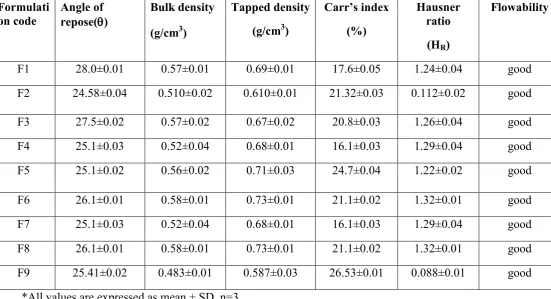
Since the flow properties of the powder mixture are important for the uniformity of the mass of the tablets, the flow of the powder mixture was analyzed before compression of the tablets. The results of angle of repose and compressibility index (%) ranged from (24.58±0.04º to 28±0.01º) and (16.1±0.03 to 26.53±0.01), respectively. The results of bulk density and tapped bulk density ranged from (0.48±0.01 g/cm3 to 0.58±0.01 g/cm3) and (0.58±0.03 g/cm3 to 0.73±0.03 g/cm3), respectively. The results of Hausner ratio ranged from 0.08±0.01 to 1.32±0.01. The results of angle of repose (<30) and compressibility index indicates good flow properties of powder blend (Table 2).
Fig.3- DSC Thermogram of physical mixture of lornoxicam and excipients
Pre-compression parameters of Lornoxicam powder blend
Table o. 2- Results of Precompression Flow Properties of Lornoxicam powder blend
Formulati on code
Angle of repose(θθθθ)
Bulk density
(g/cm3)
Tapped density
(g/cm3)
Carr’s index
(%)
Hausner ratio
(HR)
Flowability
F1 28.0±0.01 0.57±0.01 0.69±0.01 17.6±0.05 1.24±0.04 good
F2 24.58±0.04 0.510±0.02 0.610±0.01 21.32±0.03 0.112±0.02 good
F3 27.5±0.02 0.57±0.02 0.67±0.02 20.8±0.03 1.26±0.04 good
F4 25.1±0.03 0.52±0.04 0.68±0.01 16.1±0.03 1.29±0.04 good
F5 25.1±0.02 0.56±0.02 0.71±0.03 24.7±0.04 1.22±0.02 good
F6 26.1±0.01 0.58±0.01 0.73±0.01 21.1±0.02 1.32±0.01 good
F7 25.1±0.03 0.52±0.04 0.68±0.01 16.1±0.03 1.29±0.04 good
F8 26.1±0.01 0.58±0.01 0.73±0.01 21.1±0.02 1.32±0.01 good
F9 25.41±0.02 0.483±0.01 0.587±0.03 26.53±0.01 0.088±0.01 good
*All values are expressed as mean ± SD, n=3
Post-compression parameters of Lornoxicam fast dissolving tablets
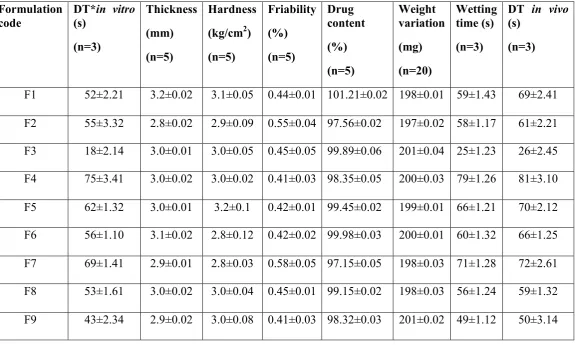
Table o. 3- Results of Post Compression Properties of Lornoxicam tablets
Formulation code
DT*in vitro
(s) (n=3) Thickness (mm) (n=5) Hardness
(kg/cm2)
(n=5) Friability (%) (n=5) Drug content (%) (n=5) Weight variation (mg) (n=20) Wetting time (s) (n=3)
DT in vivo
(s)
(n=3)
F1 52±2.21 3.2±0.02 3.1±0.05 0.44±0.01 101.21±0.02 198±0.01 59±1.43 69±2.41
F2 55±3.32 2.8±0.02 2.9±0.09 0.55±0.04 97.56±0.02 197±0.02 58±1.17 61±2.21
F3 18±2.14 3.0±0.01 3.0±0.05 0.45±0.05 99.89±0.06 201±0.04 25±1.23 26±2.45
F4 75±3.41 3.0±0.02 3.0±0.02 0.41±0.03 98.35±0.05 200±0.03 79±1.26 81±3.10
F5 62±1.32 3.0±0.01 3.2±0.1 0.42±0.01 99.45±0.02 199±0.01 66±1.21 70±2.12
F6 56±1.10 3.1±0.02 2.8±0.12 0.42±0.02 99.98±0.03 200±0.01 60±1.32 66±1.25
F7 69±1.41 2.9±0.01 2.8±0.03 0.58±0.05 97.15±0.05 198±0.03 71±1.28 72±2.61
F8 53±1.61 3.0±0.02 3.0±0.04 0.45±0.01 99.15±0.02 198±0.03 56±1.24 59±1.32
F9 43±2.34 2.9±0.02 3.0±0.08 0.41±0.03 98.32±0.03 201±0.02 49±1.12 50±3.14
Effect of concentration of superdisintegrant on the dissolution release rate
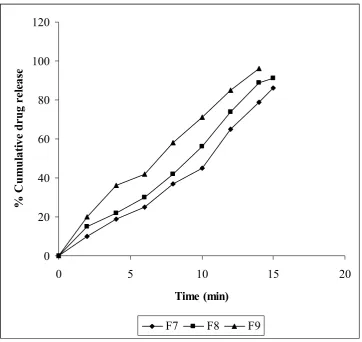
In vitro dissolution profiles of different batches are shown in figure 4, 5 and 6. The cumulative % of drug release increased as the time increases up to 15 min with increased in the concentration of superdisintegrants. Among all formulations, F3(contains 4% crospovidone) formulation considered as better as it gives disintegration time 18s which fulfills official requirement (less than 30s as per USFDA Guideline) for orodispersible tablets and also it Shows highest drug release 98% at 12 minutes compared to the other formulations. Formulation containing crospovidone showed faster release rate than other formulations. All the above-mentioned formulation showed faster release than marketed preparations. Formulation containing crospovidone showed 100% drug release within 12 min. Whereas formulation containing Crosscarmellose sodium (F4 to F6) showed 100% drug release within 14 min. Formulation F7 to F9 (containing Sodium starch glycolate as the superdisintegrant) showed slow rate of release as compared to crospovidone and Crosscarmellose sodium that is 100% release within 15 min. All the formulations showed improvement in dissolution rate with increasing the amount of superdisintegrant. Slow release of the formulation containing Sodium starch glycolate is attributed to the formation of viscous gel with increasing the amount of Sodium starch glycolate.
Stability study
Fig.4- Comparison of in vitro dissolution profile of Crospovidone formulations (F1-F3)
0 20 40 60 80 100 120
0 5 10 15 20
Time (min)
%
C
u
m
u
la
ti
v
e
d
ru
g
r
el
ea
se
F1 F2 F3
Fig.5- Comparison of in vitro dissolution profile of Crosscarmellose sodium formulations (F4-F6)
0 20 40 60 80 100 120
0 5 10 15 20
Time (min)
%
C
u
m
u
la
ti
v
e
d
ru
g
r
el
ea
se
Fig.6- Comparison of in vitro dissolution profile of sodium starch glycolate formulations (F7-F9)
0 20 40 60 80 100 120
0 5 10 15 20
Time (min)
%
C
u
m
u
la
ti
v
e
d
ru
g
r
el
ea
se
F7 F8 F9
Table o. 4- Stability Study of Optimized Batch (F6) of Lornoxicam Fast Dissolving Tablets
Parameters Sr.
o.
Time
Hardness (Kg/cm2)
Uniformity of weight
Friability (%)
In vitro
disintegration time (s)
Drug
content (%)
1 0 week 3.0±0.01 201±0.04 0.45±0.05 18 99.89±0.06
2 4 week 2.9±0.01 201±0.02 0.46±0.02 17 98.80±0.05
3 8 week 2.8±0.04 201±0.03 0.47±0.01 20 97.76±0.02
4 12
week
2.7±0.02 201±0.01 0.48±0.06 16 96.68±0.01
Conclusion
available in the market. The formulation was developed with the aim of providing patients suffering from rheumatoid arthritis, post-traumatic pain, masculo-skeletal and joint disorders, a convenient means of taking their medication, whenever and wherever needed, for immediate relief of rheumatoid arthritis, post-traumatic pain, masculo-skeletal and joint disorders. It was observed that when crospovidone used at 4% concentration (formulation F3) percentage drug release was maximum in 12 min and disintegration time was least (18s). And in stability testing of batch F3, tablets did not show any change in physical appearance or drug content. Therefore it is concluded that croscarmellose sodium can be effectively used as superdisintegrant in Lornoxicam fast dissolving tablets. The main motive was to achieve fast disintegration and immediate drug release, using an economic, industry feasible method involving conventional tabletting equipments. Undoubtedly, all the formulations showed good disintegration time, apart from fulfilling all compendial and other standard specifications, and exhibited higher release rates of Lornoxicam.
Acknowledgements
Authors thank Dr. Narayana Swamy VB, Principal, Karavali College of Pharmacy, Mangalore for providing necessary facilities for conducting the present work. Authors also thank Glenmark generics Ltd, Mumbai, India for providing gift sample of Lornoxicam .
References
1. Chein Yie W. Oral drug delivery and delivery systems. Marcel Dekker, 2nd Edition, New York, 1992.
2. Indurwade NH, Rajyaguru TH, Nakhat PD. Novel approach- Fast Dissolving Tablets. Indian Drugs 2004; 39 (8) : 405-409.
3. Kuchekar BS, Bhise SB, Arumugam V. Design of fast dissolving tablets. Indian J Pharm Educ 2001; 35 : 150-152.
4. Watanabe Y, Koizumi K, Zama Y, Kiriyama M, Matsumoto Y, Matsumoto M. New compressed tablet rapidly disintegrating in saliva in the mouth using crystalline cellulose and a disintegrant. Biol Pharm Bull 1995; 18 (9) : 1308-1310.
5. Bi Y, Yonezawa Y, Sunada H. Rapidly disintegrating tablets prepared by the wet compression method: Mechanism and Optimization. J Pharm Sci 1999; 88 (1) : 1004-1010.
6. Sreenivas SA, Dandagi PM. Orodispersible tablets: Newfangled drug delivery system-A review. Indian J Pharm Educ Res 2005; 39 (4): 177-181.
7. Bhandari S, Mittapalli RK, Ganu R, Rao YM. Orodispersible tablets: An overview. Asian J Pharm 2008; 2(1):2-11.
8. Swamy PV, Gada SN, Shirsand SB, Kinagi MB and Shilpa H. Design and evaluation of cost effective orodispersible tablets of diethylcarbamazine citrate by effervescent method. Int J Pharm Sci Res 2010;1(6): 258-264.
9. Balfour JA, Fitton A, Barradell LB. Lornoxicam. A review of its pharmacology and therapeutic potential in the management of painful and inflammatory conditions. Drugs 1996;51(4):639-57.
cerebral pain-processing in human volunteers: a functional magnetic resonance imaging study. British Journal of Anaesthesia 2008; 100(6):827-833.
11. Mishra DN, Bindal M, Singh SK, Kumar SG. Spray dried excipient base: A novel technique for the formulation of orally disintegrating tablets. Chem Pharm Bull 2006; 54:99-102.
12. Marshall K, Lachman N, Liberman HA, The theory and practice of industrial pharmacy. 3rd ed. Varghese Publishing House, Mumbai, 1987: 66-69.
13. Ishikawa T, Kuizumi N, Mukai B, Utoguchi N, Fujii M, Matsumoto M, Endo H, Shirrotake S, Watanabe Y. Preparation of rapidly disintegrating tablet using new types of microcrystalline cellulose (PH –M series) and L-HPC by direct compression method. Chem Pharm Bull 2001; 49: 134-139.
14. Musson D, Birk K, Panebianco D, Gagliano K, Rogers J, Goldberg M. Pharmacokinetics of rizatriptan in healthy elderly subjects. Int J clin Pharm ther 39: 464-466.
15. United State Pharmacopeia 31, The National Formulary. USPharmacopeial Convention. Washington DC: Board of Trustees publication; 2008, Vol 1, 272.