4658
Effect Of The Nitrile Content On Nitrile Rubber
Cure In Wide Temperature Range.
Denis Kalugin, Anton Nashchokin, Anna Sutyagina, Nikolay Tikhonov, Artem Malakho Victor Avdeev
Abstract: Vulcanization of NBR rubber with different nitrile content was studied. Enthalpy of vulcanization drops from 6.62J/g for 18% nitrile rubber to 1.89J/g for 40% one. The peak of vulcanization shifts to higher temperatures for 12°C with nitrile content increase. No secondary vulcanization process was observed for 18% nitrile rubber. The other rubbers possess thermal polymerization at 285°C in neat rubbers accelerated by nitrile groups. This process is additionally accelerated when vulcanization additives are present in rubber. Thus the post-vulcanization peak shifts up to 20°C to lower temperatures for 40% nitrile rubber with increase in enthalpy in 5 times compared to neat rubber. When heated at 250°C for 6 hours no significant change in rubber hardness is occurred for 18% nitrile rubber and 2 times increase for 40% nitrile rubber is measured indicating dramatic role of nitrile content for rubber properties. No considerable effect of nitrile groups cross link on rubber hardness is observed.
Index Terms: cross-link, cure, DSC, hardness, NBR, nitrile, properties, rubber, vulcanization
—————————— ◆ ——————————
1
INTRODUCTION
Acrylonitrile–butadiene rubber (NBR), commonly known as nitrile rubber, has been commercially available for more than 50 years. NBR has great potential in industry because of its moderate cost, excellent resistance to oils, fuels and greases, easy processibility and very good resistance to swelling by aliphatic hydrocarbons. About 80% of NBR produced is used for machinery and automobile industry [1]. One of the applications of NBR is production of gasket material working in hard conditions including high temperature [2]. The investigation of thermal resistance [3-6] as well as vulcanization [7, 8] of nitrile rubber and its composites has a great scientific and industrial importance. In this paper the influence of nitrile content on vulcanization and post-vulcanization processes and resultant properties is studied.
2
EXPERIMENTAL
2.1. Material and methods
NBR rubber in thin powder state with 18%, 33% and 40% nitrile content (technical grade) and EPDM was provided by SIBUR and used without purification. Sulphur, MBT, stearic acid, TMTD, ZnO, toluene were provided by FlukaTM and used without purificationDSC curves of the samples were measured on Netzsch DSC 211 Polyma instrument in nitrogen flow at heating rate of 10 Kpm. Hardness of rubbers was measured on shore durometer.
2.2. Samples preparation
Nitrile rubber (powder) was gradually added at constant stirring to the solution of sulphur, MBT, stearic acid and TMTD in toluene until homogeneous viscous solution is obtained. ZnO was added to the mixture at constant stirring. No sedimentation of ZnO particles occurred due to viscosity of the rubber solution.
The resulted mixture is poured into silicon paper box and rest for night for primary solvent evaporation. After that the resulted film was dried at 50°C in vacuum to a constant weight. Several layers of the resulted film were molded at 150°C and 7.5MPa load for 30 minutes to obtain vulcanized rubber samples of 8mm thickness. Heat treatment of the rubber samples was carried out in the same mold form at 200°C and 250°C for 6 hours at 0.25MPa load. All the information about samples preparation is summarized in Table 1.
3 RESULTS
AND
DISCUSSIONS
3.1. Rubber cure
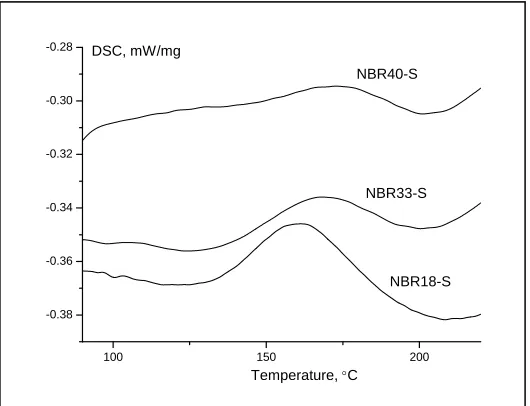
The DSC curves for vulcanization process of rubbers with various nitrile content are shown on Fig. 1. The onset temperature as well as peak temperature is affected by nitrile content. One can see that both temperatures shift to higher values with increase of nitrile content. The possible reason of this effect is the influence of nitrile group on electron density distribution in the rubber molecule (see Fig. 2). Nitrile group being an electron acceptor (negative induction effect) reduces the electron density on the double bond in butadiene part which causes decrease of activity of rubber in vulcanization process since sulfphur vulcanization process has radical nature [9]. The same effect of nitrile groups is supposed to result in decrease of heat of vulcanization. The summarized data for the influence of nitrile content on cure parameters of nitrile rubbers are shown in Table 2.
3.2. Rubber post-cure
————————————————
• M.V. Lomonosov Moscow State University, Department of Chemistry, Leninskie gory 1-3, 119234, Moscow, Russia
4659 Fig. 2. Effect of nitrile group on electron density distribution When considering post-cure processes that proceed at
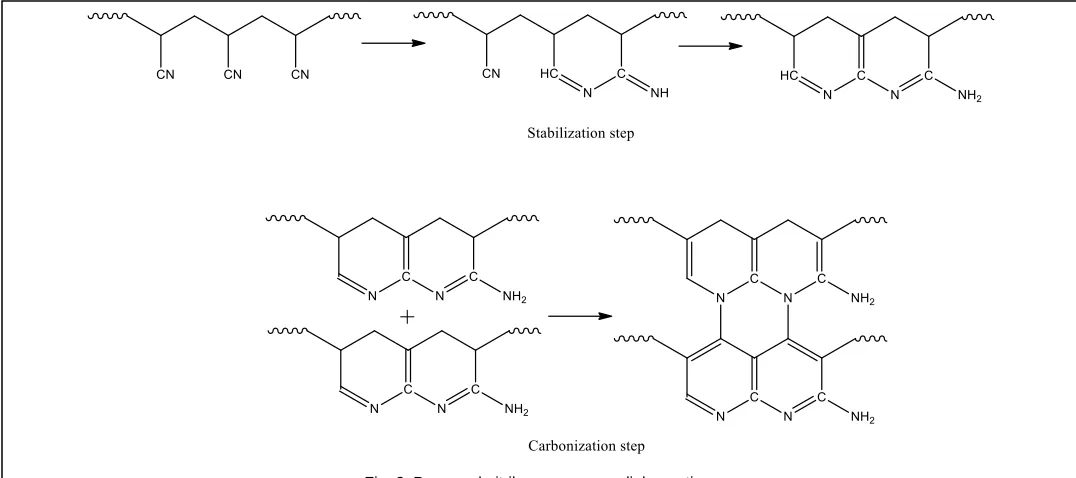
temperatures above 200°C it should be pointed out that there is only 1 peak around 365°C associated for nitrile group cross-link reactions [10, 11] (see Fig. 3) for rubber with the lowest nitrile content (18%). The other rubbers have 1 more peak located around 265°C (see Fig. 4).
To estimate the nature of lower temperature peak the post-cure process of neat rubbers was investigated (see Fig. 5). Neat nitrile rubber with 18% nitrile content possesses the same behavior as the same rubber with vulcanization additives i.e. only nitrile groups cross-link reactions proceed at 365°C and no additional process at 265°C is observed. When there are no nitrile groups with negative inductive effect like in EPDM rubber no processes
are registered up to 400°C. For other investigated nitrile rubbers
(with 33% and 40% nitrile content) additional process at 265°C occurred similar to one observed for rubbers with vulcanization additives.
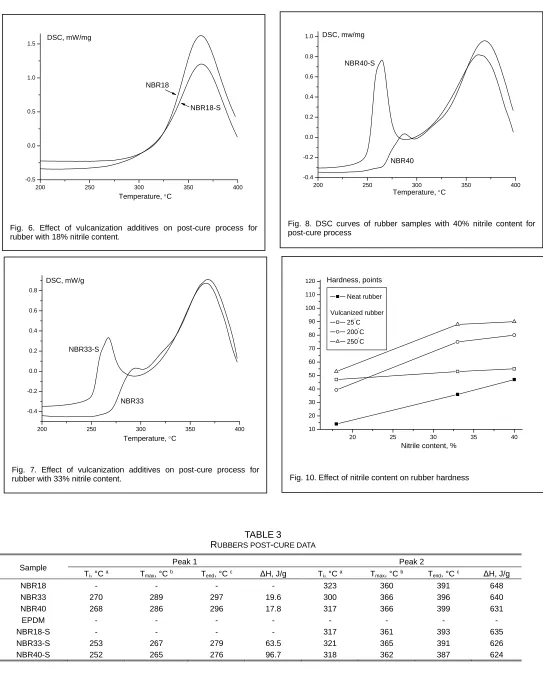
Comparing post-cure process for neat rubbers (Fig. 5) and rubbers with vulcanization additives (Fig. 4) one can see that the additional process at 265°C shifts to lower temperatures and its
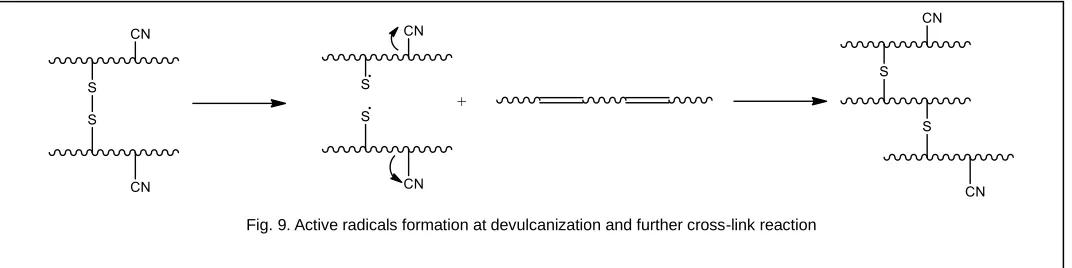
enthalpy increases with increase of nitrile content. More clearly this effect is demonstrated when corresponding sample pairs (neat rubber and with vulcanization additives) are compared (see Fig. 6, 7 and 8). When rubber is heated devulcanization process is observed at 265°C accompanied with formation of radicals (see Fig. 9). The presence of nitrile groups destabilizes there radicals due to electron density distribution discussed above. This destabilization increases activity of radicals in cross-link reaction. The formation of these radicals proceeds at lower
TABLE2 RUBBERS CURE DATA
Sample Ti, °C a Tmax, °C b Tend, °C c ΔH, J/g
NBR18-S 117 161.2 207 6.62
NBR33-S 128 168.8 204 3.32
NBR40-S 137 173.6 200 1.89
aT
i – onset temperature bT
max – temperature of the peak cT
end – temperature of the end
TABLE1
SAMPLES PREPARATION
Sample
Additive content, phr* Post-cure treatment
S ZnO Stearic acid MBT TMTD 200°C and 0.25MPa, 6h
250°C at 0.25MPa, 6h
NBR18 - - - - - - -
NBR33 - - - - - - -
NBR40 - - - - - - -
EPDM - - - - - - -
NBR18-S 2 5 2 1 2 - -
NBR33-S 2 5 2 1 2 - -
NBR40-S 2 5 2 1 2 - -
NBR18-200 - - - - - + -
NBR33-200 - - - - - + -
NBR40-200 - - - - - + -
NBR18-S-200 2 5 2 1 2 + -
NBR33-S-200 2 5 2 1 2 + -
NBR40-S-200 2 5 2 1 2 + -
NBR18-S-250 2 5 2 1 2 - +
NBR33-S-250 2 5 2 1 2 - +
NBR40-S-250 2 5 2 1 2 - +
100 150 200
-0.38 -0.36 -0.34 -0.32 -0.30
-0.28 DSC, mW/mg
Temperature, C
NBR18-S NBR33-S NBR40-S
4660 Fig. 3. Proposed nitrile groups cross-link reactions
200 250 300 350 400
0.0 0.5 1.0
DSC, mW/mg
Temperature, C NBR18-S NBR33-S
NBR40-S
Fig. 4. Effect of nitrile content on post-cure process for rubbers with vulcanization additives
100 150 200 250 300 350 400
-0.5 0.0 0.5 1.0 1.5
DCS, mW/mg
Temperature, C EPDM NBR-18
NBR-33 NBR-40
Fig. 5. Effect of nitrile content on post-cure process for rubbers with no vulcanization additives.
temperatures for vulcanized samples rather than in neat rubber because of difference in C-C and S-S bond energy. That is why this peak is shifted to lower temperatures for vulcanized samples compared with neat rubbers and this effect increases with rising nitrile content. For the rubber with 18% nitrile content it is enough
for nitrile group to activate obtained radicals and initiate cross-link reactions. The same effect is observed for rubber with no nitrile groups. The summarized data for post-cure processes are given in Table 3.
3.3. Rubber hardness
The entioned post-cure processes should increase rubber hardness due to cross-link reactions. The summarized data for shore hardness are given in Fig. 10. The rubber with
4661
200 250 300 350 400
-0.5 0.0 0.5 1.0
1.5 DSC, mW/mg
Temperature, C NBR18
NBR18-S
Fig. 6. Effect of vulcanization additives on post-cure process for rubber with 18% nitrile content.
200 250 300 350 400
-0.4 -0.2 0.0 0.2 0.4 0.6 0.8
NBR33-S
NBR33 DSC, mW/g
Temperature, C
Fig. 7. Effect of vulcanization additives on post-cure process for rubber with 33% nitrile content.
200 250 300 350 400
-0.4 -0.2 0.0 0.2 0.4 0.6 0.8
1.0 DSC, mw/mg
Temperature, C NBR40-S
NBR40
Fig. 8. DSC curves of rubber samples with 40% nitrile content for post-cure process
20 25 30 35 40
10 20 30 40 50 60 70 80 90 100 110 120
Neat rubber
Vulcanized rubber 25C 200C 250C
Nitrile content, % Hardness, points
Fig. 10. Effect of nitrile content on rubber hardness
TABLE3 RUBBERS POST-CURE DATA
Sample Peak 1 Peak 2
Ti, °C a Tmax, °C b Tend, °C c ΔH, J/g Ti, °C a Tmax, °C b Tend, °C c ΔH, J/g
NBR18 - - - - 323 360 391 648
NBR33 270 289 297 19.6 300 366 396 640
NBR40 268 286 296 17.8 317 366 399 631
EPDM - - - -
NBR18-S - - - - 317 361 393 635
NBR33-S 253 267 279 63.5 321 365 391 626
4662 The heat treatment at 250°C is associated with nitrile groups
cross-link reactions. Considering the change in hardness of nitrile rubber with 18% nitrile content it is concluded that only stabilization step occurs and no carbonization step proceeds. Intramolecular nitrile cross-link reaction i.e. stabilization step results in more rigid molecule but intermolecular cross-link proceeds at carbonization step. Thus this formation of rigid
structure at stabilization step does not have significant influence on hardness. The absolute increase in hardness increases with rising nitrile content from 18% to 33% (5 and 12 points correspondingly). But further increase in hardness is not affected by nitrile content, i.e. for both 33% and 40% nitrile content rubbers the absolute increase in hardness caused by stabilization step of nitrile cross-link is the same
.
4
CONCLUSION
Nitrile content in rubber is critical for vulcanization and post-cure processes. When vulcanization process is considered increase of nitrile content results in shift of vulcanization process to higher temperatures with decrease of process enthalpy. The presence of polar nitrile groups with strong electron acceptor properties is supposed to increase the activity of radicals arising at temperatures above 200°C and thus increasing the rate of further cross-linking causing dramatic rise of rubber hardness. There is no significant increase in hardness for rubber with 18% nitrile groups indicating negligible level of secondary cross-link reaction due to insufficient nitrile content to activate radicals. There is no significant effect of nitrile groups cross-link on rubber hardness when heating at 250°C for 6 hours since only stabilization step with intramolecular cross-link proceeds without further intermolecular carbonization step.
5
ACKNOWLEDGMENT
The research was supported by the Ministry of Education and Science of the Russian Federation, Resolution No. 218, 2010, April 9-th (Contract No. 03.G25.31.0220 «Development of high-temperature composite seals for improve energy-saving and reliability of sealing equipment and pipelines» between JSC UNICHIMTEK and Lomonosov Moscow State University).
6
REFERENCES
[1] J.A. Brydson, Rubbery Materials and Their Compounds, Elsevier (1988), pp. 187-205
[2] ChenYang, Shui-Long, Shen Dong-Wei, Hou, Shao-Ming Liao, Da-JunYuan “Material properties of the seal gasket for shield tunnels: A review” Construction and Building Materials, Volume 191, 10, 2018, Pages 877-890,
doi.org/10.1016/j.conbuildmat.2018.10.021
[3] Weitao Lou, Weifang Zhang, Hongxun Wang, Tingzhu Jin, Xuerong Liu, “Influence of hydraulic oil on degradation behavior of nitrile rubber O-rings at elevated temperature”, Engineering Failure Analysis, 92, 2018, Pages 1-11, doi.org/10.1016/j.engfailanal.2018.05.006
[4] C. Albano, M.N. Ichazo, I. Boyer, M. Hernández, J. González, A. Karam, M. Covis “Study of the thermal stability of Nitrile rubber-coconut flour compounds” Polymer Degradation and Stability, 97, 11, 2012, P. 2202-2211, doi.org/10.1016/j.polymdegradstab.2012.08.006 [5] Qidi Peng, Zhongmeng Zhu, Chengkai Jiang, Han Jiang
“Effect of stress relaxation on accelerated physical aging of hydrogenated nitrile butadiene rubber using time-temperature-strain superposition principle” Advanced Industrial and Engineering Polymer Research 2, 2, 2019, Pages 61-68 doi.org/10.1016/j.aiepr.2019.03.002
[6] P.Budrugeac “Accelerated thermal ageing of nitrile-butadiene rubber under air pressure” Polymer Degradation and Stability 47, 1, 1995, Pages 129-132 doi.org/10.1016/0141-3910(94)00101-D
[7] Khaled F.El-Nemr “Effect of different curing systems on the mechanical and physico-chemical properties of acrylonitrile butadiene rubber vulcanizates” Materials & Design 32, 6, 2011, P. 3361-3369 doi.org/10.1016/j.matdes.2011.02.010
[8] A.Y.CORAN “Chapter 7. Vulcanization” Science and Technology of Rubber (Second Edition) 1994, Pages 339-385 doi.org/10.1016/B978-0-08-051667-7.50012-3
[9] N.D. Zakharov, G.I. Kostrykina “Some features of the vulcanization of butadiene-nitrile rubbers” Polymer Science 10, 1, 1968, Pages 125-132 doi.org/10.1016/0032-3950(68)90142-1
[10]Burlant W.J., Parsons J.L. “Pyrolysis of acrylonitrile” J Polym Sci, 22, 1956, 249-256
[11]Watt W, “Chemistry and Physics of the Conversion of Polyacrylonitrile Fibers into High Modulus Carbon Fibers”, Watt W, Perov B.V. eds., Handbook of Composites Vol 1, Strong Fibers, Elsevier Science, Amsterdam, 1985, 327-287