The Impact Of Technology On Postal Services In
Ghana
Ebenezer Ankrah
Abstract: The information technology (IT) available today is being leveraged in customer acquisitions, driving automation and process efficiency, delivering ease and efficiency to customers. The study investigated the impact of technology on postal services in Ghana. The population for the study consists of all staff members of Ghana Post at the Head office. The entire population was used in the research since the researcher wanted to generalize the findings. The main instrument used is the questionnaire. Two hundred copies of the questionnaire were received, representing a return rate of 53.7%. The findings revealed that technology has improved the data processing at Ghana Post and staff member are giving frequent IT training. Subjecting all the three hypotheses to a chi square statistical test turned out that, (1) the birth of the internet has a negative effect on postal services, (2) organizational efficiency and productivity have increased as a result of technology and (3) technology has given rise to innovative products and services in Ghana Post.
Index Terms: Information Technology, Technology, Postal Services, Ghana Post, Ghana
————————————————————
1
I
NTRODUCTIONOver the last few years increasing attention has been given by both researchers and practitioners as to how technology can have an impact on an organization`s success. It is believed that technology has redefined the work of professionals and has also rendered some jobs useless. Again, it is assumed that financial reports may deteriorate or improve when managers develop new strategies to meet the growing demand of technology and how it is massively impacting businesses. Technology is no longer an enabler, but a business driver. The growth of the internet, mobiles and communication technology has added a different dimension to firms [1]. The information technology available today is being leveraged in customer acquisitions, driving automation and process efficiency, delivering ease and efficiency to customers [1]. This research focused on the impact of technology on postal services in Ghana. The Ghana Postal Company is owned and operated by the Government under the Ministry of Communications. Ghana Post provides efficient and reliable mail delivery for her cherished customers, companies and general public. Ghana Post Company Limited started in the Gold Coast, now Ghana in 1843. The first post office was opened in the Gold Coast capital, Cape Coast in 1854 but postal services were restricted to expatriates. In June 1999 the Ghana Postal Service Corporation was converted to a limited liability company (LLC), Ghana Post Company Limited, still with Ghana Government as the sole shareholder (www.ghanapostgh.com). Three hypotheses were statistically tested: (1) the birth of the internet has a negative effect on postal services, (2) organizational efficiency and productivity have increased as a result of technology and (3) technology has given rise to innovative products and services in Ghana Post. Rapid technological emergence and development has greatly affected the postal sector.
Think back to ten or more years ago, people communicated by sending mails through the postal service. Today it is no longer the case due to the emergence of technology which has led to decreasing amounts of the volume of mail sent or received. Technology brings forth new products and services which make existing products become obsolete and outdated due to the emergence of faster communication services and devices such as e-mail, social networking (Face book, twitter etc.), smart phones etc, replacing the need for letters and postal services. The emergence of technology has led to the closure of some post offices across the nation, created unemployment and layoffs because of the use of computers and smart phones, most people do not see the need to use these services. The emergence of technology has rendered the postal system obsolete and thus has affected their financial position.
2
L
ITERATURER
EVIEW2.1 The Post Market
The Universal Postal Union [2] defined the postal market as items that can fit through letterboxes, including packets delivered by any carrier. It included unaddressed mail, international mail, standard parcels, and express and courier services. The Universal Postal Union categorized the mail into the following types:
1. Letters - Addressed letters, large letters and small packets which are small enough to be posted through letter boxes.
2. Unaddressed letters - Items which can be posted through letter boxes but do not contain an address such as leaflets, catalogues, brochures and magazines.
3. Express and courier - Items which are guaranteed to arrive on a particular day or time, and / or which require a signature on delivery or ―track and trace‖ facility.
4. Standard parcels - These items are not guaranteed to be delivered by a specific time and cannot be posted through letter boxes.
5. Social mail - Mail originating from domestic consumers such as birthday cards, Christmas cards etc.
_____________________________
Ebenezer Ankrah is a Senior Lecturer with the
Department of Information Technology at the Central University College and holds a PhD in Information
126
2.2 A Decline in Postal Sector
The European Post Union described the emerging consensus amongst those in the postal service that the market is now in decline. Evidence suggests that letter volumes reached their highest point around 2005 and have been declining since then. Letter volumes have fallen since. The continuous decline in the postal market over this period is unprecedented and represents a fundamental change in the postal sector. The challenges and opportunities facing postal services need to be seen in the context of a much wider advancement in the communication sector. Broadband internet, email and text messaging (skype, whatsApp, blackberry messenger, etc) offer alternative ways for people to keep in touch, carry out business transactions and advertise. A reduction in the demand for postal services payment facilities is a real possibility [3].
2.3 Key Trends of Technology
Christensen [4] states that most of the prominent societal, behavioral and technological tendencies affecting the postal ecosystem were coupled with the ongoing improvement in communication and media trends. There have been progressive shifts in communications moving from the physical to the digital world. With every new technology, the speed and scope of communications have increased. Businesses and Governments are looking to move not only communications but also transactions, to the digital world. The internet has evolved from mass broadcast media to personalized conversations and hastened by the growth of social sites. Postal administrations have begun to realize that they have to fight for the postal business, not only with competitors for physical mail but also with the providers of new electronic communication products that have no national borders [5].
2.4 Theoretical Framework
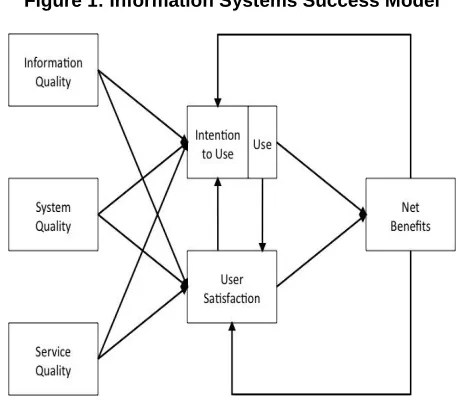
Delone and McLean IS success model
This study employed the Delone and McLean IS success model. The updated model consists of six interrelated dimensions of IS success: information, system and service quality, (intention to use) use, user satisfaction, and net benefits. The arrows demonstrate proposed associations between the success dimensions. The model can be interpreted as follows: A system can be evaluated in terms of information, system, and service quality; these characteristics affect the subsequent use or intention to use and user satisfaction. As a result of using the system, certain benefits will be achieved. The net benefits will (positively or negatively) influence user satisfaction and the further use of the information system.
Figure 1: Information Systems Success Model
Source: DeLone and McLean (2003)
3 Methodology
The population for the study consists of all staff members of Ghana Post. Since the study is about the Ghana Postal system, the Head Office which is situated in Accra is use as the main case study. This is justified by the fact that, all the other branches does the same postal operations as the Head Office. The total number of staff nationwide is thousand seven hundred. The total number of staff at the Head Office is three hundred and seventy two. The main instrument used is the questionnaire. The entire population at the Head Office was used in the research since the researcher wanted to generalize the findings. Copies of the questionnaire were given to all the staff members and were given one week to return to the researcher. Two hundred copies of the questionnaire were received fully completed, representing a return rate of 53.7%. The copies of questionnaire received were coded and entered into the Statistical Package for Social Science (SPSS) for analysis. The results were presented in tables and charts and hypotheses were also tested.
4 Major Findings
Figure 1: Rate of Data Processing
Data processing is the process through which facts and figures are collected, assigned meaning, communicated to others and retained for future use. Hence, data processing could be defined as a series of actions or operations that converts data into useful information. The data processed are saved for tracking, tracing and receiving (recording) of incoming and outgoing items (letters). Eight (4%) of the respondents indicated that, the rate of data processing is slow and 40 (20%) of the respondents indicated that, the rate of data processing is fast. Most of the respondents 152 (76%) indicated that, the rate of data processing is very fast or better still faster. Processing data by the use of computers is not only quicker but also neat, efficient, reliable and prudent.
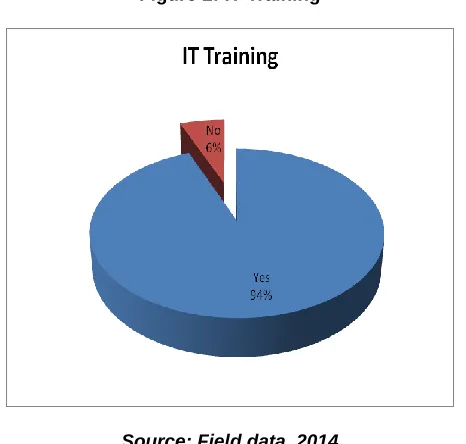
Figure 2: IT Training
Source: Field data, 2014
Quality human resource can affect performance positively. Many people of different occupations continuously train to maintain, update and upgrade their skills. To keep up with the fierce competition, it is vital to train staff periodically [6]. Every staff that plays a role in researching, selecting or implementing enterprise technology needs to have a firm grasp on the basics of emerging technologies, as well as how they serve a larger business purpose, to ensure that technology is being used to the company's best strategic advantage [6]. One hundred and eighty eight (94%) of the respodents indicated that, staff are given frequent and periodic IT training to be abreast with the new trends in technology. Twelve (6%) of the respodents also indicated that staff are not given periodic IT training. It could be infered from the above figure that Ghana Post gives peroidic IT training to staff members.
5 Hypotheses Testing
Hypothesis is a specific statement of prediction. It describes in concrete (rather than theoretical) terms what the expectation will be in the study. A single study may have one or many hypotheses [6]. The chi-square statistic was used to test the three hypotheses. The chi-square statistic was use to test the hypotheses because the researcher was testing for goodness of fit or better still relationships.
5.1 Hypothesis one
Ho: The birth of the internet has no negative effect on postal services.
Ha: The birth of the internet has a negative effect on postal services.
Where Ho is the null hypothesis and
Ha is the alternative hypothesis
Significance level
The significance level (α) for this test is 0.05.
Critical value
From the chi square distribution table, a significance level of 0.05 with two degrees of freedom gives a critical value of 5.99.
Decision rule
The researcher cannot accept Ho, if chi-square calculated is greater than 5.99 and conclude that, the birth of the internet has a negative effect on postal services else the researcher will fail to reject Ho and conclude that, the birth of the internet has no negative effect on postal services
Test statistic
The test statistic is a chi square,
χ
2
with (I-1)*(J-1) degrees of
freedom.
I1 i
J
1 j ij
2 ij ij 2
1
J
*
1
I
df
with
value
E
E
O
χ
Where Oij are the observed values
Eij are the expected values and
df is the degrees of freedom
Now, the calculated chi-square from Table 1 is as follows;
23.6845
0.9806
3514
.
0
1.1130
0.4129
15.1737
5.6529
39.2
39.2
33
105.9
105.9
112
9.2
9.2
6
24.8
24.8
28
5.7
5.7
15
15.3
15.3
6
2 2 2 2 2 22
χ
Table 1: Relationship between Patronage of Postal Services and Birth of the Internet
N = 200
Effect of
the Internet Total Yes No
Patronage of Postal Services
High
Count 6 15 21
Expected
Count 15.3 5.7 21.0
Moderate
Count 28 6 34
Expected
Count 24.8 9.2 34.0
Low
Count 112 33 145
Expected
Count 105.9 39.2 145.0
Total
Count 146 54 200
Expected
Count 146.0 54.0 200.0
128 The chi-square calculated is equal to 23.6845 and the critical
value is equal to 5.99. Since the chi-square calculated is greater than the critical value, thus, Ho cannot be accepted. Therefore, the birth of the internet has a negative effect on postal services. The correlation coefficient between the two variables is 0.261, indicating that there exists a positive relationship between the two variables which is indeed weak. The greatest direct impact of new technology is on communication. The convergence of telecommunications, broadcasting and media has revolutionized the way in which people communicate. Digital technology is superseding the traditional postal service as the new primary delivery platform for communication, significantly shrinking the latter`s role.
5.2 Hypothesis two
Ho: Organizational efficiency and productivity have not increased as a result of technology.
Ha: Organizational efficiency and productivity have increased as a result of technology.
Critical value
From the chi-square distribution table, a significance level of 0.05 with two degrees of freedom gives a critical value of 5.99.
Decision rule
The researcher cannot accept Ho, if chi-square calculated is greater than 5.99 and conclude that, organizational efficiency and productivity have increased as a result of technology else the researcher will fail to reject Ho and conclude that, organizational efficiency and productivity have not increased as a result of technology.
Test Statistic
The test statistic is a chi square,
χ
2
with (I-1)*(J-1) degrees of
freedom.
I 1 i J 1 j ij 2 ij ij 21
J
*
1
I
df
with
value
E
E
O
χ
Now, the calculated chi-square from Table 2 below is as follows;
37.7998
9.2842
4588
.
3
9.5000
3.6000
8.7568
3.2400
7.6
7.6
16
20.4
20.4
12
9.5
9.5
19
25.6
25.6
16
37.0
37.0
19
100.0
100.0
118
2 2 2 2 2 22
χ
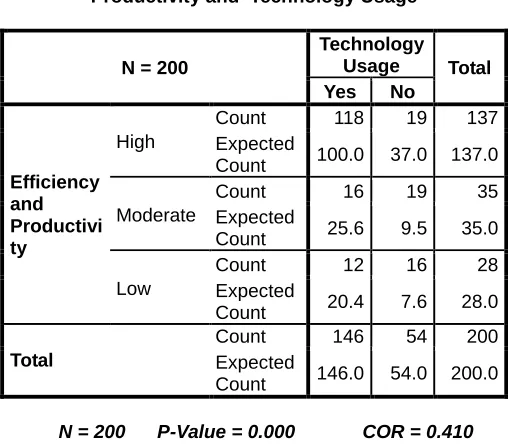
Table 2: Relationship between Efficiency and Productivity and Technology Usage
N = 200
Technology Usage Total Yes No
Efficiency and Productivi ty
High
Count 118 19 137
Expected
Count 100.0 37.0 137.0
Moderate
Count 16 19 35
Expected
Count 25.6 9.5 35.0
Low
Count 12 16 28
Expected
Count 20.4 7.6 28.0
Total
Count 146 54 200
Expected
Count 146.0 54.0 200.0
N = 200 P-Value = 0.000 COR = 0.410
The chi-square calculated is equal to 37.7998 and the critical value is equal to 5.99. Since the chi-square calculated is greater than the critical value, thus, Ho cannot be accepted. Therefore, organizational efficiency and productivity have increased as a result of technology. The correlation coefficient between the two variables is 0.410, indicating that there exists a positive relationship between efficiency and productivity and technology usage but the relationship is no strong.
5.3 Hypothesis three
Ho: Technology has not given rise to innovative products and services in Ghana Post.
Ha: Technology has given rise to innovative products and services in Ghana Post.
Critical value
From the chi-square distribution table, a significance level of 0.05 with two degrees of freedom gives a critical value of 5.99.
Decision rule
The researcher cannot accept Ho, if chi-square calculated is greater than 5.99 and conclude that, technology has given rise to innovative products and services in Ghana Post else the researcher will fail to reject Ho and conclude that, technology has not given rise to innovative products and services in Ghana Post.
Test statistic
The test statistic is a chi square,
χ
2
with (I-1)*(J-1) degrees of
freedom.
I 1 i J 1 j ij 2 ij ij 21
J
*
1
I
df
with
value
E
E
O
χ
29.0942
15.7786
9446
.
3
2.1333
0.5333
5.3635
1.3409
5.6
5.6
15
22.4
22.4
13
4.8
4.8
8
19.2
19.2
16
29.6
29.6
17
118.4
118.4
131
2 2 2 2 2 22
χ
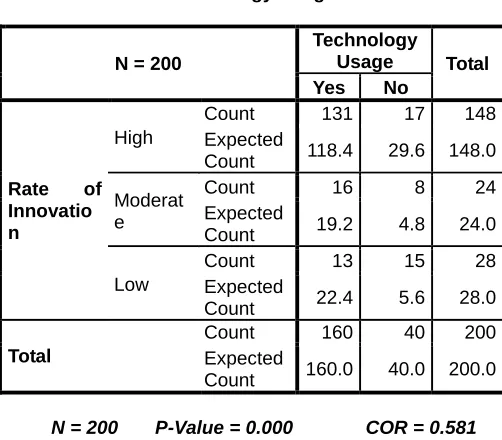
Table 3: Relationship between Rate of Innovation and Technology Usage
N = 200
Technology
Usage Total Yes No
Rate of Innovatio n
High
Count 131 17 148
Expected
Count 118.4 29.6 148.0
Moderat e
Count 16 8 24
Expected
Count 19.2 4.8 24.0
Low
Count 13 15 28
Expected
Count 22.4 5.6 28.0
Total
Count 160 40 200
Expected
Count 160.0 40.0 200.0
N = 200 P-Value = 0.000 COR = 0.581
The chi-square calculated is equal to 29.0942 and the critical value is equal to 5.99. Since the chi-square calculated is greater than the critical value, thus, Ho cannot be accepted. Therefore, technology has given rise to innovative products and services in Ghana Post. The correlation coefficient between the two variables is 0.581, indicating that there exists a positive relationship between rate of innovation and technology Usage that is quite strong. Chnology
6 Conclusion
The role of the Postal Services in Ghana is diminishing, but that does not mean that Ghanaians should neglect its role in the society and in the communication equilibrium. Technology has brought forth faster communication media and devices such as e-mail, websites, mobile phones, and social networking services which have replaced paper and accelerated the trend. From Africa to Asia and to all other parts of the world postmen have fewer letters to deliver, meaning sharply lower profits or even losses for the postal services. The key function of the postal service industry is communication. It also plays an important role in offering basic financial services, especially in remote areas. The findings revealed that technology has improved the data processing at Ghana Post and staff members are giving frequent IT training. Subjecting all the three hypotheses to a chi-square statistical test turned out that, (1) the birth of the internet has a negative effect on postal services, (2) organizational efficiency and productivity have increased as a result of technology and (3) technology has given rise to innovative products and services in Ghana Post.
7 References
[1] Ankrah, E. (2012). Technology and Service Quality in the Banking Industry in Ghana. Information and Knowledge Management, 2(8), 52-60.
[2] Universal Postal Union: Post (2007) – Core Business Scenarios, Bern, 1997.
[3] Crew, M. A., & Kleindorfer, P. R. (2000). Current directions in postal reforms. Boston, MA: Kluwer Academic Publishers.
[4] Christensen, C. M. (1997). The Innovators Dilemma: when new technologies cause great firms to fail. Boston, Massachusetts, Harvard Business School Press.
[5] Hudgins, E. (2000). Will the postal service go private? The Cato Institute, Washington.