© 2016 IJSRST | Volume 2 | Issue 3 | Print ISSN: 2395-6011 | Online ISSN: 2395-602X Themed Section: Science and Technology
Isolation of Pneumocandin Bo by Optimization of Downstream Process
Parameters using Statistical Approach
Umesh Luthra*, Yogesh Patel, Nishtha Singh, Dharmendra Singh
IPCA Laboratories Ltd., Biotech R&D, Kandivali (W), Mumbai, Maharashtra, India
ABSTRACT
Pneumocandin Bo is a lipopeptide antifungal agent that inhibits the synthesis of 1,3-β-d-glucan, an essential cell wall homopolysaccharide found in many pathogenic fungi. It is an industrial product produced as a result of fermentation by fungal strain Zelerion arboricola. The primary objective in industrial fermentation processes is to recover the product efficiently, reproducibly and safely to its required specification, while achieving maximum product yield at minimum recovery cost.Isolation of product from the fermentation broth is a challenging task. In the current study statistical approach was employed to optimize various parameters for downstream processing of Pneumocandin B0. Filtration technique was optimized initially using one variable at a time method. Press filter technique was found most suitable filtration technique. Solvent selection for extraction procedure was carried out using one variable at a time (OVAT). Isobutanol showed maximum product recovery. Further variables: agitation time, solvent volume and solvent wash were studied using full factorial design. Experimental design showed that agitation time and solvent wash had maximum impact on Pneumocandin B0 extraction.
Keywords : Pneumocandin Bo, downstream processing, filtration technique, solvent extraction, full factorial design
I.
INTRODUCTION
Pneumocandins are chemically lipopeptide in nature, consisting of large cyclic hexapeptide linked to a long chain fatty acid. Pneumocandin B0, also known as Hydroxy Echinocandin, is an organic chemical compound with formula C50H80N8O17 [1]. Fig. 1 represents structure of Pneumocandin B0.
Figure 1: Chemical structure of Pneumocandin B0 [2]
It is a strong antifungal agent that attacks the fungal cell by selective inhibition of beta-(1,3)-D-glucan synthase, which is not present in mammalian cells.This compound is used to synthesize caspofungin. Pneumocandin B0 is the starting molecule for the first semisynthetic echinocandin antifungal drug, Caspofungin acetate.
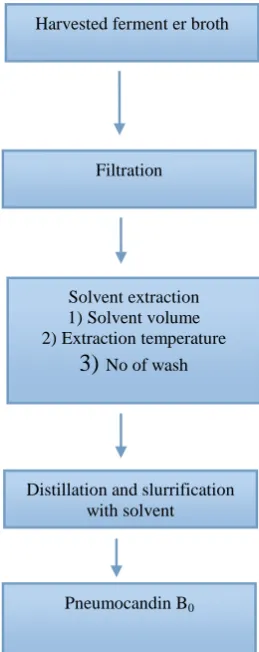
Figure 2: Steps for downstream processing of Pneumocandin B0
The primary objective in industrial fermentation process is to develop, optimize, and maintain maximum efficiency and desired product quality at minimum recovery cost. Therefore, a comprehensive approach is required when developing a new industrial purification strategy.
Downstream process design has the greatest impact on overall biomanufacturing cost. Development of a simplified and economical downstream process for microbial fermentation products is a major challenge for their commercialization. Normally, in downstream process, the optimum conditions are determined by keeping one variable parameter and others at constant level, which is a very time consuming process [3]. Statistical experimental design techniques are very useful tools when more than one factor is studied at a time. The statistical approach enables evaluation of various components at a time thus making it feasible and time saving.
The present study aims to develop a righteous and valuable downstream process for maximum recovery of Pneumocandin B0. The current research deals with the optimization of the various process parameters involved in the purification of Pneumocandin B0 at various stages of downstream processing using statistical approach.
II.
METHODS AND MATERIAL
A. Procedure
1) Fermentation: Pneumocandin B0 is a fermentation product produced by fungal strain Zelerion arboricola. The harvested fermentation broth was further processed by downstream process to isolate product of Pneumocandin B0.
2) Downstream Process: The harvested broth was preceded for product extraction during downstream processing. The broth was filtered at 30°C by centrifugation. After filtration, the filtered cake was extracted with isobutanol under stirring condition for 2 hrs. Solvent extraction procedure was done four times. Filtered solvent was distilled out at 60-65°C while concentrated mass was washed with equal volume of water by stirring at 30-35°C for 30-40 mins. The organic and aqueous layer was obtained after washing and subsequently layers were separated. The aqueous layer was discarded and activated charcoal was added to the obtained organic layer and was stirred for 1.5-2 hrs, then charcoal was filtered using Hyflow bed.
With the filtrate, distillation process was carried out with reduced pressure at 60-65°C. Ethyl acetate was added to the concentrated mass followed by heating and stirring at 45-50°C for 45-60 mins for slurrification . The slurry was filtered at nitrogen atm. and was washed twice with ethyl acetate. The filtered material was dried in vacuum oven at reduced pressure and 60-65°C temperature for 5-6 hrs. The assay purity of product was checked by HPLC.
3) Quantification of product by HPLC: Pneumocandin B0 from the fermentation broth was determined by HPLC.5.0 gm of culture broth was taken in 25.0 ml volumetric flask containing 20.0 ml acetone.Sonicated the broth for 20 minutes, water was used to make up the final volume. The resulting extracted solution was filtered through 0.22u nylon filter paper.This was further injected into HPLC system (Waters 2496) using C-18 Harvested ferment er broth
Filtration
Solvent extraction 1) Solvent volume 2) Extraction temperature
3)
No of washDistillation and slurrification with solvent
column (Hypersil BDS, 5u C18 (100 mm X 4.6 mm) for the estimation of Pneumocandin B0. Concentration of Pneumocandin B0 was calculated by comparison of peak areas with those of standard and subsequently product activity was calculated.
B. Optimization of Downstream Process Parameters
1) Filtration Technique: In the current study, filtration technique was first optimized using classical method of one variable at a time (OVAT). Filtration helps in the separation of cells, cell debris or other particulate matter from fermentation broth.
In the present study centrifugation, micro-filtration, RVDF, nutch filter and press filter techniques were used. After finalization of filtration technique with OVAT, other downstream process parameters were optimized. 2) Selection of Solvent: Solvent plays an important role in the product extraction and isolation step of the downstream process. It is involved in removal of the impurities that vary distinctly from the product. In this study, solvent used for recovery of Pneumocandin B0 was optimized using OVAT technique. The solvents used for the study were methanol, ethyl acetate, MDC and isobutanol. The solvents were selected based on the property of the product. All the solvents were utilized for the extraction of Pneumocandin B0.
3) Full Factorial Design: Full factorial design was employed in the selection of most significant variable for Pneumocandin B0 extraction. Full factorial design determines the effects of multiple variables on product extraction.
Factorial designs are constructed to obtain maximum information from the least amount of experimental runs. In general, factorial designs involve the study of two or more factors or variables, where each variable is assigned discreet values or levels, and each possible factor-level variation is tested over multiple experimental trials or runs. The most common form of factorial designs involves studying each factor at two levels [4]. The two level factorial design is considered to be a multivariable sequential search technique in which the effects of two or more factors are studied simultaneously and the response is analyzed statistically to arrive at a decision [5, 6]. A two level three factorial design was carried out on the basis of the results obtained from OVAT.
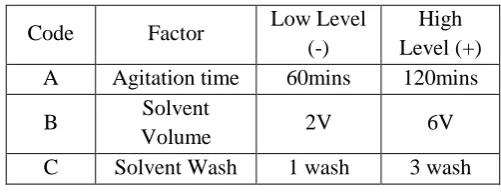
The parameters taken into consideration were 1. Agitation time
2. Solvent Volume 3. Solvent wash study
The low level (– 1) and high level (+ 1) of each factor are listed in Table 1. Experiment was designed using Design expert software (Stat-Ease Inc., Version 8.0.7.1).
Table 1: Experimental Code and Levels Of Factors In The Full Factorial Design
III.
RESULT AND DISCUSSION
Pneumocandin B0 is acylated cyclic hexapeptide belonging to the echinocandin group of antifungal antibiotics, which has broad spectrum activity. The antifungal activity of pneumocandins is connected to inhibition of the biosynthesis of glucans. 1,3β-glucan synthase, a multisubunit enzyme which is responsible for fungal cell wall construction, division septum deposition, and ascospore wall assembly. Pneumocandin and its derivatives are useful as active pharmaceutical ingredients (APIs) and/or intermediates for producing APIs. Drugs comprising the APIs are intended for use in therapeutic or prophylactic treatment of diseases or conditions involving fungal infections [7]. Pneumocandin B0 is used as a starting material for producing Caspofungin (first semisynthetic echinocandin antifungal drug).
Pneumocandin B0 is a secondary metabolite commercially derived from fermentation by fungus Zalerion arboricola [8]. The fermented broth is then subjected to downstream processing that includes various treatments to produce a pure product which is free from impurities. The optimization of downstream process parameters for extraction of Pneumocandin B0 was done using statistical approach for maximum recovery.
Code Factor Low Level (-)
High Level (+) A Agitation time 60mins 120mins
B Solvent
Volume 2V 6V
A. Filtration Technique
Filtration technique was optimized using the classical method of one variable at a time (OVAT). Filtration plays an important role in the separation of cells, cell debris or other particulate matter from fermentation broth for product recovery. The filtration technique used for the present study were centrifuge, micro-filtration, RVDF, nutch filter and press filter. The results of experiment is given in table 2.
Table 2: Effect Of Different Filtration Technique On Product Extraction
Filtration Technique
Filtration
Time (hrs) LOD % Micro
filtration 3-4 Slurry
RVDF 3-4 75-80
Nutch filter 3-4 70-80 Centrifuge 1-1.5 60-65 Press filter 1-1.5 60-65
Centrifuge and press filter were observed to be suitable filtration technique, as more dried cake in less time was obtained when compared with other techniques. Since centrifuge is costly and have limitation for industrial scale up, press filter is more suitable for filtration.
B. Selection of Solvent
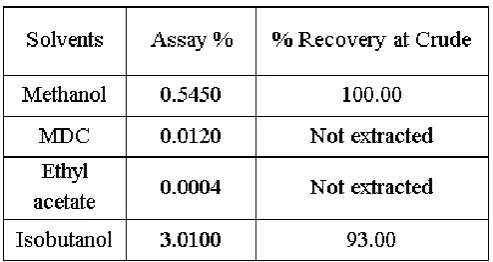
Solvents in bulk quantity are used during recovery of product. Downstream process has the greatest impact on overall biomanufacturing cost in fermentation process. Therefore, solvent used for recovery of Pneumocandin B0 was optimized using OVAT technique (Table 3). The solvents used for the study were methanol, ethyl acetate, MDC and isobutanol.
Table 3: Impact Of Type Of Solvent On Assay Percentage And Percentage Recovery
Among the solvents analyzed, it was observed that recovery of methanol and isobutanol extraction was the highest. But assay percentage of isobutanol extraction was high compared to methanol. Thus, use of isobutanol was found most suitable for extraction of Pneumocandin B0 from fermentation broth.
C. Full Factorial Design
Full factorial design was employed for selection of variables effecting extraction of Pneumocandin B0 from fermentation broth.The full factorial experiment was performed using isobutanol as a solvent after optimizing it with OVAT technique. The variables studied were solvent volume, solvent wash and agitation time. The experimental run along with the yield is represented in table 4.
Table 4: Experimental Design For Full Factorial Experiment For 4 Variables With Yield.
Run Agitation Time (mins)
Solvent Volume
Solvent Wash
Yield (g/l)
1 120 6 1 0.81
2 60 2 3 0.78
3 120 6 3 0.85
4 60 6 3 0.71
5 120 2 1 0.81
6 120 2 3 0.97
7 60 6 1 0.78
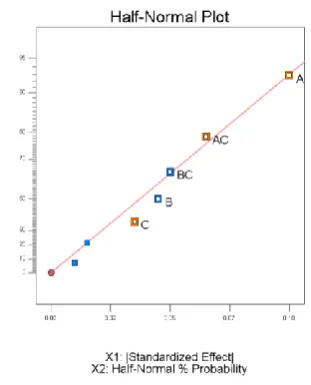
The result was analyzed using half normal plot and Pareto chart which is represented in fig. 3 and 4 respectively.
Figure 3: Half normal plot for screening of variables through full factorial design
The half normal plot indicates that factor B has a negative impact on the Pneumocandin B0 yield while factor A and C has positive effect on the yield. This implies that decreasing the solvent volume to 2V, increasing the agitation time to 120 mins and solvent wash to 3 times will give better yield of Pneumocandin B0.
Figure 4: Pareto chart for screening of variables through full factorial design
Pareto chart as shown in Fig.4 offers a convenient way to view the response obtained by full factorial design
matrix and the order of significance of the variable affecting downstream processing of Pneumocandin B0. In Pareto chart, the bars are arranged in descending order of height from left to right. The categories represented by the tall bars on the left are relatively more significant than those on the right [9]. According to the pareto chart, variable A, C and interaction AC are more significant than other variables and interactions. Further, decreasing the solvent volume whereas increasing agitation time and solvent wash would increase the Pneumocandin B0 yield.
D. Verification of the significant factors
ANOVA was used to verify the significant variables obtained through the above analysis. It is depicted in table 5.
In this analysis, the outstanding effects are incorporated into the “model” and the smaller effects are pooled together to estimate the error called “residual”. “Cor total” values are the total sum of squares corrected for the mean. It represents the total system variation using the average response as a baseline [10].
Table 5 : Anova Analysis
Abbreviations: df: degree of freedom
R-squared - 0.9840 Adj R-squared - 0.9440 Pred R-Squared - 0.7438 Adeq Precision - 16.653
ratio. A ratio greater than 4 is desirable. The obtained ratio of 16.653 indicates an adequate signal. This model can be used to navigate the design space. Analysis of the three variables and their interactions indicate that the variable agitation time and solvent wash and their interaction are the most significant factor impacting the extraction of Pneumocandin B0.
IV.
CONCLUSION
The present study demonstrates the use of statistical approach to maximize Pneumocandin B0 yield by optimizing downstream process i.e. extraction of Pneumocandin B0 from harvested fermentation broth. Optimization of filtration technique through OVAT confirmed that press filter is more suitable for filtration as more dried cake was obtained in less time and it is cost effective. Solvent selection through OVAT showed that isobutanol is the best solvent giving the maximum percentage recovery of Pneumocandin B0. Full factorial run using three variables namely, agitation time, solvent volume and solvent wash for extraction was carried out. Maximum extraction of product was obtained by full factorial design. Analysis through Pareto and half normal plot showed that the agitation time and solvent wash are most significant variables having maximum impact. Thus, increasing the agitation time and solvent wash can help in maximizing Pneumocandin B0 extraction.
V.
REFERENCES
[1] “Pneumocandin Bo” Pubmed Open Chemistry Database. Source Name: PubChem, URL: http://pubchem.ncbi.nlm.nih.gov (2005).
[2] Source name: Représentation de Cram de la
Pneumocandine Bo.
URL:https://upload.wikimedia.org/wikipedia/com mons/5/52/Repr%C3%A9sentation_de_Cram_de_ la_Pneumocandine_Bo.png
[3] Dubey KK, Goel N. “Evaluation and optimization of downstream process parameters for extraction of betulinic acid from the bark of Ziziphus jujuba L”, 2013, Scientific World Journal., 469674. [4] R.L. Mason, R.F. Gunst and J.L. Hess, “Statistical
design and analysis of experiments with applications to engineering and science” , 2003, J. Wiley: New York. p. xix, p. 728.
[5] Dirk WB “Experimental design for fermentation media development: statistical design or global random search”, 2000, J Biosci Bioeng 90: 473-483.
[6] Duta, F.P., F.P. de Franca and L.M.D.A. Lopes, “Optimization of culture conditions for exopolysaccharides production in Rhizobium sp. using the response surface method”, 2006, Electron. J. Biotechnol., Vol. 9, pp. 391-399. [7] Umesh Luthra, Aditi Trivedi and Sneha
Khadpekar, “Screening for significant medium components for Pneumoncandin B0 production at shake flask level through factorial design”, 2014, AIJCSR Volume 1 ISSUE 2: pp. 89-93.
[8] Schwartz R.E.; Giacobbe R.A.; Bland J.A.; Monaghan R.L., “A new antifungal agent”, 1989, I. Fermentation and isolation, J. Antibiot. 42, 163– 167.
[9] Scholtes, P.R., The Team Handbook, pp. 2-25. Madison, WI: Joiner Associates, 1988.
![Figure 1: Chemical structure of Pneumocandin B0 [2]](https://thumb-us.123doks.com/thumbv2/123dok_us/9068353.1442241/1.595.43.279.554.695/figure-chemical-structure-of-pneumocandin-b.webp)