981
Comparative Analysis On Sign Language
Recognition System
Swati Sharma, Varun Prakash Saxena, Kandukuru SatishAbstract—A process of exchanging information, expressions and views between two and more than two people is communication. It can be either Verbal or Non-Verbal communication. Non-Verbal communications makes use of hand gestures for interaction. Hand Gestures can also be termed as sign language which works in a systematic way. With the help of this sign language it is becoming easier for people with disability to interact with the normal people. The people who suffers from hearing disabilities makes them different from others as they lack behind due to their impaired hearing as there is a system which is used by them to interact with normal people is SLR. Sign Language Recognition (SLR) system basically used as an intermediate between normal people and hearing impaired. In this survey, various techniques that were implemented for sign language recognition along with the key points like the Classification Algorithms are discussed including the challenges and future scope too.
Index Terms—SLR(Sign Language Recognition), KNN(k-nearest neighbor), CNN(Convolutional Neural Network),ISL(Indian Sign Language), RNN(Recurrent Neural Networks), PNN(Probabilistic Neural Networks), SVM(Support Vector Machine), HOG(Histogram Oriented Gradient), HMM(Hidden Markov Model).
—————————— ——————————
1 I
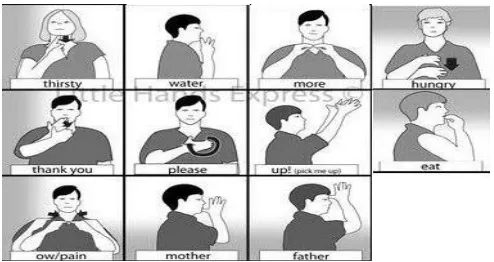
NTRODUCTIONIndia is a country where more than 27 national languages are used, and as we know few peoples of this country cannot even able to speak single language at all. According to India’s National Association of Deaf, there are almost 18 million people roughly we can say 1 percent of the total Indian population is deaf. In our routine life, we need to interact with each other either by listening or talking whenever possible. But when some people of our society who are hearing impaired needs to interact with us then we find it as huge barrier as we are unable to understand their language properly and vice-versa. To remove that communication gap between the normal people and the hearing impaired sign language is used. Sign language recognition system acts as an intermediate communication platform between the normal people and the hearing impaired. A gesture can be defined as a movement of any part of the body mainly the shapes made by hand and expression made by either the head or face that is used to express, a sign, emotion or sentiment e.g. rising of eyebrows, shrugging of shoulders, shaking hands are some of the examples of gestures that we use in our daily life as shown in Figure 1. Sign language is defined as an organized way of communication in which every word or alphabet is assigned some gesture. There are many sign languages which are used all over the world. Some of them are: Indian sign language (ISL), Argentinean Sign Language, American Sign Language (ASL), Chinese sign language (CSL), Arabic sign language, Russian sign language, Brazilian sign language, Japanese sign language, Mexican sign language, Turkish sign language and
many more. Sign language makes use of hand orientation, hand shapes and facial expression for communicating what they want to say. In our paper we will mainly focus on the Indian sign language but other languages have also been discussed. Alphabets can be created with the help of hand shapes in Indian sign language and does not need facial expression. Some words or we can say sentences needs to be created by both hand shapes and facial expression.
Figure 1: Some Daily use representation of words in sign language
2.
B
ACKGROUND2.1 SIGN LANGUAGE RECOGNITION OF ALPHABETS, WORDS AND SENTENCES
————————————————
Ms. Swati Sharma is currently pursuing masters degree program in computer engineering from Govt. Women Engineering College Ajmer, India E-mail: [email protected]
Dr. Varun Prakash Saxena is currently working as assistant professor in Govt. Women Engineering College Ajmer, India E-mail: [email protected] Mr. Kandukuru Satish is currently working as assistant professor in Govt.
Figure 2: Alphabetical representation of Indian sign language
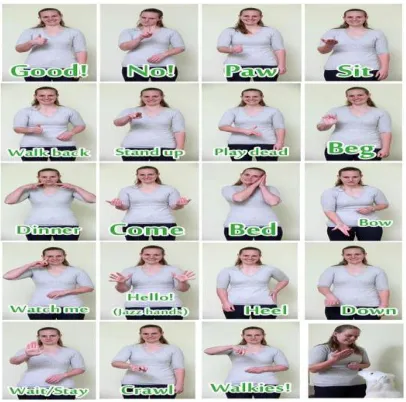
In the Figure 2, representation of alphabetical gestures in Indian sign language is shown in which some alphabets consist of only single hands while others are double handed. Alphabets like A, B, D, E, F, G, H, K, M, N, P, Q, R, S, T, X, Y, Z uses double handed notation for their gestures representation. Remaining alphabets like C, I, J, L, O, U, V, W makes use of single handed sign notations. Recognition of Words and sentences may use orientation of hands and may include facial expression as well. Mostly double handed gestures were used to create words and phrases. As shown in Figure 3 and Figure 4 some words uses orientation of hands like crawl, pledge, and, all etc. Facial Expressions are also captured in some words like Good, No, bed, wait, dinner etc. Sentence Formation in sign language is shown in Figure 7, which includes both single handed and double handed sign language gestures. After the recognition of Sign it can be converted into speech or text. English text can be converted to Hindi by [21][22] translation.
Figure 3: Representation of some words in sign language
Figure 4: Representation of sentences made by sign language
2.2 CLASSIFICATION OF SIGN LANGUAGE RECOGNITION ACCORDING TO TECHNIQUE Sign language can be classified according to systems which are named as Sensor Based Systems, and Vision Based System and a combination of both of them which is Hybrid Based System. Sensor based System can also be termed as Glove Based System which makes use of sensor based technology which can be either wireless sensor [23] or wired. In this, a glove needs to be wear and is used for capturing the gestures as shown in Figure 5. It consists of some sensors like the proximity sensor, accelerometer sensor, abduction sensor and flexion sensor to extract features describing the hand sign. Cyber Glove is used for extracting some features like the movement of hand, color of the hand and for detecting the orientation of the hand movement as it is mainly used for sign language recognition. An app in a smart phone can also be used for the recognition of hand gestures which is a wireless sensor network technology [24] and comes under Vision Based Techniques. Kinect is also used for capturing the gestures as shown in Figure 6. Vision based approaches makes use of machine learning techniques, Inbuilt-camera, digital image processing techniques to extract the features of the sign and to recognize it. It does not require gloves to extract the sign.
Figure 6: Microsoft Kinect
Figure 7: Representation of large sentences made by sign language
3.
R
ELATED WORKThe importance of Sign language can be explained from the fact that early humans used this language for communication between them because at that time there was no local language used by them. In this section, the details of previous framework is analyzed and compared on the basis of algorithms and methods used in them as shown in TABLE I.
3.1 Recognition of Alphabets and Numerals
A framework as shown in Figure 8 which consists of four major steps: First, is the Data Acquisition step which focuses on Indian sign language numerals from 0 to 9 with the self created database on ISL in which 1000 images used, 100 per numeral. Database consists of ten signers. Second, step is the Pre-Processing and Segmentation step, in this step the to recognize the skin shading in picture it is first changed to YCbCr shading space and the function rgb2ycber is used to convert RGB images to YCbCr model and is available in MATLAB environment and produces a binary image. Third step is the Feature Extraction step, in this step many feature extraction techniques are used such as the HOG, SIFT, PCA,
Fourier Descriptors etc. Last step is the classification step which consists of two phases: training phase and testing phase. In this work artificial neural network and Support Vector Machine (SVM) are used for recognition of ISL numerals. It provides accuracy approximately 99% [1].
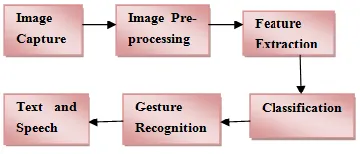
Figure 8: Flow Chart for the Proposed Framework
A paper has been cited related with the above Framework as shown in Figure 8, which involves automatic recognition of Indian Sign Language by finger spelling. It makes use of digital image processing techniques and artificial neural network for the recognition of gestures. Steps involved Image Acquisition and Pre-processing in which hand gestures are captured and preprocessed. Dataset is a self created. After this, Hand Segmentation is performed in which the hand is extracted from the captured image and then Feature Extraction process is applied and lastly classification which involves two phases: training phase and testing phase. ANN is trained to classify 36 signs with 360 images in training dataset and testing phase involves 180 images to test the system. The average recognition rate after experimentation is 91.11% [13].
Another Framework which works on this concept is an app “Fingerspelling”[14] which is built using open source tool “Blender” and consists of three basic modules one is the “Learn” module and second is “Practice” module and the third is “Test” module. Preliminary Testing is carried out at a hearing and speech impaired school. 78% of the students were inspired and said that this app can enhance the self learning skill of ISL.
A vision based approach which consists of some steps as shown in Figure 9. In this, images are being captured using the web camera and captured images are processed with the help of MATLAB. Furthermore feature Extraction and classification is performed on the gesture. Captured hand gestures are then converted into speech and text. Two languages are used English and Hindi. Classification techniques are compared PNN and KNN. It provides approximately 82% accuracy in which quality of English speech performs good because of inbuilt MATLAB function. Quality of Hindi speech depends upon the recorded sound file [2].
A Deep Learning Approach Based System is used which provides a real time system which can convert Indian Sign Language to text as shown in Figure 10. This paper mainly focuses on the RGB camera system. A Deep Learning Approach is being introduced in which classification is done by Convolutional Neural Network. It includes first phase in which classifier model is made using the numeral sign and keras implementation of CNN in python platform. In second phase another real time system which used skin segmentation is used to find the region of interest in the frame and then sign is predicted as it is fed into the classifier model. Accuracy for the same subject is found to be 99.56 % and 97.26 % for the low light conditions [3].
Figure 10: Framework for converting sign language to text
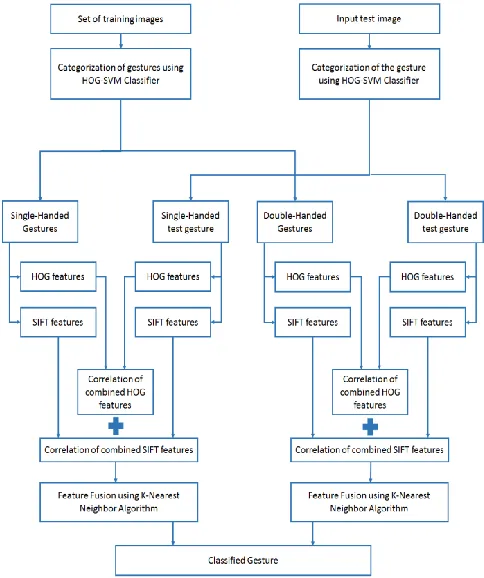
A framework as shown in Figure 11, works on recognition of Alphabets in Indian Sign Language. In this, Categorization is done which is either single handed or double handed. Feature extraction techniques HOG, SIFT are used for the extraction for a set of training images and are then combined in a single matrix form. Test images are then divided into single handed and double handed gesture and classification is used using the fusion of SIFT and HOG descriptors via a K-nearest correlated neighbor. For the training segment it constitutes 520 images and 260 images for testing part. It provides different accuracy rates like when single handed and double handed gestures are not categorized then SIFT provides 78.84%, HOG provides 80%, and fusion of both tends to provides 90% accuracy rate. When single handed and double handed gestures are categorized then SIFT provides 92.50% for single handed 75.55% for double handed, HOG provides 100% for single handed and 82.77% for double handed gestures and fusion of both provides for single handed 97.50% and 91.11% for double handed [4].
Figure 11: Framework for Gesture Recognition via categorization
A Technique for the detection of Alphabets using real sense is made which is camera device that can detect location and can track hands. It is capable of providing 3D coordinates of finger joints in real sense. For this purpose, DNN (Deep Neural Network) or Deep Belief Network (DBN) is used for recognition of signs. Two Datasets has been collected one by real sense and another by kinect and DNN is built on those dataset for recognition. Pre-training and Fine-tuning is performed. Results show that DNN Average Recognition on real sense is almost 98.9% and on kinect is 97.8% [17].
A Methodology for the recognition of signs in Indian Sign Language in which the dataset has been divided into two parts one is training and other is testing. Images are then preprocessed and converted into binary format. Feature Extraction is applied where the HOG features and the geometric features are calculated for the image. Classification is performed by using support vector machine and K-Nearest Neighbor. Experimental Analysis shows that SVM provides more accuracy than KNN. SVM when used with HOG feature is able to provide an accuracy of 94.23% [19].
3.2 Recognition of Words and phrases
A framework on Argentinean sign language gestures in which approximately 2300 videos are being used as a dataset for different words belonging to 46 gesture categories and 50 videos per gestures are used for better recognition. Two learning methodologies are used in this to train the model. First is to train model on spatial features CNN is used as shown in Figure 13, and to train temporal features RNN is being used as shown in Figure 12. Accuracy obtained is 95.217% [5].
Figure 12: Architecture of RNN Model
Figure 13: Training CNN and saving prediction Model
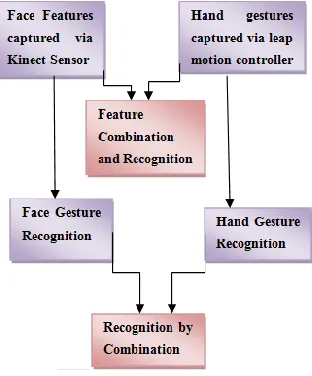
A framework which works on leap motion controller and kinect sensors as shown in the Figure 14, here the main motive is to record sign language by leap motion and kinect for capturing facial data of the signers. Dataset of dynamic gestures are used. Recognition is performed using HMM(Hidden Markov Model) and then independent Bayseian classifier approach is being applied on them. Accuracy thus obtained is 96.05% and 94.27% recognition rate in single and double hand gestures [6].
Figure 14: Flow Diagram for the proposed multimodal framework
In 2015, a framework as shown in Figure 15 in which ISL gestures are translated into English included numbers alphabets and a few phrases. The algorithm performs data acquisition then the pre-processing of gestures is being performed which is used to track hand movement using a combinational algorithm and recognition is done using template matching. Database is self created which includes 130000videosin which 72000 videos are used to create the database of the system and 58000 videos have been tested for checking the performance of the system. The overall accuracy so obtained is 97.50% [7].
Figure 15: Flow Chart for recognition of words
done by finding the rate of recognition which is equal to the correctly identified gesture videos to the total hand gesture videos. Experimental results shows that Elapse time, Precision on, and Effect of Velocity change is more in meanshift whereas effect of illumination is more in kalman filter.
A Sign Interpreter [18] which converts the Indian sign language into the audio output. It makes use of sensor based technique as an instrumented glove which consists of audio output is worn for the recognition of sign. The architecture involves some hardware component like Arduino uno, flex sensors, gyroscope with accelerometer, Bluetooth and SD-Card Module. Out of 3000 words 90 words are tested during experimentation.
3.3 Recognition Of Sentence Formation
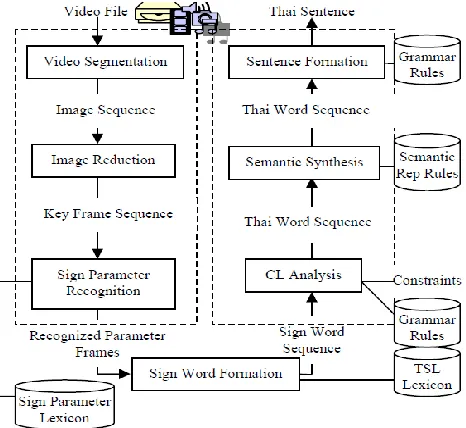
In SLR systems, main task is translation of identified gesture sequence into target spoken language sentence. TSTMT[8] on vision based approach which uses HMM classification. The architecture of TSTMT is shown in the Figure 16. In this system, Identified gestures are mapped corresponding to TSL words by adapted longest mapping method with each word has some meaning in thai. Classifiers are analyzed and replaced by nouns and repeated words are removed as per thai syntax. The relation description embedded in thai word is converted according to semantics of thai. Finally structural divergence between two languages is done by applying thai grammar ordering rules.
Figure 16: Architecture of TSTMT
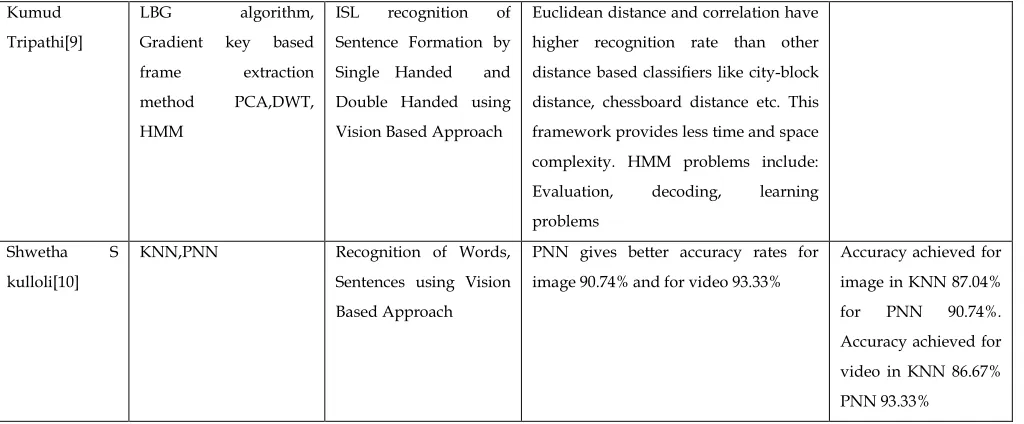
For Dynamic gesture Recognition of ISL a framework [9] which focuses on invariant backgrounds. Frame overlapping method is been applied for tracking useful gestures. Then frames are extracted which has maximum information for speedup then Discrete Wavelet Transform (DWT) is applied for extracting features and HMM for testing probe gestures. It provides very less time complexity and space complexity.
A system [10] does not only provide the translation of sign language in written text format but also convert it into voice form. It also provides an option for the normal people to enter the input in the form of text and the system converts into sign language images and also in the video form. System consists of three modules training, testing, and text to speech engine. MATLAB is used for implementation purpose with PNN KNN classifiers. Accuracy achieved for image in KNN 87.04% for PNN 90.74%. Accuracy achieved for video in KNN 86.67% for PNN 93.33%. A paper is been cited which works on Indian Sign Language on mobile platforms [11]. For this purpose, a video based database is created with the help of mobile front camera in the selfie mode for Indian sign language. Steps like Pre-filtering, segmentation and feature extraction on video frames creates a sign language feature space. Sign feature space with Minimum distance classification converts signs to text or speech. Word matching score (WMS) estimates performance average WMS of around 90.58%. Another framework has also been cited whose main objective is to convert the human sign language to Voice with human gesture understanding and motion capture and is achieved with the help of Microsoft Kinect. It also provides natural user interface [12]. A framework which works in real time and provides good accuracy rates and can identify gestures from ISL. Android Smartphone is used for capturing the gestures and frames are further transmitted to the server where preprocessing is performed using face detection and elimination using HOG features and SVM classifier. After this, skin segmentation using YUV+RGB Color Space is performed then morphology operation like erosion and dilution are used to remove any noise generated after skin color segmentation. Object Stabilization using Facial references is used and then hand mask is identified. Furthermore feature extraction using grid based technique is performed and classification is done by using KNN and HMM classifiers [16].
TABLE 1. Comparison Table
Author Name Algorithms and
Methods used:
Description Remarks Accuracy
Juhi Ekbote[1] ANN and SVM, shape descriptors, SIFT, HOG
Recognition of ISL numerals by single handed using vision Based approach
Self created database. Videos can be captured from web camera of laptop. From results SIFT does not provide good accuracy only 24.60% alone.
Umang Patel[2] PNN and KNN, Contour Based and region based shape representation and description methods,
7Hu Moment
techniques.
ISL (English and Hindi) recognition of Alphabets by Double handed using Vision Based Approach.
Easy to use and easily available as it works on MATLAB. English Speech is good because of inbuilt MATLAB function. Hindi Speech is Database of recorded sound and it depends on it.
82%
Sajanraj T D[3] CNN, Le Net Architecture.
ISL recognition of Numbers by Single Hand using Vision Based Approach
System will not work in condition when background and skin color has same color.
99.56% and in low light 97.26%
Bhumika Gupta[4]
KNN, HOG, SIFT ISL recognition of Alphabets by Single Handed and Double Handed using Vision Based Approach
Sub-categorization of gesture alphabets into single handed and double handed lowered the cost of computation. Restricted to detect static gestures
Without categorizing fusion of HOG, SIFT
90%, After
Categorizing Single handed 97.50% double handed 91.11% Sarfaraz
Masood[5]
CNN, RNN, Prediction and Pool Layer Approach
Argentinean Sign language recognition of words by Single handed and Double Handed using Vision Based Approach
LSTM is used as a variation of RNN and LSTM units is used to learn long term dependencies. LSTM learn to bridge time intervals in excess of 1000 steps even in case of noisy, incompressible input sequences. RNN was not able to learn long term dependencies. Gesture “son” incorrectly classified as “colors”
95.20%
Pradeep Kumar[6]
Deformable Model Fitting (DMF) algorithm, Kinect sensor, Leap motion sensor, HMM, feature vector, IBCC, PCA Approach
ISL Recognition of Words by Single Handed, Double Handed and Facial Recognition using Sensor Based
Kinect and leap motion controller provides better data captured image. Kinect API has frame rate 30fps and leap motion 120fps.
Detected 15 and 37 wrongly classified signs for single handed and double handed
96.05% and 94.27% recognition rate in single and double hand gestures
Purva C. Badhe[7]
Gesture Recognition Algorithms, Fourier Descriptors, Canny Edge Detection
ISL Recognition of Number, Alphabets and Phrases by Single handed and Double Handed using Vision Based Approach
Self created database is used. This system is Helpful in healthcare industry to diagnose and monitor stress level. Less accuracy obtained in case of C,M,O,R,X. Occlusion problem may occur in this model.
97.50%
T.Ditcharoen[8] HMM, TSL classifiers Thai language recognition of Words and Sentence Formation by hand-shapes, palm orientation, location, body movement, and facial expression using Vision Based Approach
Kumud Tripathi[9]
LBG algorithm, Gradient key based frame extraction method PCA,DWT, HMM
ISL recognition of Sentence Formation by Single Handed and Double Handed using Vision Based Approach
Euclidean distance and correlation have higher recognition rate than other distance based classifiers like city-block distance, chessboard distance etc. This framework provides less time and space complexity. HMM problems include: Evaluation, decoding, learning problems
Shwetha S kulloli[10]
KNN,PNN Recognition of Words, Sentences using Vision Based Approach
PNN gives better accuracy rates for image 90.74% and for video 93.33%
Accuracy achieved for image in KNN 87.04% for PNN 90.74%. Accuracy achieved for video in KNN 86.67% PNN 93.33%
Table I: Comparison of previous framework on sign language recognition
4. C
LASSIFICATIONA
LGORITHMS4.1.Convolutinal Neural Networks
Convolutional Neural Networks are also termed as Deep Artificial Neural Networks which are used primarily for classification of images, clustering them according to their similarity, and can able to perform object recognition. These algorithms can identify faces, street signs, individuals, tumors, and other aspects of visual data. Convolutional networks can
perform optical character recognition (OCR) to digitize text and make natural-language processing possible on analog and hand-written documents, where the images are symbols are to be transcribed. LeNet architecture is introduced which will run on Convolutional architecture [3] as shown in the Figure 17. CNN are major advances in computer vision (CV), and applications for self-driving cars, robotics, drones, security, medical diagnoses, and treatments for the visually impaired.
Figure 17. LeNet Architecture
4.2 Artificial Neural Networks
Artificial Neural network is a computational model inspired by the behaviour of biological systems composed of “neurons”. Neuron values are computed from inputs. A neural network is a graphical analogy of nodes which represent neurons that are connected by arcs. It consists of dendrites and synapses. Artificial Neural Network [1] can be either FeedForward or Feedback. Numerals can also be recognised by the use of ANN. In FeedForward ANN flow of information is unidirectional, one unit sends information to other units and there are no loops. It is used in the pattern recognition, pattern generation, and pattern classification.
By observing the environment ANN makes decision, if negative, the weights are adjusted by network to make a different decision next time.
4.3 Probabilistic Neural Networks
Probabilistic Neural Network is useful for multi-class classifier. PNN is an implementation of a statistical algorithm known as kernel discriminant analysis in which the operations are organized into a multilayered feedforward network which consists of four layers- input layer, pattern layer, summation layer, output layer. Mostly used in Pattern recognition and classification. Based on feed forward neural network[2]. The MATLAB command “newpnn” is used to create network. The input layer consists of predictor variable for each neuron. For N number of categories N-1 neurons is used. The range of the values is standardizing by subtracting the median and dividing by the midspread range. Then, input neurons feed to the hidden layer. The pattern layer consists of one neuron in training dataset for each case, it has the Gaussian functions formed using the given set of data points as centres. RBF kernel is applied to the Euclidean distance of/ the test case from the neuron’s centre point using the sigma values and is computed by hidden layer. The summation layer as the name suggests performs a sum operation of the outputs from the second layer for each class. The output layer performs a vote, for selecting the largest value and then associated class label is determined.
4.4. k-Nearest Neighbour(KNN)
The K-nearest neighbours (KNN) algorithms are supervised type of machine learning algorithms which are extremely easy to implement and can perform quite complex classification tasks as well. All data is used for training while classifying a new data instance. It doesn't assume anything about the underlying data that is why it is non parametric algorithm used for classification and regression [2]. Implementation of KNN Algorithm in Python follows the steps like handling the data, Calculate the distance, Find k nearest point, predict the class, and Check the accuracy. With the help of MATLAB command “knnclassify” sample vectors are classified. KNN classifier is unsupervised classifier [2].
5. C
HALLENGES ANDF
UTURES
COPEIn future, with the use of sensor based technology in ISL some words which uses wrist movement can also be detected so that those signs can be expressed by glove. Similarly elbow movement and facial recognition can be the two areas. Concept of video conferencing with the deaf and dumb people can be introduced for Indian Sign Language for advanced communication. Communication between the deaf and dumb people in Indian sign language without using sensor based technology can also be done using Smartphone platform which will provide easy to use environment, mobility and high growth rate. Indian sign language sentence formation with both single handed and double handed gestures without using sensor based approach as vision based is more easy to use and is less cost effective. Dynamic hand gesture recognition or we can say real time gesture recognition of
sentences can also be done by using Deep Learning Approach. A Bot based technology can be the further extension introduced in the Indian sign language which will reply to the question asked in conversation with the hearing impaired people.
6.
C
ONCLUSIONSIn the pursuit of communication channel between the impaired hearing people several approaches and gesture recognition systems have been observed. Apart from ISL other language works are also discussed with the classification algorithms, challenges and the future scope were also detected. It is found that most the work has yet been done on the static gestures in Indian sign language. Real time SLR system is still found to be an open problem. More work needs to be done using the vision based approaches in real time system for Indian sign language recognition so that it will be available to all and will provide easy to use environment.
R
EFERENCES[1] Juhi Ekbote and Mahasweta Joshi, “Indian Sign Language Recognition Using ANN and SVM Classifiers” 2017 International Conference on Innovations in Embedded and Communication System (ICIIECS
[2] Umang Patel and Aarti G. Ambedkar, “Moment Based Sign Language Recognition For Indian Language” 2017 International Conference on
Computing, Communication, Control and
Automation (ICCUBEA).
[3] Sajanraj T D and Beena M V “ Indian Sign Language Numeral Recognition Using Region of Interest Convolutional Neural Network” 2nd International
conference on Inventive Communication and computational technologies(ICICCT 2018).
[4] Bhumika Gupta, Pushkar Shukla and Ankush Mittal “K-Nearest Correlated Neighbour Classification for Indian Sign Language Gesture Recognition using Feature Fusion” 2016 International Conference On Computer Communication and Informatics(ICCCI-2016).
[5] Sarfaraz Masood, Adhyan Srivastava, Harish Chandra Thuwal and Musheer Ahmad “Real-Time Sign Language Gesture (Word) Recognition from Video Sequences Using CNN and RNN” Springer Nature Singapore Pte Ltd. 2018 V. Bhateja et al. (eds.), Intelligent Engineering Informatics, Advances in Intelligent Systems and Computing 695.
[6] Pradeep Kumar, Partha Pratim Roy , Debi Prosad Dogra “ Independent Bayesian classifier combination based sign language recognition using facial expression” Information Science Volume 248 February 2018, Pages 30-48.
algorithm” 2015 IEEE International Conference on Computer Graphics, Vision and information security (CGVIS).
[8] Thammanoon Ditcharoen, Kanlaya Naruedomkul, Nick Cercone, Bundit Tipakorn, “TSTMT: Step towards an Accurate Thai Sign Translation” Proceedings of the Fourth International Conference on Machine Learning and Applications (ICMLA’05) [9] Kumud Tripathi, Neha Baranwal, G.C. Nandi, “
Continuous Dynamic Indian Sign Language Gesture Recognition With Invariant Backgrounds” 2015 International Conference on Advances in Computing, Communication and Informatics (ICACCI).
[10] Shwetha S kulloli, R H goudar, “ A Effective Communication Solution for hearing Impaired Persons: A novel Approach using gesture and sentence Formation ” 2017 International Conference On Smart Technology for Smart Nation.
[11] G.Ananth Rao, P.V.V. Kishore,“Sign Lanuage Recognition System Simulated for Video Captured with Smart Phone Front Camera”, International
Journal Of Electrical and Computer
Engineering(IJECE),vol.6,No.5,pp.2176-2187,October 2016.
[12] Rajaganapathy. S, Aravind.B, et al.,”Conversation of Sign Language to Speech with Human Gestures” 2nd
International Symposium on Big Data and Cloud Computing, pp.10-15,20.
[13] Adithya V, Vinod P.R, Usha Gopalakrishna,
“Artificial Neural Network Based Method For Indian Sign Language Recognition” Proceedings of 2013 IEEE Conference on Information and Communication Technologies (ICT 2013).
[14] Tejas Nanaware, Sameer Sahasrabudhe, Nitin Ayer, Romey Christo, “Fingerspelling-Indian Sign Language Trainning Tool” 2018 IEEE 18th
International Conference on Advanced Learning Technologies.
[15] Prerna Gupta, Garim Joshi, Dr. Maitreyee Dutta, “Comparative Analysis Of Movement and Tracking Techniques For Indian Sign Language Recognition ” 2015 Fifth International Conference on Advanced Computing and Communication Technologies. [16] Kartik Shenoy, Tejas Dastane, Varun Rao, Devendra
Vyavaharkar, “Real-time Indian Sign Language(ISL) Recognition” 9th ICCCNT 2018 july 10-12, 2018, IISC,
Bengaluru,India.
[17] Jie Huang, Wengang Zhou, Houqiang Li, and Weiping Li, “Sign Language using Real-Sense” IEEE University Of Science and Technology of China, Hefei, 230027, China.
[18] Hardik Rewari, Vishal Dixit, Dhroov Batra, Hema N, “Automated Sign Language Interpreter” Proceedings
of 2018 Eleventh International Conference on Contemporary Computing(IC3), 2-4 August. 2018, Noida, India.
[19] Akanksha Singh, Saloni Arora, Pushkar Shukla, Ankush Mittal, “Indian Sign Language Gesture Classification as Single Handed or Double handed ” 2015 Third International Conference on Image Information Processing.
[20] S.Reshna and M.Jayaraju, “ Spotting and Recognition of Hand Gesture for Indian Sign Language Recognition System with skin segmentation and SVM” 2017 International Conference on Wireless Communication, Signal Processing and Networking (WiSPNET).
[21] Shruti Mathur, Varun Prakash Saxena, “Hybrid Approach to English Hindi name entity transliteration” 2014 IEEE Students Conference on Electrical, Electronics and Computer Science.
[22] Shruti Mathur, Varun Prakash Saxena, “Improving the Quality of English Hindi name Entity Translation” International Journal of Computer Applications(0975-8887) Volume 96-No. 25, June 2014. [23] Prashant Tiwari, Varun Prakash Saxena, Raj Gaurav Mishra, Devendra Bhavsar, “Wireless sensor networks: introducton, advantages, applications and research challenges” HCTL Open International
Jourmal of Technology Innovations and
Research(IJTIR).