2579
Design Of E-Student Worksheet For Linier
Equation Based On Discovery Learning To
Improve Creative Thinking
Aisyah Nur Istiqomah, Suparman
Abstract: Mathematics learning not only memorizes formulas but understands concepts and is able to improve students' creative thinking abilities. This study aims to design e-student worksheets based on discovery learning models to improve students' creative thinking. This research is a descriptive study with a qualitative approach. The subjects of this study were teachers and eighth grade students of SMP Muhammadiyah I, Sleman. The object of research is creative thinking, discovery learning, and e-student worksheets. Data collection instruments using interview guidelines, questionnaires, and observation guidelines. Data were analyzed using Miles and Huberman data analysis. The results of the study found that Discovery Learning is one of the learning models that can be applied to improve creative thinking skills. This research also resulted in e-student worksheets design that integrates creative thinking skills. These e-student worksheets can be used when the teacher uses discovery learning models. This research can be continued in the implementation and evaluation stages.
Index Terms: ADDIE, Design Development, Creative Thinking, E-LKPD, Discovery Learning.
—————————— ——————————
1.
INTRODUCTION
Mathematics is always used in all aspects of life [1]. Innovations in learning mathematics are also implemented in the 2013 curriculum which draws on the conditions of reality in life [2]. Other problems arise when students tend to find it difficult to solve mathematical problems related to abstract objects [3]. While mathematics is a science that has an important role in education because mathematics equips students with the ability to think logically, critically, creatively, systematically and innovatively [4]. At every level of education, students are always given mathematics lessons, one of them at a junior high level [5]. In a study showed that both general creativity and mathematical ability is important for creative thinking in mathematics [5].Creativity is one of the ability to find several alternative answers to a problem with a variety of answers [6]. Characteristics of creative thinking include the ability to act in conditions and think wisely, such as sensitivity, the ability to identify problems, openness to problems and ambiguity, reflection in the form of constant shocks in the world, cognitive curiosity and critical thinking, ability to draw comparisons and make decisions, and motivation to diligently find solutions and improve themselves [7]. One of the goals of the 2013 curriculum is to prepare students so they can think creatively [5]. The problem of students' low mathematical achievement is that mathematics is presented as a finished product, ready to be used, abstracted and taught mechanically, this case can lead to underdeveloped student creativity because students are not allowed to think and use their ideas in solving mathematical problems [8]. Creative thinking skills, which are being considered by the national qualifications framework for higher education 2552, are one of the five important higher-order thinking skills that focus on developing the skills of all learners [9].
Based on the results of the Program for International Student Assessment (PISA) Indonesia ranked 63 out of 72 with a literacy score of 403 [10], Indonesia is very far from Singapore and neighboring countries of Malaysia, with such an existence Indonesia needs to increase the competitiveness of students with the ability to think creatively because to answer questions about PISA students are required to have the ability to think creatively and have extensive knowledge. Students are expected to not only be able to master the theory of learning and get a satisfying learning achievement, but students are expected to be able to master the skills [11]. Three important components to demonstrate student creativity are the ability of students to solve problems by providing at least two different and correct answers. Flexibility is the ability of students to provide solutions to problems using at least two different ways. Novelty is the ability of students to solve problems by using solution methods that have never been used by students [12]. At present, it is believed that the method is in accordance with the constructivist approach where students learn more effectively by building their knowledge. In learning as well as curiosity is defined as a strong motivational force that can produce a person's behavior to understand, deal with certain material or problems [13]. Bruner points out that every individual has the will to learn and this will be used in activities where curiosity increases and directs students to learn and discover. Learning occurs with discovery, which prioritizes reflection, thinking, experimenting, and exploring. People who use self-discovery in learning are more confident [14]. Bruner thinks that an individual himself can only learn and develop his mind by using the Discovery Learning method where if the teacher is successful with this method, students feel satisfied with what they do, students get stimulation from intellectual satisfaction and cause feelings of inner appreciation. or inner motivation [15]. Discovery Learning is a learning method that encourages students to ask questions and formulate their answers and to deduce general principles from examples or experiences and develop active student learning methods by finding out for themselves, self-investigation, the results obtained last long in memory they will not be easily forgotten by students [16]. The Discovery Learning stages are stimuli, problem statements, data collection, data processing, verification, and generalization [4]. Studies conducted by Alex ————————————————
Aisyah Nur Istiqomah is currently pursuing master;s degree program in mathematics education at Ahmad Dahlan University, Indonesia, PH-083101414505. E-mail: [email protected] Suparman is an associate professor in mathematics education in
2580 and Olubung show that learning findings are very useful for
students who have high abilities and can also improve their abilities in the medium category [17]. There are many ways to achieve learning goals for students and one of them is to modify learning and facilities and infrastructure that can support learning [18]. All forms of learning and new educational activities are needed such as, student-centered approaches and learning technologies that empower students and teachers to collaborate and increase knowledge [19]. Facilities to facilitate the learning process Discovery Learning, tools such as student activity sheets (worksheets) can be used. Student worksheet (LKPD) is one of helping and facilitating teaching and learning activities so that effective interactions between students and educators formed on students can increase their activities in increasing achievement [20]. Worksheets are student activity sheets that can be done independently as well as groups containing learning activity guides [21]. This worksheet aims to simplify the learning process and improve the ability of students according to the indicators that have been made. It can be seen that education reforms that have occurred more than a decade are focused on students where technology is used to support the learning process [9]. Technology in education can improve the quality of direct learning in the classroom, so pedagogical aspects and technological aspects influence the achievement of student learning outcomes so that in the process of developing technical aspects it can be done to encourage some limitations that still exist in some schools [22]. Therefore the introduction of the role of technology in education is very effective for the convenience of teachers to provide lessons and for students to easily accept learning because it is interesting. One of the teaching materials that can improve the ability to think creatively with the Discovery Learning model is the Electronic Student Activity Sheet (E-LKPD). E-LKPD as one of the teaching materials needed by students as a support for an active and creative role in participating in learning in class. Based on the results of research that the use of LKPD can improve for creative thinking by obtaining the results of pretest-posttest students' creative thinking abilities according to n-gain of 43% of medium categories. Meanwhile, for each indicator, it obtained an n-gain of 27% in the low category, 37% in flexibility in the middle category, originality in 22% in the low category and elaboration in 56% in the medium category [23]. It can be concluded that the use of LKPD can improve students' creative thinking. To make students who can find mathematics required an appropriate learning approach [24]. The development of E-LKPD supporting the Discovery Learning learning model is needed because it makes it easier for students to improve their ability to think creatively. The Discovery Learning Model by using E-LKPD is expected to increase the ability to think creatively. In addition to improving the ability to think creatively required teaching materials in the form of Student Worksheets (LKPD). Because from the results of the researchers' validation of the LKPD that already existed at the school, several deficiencies were found, among others:, LKPD that is used in schools does not yet contain the steps of learning with the Discovery Learning mode, there are no illustrations by the material, complete information in the form of instructions not found in the LKPD this results in students having difficulty using it, LKPD has not loaded improving creative thinking, LKPD has no Indicators of Competency Achievement (IPK), and the questions do not contain IPK.
Based on the description above, the researcher intends to make teaching materials in learning. The purpose of this research is to design teaching materials in PLSV learning by using the Discovery Learning (DL) learning model and it is hoped that students can improve their ability to think creatively. This research can be continued in the implementation and evaluation stages.
2
METHOD
This research method uses the ADDIE development model. ADDIE model consists of five stages, namely analysis, design, development, implementation, and evaluation, as can be seen in Figure 1 [25] [26].
Figure 1. Proses ADDIE
The purpose of this study is to design or design a product in which this study is teaching material in the form of LKPD to improve creative thinking skills. In the analysis phase, researchers find out about the description of students' needs about teaching materials based on DL learning models to improve creative thinking skills. After that, researchers conducted observations and interviews with students and teachers to find out the learning model used by the teacher, teaching materials used by the teacher, students' characteristics, material difficulties, and facilities at school.. The design stage, the learning objectives to be achieved are designed, a description of the learning activities to be carried out, the selection of media to be used, the design of the learning and a description of the tools for evaluating the assessment of learning for a while [27]. At this stage, the researcher first makes the learning objectives to be achieved [28]. The design phase in this study was carried out through the framework of the preparation of teaching materials. The experts will validate the product in the form of teaching material design. Design validation is done to determine the assessment as a revision material so that the model for developing good quality teaching materials [29]. The subjects in this study were class VIIA, SMP Muhammadiyah 1 Sleman. Data collection instruments include guidelines for observation and interviews.
3
RESULT
AND
DISCUSSION
3.1 Analysis
At this stage contains an analysis of student needs. The need for teaching materials in the form of LKPD to improve students 'creative thinking abilities, analyze the existing curriculum, analysis of teaching materials, analysis of teaching materials and analysis of learners' characteristics. At this stage there are several conclusions, namely;
2581 Sleman Muhammadiyah I Junior High School given the
following information; (1) that the teaching materials used by the module teacher, LKS / LKPD, for E-LKPD have never been used by teachers. LKPD used only certain materials that encourage students to think creatively in the learning process. The level of student creativity is still relatively low in working on LKPD questions. The learning model used by LKPD teachers created and used has never contained the Discovery Learning model by developing students' creative thinking skills. (2) LKPD given by teachers to students has not grown students' motivation to work on the problems contained in LKPD. 2) Analysis of teacher learning models, interviews about the
model used to find out the learning model used by teachers, based on interviews obtained by the teacher using the lecture method sometimes also using other methods. The teacher has never used the Learning Learning model.
3) Analysis of the characteristics of students, interviews about the characteristics of students carried out with the aim of knowing the extent of students' thinking ability, based on interviews obtained the following information: (1) Some students when given questions have not been motivated to directly work on the questions given by the teacher. (2) Not all students when answering questions can use other unusual strategies. (3) Students, when given a task, have not been able to plan their problems. (3) not all students can solve complicated problems with other strategies given by the teacher. (4) some students given the task have not yet taken detailed steps to look for a deeper meaning to the answers to a problem-solving. It can be concluded that students and teachers need E LKPD teaching materials to facilitate the learning process and enhance students' creative thinking.
3.2 Design
At the design stage, the design of teaching materials is based on the results of the needs analysis. The teaching material used is LKPD. LKPD contains Cover, KI and KD, position map, instructions for using LKPD, LKPD I, practice questions and assessment of creative thinking skills.
3.2.1. Design Cover
The Cover Design includes the title LKPD (student worksheet) which also includes Subjects, PLSV Material and Discovery Learning models that will be developed for students, as can be seen in Figure 2.
Figure 2. Design Cover
3.2.2. Kompetensi Inti (KI) and Kompetensi Dasar (KD)
Furthermore, KI and KD indicators contain what must be achieved by students when learning to use LKPD which aims to achieve what will be done, as can be seen in Figure 3.
Figure 3. KI and KD
3.2.1 Concept Maps
Next, the position map contains an outline of the contents of the LKPD. The concept map can be seen in Figure 4.
Figure 4. Concept Map
3.2.3. Instructions for Using LKPD
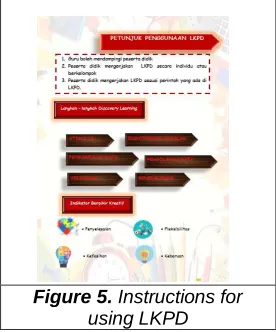
The LKPD Usage Instructions containing the steps - steps of using LKPD as well as the symbols of icons showing indicators of creative thinking, can be seen in Figure 5.
Figure 5. Instructions for using LKPD
3.2.4. LKPD I Activities
2582
Figure 6. LKPD I
Activities
3.2.5. Exercises
Exercises are presented in the form of essays. The aim is to evaluate the learning outcomes of students in understanding the material that has been studied, can be seen in Figure 7.
Figure 7. Exercises
3.2.6. Assessment of Creative Thinking Ability
Assessment of Creative Thinking Ability aims to measure how far the ability of students to think creatively. The practice questions and assessment of creative thinking can be seen in Figure 8.
Figure 8. Assessment of Creative
Thinking Ability
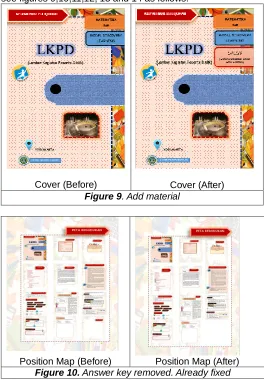
The teaching material in the form of LKPD has been assessed for eligibility by two mathematics teachers with a revision. Some input and suggestions from material and media experts that have been summarized, can be seen in Table 1.
TABLE 1
Suggestions and Comments from the validator No Suggestions and Comments Repair
1 Cover has not been added
material Already added
2 Map positions for empty ones
are removed It has been fixed 3 Writing Discovery Learning in
italics It has been fixed
4 The picture was given captions
and made clear It has been fixed 5 Practice Indicators questions gave Already added
6
Writing in the table to assess the ability to think creatively is improved
It has been fixed
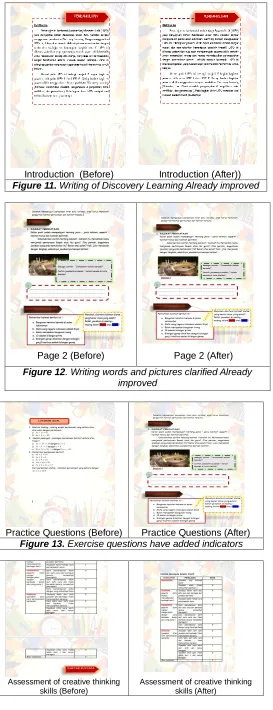
Comments and suggestions from the validators are then corrected according to the revisions given by the validators, see figures 9,10,11,12, 13 and 14 as follows.
Cover (Before) Cover (After) Figure 9. Add material
Position Map (Before) Position Map (After)
2583 Introduction (Before) Introduction (After))
Figure 11. Writing of Discovery Learning Already improved
Page 2 (Before) Page 2 (After)
Figure 12. Writing words and pictures clarified Already improved
Practice Questions (Before) Practice Questions (After)
Figure 13. Exercise questions have added indicators
Assessment of creative thinking skills (Before)
Assessment of creative thinking skills (After)
Figure 14. Writing Table The assessment of creative thinking skills has been improved
Input and suggestions from the validators have been revised. The results of the teacher questionnaire calculation regarding the developed design can be seen in table 2.
TABLE 2
Design Assessment Results
No Validator Score Category
1 Mafrudhatun Nikmah 85 Worthy 2 Haristha Rachmawati 79 Worthy
Total Score 164
Average Score 82 Worthy
Based on Table 2, the average score for the assessment of media experts is 82. So it can be concluded that the learning media are in the good category. Students' worksheets have been validated by the validator and declared eligible for revision. Revision of the student worksheet has been done. The next step is increasing LKPD. The fourth step in the ADDIE stage is implementation. At this stage, products that have been developed and meet the eligibility and effectiveness criteria are given to the school that will be used as a research site. This stage is carried out to ensure students achieve their goals in learning outcomes and can improve students' creative thinking abilities. The fifth step in the ADDIE stage is evaluation. At this stage, a process to provide value to the learning programs that have been developed. Students will be evaluated to the extent to which students can learn the material so that it can improve students' creative thinking abilities.
4 CONCLUSION
This research will produce a teaching material design in the form of LKPD Supporting the Discovery Learning model to improve students' creative thinking skills that follow the curriculum and characteristics of students. The design of this teaching material consists of cover, LKPD identity, preface, table of contents, introduction, KI, KD, Competency Achievement Indicator (IPK), position map, LKPD usage instructions, Discovery Learning Steps, LKPD I, practice exercises and assessment creative thinking skills. The design of the results of this study has the potential to improve students' creative thinking skills on PLSV material. Based on the results of the validation and improvement, it can be concluded that the design of teaching materials in the form of LKPD is categorized as feasible to be used as guidelines in making teaching materials on PLSV material with the Discovery Learning model.
ACKNOWLEDGMENT
The author is grateful to Ahmad Dahlan University for giving us the opportunity and encouraging and facilitating researchers in completing this research. Second, the authors thank the schools, teachers and students who have helped researchers in this study. Third, to the validators who have validated the instruments used as research instruments so that they become better.
REFERENCES
2584 creativity skills of blind students,‖ Int. J. Sci. Technol. Res.,
vol. 8, no. 10, pp. 1169–1173, 2019.
[2] P. Angraini and Suparman, ―Students worksheet design on geometry for seventh grade students with Rme approach,‖ Int. J. Sci. Technol. Res., vol. 8, no. 10, pp. 1155–1158, 2019.
[3] G. Ayuwandari and Suparman, ―Design of pbl mathematics student worksheets to improve student learning creativity for junior high school,‖ Int. J. Sci. Technol. Res., vol. 8, no. 12, 2019.
[4] M. R. Ramdhani, B. Usodo, and S. Subanti, ―Discovery Learning with Scientific Approach on Geometry,‖ J. Phys. Conf. Ser., vol. 895, no. 1, 2017.
[5] M. Education, N. Sciences, U. N. Surabaya, M. Education, N. Sciences, and U. N. Surabaya, ―The Profile of Junior High School Students’ Creativity in Solving Number Pattern Problems Based on Mathematical Abilities,‖ no. 3, pp. 645–651, 2018.
[6] S. Jaarsveld and T. Lachmann, ―Intelligence and creativity in problem solving: The importance of test features in cognition research,‖ Front. Psychol., vol. 8, no. FEB, pp. 1–12, 2017.
[7] E. Płóciennik, ―Children’s creativity as a manifestation and predictor of their wisdom,‖ Think. Ski. Creat., vol. 28, no. December 2017, pp. 14–20, 2018.
[8] F. Maulidia, R. Johar, and A. Andariah, ―a Case Study of Students’ Creativity in Solving Mathematical Problems Through Problem Based Learning,‖ Infin. J., vol. 8, no. 1, p. 1, 2019.
[9] N. Songkram, ―E-learning System in Virtual Learning Environment to Develop Creative Thinking for Learners in Higher Education,‖ Procedia - Soc. Behav. Sci., vol. 174, pp. 674–679, 2015.
[10] Gu ja og, C. sung Min, Lee soyeon, and G. Namwook, ―Pisa 2015 Result in Focus,‖ Univ. kurikulum dan Eval. korea Orm 2017-66-5, 2015.
[11] A. Rahmi and Suparman, ―Mathematical module based on CTL approach to increase learning motivation and 4C skills,‖ Int. J. Sci. Technol. Res., vol. 8, no. 12, pp. 1303– 1309, 2019.
[12] E. M. Schoevers, E. H. Kroesbergen, and M. Kattou, ―Mathematical Creativity: A Combination of Domain-general Creative and Domain-specific Mathematical Skills,‖ J. Creat. Behav., vol. 0, pp. 1–11, 2018.
[13] Z. Zetriuslita, W. Wahyudin, and J. A. Dahlan, ―Association Among Mathematical Critical Thinking Skill, Communication, and Curiosity Attitude As the Impact of Problem-Based Learning and Cognitive Conflict Strategy (Pblccs) in Number Theory Course,‖ Infin. J., vol. 7, no. 1, p. 15, 2018.
[14] A. G. Balim, ―The Effects of Discovery Learning on Students’ Success and Inquiry Learning Skills,‖ Eurasian J. Educ. Res., vol. 35, no. 35, pp. 1–20, 2009.
[15] T. Tran, N.-G. Nguyen, M.-D. Bui, and A.-H. Phan, ―Discovery Learning with the Help of the GeoGebra Dynamic Geometry Software,‖ Int. J. Learn. Teach. Educ. Res., vol. 7, no. 1, pp. 44–57, 2014.
[16] H. Hanafi, ―The Effect of Discovery Learning Method Application on Increasing Students’ Listening Outcome and Social Attitude,‖ Din. Ilmu, vol. 16, no. 2, p. 291, 2016. [17] M. Alex and M. Olubusuyi, ―Guided-discovery Learning Strategy and Senior School Students Performance in Mathematics in Ejigbo , Nigeria,‖ vol. 4, no. 12, 2013.
[18] M. Faulina and Suparman, ―Design guided discovery student worksheets to construct the understanding of the blind,‖ Int. J. Sci. Technol. Res., vol. 8, no. 10, pp. 3385– 3389, 2019.
[19] T. Yuliani, S. H. Noer, and U. Rosidin, ―Guided Discovery Worksheet for Increasing Mathematical Creative Thinking and Self-Efficacy,‖ Int. J. Trends Math. Educ. Res., vol. 1, no. 1, p. 30, 2018.
[20] A. Nurahman, W. Widodo, I. Ishafit, and B. O. Saulon, ―The Development of Worksheet Based on Guided Discovery Learning Method Helped by PhET Simulations Interactive Media in Newton’s Laws of Motion to Improve Learning Outcomes and Interest of Vocational Education 10th Grade Students,‖ Indones. Rev. Phys., vol. 1, no. 2, p. 37, 2019.
[21] M. Popel, S. Shokalyuk, and M. Shyshkina, ―The learning technique of the SageMathCloud use for students collaboration support,‖ CEUR Workshop Proc., vol. 1844, no. Cc, pp. 327–339, 2017.
[22] D. A. Nabuasa, K. I. Supardi, and S. S. Sumarti, ―Journal of Innovative Science Education Development of the Website based Chemistry Learning Integrated Evaluation To Measure Students Learning Interest In Colloids Material,‖ no. 4, 2019.
[23] F. P. Farumananda, N. Hidayah, and N. M. Darma, ―Improvement of Creative Thinking Ability of Students with LKPD Based on Curious Note Program Learning Model,‖ J. Innov. Sci. Educ., vol. 8, no. 1, pp. 37–42, 2019.
[24] J. Suratno, ―The Development of Students Worksheet Using GeoGebra Assisted Problem-Based Learning and Its Effect on Ability of Mathematical Discovery of Junior High Students,‖ Proceeding 3rd Int. Conf. Res., no. May, p. ME-385-ME-394, 2016.
[25] Cooper, ―Agile Learning versus ADDIE: The Choice for Instructional Designers in Online Learning Development in Higher Education,‖ no. May, pp. 5–10, 2019.
[26] Bernardez, ―Should we have a Universal Model for HPT,‖ Perform. Improv., vol. 46, no. 9, pp. 9–16, 2007.
[27] W. C. Allen, ―Overview and Evolution of the ADDIE Training System,‖ Adv. Dev. Hum. Resour., vol. 8, no. 4, pp. 430–441, 2006.
[28] H. Wiphasith, R. Narumol, and C. Sumalee, ―The Design of the Contents of an e-Learning for Teaching M.5 English Language Using ADDIE Model,‖ Int. J. Inf. Educ. Technol., vol. 6, no. 2, pp. 127–131, 2016.