Advancing community detection using
Keyword Attribute Search
Sanket Chobe
1and Justin Zhan
2*Introduction
Graphs have played an important role in the big data and social network analysis in recent years [1]. It is straightforward to represent and manage the information from dif-ferent domains with the help of graphs. It is efficient to define the relationship between different entities and get the required knowledge from graphs. Due to changing dynam-ics of users over the Internet, different applications of the social network, and the tre-mendous rise in the volume of information, it is critical to design a method to efficiently extract the knowledge and discover hidden patterns among the group of users. The com-munity detection is widely used to derive a group of nodes closely interacting and having
Abstract
As social network structures evolve constantly, it is necessary to design an efficient mechanism to track the influential nodes and accurate communities in the networks. The attributed graph represents the information about properties of the nodes and relationships between different nodes, hence, this attribute information can be used for more accurate community detection. Current techniques of community detection do not consider the attribute or keyword information associated with the nodes in a graph. In this paper, we propose a novel algorithm of online community detection using a technique of keyword search over the attributed graph. First, the influential attributes are derived based on the probability of occurrence of each attribute type-value pair on all nodes and edges, respectively. Then, a compact Keyword Attribute Sig-nature is created for each node based on the unique id of each influential attribute. The attributes on each node are classified into different classes, and this class information is assigned on each node to derive the strongest association among different nodes. Once the class information is assigned to all the nodes, we use a keyword search technique to derive a community of nodes belonging to the same class. The keyword search technique makes it possible to search community of nodes in an online and computationally efficient manner compared to the existing techniques. The experi-mental analysis shows that the proposed method derive the community of nodes in an online manner. The nodes in a community are strongly connected to each other and share common attributes. Thus, the community detection can be advanced by using keyword search method, which allows personalized and generalized communities to be retrieved in an online manner.
Keywords: Keyword search, Attributed graphs, Attribute index, Personalized community detection, Generalized community detection
Open Access
© The Author(s) 2019. This article is distributed under the terms of the Creative Commons Attribution 4.0 International License (http://creat iveco mmons .org/licen ses/by/4.0/), which permits unrestricted use, distribution, and reproduction in any medium, provided you give appropriate credit to the original author(s) and the source, provide a link to the Creative Commons license, and indicate if changes were made.
RESEARCH
*Correspondence: [email protected]
2 University of Arkansas, 227 N. Harmon Ave., Fayetteville, AR, USA
1. A novel technique of community detection is developed based on the existing revo-lutionary research [2, 7–12].
2. The node attributes are used to represent the keywords in the attributed graphs to design a novel algorithm of community detection using keyword search over attrib-uted graphs.
3. Since the multiple keyword attributes are present on every node, it is important to find the influential attributes from the set of attributes, which in turn leads to influ-ential nodes. A new measure, called as node-weight, is defined to derive the influen-tial attributes among all the nodes.
4. Apart from Node-weighted attributes, it is necessary to find the probability of con-nectivity of nodes which share similar attributes. Hence, another threshold value, called as edge-weight, is given to filter out the attributes which have the least prob-ability of being shared among different nodes, and find the influential nodes in terms of attribute similarity.
5. Once the influential attributes are determined, we assign a vector of keyword attrib-utes on each node. These node attribattrib-utes can be classified into different classes based on the similarity of two attributes. We use Jaccard Similarity Index to measure the similarity between two nodes.
6. These similar attributes between the two nodes contain the Node-weighted and Edge-weighted attributes. The average value of the weight of common attributes give the probability of edge creation between two nodes based on shared similar attributes. Thus, these nodes can be classified together based on probability of connectivity, and attribute similarity.
7. A class label is assigned to each node while classifying the attributes in differ-ent classes. This class information is used as a keyword on each node, and can be used for personalized as well as generalized community detection by using keyword search techniques.
8. The experimental analysis shows that the proposed algorithm is able to derive the personalized community for a query, and generalized communities for all class of attributes. Thus, the proposed mechanism is able to derive community of nodes in an online and efficient manner based on the keyword attributes.
The rest of the work is organized as follows. “Related work” section presents the related work and background. “Methods” section gives the detailed explanation of the proposed approach. “Keyword search based algorithm” section describes
Key-word Search based algorithm for personalized as well as generalized community
detection in detail. “Algorithm analysis” section analyzes the performance of the proposed approach. “Experimental results” section describes experimental analysis, and “Concluding remarks” section provides the conclusive remarks for the paper.
Related work
Community detection on attributed graphs
Since the inception of graph theory, many algorithms have been proposed for different applications of graph theory [2, 7, 9]. For instance, social network analysis started in 1930s and has become one of the most critical and revolutionary areas of research in the big data community.
Community detection
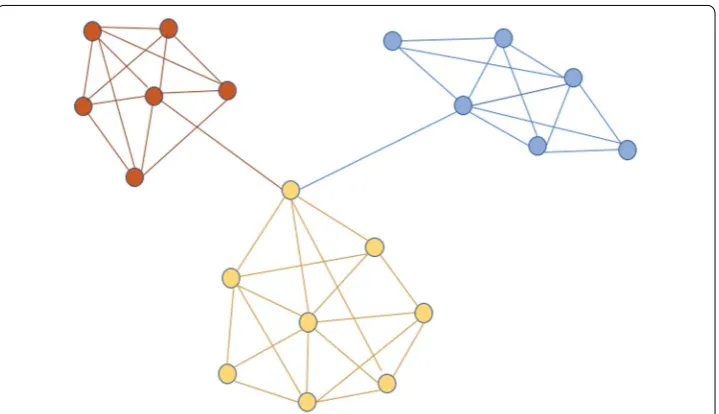
A community is also known as a cluster, and defined as a group of vertices which prob-ably share common features, or have a strong relationship with each other formed by the strong distribution of edges between vertices. In Fig. 1, a graphic representation of a sample graph with communities is shown.
A community [13] can also be defined as a dense subgraph, since the nodes in same communities have dense connection with each other than that of different communi-ties. Each community represents a functional system or working unit, due to which it is necessary to find different effective techniques of community detection. The community detection techniques can be categorized as follows:
Structure‑based community detection
This class of community detection determines the probability of possible connection based on the existing connections between nodes, and groups them together in one community. The existing methods like Label Propagation [4] and Random Walk [5] gen-erate the community structure based on a probabilistic model. The Label Propagation
[4] assigns label to each node and changes the label of each node based on the label of neighbors. Though Label Propagation [4] is computationally efficient, it does not con-sider the attributes associated with each node, hence, may not be an effective method to create a group of nodes based on the label of neighbors for attributed graphs. The
Random Walk [5] method works on the principal of Markov Chain Process, where nodes are grouped together based on the probability of transition from one node to another. Since the current Random Walk [5] based methods do not consider the attributes asso-ciated with nodes, hence, the generated communities may not have attribute similar-ity between the nodes in a communsimilar-ity. Girvan and Newman proposed a new measure known as the modularity [6, 9], which is defined as the fraction of connections within a community in the actual network minus expected fraction of connections in a random network. As per the definition of modularity, a maximum modularity gives the best par-tition of a network [9]. Fortunato and Barthelemy discovered that the modularity opti-mization [13] gives extra importance to the number of connections in a network, and hence this method cannot correctly classify some specific cases of networks. The main limitation of the modularity optimization [13] approach is that it does not consider the overall size of a community. To overcome this limitation, Rosvall and Bergstrom [3] used the full description length of a partition of a network to compress the network-based communication process. Li et al. [14] proposed a fast and accurate measure of mining community structure by providing a kernel function to measure the leadership of each node. Once the leader nodes are determined, a discrete-time dynamical system is used to assign the community for each node dynamically. All these methods consider the actual and possible connection between different nodes, and generate the structurally cohesive community structure. However, none of the above methods considers the node attributes, and hence, may not be the accurate measure to generate community struc-tures for an attributed graph.
Attributed‑based community detection
Online community detection
There are some techniques to determine the communities in an online manner, that is based on a query request. Few of these methods [23–26] obtain the community for given vertex V based on the query over q. Such a personalized community detection technique requires different measures like the minimum degree, k-core, etc., which generate the structurally cohesive communities. Sozio et al. [23] proposed the first algorithm known as the Global to find the k-core containing vertex q. Cui et al. [25]
proposed the Local to enhance the efficiency of the Global by expanding techniques to local search space. There are many other methods like k-clique [24] and k-truss
[27] which searches the communities in large complex networks, but all these tech-niques assume non-attributed graphs, and does not consider the important keyword attribute information on nodes which can be used for the generation of more accurate communities in the graph.
Keyword search over graphs
The keyword search over graphs [28–31] have attracted significant attention in recent years since it provides valuable information to users without the knowledge of underly-ing entities, schema, or access mechanism. Many advanced keyword search techniques [28–32] are developed to search information over such large complex graphs. We use the concept of keyword search over graphs to generate different communities in the graph. We apply the naive keyword search approach to search the keyword attributes on the nodes, and group them together based on the similarity between two nodes. The keyword search approach gives the flexibility of searching the required group of nodes in an online manner. Since the social network graphs may have multiple attributes assigned to their nodes, a mechanism is designed to derive clusters in the graph based on the attribute similarity among different nodes. The next section defines the problem, and describes the key definitions and major aspects of the proposed approach.
In this paper, we consider some important measures described by structure-based,
attribute-based, online community detection, and keyword search methods to design a novel method for more accurate community detection over large attributed graphs.
Methods
The proposed approach for community detection using Keyword Attribute Search is explained in detail in this section. Before explaining the proposed approach, it is neces-sary to define the problem, provide some corresponding definitions, and lemmas to sup-port the proposed approach.
Data mdel
attributes for all vertices vi∈V is denoted as Λ= {attr1,attr2,attr3...attrn} , and the set of
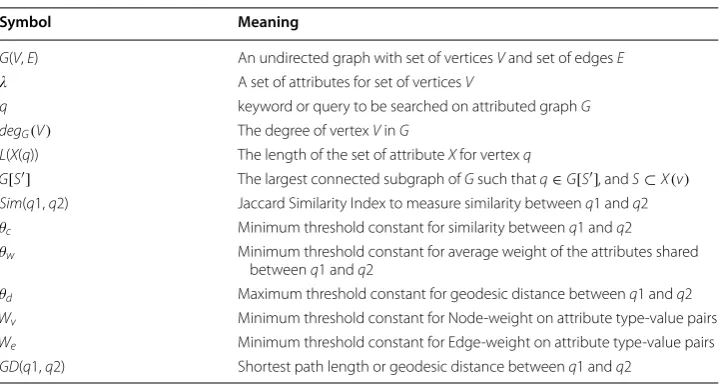
attribute values associated with each vertex vi is denoted as attrji= {attr1i,attr2i, ...attrji)}. In this paper, an undirected attributed graph G=(V,E,Λ) is considered. Let n and m be the size of V and E, respectively. Table 1 represents the meaning of all the symbols used in the paper.
Preliminary
A community can be defined as a subgraph of G that have the nodes densely connected to each other to form a cohesive structure, and sparsely connected to nodes in other com-munities. The structure cohesiveness of a graph G is defined by how different nodes are connected to each other. The minimum degree of all vertices in a community is k or more [23, 25, 26, 33, 34], also known as k-core , which is an important condition for structure cohesiveness of G.
Definition 1 (k‑core)
Given an integer k ( k≥0 ), the k-core [23, 33, 35] of G denoted by Gk is the largest subgraph of G such that, ∀v∈Gk,degGk(v)≥k . The notion of k-core [16, 23, 33] makes sure that all the nodes in a community Gk are densely connected to each other in some way, and hence makes the structure cohesive.
Definition 2 (Jaccard Similarity Index)
Given a graph G=(V,E) and two vertices v1,v2∈V which have set of attributes X1 and X2 respectively, the measure of similarity between the two vertices can be given by the Jac-card Similarity Index [36] Sim(v1,v2) and defined as follows:
(1) Sim(v1,v2)= |(X1∩X2)|
|(X1∪X2)|
Table 1 Symbols and meanings
Symbol Meaning
G(V, E) An undirected graph with set of vertices V and set of edges E A set of attributes for set of vertices V
q keyword or query to be searched on attributed graph G degG(V) The degree of vertex V in G
L(X(q)) The length of the set of attribute X for vertex q
G[S′] The largest connected subgraph of G such that q∈G[S′] , and S⊂X(v) Sim(q1, q2) Jaccard Similarity Index to measure similarity between q1 and q2 θc Minimum threshold constant for similarity between q1 and q2
θw Minimum threshold constant for average weight of the attributes shared between q1 and q2
The Jaccard Similarity Index [36] measure can be useful to give some threshold con-stant, which can be used to classify the vertices with a similarity of attributes greater than or equal to the threshold constant into a common group of vertices.
Definition 3 (shortest path length or geodesic distance)
Apart from the attribute similarity, it is necessary that the two nodes v1 and v2 are con-nected to each other at a minimum possible distance. If two nodes v1 and v2 are con-nected to each other, but far away from each other in a network than the other nodes, then such nodes may not be the part of a community. Since the communities contain nodes which are densely connected, the shortest path distance between two nodes should be minimal to make the community structure dense, or structurally cohesive. The shortest path length or geodesic distance [37] can be used to calculate and specify the maximum threshold on the distance between two nodes v1 and v2 . The shortest path
length or geodesic distance [37] can be given as follows:
Problem definition
The problem is defined as follows:
1. The vertices vi∈V in a subgraph should be connected to each other to form a cohe-sive structure, and sparsely connected to other subgraphs.
2. The vertices vi∈V which have similar attributes should be partitioned into the same group, while the vertices with different attributes should be partitioned into separate groups.
Based on the above properties, the formal problem definition for the community detection in attributed graphs is stated in the following definition:
Problem 1 (attributed community detection)
Given a graph G(V,E,) , positive integer constants k, d, θc , θw,Wv , and We , a vertex v∈V , and a set of attributes attri⊂X(vi∈V) , return a set of subgraphs such that fol-lowing properties should be satisfied ∀Gv∈G:
1. ConnectivityGv∈G is a connected subgraph and contains v∈V; 2. Dense structure∀v∈Gv following properties should be satisfied;
a. all the nodes v∈V in a subgraph have degree greater than or equal to the K_core value, degGv(v)≥k , k is a minimum threshold for k-core value.
b. if two nodes (vi,vj)∈V are connected, then the distance between them should be less than or equal to the maximum threshold constant d of the shortest path length or geodesic distance, GD(vi,vj)≤d.
3. Attribute sharing∀v∈Gv and ∀X∈ following properties should be satisfied;
the probability of attribute attri on all vertices, P(attrij∈vj,attrik ∈vk) is the probability of attribute attri shared between vertices vj and vk , Wv and We are minimum threshold constants for probability of attributes on nodes and edges, respectively.
b. if two nodes vi,vj∈V are connected, then the two nodes should share the maxi-mal similar influential attributes, and the average weight of common influential attributes should be greater than or equal to Average Edge weight, We(vi,vj)≥θw. c. if two nodes vi,vj ∈V are connected, then the two nodes should share the max-imal similar attributes, and the similarity between these attributes should be greater than or equal to Jaccard Similarity Index, Sim(vi,vj)≥θc.
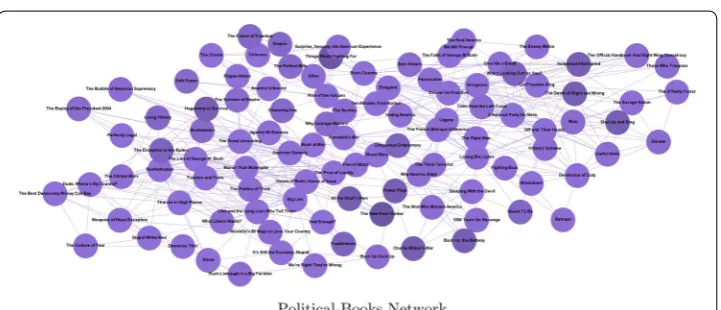
The above properties like k-core and shortest path length make sure the community structure is structurally cohesive, and the property of Node-weight, Edge-weight, and Jac-card Similarity Index makes sure the community structure follows the attribute cohe-siveness. Both of these requirements are critical for an accurate community detection. Figure 2a, b shows the attributed graph with the corresponding communities based on the problem definition. Figure 3 shows another example of ground truth network dataset having certain number of communities. Our focus is to design an efficient mechanism to derive communities not only in terms of interaction between the vertices in a com-munity, but also in terms of attribute similarity between all the vertices in a community.
Community detection using keyword search
Although the following method [16] is applicable to attributed graphs and generate communities which satisfies the structure and attribute cohesiveness, but it does not consider the attribute type-value pair for the attribute cohesiveness. Since there can be multiple values for one attribute type, it is necessary to identify the influential attribute type-value pairs, and derive the communities based on these influential attributes. Thus the proposed method is significant to identify the important attribute type-value pairs, and derive more accurate communities for these attributes. The proposed method high-lights the importance of finding the influential attributes. The Node-weighted and Edge-weighted attributes are useful to find the probability of edge creation between two nodes based on the connectivity as well as attribute similairty. The existing method [16] does not find such influential attributes or probability of edge creation, hence the proposed method is useful to find accurate communities. The vertices which have strong connec-tivity and common keyword attributes can be grouped together in the same commu-nity. An algorithmic framework is designed to classify keyword attributes on all vertices based on the similarity between a set of attributes on two vertices, and the connectivity between two vertices. These classes can be used to search the vertices strongly related to each other, and hence, eventually the community. Following major steps are involved in the community detection using keyword search method:
Fig. 2 Karate-club network dataset with ground-truth communities. A simple example for Karate-club ground-truth network dataset with corresponding communities
or equal to Node-weight , then that attribute type-value pair is considered as an important attribute.
2. A probability threshold value called as Edge-weight is defined, which derives the influential attributes in terms of the connectivity. If the probability of sharing of any attribute type-value pair between all pair of vertices is greater than or equal to Edge-weight , then that attribute type-value pair is considered as an important attrib-ute.
3. All the influential keyword attribute information on nodes can be used to construct an Attribute Index Structure, where different keyword attributes are classified and grouped together in separate groups based on the attribute similarity between the nodes, and their degree structure.
4. The factor Jaccard Index, and average weight of the Edge-weighted attributes between a pair of vertices, is used to measure the similarity of attributes, while k-core and geodesic distance are used to measure the connectivity of the vertices sharing similar attributes.
5. While classifying each vertex in the graph based on the attributes, a new class of attributes can be identified and stored in the Attribute Index Structure. This attribute class information can be assigned as a label to each node of the graph with the key-word attribute information, to find strongly associated nodes.
6. The naive keyword search algorithm is used to determine the personalized communi-ties in the graph based on a query by using different class of attributes assigned to all vertices in the graph.
7. For a generalized community detection, the naive keyword search algorithm is used to determine all communities in the graph based on the class information and keyword attribute information on different nodes in the graph.
All the classes can be accessed iteratively to determine different nodes which belong to the same class, and which share strong association in terms of keyword information. The group of such nodes will form a community structure in the graph. In the next section, an algorithmic framework is defined and explained in detail for each major step.
Keyword search based algorithm
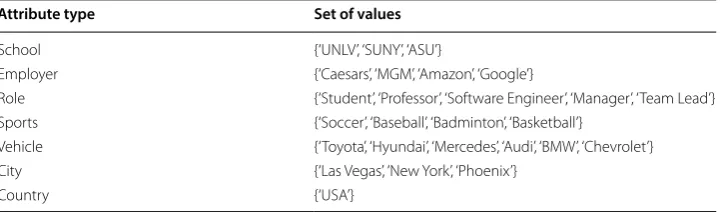
The Keyword Attribute Search-based algorithm requires that every node should have some keyword or attributes associated with them, these keyword attributes are used to search a specific type of attribute and group them together in one class. For example, we use two network datasets Karate-club and Political Book in Figs. 2a and 3 respec-tively, which have ground-truth communities associated with them. We assign random attributes on each node of both the datasets, and derive communities by using Keyword Search-based algorithm. The random attributes assigned to each node of the Karate-club
network is shown in Table 2.
Following major steps are involved in the Keyword Attribute Search-based algorithm:
Node‑weight
of attributes X∈ , and each attribute type attrij∈X might be distributed on the
dif-ferent nodes with difdif-ferent values, it is important to find the influential attribute type-value pairs among all the node attributes. The probability of each attribute type-type-value pair on all vertices can be used to get influential attributes.The influential attributes can be found based on the probability of each attribute type-value pair among all the nodes in the graph. Let O(attri) is the number of times attri present among all the vertices, N
be the number of nodes in the graph, then the probability of attri can be given as follows:
For the example network shown in Fig. 2a, if we assume the maximum threshold for
Node-weight Wv=20.0% , then the corresponding important attributes are listed in Table 3.
Edge‑weight
Once all the important attributes are determined based on the probability of each attrib-ute type-value pair on all the nodes of a graph, we consider the probability of occurrence
(3)
P(attri)=
O(attri)
N =
N j=1attri
N
Table 2 Node attributes of sample graph in Fig. 2a
Attribute type Set of values
School {‘UNLV’, ‘SUNY’, ‘ASU’}
Employer {‘Caesars’, ‘MGM’, ‘Amazon’, ‘Google’}
Role {‘Student’, ‘Professor’, ‘Software Engineer’, ‘Manager’, ‘Team Lead’} Sports {‘Soccer’, ‘Baseball’, ‘Badminton’, ‘Basketball’}
Vehicle {‘Toyota’, ‘Hyundai’, ‘Mercedes’, ‘Audi’, ‘BMW’, ‘Chevrolet’}
City {‘Las Vegas’, ‘New York’, ‘Phoenix’}
Country {‘USA’}
Table 3 Node-weight for Karate-club network
Id Attribute type‑value pair Probability
1 Country: USA 100.0
2 School: UNLV 50.0
3 School: SUNY 35.0
4 City: New York 50.0
5 City: Las Vegas 50.0
6 Role: Student 38.00
7 Sports: Baseball 38.00
8 Sports: Soccer 32.00
9 Employer: Caesars 30.00
10 Employer: Google 27.00
11 Employer: Microsoft 24.00
12 Employer: MGM 21.00
13 Vehicle: Hyundai 22.00
of each attribute type-value pair on each edge, that is, how many times each attribute type-value pair is shared between all pair of vertices. The threshold value of probabil-ity of each attribute type-value pair on each edge can be called as the Edge-weight. If the probability of each attribute type-value pair on each edge is greater than or equal to Edge-weight, then that attribute type-value pair is considered to be influential. Let
O(attrij) and O(attrik) be the number of times attribute attri present on vertices j and k, respectively. O(attrij,attrik) represents the number of times attri shared between vertex
j and k, when j and k are connected to each other. The probability of an attribute type-value pair shared among all the pair of vertices can be given as follows:
We can determine the Edge-weight from the above important attribute type-value pairs listed in Table 3, and the all the edges in Karate-club network graph sharing these attribute type-value pairs. If we assume the maximum threshold value for Edge-weight
We=10.0% , then, corresponding influential Edge-weight attributes are listed in Table 4.
Keyword attribute signature
The influential attributes can be stored in a decreasing order of the probability value, and a unique index ki→attri|∀attri∈X value can be assigned to the attribute type-value pair. The Keyword Attribute Signature contains a vector of these unique index values for a set of attributes on each node. Thus, the Keyword Attribute Signature is a compact representation of the attribute values on each node. The unique Id associated with each attribute type-value pair shown in Table 4 is used to create the Keyword Attribute Signa-ture on each node.
Attribute Index Structure
In the next step, we create an Attribute Index Structure for the Keyword Attrib-ute Signature assigned to all nodes. Given a large attributed graph G = (V, E), the task is to determine different classes of attributes from all the Keyword Attribute
(4) P(attrij,attrik)=
N i=1
N
j=1O(attrij,attrik) N
Table 4 Edge-weight for Karate-club network
Id Attribute type‑value pair Probability
1 Country: USA 100.0
2 School: UNLV 38.0
3 School: SUNY 36.0
4 City: New York 38.0
5 City: Las Vegas 22.0
7 Sports: Baseball 16.00
9 Employer: Caesars 10.00
11 Employer: Microsoft 15.00
13 Vehicle: Hyundai 12.00
Signatures on all vertices. Since we do not have prior information on the type of attributes in the graph, this information can be determined from the keyword attrib-utes on different nodes. The Attribute Index Structure is created iteratively for all nodes and will contain all the class of attributes in the large network graph. Each class of attribute is created iteratively by comparing each node with other nodes. If the two nodes have degree greater than or equal to k_core, then they are considered for the classification. If the two nodes have degree greater than or equal to k_core, and are similar to each other based on Jaccard Similarity Index, then the Keyword Attribute Signature on two nodes can be merged into one class, and two nodes belong to the same class. The Attribute Index Structure would con-sist of the inverted list of Keyword Attribute Signature for each node with a cor-responding class, first visited node, and the total number of vertices which belong to the same class of attributes. The Attribute Index Structure can be denoted as I= {C1:{X1,V1,count(C1)},C2:{X2,V2,count(C2)}, ...,Cn: {Xn,Vn,count(Cn)}} , where Ci is the class assigned to each attribute set Xi , and Vi is the first node from which the
class Ci is derived. The pseudo-code given in Algorithm 1 is used to create the Attrib-ute Index Structure:
Table 5 represents the Keyword Attribute Index structure created for the Karate-club network dataset.
Keyword attribute class information
Once the Attribute Index Structure is created, it is used to assign the class of attribute Ci on each vertex vi∈V along with the Keyword Attribute Signature information. The main idea behind the class is to create awareness about strong relationship or com-mon properties between the nodes. Initially, each vertex with the Keyword Attribute Signature is considered as a separate community while searching it’s relationship with other vertices, this Keyword Attribute Signature based search leads to different nodes which share the same attribute information, which eventually helps derive the com-munities in graph. However, for a large network graph, there are numerous type of attributes associated with all nodes, hence it becomes necessary to classify Keyword Attribute Signature at each node in different classes. There should be a parameter θc to depict a maximum threshold of similarity between two sets of Keyword Attribute Signatures on two vertices v1 and v2 , respectively, based on which it will be easy to prune the search space over a large network
Table 5 Attribute Index Structure for Karate-club graph
Class Node V Attributes Count
1 1 {1, 2, 3, 4, 5, 7, 9, 11, 13, 14} 10
Algorithm 1 Keyword Attribute Index Structure
Input: G = (V, E);
V = (V1, V2. . . , Vn) : Set of vertices in the graph;
X = (X1, X2. . . , Xm) : Set of influential attributes derived from Node-weight &
Edge-weight;
Xi={attr1(Vi), attr2(Vi), . . . , attrj(Vi)}: Set of attributes associated with each vertex in
the graph;
Output:
I = {C1 :{X1, V1, count(C1)},C2 :{X2, V2, count(C2)},.., Cn :{Xm, Vn, count(Cn)}}:
Attribute index structure whereCnis the class assigned to each attribute setXm(Vn), and Vnis the first node which belongs toCn;
1: Initializei, j, k, count node=∅
2: forVerticesvi∈V do 3: forClassCj∈Ido
4: k core←getK core(G, vi) value;
5: attri←attribute listX(vi) ofVi;
6: attrj←attribute listXj∈Cjof classCj;
7: Sim(attri, attrj)← |attri∩attrj|/|attri∪attrj|;
8: Avg weight(attri, attrj)← |We(attri∪attrj)|/|attri∪attrj|; 9:
10: ifdegreedeg vi≥k corethen
11: ifSim(attri, attrj)≥θcthen
12: if Avg weight(attri, attrj)≥θw then
13: attri∪attrj←Xj{forX(vi), Xj}
14: Vj←viclassifyviinCj;
15: count(vi) + +;{Number of nodes for each class of attribute}
16: Merge attributes ofvi,X(vi)←X(vi)∪Cjin classCj;
17: end if
18: else
19: Ck←k+ 1{Create a seperate class for attributeX(vi)};
20: Vk←vi;
21: Xk←X(vi);
22: count(Ck)←1;
23: SetI={Ck:{(Xk, Vk, count(Ck)}};
24: SetX(vi)←X(vi)∪CkwhereX(vi)∈X;
25: end if
26: end if
27: end for
28: end for
29: returnI
graph. We can verify if an attribute is present in Attribute Index Structure I. If an attribute attrij∈X(j) is present in the inverted list of attributes {Cj:Xj,Vj,count(Cj)} , then we assign the corresponding classCj of attribute attrij to the node vi . If an
attrib-ute attrij ∈X(j) is not present in the inverted list, then the attribute attrij∈Xj is
com-pared with the existing attributes in I. The similarity between the two sets of attributes is determined based on the Jaccard Similarity IndexSim(vi,vj) . If the Sim(Xi(vi),Xj(vj)) is greater than or equal to the threshold value θc , then the two attributes are combined together Xi(vi)∪Xj(vj) , and same class Ci is assigned to the combination of attributes.
If Sim(Xi(vi),Xj(vj)) is less than the threshold value θc , then a new classCj is assigned
to the attribute Xj(V(j)) along with the node Vj in the Attribute Index Structure I. We
is useful in the personalized as well as generalized community detection. Based on the key definitions and Attribute Index Structure I, following lemma is derived to prove that the Attribute Index Structure is useful to classify nodes in different clusters, or groups to form communities.
Lemma 1 GivenG=(V,E)and set of attributesX, if Xq= {Xq1,Xq2,. . .,Xqn} and ˆ
Xq= { ˆXq1,Xˆq2,. . .,Xˆqn}are the set of attributes on the two verticesqandqˆrespectively,
and ( q,qˆ)∈GXqi.e.qandqˆbelong to the same subgraphGXq . IfL(Xq∩ ˆXq)≥Kq , then
Xq∪ ˆXq∈Cq , whereCq∈I.
Proof To prove this lemma, we use a proof by contradiction. Let Xq= {Xq1,Xq2 ,. . .,Xqn} such that Xq∈Cq , and Xqˆ = { ˆXq1,Xq2ˆ ,. . .,Xqnˆ } such that Xqˆ ∈ ˆCq . Assuming
ˆ
Xq∈/Cq , then it means that Xq and Xˆq does not have any attribute in common, which
proves Cq is not equal to Cˆq and L(Xq∩ ˆXq)=φ . Thus, for every query or keyword
ver-tex Xq∈Cq and q∈Gq i.e. q belongs to the subgraph Gq , and Xˆq∈ ˆCq and qˆ ∈ ˆGq i.e. qˆ belongs to the subgraph Gˆq . This contradicts the given assumption that ( q,qˆ)∈GX
q and
also fails to satisfy the attribute cohesiveness. This proves the given lemma.
Personalized community detection
As discussed in the previous steps, the Attribute Index StructureI contains the class Ci of
attributes , first node, and the number of nodes which belongs to class Ci , also, keyword
attribute Xi(vi) on each node vi∈V is updated to include the class Ci . This information is crucial for the personalized community detection. The personalized community detection
can be defined as, a group of nodes having same class Cqi on each node for a given query
Q= {q1,q2,. . .,qi} , with i keywords in the query. For a given query Q which has keywords or class of attributes, we access the class information Ci , the number of nodes which belong
to the same class counti(Ci) , and the first vertex Vi which belongs to class Ci from I. Once
this information is fetched from the Attribute Index StructureI, the naive keyword search algorithm is used to search nodes which belong to class Ci . This naive keyword search starts
at the node Vi derived from I and finds the Breadth First Search (BFS) path with the node Vi
as the root node. It continues to search the nodes with same class Ci of attributes as node vi along the BFS path of the node Vi . The Breadth First Search (BFS) path makes sure that all
the nodes are covered in the network, and every node is compared with other nodes to find the nodes having similar class label. The keyword search has the upper bound of threshold length counti(Ci) , and continues the keyword search until the counti(Ci) number of nodes
are not matched with the given class Ci . Following pseudo-code is used for the Keyword Search required in personalized community detection. The pseudo-code for deriving the
Algorithm 2 Personalized Community Detection
Input:
G= (V, E, X);
V = (V1, V2. . . , Vn) : Set of vertices in the graph; X= (X1, X2. . . , Xm) : Set of attributes in the graph;
Xi={attr1(Vi), attr2(Vi), . . . , attrj(Vi)}: set of attributes associated with each vertex in the graph;
I = {C1 : {X1, V1, count(C1)},C2 :{X2, V2, count(c2)},.., Cn :{Xm, Vn, count(Cn)}}:
Attribute index structure whereCnis the class assigned to each attribute setXm(Vn), and Vnis the first node which belongs toCn;
Q={q1, q2, . . . , qn}: Query having a list of keywords or class information;
Output:
Comm(Ci): Communities with the nodes sharing the keyword information in the queryQ;
1: Initializei, j, node=∅; 2: forQueryqi∈Qdo 3: ClassCi←qi;
4: ifClassCi∈Ithen
5: nodei=Vi;{Attribute Index StructureI={Ci:{Xi, Vi, counti(Ci))}}}
6: k core←getK core(G, vi) value;
7: if degreedegnodei≥k corethen 8: node counti←counti(nodei);
9: bf s list(nodei)←BF S T ree(G, vi);{Get BFS list of nodevi} 10: whilecount≤node countido
11: forNodevj∈bf s list(nodei)do
12: if degreedegvj ≥k core∧GD(vi, vj)≤θdthen
13: Classj←attrj(vj){Attribute listattrj(vj) ofvj∈ClassCi}
14: ifQueryqi∈Classjthen
15: Commi(qi)←vj;{Markvjfor community}
16: end if
17: end if
18: end for
19: end while
20: end if
21: end if 22: end for
23: returnComm(Q);
Generalized community detection
The generalized community detection can derive all communities from a network graph based on the Keyword Attribute Signature associated with each node in the graph. The personalized community detection is based on the keyword search query Q, while generalized community detection may not need keyword search query Q. The Attrib-ute Index Structure I has all the required information about different attributes Xi(vi) on node vi∈V and class Ci of these attributes. All this information can be used for the generalized community detection. The process starts by scanning the Attribute Index StructureI for each class Ci of the attribute, then perform the keyword search at node
Vi associated with Ci in I. The Keyword Search process explained in the personalized
community detection leads to a community of nodes for each class Ci ∈I . Same process is performed recursively for each class Ci of the attribute, corresponding node Vi , and
the attributes Xi(Vi) associated with the node Vi . The pseudo-code given in Algorithm 3
Algorithm 3 Generalized Community Detection
Input:
G= (V, E, X);
V = (V1, V2. . . , Vn) : Set of vertices in the graph;
X= (X1, X2. . . , Xm) : Set of attributes in the graph;
attr(Vi) = {attr1(Vi), attr2(Vi), . . . , attrj(Vi)} : set of attributes associated with each
vertex in the graph;
I = {C1 :{X1, V1, count(C1)},C2 :{X2, V2, count(C2)},.., Cn :{Xm, Vn, count(Cn)}}: Attribute index structure whereCnis the class assigned to each attribute setXm(Vn), and Vnis the first node which belongs toCn;
Output:
Comm(Ci): Communities having the nodesvibelong toCi∈I;
1: Initializei, j, node=∅; 2: forClassCi∈Ido 3: ClassCi←queryqi;
4: nodei=Vi;{I={Ci:{Xi, Vi, counti(Ci)}}}
5: k core←getK core(G, vi) value;
6: if degreedegnodei≥k corethen 7: node counti←counti(nodei);
8: bf s list(nodei)←BF S T ree(G, vi);{Get BFS list of nodevi} 9: whilecount≤node counti do
10: fornodevj∈bf s list(nodei)do
11: if degreedegvj ≥k core∧GD(vi, vj)≤θdthen
12: Classj←attrj(vj){attrj(vj) =Ci}
13: if qi∈Classjthen
14: Commi(qi)←vj;{Markvjfor community}
15: end if
16: end if
17: end for
18: end while
19: end if
20: end for
21: returnComm(Q);
The personalized community detection can be used to derive a particular commu-nity from a graph in an online manner. However, the generalized
Algorithm 4 Find K core for All Vertices
Input: G= (V, E, X); Output:
K core: List of K core values for all the vertices; 1: Compute the degree of all the verticesdegvi;
2: Arrange the setV of vertices in the increasing order of their degrees;
3: forvi∈V do 4: K core[vi] =deg(vi) 5: forvj∈N eighbors(vi)do 6: ifdeg(vj)> deg(vi)then
7: deg(vj) =deg(vj)−1
8: ArrangeV in increasing order accordingly
9: end if
10: end for
Algorithm 5 Bredth First Search Tree (BFS Tree)
Input:
G= (V, E, X);
Q: Queue to add the visited vertices in the path;
Output:
bf s list: List of vertices in the BFS path starting at vertexvi∈I; 1: Addvi∈V toQand mark it as visited;
2: whilevi∈Qdo 3: w=QueueF ront(Q); 4: RemoveQ;
5: foreach visitedvj adjacent towdo 6: markvjas visited;
7: AddvjitoQ{Add(Q, vj)}; 8: end for
9: end while
community detection can be used to derive all the communities from a graph without any query in an online manner.
Illustration
The proposed method is explained by illustrating a simple example. We consider a small graph with corresponding node attributes and edges as displayed in Fig. 4a. If we con-sider the Node-weight and Edge-weight as 50% each, we get the influential attributes as {1:School =UNLV} , {2:City=LasVegas} , {3:Role=Student} , and {4:Role=Professor} . We create the compact signature from the influential attributes as shown in Fig. 4a. If we consider the Jaccard Similarity Index JCD as 40% , k_core and geodesic distance GD as 1 each, then we can apply the method to get the attribute index structure shown in Fig. 4b. Each class identified in the attribute index structure is assigned as an attribute to each node in the graph. The generalized community detection algorithm gives all the communities for the sample graph as shown in Fig. 4c.
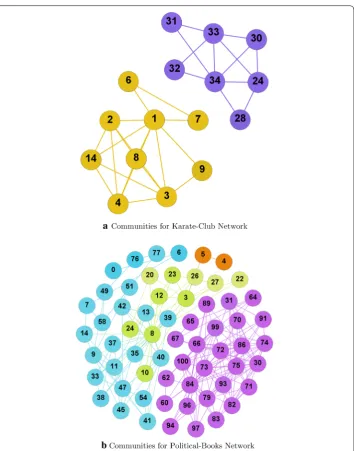
For example, if we look at the Karate-Club network graph shown in Fig. 2a with different attributes on each node and the Attribute Index Structure shown in Table 5, we derive the community of nodes that belong to the same class of attributes as shown in Fig. 5a. Simi-larly, based on the previously defined measures, we derive the communities for the Politi-cal-Books network dataset shown in Fig. 3. All the communities are displayed in Fig. 5b.
Algorithm analysis
The complexity analysis of the proposed method can be divided into following major parts based on the major steps involved in the community detection process.
Node‑weight and Edge‑weight
The Node-weight and Edge-weight are calculated by calculating the probability of each
attribute on each node vi and edge eij , respectively. Let’s assume that there are n nodes and m edges in a network graph, and each node contains an average of c attributes, then the time required to calculate Node-weight and Edge-weight can be given as follows:
(5) [H]O(attri(vj))=
c
i=1 n
j=1
Maximizing degree of nodes
Identifying the nodes, which have a maximum degree, satisfy the requirement of the struc-ture cohesiveness. The k-core measure is used to identify such nodes with a maximum
(6)
HO(attri(ejk))= c
i=1 m
j=1 m
k=1
O(attri(ejk))=O(c∗m)=O(m)
possible degree. The k-core of a graph G can be identified within the time complexity of
O(m) , where m is the number of lines. Since all the n nodes of graph G are traversed to identify the k-core value, the complexity of the process to maximize the degree of nodes can be given as follows:
(7)
O(K_core)=min(degK_core(G,V))=O(n+m))
(8)
O(K_core)=O(n)=O(|V| + |E|)
Attribute Index Structure creation
As explained in the previous section, the Attribute Index Structure is created to clas-sify Keyword Attribute Signature on each node into different classes. These classes are used to generate the communities based on the similarity of a set of attributes on two nodes of the graph. Since we consider the nodes which have degree greater than or equal to the threshold value of k_core, nodes which have degree less than the
k_core are rejected and will not be part of any community. This criteria prune the search space over a large network graph. There is another threshold known as Jac-card Similarity Index θc , which verify the similarity between two Keyword Attribute Signatures. If the similarity between two sets is greater than or equal to θc , then such
sets are combined into one class Ci , otherwise, the two sets are classified into two
dif-ferent class of attributes Ci and Cj , respectively. If we consider the worst case scenario
where all the nodes are densely connected to each other, hence, they have maximal degrees associated with them, then all the n nodes of the graph G are considered for the Attribute Index Structure creation. Also, if we assume that there are c attributes on each node of the graph G, then the time required for the comparison of the two
Keyword Attribute Signatures would be some constant value. Hence, the total time
required for the creation of Attribute Index Structure can be given by the following equation:
Keyword search for community detection
Every class of attributes in the Attribute Index StructureCi∈I is associated with a
vertex Vi , and the number of nodes counti(Ci) which belong to the class Ci . This
infor-mation is used for the personalized as well as generalized community detection by using the Keyword Search method. Since the generalized community detection uses each class of attributes Ci∈I , the Keyword Search method is executed for every class
and generate communities. The Keyword Search starts at the first vertex Vi associated
with class Ci , then it searches iteratively for keyword Ci on every node in Breadth First Search (BFS) tree oriented at root Vi ( vi∈BFS_TREE(Vi) ). It is also necessary to
con-sider another important requirement for cohesive community structure, i.e. shortest path length between two nodes. The shortest path length between two nodes should be less than or equal to a maximum threshold path length. Thus, the time required for the generalized community detection with keyword search would consist of the total time required for finding Node-weight, Edge-weight, and k-core, creating Attrib-ute Index Structure, retrieving the BFS tree for vertex vi∈Ci , and determining the nodes having shortest path length less than or equal to a maximum threshold path length. The time required for the BFS tree creation is O(|V| + |E|) , but the nodes in the graph have maximum degree forming a dense structure, hence, it is safe to assume that the time required for the BFS tree creation is dominated by the number of edges, that is O(|E|), or O(m). Now, the generalized community detection searches for all the classes Ci∈I , hence, the BFS tree is retrieved for each vertex vi associated with Ci∈I .
(9)
O(I)=
n
i=1 n
j=1
In the worst case, each vertex vi belongs to separate class Ci , hence, the BFS tree
requires the O(n∗ |E|) or O(|V| ∗ |E|) time. The time required to calculate the shortest path length for n or |V| vertices is O(n2) or O(|V|2) . Thus, the total time complexity for the generalized community detection can be given as follows:
Since as per the assumption, the given graph is undirected, attributed, and dense graph, hence the number of edges |E| dominate the number of nodes |V|, which results in the time complexity to be bounded with the number of edges or degree of the nodes. Hence, the resultant time complexity for the generalized community detection can be given as follows:
Experimental results
Different experiments are performed to verify the accuracy of the proposed method. We consider only the undirected and attributed graph for all the experiments. All the experi-ments are executed on 64 GB main memory in Intel Core i5 @ 3.70 GHz on an Windows 10 operating system. Python 2.7 is used to implement the algorithms with networkx
package for graph related operations.
Experimental setup
We divide our experiments into three parts. The first part of the experiment com-pares the proposed approach with the existing methods. We use the network datasets like Karate-Club, American Football, Political-Books, Dolphin-network, email-EU-core, DBLP, and Amazon [38] with the ground-truth communities for the comparison experi-ment. The second part contains the experiments on smaller datasets, where a number of nodes in the graph are less than or equal to 1000, while the third part contains exper-iments on the large datasets where the number of nodes in the graph is greater than 10,000. Since the community structure would contain the dense subgraphs, we include the variation in a number of edges by creating synthetic graphs having 2000, 5000, and 10,000 nodes respectively, and the probability of edge creation 0.50, 0.40, and 0.30 respectively. We distribute a number of attributes randomly on each node of all the above graphs where no attribute values are assigned to any node, so that the threshold value for attribute classification varies, and the resultant community structure can be verified. We use real datasets like YouTube video crawl [39], Twitter User Profiles [40],
Skytrax Airline Reviews, Terrorist Data [41], Caesars Entertainment anonymous data-set, and Facebook for the second and third part of the experiment. We randomly assign attributes to the datasets having only edge lists, and randomly create edges with a certain probability of edge creation for the datasets having node list only. The networkx package of Python 2.7 is used for all the graph related operation in the experiments.
Discussion
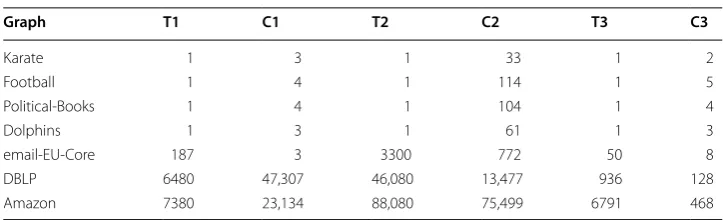
Table 6 shows the details about the runtime and a number of communities in each comparison experiment. Figure 6 displays the result for comparison of runtime and (10)
O(Commi(I))=max(O(|V|),O(|E|),O(|V| + |E|),
O(|V| ∗ |E|),O(|V|2))
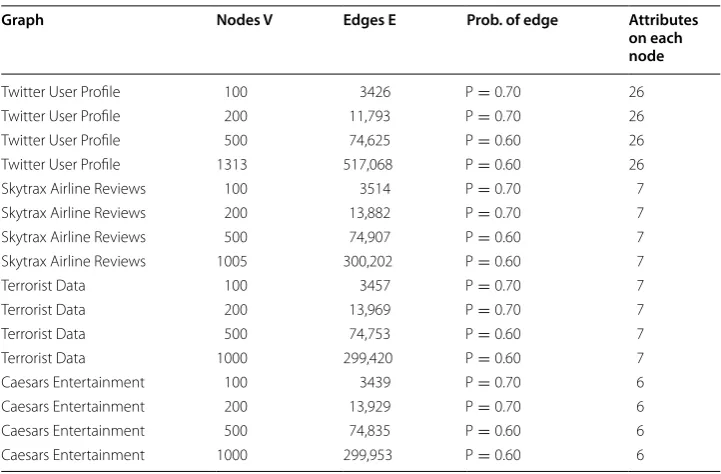
the number of communities generated for existing methods and the proposed method, respectively. Tables 7 and 8 show the statistics for the small as well as large graph data-sets, respectively. The tables show statistics about the number of nodes, the number of edges, the probability of edge creation, and the number of attributes on each node. Tables 9 and 10 show the statistics about the experimental results on the small as well as large graph datasets, respectively. The tables show detailed information of each experi-ment, where the number of nodes and edges are mentioned along with the threshold value for the similarity of attributes between two nodes, a threshold value for the short-est path length, the number of communities, and the time required for the proposed Table 6 Comparison with existing methods
T1 Time for K-Clique, C1 #Communities for K-Clique, T2 Time for GN (Girvan-Newman), C2 #Communities for GN, T3 time for proposed method, C3 #Communities for proposed method
Graph T1 C1 T2 C2 T3 C3
Karate 1 3 1 33 1 2
Football 1 4 1 114 1 5
Political-Books 1 4 1 104 1 4
Dolphins 1 3 1 61 1 3
email-EU-Core 187 3 3300 772 50 8
DBLP 6480 47,307 46,080 13,477 936 128
Amazon 7380 23,134 88,080 75,499 6791 468
method to generate these communities. All this detailed information shows the authen-ticity of the proposed method to generate more accurate communities. All the experi-mental results are depicted in Figs. 7 and 8, respectively.
Case study
We create a small case study based on a real time graph dataset provided by Cae-sars Entertainment Corporation located at Las Vegas, USA . This dataset contains the anonymous real time attribute data collected from the Caesars Entertainment Corpo-ration WiFi data, a test graph is created to represent the information about patrons vis-iting different properties of Caesars Entertainment, time, and places of their visit at a Table 7 Small graph datasets
Graph Nodes V Edges E Prob. of edge Attributes
on each node
Twitter User Profile 100 3426 P=0.70 26
Twitter User Profile 200 11,793 P=0.70 26
Twitter User Profile 500 74,625 P=0.60 26
Twitter User Profile 1313 517,068 P=0.60 26
Skytrax Airline Reviews 100 3514 P=0.70 7
Skytrax Airline Reviews 200 13,882 P=0.70 7
Skytrax Airline Reviews 500 74,907 P=0.60 7
Skytrax Airline Reviews 1005 300,202 P=0.60 7
Terrorist Data 100 3457 P=0.70 7
Terrorist Data 200 13,969 P=0.70 7
Terrorist Data 500 74,753 P=0.60 7
Terrorist Data 1000 299,420 P=0.60 7
Caesars Entertainment 100 3439 P=0.70 6
Caesars Entertainment 200 13,929 P=0.70 6
Caesars Entertainment 500 74,835 P=0.60 6
Caesars Entertainment 1000 299,953 P=0.60 6
Table 8 Large graph datasets
Graph Nodes V Edges E Prob. of edge Attributes
on each node
Facebook 2000 1,000,025 P=0.50 7
Facebook 5000 4,997,567 P=0.40 7
Facebook 10,000 14,998,579 P=0.30 7
Youtube video crawl 2000 998,910 P=0.50 9
Youtube video crawl 5000 4,997,518 P=0.40 9
Youtube video crawl 10,000 14,996,737 P=0.30 9
Terrorist data 2000 1,000,470 P=0.50 7
Terrorist data 5000 4,998,900 P=0.40 7
Terrorist data 10,000 15,004,225 P=0.30 7
Caesars entertainment 2000 998,937 P=0.50 6
Caesars entertainment 5000 4,887,265 P=0.40 6
particular property. We create a graph G=(V,E) with |V| =200 nodes and |E| =12000 edges with 60% probability of edge creation in the graph at different nodes, this makes
the graph structurally cohesive. We assign different attributes Xi(vi) like, Patron_Id,
Path_From_Property, Path_To_Property, Time_From_Property, Time_To_Property, and
Place_Visited on all the vertices vi ∈V . Since each attribute may have different values on each node, the probability threshold value of Node-weight =10.0 and Edge-Weight =1.0
is set. Tables 11 and 12 represent all the attribute type-value pairs having probability greater than or equal to Node-weight and Edge-weight, respectively. Table 13 represents the Attribute Index Structure for graph dataset. Figs. 9, 10a–c, 11a–c show the original graph and communities generated through the proposed method, respectively.
Table 9 Experimental results on small graphs
G Graph, V #Nodes in the graph, E edges in the graph, Sim #attribute similarity, L shortest path length, C #number of communities,T #time in seconds
G V E Sim (%) L C T
Twitter user profile 100 3426 70 3 2 1
Twitter user profile 200 11,860 70 3 2 3
Twitter user profile 500 74,625 70 3 4 10
Twitter user profile 1313 517,072 70 5 3 25
Skytrax airline reviews 100 3514 50 3 3 1
Skytrax airline reviews 200 13,882 50 3 3 2
Skytrax airline reviews 500 74,907 50 3 4 6
Skytrax airline reviews 1005 300,202 50 3 5 28
Terrorist data 100 3457 70 3 2 1
Terrorist data 200 13,969 70 3 2 2
Terrorist lata 500 74,753 70 3 3 10
Terrorist lata 1000 299,420 70 3 3 37
Caesars entertainment 100 3439 70 3 10 1
Caesars entertainment 200 13,929 70 3 12 2
Caesars entertainment 500 74,835 70 3 12 6
Caesars entertainment 1000 299,953 70 3 13 22
Table 10 Experimental results on large graphs
G graph, V #nodes in the graph, E edges in the graph, Sim #attribute similarity, L shortest path length, C #number of communities, T #time in seconds
G V E Sim (%) L C T
Facebook 2000 1,000,025 70 3 60 100
Facebook 5000 4,997,567 70 3 37 2577
Facebook 10,000 9,996,858 70 3 51 1701
Youtube video crawl 2000 998,910 70 3 5 62
Youtube video crawl 5000 4,997,518 70 3 5 817
Youtube video crawl 10,000 14,996,737 70 3 6 6785
Terrorist data 2000 1,000,470 70 3 9 100
Terrorist data 5000 4,998,900 70 5 10 2149
Terrorist data 10,000 15,004,225 70 5 10 25,000
Caesars entertainment 2000 998,937 70 3 7 109
Caesars entertainment 5000 4,997,265 70 3 10 1321
Now, for the personalized community detection, we can create the queries q
like, find a community of nodes where people traveled from property A to
prop-erty B. Such a query q represents the class of keyword attributes Path_From_
Property=A,Path_To_Property=B , and the personalized community detection algo-rithm finds all the nodes vi ∈I , where Ci(vi)=q . This creates a community of nodes Commi(Ci) , where all the nodes have path from PropertyA to B . However, the
general-ized community detection finds the communities Commi(Ci) for all Ci∈I , which con-tains all the nodes sharing the keyword attribute information, resulting in more accurate community detection as desired.
Concluding remarks
A community structure derived from an attributed graph exhibits the structure and keyword attribute cohesiveness. The proposed keyword search based method derives communities with the structure and keyword attribute cohesiveness by constructing an
Fig. 8 Run time vs number of communities for large graph datasets. Experimental results showing the run time and the number of communities generated for large graph datasets using the proposed method
Table 11 Node-weight for Caesars-WiFi dataset
Id Attribute type‑value pair Probability
1 Property_Region: Gaming 21.0
2 To_Property: Cromwell 20.50
3 From_Property: Cromwell 20.50
4 From_Property: Harrahs_LV 18.0
5 From_Property: Paris 17.0
6 To_Property: Caesars Palace 16.00
7 To_Property: Paris 15.00
8 From_Property: Caesars Palace 14.50
9 To_Property: Harrahs_LV 14.00
10 From_Property: Ballys 14.00
11 Property_Region: Cromwell_Valet 11.00
Table 12 Edge-weight for Caesars-WiFi dataset
Id Attribute type‑value pair Probability
1 Property_Region: Gaming 4.5
2 To_Property: Cromwell 4.0
3 From_Property: Cromwell 4.0
4 From_Property: Harrahs_LV 3.16
5 From_Property: Paris 3.0
6 To_Property: Caesars Palace 3.00
7 To_Property: Paris 2.26
8 From_Property: Caesars Palace 2.19
9 To_Property: Harrahs_LV 2.00
10 From_Property: Ballys 2.00
11 Property_Region: Cromwell_Valet 1.09
Table 13 Attribute Index Structure for Caesars-WiFi Dataset
Class Node V Attributes Count
1 0 {2, 4, 5, 8, 10} 48
2 2 {0, 1, 6, 9, 10} 35
3 9 {0, 1, 2, 5} 15
4 11 {0, 6, 7, 9} 16
5 14 {0, 3, 4, 5, 6} 29
6 21 {0, 1, 6, 7, 10} 6
7 31 {2, 4, 6, 8, 10} 4
8 35 {0, 1, 2, 3} 9
9 47 {0, 2, 3, 6, 8} 12
10 50 {0, 5, 7, 8, 9} 13
10 61 {1, 2, 4, 10} 5
10 188 {0, 1, 10, 3, 4} 2
classes of attributes and helps to derive the community of nodes which share a finite number of keyword attributes, along with the cohesive structure. The proposed method is able to provide the personalized and generalized community detection methods, which provides the flexibility to determine community of nodes in an online manner. Hence, the proposed method provides a more accurate measure of community detection in terms of the cohesive structure as well as keyword attribute similarity, compared to the existing algorithms. In addition, the proposed method provides a mechanism to gener-ate communities in an online manner, which is more useful to determine real-time com-munity of nodes. For future work, we intend to design a probabilistic model to predict the community of a node based on its connectivity with different nodes and attribute similarity. A probabilistic model can predict the class of a node, which can be further used for the Advanced Keyword Search techniques. We will also examine other metrics
of keyword search over distributed graphs so that, the current work can be extended to a distributed environment and more efficient techniques of keyword search can be incor-porated for the purpose of community detection.
Abbreviations
GD: geodesic distance; BFS: Breadth First Search.
Acknowledgements
We sincerely and gratefully acknowledge following organizations for their help and support.
Caesars Entertainment Corporation, Las Vegas, USA, for providing the attributed graph dataset. This graph dataset was created for the test purpose from the Anonymous Pervasive WiFi data, and contains the anonymous information of dif-ferent patrons visiting difdif-ferent properties of Caesars Entertainment, time of visit, place of visit at the property, and path taken from one property to another.
The United States Department of Defense (W911NF-17-1-0088, W911NF-16-1-0416), AEOP/REAP programs support, the National Science Foundation (1625677, 1710716), and the United Healthcare Foundation (UHF 1592) for their support and finance for this project.
Authors’ contributions
All authors have contributed to the research and manuscript with the order they appear. The last author being the pro-ject principal investigator. All authors discussed the final results as well as improved the final manuscript. Both authors read and approved the final manuscript.
Funding
The authors were funded through the UNLV Big Data Hub.
This study was supported by U.S. Department of Defense (Grant numbers: W911NF1810437; W911NF1810246).
Data availability statement
Since we used the dataset from Caesars Entertainment for the experimental analysis. This dataset contains the anony-mous information about the Caesars’ customers visiting different properties at different time and hours of the day. How-ever, we will not be able to disclose the dataset. We used some open source datasets for experimental analysis available [38]. All the implementation related source codes are available at : https ://githu b.com/sanke tchob e/Advan ce-Commu nity-Detec tion.
Consent for publication Not applicable.
Competing interests
The authors declare that they have no competing interests.
Author details
1 University of Nevada, Las Vegas, Las Vegas, USA. 2 University of Arkansas, 227 N. Harmon Ave., Fayetteville, AR, USA.
Received: 27 April 2019 Accepted: 16 August 2019
References
1. Albert R, Barabási AL. Statistical mechanics of complex networks. Rev Mod Phys. 2002;74:47–97. 2. Sun PG, Sun X. Complete graph model for community detection. Phys A Stat Mech Appl. 2017;471:88–97. 3. Rosvall M, Bergstrom CT. An information-theoretic framework for resolving community structure in complex
net-works. Proc Natl Acad Sci. 2007;104:7327–31.
4. Raghavan UN, Albert R, Kumara S. Near linear time algorithm to detect community structures in large-scale net-works. Phys Rev E. 2007;76:36106.
5. Aldous D, Fill J. Reversible Markov chains and random walks on graphs; 2002. http://www.stat.berke ley.edu/users / aldou s/RWG/book.html.
6. Zhang XS, Wang RS, Wang Y, Wang J, Qiu Y, Wang L, et al. Modularity optimization in community detection of com-plex networks. Epl. 2009;87:38002.
7. Fortunato S, Castellano C. Community structure in graphs. In: Meyers RA, editor. Computational complexity theory. New York: Springer; 2012. p. 490–512.
8. Sachan M, Contractor D, Faruquie TA, Subramaniam LV. Using content and interactions for discovering communities in social networks. In: Proceedings of the 21st internarional confernce on world wide web—WWW ’12. New York: ACM; 2012. p. 331. http://dl.acm.org/citat ion.cfm?doid=21878 36.21878 82.
9. Girvan M, Newman MEJ. Community structure in social and biological networks. Proc Natl Acad Sci USA. 2002;99:7821–6.
10. Nallapati RM, Ahmed A, Xing EP, Cohen WW. Joint latent topic models for text and citations. In: Proceeding 14th ACM SIGKDD international conference knowledge discovery data Min—KDD 08. New York: ACM; 2008. p. 542. 11. Liu Y, Niculescu-Mizil A, Gryc W. Topic-link LDA. In: Proceedings of the 26th annual international conference on
machine learning. New York: ACM; 2009. p. 1–8.
12. Newman M, Girvan M. Finding and evaluating community structure in networks. Phys Rev E. 2004;69:26113. 13. Fortunato S, Barthelemy M. Resolution limit in community detection. Proc Natl Acad Sci. 2006;104:36–41. 14. Li HJ, Bu Z, Li A, Liu Z, Shi Y. Fast and accurate mining the community structure: integrating center locating and
membership optimization. IEEE Trans Knowl Data Eng. 2016;28:2349–62.
15. Tong H, Faloutsos C, Gallagher B, Eliassi-Rad T. Fast best-effort pattern matching in large attributed graphs. In: Pro-ceedigns of the 13th ACM SIGKDD intenational conference on knowledge discovery data minning—KDD ’07. New York: ACM; 2007. p. 737.
16. Fang Y, Cheng R, Luo S, Hu J. Effective community search for large attributed graphs. In: Proceedings of the VLDB endow. VLDB Endowment; 2016. p. 1233–44.
17. Zhou Y, Cheng H, Yu JX. Graph clustering based on structural/attribute similarities. In: Proceedings of the VLDB endow. VLDB Endowment; 2014. p. 718–29.
18. Ruan Y, Fuhry D, Parthasarathy S. Efficient community detection in large networks using content and links. In: Pro-ceedings of the 22nd international conference on world Wide Web—WWW ’13. New York: ACM; 2016. p. 1089–98. 19. Xu Z, Ke Y, Wang Y, Cheng H, Cheng J. A model-based approach to attributed graph clustering. In; Proceedings of
the 2012 international conference on management of data—SIGMOD ’12. New York: ACM; 2012. p. 505. 20. Yang J, McAuley J, Leskovec J. Community detection in networks with node attributes. In: Proceedings of the IEEE
international conference data mining. Nwe York: ICDM; 2013. p. 1151–6.