RELATED TO COURSE ACTIVITIES
DEVELOPING TRANSFER SKILL IN
PROBLEM SOLVING IN ELEMENTARY
SCHOOL PROGRAMS IN SOUTHEAST
ANATOLIA REGION
Y. Gürcan Ültanır
Hasan Kalyoncu University, Turkey E-mail: [email protected]
Abstract
As of 2004-2005 school year, principles of constructivism have been adopted to a great extent in the education system of Turkey. In the present study, the lessons were video recorded in order to observe the activities to develop the transfer skills used in problem solving by the students attending 4th and 5th grades
of elementary schools in Tarsus province of Icel in Southeast Anatolian Region. Moreover, lessons were also video recorded in order to observe the problem solving behaviors of the 6th grade Turkish students
attending Turkish language lessons given by a Turkish teacher in Linden province of Hannover in Germany. The lessons given in Linden and Tarsus were compared in terms of “environment and process” through tables. It was concluded that the environmental conditions existing in the elementary school in Southeast Anatolian Region are not suitable for constructivist applications and here, it was observed that direct instruction model was continuously in use. On the other hand, at the school in the Linden region, while transfer skills necessary for real life are being developed, “asking question and discussion” behaviors are also gained.
Key words: inert / flexible knowledge; direct instruction model; invention; self-explaining.
Introduction
Since the 2004-2005 school year, constructivist applications have been in effect at schools in Turkey. Knowledge existing on an individual’s opinions is constructed on prior information as a result of interaction with experiences (Arslan, 2007). What is important here is creating learning-teaching settings which could activate former experiences and impart new experiences. While working on these experiences, the learner continuously asks why and how questions so that he/she can explain his/her own thoughts. Dufresne et al. (1996) interpretation
of the benefits of class-wide discussion is consistent with, but more developed than, that of
OF EDUCATION IN THE 21st CENTURY Volume 48, 2012 149 Throughout a living period, each individual from any age group should continuously solve various problems. As we solve some problems by means of our former experiences, we either do not realize that they are problems or solve them at a higher speed and more successfully when compared to the past. However, there are some phases in our life which have turned into
barriers that seem to be insurmountable because, we have encountered with them for the first
time and with our existing problem solving skills we cannot solve these problems. In such cases we need different transfers. We gain these transfer skills starting from early ages both inside and outside the school. We need to apply what we have gained at school in the outside world. By acquiring new knowledge about problem solving, we can either gain new skills or improve
already existing skills. The research has revealed that the only justifiable answer to be given
to the question “What does the school want to do?” is: The school should teach children how to use their intelligence in and outside the school (Kuhn, 2008). In this regard, there are two main skills that can be developed by schools: Asking questions and discussing (Anderson et al., 2000). These skills are necessary not only for school but also for real life. What should be taught at schools is the knowledge and skills necessary for new generations to solve their daily problems.
If a new problem is continuously confronted with, we usually develop a new solution to solve this problem. That is, we proceed step by step towards a procedure for the solution of
the problem. In general, while performing our duties, we learn flexible and relative abstract
procedures which we hardly need. Flexible, abstract knowledge is also a key characteristic of expertise (Chi, Feltovich, and Glaser, 1981). Many of the people from every age group have
knowledge which they do not need even in their professional fields (Bransford, Brown and
Cocking, 2001). Most of this knowledge does not have even direct relations with the knowledge to be learned later. This knowledge which is not needed at the moment of learning is taught
to students by means of coercion at school. Instead, courses should aim to impart “flexible
knowledge” rather than “inert knowledge” to students so that their problem solving skills can be developed. While solving problems, the student develops some procedures and these procedures
do not only include generalizable but also case-specific new procedures.
A resolution has been in the direction of undertaking to teach not simply knowledge itself but the skills of knowledge acquisition—skills that will equip a new generation to learn what
they need to know to adapt flexibly to continually changing and unpredictable circumstances
(Anderson et al., 2000; Bereiter, 2002; Botstein, 1997; Kuhn, 2008; Noddings, 2006; Olson, 2003).
Learning flexible knowledge instead of inert knowledge and supporting the learning of flexible knowledge can be evaluated within two procedures. Instead of learning inert knowledge why people should learn flexible knowledge and how such knowledge should be supported are
dealt within two processes: 1) The source of new knowledge and 2) possible mechanism based
on flexible knowledge. A potential mechanism underlying flexible learning –generating
self-explanations for why and how things work. Where do new procedures come from? Typically, we invent a procedure through problem exploration or we learn a procedure from others (e.g. via imitation or direct instruction) (cited in Rittle-Johnson, 2006). While dealing with a problem, a student tries to answer why and how questions based on his/her prior information or skills. Within the context of problem solving studies, incorrect explanations should also be evaluated to help students overcome their mistakes. In addition to students’ promoted correct solutions and judgments, incorrect explanations can help students get rid of their incorrect prior knowledge (Rittle-Johnson, 2006). Promoted students can come up with both correct and
incorrect solutions and then reach to correct solution by making use of the procedural flexibility
(Siegler, 2002). Successful learners typically generated explanations while studying
worked-examples to problems. These explanations included identification of gaps in understanding and
an important role (Judd, 1908). DI model is a kind of a system in which the teacher sticks to timetables, expects collective or similar responses from the students, directs classroom activities and emphasizes guided applications (Wrobel, 1996). DI model can also be used in constructivist learning theory. In fact, DI model is neither constructivist nor behaviorist. The direct instruction model means guiding classroom activities (Ultanir and Akay, 2010). However, DI should be employed while conveying new information and for a short period of time in class because students should develop their transfer skills like a scientist who is dealing with the problem on his/her own. Making explanations by giving answers to “why” and “how” questions is self-explaining (Rittle-Johnson, 2006).
Another critical issue in the support of flexible generalizable knowledge is the source of
information. Direct instruction on a procedure can lead people to learn the procedure by rote, to make nonsensical errors and to be unable to transfer the procedure to solve novel problems (Brown and Burton, 1978; Hiebert and Wearne, 1986), whereas when people invent procedures,
they often use the procedures flexibly in new situations (Hiebert and Wearne, 1986).
Problem of the Research
The goal of this research is to compare Turkish and Mathematics courses taught at 4th
and 5th grade classes at primary schools in Tarsus, İçel in Turkey with Turkish courses taught
at 6th grades at Hannover Linden in Germany in terms of • facilities the class atmosphere provide,
• relevance of the teacher-student behaviours to “flexible learning”, “DI model”,
“Invention” and “self-explaining”.
The focus of this research is to compare similarities and differences based on the comparative education science.
Methodology of Research
This is a comparative educational field study carried out based on observations made
in a school in Linden district of Hannover and another school in Tarsus province of Southeast Anatolia. The present study is limited to Turkish course given to 6th grade Turkish students by a Turkish teacher in a school in Linden district and the Turkish and Mathematic courses given to 4th and 5th graders in a school in Tarsus.
Participants
The participants of the present study are the 6th grade students attending Turkish language class in Linden district of Hannover in Germany and their teacher and 4th and 5th grade students attending Turkish and Mathematic classes and their teachers in a school located in Tarsus
province of the city of İçel in Turkey. The participation was on a voluntary basis.
The number of the Turkish students in Linden was 13. In Tarsus, the number of students in each class was 35 or more. The school in Linden and the school in Tarsus do not exhibit cultural differences as inhibitory factor because all the students participating from Germany are Turks and their teacher is also a Turk. (However, within the limitations of the study, the effects of German culture dominant on the students cannot be ignored. These Turkish students were born in Germany and have been in interaction with their German peers in classes. This group of students has the same tendencies towards learning-teaching processes at German schools). In
addition, the course is taught in Turkish. The reason why the first year students from secondary
OF EDUCATION IN THE 21st CENTURY Volume 48, 2012 151 recognized as a second language in February 2008. Since early 1980s, Turkish origin students
have been able to select their mother tongue as a second language in the first year of secondary
level elementary education (1st December 1989, with the ruling of the Ministry of Culture). In the 1980-1981 school year, in Berlin-Kreuzberg, attempts was initiated in elementary schools to
allow Turkish students to select the Turkish language as their first language (Wikipedia).
Design
After granting the necessary permissions from the schools in Linden and Tarsus, an
hour-long film was shot without interfering with the teaching-learning process in the classes.
The video camera was located in different places to record within the class by changing its place during the lesson. The only criterion to be followed in the selection of its location was
the visibility of the whole class. The person using the video camera rarely focused on specific
behaviors of the teachers and students. In Linden, in addition to video recording, some photos were also taken. The present study was carried out based on the evaluation of the video-recordings of the lessons, the teachers were previously asked to design their lesson plans in such a way as to conduct the lessons in a democratic environment in line with the principles of constructivist approach and they were told that video recordings would be analyzed in order to elicit how student participation in the solution of the problems which were believed to improve students transfer skills was guided.
The recordings were analyzed in relation to two criteria connected to each other as shown in Table 1.
Table 1. The design used to compare the lessons taught at schools participating in the project in Linden and Tarsus in terms of their improving transfer skills in problem solving.
Linden Tarsus
Problem Type 1
Environmental conditions Contributions/obstructions offered by the arrangement of the classroom and furniture for constructivism
Problem Type 2
Procedural conditions The compliance of student and teacher behaviors during the lesson with some models of constructivism (flexible learning; DI model; Invention; Self-Explaining)
Results of Research
Data analysis is below:
Problem Type 1
In the comparison made in Linden, Hannover and Tarsus, İçel in terms of the environmental
conditions of the classes, these elements were investigated:
• Opportunities/obstructions provided by the classroom setting for student activities • The arrangement of desks and activity tables/chairs in the class (distance to each other) • The maximum number of students to be catered to in the class (population density in the
class)
• The size of the area given to each student in individual/pair/group works
• The extent to which the environment allows the teacher to approach to each student • Availability of teaching resources (textbook, workbooks, supporting course materials
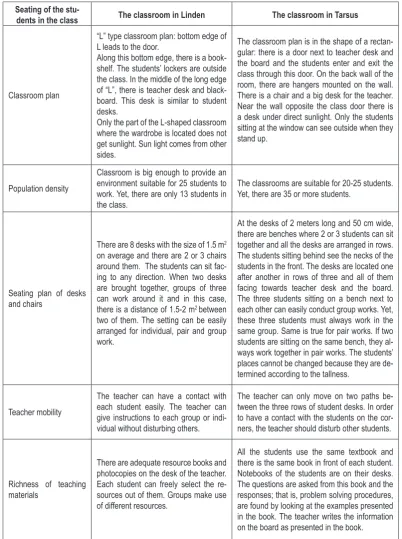
mentioned criteria are presented in Table 2.
Table 2. Opportunities/obstacles created by the classroom settings in Linden and Tarsus for the application of teaching principles to improve prob-lem solving skills of the students.
Seating of the
stu-dents in the class The classroom in Linden The classroom in Tarsus
Classroom plan
“L” type classroom plan: bottom edge of L leads to the door.
Along this bottom edge, there is a book
-shelf. The students’ lockers are outside
the class. In the middle of the long edge
of “L”, there is teacher desk and black
-board. This desk is similar to student desks.
Only the part of the L-shaped classroom
where the wardrobe is located does not
get sunlight. Sun light comes from other
sides.
The classroom plan is in the shape of a rectan -gular: there is a door next to teacher desk and the board and the students enter and exit the
class through this door. On the back wall of the room, there are hangers mounted on the wall. There is a chair and a big desk for the teacher. Near the wall opposite the class door there is a desk under direct sunlight. Only the students sitting at the window can see outside when they stand up.
Population density
Classroom is big enough to provide an environment suitable for 25 students to work. Yet, there are only 13 students in the class.
The classrooms are suitable for 20-25 students.
Yet, there are 35 or more students.
Seating plan of desks
and chairs
There are 8 desks with the size of 1.5 m2 on average and there are 2 or 3 chairs around them. The students can sit fac
-ing to any direction. When two desks are brought together, groups of three can work around it and in this case,
there is a distance of 1.5-2 m2 between
two of them. The setting can be easily arranged for individual, pair and group work.
At the desks of 2 meters long and 50 cm wide, there are benches where 2 or 3 students can sit together and all the desks are arranged in rows. The students sitting behind see the necks of the students in the front. The desks are located one after another in rows of three and all of them facing towards teacher desk and the board.
The three students sitting on a bench next to
each other can easily conduct group works. Yet, these three students must always work in the
same group. Same is true for pair works. If two
students are sitting on the same bench, they al
-ways work together in pair works. The students’ places cannot be changed because they are de
-termined according to the tallness.
Teacher mobility
The teacher can have a contact with each student easily. The teacher can give instructions to each group or indi
-vidual without disturbing others.
The teacher can only move on two paths be -tween the three rows of student desks. In order
to have a contact with the students on the cor
-ners, the teacher should disturb other students.
Richness of teaching materials
There are adequate resource books and photocopies on the desk of the teacher. Each student can freely select the re
-sources out of them. Groups make use of different resources.
All the students use the same textbook and
there is the same book in front of each student. Notebooks of the students are on their desks. The questions are asked from this book and the
responses; that is, problem solving procedures, are found by looking at the examples presented
OF EDUCATION IN THE 21st CENTURY Volume 48, 2012 153 Table 2 comparing Problem Type 1 can provide us with the following interpretations: • The teaching setting in the courses given in Linden, there are opportunities provided
for the formation of new procedures.
• While the classroom environment is suitable for group works in Linden, the setting in Tarsus is suitable for lecturing.
• The lessons in Linden enable students to conduct research on different sources. In lessons in Tarsus, only textbooks are drawn on.
Problem Type 2
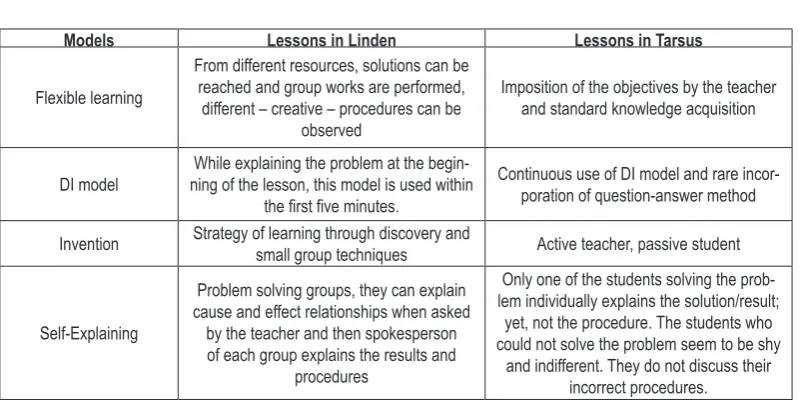
The results of the observations of student and teacher behaviors made in the class to elicit the suitability of the approaches to the procedures adopted in the schools in Linden and Tarsus for the transfer of problem solving skills are presented in Table 3.
Table 3. Compliance of the teaching procedures adopted in the lessons with the models aiming to develop problem solving skills as a result of the comparison made among the students’ behaviors and the teachers’ behaviors.
Models Lessons in Linden Lessons in Tarsus
Flexible learning
From different resources, solutions can be reached and group works are performed,
different – creative – procedures can be observed
Imposition of the objectives by the teacher
and standard knowledge acquisition
DI model ning of the lesson, this model is used within While explaining the problem at the
begin-the first five minutes.
Continuous use of DI model and rare incor-poration of question-answer method
Invention Strategy of learning through discovery and small group techniques Active teacher, passive student
Self-Explaining
Problem solving groups, they can explain
cause and effect relationships when asked by the teacher and then spokesperson
of each group explains the results and
procedures
Only one of the students solving the prob -lem individually explains the solution/result;
yet, not the procedure. The students who could not solve the problem seem to be shy
and indifferent. They do not discuss their incorrect procedures.
Table 3 includes the comparisons in Problem Typ 2. Related interpretations are presented below:
• Teaching procedures followed in Linden comply with flexible learning, DI model,
Invention and Self-Explaining.
• Teaching procedures in Tarsus only allows the use of DI model; yet, there are attempts to direct students to meaningful learning.
• In Linden, the main role of the teacher is counselor and unless it is necessary the teacher does not intervene. In Tarsus, the teacher is the sole authority in the class and always explains something.
Discussion
somehow restless in their answers probably due to the presence of a camera in the class. Such effects different from usual student and teacher behaviors seen in normal teaching process should be taken into consideration by the discussions presented here.
In Linden, the students actively participate in lesson and each group works with the material they need. Flexible use of knowledge is dominant in the class. At the basis of the procedure followed lies the principle “students decide what they learn not the teacher”. The teacher does not change students’ belief systems and ways of thinking unless they wish (Kuhn 2008). Hence, the teachers in Linden are aware of the fact that they need to know what the students want to learn and their ways of thinking. In Tarsus, on the other hand, the teacher is the sole authority in the class and the students have to understand him/her.
In Tarsus, the teachers employ only DI model in both mathematics and Turkish language classes. In Tarsus, the teachers themselves explain every detail to their students. In Linden, on the other hand, the teacher makes use of DI model when they detect the points not understood by the students and only for a short period of time. Kirschner, Sweller and Clark (2006) argue the effectiveness of DI model for students from every age group. When students are wanted to learn something, teachers should directly and explicitly convince their students to do so.
Self-explanation is a critical learning mechanism that leads to greater procedural
flexibility. The current findings –in Linden- converge with past findings that better learners
spontaneously produce self-explanations and that prompting learners to generate explanations leads to greater learning (Aleven and Koedinger, 2002; Bielaczyc et al., 1995; Chi et
al., 1989; Chi et al., 1994).
In Tarsus, while the number of students finding solutions and expressing their personal
opinions is few, the students in Linden actively construct their own concept understandings when they use group work techniques (see Resnick, 1989; Glaser 1990).
The active interaction of the teacher and students and students and students can be clearly observed in lessons in Linden. Moreover, the teacher encourages student-student interactions.
In this way, students become accustomed to finding solutions to problems through group
works or interaction with their peers. Group achievement is emphasized more than individual achievement. In Tarsus, on the other hand, students only explain their individual prior knowledge or the solution they have found individually, but not the way leading to solution. As the incorrect
results are not discussed, they cannot support their incorrect findings.
Conclusions
In light of the findings of the present study, it can be argued that the applications
performed in Turkish language and mathematic courses do not almost have any contribution to the development of transfer skills. This way of instruction is in good compliance with
traditional education. In Linden, the students can create original ideas and find answers to
“why and how” questions and they defend the procedures they have found by using group work techniques. Hence, applications in Turkish language course in Linden are in good compliance with constructivist approach and improve the ability to use transfer skills gained at school in
real life and flexible knowledge.
Acknowledgements
OF EDUCATION IN THE 21st CENTURY Volume 48, 2012 155 to the organization of video-recordings of the lessons in Tarsus, I want to thank Ass. Prof. Dr.
Fazilet Karakuş. I also thank Turkish teacher, Nazmi Dagtekin, who himself video-recorded the
lessons in Linden.
References
Aleven, V. A. W. M. M., & Koedinger, K. R. (2002). An effective metacognitive strategy: Learning by doing and explaining with a computer-based Cognitive Tutor. Cognitive Science, 26 (2), 147-179.
Anderson, J., Greeno, J., Reder, L., & Simon, H. (2000). Perspectives on learning, thinking, and activity.
Educational Researcher, 29 (4), 11-13.
Arslan, M. (2007). Eğitimde Yapılandırmacı Yaklaşımlar (Constructivist Approaches in Education) Ankara Üniversitesi Eğitim Bilimleri Fakültesi Cilt 40 Sayı 1, sf.41-61
Bielaczyc, K., Pirolli, P. L., & Brown, A. L. (1995). Training in self-explanation and self-regulation strategies: Investigating the effects of knowledge acquisition activities on problem solving.
Cognition and Instruction, 13 (2), 221-252.
Bereiter, C. (2002). Education and mind in the knowledge age. Mahwah, NJ: Erlbaum.
Bransford, J. D., Brown, A. L., & Cocking, R. R. (2001). How People Learn: Brain, Mind, Experience and School (Expanded Edition Ed.) Washington, D.C.: National Academy Press.
Brown, J. S., & Burton, R. R. (1978). Diagnostic models for procedural bugs in basic mathematical skills.
Cognitive Science, 2 (2), 155-192.
Brown, J. S., Collins, A., & Duguıd, P. (1989) Situated cognition and the culture of learning, Educational Researcher, 18, 32-42.
Botstein, L. (1997). Jefferson’s children: Education and the promise of American culture. New York: Doubleday.
Chi, M. T. H., Feltovich, P. J., & Glaser, R. (1981). Categorization and representation of physics problems by experts and novices . Cognitive Science, 5, 121-152.
Chi, M. T. H., Bassok, M., Lewis, M. W., Reimann, P., & Glaser, R. (1989). Self-explanations: How students study and use examples in learning to solve problems. Cognitive Science, 13 (2), 145-182.
Chi, M. T. H., de Leeuw, N., Chiu, M. H., & LaVancher, C. (1994). Eliciting self-explanations improves understanding. Cognitive Science, 18 (3), 439-477.
Doise, W., & Mugny, G. (1984). The Social Development of the Intellect. Oxford, Pergamon.
Dufresne, R. J., Gerace, W. J., Leonard, W. J., Mestre, J. P., & Wenk, L. (1996). Classtalk: a classroom communication system for active learning. Journal of Computingin Higher Education, 7, 3-47. Glaser, R. (1990). The re-emergence of learning theory within instructional research. American
Psychologist, 45, 29-39.
Hiebert, J., & Wearne, D. (1986). Procedures over concepts: The acquisition of decimal number knowledge. In J. Hiebert (Ed.), Conceptual and procedural knowledge: The case of mathematics
(pp. 199-223). Hillsdale, NJ: Erlbaum.
Judd, C. H. (1908). The relation of special training to general intelligence. Educational Review, 36, 28-42.
Kirschner, P., Sweller, J., & Clark, R. (2006). Why minimal guidance during instruction does not work: An analysis of the failure of constructivist discovery, problem-based, experiential, and inquiry-based teaching. Educational Psychologist, 41, 75-86.
Kuhn, D. (2008). Education for thinking. Cambridge, MA: First Harvard University Press. USA
Lave, J., & Wenger, E. (1991). Situated Learning: legitimate peripheral participation. Cambridge, Cambridge University Press.
Nicol, J. D., & Boyle, J. T. (2003). Peer Instruction Versus Class-Wide Discussion in Large Classes: A Comparison of Two Interaction Methods in Wired Classroom. Studies in Higher Education, 28
(4), 457- 473.
Noddings, N. (2006). Critical lessons: What our schools should teach. New York: Cambridge University Press.
NJ, Lawrence Erlbaum.
Rittle-Johnson, B. (2006). Promoting Flexible Problem Solving The Effects of Direct Instruction and Self-Explaining.Child Development, 77 (1), 1-15.
Siegler, R. S. (2002). Microgenetic studies of self-explanation. In N. Garnott & J.Parziale (Eds.),
Microdevelopment: A Process-oriented perspective for studying development and learning (pp.31-58) Cambridge: Cambridge University Press.
Ultanir,Y. G., & Akay, C. (2010). MEB Hizmetiçi Egiticilerinin Egitim Uygulamalarının Olusturmacılık
ve Dogrudan Ogretim Modeline Gore Yorumlanmasi (Interpretation of Training Applications of In-service Trainers from The Ministry of National Education according to Constructivism and Direct Teaching). Education Science, 5 (2).
Wikipedia Türkischunterricht Die freie Enzyklopaedie (19.08.2012)
Wrobel, S., (1996). The Effectiveness of Direct Instruction on the Various Reading Achievement Categories.
Technical Research-Report, No:143. ERIC Publications, US Department Of Education. ies.ed.gov.
Erişim tarihi: (22.08.2010).
Advised by Milan Kubiatko, Masaryk University, Czech Republic
Received: September 11, 2012 Accepted: November 11, 2012
Y. Gurcan Ultanir PhD., Professor, Department of Educational Sciens, Educational Faculty,
Hasan Kalyoncu Üniversty in Gaziantep, Turkey.
Phone: 90 (0342) 2118080.
E-mail: [email protected]