R E S E A R C H
Open Access
Validity and reliability of the Finnish version of
the Functioning Assessment Short Test (FAST) in
bipolar disorder
Kirsi Suominen
1, Elina Salminen
1, Susanna Lähteenmäki
1, Tiina Tupala
1and Erkki Isometsä
2*Abstract
Background:The Functioning Assessment Short Test (FAST) was developed for the clinical evaluation of functional impairment of patients suffering from bipolar disorder. The aim of this study was to validate the Finnish version of FAST.
Methods:Translation and back-translation of FAST were performed. Fifty patients with the Diagnostic and Statistical Manual of Mental Disorders-Fourth edition (DSM-IV) bipolar type I and II were interviewed at the Bipolar Disorder Research and Treatment Centre, City of Helsinki, Finland. Participants completed the FAST, the Social and Occupational Functioning Assessment Scale (SOFAS) of DSM-IV, and the Sheehan Disability Scale (SDS) as part of the assessment. Internal consistency and correlations between FAST and SOFAS and SDS were analysed. Twenty-five patients participated in a reliability assessment carried out 1 week apart by a different rater.
Results and discussion:The internal consistency coefficient obtained was very good, with a Cronbach alpha of 0.870. Reliability of FAST was also found excellent (correlation between two measuresr= 0.896,p< 0.001). A highly significant negative correlation between FAST and SOFAS scores was found (r=−0.723,p< 0.001). FAST and SDS were also highly significantly correlated (r= 0.742,p< 0.001).
Conclusions:The psychometric validity and reliability of FAST in the Finnish sample of patients with bipolar disorder types I and II were good.
Keywords:Bipolar disorder; Functional assessment; FAST; Validity; Reliability; Rehabilitation; Psychology
Background
Bipolar disorder is frequently associated with functional impairment (Whiteford et al. 2013). However, the concept of functional impairment is complex, involving different domains of functioning and areas of life. Furthermore, measures assessing functional impairment in bipolar dis-order have also varied widely across studies. Among global scales assessing functioning, the Global Assessment of Functioning scale (GAF) (First et al. 1997) and the Social and Occupational Functioning Assessment Scale (SOFAS) (Goldman et al. 1992) are the ones most commonly used. The Social Adjustment Scale (SAS) (Weissman and Bothwell 1976), the Short Form Health Survey (SF-36)
(Ware et al. 1994), the RAND-36 (Hays and Morales 2001) and the WHO-DAS (Guilera et al. 2014) are also used frequently. Nevertheless, none of these scales was de-veloped to assess specific areas of functional impairment in bipolar disorder. While there are advantages to using uniform measures across different mental disorders, such scales may lack sensitivity or precision in illness-specific impairments. For example, the distinction between hypo-mania and hypo-mania is defined by the severity of impairment due to symptoms of mania, which typically lead to specific types of impairment not commonly seen in other mental disorders. The QoL.BD scale (Michalak and Murray 2010) is a disorder-specific scale of quality-of-life for patients with bipolar disorder. However, although constructs of functioning and quality-of-life partly overlap, they are also distinct, with quality-of-life emphasizing more the subject-ive experience. Thus, there is a need for illness-specific
* Correspondence:[email protected] 2
Department of Psychiatry, University of Helsinki and Helsinki University Hospital, Välskärinkatu 12, 00260 Helsinki, Finland
Full list of author information is available at the end of the article
measures of functioning to take into account the domains of disability relevant to the illness.
The Functioning Assessment Short Test (FAST) (Rosa et al. 2007) was developed for the clinical evaluation of functional impairment of patients suffering from mental disorders, particularly bipolar disorder. The psychomet-ric properties of FAST in terms of reliability and validity have been found to be good in bipolar disorder (Rosa et al. 2007, Cacilhas et al. 2009, Aydemir and Uykur 2012, Moro et al. 2012, Barbato et al. 2013). FAST has good psychometric properties also in attention-deficit/ hyperactivity disorder (Rotger et al. 2014) and in the first psychotic episodes (González-Ortega et al. 2010).
The aim of this study was to validate the Finnish ver-sion of FAST in the assessment of functional impair-ment in subjects with bipolar disorder.
Methods
Subjects
The study was conducted in the city of Helsinki, Department of Social Services and Healthcare, Bipolar Disorder Research and Treatment Centre. Fifty bipolar types I and II patients were recruited and evaluated in 1 September 2013 to 31 March 2014. The diagnosis of bipolar disorder was made using the Structured Clinical Interview for Diagnostic and Statistical Manual of Mental Disorders-Fourth edition (DSM-IV) Disorders (SCID-I/P) (First et al. 1997) and all available information, including psychiatric records and interviews with significant others. Subjects with psychotic symptoms and substance use dependence were excluded. The study protocol was approved by the ethics committee of HUCH. All subjects were informed about the study protocol, and written informed consent was obtained. Twenty-five voluntary subjects participated also in a reli-ability assessment 1 week later, conducted by a different interviewer.
Variables
Information was gathered on socio-demographic, lifestyle, and clinical variables, including age, sex, marital status, education, employment status, information about sick leave and disability pension, smoking and previous psycho-active substance use, and the subject’s self-assessment of capability to work. The Social and Occupational Function-ing Assessment Scale of DSM-IV (SOFAS) (Goldman et al. 1992) and the Sheehan Disability Scale (SDS) (Sheehan et al. 1996) were also applied.
Functioning Assessment Short Test
FAST was developed by the Bipolar Disorder Program, Barcelona, Spain (Rosa et al. 2007). This instrument was designed to be used by a trained clinician. The time-frame investigated is the last 15 days before assessment. It comprises 24 items divided among the six specific
areas of functioning. All of the items are rated on a four-point scale. The global score is obtained by summing the scores of each item; the higher the score, the more
Table 1 Socio-demographic and clinical characteristics of 50 bipolar patients
N %
Gender
Male 19 38
Female 31 62
Bipolar type I 27 54
Bipolar type II 23 46
Marital status
Married or cohabiting 20 40
Not cohabiting 19 38
Divorced or widowed 11 22
Education
University 13 26
College 13 26
Vocational school 9 18
No professional education 15 30
Employment status
Employed 15 30
Unemployed 2 4
Sick leave 5 10
Disability pension 23 46
Others 5 10
Living
Alone 21 42
With parents 1 2
With partner 25 50
Others 3 6
Smoking
Never 10 20
Finished 13 26
Occasionally 7 14
Regularly 20 40
Psychoactive substance abuse
Never 38 76
Occasionally 10 20
Regularly 2 4
Mean SD
Age (years) 37.5 12.1
FAST 24.5 11.3
SOFAS 65 12.9
Sheehan 14.5 7.7
serious the difficulties. A more detailed description of the instrument is presented in the original paper (Rosa et al. 2007). FAST has been translated into English (Vieta 2010), Italian (Moro et al. 2012, Barbato et al. 2013), Portuguese (Cacilhas et al. 2009), and Turkish (Aydemir and Uykur 2012). FAST was translated into Finnish and then back-translated into English and ap-proved by the researchers of the Bipolar Disorder Pro-gram, Barcelona (Rosa et al., 2007), who developed the scale. A researcher from the group trained the Finnish group to administer the FAST.
Statistical analyses
Internal consistency was analysed using Cronbach’s alpha. Reliability between two independent researchers was exam-ined using the intra-class correlation coefficient. Pearson’s correlation coefficient was used to investigate the correl-ation between FAST and SOFAS and SDS. Total scores of FAST in the three groups according to employment status and experienced work ability were compared using one-way ANOVA with the Tukey’s HSD test.
Results
Fifty bipolar patients (27 BP I, 23 BP II) participated in the study (Table 1). Male subjects comprised 38% of the study population. The mean age of participants was 37.5 ± 12.1 years (range 20 to 70 years).
All items of the FAST were answered by all patients. The internal consistency coefficient obtained for the total translated scale was good (Cronbach’s alpha = 0.870).
The reliability of the FAST, SOFAS, and Sheehan was measured by comparing the first and second evaluation scores using a correlation coefficient (Table 2). The cor-relation between total FAST scores for each subject at measurements 1 and 2 was excellent (correlation coeffi-cientr= 0.896).
Validity based on functional impairment according to clinician-rated SOFAS and self-rated SDS was also inves-tigated. Patients with good functioning receive high scores in SOFAS and low scores in FAST. FAST and SOFAS scores correlated negatively at the first evalu-ation (N= 50, r=−0.723, p< 0.001) and at the second evaluation (N= 25) (r=−0.863, p< 0.001). Both FAST
Table 2 Test-retest reliability of the FAST, SOFAS, and SDS
First evaluationN= 25 Second evaluationN= 25 Intraclass correlation p
Mean SD Mean SD
FAST autonomy (items 1 to 4) 1.68 1.84 1.76 1.59 0.827 <0.001
FAST occupational functioning (items 5 to 9) 8.12 5.71 7.76 5.92 0.988 <0.001
FAST cognitive functioning (items 10 to 14) 3.68 2.58 4.40 2.60 0.787 <0.001
FAST financial issues (items 15 to 16) 1.04 1.14 0.56 0.71 0.563 0.02
FAST interpersonal relationships (items 17 to 22) 4.21 2.48 4.56 1.89 0.551 0.03
FAST leisure time (items 23 to 24) 1.52 1.61 1.32 1.22 0.557 0.03
FAST total 20.12 10.48 20.36 9.42 0.896 <0.001
SOFAS 65.68 11.34 64.72 11.79 0.793 <0.001
Sheehan 13.24 6.69 14.32 7.38 0.938 <0.001
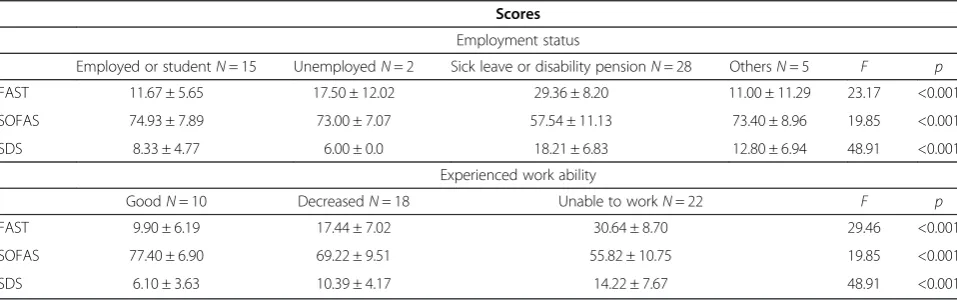
Table 3 FAST, SOFAS, and SDS scores according to employment status and experienced work ability
Scores
Employment status
Employed or studentN= 15 UnemployedN= 2 Sick leave or disability pensionN= 28 OthersN= 5 F p FAST 11.67 ± 5.65 17.50 ± 12.02 29.36 ± 8.20 11.00 ± 11.29 23.17 <0.001
SOFAS 74.93 ± 7.89 73.00 ± 7.07 57.54 ± 11.13 73.40 ± 8.96 19.85 <0.001
SDS 8.33 ± 4.77 6.00 ± 0.0 18.21 ± 6.83 12.80 ± 6.94 48.91 <0.001
Experienced work ability
GoodN= 10 DecreasedN= 18 Unable to workN= 22 F p
FAST 9.90 ± 6.19 17.44 ± 7.02 30.64 ± 8.70 29.46 <0.001
SOFAS 77.40 ± 6.90 69.22 ± 9.51 55.82 ± 10.75 19.85 <0.001
and SDS give low scores with good functioning. FAST and SDS were correlated at both first evaluation (N= 50,
r= 0.742, p< 0.001) and second evaluation (N= 25, r= 0.773, p< 0.001). Validity based on functioning at work according to FAST and SDS domains was examined. FAST occupational functioning domain (8.86 ± 6.29) and SDS work domain (5.28 ± 3.15) correlated positively (r= 0.738, p< 0.001). FAST correlated positively also with employment status and self-experienced work ability (Table 3).
Discussion
The Finnish version of FAST showed similar excellent psychometric properties as the original version regarding internal consistency and test-retest reliability. Further-more, the correlation with well-known previous scales assessing functioning, namely the SOFAS and the SDS, was high.
In addition to Spanish and English, the FAST has been translated into Italian (Moro et al. 2012, Barbato et al. 2013), Portuguese (Cacilhas et al. 2009), and Turkish (Aydemir and Uykur 2012) and now also Finnish. The psychometric properties of the Finnish version of FAST showed high internal consistency, in accord with earlier studies. Furthermore, the reliability of the scale, as evalu-ated by two different clinicians blind to each other’s findings, was excellent (correlation coefficient 0.896). FAST includes the following six areas of functioning: au-tonomy, occupational functioning, cognitive functioning, financial issues, interpersonal relationships, and leisure time. The reliability for domains regarding autonomy, occupational functioning, and cognitive functioning was excellent, whereas for domains regarding financial is-sues, interpersonal relationships, and leisure time, the reliability was good. These domains are potentially more difficult to assess over a short period. We also compared FAST with the commonly used and well-known scales of SOFAS and SDS. The correlations between FAST and SOFAS and between FAST and SDS were good. In addition, the correlation between FAST occupational functioning and SDS work domain was good. Finally, we investigated the validity of FAST according to employ-ment status and experienced work ability. The scores of employed subjects were significantly lower than the scores of subjects with sick leave or disability pension. Also, subjective ability to work correlated well with FAST scores. Thus, the results confirm previous findings that higher scores in FAST are associated with poorer functioning.
This study has some limitations. We did not have healthy controls to analyse the scale’s capacity to discrim-inate between patients and controls. However, previous studies have examined this and have reported the optimal cutoff on the FAST total score for discriminating patients
from controls to be 11 (Rosa et al. 2007, Moro et al. 2012) or 15 (Barbato et al. 2013). The sample size of the study was also modest. However, our results were statistically highly significant and similar to those of earlier studies. Furthermore, we did not investigate sensitivity to change, which is a critical feature of a scale in outcome studies, and it should be investigated in the future. However, in other studies, the original FAST has demonstrated suffi-cient sensitivity to change (Rosa et al. 2011; Torrent et al. 2013). Finally, the translation was conducted by the clin-ical research group in collaboration with researchers of the Barcelona Bipolar Disorders program. Issues of cross-cultural adaptation (see Epstein et al. 2015) were explicitly discussed between the two groups, and back-translation was undertaken, but no focus group or expert committee was available.
Conclusions
The psychometric validity and reliability of FAST in the Finnish sample of patients with bipolar disorder types I and II were good. The Finnish version of FAST is suitable for assessing functional impairment in bipolar disorder in both research and clinical practice. The study adds to the accumulating international literature documenting the validity of translated versions of the FAST in evaluation of impairment of patients with bipolar disorder.
Competing interests
This study was financially supported by the insurance company Etera. The authors declare that there are no other competing interests.
Authors’contributions
EI and KS designed the study protocol. KS, ES, SL, and TT participated in conducting the study. KS did the statistical analyses and drafted the manuscript. All authors were involved in the interpretation of data and have critically reviewed the manuscript for important intellectual content. All authors read and approved the final manuscript.
Acknowledgements
We are grateful to all those who gave their consent to participate in this study and to Adriane Ribeiro, Caterina Bonnin, and Eduard Vieta for their kind and generous help in training and translation. This study was financially supported by Etera.
Author details
1City of Helsinki, Social services and health care, Department of mental
health and substance abuse, Bipolar Disorder Research and Treatment Centre, Nordenskiöldinkatu 20, 00250 Helsinki, Finland.2Department of
Psychiatry, University of Helsinki and Helsinki University Hospital, Välskärinkatu 12, 00260 Helsinki, Finland.
Received: 31 December 2014 Accepted: 16 March 2015
References
Aydemir O, Uykur B. Reliability and validity study of the Turkish version of functioning assessment short test in bipolar disorder. Turk Psikiyatri Derg. 2012;23:193–200.
Cacilhas AA, Magalhães PV, Ceresér KM, Walz JC, Weyne F, Rosa AR, et al. Validity of a short functioning test (FAST) in Brazilian outpatients with bipolar disorder. Value Health. 2009;12:624–7.
Epstein J, Santo RM, Guillemin F. Cross-cultural adaptation of questionnaires: review of concepts and current guidelines. Journal of Clinical Epidemiology. 2015. doi:10.1016/j.jclinepi.2014.11.021.
First MB, Spitzer R, Gibbon M. Structured clinical interview for DSM-IV axis I disorders biometrics research department edition. Washington DC, American Psychiatric Press Inc; 1997.
Goldman HH, Skodol AE, Lave TR. Revising axis V for DSM-IV: a review of measures of social functioning. Am J Psychiatry. 1992;149:1148–56. González-Ortega I, Rosa A, Alberich S, Barbeito S, Vega P, Echeburúa E, et al.
Validation and use of the functioning assessment short test in first psychotic episodes. J Nerv Ment Dis. 2010;198:836–40.
Guilera G, Gómez-Benito J, Pino Ó, Rojo E, Vieta E, Cuesta MJ, et al. For the spanish working group in cognitive function. Disability in bipolar I disorder: the 36-item world health organization disability assessment schedule 2.0. J Affect Disord. 2014;174C:353–60.
Hays RD, Morales LS. The RAND-36 measure of health-related quality of life. Ann Med. 2001;33:350–7.
Michalak EE, Murray G, CREST.BD. Development of the Qol:BD: a disorder-specific scale to assess quality of life in bipolar disorder. Bipolar Disord. 2010;12:727–40. Moro MF, Colom F, Floris F, Pintus E, Pintus M, Contini F, et al. Validity and
reliability of the Italian version of the Functioning Assessment Short Test (FAST) in bipolar disorder. Clin Pract Epidemiol Ment Health. 2012;8:67–73. Rosa AR, Reinares M, Amann B, Popovic D, Franco C, Comes M et al. Six-month
functional outcome of a bipolar disorder cohort in the context of a specialized-care program. Bipolar Disord. 2011;13:679–686.
Rosa AR, Sánchez-Moreno J, Martínez-Aran A, Salamero M, Torrent C, Reinares M, et al. Validity and reliability of the Functioning Assessment Short Test (FAST) in bipolar disorder. Clin Pract Epidemiol Ment Health. 2007;3:5.
Rotger S, Richarte V, Nogueira M, Corrales M, Bosch R, Vidal R, et al. Functioning Assessment Short Test (FAST): validity and reliability in adults with attention-deficit/hyperactivity disorder. Eur Arch Psychiatry Clin Neurosci.
2014;264(8):719–27.
Sheehan DV, Harnett-Sheehan K, Raj BA. The measurement of disability. Int Clin Psychopharmacol. 1996;11 Suppl 3:89–95.
Torrent C, Bonnin CM, Martinez-Aran A, Valle J, Amann BL, González-Pinto A, et al. Efficacy of Functional Remediation in Bipolar Disorder: A Multicenter Randomized Controlled Study. Am J Psychiatry. 2013;170:852–859.
Vieta E. Guide to assessment scales in bipolar disorder. 2nd ed. London: Springer Healthcare; 2010.
Ware JE, Kosisnki M, Keller SD. SF-36 physical and mental health summary scales: a user’s manual. Boston: The Health Institute; 1994.
Weissman MM, Bothwell S. Assessment of social adjustment by patient self-report. Arch Gen Psychiatry. 1976;33:1111–5.
Whiteford HA, Degenhardt L, Rehm J, Baxter AJ, Ferrari AJ, Erskine HE, et al. Global burden of disease attributable to mental and substance use disorders: findings from the Global Burden of Disease Study 2010. Lancet.
2013;382:1575–86.
Submit your manuscript to a
journal and benefi t from:
7Convenient online submission 7Rigorous peer review
7Immediate publication on acceptance 7Open access: articles freely available online 7High visibility within the fi eld
7Retaining the copyright to your article