Original Research Article
Teaching and assessment of basic clinical communication skills among
undergraduate third year medical students in Gujarat
Krutarth Brahmbhatt, Kaushik Lodhiya*
INTRODUCTION
One of the core clinical skills for the practice of medicine is “communication with patients”. It can be defined as observable behaviours and also specific tasks that include interviewing the patient to obtain a complete medical history, explaining the diagnosis and also the prognosis, taking informed consent of the patient to undergo
diagnostic and therapeutic procedures after giving therapeutic instructions and information, and providing counselling to motivate participation in therapy or lifestyle change or to relieve symptoms.1,2
Good communication skills are essential components of physician-training. Effective communication between the doctor and the patient leads to better compliance to suggested lifestyle changes and treatment, better health ABSTRACT
Background: Good communication skills are essential components of physician-training. Effective communication between the doctor and the patient leads to better compliance, better health outcomes, decreased litigation, and higher satisfaction both for doctors and patients. The acquisition of communication and interpersonal skills is recognized and documented as a core competency for physician training in many countries. In the absence of proper training, Indian medical graduates often have less than adequate communication skills and the demand for formal training in this area has often been echoed. Aim and objectives wereto know the attitude and ascertain the change in attitude, assess basic communication skills, ascertain the change in basic clinical communication skills (before and after training) and to impart training regarding communication skills by using different teaching learning methods to undergraduate medical students (third year).
Methods: An interventional study was conducted using convenience sampling method. Assessment of attitude, communication skills and self-competence of communication skills was done using standardized questionnaires. Data analysis was done by using appropriate statistical tests.
Results: Total 60 students participated in the study. The change in the mean scores of pre-training and post-training attitude, SEGUE (set the stage, elicit information, give information, understand patient‟s perspective, end the encounter) framework score and self-assessment of communication competence scores were statistically significant before and after training.
Conclusions: After training undergraduate medical students by using variety of effective training methods; their attitude towards learning communication skills changed positively and their basic clinical communication skills improved significantly.
Keywords: Communication skills, Medical education, Medical graduate, Training Department of Community Medicine, GMERS Medical College, Junagadh, Gujarat, India
Received: 15 February 2019 Revised: 04 March 2019 Accepted: 05 March 2019
*Correspondence: Dr. Kaushik Lodhiya,
E-mail: [email protected]
Copyright: © the author(s), publisher and licensee Medip Academy. This is an open-access article distributed under the terms of the Creative Commons Attribution Non-Commercial License, which permits unrestricted non-commercial use, distribution, and reproduction in any medium, provided the original work is properly cited.
outcomes, decreased legal conflicts, and higher satisfaction both for doctors and patients.3-6 Some of the common barriers to good communication include use of medical terminology, communicating in a language that‟s difficult for the patient to understand, arrogance, inadequate time given to the doctor-patient encounter, and interrupting the patient frequently while the patient is narrating his/her problems.7-9 Doctors should be supportive, empathetic, non-judgemental, honest and open towards their patients‟ illness, side effects of medication and expected relief in symptoms.10 Patients appreciate those doctors who listen them actively, encourage them to ask clarifying questions, check for their understanding, and value their privacy and comfort.8 In building rapport between the doctor and the patient; the non-verbal aspects of communication such as body language, eye contact, facial expression, touch, gestures, and interpersonal distance also play very important role. Doctors also have to communicate in writing for clinical documentation and referrals, which have important medico-legal implications. Effective communication goes a long way in building a relationship of trust between doctors and patients.10,11
Although medical students may learn some basic communication skills consciously or subconsciously by merely observing their teachers; these are not adequate to exhibit good communication skills in their professional careers.12 Also not all senior physicians are good role models and they may not demonstrate good communication skills in their work each time. During interpersonal interactions in clinical settings, teachers display both positive and negative role model behaviours. Though not explicitly taught, these unspoken messages form part of the „hidden curriculum‟, which influences students‟ development as physicians.13,14
Medical students themselves, and several professional bodies, have acknowledged the need to incorporate communication skills training within the formal curriculum.15-18
The acquisition of communication and interpersonal skills is recognized and documented as a core competency for physician training in many countries.18-20 In India, while this is included as a requirement in the 1997 graduate medical education (GME) regulations of the medical council of India (MCI), they are not being taught or assessed in most medical colleges.21 Due to this, Indian medical students often have less than adequate communication skills and the demand for formal training in this area has often been mentioned.22-26 The vision 2015 document of the MCI mentions the need to schedule dedicated time for training in communication skills for Indian medical graduates.27 They are expected to communicate appropriately with patients, families, colleagues and community, and behave as leaders and members of the health care team and system. The document proposes a two-month foundation course at the
beginning of phase 1 where communication skills‟ training is one of the many objectives.
Aim of the study was to make undergraduate medical students competent in basic clinical communication skills.
Specific objectives
To know the attitude and ascertain the change in attitude of undergraduate medical students (third year) towards learning communication skills (before and after training).
To assess basic communication skills and ascertain the change in basic clinical communication skills of undergraduate medical students of 3rd year (before and after training).
To impart training regarding communication skills by using different teaching learning methods; to undergraduate medical students of 3rd year.
To know the communication competence of students (self-assessed by them) before and after training regarding communication skills.
METHODS
An interventional study was conducted from May to November 2018 in the department of community medicine at GMERS Medical College, Junagadh. Students from third M.B.B.S were voluntarily invited to participate in the study. Students who did not gave consent to participate in the study and the students who were absent during pre-training assessment, during training part or post-training assessment were excluded. Total 60 students had participated in the study.
Research proposal was sent well in advance to institutional ethics committee (IEC) for approval and then the study was started.
Data collection tools
Students‟ attitude towards learning and importance of communication skills was assessed using communication skills attitude scale. The communication skills attitude scale (CSAS) consists of 26 items, 13 of which are written in the form of positive statements and 13 negative statements about communication skills learning. Each item is accompanied by a 5-point Likert scale, ranging from 1 (strongly disagree) to 5 (strongly agree). The items in the scale has got good internal consistency (cronbach‟s alpha: 0.80) and satisfactory test-retest reliability.28 Brief instructions regarding the scale were given and it was self-administered by the participants.
The assessment was done by the faculty using SEGUE framework guide. The SEGUE framework contains 25 items divided into 4 content areas (set the stage; elicit information; understand the patient‟s perspective; and end the encounter). The scoring was done after the student‟s encounter was over. The summary scores were generated by assigning a value of „1‟ to „yes‟ and „0‟ to „no‟ for each item. The SEGUE framework has a high degree of acceptability, can be used reliably, has evidence of validity, and is applicable to a variety of contexts.29
The students also did self-assessment of communication competence using self-rating communication competence questionnaire. The questionnaire contains 17 questions and students were instructed to give a score from 1 to 10 (1 being the least and 10 being the highest competence) for each question.
The students were taught communication skills by using variety of teaching-learning methods like lectures, showing videos, demonstration of an encounter with the standardized patient by the principal researcher himself and role play by the students themselves. Total 3 lectures of one hour each were taken. Students were given enough time and opportunities to ask and clarify any doubts they had after the lectures and demonstration. Two students voluntarily performed a role play and the peer assessment was done and feedback was given. The teaching incorporated the aspects mentioned under SEGUE framework and self-rating of communication competence questionnaire. The next day students were again assessed using the same questionnaire: communication skills attitude scale, SEGUE framework guide and self-rating communication competence questionnaire in the same manner as it was done before training.
Data entry and statistical analysis
Data entry was done in Microsoft excel sheet and data was analysed using descriptive statistics like frequencies and percentage. Mean scores for communication skills attitude scale, SEGUE framework and self-rating communication competence questionnaire were
calculated. “Shapiro-wilk test” was used as a test of normality and then “paired t test” was applied as a test of significance. P<0.05 was considered statistically significant. Data analysis was done using SPSS 16.0 software. No missing data were found.
RESULTS
Total 60 students participated in the study. The mean age of the students was 21±0.7 years. Twenty-two students (37%) were females and 38 (63%) were males.
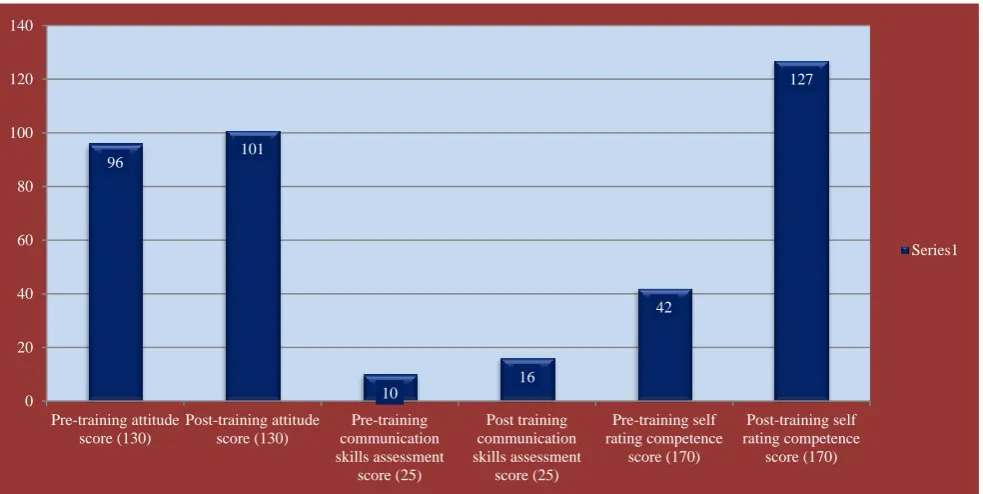
The mean score of pre-training and post-training: attitude scale, assessment by SEGUE framework (score), self-rating of communication competence is illustrated in Figure 1.
Figure 1: Flow chart for the events.
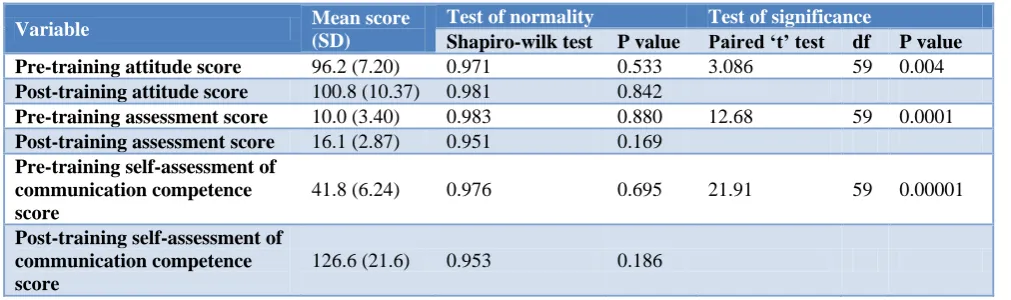
Table 1: Inferential statistics of communication skills scores obtained by students.
Variable Mean score
(SD)
Test of normality Test of significance
Shapiro-wilk test P value Paired ‘t’ test df P value
Pre-training attitude score 96.2 (7.20) 0.971 0.533 3.086 59 0.004
Post-training attitude score 100.8 (10.37) 0.981 0.842
Pre-training assessment score 10.0 (3.40) 0.983 0.880 12.68 59 0.0001 Post-training assessment score 16.1 (2.87) 0.951 0.169
Pre-training self-assessment of communication competence score
41.8 (6.24) 0.976 0.695 21.91 59 0.00001
Post-training self-assessment of communication competence score
126.6 (21.6) 0.953 0.186
Self rating of communication cometence by the students Clinical encounter with a standardized patient; assessed by a faculty
Communication skills attitude scale administered Communication skills taught by using a variety of teaching learning
methods
Self rating of communication competence by the students Clinical encounter with a standardized patient; assessed by a faculty
The difference between pre and post training mean attitude score was found statistically significant (p=0.004). The difference between pre and post training communication skills assessment mean score was found highly significant (p=0.0001). The difference between mean scores of pre and post training self-assessment of communication competence by the students was also found highly significant (p=0.00001) (Table 1).
Thirty-two students (53%) had pre-training attitude score that was <75% which decreased to nineteen students (32%) having post-training attitude score of <75%.
The mean pre-training attitude score among females was 98.3±6.5 while in males it was 95.3±7.1.
The mean post-training attitude score among females was 102.1±11.13 while in males it was 100.6±9.72.
The mean pre-training communication skills assessment score among females was 10.0±2.97 while in males it was 10.3±3.50.
The mean post-training communication skills assessment score among females was 15.8±2.89 while in males it was 16.4±2.81.
Figure 2: Communication skills-pre and post training status (n=60).
DISCUSSION
Effective communication between the doctor and the patient leads to better compliance, better health outcomes, decreased litigation, and higher satisfaction both for doctors and patients. The communication skills were taught and assessed in the present study by using SEGUE framework.
Communication skills of students improved significantly after training as per the assessment done by faculties by using the checklist. Self-assessment of communication competence done by students also showed significant improvement after training (Table 1).
Forty six students had pre-training communication skills assessment score <50%, which decreased significantly to only 3 students having <50% post-training communi-cation skills assessment score. It means 95% students had scored ≥50% in the post-training communication skills assessment. Similar finding was reported from a study
where 90% students were communicating better after training.30
In the present study authors found significant change in attitude of undergraduate medical students towards learning communication skills after training. Positive attitude increases by perceived relevance of the skills by the students and the similar finding was reported by another study.31
The present study revealed that female students had higher positive attitude towards learning communication skills compared to males. Similar result was reported by another study done in Saudi Arabia.32
Communication skills of undergraduate medical students can be improved by teaching the same; using standard methods at department level.
Acquired communication skills decline shortly after training and therefore a longitudinal incorporation of
96 101
10
16
42
127
0 20 40 60 80 100 120 140
Pre-training attitude score (130)
Post-training attitude score (130)
Pre-training communication skills assessment
score (25)
Post training communication skills assessment
score (25)
Pre-training self rating competence
score (170)
Post-training self rating competence
score (170)
Imparting communication skills will go a long way in building a relationship of trust and mutual respect between the doctors and the patients.
Strengths: to ascertain students‟ attitude towards learning communication skills we had used communication skills attitude scale which has got good internal consistency and reliability. We had used standardized “SEGUE” framework for teaching and assessment of communi-cation skills to the students. Standardized patients were used to teach and assess the communication skills to the students.
CONCLUSION
After teaching undergraduate medical students by using variety of effective teaching learning methods; their attitude towards learning communication skills changed positively and their basic clinical communication skills improved significantly. Students self-rating of communication competence also improved significantly.
ACKNOWLEDGEMENTS
The authors thank all the study participants without whom this study would not have been possible. The authors are also thankful to all departmental colleagues and medical social workers of our department for their support. Finally the authors express their gratitude for Faculties of Nodal centre for Advance Course in Medical Education–Karamsad, for their continuous guidance for the project.
Funding: No funding sources Conflict of interest: None declared
Ethical approval: The study was approved by the Institutional Ethics Committee
REFERENCES
1. Coulehan JL, Block MR. The Medical Interview: Mastering Skills for Clinical Practice, 4th ed. Philadelphia: FA Davis Company; 2001.
2. Cole SA, Bird J. Medical Interview: The Three-Function Approach. Philadelphia: Mosby; 2000: 7-13.
3. Deveugele M, Derese A, De Maesschalck S, Willems S, van Driel M, De Maeseneer J. Teaching communication skills to medical students, a challenge in the curriculum? Patient Educ Couns. 2005;58:265-70.
4. Rider EA, Hinrichs MM, Lown BA. A model for communication skills assessment across the undergraduate curriculum. Med Teach. 2006;28:127-34.
5. Laidlaw A, Hart J. Communication skills: An essential component of medical curricula. Part I: Assessment of clinical communication: AMEE Guide No.51. Med Teach. 2011;33:6-8.
6. Tamblyn R, Abrahamowicz M, Dauphinee D, Wenghover E, Jacques A, Klass D, et al. Physician scores on a national clinical skills examination as predictors of complaints to medical regulatory authorities. J Am Med Assoc. 2007;298:993-1001. 7. Shendurnikar N, Thakkar PA. Communication skills
to ensure patient satisfaction. Indian J Pediatr. 2013;80:938-43.
8. Rowland-Morin PA, Carroll JG. Verbal communication skills and patient satisfaction. Eval Health Prof. 1990;13:168-85.
9. Silverman J, Kinnersley P. Doctors‟ non-verbal behavior in consultations: look at the patient before you look at the computer. Br J Gen Pract. 2010;60:76-8.
10. Mehta PN. Communication skills – Talking to parents.Indian Pediatr. 2008;45:300-4.
11. Anshu, Singh T. The art of talking to patients. In: Patwari AK, Sachdev HPS (editors). Frontiers in Social Pediatrics. New Delhi: Jaypee Brothers; 2016: 199-209.
12. Aspegren K, Lonberg-Madsen P. Which basic communication skills in medicine are learnt spontaneously and which need to be taught and trained? Med Teach. 2005;27:539-43.
13. Gaufberg EH, Batalden M, Sands R, Bell SK. The hidden curriculum: What can we learn from third-year medical student narrative reflections? Acad Med. 2010;85:1710-6.
14. Benbassat J. Undesirable features of the medical learning environment: A narrative review of the literature. Adv Health SciEduc Theory Pract. 2013;18:527-36.
15. Laidlaw TS, MacLeod H, Kaufman DM, Langille DB, Sargeant J. Implementing a communication skills programme in medical school: Needs assessment and programme change. Med Educ. 2002;36:115-24.
16. Learning objectives for medical student education. Medical School Objectives Project. Washington DC: Association of American Medical Colleges; 1998.
17. Simpson J, Furnace J, Crosby J, Cumming A, Evans P, Friedman M, et al. The Scottish doctor–learning outcomes for the medical undergraduate in Scotland: A foundation for competent and reflective practice. Med Teach. 2002;24:136–43.
18. General Medical Council. Tomorrow‟s doctors: Outcomes and standards for undergraduate medical education. London: GMC, 2009. Available at: http://www.gmcuk.org/Tomorrow_s_Doctors_1214. pdf_48905759.pdf. Accessed on 18 February 2019. 19. Accreditation Council for Graduate Medical
Education. General Competencies: ACGME Outcome Project 2001. Available at: http://umm.edu/professionals/gme/ competencies. Accessed on 18 February 2019.
College of Physicians and Surgeons of Canada; 2005. Available at: http://www.royalcollege. ca/portal/page/portal/rc/common/documents/canmed s/resources/publications/framework_full_e.pdf. Accessed on 18 February 2019.
21. Regulations on Graduate Medical Education, 1997. Medical Council of India. Available at: http://www.mciindia.org/ Rules-and Regulation/ GME_REGULATIONS.pdf. Accessed on 18 February 2019.
22. Sood R, Adkoli BV. Medical education in India- Problems and prospects. J Indian Acad Clin Med. 2000;1:210-2.
23. Verma M, Singh T. Communication skills for clinical practice: Fad or necessity? Indian Pediatr. 1994;31:237-8.
24. Chhatwal J. Creating a demand for communication skills training in India. Med Educ. 2009;43:478. 25. Supe AN. Interns‟ perspective about communicating
bad news to patients: A qualitative study. Educ Health. 2011;24:541.
26. Choudhary A, Gupta V. Teaching communication skills to medical students: Introducing the fine art of medical practice. Int J App Basic Med Res. 2015;5:41-4.
27. Vision 2015. Medical Council of India. 2011. Available at: http://www.mciindia.org/tools/ announcement/MCI_booklet.pdf. Accessed on 18 February 2019.
28. Rees C, Sheard C, Davies S. The development of a scale to measure medical students' attitudes towards communication skills learning: the Communication Skills Attitude Scale (CSAS). Med Edu. 2002;36:141-7.
29. Makoul G. The segue framework for teaching and assessing communication skills. Patient Edu Counsel. 2001;45:23-34.
30. Choudhary A, Gupta V. Teaching communications skills to medical students: Introducing the fine art of medical practice. Int J App Basic Med Res. 2015;5:41-4.
31. Neupane MS, Neupane HC, Adhikari S, Aryal B. Attitude Towards learning communication skills in medical students of Chitwan Medical College, Chitwan, Nepal. Int J Pharm Biol Arch. 2012;3:1058-61.
32. Alotaibi FS. Attitudes of medical students toward communication skills learning in Western Saudi Arabia. Saudi Med J. 2016;37(7):791–5.