Original Research Article
An epidemiological study of injuries in an urban slum community
in the metropolitan city of Mumbai
Dasi H. Rao, Harshalkumar N. Mahajan*
INTRODUCTION
In India, injuries account for an estimated 15% of total deaths and 15% of disability adjusted life years (DALYs). Consequently, an estimated 1.5 million people die as a result of injuries and 15-20 million are hospitalized with resulting economic losses of 3% of gross domestic product (GDP) for the country.1 Every year, injuries contribute to a significant number of deaths, hospitalizations (for short and long periods), emergency care, disabilities (physical, social and psychological), amputations, disfigurement, pain, suffering and agony. Many children become orphans, women become destitute
and the elderly grieve in isolation. In addition, injuries also result in disruption of several activities leading to loss of work, income, education and other social activities, causing long term suffering among survivors and families.2
Many injuries are linked to social, environmental, cultural and biological issues in causation which are recognized as man-made and behavior linked disorders. Even common people don't consider injuries as preventable events. As most of them are accidental and happen all of a sudden, the impact of injuries on the human life is greater. The major challenges faced today
ABSTRACT
Background: In India, injuries account for an estimated 15% of total deaths and 15% of disability adjusted life years (DALYs) with resulting economic losses of 3% of gross domestic product (GDP) for the country. Learning about injuries is the first step to reduce the risks of injuries in the community. The objectives of the study were to describe the nature of injuries and their relationship to select epidemiological variables and also to assess the type of health facility accessed and the cost incurred therein.
Methods: A descriptive cross-sectional study was carried out from May 2016 to October 2017. A recall period of three months for minor injuries & one year for major injuries or deaths due to injury was used. Data was collected by using semi-structured, pre-designed, pre-tested and open-ended questionnaires.
Results: In this study, 70.7% subjects were male and 29.3% were female. There were 216 injuries either affecting work or for which treatment was availed, out of which 170 did not have knowledge about first-aid. 44.4% of study subjects belonged to 25- 44 years and 35.6% injured were daily wage-earners. 37.96% of injuries were caused by road traffic accident and 19.9% found to have suffered from cut injuries and there were 5 deaths. 48.3% study subject took treatment in the government hospital because of the affordable cost.
Conclusions: This study can help the integrated disease surveillance program to plan data collection on injuries occurring in the community in order to get a comprehensive picture of total morbidity.
Keywords: Injuries, Healthcare facility, Mechanism and nature
Department of Community Medicine, Lokmanya Tilak Muncipal Medical College and General Hospital, Sion, Mumbai, Maharashtra, India
Received: 13 December 2018
Accepted: 29 December 2018
*Correspondence:
Dr. Harshalkumar N. Mahajan, E-mail: [email protected]
Copyright: © the author(s), publisher and licensee Medip Academy. This is an open-access article distributed under the terms of the Creative Commons Attribution Non-Commercial License, which permits unrestricted non-commercial use, distribution, and reproduction in any medium, provided the original work is properly cited.
by injuries are prevention, acute and long-term care, and rehabilitation. The study of injuries with respect to these factors is essential to decide the preventive strategies.2
Recent progress in industrialization and use of vehicles, increased number of people living in crowded and unsafe settlements, coupled with inaccessible and unaffordable emergency health services also contribute to the higher health burden of injury in the developing regions of the world.3 In India, very few community-based studies have been conducted on injuries. While the mortality data on injuries could be available with less effort, the data on non-fatal injuries is very difficult to obtain. Learning about injuries is the first step to reduce the risks of injuries in the community. Hence, need was felt to conduct a study to assess the multi-factorial nature of the injuries.
Objectives
To estimate the incidence of unintentional injury in a urban community
To describe the nature of injuries and their
relationship to select epidemiological variables
To assess the type of health facility accessed and the cost incurred.
METHODS
A descriptive cross-sectional study was conducted in Babrekar nagar which is field practice area of Department of Community Medicine of Lokmanya Tilak Municipal Medical College and General Hospital, Sion, Mumbai during the period from May 2016 to October 2017. The study population was persons having any type of injury in
household of surveyed population in field practice area of Department of Community Medicine. A recall period of three months for minor injuries and one year for major injuries or deaths due to injury was used. The total population of selected area is approximately 4500. There are total 726 houses (family size approximately 6), which are distributed in 8 lanes. The annual incidence of injury was found to be from 7 to 14 per 100 in various studies. By using the formula, 4PQ/L2; where P=annual incidence of injuries, Q=100-P and L=allowable error (20% of P). The population to be covered from the above calculation of any randomly selected area should be 1270 i.e. approximately 211 houses. They were numbered according to micro-planning of intensive pulse polio immunization. The houses were selected by systematic random sampling. By calculating the sampling interval, every third house was selected. Data thus collected by using semi-structured, pre-designed, pre-tested and open-ended questionnaires, data was analyzed with the help of Microsoft excel and SPSS Software version-21.
RESULTS
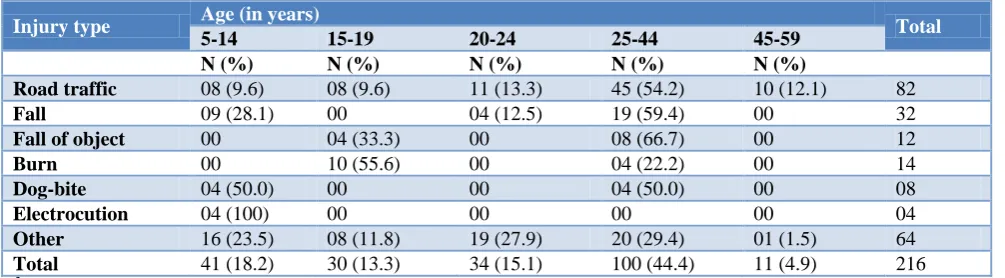
It was seen from Table 1 that 159 (70.7%) subjects were male and 66 (29.3%) were female and there were 216 injuries either affecting work or for which treatment was availed, corresponding to an annual incidence of 19.4 per 100 populations (n=1270). Majority (44.4%) of study subjects belongs to 25-44 years age group followed by those in the 5-14 (18.2%) years of age group. Amongst the surveyed population, the leading type 82 (37.96%) of injury were caused by road traffic accident followed by injury caused due to fall i.e. 32 (14.81%) and burns 14 (6.48%). All the patients of dog bite and electrocution (not displayed in table) were treated on OPD (out patients department) basis.
Table 1: Distribution of study subjects according to mechanism of injury and age.
Injury type Age (in years) Total
5-14 15-19 20-24 25-44 45-59
N (%) N (%) N (%) N (%) N (%)
Road traffic 08 (9.6) 08 (9.6) 11 (13.3) 45 (54.2) 10 (12.1) 82
Fall 09 (28.1) 00 04 (12.5) 19 (59.4) 00 32
Fall of object 00 04 (33.3) 00 08 (66.7) 00 12
Burn 00 10 (55.6) 00 04 (22.2) 00 14
Dog-bite 04 (50.0) 00 00 04 (50.0) 00 08
Electrocution 04 (100) 00 00 00 00 04
Other 16 (23.5) 08 (11.8) 19 (27.9) 20 (29.4) 01 (1.5) 64
Total 41 (18.2) 30 (13.3) 34 (15.1) 100 (44.4) 11 (4.9) 216
X2=12.396; d.f.=3; p=0.015 (statistically significant).
It was seen from Table 2 that 19.9% study subjects found to have suffered from cut injuries followed by fracture 18.9%. The percentage of study subjects suffering from laceration and abrasion were 15.3% and 13.8% respectively; whereas the percentage of concealed injury, contusion and penetrating injury respectively was 6%, 9.7% and 7.9%. About 8.3% suffered from burn injury and 3.6% study subjects had other type of injury like blunt trauma.
Table 2: Distribution of study subjects according to nature of injury.
Nature of injury Frequency Percentage (%)
Abrasion 30 13.8
Cut 43 19.9
Concealed 13 6.0
Contusion 21 9.7
Fracture 41 18.9
Laceration 33 15.3
Penetrating 17 7.9
Burn 18 8.3
Total 216 100.0
Table 3: Distribution of study subjects according to severity of injury, abbreviated injury scale score and hospitalization status.
Severity of injury Abbreviated injury scale
score
Hospitalized z value
p value
Yes (%) No (%)
Minor 1 00 113 (72.9)
Z=12.595 P=0.0001
Moderate 2 04 (6.0) 42 (27.1)
Serious 3 17 (25.4) 00
Severe 4 41 (61.1) 00
Un-Survivable 6 05 (7.5) 00
Total - 67 (100) 165 (100)
Table 4: Distribution of study subjects according to type of health care facility used and its reasons.
Health care facility
Reasons for using
No. (%) Total
Preference Proximity Treatment cost Other
Govt. hospital 06 (10.3) 04 (6.9) 28 (48.3) 20 (34.5) 58
Govt. dispensary 12 (40.0) 18 (60) 00 00 30
Private clinic 57 (58.2) 29 (29.6) 00 12 (12.2) 98
Private hospital 24 (80.0) 05 (16.7) 00 01 (3.3) 30
Total 99 (44.6) 56 (22.2) 28 (15.3) 33 (14.9) 216
X2=27.39; d.f.=3; p=0.0001 (statistically significant).
Table 5: Occupation status of study subjects.
Occupation Frequency Percentage (%)
Government 16 7.5
Private 41 18.9
Daily worker 77 35.6
Unemployed 04 1.8
Student 47 21.7
Housewife 25 11.6
Retired 05 2.3
Total 216 100
Table 6: Distribution of study subjects according to cost of treatment and money borrowed.
Cost of treatment (In Rs.) Money borrowed Total
Yes No
0-500 24 (32.4) 122 (83.5) 146
500-1000 08 (10.8) 00 08
1000-10000 38 (51,4) 07 (4.7) 45
>10000 04 (5.4) 13 (8.8) 17
Total 74 142 216
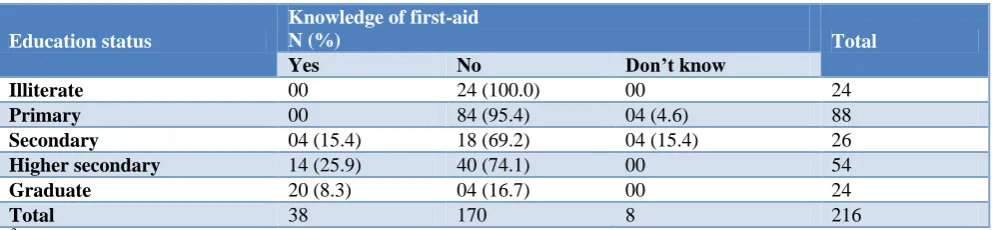
Table 7: Distribution of study subjects according to education status and first aid knowledge.
Education status
Knowledge of first-aid
N (%) Total
Yes No Don’t know
Illiterate 00 24 (100.0) 00 24
Primary 00 84 (95.4) 04 (4.6) 88
Secondary 04 (15.4) 18 (69.2) 04 (15.4) 26
Higher secondary 14 (25.9) 40 (74.1) 00 54
Graduate 20 (8.3) 04 (16.7) 00 24
Total 38 170 8 216
X2=52.789; d.f.=1; p=0.0001 (statistically significant).
It was seen from Table 4 that 48.3% study subject who took treatment in the government hospital because of the affordable treatment cost. 60.0% study subject who took treatment in the government dispensary because of the proximity of the health care facility. 58.2% and 80.0% study subject preferred to take treatment in the private clinic and the private hospital respectively. The association between the health care facility used and the reason is found to be statistically significant.
It was seen from Table 5 that 35.6% study subjects were daily workers, while 21.7% were students. The study subjects working in private and government were found to be 18.9% and 7.5% respectively. About 11.6% were housewife while 2.3% were retired. About 1.8% study subjects were unemployed.
It was seen from Table 6 that 32.4% study subjects who borrowed money for treatment of injury, the cost of treatment of injury was less than Rs. 500/-. In 10.8% study subjects who borrowed money for treatment of injury, the cost of treatment of injury was between Rs. 500-1000. In 51.4% study subjects who borrowed money for treatment of injury, the cost of treatment of injury was between Rs.1000-10000. The association between the total income of family of study subject and money borrowed for treatment of injury was found to be statistically significant.
It was seen from Table 7 that all illiterate were not having knowledge of First-Aid. 95.4% study subjects whom educational status is up to primary level were not having knowledge of first aid. 15.4% study subjects whom educational status is up to secondary level were having knowledge of first aid. 25.9% study subjects whom educational status is up to higher secondary level were having knowledge of first aid. 83% study subjects whom educational status is up to graduate level were having knowledge of first aid. The association between the educational status and the first aid knowledge was found to be statistically significant.
DISCUSSION
This is an epidemiological study of factors responsible for morbidity, disability and mortality among study
subjects due to injuries in an urban slum of a Metropolitan city (n=1270). In the study sample, there were 216 injuries either affecting work or for which treatment was availed, corresponding to an annual incidence of 19.4 per 100 population. About 8 study subjects were found to have died due to injury corresponding to an annual rate of 7 per 1000 population. Amongst the surveyed population, the leading type 82 (37.96%) of injury were caused by road traffic accident followed by injury caused due to fall i.e. 32 (14.81%) and burns 14 (6.48%). Whereas the study done by Sharma M et al in 2013 found that the three-leading mechanism of injury were Fall 44 (33.8%) followed by road traffic accident 40 (28.2%) and stuck or hit by person or object 16 (11.3%).4 Other study done by Konda et al showed that majority of the participants (77.8%) fell in indoor settings and 22.2% fell outdoor settings. In the house, most of the fall incidents injuries occurred in living room (23.8%) followed by the bathroom and kitchen (19%), and bedroom and on the stairs (9.6%).5
Majority (44.4%) of study subjects belongs to 25-44 years age group followed by 18.2% in the 5-14 years of age group. Whereas in a study conducted in Delhi by Verma and Tewari found that the number of injuries was the highest 48% among the 5-25 years age group followed by 28% in the 25-45 age group.6
In the present study, dog-bite injury was common among the children between 5-14 years, whereas study done by Parmeswaran et al revealed that injuries caused by dog-bite were 29 (25%) in the same age group.7 About 19.9% study subjects found to have suffered from cut injuries followed by fracture 18.9%. The percentage of study subjects suffering from laceration and abrasion were 15.3% and 13.8% respectively; whereas the percentage of concealed injury, contusion and penetrating injury was 6%, 9.7% and 7.9% respectively. About 8.3% suffered from burn injury. 3.6% study subjects had other type of injury like blunt trauma. Whereas, in a study conducted by Patil et al found that majority of injuries caused by fractures were 190 (54.3%).8
health care facility. About 58.2% and 80% study subject preferred to take treatment in the private clinic and the private hospital respectively. Whereas a study done by Lamawansa and Piyathilake, about 42 (49.4%) took treatment at the government facility and 20 (23.5%) took treatment in private institution.9
In the present study, 88 (40.7%) were educated till primary level followed by higher secondary school 54 (25%), secondary school 26 (12%). Whereas a study done by Jha et al found that 107 (21.4%) had education upto 5th class. Ninety-five (19.3%) were educated upto 8th class, while 82 (16.6%) were illiterates. Victims with a higher education (matriculation and above) were fewer in proportion.10
About 35.6% study subjects were daily worker, while 21.7% were students. The study subjects working in private and government were found to be 18.9% and 7.5% respectively. About 11.6% were housewife while 2.3% were retired. Only 1.8% study subjects were unemployed. Whereas a study done by Jha et al found laborers (29.9%) to be highest in number among the injured. Persons who were employed in service were the next largest group with 157 (21.6%) injured and 115 (15.8%) students were involved in accidents.10
In present study, the ratio of deaths: serious injuries: minor injuries were 1:12:23 however, a recent working committee report for the planning commission after examining available national data estimated the ratio of deaths: serious injuries: minor injuries as 1:15:70.11 Many injuries are linked to social, environmental, cultural and biological issues in causation which are recognized as man-made and behavior linked disorders. Even common people don't consider injuries as preventable events.
CONCLUSION
This study can help the Integrated Disease Surveillance Program to plan data collection on injuries occurring in the community to get a comprehensive picture. The cross-sectional nature of this study limits the causal interpretation of risk factors and types of injuries. It is necessary to undertake longitudinal follow up in that area. Despite the above mentioned limitations, this study allows useful conclusions to be drawn, which may be useful for developing preventive programs.
Funding: No funding sources Conflict of interest: None declared
Ethical approval: The study was approved by the Institutional Ethics Committee
REFERENCES
1. Gumber A. Burden of injury in India: Utilization and Expenditure Pattern Utilization and Expenditure Pattern, Takemi Program in International Health Working Paper 88, 1993-94.
2. Barss P, Smith A, Baker S, Mohan D. Injury
prevention: An international perspective.
Epidemiology, surveillance and policy. New York: Oxford University Press; 1998: 278-282.
3. Krug E. Injury: A leading cause of the global burden of disease. Geneva: WHO; 1999: 17-22.
4. Sharma M, Srivastava A, Singh B, Gupta SC.
Injuries in rural and urban areas of Agra district: an observational study. Indian J Community Health. 2013;25(4):480-7.
5. Konda S, Ravikumar BP, Giri PA. Risk Profiles for
Falls among Elderly People In South India. Natl J Community Med. 2018;9(9):730-4.
6. Verma PK, Tewari KN. An epidemiological study
of injuries in the area of Municipal Corporation of Delhi WHO Project No: ICP DPR 001; 2004: 6-14.
7. Parmeswaran GG, Kalaivani M, Gupta SK,
Goswami AK. Unintentional Childhood Injuries in Urban Delhi: A Community-Based Study. Indian J Community Med. 2017;42(1):8–12.
8. Patil SS, Kakade RV, Durgawale PM. Pattern of Road Traffic Injuries: A Study From Western
Maharashtra Indian J Community Med.
2008;33(1):56–7.
9. Lamawansa MD, Piyathilake A. Incidence of
Physical Injuries in a Rural Community in Sri Lanka: Results of the First Community Survey in
Sri Lanka, Indian J Community Med.
2008;33(4):238–42.
10. Jha N, Srinivasa DK, Roy G, Jagdish S.
epidemiological study of road traffic accident cases: a study from South India. Indian J Community Med 2004;29(1):25-8.
11. Report of the Working Group on Road Accidents, Injury Prevention and Control. New Delhi: Planning Commission, Government of India; 2001: 3-5.