Http://www.ijetmr.com©International Journal of Engineering Technologies and Management Research [1]
TO STUDY MECHANICAL PROPERTIES OF SPRING LIKE SPECIMEN
BEFORE AND AFTER DIFFERENT HEAT TREATMENT OPERATIONS
Amit Kumar *1
*1 Department of Mechanical Engineering, Arni University, Kathgarh, (H.P.) India
Abstract:
In this work we have analyzed the effect heat treatment on properties of spring shape steel specimens under various heat treatment processes. Specimen was subjected to heat treatment in electric muffle furnace. Heat treatment temperature, soaking time and cooling rate were selected as per phase diagram of specimen material. Specimen was tested for mechanical properties before and after heat treatment. Two processes annealing and normalizing compared with respect to their effect on properties of spring shape specimens in reference with standard data for steel used.
Keywords: Steel; Heat Treatment; Soaking; Cooling; Strength; Hardness.
Cite This Article: Amit Kumar. (2019). “TO STUDY MECHANICAL PROPERTIES OF SPRING LIKE SPECIMEN BEFORE AND AFTER DIFFERENT HEAT TREATMENT OPERATIONS.” International Journal of Engineering Technologies and Management Research, 6(6), 1-8. DOI: https://doi.org/10.29121/ijetmr.v6.i6.2019.388.
1. Introduction
Heat treatment is process widely used alter the physical and chemical properties of a material as per requirement. [1-19] Heat treatment is used to change mechanical properties such as hardness, elasticity, toughness, ductility, plasticity, strength, malleability. Heat treatment can involve the heating of a material and then chilling. In case of heat treatment annealing, quenching, tempering, case hardening, carburizing. [20-25] Present work was planned to study heat treatment process, in reference to their effect on properties of metal components used in various engineering application. The main objectives of this work are:
To study various heat treatment processes.
To study properties of spring shape specimen.
To analyze effect of heat treatment on mechanical properties of spring shape specimen.
To compare mechanical behavior before and after heat treatment.
2. Materials and Methods
Composition & properties of materials used and various Methods applied in present work are as follows:-
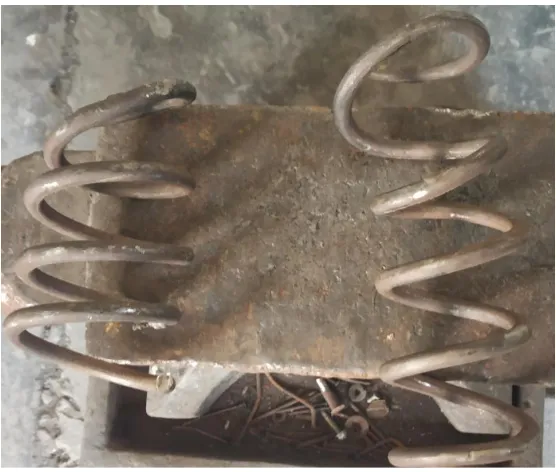
Http://www.ijetmr.com©International Journal of Engineering Technologies and Management Research [2] Figure 1: Mild Steel Spring Specimens.
Http://www.ijetmr.com©International Journal of Engineering Technologies and Management Research [3]
3. Results and Discussions
Hardness Measurement-: Samples were prepared for hardness testing. Hardness test was performed before and after heat treatment. Rockwell hardness Tester in HRC mode is used for hardness measurement with a load of 150 Kg.
Indenter Used = Diamond Cone Load Applied = 150 Kg
Table 3.4: Hardness data (Before & After HT)
Specimen/Ht Operation Load Applied (Kg) Touch Point Hardness (Hrc) Hardness (Hrc)
Before HT After HT
Specimen 1(Annealing)
150 240
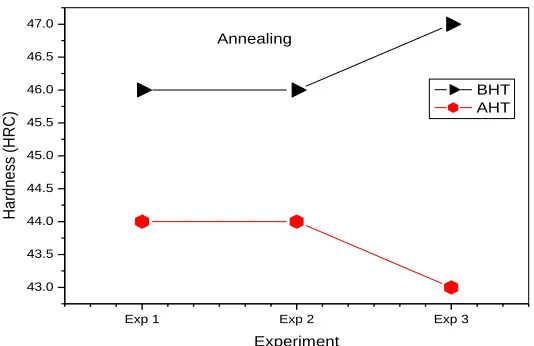
Experiment 1 = 46 Experiment 1 = 44 Experiment 2 = 46 Experiment 2 = 43 Experiment 3 = 47 Experiment 3 = 43 Average ~= 46 Average ~= 43
Specimen 2(Normalizing)
150 240
Experiment 1 = 48 Experiment 1 = 51
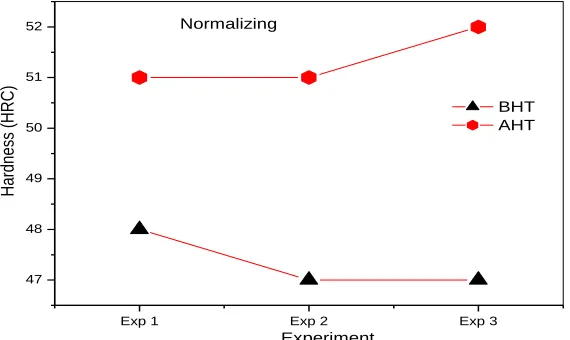
Experiment 2 = 47 Experiment 2 = 51 Experiment 3 = 47 Experiment 3 = 52 Average ~= 48 Average~= 51
Touch point hardness-: It refers to hardness when indenter just touches the surface of specimen, before actually pressing it.
Annealing which differs from normalizing in terms of cooling rate, temperature range, holding or cooling mechanism. Here first step is to heat sample at slow rate to critical temperature range and then cooling is performed inside the furnace at specific rate. HT treatment not always bring out increase in hardness, additionally in case of annealing there is decease in hardness, which can be because, annealing is implemented in materials which undergone cold working, casting or quenching during fabrication, further metal/alloy becomes softer after annealing, which can be attributed to phase change due to slow heating and cooling rate that offers enough time for formation of phase with reduced hardness which is favorable for machining of material. [30-33]
Figure 3: Plot of variation in hardness before and after heat treatment (Annealing).
Exp 1 Exp 2 Exp 3
Http://www.ijetmr.com©International Journal of Engineering Technologies and Management Research [4] Figure 4: Plot of variation in hardness before and after heat treatment (Normalizing).
Tensile Test: Here characteristics of results obtained for “Extension” of specimen, for two
different HT processes can be related to value of hardness for respective samples. Increase in hardness results in decrease in ductility and vice versa. Additionally as ductility decreases, extension also decreases. Hence when normalizing operation performed, hardness increase after HT which decreases ductility and finally decrease in extension. Similar theory applicable for specimen undergoes annealing operation. Our results are in agreement with theory. [30-37]
Table 1: Extension characteristics (Before & After HT)
SPECIMEN/HT OPERATION Load (Kg) Extension (cm) BHT Extension (cm) AHT Specimen 1(Annealing) 5 0.5 0.6
10 1.1 1.3
15 1.6 2.0
20 2.0 2.4
Specimen 2(Normalizing) 5 0.5 0.4
10 1.0 0.8
15 1.5 1.2
20 2.0 1.7
Figure 5: Plot of variation in extension with load (Annealing, Before & After HT)
Exp 1 Exp 2 Exp 3
47 48 49 50 51
52 Normalizing
BHT AHT
H
ard
ne
ss
(H
R
C
)
Experiment
3 4 5 6 7 8 9 10 11 12 13 14 15 16 17 18 19 20 21 22
0.0 0.5 1.0 1.5 2.0 2.5
AHT BHT
Annealing
Ex
te
nsi
on
(cm
)
Load (Kg)
Http://www.ijetmr.com©International Journal of Engineering Technologies and Management Research [5] Figure 6: Plot of variation in extension with load (Normalizing, Before & After HT)
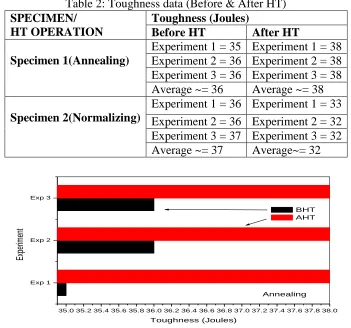
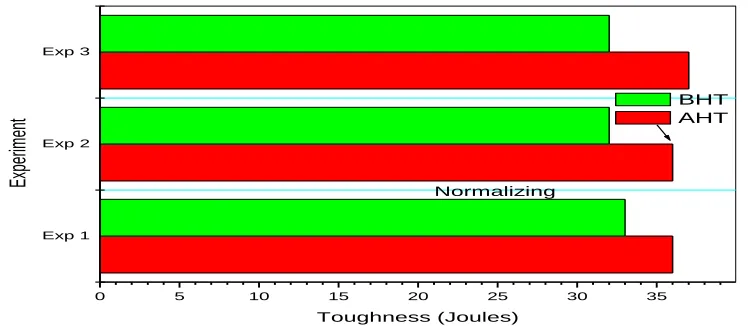
Toughness/ Impact Strength: Toughness requires a reasonable value of ductility in the material, so that material delays fracture or we can say material deform first before facing fracture. As material lost hardness, it retains some amount of toughness. In case of annealing operation there is decrease in hardness, which on the one hand give indication that amount of energy absorbed before fracture will increase, on other hand it requires strength so that to withstand applied load or to resist fracture. Similar theory applicable for normalizing operation. Charpy test technique used in present work. [31,32]
Table 2: Toughness data (Before & After HT)
SPECIMEN/ HT OPERATION
Toughness (Joules)
Before HT After HT
Specimen 1(Annealing)
Experiment 1 = 35 Experiment 1 = 38 Experiment 2 = 36 Experiment 2 = 38 Experiment 3 = 36 Experiment 3 = 38 Average ~= 36 Average ~= 38
Specimen 2(Normalizing)
Experiment 1 = 36 Experiment 1 = 33
Experiment 2 = 36 Experiment 2 = 32 Experiment 3 = 37 Experiment 3 = 32 Average ~= 37 Average~= 32
3 4 5 6 7 8 9 10 11 12 13 14 15 16 17 18 19 20 21 22
0.0 0.5 1.0 1.5 2.0
AHT BHT Normalizing
Ex
te
nsi
on
(cm
)
Load (Kg) BHT AHT
Exp 1 Exp 2 Exp 3
35.0 35.2 35.4 35.6 35.8 36.0 36.2 36.4 36.6 36.8 37.0 37.2 37.4 37.6 37.8 38.0 Annealing
Toughness (Joules)
Ex
pe
rim
en
t
Http://www.ijetmr.com©International Journal of Engineering Technologies and Management Research [6] Figure 7: Plot of variation in toughness with heat treatment parameters (Annealing &
Normalizing, Before & After HT)
4. Conclusions
From all the characterizations and study of various parameters involved in heat treatment, we conclude that annealing and normalizing have significant and different effect on the properties of alloys. Following conclusions have been drawn:
1) Heat treatment of spring shape mild steel specimen results in variation in mechanical properties to a significant amount.
2) Annealing reduces hardness with destruction of cementite/pearlite networks during phase transformation by heat treatment. Normalizing results in formation of martensite, cementites and hence improves hardness.
3) Annealing increase extension characteristic of spring structure while Normalizing results in decrease in extension.
4) Annealing increases toughness in spring structure, whereas normalizing result in decrease in toughness.
Annealing and normalizing differs in terms of heating rate, soaking time & cooling rate which effects the overall phase transformation and hence properties of material after heat treatment.
Here one cannot mention which HT operation brings improvement in properties, as both processes and their experimental data have their own significance. Annealing provides better machinability and normalizing favors strength oriented applications of material in production field.
References
[1] https://en.wikipedia.org/wiki/heat-treatment.
[2] http:/www.global security.org/military/library/policy/navy/nrte/14250-ch2.pdf. [3] http://www.phase-trans.msm.cam.ac.uk/2012/Manna/part1.pdf.
[4] Rapid Stress Relief and Tempering: Process description by Mario GRENIER and Roger GINGRAS.
[5] https://www.educationportals.net/2014/10/various-types-heat-treatment-process-2). [6] http://en.wikipedia.org/wiki/Annealing-(metallurgy).
[7] https://en.wikipedia.org/wiki/hardening-(metallurgy).
Exp 1 Exp 2 Exp 3
0 5 10 15 20 25 30 35
Normalizing
Toughness (Joules)
Ex
pe
rim
en
Http://www.ijetmr.com©International Journal of Engineering Technologies and Management Research [7]
[8] Anil Sharma, Amit Sharma, Anurag Dhiman, analysis of change in mechanical behavior of welded steel alloy by post weld heat treatment. International journal of engineering research-online, ISSN: 2321-7758, volume. 4, Issue.3. 2016 (May- June), pp.393-399.
[9] ASTM International, ASTM Handbook, vol. 4, Heat Treating, American Society for Metals Park, Ohio, 1991.
[10] https://inspectioneering.com/tag/postweld+heat+treatment. [11] http://vibfem.com.org/resourse/stress-reveling/post.weld-HT.pdf. [12] http://en.wikipedia.org/wiki/furnace.
[13] https://en.m.wikipedia.org/wiki/steel.
[14] Sujit Raj, Rahul Davis, Analysis of the effects of heat treatment and turning process parameters on AISI 4340 steel.International Journal of Application or Innovation in Engineering & Management (IJAIEM)/www.ijaiem.org/ISSN: 2319-4847, volume 3/Issue 3, June 2014, pp.129-134.
[15] Sayed Shafayat Hossain, Md. Maksudul Islam and Sajibul Alam Bhufana case study of heat treatment on AISI 1020 steel, Global journal of research in engineering a mechanical and mechanics engineering online ISSN: 2249-4596/volume 14/ issue 5/version 1.0/2014/pp.34-39. [16] Amit Sharma, Himanshu Triphati, Jatinder Kumar, Analysis of change in mechanical properties of
low alloy steel (similar to AISI 8740) friction welded with INCONEL 708 (Austenitic Nickel- chromium based super alloys) after heat treatment. International journal of advanced engineering technology, E-ISSN 0976-3945/IJAET/VOL.IV/Issue. I/jan-march.2013/pp.54-57.
[17] http://nptel.ac.in/courses/iit-Madras/Design-steel-structure-1/1-introduction/3-properties of steel pdf.
[18] https://www.thebalnce.com/general properties-of-steel-2340118 (steel table)
[19] Mohammed H.Frihat,effect of heat treatment parameters on mechanical and microstructure properties of low alloy steel. Journal of surface engineered material and advanced technology/volume 5/2015/pp.214-227.
[20] Utsav Vatsayon, K.M Pandy, A.Biswas, effect of heat treatment on material used in automobiles, ISOR journal of mechanical and civil engineering (ISPR-JMCE) e-ISSN:2278-1648, P-ISSN: 2323-334X,volume 11, Issue 5,ver.1 (sept-oct.2014),pp.90-95.
[21] Sanjay Murari, Sunil Bhujanyannwar, cryogenic technique for the steel heat treatment, International Journal of Scientific & Engineering Research, Volume 4, Issue 8, August 2013, ISSN 2229-5518.
[22] http//ecyclopedia2.the free dictionary.com/batch=type+furnace.
[23] Nadun Ibrahim Nasir, the effect of heat treatment on mechanical properties of stainless steel type 304,International journal of scientific engineering and research (IJSER),Volume 3,ISSUE 8,Augest 2015,pp.87-93.
[24] Devnath Khunte, Gopal Sahu, Parkash Kumar Sen, Dilesh Sharma, Shailendra Bohidar, A review on effect of heat treatment on steel .International journal of research in aeronautical and mechanical engineering ISSN (online): 2321-3051.volume 3, issue 11, November 2015, pp.90-99.
[25] P. Tamil Arasu, R.Dhanasekaran, P.Senthil, N.Srinivasan, effect of hardness and microstructure on En 353 steel by heat treatment. International journal of engineering and science.Vol.2, Issue 11(April 2013), pp.01-05.
[26] D. A. Fadare, T. G. Fadara and O. Y. Akanbi,Effect of Heat Treatment on Mechanical Properties and Microstructure of NST 37-2 SteelJournal of Minerals & Materials Characterization & Engineering, Vol. 10, No.3, pp.299-308, 2011.
[27] William E. Luecke and John A. Slotwinski, Mechanical Properties of Austenitic Stainless Steel Made by Additive Manufacturing,Volume 119 (2014) http://dx.doi.org/10.6028/jres.119.015 Journal of Research of the National Institute of Standards and Technology.
[28] Agarwal RL. Welding engineering: a textbook for engineering students. 4 ed. Delhi: Kanaa Publishers; 1992.
Http://www.ijetmr.com©International Journal of Engineering Technologies and Management Research [8]
[30] O. R. Adetunji*, P. O. Aiyedun, S. O. Ismaila, M. J. Alao, Journal of Minerals and Materials Characterization and Engineering, 2012, 11, 832-835.
[31] Anmol Singh et al., To analyze effect of heat treatment on properties of steel specimen before welding and after welding, International Journal of Engineering Science Invention Research & Development; Vol. III, Issue XII, JUNE 2017
[32] Rajani kant, Analysis of change in properties of steel specimen under various heat treatment parameters, April 2018| IJIRT | Volume 4 Issue 11 | ISSN: 2349-6002.
[33] [https://kvsteel.co.uk/steel/mild-steel.html] [34] https://en.wikipedia.org/wiki/Spring_Framework
*Corresponding author.