
Ames Laboratory Publications
Ames Laboratory
10-28-2009
Single-crystal neutron diffraction study of
short-range magnetic correlations in Tb5Ge4
W. Tian
Iowa State University
Andreas Kreyssig
Iowa State University, [email protected]
Jerel L. Zarestky
Iowa State University, [email protected]
L. Tan
Iowa State University
Shibabrata Nandi
Iowa State UniversitySee next page for additional authors
Follow this and additional works at:
http://lib.dr.iastate.edu/ameslab_pubs
Part of the
Condensed Matter Physics Commons
, and the
Metallurgy Commons
The complete bibliographic information for this item can be found at
http://lib.dr.iastate.edu/
ameslab_pubs/65
. For information on how to cite this item, please visit
http://lib.dr.iastate.edu/
howtocite.html
.
Single-crystal neutron diffraction study of short-range magnetic
correlations in Tb5Ge4
Abstract
We present a single-crystal neutron diffraction study of the magnetic short-range correlations in Tb
5Ge
4which orders antiferromagnetically below the Neel temperature T
N≈92 K. Strong diffuse scattering arising
from magnetic short-range correlations was observed in wide temperature ranges both below and above T
N.
The antiferromagnetic ordering in Tb
5Ge
4is described to consist of strongly coupled ferromagnetic block
layers in the ac plane that stack along the b axis with weak antiferromagnetic interlayer coupling. Diffuse
scattering was observed along both a
∗
and b
∗
directions indicating three-dimensional short-range
correlations. Moreover, the q dependence of the diffuse scattering is Squared Lorentzian in form suggesting a
strongly clustered magnetic state that may be related to the proposed Griffiths-like phase in Gd
5Ge
4.
Keywords
Physics and Astronomy, Materials Science and Engineering
Disciplines
Condensed Matter Physics | Metallurgy
Comments
This article is from
Physical Review B
80 (2009): 134422, doi:
10.1103/PhysRevB.80.134422
.
Authors
W. Tian, Andreas Kreyssig, Jerel L. Zarestky, L. Tan, Shibabrata Nandi, Alan I. Goldman, Thomas A. Lograsso,
Deborah L. Schlagel, Karl A. Gschneidner Jr., Vitalij K. Pecharsky, and Robert J. McQueeney
Single-crystal neutron diffraction study of short-range magnetic correlations in Tb
5Ge
4W. Tian,1,2A. Kreyssig,1,2J. L. Zarestky,1,2L. Tan,1,2S. Nandi,1,2A. I. Goldman,1,2T. A. Lograsso,2D. L. Schlagel,2
K. A. Gschneidner,2,3V. K. Pecharsky,2,3and R. J. McQueeney1,2 1Department of Physics and Astronomy, Iowa State University, Ames, Iowa 50011, USA
2Ames Laboratory, U.S. DOE, Iowa State University, Ames, Iowa 50011, USA
3Department of Materials Science and Engineering, Iowa State University, Ames, Iowa 50011, USA
共Received 17 August 2009; revised manuscript received 2 October 2009; published 28 October 2009兲
We present a single-crystal neutron diffraction study of the magnetic short-range correlations in Tb5Ge4
which orders antiferromagnetically below the Neel temperatureTN⬇92 K. Strong diffuse scattering arising
from magnetic short-range correlations was observed in wide temperature ranges both below and aboveTN. The antiferromagnetic ordering in Tb5Ge4 is described to consist of strongly coupled ferromagnetic block layers in theac plane that stack along the baxis with weak antiferromagnetic interlayer coupling. Diffuse scattering was observed along bothaⴱandbⴱdirections indicating three-dimensional short-range correlations. Moreover, the q dependence of the diffuse scattering is Squared Lorentzian in form suggesting a strongly clustered magnetic state that may be related to the proposed Griffiths-like phase in Gd5Ge4.
DOI:10.1103/PhysRevB.80.134422 PACS number共s兲: 75.40.Cx, 75.30.Sg, 75.50.Ee
I. INTRODUCTION
Tb5Ge4and Gd5Ge4belong to the rare earth R5共SixGe1−x兲4
series compounds. These materials exhibit large magnetoca-loric共MC兲effects1–4and are currently attracting much
atten-tion for their potential application in magnetic refrigeration.2,5–7Both Tb
5Ge4and Gd5Ge4 are rich in
mag-netic properties8–16 and are believed to play a key role in
understanding the underlying physics of the R5共SixGe1−x兲4
systems. They both crystallize in the Sm5Ge4-type
crystallo-graphic structure and adopt the same magnetic space group,
Pnm
⬘
a.15,17,18 Tb5Ge4 and Gd5Ge4 undergo long rangeanti-ferromagnetic 共AFM兲 transitions at ⬃92 K and ⬃127 K, respectively. The magnetic structure of Tb5Ge4 and Gd5Ge4
consist of Tb/Gd-rich block layers in theacplane that stack along the b-axis with strong ferromagnetic intralayer and weak AFM interlayer interactions. Gd5Ge4 has a collinear
AFM structure with the magnetic moments lying within the block layers along the c axis. Tb5Ge4 orders in a similar
fashion, although the single-ion anisotropy results in signifi-cant signifi-canting of the moments at low temperature.
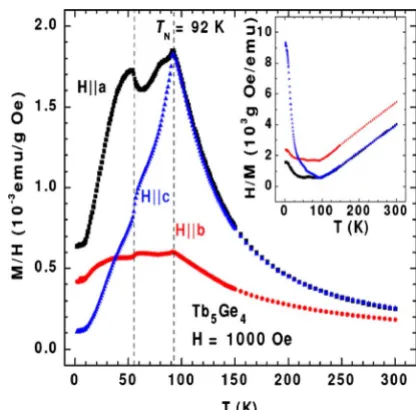
Figure 1 shows the magnetic susceptibility of Tb5Ge4
along all three crystallographic axes measured with a quan-tum design SQUID magnetic properties measurement sys-tem. The inset of Fig.1 depicts the temperature dependence of the inverse magnetic susceptibility. It follows Curie-Weiss behavior above 160 K with similar slope for all three crys-tallographic directions. The derived Curie constant of 58.8 cm3K/mol results in an effective paramagnetic
mo-ment of ef f= 9.7
Bclose to the theoretical value 9.72 B
for a free Tb3+ion. The paramagnetic Curie temperatures are about⬃25 K along bothaaxis andcaxis pointing to domi-nating ferromagnetic coupling in the acplane. On the other hand, the paramagnetic Curie temperature along thebaxis is about ⬃−50 K indicating dominating antiferromagnetic in-teraction along this direction. These couplings are consistent with the reported magnetic order in Tb5Ge4.15 Two phase
transitions were observed in the magnetic susceptibility mea-surements: the AFM transition at TN⬃92 K and a second
phase transition at⬃55 K. The⬃55 K transition was attrib-uted to a spin reorientation transition7,15 关a weak anomaly
observed in the electrical resistivity and a x-ray resonant magnetic scattering measurement of Gd5Ge4at⬃75 K共Ref. 19兲 was proposed to be associated with a spin reorientation transition similar to Tb5Ge4兴. It has been suggested that the
spin reorientation transition in Tb5Ge4 may arise from the
delicate competition between the magnetic anisotropy from the spin-orbit coupling of the conduction electrons and the dipolar interaction anisotropy.19In addition to the AFM and
spin reorientation transitions, it is of particular interest that significant magnetic short-range correlations共SRC兲was sug-gested in Gd5Ge4 at temperatures both below and aboveTN
based upon the low magnetic field dc magnetization and ac magnetic susceptibility measurements.12 It has been
inter-preted as evidence of a Griffiths-like phase similar to the one
FIG. 1. 共Color online兲Temperature dependencies of the mag-netic susceptibility 共Inset: inverse magnetic susceptibility兲 mea-sured with applied magnetic field共H = 1000 Oe, zero-field cooled兲 parallel to all three crystallographic axes.
PHYSICAL REVIEW B80, 134422共2009兲
[image:3.609.331.539.487.692.2]observed in Tb5Si2Ge2, investigated by small-angle neutron
scattering.16 A Griffiths phase20 is a nanoscale magnetic
clustering phenomenon that is usually associated with com-peting magnetic interactions in the system.21–23It is possible
for a Griffiths-like phase to exist in Gd5Ge4due to the
com-petition between FM and AFM interactions in Gd5Ge4, FM interactions within the layers, and either AFM or FM inter-actions between the layers 共small structural changes or ap-plying relatively low magnetic field comparing to TN can
switch the interlayer interactions between AFM and FM in-teractions therefore switch the low-temperature phase be-tween AFM order or FM order兲. However, studies of Gd5Ge4
have been hampered by the large neutron absorption cross-section of gadolinium. Tb5Ge4 exhibits similar magnetic
properties as to Gd5Ge4 hence it is an ideal candidate for neutron-scattering studies of magnetic SRC displayed in these compounds. We report here neutron diffraction studies of the AFM phase transition and the magnetic SRC in Tb5Ge4.
II. EXPERIMENTAL DETAILS
A large Tb5Ge4 single crystal 共⬃5 grams兲 was used for
the neutron diffraction experiment. The single crystal was grown at the Materials Preparation Center24using the
Bridg-man technique as described in Ref. 25. The mosaic of the crystal is 0.41共3兲° along thea axis and 0.63共2兲° along theb
axis as determined by the full width at half maximum of the
共400兲and共060兲Bragg peak rocking curves. The crystal was mounted on a thin aluminum post, oriented in the共hk0兲 scat-tering plane, and sealed in a helium filled aluminum sample can. A closed-cycle Helium refrigerator 共Displex兲 was used which allows accurate temperature control between 10 and 300 K. The experiments were performed using the HB1A triple-axis spectrometer located at the high flux isotope reac-tor 共HFIR兲at the Oak Ridge National Laboratory 共ORNL兲. The HB1A spectrometer operates with a fixed incident en-ergy, Ei= 14.6 meV using a double pyrolitic graphite 共PG兲
monochromator system. Two highly oriented PG filters were mounted before and after the second monochromator to sig-nificantly reduce higher order contaminations of the incident beam 共i.e.,I/2⬵10−4I兲. A collimation ofopen-40
⬘
-sample-40
⬘
– 68⬘
was used throughout the experiment. All data have been normalized to the beam monitor count.III. RESULTS AND DISCUSSIONS
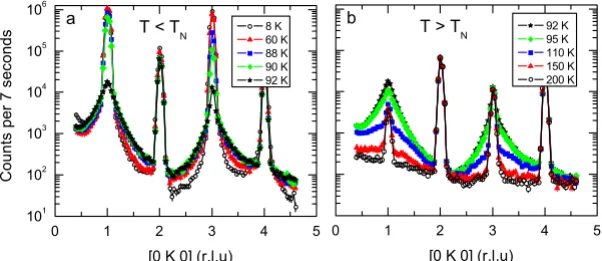
Figure2compares longitudinal scans measured along the
共0k0兲 direction at selected temperatures both below 关Fig.
2共a兲兴and above关Fig.2共b兲兴TN. Strong AFM magnetic
reflec-tions withk= odd integer were observed belowTNconsistent
with the magnetic structure of Tb5Ge4. At low temperatures, the 共010兲 and 共030兲 magnetic reflections are superimposed on weak and very broad Lorentzian-shaped diffuse scattering peaks arising from magnetic fluctuations. BelowTN, the
dif-fuse scattering increases with increasing temperatures as il-lustrated in Fig.2共a兲. The diffuse scattering is strongest atTN
and then weakens as the temperature increases above TNas
shown in Fig. 2共b兲as expected for typical critical behavior. The data indicate strong diffuse scattering around the strong magnetic reflections over a wide temperature range.
We characterized the TN⬃92 K AFM transition with an
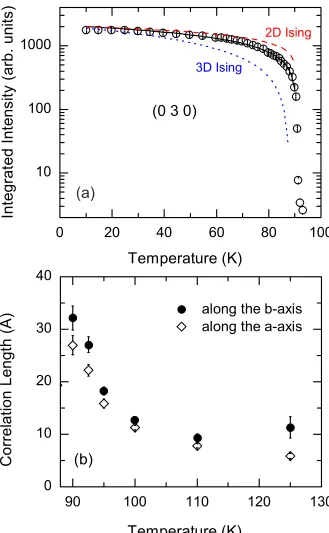
order-parameter measurement. Similar results were obtained by monitoring the magnetic reflections 共010兲 and 共030兲. Figure 3共a兲 depicts the order parameter of Tb5Ge4 as
mea-sured by monitoring the strong magnetic reflection共030兲as a function of temperature. The integrated intensity was obtained by fitting the 共030兲 rocking curve measured at each temperature to a Lorentzian function with a constant background. A fit of the order parameter to a power-law
I共T兲=I0关共共TN−T兲/TN兲兴2 yields TN⬇91.38⫾0.05 K and ⬇0.20⫾0.01, whereis the critical exponent. The fitting result is plotted in Fig. 3共a兲, solid line, in comparison to calculations using the same fitting parameters but replacing
 with the values of a two-dimensional 共2D兲 Ising
共= 0.125兲 and a three-dimensional 共3D兲 Ising 共= 0.326兲 system.26 The obtained critical temperature T
N is in good
agreement with the magnetic susceptibility result. The yieldedvalue⬃0.20 is between the theoretical values of a 2D and a 3D Ising system, which suggests that the magnetic dimensionality of Tb5Ge4 is intermediate between 2D and
3D consistent with its layered magnetic structure. The in-plane共along the共h00兲direction兲and out-of-plane共along the
[image:4.609.50.351.69.199.2]共0k0兲 direction兲 correlation lengths were measured by per-forming relatively wide transverse and longitudinal scans around共030兲at several temperatures. The data at each tem-perature are fit to a Lorentzian,⬀1/共q2+2兲, convoluted with Gaussian-shaped instrumental resolution. Here= 1/, and is the spin correlation length. The derived correlation lengths along both directions are shown in Fig.3共b兲. Similar corre-lation lengths were obtained along both directions.
FIG. 2. 共Color online兲 Longitudinal scans共in Log10 scale兲along the共0k0兲 direction measured at several temperatures 共a兲 belowTN, 共b兲 above TN, indicate strong AFM SRC with broad mag-netic scattering observed aroundk= odd. The re-maining scattering intensity of共010兲and共030兲at 200 K is likely due to multiple scattering.
TIANet al. PHYSICAL REVIEW B80, 134422共2009兲
The longitudinal scans shown in Fig. 2 indicate strong diffuse scattering along the b axis. In order to see how the diffuse scattering is distributed in the共hk0兲plane, a series of grid scans around共030兲were performed at two temperatures, 8 and 88 K. The 8 K data were subtracted from the 88 K data to eliminate contributions from the 共030兲 magnetic Bragg reflection. Figure 4is the contour plot of the subtracted dif-fuse scattering intensity vshandk. It shows that the diffuse scattering extends along bothh andkdirections. The diffuse scattering intensity is strong around 共⬃0.1⬃3.10兲 and its equivalent positions. No strong anisotropy is observed sug-gesting the magnetic correlations associated to the diffuse scattering are not restricted to the FM block layer共acplane兲 but are rather more three-dimensional exhibiting AFM criti-cal scattering behavior.
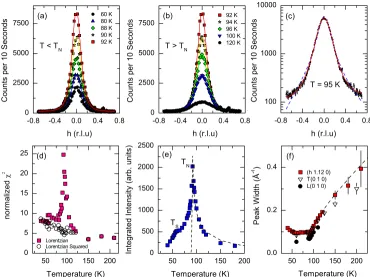
The diffuse scattering was studied in detail as a function of temperature. Wide transverse scans along the h direction were performed at 共0 1.12 0兲 to reduce contributions from the nearby 共010兲 strong magnetic reflection. At 10 K, the FWHM 共full width at half maximum兲 peak width of the
共010兲is about 0.09关r.l.u兴 共reciprocal lattice unit兲. Therefore we may attribute the scattering intensity measured at共0 1.12 0兲 to diffuse scattering from magnetic correlations. Figures
5共a兲 and5共b兲shows typical scans at different temperatures. The scattering intensity of the strong diffuse scattering peak first increases with increasing temperature up to TN 关Fig.
5共a兲兴and then decreases with further increasing temperature above TN 关Fig.5共b兲兴. In general, the q dependence共here q
=h or k兲 of diffuse scattering can be well described by the following equation,27,28a sum of a Lorentzian function and a
Squared-Lorentzian function plus constant background共BG兲,
I共q兲= A
L 2
+q2+ B 共LS
2
+q2兲2+BG. 共1兲
The first Lorentzian term is the conventional critical scat-tering component representing an Ornstein-Zernike form, i.e., exp−r/r, for the magnetic correlations.26 The second
Squared-Lorentzian term29 is generally considered to arise
from static or frozen spin clusters within which the spin cor-relations decrease more gradually as exp−r. Surprisingly, by fitting the data to a Lorentzian+ BG function only, a Squared-Lorentzian+ BG function only, and the sum of Lorentzian plus Squared-Lorentzian function as described in Eq.共1兲, respectively, we found that the diffuse scattering data can be best described by the Squared-Lorentzian function only plus constant background. Adding an extra Lorentzian term does not improve the quality of the least-squares fit to data. The comparisons between the fits to a Lorentzian only and a Squared-Lorentzian only are shown in Fig.5. Note that the diffuse scattering peak is very broad, thus the resolution effect can be neglected and no resolution corrections are ap-plied in the data analysis. Figure5共c兲compares the fits of the 95 K data to Lorentzian+ BG 共dashed line兲 only and Squared-Lorentzian+ BG共solid line兲only. This indicates that the 95 K data cannot be described by a Lorentzian+ BG func-tion. On the other hand, as shown in Figs.5共a兲and5共b兲, the solid curves are fits to a Squared-Lorentzian+ BG only that adequately describe the data for the measured qrange at all temperatures. The comparison of the obtained normalized2
from these two fittings is shown in Fig.5共d兲. It clearly shows that the data are better captured by a Squared-Lorentzian form, the Lorentzian line shape does not give a good descrip-tion of the data, particularly at temperatures nearTNas
illus-trated in Fig. 5共c兲.
[image:5.609.90.255.66.333.2](a)
FIG. 3. 共Color online兲 Tb5Ge4 order-parameter and
spin-correlation lengths. 共a兲 Integrated intensity of the共030兲 magnetic peak as a function of temperature. The solid line is the fitting of the order-parameter data to the power law as described in the text which yields TN⬇91.38⫾0.05 K and ⬇0.20⫾0.01, and the dashed and dotted lines are calculations using the same fitting pa-rameters but simply replacing thevalue to be the values of a 2D Ising 共= 0.125兲 and a 3D Ising 共= 0.326兲 system. 共b兲 Spin-correlation lengths along thebaxis andaaxis.
FIG. 4.共Color online兲Diffuse scattering intensity共88–8 K兲vsk and h around 共030兲 constructed from a series of grid scans mea-sured at 8 and 88 K. The 8 K data is subtracted from the 88 K data to eliminate contributions from共030兲magnetic Bragg reflection. SINGLE-CRYSTAL NEUTRON DIFFRACTION STUDY OF… PHYSICAL REVIEW B80, 134422共2009兲
[image:5.609.353.518.69.243.2]The integrated intensity and the FWHM obtained from least-squares fits to the data with a Squared-Lorentzian func-tion are plotted in Figs. 5共e兲 and 5共f兲. Two features are observed in the integrated intensity data 关Fig. 5共e兲兴. The small kink at⬃55 K is associated with the spin reorientation transition, and the peak at ⬃92 K is associated with the AFM transition. Both temperatures agree well with the mag-netic susceptibility data. Despite the small kink at ⬃55 K, the⬃92 K peak is nearly symmetric indicating strong criti-cal fluctuations atTNthat die off as one moves away fromTN
in either direction. Above TN, the integrated intensity data
can be fit to a power lawI共T兲=I0关共共T−TN兲/TN兲兴−2⬘yielding TN⬇90⫾1 K and 
⬘
⬇0.22⫾0.02 关dashed line in Fig. 5共e兲兴. The obtained⬘
value agrees to the value obtained from the fit to the order-parameter data. As illustrated in Fig. 5共f兲, the correlation length of the SRC remains rela-tively constant below TN as indicated by a nearly constantpeak width. Above TN, the peak width increases as
expec-ted as the correlation length decreases with increasing tem-perature. A fit to the T⬎TN peak width data to a power
law 共T兲=0关共共T−TN兲/TN兲兴 gives TN⬇92⫾1 K and ⬇0.77⫾0.06 关dashed line in Fig. 5共f兲兴, the value is be-tween the theoretical values of a 3D Ising共= 0.6312兲and a 2D Ising共= 1兲 共Ref.26兲consistent with the order-parameter measurement results. The Squared-Lorentzian peak widths obtained from fits to共010兲longitudinal and transverse scans are also shown in Fig. 5共f兲. The Lorentzian-squared line-shape provides the best fit along both thehandkdirections,
indicating that the correlations in the spin clusters extend both in the block layers and between the blocks.
Our neutron diffraction study reveals strong diffuse scat-tering in Tb5Ge4that persists to temperatures well aboveTN.
A detailed study of the peak shape indicates it is not conven-tional critical scattering with a Lorentzian shape but shows a Squared-Lorentzian peak shape. As described in Refs.29and
30, the Squared-Lorentzian term arises if the pair correlation function falls off as exp−r, which is characteristic of a
spin-cluster state. Although the diffuse scattering is Squared-Lorentzian in form providing evidence of a clustered mag-netic state in Tb5Ge4, we believe that the diffuse scattering
observed in Tb5Ge4is quite different from the proposed FM
Griffiths-like phase in Gd5Ge4共inferred from dc/ac magneti-zation and magnetic susceptibility studies兲12 for the
follow-ing reasons. 共1兲As depicted in Fig. 2, at temperatures both below and above TN, the diffuse scattering is peaked at odd
values of k 共AFM wave vector兲 only, indicating that it is associated with AFM fluctuations. 共2兲The integrated inten-sity of the diffuse scattering also behaves like that typical of magnetic critical fluctuations, with a divergence of the cor-relation length atTN.共3兲The critical exponents obtained by
[image:6.609.118.489.67.344.2]fits of the diffuse scattering integrated intensity and peak width to a power law are consistent with the values obtained from AFM order parameter measurements. 共4兲 Quasielastic measurements indicate the diffuse scattering is static in ori-gin. Our neutron diffraction data indicate that the diffuse scattering observed in Tb5Ge4 exhibits behaviors of AFM
FIG. 5. 共Color online兲 Diffuse scattering along the h direction measured at 共0 1.12 0兲. Representative scans measured at different temperatures共a兲belowTN,共b兲aboveTN. The solid curves are least-squares fits to a Squared-Lorentzian function ofhas described in the text;
共c兲Comparison of the fits of the 95 K data to a Lorentzian+ BG 共dashed line兲 function only and a Squared-Lorentzian+ BG共solid line兲 function only; 共d兲 2 vs T, where the normalized 2 is obtained from least-squares fits to a Lorentzian+ BG only and a
Squared-Lorentzian+ BG function only;共e兲Integrated intensity vs temperature;共f兲Peak width vs temperature; The dashed lines in共e兲and 共f兲are fits of theT⬎TNdata to a power law as described in the text.
TIANet al. PHYSICAL REVIEW B80, 134422共2009兲
critical fluctuations despite the Squared-Lorentzian peak shape.
The fact that the peak shape of the diffuse scattering is not a Lorentzian, as expected for normal critical scattering, is interesting and should not be left without a discussion. Here we consider two possibilities that may affect the diffuse scat-tering peak shape. 共1兲 The Squared-Lorentzian peak shape may be intrinsic, i.e., related to the Griffiths-like phase, for-mation of which has been discussed in Refs.12and16;共2兲 The unusual peak shape may also arise from some extrinsic effects, for example impurities in Tb5Ge4. It has been
re-ported that R5共SixGe1−x兲3-type impurity phases, seen as very
thin plates that are scattered through the bulk of R5共SixGe1−x兲4samples, are present in all studied compounds
of this series regardless of R.31 Our data show that Tb
5Ge3
impurity phase is also present in the studied Tb5Ge4crystal. It is possible that the Tb magnetic sublattices of Tb5Ge4are
disrupted by the Tb5Ge3 impurities resulting in spin-clusters
in Tb5Ge4which give rise to the squared-Lorentzian diffuse
scattering peak shape.
ACKNOWLEDGMENTS
Ames Laboratory is operated for the U.S. Department of Energy by Iowa State University under Contract No. DE-AC02-07CH11358. The HFIR is a national user facility funded by the United States Department of Energy, Office of Basic Energy Sciences, Materials Science, under Contract No. DE-AC05-00OR22725 with UT-Battelle, LLC.
1V. K. Pecharsky and K. A. Gschneidner, Jr., Phys. Rev. Lett. 78,
4494共1997兲.
2V. K. Pecharsky and K. A. Gschneidner, Jr., Appl. Phys. Lett.
70, 3299共1997兲.
3V. K. Pecharsky and K. A. Gschneidner, Jr., J. Magn. Magn.
Mater. 167, L179共1997兲.
4V. K. Pecharsky and K. A. Gschneidner, Jr., J. Alloys Compd.
260, 98共1997兲.
5V. K. Pecharsky and K. A. Gschneidner, Jr., Adv. Cryog. Eng.
43, 1729共1998兲.
6G. J. Miller, Chem. Soc. Rev. 35, 799共2006兲.
7L. Morellon, C. Magen, P. A. Algarabel, M. R. Ibarra, and C.
Ritter, Appl. Phys. Lett. 79, 1318共2001兲.
8F. Casanova, A. Labarta, and X. Batlle, Phys. Rev. B 72, 172402
共2005兲.
9H. Tang, V. K. Pecharsky, K. A. Gschneidner, Jr., and A. O.
Pecharsky, Phys. Rev. B 69, 064410共2004兲.
10E. M. Levin, K. A. Gschneidner, Jr., and V. K. Pecharsky, Phys.
Rev. B 65, 214427共2002兲.
11Z. W. Ouyang, V. K. Pecharsky, K. A. Gschneidner, Jr., D. L.
Schlagel, and T. A. Lograsso, Phys. Rev. B 74, 024401共2006兲.
12Z. W. Ouyang, V. K. Pecharsky, K. A. Gschneidner, Jr., D. L.
Schlagel, and T. A. Lograsso, Phys. Rev. B 74, 094404共2006兲.
13E. M. Levin, K. A. Gschneidner, Jr., T. A. Lograsso, D. L.
Schla-gel, and V. K. Pecharsky, Phys. Rev. B 69, 144428共2004兲.
14C. Magen, Z. Arnold, L. Morellon, Y. Skorokhod, P. A.
Algara-bel, M. R. Ibarra, and J. Kamarad, Phys. Rev. Lett. 91, 207202 共2003兲.
15C. Ritter, L. Morellon, P. A. Algarabel, C. Magen, and M. R.
Ibarra, Phys. Rev. B 65, 094405共2002兲.
16C. Magen, P. A. Algarabel, L. Morellon, J. P. Araújo, C. Ritter,
M. R. Ibarra, A. M. Pereira, and J. B. Sousa, Phys. Rev. Lett. 96, 167201共2006兲.
17P. Schobinger-Papamantellos, J. Phys. Chem. Solids 39, 197
共1978兲.
18L. Tan, A. Kreyssig, J. W. Kim, A. I. Goldman, R. J.
Mc-Queeney, D. Wermeille, B. Sieve, T. A. Lograsso, D. L. Schla-gel, S. L. Budko, V. K. Pecharsky, and K. A. Gschneidner, Jr., Phys. Rev. B 71, 214408共2005兲.
19L. Tan, Ph.D. thesis, Iowa State University共2008兲. 20R. B. Griffiths, Phys. Rev. Lett. 23, 17共1969兲.
21J. Deisenhofer, D. Braak, H.-A. Krug von Nidda, J. Hemberger,
R. M. Eremina, V. A. Ivanshin, A. M. Balbashov, G. Jug, A. Loidl, T. Kimura, and Y. Tokura, Phys. Rev. Lett. 95, 257202 共2005兲.
22M. B. Salamon, P. Lin, and S. H. Chun, Phys. Rev. Lett. 88,
197203共2002兲.
23M. C. de Andrade, R. Chau, R. P. Dickey, N. R. Dilley, E. J.
Freeman, D. A. Gajewski, M. B. Maple, R. Movshovich, A. H. Castro Neto, G. Castilla, and B. A. Jones, Phys. Rev. Lett. 81, 5620共1998兲.
24Single-crystals synthesized at the Materials Preparation Center,
Ames Laboratory, US DOE Basic Energy Sciences, Ames, IA, USA: www.mpc.ameslab.gov
25T. A. Lograsso, D. L. Schlagel, and A. O. Pecharsky, J. Alloys
Compd. 393, 141共2005兲.
26F. Malcolm, Collins 共Magnetic Critical Scattering, New York,
1989兲.
27K. Motoya and K. Hioki, J. Phys. Soc. Jpn. 72, 930共2003兲. 28P. Bentley, J. R. Stewart, and R. Cywinski, Appl. Phys. A: Mater.
Sci. Process. 74, S862共2002兲.
29S. W. Lovesey, J. Phys. C 17, L213共1984兲.
30Methods of Experimental Physics, Vol. 23, Neutron Scattering
part C, edited by Kurt Sköld and David L. Price 共Academic, New York, 1987兲.
31O. Ugurlu, L. S. Chumbley, D. L. Schlagel, and T. A. Lograsso,
Acta Mater. 54, 1211共2006兲.
SINGLE-CRYSTAL NEUTRON DIFFRACTION STUDY OF… PHYSICAL REVIEW B80, 134422共2009兲
![N,N Diphenyl 4 (1H pyrrolo[1,2 f][1,10]phenanthrolin 2 yl)aniline ethanol monosolvate](data:image/gif;base64,R0lGODlhAQABAIAAAP///wAAACH5BAEAAAAALAAAAAABAAEAAAICRAEAOw==)