27
Egypt. J. Soil Sci. Vol. 55, No. 4, pp. 441- 452 (2015)Effect of Magnetic Iron Oxide Combined with
some Additives on the Yield of Groundnut, Wheat
and Nutrient Availability in Sandy Soil
S.M. El-Basioni, H. M. Hassan and Rama T. Rashad
*
Soils, Water and Environment Research Institute, Agricultural Research Center, Giza, Egypt.
WO field experiments under sprinkler irrigation using groundnut (Arachis hypogaea L.) and wheat (Triticum sativa) were carried out to study the effect of adding the magnetic iron ore combined with different types of additives on the yield and nutrient availability in sandy soil. Single and combined levels of iron ore, shale deposits (bentonite), bio-fertilizer (Phosphorine) and super phosphate forming 10 treatments were applied in a randomized complete block design. At harvest, the groundnut seed and wheat grain yields (kg fed-1), 100 seed and grain weights (g) were recorded then analyzed for N, P, K and Fe. The groundnut oil percent was determined. In addition, the soil samples were analyzed for the available N, P, K and Fe after harvesting each crop. The maximum yield compared to the control has been obtained in case of applying the treatment (super phosphate: 22.5 kg P2O5 fed
-1
+ magnetic iron ore: 120 kg fed-1 + bentonite: 100 kg fed-1) for the two crops. An increase of 32.42% and 48.8% for the groundnut seeds and the wheat grain over the control, respectively exists with significant difference for wheat only, which was more affected by the magnetic iron ore. Moreover, applying this treatment resulted in increasing the groundnut seeds oil, K and Fe percent by 9.65%, 55.74% and 61.3% respectively. Almost the same trend was observed for the wheat grain K, P and Fe percentage where an increase of 85.71%, 54.84% and 43.75%, respectively exists. The soil available P, K and Fe values after harvesting the two crops were mostly unaffected compared with the initial soil.
Keywords: Sandy soil, Super phosphate, Bentonite, Magnetic iron ore, Bio-fertilizers (Phosphorine), Groundnut; Wheat.
Iron is considered an extremely important element for life in general, and plants in particular. It is considered a growth-limiting factor due to its low solubility at neutral and basic pH and its lower toxicity compared to other metals. Iron is essential for both plant productivity and nutritional quality. It is not clear whether iron bio-minerals are formed within the internal structures of the higher plants tissues. Studies on the iron hyper-accumulator plants such as Imperata cylindrica
have indicated that the metabolism of iron in plants is much more complex than has been reported. Jarosite (KFe3(OH)6(SO4)2) and ferrihydrate-ferritin, accumulate in the different tissues like roots and rhizomes while in the leaves
most of the ferric iron is stored in ferritin as the main iron managing structure of the plant (Amils et al., 2007).
Iron is essential for photosynthesis being required for CO2 fixation, biomass,
and O2 production, which can react with iron to produce reactive oxygen species
(ROS) deleterious for the cell integrity. Iron may interfere with the complex redox (oxidation-reduction) reactions involved. The iron uptake in the form of iron chelates is known as phyto-siderophores. Homeostasis of iron in plants is achieved through very dynamic processes requiring proteins and small organic molecules in order to take up the metal from the soil, to traffic it throughout the plant, to compartmentalize it intra-cellularly, to buffer and to store it in case of excess. Among the molecules required in these processes, the ferritins that are a class of ubiquitous iron storage proteins, found in all living kingdoms. The beneficial effect of iron on seed production appears dependent on the presence of ferritins (Briat et al., 2010). Studies have reported that iron treatment of Zea mays
induced ferritin protein accumulation in the roots and leaves. The magnetic nano-particles may be internalized in the vegetal tissue and may have not only a chemical but also a magnetic influence on the enzymatic structures implied in the different stages of the photosynthesis reactions (Răcuciu, 2012).
Novel properties of iron oxide magnetic nano-particles (IOMNPs) such as super Para magnetism were reported to affect the soil microorganisms. They could stimulate some bacterial growth not the whole soil microbes and influence
the soil bacterial community structure that facilitate C and N cycling in soil (He et
al., 2011). The use of expensive hazardous chemical nematicides that cause
serious environmental pollution may be replaced by environmentally friendly natural materials like magnetic iron ore (MIO). The addition of the natural MIO or “ferromagnetic" could improve soil structure, organic matter, water properties, cation exchange capacity and become more energy and vigour which is known as "Magneto biology" that helps plant growth, moderation of soil temperature, improved water – holding capacity and crop nutrition from macro and microelements. Moreover, the magnetic process separates all chlorine, toxic and harmful gases from soil, which increased salt movement and solubility of nutrients (Ismail et al., 2010).
applications for improving the vegetative growth, yield production of cucumber plants (Shehata et al., 2012).
The magnetic environment helps to concentrate nutrients in the leaves of the plant because some of the nutrients in plants such as magnesium, sulfur and iron are magnetic. They are attracted to the magnetic field and concentrate in the leaves that are in direct contact of that field (Carrera, 2009). Magnetic fields (MF) may play an important role in cation uptake capacity of immobile plant nutrients. Elemental composition of the date palm was significantly affected by MF treatment. The content of N, K, Ca, Mg, Fe, Mn and Zn were significantly increased while P was significantly decreased. Increased MF strength had increased the content of Mn, Fe and Zn in strawberry leaves (Fragaria x
ananassa) as studied by
Esitken and Turan (2003)
, the content of Mg, Fe andCu in buckwheat (Fagopyrum esculentum) grain (Gubbels, 1982) and the P, Ca, K and Zn content of straw. The change in ion content under MF may differ in organs of the same plant (Dhawi and Al-Khayri, 2009).
Bentonite minerals are naturally occurring clay deposits which have high cation exchange, adsorption capacity and a high potential for Zn and Fe retention. Their addition to the sandy soil reduced the velocity of downward water movement, increased soil moisture retention, and restricted the deep percolation and leaching out nutrients (Hassan and Abdel Wahab, 2013). There was a positive effect of bentonite treatment on the plant total nitrogen content. Bentonite could be a very promising material for the improvement of the physical, chemical, and biological properties of sandy soils in arid regions and contribute positively to improved production yields agriculture (Reguieg et al., 2011)
Super phosphate ores such as (Ca[H2PO4]2) is among various sources of inorganic P fertilizer that can be used to build up the soil P level. Some of them dissolve quickly in water and thus can produce levels of soil solution P high enough that crops can compete for P with the soil’s P-fixation capacity (Hue and Silva, 2000).
strains of Bacillus megatherium var. phosphaticum which supply the growing plants by their phosphorous needs during growth (Maksoud et al., 2009, El-Nagdy
et al., 2010 and Youssef & Eissa, 2014). It enhanced the oil content of flax (Mostafa and Ahmed, 2000, Mohamed, 2003 and Aowad & Mohamed, 2009). It resulted in higher N, P and K contents of sunflower leaves and higher indole acetic acid (IAA), Gibberellins (GA3) and Cytokinins of tomato plant (El-Tohamy et al.,
2009). Additionally, it alleviated the adverse effect of water stress on barley yield and produced the highest grain yield and seed index (Thalooth et al., 2012).
The present study aims to evaluate the effect of adding magnetic iron ore combined with different types of additives on the yield and nutrient percent of wheat, groundnut, and the nutrient availability in sandy soil.
Material and Methods
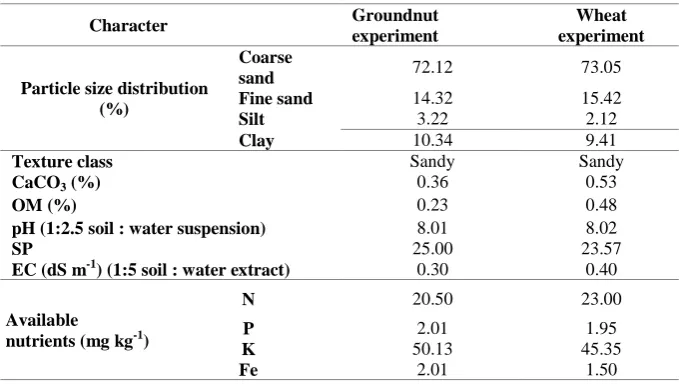
Two field experiments under sprinkler irrigation were carried out using groundnut (Arachis hypogaea L.) cv. Giza 5 (summer season of 2012) and wheat (Triticum sativa) cv. Sakha 93 (winter season of 2012/2013), respectively, in the sandy soil of Ismailia Agric. Res. Station. Some characteristics of the experiment soil were determined in the upper 30 cm layer according to Page et al. (1982) and shown in Table 1a.
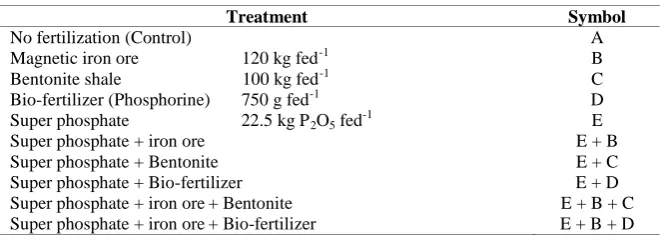
Single and combined applications of magnetic iron ore, shale deposits (bentonite), bio-fertilizer (Phosphorine), and super phosphate were applied according to the studied treatments (Table 2). Magnetic iron ore and bentonite were obtained in a ground and purified from El-Kossier, Red sea Governorate. Analysis of bentonite was shown in Table 1b where magnetic iron ore was 99% pure.
TABLE 1a. Some characteristics of the experiments soils before cultivation .
Character Groundnut
experiment
Wheat experiment
Particle size distribution (%)
Coarse
sand 72.12 73.05
Fine sand 14.32 15.42
Silt 3.22 2.12
Clay 10.34 9.41
Texture class Sandy Sandy
CaCO3 (%) 0.36 0.53
OM (%) 0.23 0.48
pH (1:2.5 soil : water suspension) 8.01 8.02
SP 25.00 23.57
EC (dS m-1) (1:5 soil : water extract) 0.30 0.40
Available nutrients (mg kg-1)
N 20.50 23.00
P 2.01 1.95
K 50.13 45.35
TABLE 1b. Analysis of bentonite shale deposit
Character Bentonite
Texture class Clay
CaCO3 (%) 2.50
OM (%) 0.28
pH (1:2.5 shale : water suspension) 7.85
SP 70.00
EC (dS m-1) (1:5 shale : water extract) 3.85
Total Fe2O3 (%) 8.79
Total K2O (%) 0.42
Total P2O5 (%) 0.02
Total N 0.08
Others (%) —
Notes:
1. Iron deposits contain 2.5 % iron oxide Fe3O4 % equivalent to 25 kg ton-1. 2. These natural materials are free from any radioactive elements or harmful elements according to the analysis carried out by the source company.
The bio-fertilizer Phosphorine was the commercial name of phosphate dissolving bacteria containing Bacillus megatherium var. phosphaticum. It was a commercial product obtained from General Organization for Agricultural Equalization Fund (GOAEF), Agricultural Research Center, Giza, Egypt and added at the recommended dose.
Plots (3 × 4 m2) were prepared for cultivation. The studied treatments were arranged in a randomized complete block design with four replicates.
TABLE2. Treatments.
Treatment Symbol
No fertilization (Control) A
Magnetic iron ore 120 kg fed-1 B Bentonite shale 100 kg fed-1 C
Bio-fertilizer (Phosphorine) 750 g fed-1 D
Super phosphate 22.5 kg P2O5 fed -1
E
Super phosphate + iron ore E + B
Super phosphate + Bentonite E + C
Super phosphate + Bio-fertilizer E + D
Super phosphate + iron ore+ Bentonite E + B + C
Super phosphate + iron ore+ Bio-fertilizer E + B + D
fed-1 of K2SO4 (48% K2O) for both groundnut and wheat was applied in two equal doses after sowing as recommended.
At harvest, plants of each plot were collected and air dried. The groundnut seed and wheat grain yields (kg fed-1), 100 seed, and grain weights (g) were recorded. Oven dried groundnut seeds and wheat grain samples were digested then analyzed for N, P, K and Fe as described by Jackson (1967) and Black (1965). Groundnut oil percent was determined according to AOAC (1990). Soil samples were analyzed for available N, P, K and Fe after harvesting of each crop.
Analysis of variance had been done according to Gomez and Gomez (1984) using the Co-State computer program.
Results and Discussion
The data indicate that an obvious difference in the values of yield, yield components, and the nutrient percent of both the groundnut and wheat exists as a result of applying the different treatments compared with control. The obtained data are discussed as follows:
Yield and yield components
Table 3 shows that in case of groundnut, the seed yield values of all treatments increased as compared to the control; however, these increases were insignificant. The yield increase was higher in case of the combined treatments than the single ones. For instance, the treatment of super phosphate + magnetic iron ore+ bentonite (E + B + C) followed by the super phosphate + magnetic iron ore (E + B) gave the highest yield values for the groundnut seeds with an increase of 32.42% and 28.73%, respectively, compared to the control. Moreover, no significant differences were found between the values of the 100 seed weight or shelling percent.
The wheat grain yield obtained in case of (E+C) and (E+D) treatments was significantly increased by including the magnetic iron ore in such treatments, where an increase of 9.68% and 12.13% exists in case of (E+B+C), (E+B+D) treatments, respectively. This may indicate that wheat is more sensitive towards the applied magnetic iron ore than groundnut. Moreover, the application of the magnetic iron ore combined with both the super phosphate and bentonite was more effective than the same combination using the bio-fertilizer Phosphorine instead of the bentonite for the studied crops (De Souza et al., 2005).
Nutrient percent of seeds and grains
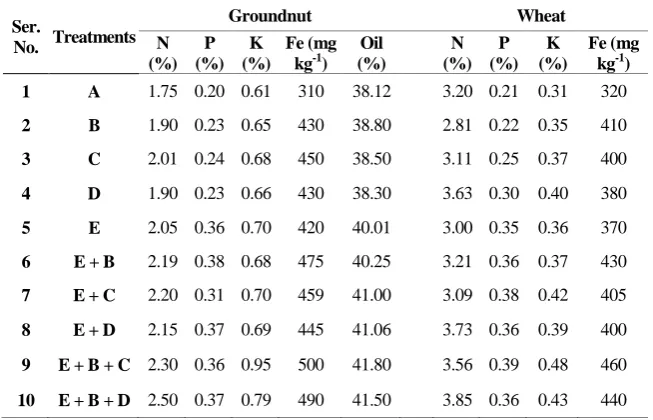
Data shown in Table 4 indicate that the studied treatments increased the N, P, K, Fe and oil percents of the groundnut seeds compared to the control where the combined treatments were more effective than the single ones. The treatments of (E+B+C and E+B+D) were more effective than their corresponding non-magnetic treatments (E+C and E+D) in improving the groundnut seeds characteristics. Moreover, the treatment E + B + C has exhibited the maximum percent of the groundnut seeds oil, K and Fe where an increase of 9.65%, 55.74%, and 61.3%, respectively over the control exists. The same trend was observed for the wheat grain percent of K, P and Fe where an increase of 85.71%, 54.84% and 43.75%, respectively compared to the control was recorded. Similar results had been obtained by Dhawi and Al-Khayri (2009) and Shehata et al. (2012).
Applying Phosphorine treatments (D and E+D) resulted in higher values of the different estimated crops characteristics compared to the control and lower values compared to the magnetic iron ore treatments according to Table 4.
The Phosphorine combined with both the super phosphate and the magnetic iron ore (E + B + D) gave the highest values of N percent for both the groundnut and wheat, respectively. However, the Phosphorine treatment (D) showed lower P percent than the super phosphate ones for both crops (Mohamed, 2003 and Dhawi & Al-Khayri, 2009). The combination with the magnetic iron ore alone (E + B) or with both the magnetic iron ore and the bentonite (E + B + C) gave the highest total P percent which was increased by 90% and 85.71% for the groundnut seeds and wheat grains, respectively. The super phosphate was more effective than the bio- one (Phosphorine), i.e. (E) > (D). The combination between both was better in improving the P percent (E + B + D) = (E + B) >(E)>(D)>(A) (Shehata et al.,
2012).
Soil available nutrients
higher iron availability was observed by combining the magnetic iron ore with other additives such as super phosphate and bentonite or phosphorine. Similar results were defined by El-Sedfy et al. (2008) and Mohamed et al. (2013).
TABLE 3. Yield and yield components.
Groundnut Wheat
Ser.
No. Treatments
Seed yield (kg fed -1)
100 Seed wt
(g)
Shelling (%)
Grain yield (kg fed -1)
100 Grain wt (g)
1 A 559.72 70.17 64.19 1493.90 4.40
2 B 562.14 72.37 65.88 1719.80 4.70
3 C 606.85 73.03 63.71 1863.73 4.65
4 D 691.55 70.77 64.88 1911.63 4.82
5 E 667.65 71.64 65.36 1789.54 4.77
6 E + B 720.52 73.53 65.78 1935.61 4.88
7 E + C 676.85 72.38 65.62 2007.53 4.61
8 E + D 645.93 70.29 66.32 1891.99 4.41
9 E + B + C 741.18 72.40 66.14 2222.85 4.68
10 E + B + D 642.44 72.48 64.45 2153.40 4.85
L.S.D 0.05 NS NS 100.7 NS
TABLE 4. Effect of treatments on the nutritional percent of seeds and grains .
Ser.
No. Treatments
Groundnut Wheat
N (%)
P (%)
K (%)
Fe (mg kg-1)
Oil (%)
N (%)
P (%)
K (%)
Fe (mg kg-1)
1 A 1.75 0.20 0.61 310 38.12 3.20 0.21 0.31 320
2 B 1.90 0.23 0.65 430 38.80 2.81 0.22 0.35 410
3 C 2.01 0.24 0.68 450 38.50 3.11 0.25 0.37 400
4 D 1.90 0.23 0.66 430 38.30 3.63 0.30 0.40 380
5 E 2.05 0.36 0.70 420 40.01 3.00 0.35 0.36 370
TABLE 5. Available nutrients in soil after harvest (mg kg-1) .
Ser. No.
Treatme nts
Groundnut Wheat
N P K Fe N P K Fe
1 A 28 2.0 75 1.61 20 1.05 77 1.90
2 B 29 2.0 77 3.01 21 1.50 78 2.85
3 C 30 2.6 80 3.05 22 1.66 83 2.70
4 D 35 2.8 80 2.70 24 1.80 82 2.30
5 E 31 3.05 79 2.80 23 1.90 81 2.25
6 E + B 33 3.06 80 3.50 23 1.85 79 3.00
7 E + C 35 3.80 85 3.65 22 2.00 82 3.15
8 E + D 38 3.19 80 3.35 26 2.20 79 2.75
9 E + B +
C 36 3.90 88 4.50 24 2.03 88 3.30
10 E + B +
D 39 3.5 84 4.00 28 2.28 77 3.10
Conclusion
The results indicate that the applied additives have enhanced the yield and nutrient percent of groundnut seeds and wheat grains compared to the control. This may be due to the dual effect of additives as soil conditioners and nutritive sources. Differences in yield were insignificant for groundnut but significant for wheat, moreover, the yield of the combined treatments was better than the single ones compared to the control. Increase in different values followed an ascending order starts from single applications followed by the double combination, whereas the highest values were recorded in the case of the triple combination for both crops. Magnetic treatments were more efficient than the corresponding non-magnetic indicating an important nutritional role of non-magnetic iron especially for wheat while groundnut was less affected. Magnetism may be promising on the soil conditioning and plant nutrition scales.
References
Anonymous )1990( Official Methods of Analysis of the Association of the Official Analytical Chemists (A.O.A.C.). 15th ed, Published by A.O.A.C., Washington, D.C.
Amils, R., de la Fuente, V., Rodrı´guez, N., Zuluaga, J., Mene´ndez, N.and Tornero, J. (2007) Composition, speciation, and distribution of iron minerals in Imperata cylindrical. Plant Physiol. Biochem. 45, 335-340.
Aowad, M. M. and Mohamed, A. A. (2009) The effect of bio, organic and mineral fertilization on productivity of Sunflower seed and oil yields. J. Agric. Res. Kafrelsheikh Univ. 35 (4), 1013-1028.
Briat, J-F., Duc, C., Ravet, K. and Gaymard, F. (2010) Ferritins and iron storage in plants: Review. Biochimi. Biophys. Acta. 1800, 806–814.
Carrera, E. J. (2009) Growing vitamins: The environmental effects on plant nutrition, project no. S2003, California State Science Fair, project summary.
De Souza, A., García, D., Sueiro, L., Licea, L. and Porras, E. (2005) Pre-sowing magnetic treatment of tomato seeds: effects on the growth and yield of plants cultivated late in the season. Span. J. Agric. Res. 3(1), 113-122.
Dhawi, F. and Al-Khayri, J. M. (2009) The effect of magnetic resonance imaging on date palm (Phoenix dactylifera L.) elemental composition. Commun. Biometry Crop Sci. 4 (1), 14–20.
Esitken, A. and Turan, M. (2003) Alternating magnetic field effects on yield and plant nutrient element composition of strawberry (Fragaria x ananassa cv. Camarosa). Acta Agriculturae Scandinavica. Section B, Soil Plant Sci. 54, 135–139.
El-Nagdy, G. A., Nassar, D. M., El-Kady, E. A. and El-Yamanee, G. S. (2010) Response of flax plant (Linum usitatissimum L.) to treatments with mineral and bio-fertilizers from nitrogen and phosphorus. J. Amer. Sci. 6 (10), 207-217.
El-Sedfy, O. F., Abd El-Hamid, A. R. and Mahmoud, A. A. (2008) Impact of compost and phosphate fertilizers utilization on phosphorous availability and some crop productivity on sandy soils. Minufiya J. Agric. Res. 33(4), 1031-1053.
El-Tohamy, W. A., El-Abagy, H. M., El-Greadly, N. H. and Gruda, N. (2009) Hormonal changes, growth and yield of tomato plants in response to chemical and bio-fertilization application in sandy soils. J. Appl. Bot. Food Qual. 82, 179-182.
Gomez, K. A. and Gomez, A. A. (1984) Statistical Procedures for Agricultural Research, John Wiley & Sons, New York, NY, USA.
Gubbels, G. H. (1982) Seedling growth and yield response of flax, buckwheat, sunflower, and field pea after preceding magnetic treatment. Can J. Plant Sci. 62(1), 61-64.
Hassan, A. Z. A. and Abdel Wahab, M. M. (2013) The combined effect of bentonite and natural zeolite on sandy soil properties and productivity of some crops. Topclass J. Agric. Res. 26 Sept. 1(3), 22-28.
He, S., Feng, Y., Ren, H., Zhang, Y., Gu, N. and Lin, X. (2011) The impact of iron oxide magnetic nano-particles on the soil bacterial community. J. Soils Sediments. 11, 1408–1417.
Hue, N. V. and Silva, J. A. (2000) Organic soil amendments for sustainable agriculture: organic sources of nitrogen, phosphorus, and potassium, chapter 15, From: Plant Nutrient Management in Hawaii’s Soils, Approaches for Tropical and Subtropical Agriculture, J. A. Silva and R. Uchida, (Ed). College of Tropical Agriculture and Human Resources, University of Hawaii at Manoa.
controlling root-knot nematode of grapevine in a newly reclaimed area of Egypt. Pak. J. Nematol. 28(2), 307-328.
Jackson, M. L. (1967) “Soil Chemical Analysis”. Constable and Co. L.T.P., London, England.
Mansour, E. R. (2007) Effect of some culture practices on cauliflower tolerance to salinity under Ras Suder conditions. M. Sc. Thesis. Fac. Agric., Horticulture Dept. Ain Shams Univ.
Maksoud, M. A., Saleh, M. A., El-Shamma, M. S. and Fouad, A. A. (2009) The beneficial effect of bio-fertilizers and antioxidants on olive trees under calcareous soil conditions. World J. Agric. Sci. 5 (3), 350-352.
Mohamed, H. M., Al- Kamar, F. A. and Azza, Abd-Elall, A. M. (2013) Effect of magnetite and some bio-fertilizer application on growth and yield of Valencia Orange trees under El–Bustan condition. Nature Sci. 11(6), 46-61.
Mohamed, A. E. (2003) Response of sunflower to Phosphorine and cerealine in inoculation under low NP-fertilizer levels. J. Agric. Res., Tanta Univ. 29(2), 653-663.
Mostafa, S. H. and Ahmed, M. E. (2000) Effect of inoculation with Phosphorine and nirtobin on flax yield and some anatomical characters under different nitrogen levels. J. Agric. Sci. Mansoura Univ. 28 (6).
Page, A. L., Miller, R. H. and Keeney, D. R. (1982) Methods of Soil Analysis. II. Chemical and Microbiogical properties 2nd Ed. Madison, Wisconsim. U.S.A.
Răcuciu, M. (2012) Iron oxide nano-particles coated with β-cyclodextrin polluted of Zea mays plantlets. Nanotech. Develop. vol. 2, E6.
Reguieg, H. Y., Belkhodja M. and Chibani, A. (2011) Effect of bentonite on the sandy soils of arid regions: study of behaviour of an association of wheat and chickpea. J. Environ. Sci. Eng. 5, 1668-1677.
Shehata, S.A., Yasser, M. Ahmed, Youssef T. Emam and Mahmoud A. Azoz (2012) Influence of some organic and inorganic fertilizers on vegetative growth, yield, and yield components of cucumber plants. Res. J. Agric. Biol. Sci. 8(2), 108-114.
Taha, B. A., Khalil, S. E. and Khalil, A. M. (2011) Magnetic treatments of capsicum Annuum L. grown under saline irrigation conditions. J. Appl. Sci. Res.7(11), 1558- 1568.
Thalooth, T., Bahr, A. A. and Tawfik, M. M. (2012) Productivity of some barley cultivars as affected by inoculation under water stress conditions. Elixir Appl. Bot. 51, 10743-10749.
Youssef, M. M. A. and Eissa, M. F. M. (2014) Bio-fertilizers and their role in management of plant parasitic nematodes: a review. E3. J. Biotechnol. Pharma. Res. 5(1), 001-006.
ىلع ةدمسلأا ضعب عم فاضملا ىسيطانغملا ديدحلا ديسكأ ريثأت
ةيلمرلا ةبرتلا ىف رصانعلا رسيتو حمقلاو ىنادوسلا لوفلا ةيجاتنإ
ىنويسبلا دومحم ىربص ،
نسح ىفطصم نيسح و
داشر تعلط اـمار
ةيريجلاو ةيلمرلا ىضارلأا ثوحب مسق –
ةئيبلاو هايملاو ىضارلأا ثوحب دهعم – وحبلا زكرم ةيعارزلا ث – ةزيجلا – رـصم .
ىنادوسلا لوفلا ىلع ةيليعامسلإاب ةيثحبلا ةعرزملا ىف ناتيلقح ناتبرجت تيرجأ ةيجاتنإ ىلع تافاضلإا نم ةفلتخم عاونأ ريثأت ةساردل شرلاب ىرلا ماظنب حمقلاو ةيلمرلا ةبرتلا ىف رصانعلا رسيتو .
ماخ نم ةطلتخمو ةيدرف تلاماعم تمدختسإ
ةلفطلا بساورو ديدحلا ( تينوتنبلا ) ىويحلا دامسلاو ( نيروفسوفلا ) تافسوف ربوسو
تارركم ةعبرأب ةيئاوشعلا ةلماك تاعاطق ميمصت ىف مويسلاكلا .
و ىنادوسلا لوفلا نم لك ةيجاتنإ باسح مت داصحلا دعب حمقلا ( مجك / ف ) نزوو ٠١١ نم حمقلا بوبحو ىنادوسلا لوفلا روذبل ىلكلا ىوتحملا ريدقت مت كلذكو ةبح تيزلا ةبسنو ةبرتلا ىف رصانعلا هذه نم رسيملا كلذكو ح ، وب ، وف ، ن رصانع
ىنادوسلا لوفلا روذب ىف .
وكلاب ةنراقم حمقلاو ىنادوسلا لوفلل ةيجاتنإ ىلعأ نأ جئاتنلا ترهظأ لورتن
تافسوفلا ربوس نم ةنوكملا ةلماعملل تلجس ( ٫٫٢٢ وف ٫ أ ٢ / ف + ) ديدحلا ماخ
( ٠٫١ مجك / ف + ) تينوتنبلا ( ٠١١ مجك / ف ) ةبسنب ةيجاتنلإا تداز ثيح
٢٫٢٢٫ و ٪ ٢٤٢٤ بيترتلا ىلع نيلوصحملا لاكل ٪ ،
بسن ىلعأ تلجس كلذك
اتوبلاو تيزلا نم ىنادوسلا لوفلا روذبل ىلكلا ىوتحملل رادقمب ديدحلا و مويس
٥٢٫٢ و ٪ ٢٢٢٥٢ و ٪ ٫٠٢٢ بيترتلا ىلع ٪ .
ىف ةرسيملا ةبسنلا تفلتخإ امنيب