ABSTRACT
The effect of tomato juice on the expression of matrix
metalloproteinase-2 (MMP-2) and type-1 collagen on
the vaginal wall of the menopausal rats
Juminten Saimin1*, Hendy Hendarto2, Soetjipto3
Background: Aging is a multifactorial phenomenon that is characterized by a decrease in physiological functions that increases with age. Free radicals cause oxidative stress, which plays a role in the aging process. The accumulation of reactive oxygen compounds increases matrix metalloproteinase-2. Collagen can be directly destroyed by reactive oxygen compounds or through the induction of MPPs. Tomato fruit is an antioxidant, which acts as a binder and damper of free radicals that activate collagen damage. This study aims to assess the effect of tomato juice on the expression of MMP-2 and type-1 collagen on the vaginal wall of the menopausal rat.
Methods: This was a true experimental study, using Sprague-Dawley rats and tomato juice (Solanum lycopersicum). Expression of MMP-2 and type-1 collagen was examined using immunohistochemistry staining. Twenty-four healthy female rats, aged 4 months weighing 150-200 grams, were divided into 4 groups, each group as many as 6 rats. The negative control group (NC) was a group of rats with a sham procedure, given aquades for 28 days. The positive control group (PC) was bilaterally ovariectomized rats, given aquades for 28 days. The first treatment group (P1) was bilaterally ovariectomized rats, given tomato juice with a dose of 11 g / 200 g BW / day. The second treatment group (P2) was bilaterally ovariectomized rats, given tomato juice with a dose of 15 g / 200 g BW / day. Data
analysis used the One-way ANOVA statistical test (α = 0.05) and different tests between groups using Games-Howell and Tukey HSD. The association between tomato juice and the expression of MMP-2 and type-1 collagen used regression tests.
Results: This study found that the lowest expression of MMP-2 was NC group (2.07 ± 0.84), and the highest was the PC group (5.72 ± 1.91). The mean MMP-2 expression in the treatment groups was lower than the PC group but still higher than the NC group. There was a significant difference in MMP-2 expression between groups (p = 0,000). There was a negative correlation between tomato juice administration and MMP-2 expression (b = -0.592). The lowest type-1 collagen expression was PC group (3.83 ± 1.44), and the highest was the P2 group (7.27 ± 2.21). The mean type-1 collagen expression in the treatment groups was higher than the PC group. There were significant differences of type-1 collagen expression between groups (p = 0.012). There was a positive correlation between tomato juice administration and type-1 collagen expression (b = 0.682).
Conclusions: Tomato juice administration can reduce the expression of MMP-2 and increase the expression of type-1 collagen on the vaginal wall of the menopausal rat. The higher the dose of tomato juice, the higher the expression of type-1 collagen.
Keywords:MMP-2, menopause, tomato juice, type-1 collagen
Cite this Article:Soetjipto., Saimin, J., Hendarto, H. 2019. The effect of tomato juice on the expression of matrix metalloproteinase-2 (MMP-2) and type-1 collagen on the vaginal wall of the menopausal rats. Bali Medical Journal 8(3): 591-596. DOI: 10.15562/bmj.v8i3.1277 1Obstetrics and Gynecology
Department, Faculty of Medicine, Universitas Halu Oleo
2Obstetrics and Gynecology
Department, Faculty of Medicine, Universitas Airlangga
3Biochemistry Department, Faculty
of Medicine, Universitas Airlangga
*Corresponding to:
Juminten Saimin, Obstetrics and Gynecology Department, Faculty of Medicine, Universitas Halu Oleo;
P-ISSN.2089-1180, E-ISSN: 2302-2914
Received: 2018-08-07 Accepted: 2019-09-12 Published: 2019-12-01
INTRODUCTION
Menopause is a period of life that is passed by all women who have a long life. Improved welfare and better economic standards bring a higher life expectancy for women.1 Aging is a multifactorial phenomenon that is characterized by a decrease in physiological functions that increases with age. This decrease in function is also associated with the accumulation of damage to the metabolic pathway. The aging process is expressed in various theories, and the most popular is the theory of free radicals.2 Free radicals are chemical compounds in the form of atoms or molecules that have unpaired electrons in the outer layer. These chemical compounds have
one or more free electrons so that in large quantities can cause oxidative stress. Oxidative stress occurs because of an imbalance between oxidants and antioxidants, which then has the potential to cause cell damage. Damage to these important molecules plays a role in degenerative changes in the aging process.3,4,5
Tomatoes contain lycopene, ß-carotene, and vitamin C, which function as antioxidants, which act as binders and silencers of free radicals that activate collagen damage.8,9 Vitamin C plays a role in collagen biosynthesis. Collagen synthesis from fibroblasts requires oxygen, and vitamin C.10,11 Collagen can be directly destroyed by reactive oxygen compounds or through induction of a group of enzymes that play a role in the degradation of collagen, namely matrix metalloproteinases (MMPs).3,4 The accumulation of reactive oxygen compounds will increase the matrix metalloproteinase-1 (MMP-1) and matrix metalloproteinase-2 (MMP-2). Matrix metalloproteinase-1 will break down collagen type-1, while MMP-2 can break down gelatin, elastin, fibronectin, collagen types I, IV and V. This damage to collagen type I and IV will result in a decrease in collagen products.3,12
Research on premenopausal women with uterine prolapse, which measured gelatinase enzyme activity using zymography showed an increase in MMP-2 activity.13 Prasetya (2015) found that administration of tomato juice on post-ovariectomy rats was shown to increase estrogen levels in the blood and induce proliferation of fibroblasts, thereby increasing collagen synthesis in the vaginal wall.14 Wahyono (2008) in his study proved that the administration of tomato fruit extracts caused an increase in the expression of collagen type-1 and decreased MMP, such as MMP-1 and MMP-3, on skin of rats which was allowed to experience additional age.5 Increased MMP causes increased degradation of collagen, so that collagen produced decreases.3,15
This study aimed to assess the effect of tomato juice on the expression of MMP-2 and type-1 collagen on the vaginal wall of the menopausal rat model, to assess the relationship between the dose of tomato juice and the expression of MMP-2 and type-1 collagen.
METHODS
Study designThis was a true experimental study using Sprague-Dawley rats. The research material was tomatoes fruits (Solanum lycopersicum) which had been certified by the Indonesian Institute of Sciences, Plant Conservation Center, Purwodadi Botanical Garden in East Java Indonesia. Maintenance and treatment of experimental animals were carried out at the experimental animal cage Faculty of Veterinary Medicine, Universitas Airlangga Surabaya. Immunohistochemical staining for the expression of MMP-2 and type-1 collagen in the vaginal wall were carried out at Veterinary Pathology Laboratory, Faculty of Veterinary
Medicine Universitas Airlangga Surabaya.
The ethical clearance was obtained from the Ethics Committee of Faculty of Veterinary Medicine, Universitas Airlangga, with number: 2.KE.024.02.2018.
Treatment of Rats
The study was conducted on twenty-four healthy female rats, aged 4 months and weighing 150-200 grams, starting with acclimatization for two weeks. The rats were randomly divided into 4 treatment groups, each group as many as 6 mice. The negative control group (NC) was a group of rats with a sham procedure, which was done in the abdomen incision but not ovariectomy and then sewn again, given aquades for 28 days. The positive control group (PC) was a group of rats with bilateral ovariectomy and given aquades for 28 days. The first treatment group (P1) was a group of rats with bilateral ovariectomy and given tomato juice at a dose of 11 grams / 200 grams of rats body weight/day. The second treatment group (P2) was a group of rats with bilateral ovariectomy and given tomato juice at a dose of 15 grams / 200 grams of rats body weight/ day. The menopausal condition was confirmed by the results of vaginal swabs that show diestrus on the 21st day after bilateral ovariectomy. Rats were
sacrificed on the 29th day for tissue retrieval.
Immunohistochemistry staining of MMP-2 and type-1 collagen
dH2O and dry air. Mounting uses an entanglement and covers with a glass cover. The observation was using a microscope at 400x magnification.
Statistical analysis
Statistical analysis using One-way ANOVA statistical test at a confidence level of α = 0.05, followed by a different test between groups using Games-Howell and Tukey HSD. The association between various doses of tomato juice with MMP-2
expression and type-1 collagen in the vaginal wall of the menopausal model using a regression test.
RESULT
The Effect of tomato juice on the MMP-2 expression
Figure 1 showed that the lowest expression of MMP-2 was NC group (2.07 ± 0.84), and the highest expression was PC group (5.72 ± 1.91). The mean MMP-2 expression of P1 group was lower than the P2 group. The mean of the treatment groups (P1 and P2) was lower than the PC group but still higher than the NC group. In the Kolmogorov-Smirnov normality test, the data were normally distributed (p> 0.05). One-way ANOVA test (α = 0.05) found a significant difference in the average number of MMP-2 expression between study groups (p = 0,000). It showed that the administration of tomato juice could reduce MMP-2 expression even though it did not reach normal conditions as NC group.
The variance homogeneity of MMP-2 expression data was not homogeneous, so multiple comparisons were conducted using Games-Howell, it appears that there are differences in MMP-2 expression between NC group and PC group, and differences in MMP-2 expression between PC group and P1 group (p <0.05). The linear regression test showed a negative correlation with a standard coefficient of b = -0.592; it means an increase in tomato juice administration would reduce MMP-2 expression by 0.592.
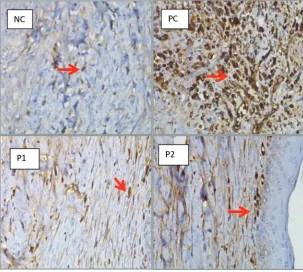
Figure 2 shows the MMP-2 expression.
The red arrow shows the expression of MMP-2, which is indicated by the brown color of chromogen in the cytoplasm (Figure 2). The results showed that MMP-2 expression in PC group was higher than the treatment groups (P2 and P1) and the NC group.
The effect of tomato juice on type-1 Collagen expression
Figure 3 shows that the lowest average type-1 collagen expression is PC group (3.83 ± 1.44), and the highest is the P2 group (7.27 ± 2.21). The type-1 collagen expression in the Ptype-1 group was lower than the P2 group but higher than the PC group. In the Kolmogorov-Smirnov normality test, the data were normally distributed (p> 0.05), and the one-way ANOVA test showed significant differences between groups (p = 0.012). It shows that tomato juice administration significantly increases the expression of type-1 collagen. The higher the dose of tomato juice, the higher the expression of type-1 collagen.
The variance homogeneity test of type-1 collagen expression was homogeneous so that the
Figure 1. Expression of MMP-2 on the vaginal wall
different tests between groups were carried out using Tukey HSD, showed there were differences in type-1 collagen expression between PC group and P2 group (p <0.05). The regression test shows that the standard coefficient (b = 0.682), which means that an increase in tomato juice administration will increase the expression of type-1 collagen by (0.682).
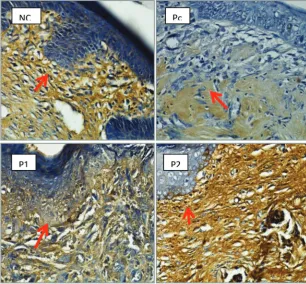
In Figure 4, the red arrow shows the expression of type-1 collagen, which is characterized by the brown color of chromogen in the cytoplasm. The results showed that type-1 collagen expression in the NC group was higher than the treatment groups (P2 and P1), as well as the PC group.
DISCUSSION
The aging process causes free radicals to increase continuously. As a result, there is an imbalance between free radicals and antioxidants, causing the formation of ROS.4,5,6 Free radicals can destroy collagen and induce matrix metalloproteinases (MMPs). Matrix metalloproteinase (MMPs) is a group of enzymes that is responsible for the degradation of collagen.3,4 The accumulation of reactive oxygen compounds will increase the number of MMPs, including MMP-2. Matrix metalloproteinase-2 can break down gelatin, elastin, fibronectin, collagen types I, IV and V. This damage to collagen type I and IV results in a decrease in collagen products.3,12 Oxidative stress conditions induce the formation of Hsp-70. Increased Hsp70 causes an increase in p38 pathway activation.16 Increased ROS activates the pathway of the mitogen-activated protein kinase (MAPK) thereby reducing extracellular signal-regulated kinase (ERK) and increasing cJun Kinase (JNK / p38), then activating an increase in anti-protein 1 (AP-1). An increase in AP-1 causes an increase in MMPs, including collagenase. Increased collagenase activates a decrease in procollagen-1, causing decreased type-1 collagen expression.3,5
This study found that the highest average MMP-2 expression and the lowest type-1 collagen expression were the menopausal groups given by aquades. This result was similar to Alarab’s study (2014), which found an increase in MMP-2 activity in premenopausal women who had uterine prolapse.13
Tomatoes are a source of antioxidants because they are rich in vitamin C, vitamin E, β-carotene and lycopene. Lycopene can function as a powerful antioxidant and react with free radicals.8,9 Lycopene can also interact with ROS, such as H2O2 and NO2. Consumption of beta carotene with vitamins C and E has been shown to improve antioxidant abilities. Vitamin C can help stabilize free radicals.17 Antioxidants can reduce free radicals so that ROS is not formed. Antioxidants activate nitrides oxide synthase (NOS) and the mitogen-activated protein kinase (MAPK), which increases extracellular signal-kinase (ERK) and decreases c-Jun Kinase (JNK / p38), resulting in a decrease anti-protein-1 (AP-1). A decrease in AP-1 will reduce the expression of MMP, including MMP-2.5,15
Figure 3. Expression of type 1 collagen in the vaginal wall
Figure 4. Expression of type-1 collagen (chocolate chromogen) in the vaginal wall between groups
This study found that the administration of tomato juice can reduce MMP-2 expression in menopausal rats, even though it does not arrive at normal conditions. It indicates that the administration of tomato juice in menopausal conditions can reduce MMP-2 expression. This study found that administration of tomato juice, as an antioxidant, increases the expression of type-1 collagen in menopausal rats.
This results study are similar to the study of Wahyono (2008), which found that the administration of tomato extracts had the effect of decreasing MMP-1 and MMP-3 on the mice skin that had a change in age from 4 to 7 months.5 However, Wahyono (2008), found that the administration of various doses of tomato extract showed a tendency to be negatively correlated, increasing the dose would reduce the number of MMP-1 and MMP3.
In the normal conditions, the extracellular matrix is physiologically remodeling, through a balance of synthesis and degradation. This balance is maintained mainly by cytokine stimulators and growth factors, as well as degradative MMP and tissue inhibitors of metalloproteinases (TIMPs). The synthesis and secretion of MMP and TIMPs are regulated by complexes of signaling factors, cytokines, growth factors, and hormones. This process will regulate cell and extracellular matrix interactions on physiological and pathological conditions that will cause a turnover. In estrogen deficiency conditions at menopause, balance shifts towards increasing MMP activity, which causes degradation of collagen.12,18 Changes in the balance between synthesis and degradation affect tissue formation and changes in mechanical properties in connective tissue.19,20 Connective tissue consists of the extracellular matrix, including collagen and elastin as the main proteins and glycoproteins and proteoglycans. The two main fiber components of this connective tissue are the vaginal support; collagen is responsible for the strength of the strain and elastin is responsible for the resilience and the ability to return from stretching.19,21 Postmenopausal estrogen receptors in the vaginal wall and sacro-uterine ligament are reduced, causing atrophy of connective tissue and thinning of the urogenital tract epithelium, including the vaginal mucosa.22,23 Decreased of estrogen during menopause results in vaginal atrophy due to epithelial atrophy decreased collagen and elastin fibers.24,25Vaginal atrophy has a significant impact on sexual activity, disrupting household harmony, and affecting the quality of life of menopausal women. That affects the physical and psychological postmenopausal women.26
Tomato fruit is one source of phytoestrogen, which is cheap and easy to obtain, has a high
content of phytoestrogens, especially in the fruit water.27 Tomatoes contain lycopene which can react with free radicals and function as a powerful antioxidant.9 Vitamin C is known as the main body compound needed in a variety of important processes, ranging from collagen biosynthesis, fat transport, electron carriers from various enzymatic reactions, regulating cholesterol levels, and boosting the body’s immunity. Collagen synthesis from fibroblasts requires oxygen and vitamin C.10,11,17
This study found that administration of tomato juice in menopausal conditions significantly reduced MMP-2 expression, but the reduction of MMP-2 expression was not significantly associated with increased type-1 collagen expression. Tomato juice administration can significantly increase the expression of type 1 collagen. There is a positive correlation between the dose of tomato juice and the increasing of collagen type-1 expression. The higher the dose of tomato juice will increase of type-1 collagen expression in menopausal rats. Increasing the dose of tomato juice will increase the expression of type-1 collagen by 0.682.
CONCLUSION
The tomato juice reduces the expression of MMP-2 and increases the expression of type-1 collagen on the vaginal wall of the menopausal rats. There was a negative correlation between increasing the dose of tomato juice and MMP-2 expression with a standard coefficient of b = -0.592, which means that an increase in the dose of tomato juice will reduce MMP-2 expression by 0.592. There was a positive correlation between increasing the dose of tomato juice and expression of type-1 collagen with a standard coefficient of b = 0.682, which means that increasing the dose of tomato juice will increase the expression of type-1 collagen by 0.682.
CONFLICT OF INTEREST
The authors declare that there is no conflict of interest regarding the manuscript.
FUNDING
The authors are responsible for the funding without the involvement of grant, sponsorship, or any other sources of funding.
AUTHOR CONTRIBUTION
REFERENCES
1. Brincat MP., Baron YM., Galea R. Estrogens, and the skin. Climacteric. 2005. 8: 110–123.
2. Zalukhu ML., Phyma AR., Pinzon RT. Proses menua, Stres Oksidatif, dan Peran Antioksidan. CDK-245. 2016. 43 (10); 733-6.
3. Pinnell SR. Cutaneous photodamage, oxidative stress, and
topical antioxidant protection. J Am Acad Dermatol. 2003.
14:1-19.
4. Stevenson S., Thornton J. Effect of estrogens on skin aging
and the potential role of SERMs. Clinical Interventions in
Aging. 2007. 2(3): 283-297.
5. Wahyono P. Efek ekstrak buah tomat (Licopersicum
pyriforme) terhadap ekspresi kolagen tipe 1, MMP-1 dan
MMP-3 pada penuaan kulit. Jurnal Kedokteran Brawijaya.
2008. 24 (3).
6. Suryohudoyo P. Oksidan, Antioksidan dan Radikal bebas. Dalam: Ilmu Kedokteran Molekuler. Kapita Selekta. Jakarta: Sagung Seto. 2000.h.31-46.
7. Droge W. Free Radicals in the physiology control of cell function. Physiol Rev. 2003. 82: 47-9.
8. Canene-Adams K., Campbell JK., Zaripheh S., Jeffery EH.,
Erdman JW. The tomato as a functional food. J Nutr. 2005.
135:1226-1230.
9. Andayani R., Maimunah, Lisawati Y. Penentuan aktivitas antioksidan, kadar fenolat total dan likopen pada buah
tomat (Solanum lycopersicum L). Jurnal Sains dan
Teknologi Farmasi. 2008.13 (1).
10. May JM., Qu ZC. Transport and intracellular accumulation of vitamin C in endothelial cells: relevance to collagen
synthesis. Arch Biochem Biophys. 2005. 434(1); 178-85.
11. Qiao H., Bell J., Juliao S., Li L., May JM. Ascorbic acid uptake and regulation of type I collagen synthesis in cultured vascular smooth muscle cells. J Vasc Res. 2009. 46; 15-24.
12. Klein & Bischoff. Physiology and pathophysiology of
Matrix Metalloproteases. Amino Acids. 2011. 41(2):271-90.
13. Alarab M., Kufaishi H., Lye S., Drutz H., Shynlova O. Expression of extracellular matrix-remodeling proteins is altered in vaginal tissue of premenopausal women with
severe pelvic organ prolapse. Reproductive Sciences. 2014.
21(6); 704–715.
14. Prasetya A., Widjayanti Y. Effect of tomato juice on vaginal wall elasticity in menopausal rats. Folia Medica Indonesia. 2015. 51:132-136.
15. Shin MH., Rhie G., Kim YK., Park CH., Cho KH., Kim KH., Eun HC., Chung JH. H2O2 accumulation by catalase reduction changes map kinase signaling in aged human
skin in vivo. Journal Invest Dermatology. 2005.125:
221-229.
16. Bellmann K., Burkart V., Bruckhoff J., Kolb H, Landry J. p38-dependent enhancement of cytokine-induced
nitric-oxide synthase gene expression by heat shock protein 70. J
Bio Chem. 2000. 275(24): 18172–18179.
17. Sayuti K., Yenrina R. Antioksidan alami dan sintetik. Padang: Andalas University Press. 2015.
18. Sun B., Zhou L., Wen Y. Proliferative behavior of vaginal fibroblasts from women with pelvic organ prolapse. European Journal of Obstetrics And Gynecology And Reproductive Biology, 2014.183:1 – 4.
19. Ewies A., Alzzawi F., Thompson J. Changes in extracellular matrix proteins in the cardinal ligaments of post-menopausal women with or without prolapsed: a
computerized immunohistophometric analysis. Europen
Society of Human Reproduction and Embryology. 2003. 18 (10): 2185-95.
20. Liang, CC. Expression of Matrix Metalloproteinase-2 and Tissue Inhibitors of Metalloproteinase-1 (TIMP-1, TIMP-2 and TIMP-3) in women with uterine prolapse but without
urinary incontinence. European Journal of Obstetrics &
Gynecology and Reproductive Biology. 2010. 153, 94–8. 21. Budatha M., Roshanravan S., Zheng Q., Weislander
C., Chapman SL., Davis EC., Starcher B., Word RA., Yanagisawa H. Extracellular matrix proteases contribute to
progression of pelvic organ prolapse in mice and humans. J
Clin Invest. 2011. 121(5): 2048-2059.
22. Mescher AL. The female reproductive system. Junquera’s
Basic Histology. 13ed. McGraw-Hill Education. 2013.
p.449-77.
23. Konar H. DC Dutta’s Textbook of Gynecology. JP Medical Ltd. 2014. pp. 2–7.
24. Grady D. Management of menopausal symptoms. N Engl J
Med. 2006. 355:2338-47.
25. Illston JD., Wheeler TL., Parker CR., Conner MG., Burgio KL., Goode PS., Richter HE. Low-Dose 17-β-Estradiol cream for vaginal atrophy in a cohort without prolapse: serum levels and vaginal response including tissue
biomarkers associated with tissue remodeling. Maturitas.
2015. 81(4):475-479.
26. Saimin J., Wicaksono S., Junuda, Minarti. 2018. Factors affecting the development of anxiety in postmenopausal women: a cross sectional study in coastal areas. Maj Obstet Ginekol Indones. 6(3): 133-136.