Available Online at www.ijpret.com 192
INTERNATIONAL JOURNAL OF PURE AND
APPLIED RESEARCH IN ENGINEERING AND
TECHNOLOGY
A PATH FOR HORIZING YOUR INNOVATIVE WORK
EFFECT OF RECYCLED COARSE AGGREGATE ON WORKABILITY ON GEOPOLYMER
CONCRETE
DARSHAN K. GOSWAMI1, JATIN J. VAGHELA1, RONAK DESAI1, DHAVAL SUTHAR 1, ABHIJITSINH
PARMAR2
1. U.G. Student, Department of Civil Engineering, SVBIT, Gandhinagar. 2. Assistant Professor, Department of Civil Engineering, SVBIT, Gandhinagar.
Accepted Date: 27/02/2016; Published Date: 01/03/2016
\
Abstract: - Geopolymers are new materials for fire and heat-resistant coatings and adhesives, medicinal applications, high-temperature ceramics, new binders for fire-resistant fiber composites, toxic and radioactive waste encapsulation and new cements for concrete.[1] In this study Recycled coarse aggregate (Waste material) was used for the replacement of conventional coarse aggregates to find out the possible best replacement of conventional coarse aggregate. From the study it indicates that replacement by Recycled Coarse Aggregate is reducing the workability of Geopolymer concrete.
Keywords: Fly Ash, recycled coarse aggregate, Geopolymer Concrete, alkaline solution
Corresponding Author: MR. ABHIJITSINH PARMAR
Access Online On:
www.ijpret.com
How to Cite This Article:
Available Online at www.ijpret.com 193
INTRODUCTION
Geopolymers are novel materials intended for fire and heat-resistant coatings and adhesives, medicinal applications, high-temperature ceramics, novel binders for fire-resistant fiber composites, toxic and radioactive waste encapsulation and novel cements for concrete [2].
The properties and utilize of geopolymers are being explored in numerous scientific and industrial disciplines: recent inorganic chemistry, physical chemistry, colloid chemistry, mineralogy, geology, and in further types of engineering practice technologies.
Geopolymers are division of polymer science, chemistry and technology that forms one of the most important areas of materials science. Polymers are either organic material, i.e. carbon-based, or inorganic polymer, for example silicon-based.
The organic polymers comprise the classes of natural polymers (rubber, cellulose), synthetic organic polymers (textile fibers, plastics, films, elastomers, etc.) and natural biopolymers (biology, medicine, pharmacy) [3]. Raw materials used in the synthesis of silicon-based polymers are mainly rock-forming minerals of geological origin [4].
Materials:
a. Fly ash
Fly ash used in this study was unprocessed fly ash from torrent power plant (locally available). The whole quantity of fly ash was obtained from one batch. Later, Fly ash was used in small proportions in mass concreting for dams and other hydraulic.
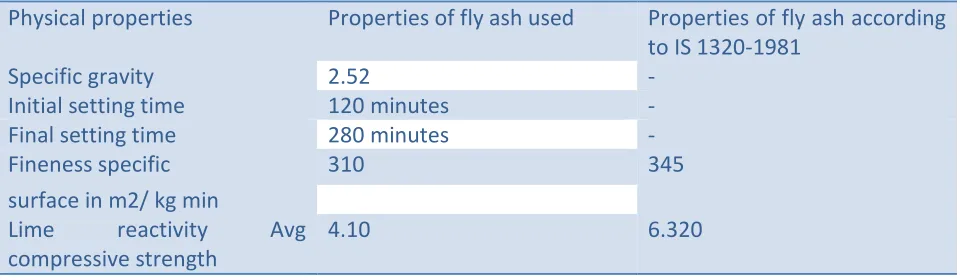
Table 1: Physical Properties of low calcium class F Fly Ash
Physical properties Properties of fly ash used Properties of fly ash according
to IS 1320-1981
Specific gravity 2.52 -
Initial setting time 120 minutes -
Final setting time 280 minutes -
Fineness specific 310 345
surface in m2/ kg min
Lime reactivity Avg
compressive strength
Available Online at www.ijpret.com 194 b. Course Aggregates & Fine aggregate
Locally available crushed stones of 10 mm and 20 mm aggregates were used as coarse aggregates. Local river sand was used as fine aggregate in the concrete mixtures.
c. Alkaline Solution as binder materials
The alkaline liquid used was a combination of sodium silicate solution and sodium hydroxide solution. The sodium silicate solution (NaOH = 15.38%, Na2SiO3 = 46, 15%, and water = 38.46%
by mass) was purchased from a local supplier in bulk. The sodium hydroxide (NaOH) in flakes or pellets from with 97%-98% purity was also purchased from a local supplier in bulk. The NaOH solids were dissolved in water to make the solution. To make alkaline solution first of all to prepare 10 M solution 400 grams of NaOH are dissolved in 1000 gm of water than 1200 grams of Na2SiO3 are added in dissolved solution. Then this solution kept as it for 24 hours at normal
room temperature.
d. Recycled Coarse aggregate
Recycled coarse aggregate were taken from the debris which is demolished building having grade of M20.
Mix Proportion:
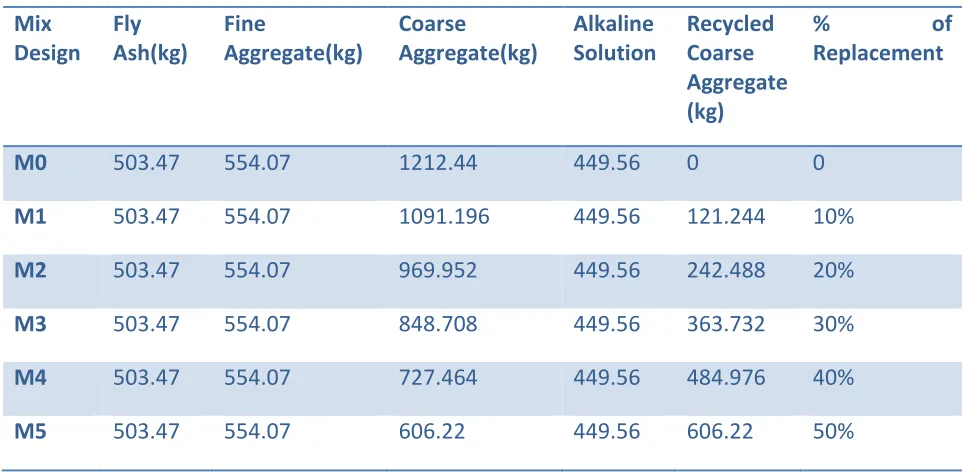
Table 1-Mix Design
Mix Design
Fly Ash(kg)
Fine
Aggregate(kg)
Coarse
Aggregate(kg)
Alkaline Solution
Recycled Coarse Aggregate (kg)
% of
Replacement
M0 503.47 554.07 1212.44 449.56 0 0
M1 503.47 554.07 1091.196 449.56 121.244 10%
M2 503.47 554.07 969.952 449.56 242.488 20%
M3 503.47 554.07 848.708 449.56 363.732 30%
M4 503.47 554.07 727.464 449.56 484.976 40%
Available Online at www.ijpret.com 195
Workability Tests
a) Slump Test:
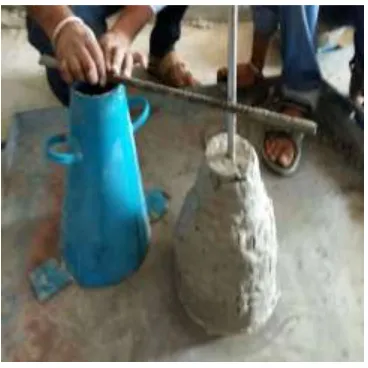
To determine the workability of concrete mix by slump test conducted by as per IS 1199-1959. The internal surface of the mould thoroughly cleaned and freed from superfluous moisture than mould placed on a smooth, horizontal, rigid and nonabsorbent surface. The mould was filled in four layers, each approximately one-quarter of the height of the mould. Each layer was tamped with twenty-five strokes of the rounded end of the tamping rod. The bottom layer tamped throughout its depth. After the top layer has been rodded, the concrete was struck off level with a trowel or the tamping rod, so that the mould is exactly filled. The mould removed from the concrete immediately by raising it slowly and carefully in a vertical direction. This allows the concrete to subside and the slump shall be measured immediately by determining the difference between the height of the mould and that of the highest point of the specimen being tested.
Fig. – 2 Slump Test
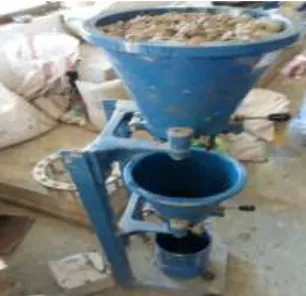
b) Compaction Factor Test:
Available Online at www.ijpret.com 196
Fig. – 3 Compaction Factor Test
Result:
(Table 2-Slump test results)
Mix Proportion Slump(mm)
M0 128
M1 124
M2 119
M3 112
M4 106
M5 101
(Table 3-C.F. Test results)
Mix Proportion C.F.
M0 0.96
M1 0.96
M2 0.96
M3 0.95
M4 0.95
M5 0.95
CONCLUSION:
Available Online at www.ijpret.com 197 replacement percentage is 50. Replacement of coarse aggregates with Recycled Coarse Aggregate will reduce the workability of Concrete. Increase in the percentage of replacement of aggregate will decrease the workability of Geopolymer concrete.
REFERENCES
1. Ankush Chakravorty, Raj Khatri, Tejkuvarba, Abhijitsinh Parmar, “EFFECT OF AGGREGATE SIZE AND SILICA FUME ON THE WORKABILITY OF GEOPLOYMER CONCRETE”, International Journal of Research in Engineering and Technology, Volume: 03 Issue: 04, Apr-2014
2. Michael J. Gibbs, Peter Soyka and David Conneely - CO2 Emissions from cement production, (ICF Incorporated). It was reviewed by Dina Kruger (USEPA).
3. Stevenson, M., and Panian, L. - “Sustainability through Strength,” Concrete International, V. 31, No. 3, Mar. 2009, pp. 34-39.
4. Raijiwala D.B. Patil H. S. - Geopolymer concrete: A concrete of next dicade.
5. Joseph Davidovits - Geopolymer chemistry & application 2nd edition (June 2008), Institute Geopolymer, France
6. Prof. M. A. Bhosale, Prof. N. N. Shinde - Geopolymer Concrete by Using Fly Ash in Construction (Energy, shivaji University, India), (Department of Energy Technology, Shivaji University, Kolhapur)
7. N. Lloyd and V. Rangan - Geopolymer Concrete Sustainable Cement less Concrete
8. Satpute Manesh B., Wakchaure Madhukar R., Patankar Subhash V. - Effect of Duration and
Temperature of Curing on Compressive Strength of Geopolymer Concrete
9. Djwantoro Hardjito, Steenie E. Wallah, Dody M.J. Sumajouw, and B.V. Rangan - Factors influencing the compressive strength of fly ash-based Geopolymer concrete
10. S. vaidya ,E. i. diaz, E. n. allouche - Experimental evaluation of self-cure geopolymer concrete for mass pour applications
11. ashida A Jhumarwala, P. S. Rao , T. N. Patel - Experimental Investigation on Self-Compacting Geopolymer Concrete (SCGC)
12. Djwantoro Hardjito, Steenie E. Wallah, Dody M.J. Sumajouw, and B.V. Rangan - Factors influencing the compressive strength of fly ash based geopolymer concrete
13. M. Olivia*, Curtin University of Technology, Australia, P. Sarker, Curtin University of Technology, Australia, H. Nikraz, Curtin University of Technology, Australia - Water Penetrability of Low Calcium Fly Ash