Available Online at www.ijpret.com 779
INTERNATIONAL JOURNAL OF PURE AND
APPLIED RESEARCH IN ENGINEERING AND
TECHNOLOGY
A PATH FOR HORIZING YOUR INNOVATIVE WORK
COMPARISON AND PERFORMANCE EVALUTION OF ROUTING PROTOCOLS IN
WIRELESS SENSOR NETWORKS
MR. SUSHIL R. SAWDEKAR, PROF. C. M. MANKAR Department of Computer Engineering, Shri Sant Gajanan Maharaj College of Engineering, Shegaon.
Accepted Date: 05/03/2015; Published Date: 01/05/2015
Abstract: Recently, wireless sensor networks have been found to use in many applications. For the design of sensor networks, the factors needed to be considered are the mobility, power consumption, communication capabilities, coverage area etc. And the efficiency of sensor networks strongly depends on the routing protocol used. So it is a challenging task of proper selection of the routing protocol to achieve maximum efficiency since latency, reliability and energy consumption are interrelated with each other. This paper investigates the performance comparison and analysis in case of using Ad-hoc on-Demand Distance
Vector (AODV) and Optimized Link State Routing Protocol (OLSR) with IEEE802.11. This was
done with the help of simulation results, derived by using Network Simulator NS-3. These results may be particularly useful for deployment of sensor network for Industrial control.
Keywords:AODV, OLSR, Wireless Sensor Network, NS-3, Multi-point Relay.
Corresponding Author: MR. SUSHIL R. SAWDEKAR
Access Online On:
www.ijpret.com
How to Cite This Article:
Available Online at www.ijpret.com 780 INTRODUCTION
A wireless Sensor Network is a network of many sensor nodes, having wireless channels to communicate with each other. The WSN is undergoing a major revolution opening the prospect of significant impacts in many areas application. A large number of sensors can be considered, integrated and organized as a network. All wireless sensor nodes are capable to act as a source or sink node at the same time. These nodes have a limited processing power due to their small size, which limits the capacity of processor and size of battery. Efficient data packet transmission is the main goal in a wireless sensor networks. Sensor nodes collect the information, process it and send it to the base station. End-to-End delay is the most significant factor for assessing the Quality of Service. It is the time taken by a node, to sense, to process and to communicate with other nodes. It also depends on the scope of an application. Time delay in a network is calculated based on these activities as well as how much time a sensor takes to forward the data in heavy load traffic. When large numbers of nodes are uniformly deployed to transmit the data packets then, the network should be able to provide the guarantee of low-delay and low-error rate.
Routing is fundamental in this type of network because there is no infrastructure that manages the information between network nodes. Indeed, that is to say each network node acts as routers. Thus, all nodes cooperate to route information to a certain destination. The routing algorithm is to provide a strategy to ensure at any moment, the connection between any pair of nodes belonging to the network.
In this paper, we compare the performance of two routing protocols i.e. AODV (Ad-hoc On-Demand Distance Vector) [1] and OLSR Optimized Link State Routing Protocol) [2] using Network Simulator.
1. ROUTING PROTOCOLS
Routing Protocols According to routing strategy can be classified in proactive (Table driven), reactive (On Demand) and hybrid routing protocols.
Table-driven or Proactive Protocols
Available Online at www.ijpret.com 781 information needed to collect global routing decisions. DSDV and OLSR are the main representative protocols.
On-Demand or Reactive Protocols
Reactive protocols limit the exchange of route information and build the routes only towards nodes involved in higher layers communication. So it constructs necessary routes only when source wants to send data to destination. The major representative protocols are AODV, DYMO and DSR.
Hybrid Protocols
Combine proactive and reactive routing, like Zone Routing Protocol (ZRP).
The protocols that are to be compared are AODV and OLSR.
2.1.Ad-hoc On-Demand Distance Vector Protocol (AODV)
Ad hoc On Demand Distance Vector (AODV) protocol is suitable for “Unicast” and “Multicast” routing. It is loop-free and self-starting protocol [3]. AODV establishes routes between nodes only as desired by source nodes and maintains these routes as long as they are needed by the source nodes. The AODV routing protocol is suitable for large mobile nodes. It can handle different mobility rates with a variety of data traffic levels and quickly adapt to dynamic link conditions. Low processing times, small memory overhead, Low-network utilization, are some more advantages of AODV protocol [4]. Control messages used for the discovery and breakage of route are as follows:
Available Online at www.ijpret.com 782 • Route Reply Message (RREP): On having a valid route to the destination or if the node is destination, a RREP message is unicasted back to the source by the node.
• Route Error Message (RERR): When a route that is active is lost, the neighborhood nodes are notified by route error message (RERR) on both sides of link. Route Error packets in AODV are intended to inform all sources using a link when a failure occurs.
• Hello Messages: Hello messages are periodically broadcasted by active nodes and use to detect and monitor links to neighbours.
2.2.Optimized Link State Routing Protocol (OLSR)
Optimized Link State Protocol (OLSR) is a proactive routing protocol. In this, the routes are immediately available in each node for all destinations in the network. OLSR is an optimization of a pure link state protocol. The optimization of OLSR is based on the concept of Multi Point Relays [6]. So the topological changes cause the flooding of the topological information to all available hosts in the network. OLSR uses two control messages: Hello and Topology Control (TC). Hello message is used for finding the information about the link status and the host’s neighbors. TC message is used for broadcasting information about own advertised neighbors which includes at least the MPR Selector list. The two main functionalities of OLSR are the Neighbor Discovery, and Topology Dissemination.
• Multipoint Relays: The Multipoint Relay (MPR) [7] is the key behind the OLSR protocol to reduce the information exchange overhead. Using multi-point relays reduces the size of the control messages: rather than declaring all link, a node declares only the set of links with its neighbors that are its “multipoint relays”. The use of MPRs also minimizes flooding of control traffic. Indeed only MPRs forward control messages throughout the network. This technique significantly reduces the number of retransmissions of broadcast control messages.
• Neighbour Discovery: Each node must detect the neighbor nodes with which it has a direct link. Due to the uncertainties in radio propagation, the transmission of data is in either one or both directions over the link. So, each node periodically broadcasts “Hello” messages, containing the list of known neighbors and their link status. The link status [7] can be either symmetric, asymmetric, multipoints relay, or lost.
Available Online at www.ijpret.com 783 network and take advantage of MPRs to reduce the number of retransmissions. A node is reachable either directly or via its MPRs.
3. SIMULATION ENVIRONMENT
The simulation is carried out using discrete event simulation software known as NS-3(Network simulator) version 3.19. It is targeted primarily for research and educational use. Ns-3 is free software, licensed under the GNU GPLv2 license, and is publicly available for research, development, and use.
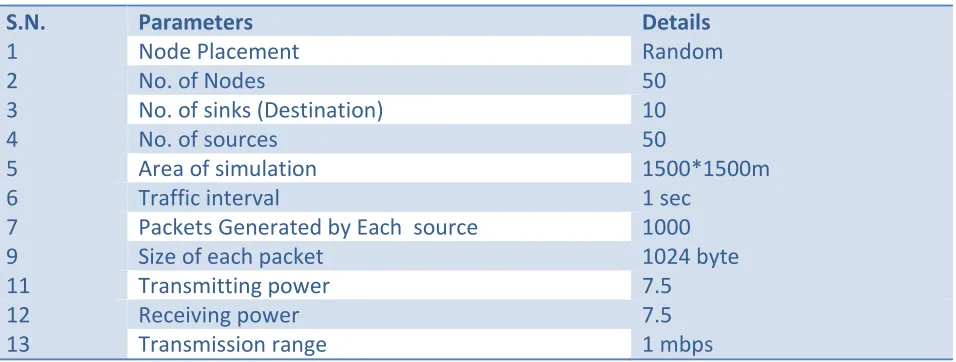
The simulation is focused on the performance of routing protocols in wireless sensor networks. Therefore the simulation scenarios consisting of 50 nodes are considered. The nodes were randomly placed within certain gap from each other in 1500*1500m area for 50 nodes.
The simulation parameters and node configuration is listed in Table 1.
Table 1. Simulation parameters and node configuration
4. SIMULATION RESULTS
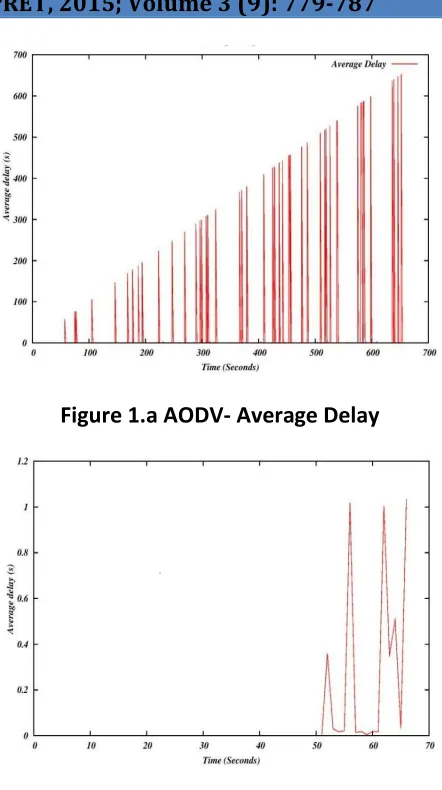
From the figures 1.a and 1.b, the average delay in case of AODV goes increasing constantly at particular time instants with respect to time. And this average delay is very high as compared to OLSR protocol. The average delay of OLSR is very small and fluctuates from 0 to 1sec. Therefore OLSR protocol in this case is most suitable.
S.N. Parameters Details
1 Node Placement Random
2 No. of Nodes 50
3 No. of sinks (Destination) 10
4 No. of sources 50
5 Area of simulation 1500*1500m
6 Traffic interval 1 sec
7 Packets Generated by Each source 1000
9 Size of each packet 1024 byte
11 Transmitting power 7.5
12 Receiving power 7.5
Available Online at www.ijpret.com 784 Figure 1.a AODV- Average Delay
Figure 1.b OLSR- Average Delay
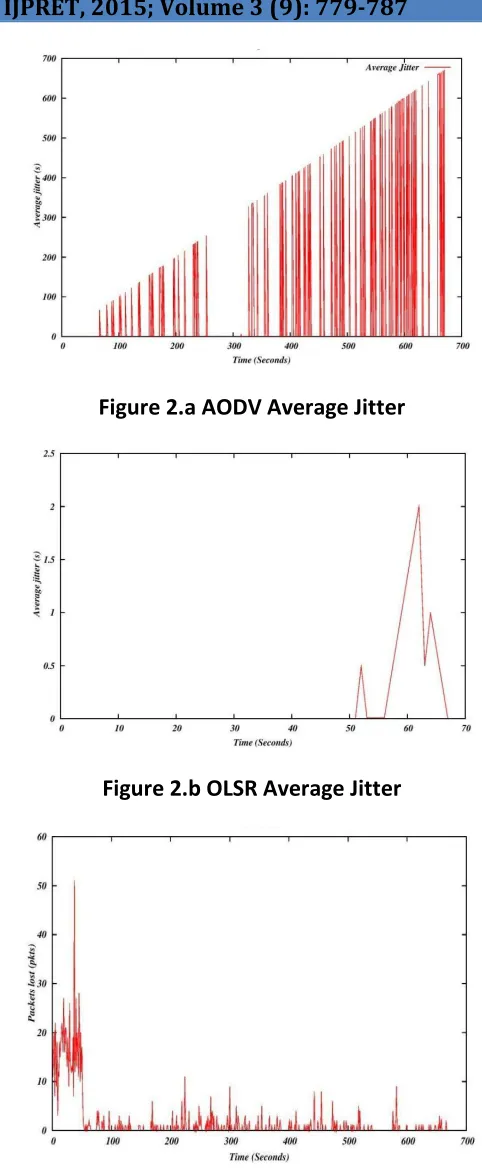
From figures 2.a and 2.b, the average jitter in AODV protocol increases constantly at particular instants of time. But the average jitter in case of OLSR is very small compared to AODV and it fluctuates from 0 to 2 sec. Therefore the OLSR protocol is also better in terms of average jitter.
Available Online at www.ijpret.com 785 Figure 2.a AODV Average Jitter
Figure 2.b OLSR Average Jitter
Available Online at www.ijpret.com 786 Figure 3.b OLSR Packet Loss
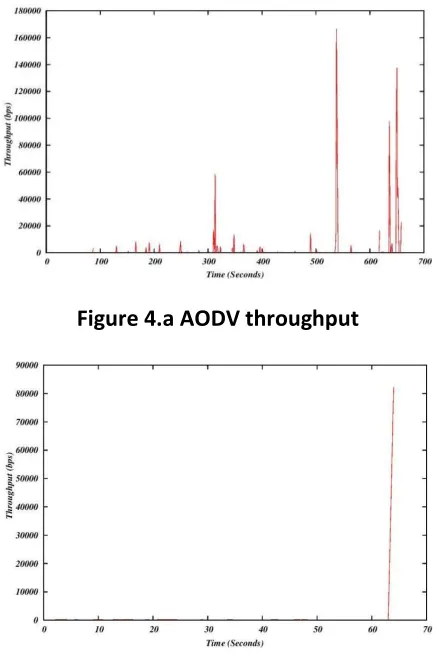
Lastly from figures 4.a and 4.b, the throughput in both the protocols increases sharply at some point of time only and most of the time it is equal to zero. Hence the throughput cannot be considered as good in both the protocols.
Figure 4.a AODV throughput
Available Online at www.ijpret.com 787 5. CONCLUSION
In this paper, two routing protocols namely AODV and OLSR are compared in terms of average delay, average jitter, packet loss and throughput. The OLSR protocol is preferable over AODV when average delay, average jitter and packet loss are considered for comparisons. And in this scenario the throughput is better in AODV than the OLSR protocol. These results are fully based on simulation and analysis with the help of graphs.
So if the average delay, average jitter and packet loss is major aim then OLSR protocol is suitable.
6. REFERENCES
1. Charles E. Perkins and Elizabeth M. Royer, “Ad Hoc On-Demand Distance Vector Routing,” in Proceedings of the 2nd IEEE Workshop on Mobile Computing Systems and Applications, Feb. 1999, pp. 90-100.
2. T. Clausen and P. Jacquet (editors). “Optimized Link State Routing Protocol (OLSR)”, RFC 3626, IETF Network Working Group, October 2003.
3. D. D. Chaudhary, Pranav Pawar, Dr. L. M. Waghmare, "Comparison and Performance Evaluation of wirelesss Sensor Network with different Routing Protocols", 2011 International Conference on Information and Electronics Engineering IPCSIT vol. 6 (2011), IACSIT Press, Singapore.
4. Ian D Chakeres et al. “AODV Routing Protocol implementation Design”, Dept. of ECE, University of California Santa Barbara, 2004.
5. Md. Anisur Rahman, Alex Talevski “Performance Measurement of Various routing Protocols in ad-Hoc Network”, IMECS, March 18-20,2009, Hong Kong.
6. T. H. Clausen and P. Jacquet (eds.),”Optimized Link State Routing Protocol (OLSR)”, IETF Experimental RFC3626, October 2003.