AUT J. Model. Simul., 49(2)(2017)209-216 DOI: 10.22060/miscj.2017.12074.5000
Adaptive Control Strategy for a Bilateral Tele- Surgery System Interacting with Active
Soft Tissues
M. Sharifi and H. A. Talebi*
1 Department of Electrical Engineering, Amirkabir University of Technology, Tehran, Iran
ABSTRACT: In this paper, the problem of control and stabilization of a bilateral tele-surgery robotic system in interaction with an active soft tissue is considered. To the best of the authors’ knowledge, the previous works did not consider a realistic model for a moving soft tissue like heart tissue in beating heart surgery. Here, a new model is proposed to indicate significant characteristics of a moving soft tissue, rolling as the teleoperation system environment. The model is formed by a parallel combination of a viscoelastic passive part and an active part. Furthermore, the delays in communication and parameter uncertainties of the master and slave robot dynamics are considered. Using an adaptive control strategy, the ultimate boundedness of the system trajectories while interacting with the active environment is certified, and this ultimate bound is calculated. Moreover, to evaluate the theoretical results, simulation results are presented.
Review History: Received: 23 October 2016 Revised: 26 February 2017 Accepted: 5 March 2017 Available Online: 5 April 2017
Keywords: active soft tissue viscoelastic model bilateral tele robotic surgery communication time delay adaptive control
1- Introduction
The bilateral teleoperation scheme has found numerous applications in inaccessible or dangerous areas or where one needs a high precision in an operation and magnifies the workspace. Some examples include operations in hazardous environments, undersea explorations or telerobotic surgeries to name a few [1]. Prior studies have considered the stabilization of bilateral teleoperation systems, several times. Among them are passivity-based methods [2], [3] that use velocity information to send to the other side of the bilateral system. However, these methods are limited to applications that contain passive operators and environment models. In addition, the presence of any difference between initial conditions of master and slave sides results in a position drift. The authors of [4] suggested a four-channel-adaptive architecture based on the inverse dynamics of robots with uncertainties to achieve transparency in addition to stability. In [5], in addition to dynamic uncertainties, kinematic uncertainties were considered. Using the position error information, some adaptation laws were established to realize the stability of the system. In the last two mentioned references, no time delay was considered. In [6], [7] some assumptions concerning the communication time delay in teleoperation system were considered. Furthermore, no acceleration signals were used in the control torques. There are also some other studies that remove all the limitations of the variations of time-varying communication delays. For example, in [8], the stability condition is achieved under the assumption of small delay rate variations. However, in [9], such limitations are omitted to reach position synchronization. Recently, the authors of [10] have guaranteed position and
force tracking without any limitation in delay variations. All the above-mentioned studies considered a simple passive mass-spring-damper model as the environment of teleoperation systems. Such models are not acceptable for the applications that work on moving soft tissues, including telerobotic beating heart surgeries.
Due to the delicacy of soft tissues, safety in contact is an important issue. To provide a correct and safe interaction, force control is one of the best approaches to control the physiological motion and deformation of the tissues. Because soft tissue models are an important index of model-based force control approaches [11], providing a model that has the ability to represent the main characteristics of a soft tissue is of great importance. Generally, there are two main approaches to model soft tissues: finite element method (FEM) and analytical models. The models obtained from FEM have a good accuracy. However, there are two important issues when using such models; long computing time and boundary conditions which are difficult to be determined [19]. Among analytical models, some studies consider the model as an elastic one which does not show the viscoelasticity, inhomogeneity and nonlinearity properties of a soft tissue [13]. Among these studies, [20], [21] proposed and used different viscoelastic models like fractional and Hunt-Crossley models for tissues, respectively. The most important advantages of viscoelastic models are the low computation cost and an appropriate physical meaning for the parameters, including springs and dampers [14]. The mentioned works did not consider the property of having movement, because of acting as a living organ inside the body for the soft tissue. Heart beating surgeries are performed on a moving tissue. This movement causes a different behavior in comparison to a non-moving soft tissue. In fact, the beating heart induces an amount of energy because of its movements, caused by
respiration and breathing motions that can be called an active behavior. In conclusion, to achieve the most precise control, we should present an appropriate model to show the behavior of the soft tissue suitably.
In [11], different proposed models for soft tissues were introduced. After applying several tests on the models, the most similar one to the behavior of a real soft tissue is chosen. Our proposed model is based on the parallel behavior of active part of the heart tissue force, caused by its movement and the passive part of the force due to its viscoelasticity behavior. Because there are too many factors affecting the behavior of heart motion, the active part model is considered without a determined mathematical mo del. At last, the interaction force between the moving soft tissue and robot end-effector is modeled by sum of a passive and an active part. The passive part is a Kelvin-Boltzman model. The active part is an unknown bounded time-varying value that is added to the passive part. In fact, in telerobotic surgery application, the soft tissue has a movement. Due to this movement, some bounded energies will be injected into the system and this affects the stability of the teleoperation system. To this end, we will add an active part to the model that includes the characteristic of heart tissue as what was proposed in [12].
The paper is organized as follows. Section 2 introduces an active soft tissue model to move the soft environment of the teleoperation system based on the experiments performed formerly on the real tissues and their physical results (especially heart tissue). Moreover, validation of this model has been performed using heart tissue position and force data. Stability conditions for a bilateral teleoperation system in the presence of parameter dynamic uncertainties, communication time delays, while interacting with the proposed moving soft tissue, are given in section 3. Section 4 focuses on obtaining the ultimate bound of the system trajectories. In section 5, in order to confirm the theoretical results, simulation results are presented. In section 7, concluding points are presented and some future work are proposed.
2- Proposed Active Soft Tissue Model
Having precise knowledge about the interaction behavior between robot end-effector and soft tissue is significant while using robotic tools in medical applications. In this regard, assuming an appropriate model and indicating major characteristics of soft tissues, improve the control performance. Additionally, there is no mathematical model that describes the exact complex behavior of a soft tissue. In [11], six viscoelastic candidate models for the soft tissue have been introduced. In order to analyze their accuracy, two types of experiments have been performed. These are relaxation and creep tests [13]. In the relaxation test, a deformation in the position of tissue is made, and the resultant force is measured. However, in the creep test, a constant force is applied to the tissue, and the deformation will be measured. After that, the experimental results are evaluated in comparison to the behavior of each suggested model. In this evaluation among these six models, Kelvin-Boltzmann model represents the best result according to its transient response and accuracy [11]. Thus, we will utilize Kelvin-Boltzmann structure to demonstrate soft tissue modeling.
However, as mentioned before, during beating heart surgery, the heart muscle is not stopped. Due to its movement, there
exists an active environment for the tele-surgery system. The active environment can affect its performance, adversely. Thus, the Kelvin-Boltzmann model cannot state this behavior properly. In order to develop an appropriate model of the heart muscle, in [12], the properties of the contracting muscle as well as resting muscle were studied. In this regard, nine papillary muscles from nine chloroform-anesthetized cats were utilized. To reach the moving muscle’s properties, a series of sinusoidal frequencies was used. The frequency ranges of these sinusoidal signals cover the frequency components of heart muscle length changes [12]. Finally, the force response to the length changes in resting muscle is called passive force, while for the contracting muscle is regarded as the total force. The authors of [12] assumed that while contraction occurs, the total muscle force is the sum of the generated passive and active force. We utilize the assumption of parallelism and independency of forces that was also supported by experimental results.
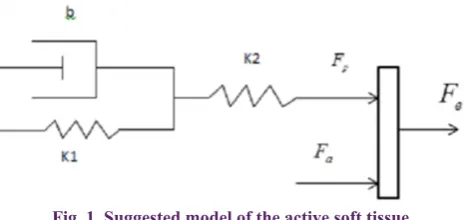
However, the parallel branches in [12] were considered as coupled viscoelastic units. Since the behavior of a beating heart is too complicated to be described by a theoretical model, considering a mathematical model to demonstrate the active behavior of contracting muscle that is defined in [12] is not realistic and might deteriorate the stability condition of the system. Eventually, our proposed modeling strategy here is that we use the parallelism and independency property for the passive and the active parts of the beating heart model, while no definite model for the active part is assumed. Thus, the total force between the heart tissue and the end-effector is the sum of passive and active forces. The passive part is represented by Kelvin-Boltzmann model, because its viscoelastic property is very similar to a real soft tissue behavior. Furthermore, the active part is defined as a parallel force to the passive one. In addition, the active force and its derivative are unknown bounded time-varying values. The motion of heart tissue does not include infinite energy, thus the bounded-ness of active force is obvious. Furthermore, the natural contraction of the heart muscle does not involve rapid and drastic length changes leading to sudden energy changes. Thus, boundedness assumption about the derivative is true as well. Figure 1 represents the schematic model of the suggested model for the active soft tissue. In this figure, Fp is the passive part of the
interaction force that is produced due to Kelvin-Boltzmann model. K1,K2 and b are the spring and damping model
parameters, respectively. In addition, Fa is the active part that
is considered as a bounded time-varying unknown parameter.
Therefore, now we are able to present our suggested model of the total force for the soft tissue.
A. Dynamic Model of The Moving Soft Tissue
A moving soft tissue like a beating heart muscle has a complicated
structure. An active tension of heart muscle depends on the combination and the concentration of ions like calcium. It also varies with temperature changes [13] and has the quasi-periodic behavior of respiration motion [14]. Online measurement of the tension is not applicable. Therefore, considering the active part of the heart tissue model as a time-varying and bounded in norm value is more convenient and realistic.
Regarding the extracted results of what was mentioned up to now in this section, we propose the beating heart model with passive and active parts, acting independently and in parallel to each other, as follows:
where Fe is the total force, Fp and Fa are passive and active
parts, respectively. This model was presented in the last paper of authors in [22] and now is explained more specifically. Table 1 shows different existing soft tissue models with their equation models.
Due to appropriate results of Kelvin-Boltzmann model in the previous experiments , consider this model for the passive part of interaction force as below:
Now, we add the active force term to the model. Thus, it can be concluded that:
where a, b, g are the identified parameters of the model, and d(t) represents the active movement of tissue that is an unknown bounded time-varying value.
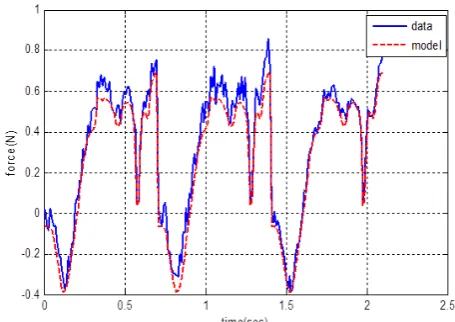
Figure 2 is presented to evaluate the suggested model. This has been done by comparing model response with the real data given in reference [15]. As you can see, the figure shows a good similarity between the real force data and the force data obtained from our model. The position and the force data [15] that belong to the heart of a pig are obtained for
about two sec. Using the position data and our dynamic equation of soft tissue, the force response is calculated. The inputs of our proposed force model are the position data and its derivative that is obtained by taking the difference of the two successive position data with a sampling time of 0.01 sec. The other parameters of the model are derived from of Kelvin-Boltzmann model parameters [17]. The results show 90% similarity of the magnitude of the force obtained from the proposed model and the real force data given in [15].
3- Control Structure
Control goals in this paper can be listed as follows:
1. Master and slave robot trajectories remain bounded in both free and contact motions no matter how much the time delay is.
2. Force tracking error between operator-master and environment-slave while interacting with an active soft tissue remains bounded.
In order to achieve these goals, an adaptive control scheme based on the position and the velocity signals of master and slave robots is designed. The communication time delay of the teleoperation system is considered as a constant value. Control torque signals do not use acceleration signals and position and velocity signals are adequate for our purpose. This is desired because of measurement challenges. Moreover, due to an existing delay, an integral term is added to Lyapunov function and Lyapunov-Krasovski function is established.
A. Teleoperation System Model
Nonlinear dynamics of the n-DOF master and slave robots in the joint space is represented as follows:
where are the position, velocity, and accelerations of the joints, respectively. Mi(qi)∈Rn×n are inertia
matrices, are Coriolis and Centripetal torques and Gi(qi)∈Rn are gravitational forces. ti∈Rn are
control signals and th∈Rn and te∈Rn are the operator and
environment applied forces. The subscript i stands for master and slave robots.
There are some characteristics in the dynamic equations of robots as follows:
1. The inertia matrix M(q) is symmetric, positive definite, such that mI<M(q) for a positive constant m.
Table 1. soft tissue candidate models [11]
Fig. 2. Comparison between the actual behavior of moving soft tissue and results of the suggested model.
(1)
(2)
(3)
, ,
∈
n i i iq q q
R
( , ) ∈ n n× i i i
C q q R
2. The robot dynamics is linearized with respect to parameters as below [6]:
where q is a p-dimensional vector, containing some physical parameters, including the mass of links, moments of inertia, etc. is a known regressor matrix of measurable signals and their derivatives.
3. would be skew-symmetric, by appropriate definition of the matrix .
B. Active Soft Tissue as the Environment of the teleoperation System, Interacting with End-effector
In this section, the designed adaptive control signals are applied to stabilize the bilateral teleoperation system regarding the suggested model of the active soft tissue as the environment of the teleoperation system.
Assume operator and environment models of the teleoperation system as follows:
where am, bm, as, bs, gs are positive, constant, bounded
coefficients. Fh and Fe are the operator and the environment
forces, respectively. The dynamic equation of Fe is the model
that we proposed for the interaction between moving soft tissue and the robot. as is the unknown bounded time-varying
parameter in order to show its active force. rm(t), rs(t) are newly
defined outputs that will be introduced in (6). In the model structure, both the operator and the environment are modeled as active elements. As mentioned in the modeling section, environment model is derived by adding an active term to the soft tissue model to represent the moving characteristics of the tissue. In addition, am is the term that makes the operator
model active.
By considering the master and slave robots dynamic models with uncertainty and utilizing the regressor form of (4) , the system dynamics would be as follows:
The controlling torque signals of equation (6) are designed in the following:
where are the estimation of relevant matrices that will be explained in (13) in regressor form. l is a positive definite constant matrix. Due to characteristic 2 of the robots, we will find the following equations for the control signals in regressor form:
where Ym(qm,rm) and Ys(qs,rs) are known regressor matrices
and , are time-varying estimations of the unknown parameters qm(t), qs(t).
In section 5, you will find these parameters in (17) and (18) for a 2 DOF planar robot.
Furthermore, is a new defined output for master and slave robots ([6]) and
, are estimation errors.
In addition, and that were used in (8) are defined as follows:
where K is a positive constant. T is the forward or the backward communication delay. There is no necessity that the forward and the backward delays be equal. Without losing generality, non-uniform delays can be considered here.
It is obvious that the controllers use the estimates of parameters of the robots. These parameters are adapted according to the adaptive laws that will be introduced in Theorem 1.
By using these adaptation laws, stability and synchronization will be shown.
Now consider the following theorems in order to study the stability of the system and master and slave robots synchronization property.
Theorem 1. All the states of the described non-linear teleoperation system (3) under the control signals (7) and operator and environment models (5) remain ultimately bounded in the presence of communication delays.
Proof. Consider the following continuous positive definite Lyapunov-Krasovski function:
In addition, (11) introduces the master and slave robots position errors.
By time-derivation of the Lyapounov function along the system trajectories and using equations (6) to (9), we would get the following:
(4)
(5)
(9)
(6)
(10)
(11) (7)
(8)
( , , ) ∈ n p×
Let the estimates of uncertain parameters be obtained from the following adaptation laws:
Utilizing the above adaptation laws and control laws (7) and after some algebraic manipulations, we have:
Consider the augmented state vector of the system given as below:
Note that the derivative of resultant force between robot end-effector and soft tissue is bounded due to the nature of tissue movements. Thus, by considering an upper bound for the interaction force between robot and tissue due to tissue movement, we achieve that:
Therefor, we can conclude that:
By the boundedness of a1, Kmin and w, for the large
values of the norm of that was defined in (16), .Thus, as a conclusion, the system trajectories remain bounded ultimately.
4- Obtaining The Ultimate Bound Of System
Theorem 2. Consider the nonlinear bilateral teleoperator interacting with the active soft tissue described by (5) and (6) in the absence of communication delays. This system is input-to-state stable (ISS) with a1 as input.
Proof. Consider the following Lyapunov function V1(x):
Similarly to the proof of Theorem 1, the derivative of V1(x)
along its trajectories will be:
Where
V1(x) is continuous, positive definite and radially unbounded.
Thus, using Lemma 4.3 of [17] there exist class K∞ functions
c1, c2 functions such that:
Besides, using Theorems 4.18 and 4.19 of [18], the nonlinear bilateral teleoperation system is ISS with a1 as input and
there is a class KL function b for each x(t0) that lies in
,
with , such that D is a
domain that the system is defined on and Br is a ball with the
radius r. Therefore, there exists T > 0 such that:
And
where
Hence, the ultimate bound of the trajectories of the system
is ,
5- Simulation Results
In this section, we simulate the proposed controller on 2-DOF identical planar nonlinear dynamic robots as master and slave. There are forward and backward communication time delays in the teleoperation system. Figure 3 shows the 2-DOF planar robot scheme that is used for simulation.
The time delay is chosen as 0.1 sec for both backward and forward directions. The nonlinear dynamics of the robots are as below:
(12)
(13)
(14)
(15)
(16)
( )
+
( , )
+
( )
= −
T( )
e
where the matrices are given by [16]:
where .
The vector of uncertain parameters and the coordinated regression matrices will be demonstrated as follows:
in which:
Thus the vector of parameters estimates will be as below:
The desired values of the uncertain parameters are as below:
The initial conditions for parameter estimates are chosen as
.
The control parameters and the coordinated parameters for the estimation process are chosen as l=10, K=3 and L=P=0.1×eye(3), respectively. The operator and environment force models are defined as follows:
The parameters of active soft tissue environment force are obtained from [17], which are a=30.76(N.s/m), b=100.43(N/m) and g=0.06(s) for relation (2). These parameters are derived by the least square method, by comparing the measured force of the robot with that of the soft tissue.
The coefficient as is related to the active motion of the soft
tissue and is chosen as as =0.1sin(2t). For our considered
application that is the interaction of beating heart tissue with
robot end-effector in tele-surgeries, we have chosen 1/π
for the frequency of heart movement, which is appropriate. The magnitude of the motion is not conservative at all as it is much bigger than the real force that is injected by a real moving tissue. At last, the exogenous force of the master side has been opted as F*
h(t)=5sin(0.1t). This applied force
is compatible with the quasi-periodic behavior of the moving heart tissue that is injected from the master side.
6- Discussion About Simulation Results
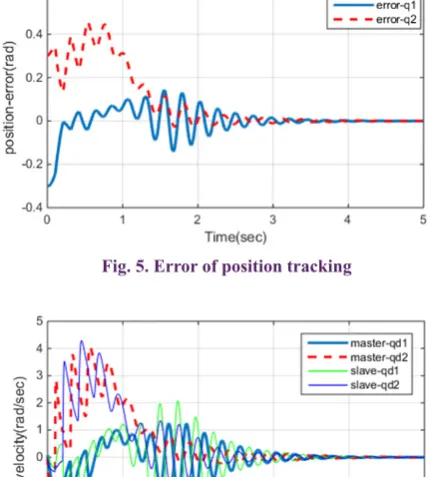
The simulation results are present in the following figures. In Figure 4, the positions of the two links of master and slave robots in the joint space have been shown. As can be seen, tracking is achieved in less than 3 sec, while the initial conditions of the master and slave robots were different. It has been shown in this figure that each of the two joints of the slave robot can track the corresponding joints of the master robot with a negligible delay initially and after this transient time, the position error converges to zero, i.e. position tracking has been achieved. The error of position tracking in joint space configuration is presented in Figure 5. This figure is simply achieved by the difference of the two tracking curves in Figure 4 to show that the position tracking error converges to zero, simpler. The tracking of velocities of two robots and their errors in joint space are shown in Figures 6 and 7, respectively. Figure 8 is devoted to showing the convergence of operator and environment forces along two links as an index of rather good transparency. Thus, as the inserted force
Fig. 3. 2 DOF planar manipulator [4]
( ), ( , ) , ( ), ( )
M q C q q q G q J q
2 2 1 2 1 2 2 2
2 2 1 2 1 2
(2
)cos
( , )
sin
−
+
=
m l l q q q
q
C q q q
m l l q
q
(17)
by operator on the master robot is shown by fh. Also, the force that
is created between the slave robot and soft tissue (environment) is shown by fe. Because our considered robots have 2 links,
each force have 2 components. From Fig.8., it can be seen that fh and fe are converging to each other. This convergence shows
the transparency property of the teleoperation system. In Figure 9, the estimation process for unknown parameters is illustrated. As can be seen, the parameters’ estimates converge to a steady value in about 2 sec. In fact, using the adaptation laws that were presented before, the unknown parameters have been estimated and the controllers use these estimates to control the tele-robotic system. These results are obtained in the condition of interaction between the robot end-effector and the moving soft tissue as an active environment. Convergence of the master and the slave are not proven, however Figure 8 is presented as an indicator of good transparency. Comparing similar works like [1] shows a good result, although in that work, an active model like what we used for the tissue, was not considered. In none of the prior studies, the problem of teleoperation control and synchronization, when the robotic tool interacts with a moving soft tissue, was considered. In fact, the movement of the tissue proposes an active behavior in the role of the environment of the telerobotic system. This behavior adds an amount of energy to the system and causes instability. Thus, a new challenge arises in control and synchronization that is solved in this paper. In fact, we presented a new active moving soft tissue model as an active environment and solved the control issues that arise due to this behavior. This achievement was confirmed through the results of the simulation.
7- Conclusion
In this paper, control and stabilization of a nonlinear bilateral tele-surgery robotic system was considered. The objective
Fig. 4. Master and slave robots position tracking Fig. 8. Master and slave side forces
Fig. 5. Error of position tracking Fig. 9. Parameter estimation
Fig. 6. Master and slave robots velocity tracking
is the tele-surgery of moving soft tissues, e.g. beating heart, as the teleoperation system environment. The significant properties of a moving soft tissue that separate it from other teleoperation environments is its viscoelastic property because of its softness and, also, active behavior property because of its movement and energy injection. These properties can destabilize the system. For this aim, an appropriate model for active soft tissue based on the previous experimental results was suggested. Applying a proposed adaptive control strategy based on this model can guarantee the stability and boundedness of the system trajectories.
For future works, one can focus on attaining more information from the movement of the tissue, for example from ECG signals of the heart. This can improve our knowledge of the unknown bounded parameters as the active part of interaction force and, thus, make the moving soft tissue model more accurate. The other work to be done in the next studies will be seeking transparency of the teleoperation system as well as stability. In this regard, some efforts will be made to propose some theorems to prove the transparency condition.
REFERENCES
[1] N. Chopra, M.W. Spong, R. Lozano, Synchronization of bilateral teleoperators with time delay, Automatica, 44(8) (2008) 2142-2148.
[2] N. Chopra, M.W. Spong, Passivity-based control of multi-agent systems, in: Advances in robot control, Springer, 2006, pp. 107-134.
[3] N. Chopra, M.W. Spong, R. Ortega, N.E. Barabanov, On tracking performance in bilateral teleoperation, IEEE Transactions on Robotics, 22(4) (2006) 861-866.
[4] X. Liu, M. Tavakoli, Inverse dynamics-based adaptive control of nonlinear bilateral teleoperation systems, in: Robotics and Automation (ICRA), 2011 IEEE International Conference on, IEEE, 2011, pp. 1323-1328.
[5] X. Liu, R. Tao, M. Tavakoli, Adaptive control of uncertain nonlinear teleoperation systems, Mechatronics, 24(1) (2014) 66-78.
[6] N. Chopra, M.W. Spong, R. Lozano, Synchronization of bilateral teleoperators with time delay, Automatica, 44(8) (2008) 2142-2148.
[7] E. Nuño, R. Ortega, L. Basañez, An adaptive controller for nonlinear teleoperators, Automatica, 46(1) (2010) 155-159.
[8] I.G. Polushin, P.X. Liu, C.-H. Lung, G.D. On, Position-error based schemes for bilateral teleoperation with time delay: theory and experiments, Journal of dynamic systems, measurement, and control, 132(3) (2010) 031008.
[9] C.-C. Hua, X.P. Liu, Delay-dependent stability criteria of teleoperation systems with asymmetric time-varying delays, IEEE Transactions on Robotics, 26(5) (2010) 925-932.
[10] F. Hashemzadeh, M. Tavakoli, Position and force
tracking in nonlinear teleoperation systems under varying delays, Robotica, 33(4) (2015) 1003-1016.
[11] P. Moreira, N. Zemiti, C. Liu, P. Poignet, Viscoelastic model based force control for soft tissue interaction and its application in physiological motion compensation, Computer methods and programs in biomedicine, 116(2) (2014) 52-67.
[12] L. Loeffler, K. Sagawa, A one-dimensional viscoelastic model of cat heart muscle studied by small length perturbations during isometric contraction, Circulation research, 36(4) (1975) 498-512.
[13] Y.-c. Fung, Biomechanics: mechanical properties of
living tissues, Springer Science & Business Media, 2013.
[14] L. Barbé, B. Bayle, M. de Mathelin, A. Gangi, In
vivo model estimation and haptic characterization of needle insertions, The International Journal of Robotics Research, 26(11-12) (2007) 1283-1301.
[15] W. Bachta, P. Renaud, E. Laroche, A. Forgione, J.
Gangloff, Cardiolock: An active cardiac stabilizer. First in vivo experiments using a new robotized device, Computer Aided Surgery, 13(5) (2008) 243-254.
[16] F.L. Lewis, C.T. Abdallah, D.M. Dawson, Control of
robot manipulators, Macmillan New York, 1993.
[17] P. Moreira, C. Liu, N. Zemiti, P. Poignet, Soft tissue force control using active observers and viscoelastic interaction model, in: Robotics and Automation (ICRA), 2012 IEEE International Conference on, IEEE, 2012, pp. 4660-4666.
[18] H.K. Khalil, Nonlinear systems. 2002, ISBN, 130673897 (2002) 9780130673893.
[19] P. Jordan, S. Socrate, T. Zickler, R. Howe, Constitutive modeling of porcine liver in indentation using 3D ultrasound imaging, Journal of the mechanical behavior of biomedical materials, 2(2) (2009) 192-201.
[20] Y. Kobayashi, A. Onishi, H. Watanabe, T. Hoshi,
K. Kawamura, M.G. Fujie, In vitro validation of viscoelastic and nonlinear physical model of liver for needle insertion simulation, in: Biomedical Robotics and Biomechatronics, 2008. BioRob 2008. 2nd IEEE RAS & EMBS International Conference on, IEEE, 2008, pp. 469-476.
[21] S. Bhasin, K. Dupree, P.M. Patre, W.E. Dixon, Neural
network control of a robot interacting with an uncertain viscoelastic environment, IEEE Transactions on Control Systems Technology, 19(4) (2011) 947-955.
[22] M. Sharifi, H.A. Talebi, Adaptive control of a telerobotic surgery system interacting with non-passive soft tissues, in: Control, Instrumentation, and Automation (ICCIA), 2016 4th International Conference on, IEEE, 2016, pp. 214-219.
Please cite this article using:
M. Sharifi and H. A. Talebi, Adaptive Control Strategy for a Bilateral Tele- Surgery System Interacting with Active Soft Tissues, AUT J. Model. Simul., 49(2)(2017)209-216.
![Fig. 3. 2 DOF planar manipulator [4]](https://thumb-us.123doks.com/thumbv2/123dok_us/8944325.1853693/6.595.48.292.536.753/fig-dof-planar-manipulator.webp)