International Journal of Research Publications
Digital Nepal: Opportunities and Challenges Shib Raj Bhatta Jeevan Khanalb*
a
PhM Research scholar Faculty of Science, Health and Technology, Nepal Open University, Lalitpur, Nepal
b
Faculty Member,Faculty of Science, Health and Technology, Nepal Open University, Lalitpur, Nepal
Abstract
Information and communication technology (ICT) plays an important role in service delivery to the entire socio-economic and political development of the country. United Nations Department of Economic and Social Affairs measure the status of e-government by assessing indicators and develop an e-government development index. Considering the importance of ICT, the study has been carried out; this article compares Nepal's digital government status with SAARC countries on the basis of United Nations e-government survey 2012 to 2018. The article also presents the challenges and opportunities for implementing digital government. To implement digital policy of Nepalese government, Nepal has been facing many challenges such as Insufficient infrastructure, illiteracy, language barrier, lack of human resources, digital divide, political instability and sustainability, limited financial resources, insufficient law, rule, regulation, strategy and plans, lack of integrity of system, employee barrier, lack of feasibility study, rapidly changing technology, security and privacy issues. Despite these challenges, there are many opportunities like immerging Social Media, Cloud Computing, the rapid development of mobile technology, the digital government experience of developed and developing countries. Regarding these issues, this paper presents few opportunities and challenges of digital government.
© 2018 Published by IJRP.ORG. Selection and/or peer-review under responsibility of International Journal of Research Publications (IJRP.ORG)
Keywords: e-government; digital government; ICT; EGDI; digital divide; IT skilled manpower
1.Main text
* Corresponding author. Dr Jeevan Khanal, Tel.: +9779813165577
E-mail address: [email protected]
International Journal of Research Publications
Volume-34, Issue-1,August 2019
Accepted and Published Manuscript
Digital Nepal: Opportunities and Challenges
Shib Raj Bhatt, Dr. Jeevan Khanal
PII : Shib Raj Bhatt.10034182019668
DOI: 10034182019668
Web: http://ijrp.org/paper-detail/669
To appear in: International Journal of Research Publication (IJRP.ORG)
Received date: 09 Aug 2019
Accepted date: 17 Aug 2019
Published date: 18 Aug 2019
Please cite this article as: Shib Raj Bhatt, Dr. Jeevan Khanal , Digital Nepal: Opportunities and Challenges ,
International Journal of Research Publication (Volume: 34, Issue: 1), http://ijrp.org/paper-detail/669
International Journal of Research Publications
Digital Nepal: Opportunities and Challenges
Shib Raj Bhatt
aJeevan Khanal
b*
a PhM Research scholar Faculty of Science, Health and Technology, Nepal Open University, Lalitpur, Nepal bFaculty Member,Faculty of Science, Health and Technology, Nepal Open University, Lalitpur, Nepal
Abstract
Information and communication technology (ICT) plays an important role in service delivery to the entire socio-economic and political development of the country. United Nations Department of Economic and Social Affairs measure the status of e-government by assessing indicators and develop an e-government development index. Considering the importance of ICT, the study has been carried out; this article compares Nepal's digital government status with SAARC countries on the basis of United Nations e-government survey 2012 to 2018. The article also presents the challenges and opportunities for implementing digital government. To implement digital policy of Nepalese government, Nepal has been facing many challenges such as Insufficient infrastructure, illiteracy, language barrier, lack of human resources, digital divide, political instability and sustainability, limited financial resources, insufficient law, rule, regulation, strategy and plans, lack of integrity of system, employee barrier, lack of feasibility study, rapidly changing technology, security and privacy issues. Despite these challenges, there are many opportunities like immerging Social Media, Cloud Computing, the rapid development of mobile technology, the digital government experience of developed and developing countries. Regarding these issues, this paper presents few opportunities and challenges of digital government.
© 2018 Published by IJRP.ORG. Selection and/or peer-review under responsibility of International Journal of Research Publications (IJRP.ORG)
Keywords: e-government; digital government; ICT; EGDI; digital divide; IT skilled manpower
1.Main text
* Corresponding author. Dr Jeevan Khanal, Tel.: +9779813165577
Introduction
In the present scenario, we all are living in the age of digital technology, which has been used worldwide to facilitate people for getting access in education, science, business, and other sectors. Over the past few years, there has been rapid development in information and communication technologies (ICT)[1]; industries corporate and individual people are using ICT devices like mobile, notepad, laptop and other electronic devices for their daily work[2]. Countries are transferring their paper-based manual administration system into the machine-based digital system using information technology (IT), ICT, and electronic devices. This provides improved quality, easy, cheap, smooth, efficient, fast, transparent and citizen-centric public services to the citizens, employees, business partners, business organizations, governmental and non-governmental agencies, and governmental entities. Increasing number of government institutions and agencies are dramatically attempting to offer a wide variety of ICT based solutions and services. Use of modern IT tools like web-based applications to enhance and manage government activities known as electronic[3] or digital government is becoming increasingly popular [4].
The governance is a process through which companies, organizations, groups, and societies make decisions and manage and control daily operations and activities [5] and interact with others. Introduction of sound technology infrastructure in the public sector will not automatically create a better digital government unless it is based on the best policies and actions to promote the effective utilization of modern tool of technology [4]. To convert the human-based system into a digital system, to improve the efficiency and change the nature and quality of government services, there is a need of reformulating all the government system and service delivery[6].
Digital Governance and electronic governance are generally used as synonyms but both are not exactly the same. Digital government is an advanced form of e-government or upgraded version of e-government [5]. E-government services are business oriented, and services are designed according to the need of the government rather than citizen service oriented. In the digital government services are a citizen-oriented engagement to improve citizen satisfaction and optimal use of communication channels[7]. Services are designed on the basis of thinking and identifying about the real citizen, customers, and other user needs.
E-government is defined “Electronic government is the use of ICT in the transformation of government; primarily aiming to improve the accessibility, effectiveness, and responsibility. It is based on the diffusion of the information and the information policy development. Electronic government guides to increasing citizens' participation and active citizens' development affecting the mechanisms of
democracy”[8].
In this regard, Gartner defined digital government as “Digital government is government designed and
operated to take advantage of digital data in optimizing, transforming and creating government services”[9]. In e-government, generally, technology is used to convert the existing manual administrative system into an electronic system[10]. Similarly, Electronic governance (e-governance) is defined by the OECD the e-government imperative 2003 as “the use of information and communications
For this article, data were collected from secondary sources like empirical studies and reports, United Nations reports, government report and news blogs. The main objectives of this article were: (1) to discuss digital government in Nepal, (2) to compare the status of digital government with the SAARC countries and, (3) find out the challenges and opportunities for implementing digital government. To accomplish these objectives, the extensive literature search about digital government was undertaken. In internet search process, the main combinations of keywords considered were: (1) "digital government
challenge and opportunities” (2) "e-government in Nepal", (3) "e-government in SAARC countries", (4)
“ICT in government” (5) “United Nations e-government survey report” , (6) “digital government in
OECD”. Technology is changing and advancing day by day and resources are sufficient from the previous
three or four year's publication to analyze the status of e-government with its challenges and opportunities. However, some old challenges and opportunities may be common with the new technology and circumstances. So the articles published after 2000 have been collected and reviewed. After a thorough review and analysis of each of these resources, a new point of view arose, Nepal is a least developed country so challenges and opportunities of digital government are common with other developing countries. To analyze Population status of Nepal and government policy, Plan, rule and regulations search is extended using the following keywords (1) "e-government in developing countries
", (2) “e-government in India”, (3) “e-government master plan of Nepal”, (4) “cyber low of Nepal” etc. and altogether 63 articles related document and news blogs were reviewed. The following themes were emerged form this extensive literature reviews.
1.
E-government Development Index (EGDI) Grouping
In every two years, the United Nations Department of Economic and Social Affairs
(UNDESA) publish an ‘e-government survey report’ by collecting data from all member countries of the United Nations. UNDESA uses three dimensions to calculate e-government score. These are (i) Online service index (ii) Telecommunication infrastructure index and (iii) Human capital index. The average of these three dimensions is called e-government score. A numerical ranking is created on the basis of these scores named e-government development index. E-government development index is a benchmark of development and implementation of the e-government in the country[12], [13].
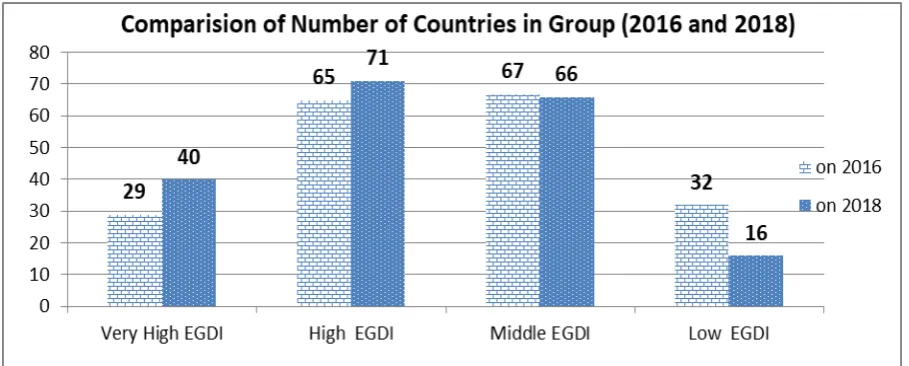
UN e-government Survey Report, 2018 has grouped United Nations member countries into four categories on the basis of the e-government score. 40 countries that scored more than 0.75 are grouped under the category "very high EGDI", 71 Countries that scored more than 0.50 and less than
Table 1. Scores of Countries all Over the World
Group of Countries
Group Number of Countries
2016 2018
Very High EGDI 29 40
High EGDI 65 71
Middle EGDI 67 66
Low EGDI 32 16
(Source: United Nations e-government survey 2016,2018)[12], [13]
Fig 1: Comparison of the Number of Countries 2016 and 2018 (Source: United Nations e-government survey 2012,2014,2016,2018)[12], [13]
high EGDI group and reached 40 countries. Average EGDI of the world reached 0.49 to 0.55 within the period of two years[12], [13].
2.
E-government Development Index in SAARC Countries
According to UNDESA assessment report “E-government Development Survey 2018”, Denmark
scored 0.9150 and grouped under “very high EGDI” ranked at 1st position in the world, Australia and South Korea are in 2nd and 3rd position respectively and also grouped in “very high EGDI”. Nepal
scored 0.4748 and ranked in 117th position in world ranking which is 5th position in the SAARC countries and grouped into middle EGDI group. Sri Lanka scored 0.5751 ranked 94th position in the world with 1st position in the SAARC countries, India is scored 0.5669 and ranked 96th position in the world and 2nd position in the SAARC countries, Maldives scored 0.5615 and ranked 97th position in the world and 3rd position in the SAARC countries, Bangladesh scored 0.4862 and ranked 115th position in the world and 4th position in the SAARC countries. Bhutan scored 0.4274 and ranked 126th position in the world and 6th position in the SAARC countries. Pakistan scored 0.3566 ranked 148th position in the world and 7th position in the SAARC countries and Afghanistan scored 0.2585 and ranked 177th and 8th
in the SAARC countries. Sri Lanka, India, and the Maldives are grouped as “high EGDI” and the rest are grouped into “middle EGDI”. [12]–[15]
Table2: SAARC Countries Score Development Table
Country 2012 2014 2016 2018
Afghanistan 0.1701 0.1900 0.2313 0.2585
Bangladesh 0.2991 0.2757 0.3799 0.4862
Bhutan 0.2942 0.2829 0.3506 0.4274
India 0.3829 0.3834 0.4637 0.5669
Maldives 0.4994 0.4813 0.4330 0.5615
Nepal 0.2664 0.2344 0.3458 0.4748
Pakistan 0.2823 0.2580 0.2583 0.3566
Sri Lanka 0.4357 0.5418 0.5445 0.5751
Average 0.3287 0.3320 0.3758 0.4633
Fig2: SAARC Countries Score Development
(Source: United Nations e-government survey 2012, 2014, 2016, and 2018)
(United Nations,
2012, 2014, 2016, 2018)
From 2012 AD to 2018 AD Average EGDI scores of SAARC countries reached 0.4633 from 0.3282. Nepal has also good score development with respect to SAARC countries average score development. In 2012, Nepal had a lower score than the average score of SAARC countries but in 2018, a score of Nepal higher than the average score of other SAARC countries. It indicates that Nepal is improving its score faster than the other SAARC countries. Nepal has increased the highest score 0.2084 among the SAARC countries. In the Same way, Maldives is slowly growing its score and has shown the increment by 0.0621[12]–[15].
3.
Measure Challenges
government. Generally, developed countries are transferring their technology to developing countries. To implement these systems, it is also necessary to understand and convert the local context and local practices[16]. Although the developing countries are constantly trying to develop Digital government, many obstacles and challenges are making ICT project failure[17]. Besides these, we have noticed the following challenges.
3.1.
Insufficient infrastructure
The IT infrastructure is essential for digital government. Infrastructures like a telephone, broadband internet services are easily available in the urban areas. In the rural areas, low density of population and distance of market and other resources makes hard to develop infrastructures for development[18]. Almost 17% people live in the urban area and the remaining 83% are living in rural areas[19]. Common people of rural areas are suffering from poverty, lack of electricity, lack of transportation, illiteracy, and other physical infrastructures are the hurdle for the implementation of digital government. “National population and housing report (CBSE, 2012) has stated that only 7.28% of total population (23.66% urban population and 3.37% rural population) has access of a computer. Total 3.33% of the population (12.11% urban population and 1.24% urban population) has internet access[19]. Access on the computer, mobile, telephone services, internet services plays an important role in the implementation and development of digital government[20]. It is impossible to enhance the digital government without sufficient ICT infrastructures. In this context, rapid infrastructure development is a major challenge for the implementation of digital government.
3.2.
Low Literacy Rate and Language Barrier
Literacy and digital literacy are two different things. Literacy is defined as the ability to read and write with understanding in any language. Capability to generate, access, use, manage and share various information resources using the tools of ICT is digital literacy. It is obvious that digital literacy rate of a country is always less than the literacy rate. The overall literacy rate of Nepal (for the population aged 5 years and above) was 65.9% in 2012. The male literacy rate was high (75.1%) compared to female literacy rate (57.4%) [19]. Digital illiterate people can’t operate and use information technology tools. Another challenge for implementation of digital government is the language. Generally, applications are found in the English language, to operate these tools there must be an English literacy or tools must be in Nepali language or their native language. Creating an application in the native language is the easiest way than rising English literacy all over the country. To convert government service applications in the native
language and make it “easy to use”[21]is also a challenging job for the government.
3.3.
Lack of Human Resources
equip the "75% people with digital literacy skills by 2020"[22]. Literacy of Nepal was almost 65.9% in 2012[19]. It is obvious that digital literacy rate is always lesser than the literacy rate. Within the short period of time, to achieve more digital literacy rate than the present literacy rate seems impossible with a poor plan, policy, infrastructure, and budget. Training for all employees within the government organization and other stakeholders is also necessary to have an update and make familiar with the new technology. The collaboration with the public and private sector can fulfill the gap and the need of the government. The government should be able to engage the private sector for the program. The government of Nepal is facing many problems like financial, political, inadequate human resource, poverty, and corruption. In this critical stage, it is a challenging job to create collaboration with the private sector and run such training programs frequently.
3.4.
Digital Divide
Only having a computer is not the source of information, there must be an internet connection. The gap
between those who have easy access of information services like broadband internet and those who don’t
have is called the digital divide[23][4]. Unreliable low bandwidth connection like dial-up is also generating digital divide. In rural areas, most of the population are facing problem in internet service, due to inadequate infrastructure or low bandwidth of internet. The age gap is also a factor of the digital divide; aged people are not much interested to learn modern techniques and skills[24]. The income gap is also a factor of the digital divide. Poverty is another problem which creates a digital divide. People who have high-income use modern information technology tools but who have low income and who struggle for their livelihood, cannot afford tools of information technology[25]. National information and communication technology policy (2015) aimed to provide broadband services to 90% population by 2020[22]. But it is a challenging job to fulfill this gap of digital divide within a short period of time.
3.5.
Political Instability and Sustainability
Political stability and sustainability is another factor. To implement a successful digital government, there must be a stable government and capable leader having a straight and clear vision and leadership. The long-term and short-term plan is essential for effective implementation of E-government. Due to the tussle between different political parties aimed at securing the attractive position in the government. It is obvious that in such circumstances many policy, plan, and procedures were changed with the change of government and badly hampered the country’s development and economic growth. Plan and projects started by one government are replaced by a new plan and project by a new government[26]. The plan for implementation of digital government needs long-term practices and continuous efforts. The political instability and unstable government are the challenges for implementation of digital government.
3.6.
Limited Financial Resource
well as to develop the infrastructure of ICT. People under the below poverty line can’t afford for ICT
tools and services. Poverty and limited financial condition is also a challenge to develop digital government.
3.7.
Insufficient Law, Regulation, Strategy, and Plans
The government of Nepal has made many efforts for the implementation of digital government. Nepal government has issued Electronic Transaction Act (ETA) 2006, Electronic Transaction Rules 2005, National IT Policy 2067 (2010 AD), Government Enterprise Architecture (GEA), Telecommunication Policy 2060 (2004), E-governance Master Plan (2015-2019). Nepal government showed the strong efforts and interest in digital government but these are not sufficient to implement electronic transactions. Financial and other kinds of online transactions are applied after the implementation of digital government. For the secure transaction, there is a need of electronic signature, data protection from cybercrime, intellectual property right and copyright issues. Freedom of information is another constitutional right to the people. These requirements need to change all concerned laws, rules, and regulations. Legislation which can guarantee the secure transactions between two stakeholders trusts the digital government and makes a good environment for the participation of citizens. To implement digital government there is need of appropriate and context tailored dynamic strategy which supports the holistic and long-term vision of the government. Only transferring manual system into the machine-based automated system is not the strategy of the digital government. The strategy must have a plan to mitigate with risks. This is a challenging job to change legislation according to the present context.
3.8.
Whole-of-Government
Australian public service commission stated, “Whole of government denotes public service agencies
working across portfolio boundaries to achieve a shared goal and an integrated government response to particular issues. Approaches can be formal and informal. They can focus on policy development, program management, and service delivery". It is also known as joined-up government, connected government, policy coherence, networked government, horizontal management and the whole-of-government[28]. Different ministries, departments, offices and other government agencies are delivering different kind of services to the citizens individually. There is a need for coordination, data sharing, and integration of data among them. Integrated database generates redundancy, becomes time-consuming, expensive and incomplete. For example, Inland Revenue Department and the Customs Department reside under the Finance ministry of Nepal, have an online transaction system[29]. Data sharing and Interoperation among ministries and departments is a difficult task[30]. It is obvious that in the absence of integration and data sharing between these two departments is creating a data gap, loss of revenue, and administrative burden. To make digital government efficient and optimal data integration and sharing of heterogeneous databases is a challenging job.
3.9.
Employee Barrier
Existing manpower are comfortable with the traditional administrative models of service delivery. Employees are considering the new system as a complementary system not substitute for the manual system[31]. There may be a fair of breaking traditional vertical hierarchical culture, fair of hierarchical power loss, fair of replacement and fair of job loss[26]. Employees like to preserve their present status,
employees may be an obstacle to transforming the traditional system into a modern automated system.
But citizens and other people don’t like this type of traditional administration, they always accuse
administration as corrupt, dictator, ineffective, dishonest and lack of professionalism[32]. To change this government must motivate and lure the employees by providing different incentives and packages[33]. To motivate the employees and providing an incentive in budgetary constraints are challenging for developing countries.
3.10.
Lack of Feasibility Study
Before implementing digital government it is necessary to make prstudy and assessment of e-readiness of the citizen, infrastructure, skilled manpower, and legislative structure. On the basis of this assessment, strategy and plans are created. Software Requirement specification is also the main document of the software development on the basis of this design of software is developed and software test is conducted[34]. It is obvious that the test process also can not conduct and compete without software requirement specification documentation. Generally, in the least developed countries like Nepal, lack of skilled manpower, autocratic administration, and lack of political will and the financial problem, many tools and techniques are implemented without feasibility study and systems analysis, software requirement specification, design, and documentation. Projects are started with the undefined documentation, framework, objectives, and goals consequently generate a conflict between stakeholders [17]. Implementation of information technology and the development of Software without system analysis, software requirement specification, design, and proper documentation will create a problem at the stage of maintenance and update; and will not be sustainable.
3.11.
Change in Technology
The technology is changing rapidly. With the change of technology different type of technical options are also available in the market. Social expectations with the new technology are also increased. In the competitive market, private sector easily accepts and adopts this new technology while Government is not fully ready and prepared for the implementation of it. In this scenario, new technology used by citizens may create a risk for the government or the use of new technology by the government without skills and knowledge of new technology also create a risk. There is need of training and skill development program for updating with the changed technology frequently and also needs purchase hardware and software. In context of Nepal, due to lack of sufficient budget allocation, innovation and rapid change in technology is also a challenge for the implementation of digital government.
3.12.
Security and Privacy
user, and authorization process should have access only authorized personnel. Hence, the security and privacy of data is another challenging for the government.
3.13.
Less Priority
In the least developed countries like Nepal, several infrastructures like education, electricity, road, bridge, drinking water etc. are yet to be developed. GDP of Nepal is low and resources of revenues like industries, trade, and other areas are not well developed. Revenue collection is poor and IT infrastructure development is affected by less percentage of budget allocation. Lack of coherent vision and commitment, weak collaborative leadership[15] and willpower, low capability, mistrust among Ministries/agencies; the budget is randomly allocated for unproductive areas. To implement digital government there is a need of lot of budget for purchasing software and hardware infrastructure, and for conducting training programs. There may be need of incentives for employees to transform manual system into automated system. Digital system implementation always gets low priority[26] and least budget allocation. Giving high priority to the implementation digital system and high budget allocation at this critical stage is a challenging job.
4.
Opportunities
Despite these challenges, there are many opportunities like rapid growth of internet services and social media, cloud computing, advancement of mobile technology and experience and lesson learned from the developed countries can be fruitful for the implementation of digital government. So least developed countries like Nepal can take advantages of these opportunities to implement digital government system.
4.1.
Rapidly Growing Internet Services and Social Media
Due to the rapid advancement of attractive social media applications, people are using social media like Facebook, YouTube, Twitter, and LinkedIn for Connecting and communicating with friends, family, relatives, colleagues, peers across the globe. Social media is a good source of information and entertainment facilitator to share text, pictures, and fun videos, sharing important news and events, and so on. Social media are becoming an essential element in our daily life. Frequent use of social media is making people more and more familiar with information technology, internet friendly and technology friendly. Social Medias are compelling them to learn about information technology in the form of entertainment[36]. The rapid advancement of technology and decreasing cost of IT tools is attracting general people towards the use of IT. So the number of internet users is rapidly increasing day by day. According to world internet status, the average percentage of internet users with a total population of SAARC countries is 48.10% and percentage of internet users in Nepal is 54.70% [15]. Nepalese internet users are higher in number than the average users of SAARC countries. This indicates that digital literacy is increasing and infrastructures are developing as a result, this is paving the path and creating opportunities for digital government.
4.2.
Cloud Computing
computing resources available in the internet pay-per-use service[37]. Cloud computing is economical, fast, and easy to access, secure, save the cost for human resource and expensive hardware. Cloud computing is creating a convenient environment for people, private companies, and organizations[38].Main advantages of the cloud are elasticity and scalability permitting to accommodate resources according to the need and demand of the business. Cloud computing is creating infrastructure and helping to create the IT-friendly environment for users and reducing the cost for implementation of information technology systems[39]. In Nepal, Government Integrated Data Centre (GIDC) was established in 2000 AD. It provides cloud computing services such as domain registration, web hosting, email and internet services for government agencies acting as the central nervous system of the country[40]. Many private companies are also providing cloud computing services in Nepal. It makes an opportunity for the implementation and development of digital government.
4.3.
Mobile Technology
Handheld digital devices and technology like Cell phone, Smartphone, PDA, and Palmtop etc. are expanding faster due to the high penetration rate of mobile services and data services. The rapid advancement of different kinds of mobile apps for entertainment and other daily life use is also another cause of the expansion of mobile. These digital devices are connecting people to the internet, can be accessed anywhere in remote areas[41]. Generally, digital government services are based on mobile-first design principle[9].Use of mobile helps to obtain information easily and it is at the fingertips of citizens. People use it for different purposes such as they use it for banking service, information collection, education, entertainment, e-business, and many others. High speed and high capacity broadband technologies are moving towards remote areas of Nepal. According to Nepal Telecommunications Authority, MIS Report published in July 2018, the total number of the mobile subscriber is 129.88% [42]. This makes internet access faster, easier, and cheaper and fulfills an essential part of the infrastructure for e-government. By taking advantage of these opportunities government must move a step forward for the implementation and development of digital government.
4.4.
Learning from Developed and Developing Countries
Many developed and developing countries had already implemented digital government. For example,
according to United Nation’s e-government survey 2018, Denmark is the world’s best e-government and ranked at the first position followed by Australia and Korea at the second and third position respectively.
Discussion
Being based on the evidence of the use of digital government mentioned above, it is found that the government of Nepal has been facing many challenges in the implementation of digital government. However, agencies of the government are planning to fight and overcome the challenges and obstacles faced in the implementation process. Most of these challenges can be converted into weapons for the implementation of digital government. Such some examples are as following
Due to the political instability, illiteracy, poverty, lack of leadership, corruption frequently occurred in the least developed countries like Nepal, government performance is less accountable and less transparent to the citizens. The evidence drawn show that digital government is the best tool to reduce corruption, bureaucratic complexity and establish good governance[43], increase transparency and enforce the rule of laws[44]. Transparency prevents political leaders from abusing their power or misusing state treasury since the people can always hold their leaders accountable. Digital government is citizen-centric, it directly creates a relationship with a citizen, reduces chances of being contact with a citizen. ICT tools are
also used to monitor and control employees’ behaviors. Both of these help reducing corruption[45], create transparency and reduce poverty. The advantage of these opportunities can only be utilized by the government or leader who has a good vision and strong leading capability. By the implementation of the digital automated system, the government is turned to the accountable and transparent in its function and performance.
Public sector efficiency means delivering better outcomes and more effective performance. However, in the least developed countries, the public sector is not seen as efficient and competitive and result oriented. To improve the public sector and make it more efficient, competitive and result oriented, the government must change its system into the digital automation system. Lack of skilled manpower is another challenge which can be converted into opportunity by transforming traditional manual-based government into the digital automated system. Digital transformation will compel them to become skilled, efficient and competitive in the service delivery.
Similarly, a number of computer training institutes and university colleges are increasing day by day in the private sector. These organizations are supporting to provide the digital literacy and advanced Skills of IT in the country. Collaboration with the private sector can bring multiple effects on this process. To enhance digital literacy and to create a highly skilled workforce, the government should formulate and implement the policy for public-private partnership.
Moreover, the community center and middleman agencies can also solve the problem of infrastructure, digital illiteracy, and the digital divide. The government establishes community centers which provide free ICT services for poor families[46]. To solve these problems, Singapore is using the community center for free ICT services. The government can also use the middleman access agencies like cybercafé established by the private sector, where computers can be hired for particular time periods or gives services for fee behalf of the citizens or customers. For this type of service, Bangladesh is a good example, and they are playing a vital role to bring access in the digital government services for digital illiterate people [47]. In Nepal, many middleman agencies are providing satisfactory services like tax filing, filling passport form, filling citizenship form etc. Good environment for prompting middleman access agencies may be helpful for the implementing digital government.
Conclusion
Information technology is growing rapidly day by day and it has been the cry of the day. IT has occupied its space in service delivery to the entire socio-economic and political development of the country. Considering the importance of digital government, Nepal has been trying to develop and implement the policy of the digital government. United Nations e-government survey 2018 score shows that Nepal has good development index of digital government compared to the SAARC countries in the last two years. From this evidence, it can be concluded that Nepal has been achieving the high goal of digital government. However, there are many challenges to overcome for the implementation of e-government. Insufficient infrastructure, illiteracy, language barrier, lack of human resources, digital divide, political instability and sustainability, limited financial resources, insufficient law, rule, regulation, strategy and plans, lack of integrity of system, employee barrier, lack of feasibility study, rapidly changing technology, security and privacy issues are some of them. Most of these challenges can be converted into a weapon for the implementation of digital government. Nepal can benefit from these historical experiences and lesson learned from the developed countries and can avoid the problems. Government of Nepal should change these challenges and weaknesses into opportunities for implementation of digital government.
Cost of information technology infrastructure (hardware and software) is decreasing day by day. It is cheaper to develop IT infrastructure than the other infrastructure development. Implementation of digital government will reduce the cost of government services, greater and faster public access, increases transparency and accountability of government activities. So the government of Nepal must give the high priority to digital government and implement digital government services. ‘Digital first’ strategy, the government must give high priority to digital transactions
To implement digital government properly, Government of Nepal has to develop suitable and proper skill based programme for the employees. An online training program for the employees is the best part of implementing digital government at low cost. Similarly, online training can achieve a good result in developing skilled manpower. This type of skill development programme can increase the self-employment and IT industries in the country. Finally, there is a need of conducting other researches to explore the impact of Digital government on the service delivery of the government. Therefore, future studies should collect data from more diverse and study of each of above-mentioned challenges can be a single subject for more comprehensive investigation.
References
[1] V. Dardha, “E –Government for Developing Countries: Opportunities and Challenges,” EJISDC Electron. J. Inf. Syst. Dev. Ctries., vol. 18, no. 1, pp. 1–24, 2004.
[2] Z. Fang, “E-government in digital era: concept, practice, and development,” Int. J. Comput. Internet …, vol. 10, no. 2, pp. 1–22, 2002.
[3] K. Layne and J. Lee, “Developing fully functional E-government : A four stage model,” vol. 18, pp. 122–136, 2001.
[4] M. Asgarkhani, “Digital government and its effectiveness in public management reform,” Public Manag. Rev., vol. 7, no. 3, pp. 465–487, 2007.
[6] L. L. Lim Siew, “E-Government in Action,” J. Polit. Mark., vol. 2, no. 2, pp. 147–157, 2014.
[7] “Digital Government: Pathways to Delivering Public Services for the Future. A comparative study of digital government performance across 10 countries,” no. January, p. 147, 2014.
[8] G. Spirakis, C. Spiraki, and K. Nikolopoulos, “The impact of electronic government on democracy: e-democracy through e-participation,” Electron. Gov. an Int. J., vol. 7, no. 1, p. 75, 2010.
[9] “Digital Government 2020 Prospects for Russia.”
[10] “E-government vs digital government in tax administrations.” [Online]. Available: https://www.ibm.com/blogs/insights -on-business/government/e-government-digital-government-tax-administrations/. [Accessed: 12-Aug-2018].
[11] “Background paper: implementing e-government in oecd countries: experiences and challenges 1,” pp. 1–9.
[12] United Nations, E-Government Survey 2016, no. 1. 2016.
[13] United Nations, “E-Government Survey 2018,” 2018.
[14] United Nations, E-Government Survey 2012. 2012.
[15] United Nations, E-government Survey 2014. 2014.
[16] J. P. Gant, “Electronic Government for Developing Countries,” Int. Telecommun. Union, no. August, p. 59, 2008.
[17] P. Malik, P. Dhillon, P. Verma, and A. Prof, “Challenges and Future Prospects for E-Governance in India,” Int. J. Sci. Eng. Technol. Res., vol. 3, no. 7, pp. 1964–1972, 2014.
[18] M. Edward J, “Digital development in rural areas: potentials and pitfalls,” J. Rural Stud., vol. 19, no. 2, pp. 201–214, 2003.
[19] C. B. of Statistics, “National Population and Housing Census 2011 Central Bureau of Statistics,” 2012.
[20] P. Kharel, “Comparative Study of Electronic Government Infrastructure of Nepal with SAARC Nations,” pp. 274–279, 2006.
[21] M.-S. Hwang, C.-T. Li, J.-J. Shen, and Y.-P. Chu, “Challenges in E-Government and Security of Information,” Inf. Secur. An Int. J., vol. 15, no. 1, pp. 9–20, 2004.
[22] “National Information and Communication Technology Policy , Ministry of Information and Communication , Government of Nepal , Singhadurbar , Kathmandu , Nepal,” 2015.
[23] R. Davies, “eGovernment using technology to improve public services and democratic participation,” EU Res. Serv., no. September, p. 28, 2015.
[24] C. Ball, J. Francis, K. Huang, T. Kadylak, S. R. Cotten, and R. V Rikard, “The Physical –Digital Divide : Exploring the Social Gap Between Digital Natives and Physical Natives,” pp. 1–19, 2017.
[25] Robert Longley, “What Is the Digital Divide and Who’s Still In It?” [Online]. Available: https://www.thoughtco.com/the -digital-divide-introduction-4151809. [Accessed: 12-Aug-2018].
[26] D. B. Dhami and I. Futó, “Implementation Challenges of e-Governance in Nepal and Possible Steps,” 8th Int. Conf. Appl. Informatics , EGR, Hungary, vol. 1, pp. 433–445, 2010.
[27] “Country’s economy to grow by 5.89 percent this year - Money - The Kathmandu Post.” [Online]. Available:
https://kathmandupost.ekantipur.com/news/2018-04-25/countrys-economy-to-grow-by-589-percent-this-year.html. [Accessed: 15-Aug-2018].
[29] Government of Nepal, “E‐Governance Master Plan (eGMP),” no. July 2014, 2015.
[30] K. Nagaraja, “E-Governance in India : Issues and Challenges,” IOSR J. Econ. Financ., vol. 7, no. 5, pp. 50–54, 2016.
[31] N. R. W. Abdullah, N. B. Mansor, and A. Hamzah, “Keeping ahead of the game: Innovations and challenges in e-government in Malaysia,” Econ. Labour Relations Rev., vol. 24, no. 4, pp. 549–567, 2013.
[32] S. Giri, S. Shakya, and R. N. Pande, “E-Governance Implementation : Challenges of Effective Service Delivery in Civil Service of Nepal,” vol. 18, no. 3, 2018.
[33] “OECD Recommendation on Digital Government Strategies - OECD.” [Online]. Available: http://www.oecd.org/gov/digital -government/recommendation-on-digital-government-strategies.htm. [Accessed: 12-Aug-2018].
[34] S. S. R. Ahamed, “Studying the Feasibility and Importance of Software Testing : an Analysis,” Sci. Technol., vol. 1, no. 3, pp. 119–128, 2009.
[35] R. Palanisamy, “Issues and challenges in e-governance planning,” Electron. Gov. an Int. J., vol. 1, no. 3, p. 253, 2004.
[36] L. F. Luna-reyes, “Opportunities and challenges for digital governance in a world of digital participation,” vol. 22, pp. 197–205, 2017.
[37] T. Dillon, C. Wu, and E. Chang, “Cloud Computing: Issues and Challenges,” 2010 24th IEEE Int. Conf. Adv. Inf. Netw. Appl., pp. 27–33, 2010.
[38] S. Marston, Z. Li, S. Bandyopadhyay, J. Zhang, and A. Ghalsasi, “Cloud computing — The business perspective ☆,” vol. 51, no. 2011, pp. 176–189, 2014.
[39] M. Armbrust et al., “A Viow of Cloud Computing.”
[40] B. Dongol and M. Pokharel, “ENHANCING AVAILABILITY OF GOVERNMENT DATA CENTER SYSTEM ( GIDC NEPAL ),” vol. 6, no. 7, pp. 98–105, 2017.
[41] D. Mengistu, H. Zo, and J. J. Rho, “M-Government : Opportunities and Challenges to Deliver Mobile Government Services in Developing Countries,” 2009.
[42] NTA, “Nepal Telecommunications Authority MIS Report,” vol. 122, no. 74, pp. 1–30, 2015.
[43] M. G. Faroqi and N. A. Siddiquee, “Limping into the information age: Challenges of e-Government in Bangladesh,” J. Comp. Asian Dev., vol. 10, no. 1, pp. 33–61, 2011.
[44] C. G. Wescott, “region E-Government in the Asia-Pacific Region,” no. October 2014, pp. 37–41, 2010.
[45] D. C. Shim and T. H. Eom, “E-Government and anti-corruption: Empirical analysis of international data,” Int. J. Public Adm., vol. 31, no. 3, pp. 298–316, 2008.
[46] S. B. T. Y. A. M. N. Andiappan, “Singapore Government Online: A Consideration of E-Government Outcomes,” J. E-Government, vol. 3, no. 4, pp. 37–41, 2008.