DEMOGRAPHIC RESEARCH
VOLUME 34, ARTICLE 36, PAGES 1037
−
1052
PUBLISHED 8 JUNE 2016
http://www.demographic-research.org/Volumes/Vol34/36/ DOI: 10.4054/DemRes.2016.34.36
Descriptive Finding
The fertility of recent migrants to England and
Wales
James Robards
Ann Berrington
© 2016 James Robards & Ann Berrington.
1 Introduction 1038
2 Migration and migrant fertility context 1038
3 Data and method 1040
4 Results 1042
5 Discussion and conclusion 1045
6 Acknowledgements 1046
The fertility of recent migrants to England and Wales
James Robards1Ann Berrington2
Abstract
BACKGROUND
Estimates of fertility for the overseas-born based on the period Total Fertility Rate (TFR) suggest that levels of childbearing are significantly higher among foreign-born women than women born in the UK. However, migration and timing of subsequent family formation mean that aggregate measures of fertility based on period TFRs may not be a useful indicator of the likely completed family size that migrant women will have at the end of their reproductive lives.
OBJECTIVE
The paper quantifies childbearing according to duration since migration among female migrants to England and Wales arriving between 2001 and 2011, and examines how these patterns differ according to age at arrival and country of birth.
METHODS
Data from the Office for National Statistics Longitudinal Study, a 1% sample of the population of England and Wales, are used to identify the reported date of arrival in the UK and to estimate childbearing prior to and subsequent to arrival.
RESULTS
not necessarily a useful summary measure of the likely lifetime fertility of migrant groups.
1. Introduction
Decisions regarding migration and family formation are often interconnected and jointly determined (Kulu 2005). Postponement of family formation prior to migration and a subsequent rise in fertility following immediately after can cause a tempo distortion to the childbearing patterns of migrants and an overestimation of migrant fertility as measured by the period Total Fertility Rate (TFR) (Dubuc 2012; Milewski 2010; Sobotka and Lutz 2009; Kulu 2005; Toulemon 2004). Hence it is important to account for time since migration when studying the fertility of immigrant groups (Kulu 2005; Andersson 2004; Toulemon 2004). This paper describes the fertility rates of women migrating to England and Wales in the period 2001‒2011, and how they differ by duration since arrival, age at migration, and country of birth. It is not our intention to provide an unbiased account of a migration effect on fertility, since this would require a complete analysis of childbearing for those who do and do not migrate (Hoem and Nedoluzhko 2014). In our analyses, the fertility of migrants before migration is conditioned on the fact that they later migrate (Hoem 2014). Bearing these difficulties in mind, we ask the following questions: What are the estimated fertility rates of migrants before migration based on the children they bring with them? How do fertility rates change over the first five years subsequent to arrival in England and Wales? How does this pattern differ depending on age at arrival and country of birth? Thus, our analyses provide new insights into potential biases in period measures of fertility in relation to lifetime achieved fertility and will inform future population projections for the United Kingdom (UK) (ONS 2015a).
2. Migration and migrant fertility context
family reasons (Ballard 2008; Robinson, Reeve, and Casey 2007). Indian migrants to England and Wales are very heterogeneous in terms of socio-background and reasons for migration (Fargues and Lum 2014; Robards and Berrington 2015). Younger migrants from within Europe tend to come to study, whilst older migrants (and those from the EU8 countries) are more likely to come for work reasons (Robards and Berrington 2015).
The changing role of gender in international migration to the UK is an under-researched area. Increasingly, skilled migrants to the UK are women; for example, as a result of recruitment to feminized sectors such as health and social services (Berkeley, Khan, and Ambikaipaker 2006; Kofman 2000). Furthermore, family and marriage migration should no longer be seen as predominantly female because of the increase in the number of men who enter as spouses and fiancés (Kofman 2004). Whilst not all women migrate to the UK for the purposes of family formation, over 85% of migrants to England and Wales are of childbearing age (ONS 2014) and make a significant contribution to overall fertility (Tromans, Natamba, and Jefferies 2009).
Table 1: Proportion of all births in England and Wales (2011) to women born in selected countries, Total Fertility Rates (TFRs) in England and Wales and in country of birth
Country of mother’s
birth Proportion of all births in England and Wales, 2011 (%) 1 TFR in England & Wales, 2011 1 TFR in origin, around 2011 2
Poland 2.8 2.1 1.4
Pakistan 2.6 3.8 3.2
India 2.1 2.4 2.5
Bangladesh 1.2 3.3 2.2
Nigeria 1.0 3.3 6.0
Somalia 0.8 4.2 6.6
All foreign born (2011) 25.5 2.2 -
Source: 1Dormon (2014); 2United Nations Population Division (2014)
3. Data and method
Data for this study come from the Office for National Statistics (ONS) Longitudinal Study (LS), which links information from the census and official birth registration data for a 1% sample of the population of England and Wales (ONS 2015b). We include in our analyses women who arrived between April 2001 and March 2011. Date of arrival is based on the date reported at the 2011 Census. Where this was missing (2% of cases), or an earlier date was found in the National Health Service registration (with a doctor) (8% of cases), we used the latter. We are mindful of the potential link between pregnancy and the likelihood of registration (Robards, Berrington, and Hinde 2013). We follow past research (e.g., Mussino et al. 2015) by selecting migrants to the UK and calculating pre- and post-migration fertility rates. This approach risks anticipatory analysis where pre-migration fertility may be low due to occurrence/timing of an event within another decision-making framework and timescale (the decision to migrate) (Hoem 2014). However, it is not our purpose to examine how the migration event affects fertility among all potential immigrants to the UK (this would require information about fertility rates and migration risks among all women who could in principle migrate). Our aim is to show that, among the select group of women who do migrate, rates of childbearing vary according to duration since arrival, and that these patterns differ considerably across countries of birth and age at arrival.
34 years at arrival. We do not go above age 35 at arrival so as to ensure that women remain in the main reproductive age range during the five-year follow-up period, and also to minimize the possibility that children have left home. The assumption that women are coresident with all of their children will result in some underestimation of childbearing prior to arrival. However, there is little evidence of significant numbers of children left behind among migrants from Poland (White 2011; White 2009; Ryan and Sales 2013). Fertility rates subsequent to migration are calculated according to age at arrival and years since arrival. The numerator is registered births that took place in England and Wales at each yearly duration since arrival. The denominator is the number of women resident in England and Wales at midyear for each year after the date of migration.
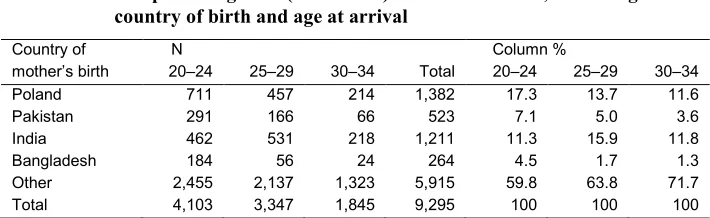
Table 2: Sample of migrants (2001–2011) from the ONS LS, according to country of birth and age at arrival
Country of
mother’s birth 20–24 N 25–29 30–34 Total Column % 20–24 25–29 30–34
Poland 711 457 214 1,382 17.3 13.7 11.6
Pakistan 291 166 66 523 7.1 5.0 3.6
India 462 531 218 1,211 11.3 15.9 11.8
Bangladesh 184 56 24 264 4.5 1.7 1.3
Other 2,455 2,137 1,323 5,915 59.8 63.8 71.7
Total 4,103 3,347 1,845 9,295 100 100 100
Source: Authors’ own analysis of ONS LS.
4. Results
Figure 1: (Continued)
Source: Authors’ own analysis of ONS LS.
For migrants aged 25‒29 years at arrival, there is a large increase in rates of childbearing in the first two years following arrival for women migrating from Pakistan and Bangladesh, but this sudden increase in fertility immediately subsequent to migration is not seen among women born in India or Poland. However, Indian women who arrive in their late twenties do display raised fertility (especially two-to-five years following arrival) as compared with England and Wales. By contrast, Polish migrants who arrive in their mid- to late twenties experience fertility similar to the host population.
5. Discussion and conclusion
The relationship between migration and childbearing differs according to country of birth and age at arrival in England and Wales. Relatively few younger migrants move to the UK with young children. At short durations (up to five years) after migration there is evidence of very high age-specific fertility rates among Pakistani-born and Bangladeshi-born women who arrived in their twenties. Fertility rates also increase following migration among young migrants from India, but the levels are significantly lower than for women from Pakistan and Bangladesh. Migrants from Pakistan and Bangladesh show higher fertility rates than migrants from other countries of birth for the post-migration period observed in this study. For women arriving in their late twenties, the high rates of childbearing seen in the first few years following migration among women from Pakistan and Bangladesh are not sustained at longer durations, suggesting a temporary effect that has the potential to distort period measures of fertility (e.g., Table 1). There is evidence of low rates of childbearing in the first year after migration among Polish-born and Indian-born migrants arriving in their early thirties. For older Indian-born migrants, rates of childbearing in England and Wales are lower than in the years prior to migration, suggesting that many become mothers prior to arrival in the UK. By contrast, older Polish migrants appear to have very low fertility prior to migration.
systematically by age and country of birth (Robards and Berrington 2015; Berkeley, Khan, and Ambikaipaker 2006). Similar to previous findings from France (Toulemon 2004), Sweden (Persson and Hoem 2014), Norway (Østby 2002), and Italy (Mussino and Strozza 2012), high fertility was identified in years immediately after migration for migrants from low-income countries of birth – in this case Pakistan and Bangladesh. By contrast, women moving from countries of birth where education and work-related migration reasons are key (e.g., India, Poland) appear to delay childbearing until some years after migration. Future research needs to jointly consider reasons for migration alongside fertility outcomes among migrants.
Tempo distortions in childbearing associated with the migration event for some migrant groups should make for more cautious use of period TFRs as a summary measure of the likely completed family size of migrants. When migration is associated with high fertility on arrival, an increase in migration rates can inflate the TFR by increasing the number of women with short durations of stay when their fertility rates are highest, therefore exaggerating the fertility quantum (Sobotka and Lutz 2009; Toulemon 2004). Therefore, relatively high period TFRs for some foreign-born women, which are widely reported in the UK media and policy reports, may reflect tempo distortions. Specifically, in this study, migrants from Pakistan and Bangladesh aged 20‒ 24 and 25‒29 at arrival show high fertility at short durations compared to migrants from other countries of birth, and also the host population. It would appear that there is a close connection between migration and family formation that is connected with the higher numbers of women accepted as spouses for “settlement” from Pakistan and Bangladesh compared with India and other countries (Home Office 2015). For migrants from India there is no evidence of a sharp increase in fertility immediately after migration and there is little evidence of a tempo distortion in fertility among Polish migrants. Other countries of origin also show more limited evidence of tempo distortions, although with higher fertility rates than for those born in England and Wales. Tempo distortions to the period TFR are likely to be particularly strong for migrant groups who tend to migrate for family-related regions, such as those from Pakistan and Bangladesh.
6. Acknowledgements
The permission of the Office for National Statistics to use the Longitudinal Study is gratefully acknowledged, as is the help provided by staff of the Centre for Longitudinal Study Information and User Support (CeLSIUS). CeLSIUS is supported by the ESRC Census of Population Programme (Award Ref: ES/K000365/1). The authors alone are responsible for the interpretation of the data. This work contains statistical data from ONS which is Crown Copyright. The use of the ONS statistical data in this work does not imply the endorsement of the ONS in relation to the interpretation or analysis of the statistical data. This work uses research datasets which may not exactly reproduce National Statistics aggregates. Clearance number LS30106.
References
Andersson, G. (2004). Childbearing after migration: Fertility patterns of foreign-born women in Sweden. International Migration Review 38(2): 747‒774. doi:10.111 1/j.1747-7379.2004.tb00216.x.
Ballard, R. (2008). Inside and outside: Contrasting perspectives on the dynamics of kinship and marriage in contemporary South Asian transnational networks. In Grillo, R. (ed.). The family in question: Immigrants and minorities in
multicultural Europe. Amsterdam: Amsterdam University Press. pp 37‒70.
Berkely, R., Khan, O., and Ambikaipaker, M. (2006). What’s new about new immigrants in twenty-first century Britain? York: Joseph Rowntree Foundation. Coleman, D.A. and Dubuc, S. (2010). The fertility of ethnic minorities in the UK,
1960s–2006. Population Studies 64(1): 19‒41. doi:10.1080/003247209033912 01.
Dormon, O. (2014). Childbearing of UK and non-UK born women living in the UK: 2011 Census data. Office for National Statistics. http://www.ons.gov.uk/ons/rel/ fertility-analysis/childbearing-of-uk-and-non-uk-born-women-living-in-the- uk/2011-census-data/article--childbearing-of-uk-and-non-uk-born-women-in-england-and-wales-using-2011-census-data.html.
Dubuc, S. (2012). Immigration to the UK from high-fertility countries: Intergenerational adaptation and fertility convergence. Population and Development Review 38(2): 353‒368. doi:10.1111/j.1728-4457.2012.00496.x. Fargues, P. and Lum, K. (2014). India‒EU migration: a relationship with untapped
potential. Florence: European University Institute. http://hdl.handle.net/1814/ 31305.
Hoem, J.M. (2014). The dangers of conditioning on the time of occurrence of one demographic process in the analysis of another. Population Studies 68(2): 151‒ 159. doi:10.1080/00324728.2013.843019.
Hoem, J.M. and Nedoluzhko, L. (2014). Pre- and post-migration fertility. Stockholm
Research Reports in Demography 18. http://www.suda.su.se/SRRD/SRRD_
2014_18.pdf
Kofman, E. (2000). The invisibility of skilled female migrants and gender relations in studies of skilled migration in Europe. International Journal of Population Geography 6: 1‒15. doi: 10.1002/(SICI)1099-1220(200001/02)6:1<45::AID-IJPG169>3.0.CO;2-B.
Kofman, E. (2004). Family-related migration: A critical review of European
studies. Journal of Ethnic and Migration Studies 30(2): 243‒262. doi:10.1080/1
369183042000200687.
Kulu, H. (2005). Migration and fertility: Competing hypotheses re-examined. European Journal of Population 21(1): 51‒87. doi:10.1007/s10680-005-3581-8.
Milewski, N. (2010). Fertility of immigrants: A two-generational approach in Germany. Berlin: Springer. doi:10.1007/978-3-642-03705-4.
Mussino, E. and Strozza, S. (2012). The fertility of immigrants after arrival: The Italian case. Demographic Research 26(4): 99‒130. doi:10.4054/DemRes.2012.26.4. Mussino, E., Gabrielli, G., Paterno, A., Strozza, S., and Terzera, L. (2015). Motherhood
of foreign women in Lombardy: Testing the effects of migration by citizenship.
Demographic Research 33(23): 653–664. doi:10.4054/DemRes.2015.33.23.
Ní Bhrolcháin, M. (2011). Tempo and the TFR. Demography 48(3): 841‒861.
doi:10.1007/s13524-011-0033-4.
Office for National Statistics (2012). International migrants in England and Wales 2011. http://www.ons.gov.uk/ons/dcp171776_290335.pdf.
Office for National Statistics (2013a). Immigration patterns of non-UK born populations in England and Wales in 2011. http://www.ons.gov.uk/ons/ dcp171776_346219.pdf.
Office for National Statistics (2013b). Family size in 2012. www.ons.gov.uk/ons/rel/ family-demography/family-size/2012/family-size-pdf.pdf
Office for National Statistics (2015b). Longitudinal study 2001–2011: Completeness of census linkage (Series LS No. 11). http://www.ons.gov.uk/ons/guide-method/user-guidance/longitudinal-study/what-s-new/ls11-for-publication.pdf. Office for National Statistics (2015c). Published ad hoc data and analysis: Population,
requests during September 2015. http://webarchive.nationalarchives.gov.uk/ 20160105160709/http://www.ons.gov.uk/ons/about-ons/business-transparency/ freedom-of-information/what-can-i-request/published-ad-hoc-data/pop/sep tember-2015/index.html.
Østby, L. (2002). The demographic characteristics of immigrant populations in Norway. Reports 2002/22. Oslo: Statistics Norway. https://www.ssb.no/ english/subjects/02/02/rapp_200222_en/rapp_200222_en.pdf.
Persson, L. and Hoem, J.M. (2014). Immigrant fertility in Sweden, 2000–2011: A descriptive note. Demographic Research 30(30): 887‒898. doi:10.4054/Dem Res.2014.30.30.
Retherford, R.D., and Cho, L.J. (1978). Age-parity-specific birth rates and birth
probabilities from census or survey data on own children. Population Studies
32(3): 567‒581. doi:10.1080/00324728.1978.10412816.
Robards, J. and Berrington, A. (2015). The fertility of recent migrant to England and
Wales: Interrelationships between migration and birth timing. CPC Working Paper 65, ESRC Centre for Population Change, UK. http://eprints.soton.ac.uk/ 377909/1/2015_WP65_The_fertility_of_recent_migrants_to_England_and_Wal es.pdf.
Robards, J., Berrington, A., and Hinde, A. (2013). Identifying biases arising from combining census and administrative data: The fertility of migrants in the Office for National Statistics Longitudinal Study. Longitudinal and Life Course Studies
4(3): 258‒267.
Robinson, D., Reeve, K., and Casey, R. (2007). The housing pathways of new immigrants. York: Joseph Rowntree Foundation.
Rogers, A. and Castro, L.J. (1981). Model migration schedules. Laxenburg: International Institute for Applied System Analysis.
Sobotka, T. and Lutz, W. (2009). Misleading policy messages from the period TFR: Should we stop using it? European Demographic Research Papers 4. Vienna: Vienna Institute of Demography of the Austrian Academy of Sciences.
Toulemon, L. (2004). Fertility among immigrant women: new data, a new approach.
Population and Societies 400: 1‒4.
Tromans, N., Natamba, E., and Jefferies, J. (2009). Have women born outside the UK driven the rise in UK births since 2001? Population Trends 136: 28‒42.
United Nations Economic and Social Affairs, Population Division (2013). World fertility patterns 2013. http://www.un.org/en/development/desa/population/ publications/fertility/fertility-patterns-2013.shtml.
White, A. (2009). Family migration from small-town Poland: A livelihood strategy approach. In: Burrell, K. (ed.). Polish migration to the UK in the ‘new’
European Union after 2004. Farnham: Ashgate: pp 67‒86.