World Maritime University
The Maritime Commons: Digital Repository of the World
Maritime University
World Maritime University Dissertations Dissertations
2001
Identifying and reducing the involvement of
human element in collisions at sea
Zhengjiang Liu
World Maritime University
Follow this and additional works at:http://commons.wmu.se/all_dissertations
This Dissertation is brought to you courtesy of Maritime Commons. Open Access items may be downloaded for non-commercial, fair use academic purposes. No items may be hosted on another server or web site without express written permission from the World Maritime University. For more
Recommended Citation
Liu, Zhengjiang, "Identifying and reducing the involvement of human element in collisions at sea" (2001).World Maritime University Dissertations. 109.
WORLD MARITIME UNIVERSITY
Malmö, Sweden
IDENTIFYING AND REDUCING THE
INVOLVEMENT OF HUMAN ELEMENT IN
COLLISIONS AT SEA
By
LIU ZHENGJIANG The People’s Republic of China
A dissertation submitted to the World Maritime University in partial Fulfilment of the requirements for the award of the degree of
MASTER OF SCIENCE
In
MARITIME AFFAIRS
(MARITIME SAFETY AND ENVIRONMENTAL PROTECTION)
2001
ã ã ã
Dedicated to
DECLARATION
I certify that all the material in this dissertation that is not my own work has been identified, and that no material is included for which a degree has previously been conferred on me.
The contents of this dissertation reflect my own personal views, and are not necessarily endorsed by the University.
Liu Zhengjiang
14 September 2001
Supervised by:
Prof. R.E. McFarland, LCDR U.S. Coast Guard
Associate Professor, Maritime Safety and Environment Protection
World Maritime University
Assessor:
Dr. P.K. Mukherjee
Professor, Maritime Safety and Environment Protection World Maritime University
Co-assessor:
Mr. Thomas Koester Psychologist, MA
ACKNOWLEDGEMENTS
I would like to extend my heartfelt gratitude to Dalian Maritime University, the Department of Science and Education of the Ministry of Communication, and the Department of International Cooperation of the Ministry of Communications, which nominated me to pursue a course of studies at the World Maritime University.
I am most grateful for DANIDA, Denmark, for having awarded me a scholarship, which made my study in World Maritime University possible.
I would like to express my sincere thanks to Prof. R.E. McFarland, my supervisor, who has been greatly encouraging and put forward invaluable recommendations and comments on my work.
I want to express my profound thanks to Prof. Wu Zhaolin, My supervisor in China, who has initiated my inspiration on the issue studied in this dissertation and give me much valued advice and assistance in the writing of this dissertation.
Mr. Zhao Yuelin, Associate Professor of Dalian Maritime University; Captain Guo Zirui, Mr.Zhou XiuHong, and Mr.Li Jianjun, officers of China Maritime Safety Administration; and Captain C.L. Petersen, Ship Surveyor of Danish Maritime Authority, have given me their hands in questionnaire investigation, I am deeply grateful for their generous assistance.
Deeply thanks will also go to Mr. C. Cole and Ms. I. Battista for who has performed the thankless task of reading the draft of the dissertation to correct the grammar and spelling mistakes in it.
I wish to thank Mr. Y.J-U. Schroeder for his comments and recommendations on the dissertation has been most helpful and are greatly appreciated.
My sincere appreciation also extended to all the staff of World Maritime University, especially to Prof. P.K. Mukherjee, Prof. P. Muirhead, Capt. J. Horck, and the staff at the library of the University. Without their great help in providing idea and information, this dissertation could not have been completed.
My particular gratitude goes to all my colleagues and friends in China for their firm support and great help to me.
Abstract
The dissertation is a study of the human element in collision at sea; both the human
elements that may be involved in maritime collisions and the countermeasures that are
applicable in reducing the involvement of those human elements are identified and
analyzed.
The meaning of the phrases “human error”, “human factors”, and “human element” in
the context of maritime system are differentiated based on the comparison of the
definitions proposed by various researchers and organizations. Thereby the application
scope of “human element “ is defined for the purpose of the dissertation.
The commonly used human element classifications are examined. Based on these
examination, a new human element classification for storing and gathering the human
element data in maritime collision is proposed, taking into account of the direct causes,
the underlying causes, and the external influencing factors leading to collision at sea.
The human element involved in collision at sea are identified by two approaches: in one
hand, existing written accident reports are analyzed and the human elements involved in
these accident cases are picked up; in the other hand, seafarers and exports’ view on the
human elements involved in marine collisions are interviewed by questionnaires. A
comparison between the results get from the two approaches is made. Mathematical
tools such as fuzzy sets have been used in dealing with the data collected by
questionnaires.
Faced with the identified human elements, countermeasures against these elements are
examined, taking into account of the measures recommended by researchers,
The concluding chapter summarizes the main findings concerning the identified human
elements, countermeasures, and the approaches used in the study. A number of
recommendations are made relating to the need for further research in the subjects.
KEYWORDS: Human element; collision at sea; accidents; maritime investigation;
TABLE OF CONTENTS
DeclarationAcknowledgements
Abstract
Table of Contents
List of Tables
List of Figures
List of Abbreviation
1 Introduction
1.1. Background 1.2. Objectives 1.3. Methodology
1.4. Dissertation structure
2 Human elements in collision at sea
2.1. Defining the human element, human factor and human error 2.1.1. Human error
2.1.2. Human factor 2.1.3. Human element
2.2. Human elements in maritime systems 2.2.1. Maritime system
2.2.2. Human elements involved
2.3. Frequently observed human element in ship collisions 2.4. Proposing structure of maritime safety systems
2.4.1. Structure of maritime system 2.4.2. Application of “human element” 2.5. Summary
3 Classification of Human Elements in Collisions at Sea
3.1. Existing marine collision related human element classification
3.1.1. Human element classification used in marine casualty database
3.1.1.1 MAIB Human Element Classification for Marine Accidents
3.1.1.2 CASMAIN human error classification
3.1.2. Human element classification used in marine casualty statistical reports
3.1.2.1 TAIC Maritime Statistical Overview
Marine Accidents 3.1.3 Comments
3.2. Some theoretical researches results on human element classification 3.2.1. Reason’s classification
3.2.2. Moore and Bea’s classification 3.2.3. SHEL Model
3.3. The human element classification recommended by IMO 3.4. Classification of human elements in marine collisions
3.4.1. Consideration in establishing the human element classification 3.4.2. Structure of the classification
3.5. Summary
4 Identifying the human elements involved in collision
4.1. Identifying the human elements from the written accident reports
4.1.1. Collision data search
4.1.2. Results derived from the written reports 4.1.2.1 Unsafe acts
4.1.2.2 Underlying human elements 4.1.2.3 External influencing factors
4.1.3. Main findings from written accident reports
4.2. Experts’ and seafarers’ view
4.2.1. Briefing the background of respondents
4.2.2. Fuzzy sets model and calculation of membership grade 4.2.2.1 Constructing fuzzy sets
4.2.2.2 Calculating the membership grade 4.2.2.3 De-fuzzying
4.2.3. Calculated statistical results 4.3. Discussion
4.3.1. How far are the human beings’ perspectives from the actual world?
4.3.2. Which human elements are most likely involved in collision accidents?
4.3.3. What should and what could be done next? 4.4. Summary
5 Reducing the involvement of human elements in collision accidents
5.1. Researchers’ perspectives on countermeasures against human errors 5.1.1. Improving education and training methodology
5.1.2. Developing a safety culture
5.1.3. Using human error assessment and reduction techniques 5.1.4. Managing bridge team and resources
5.2 IMO’s work on reducing human element involvement in maritime accidents
5.2.1. The STCW Convention
5.2.2. International Safety Management Code
5.2.4.Casualty investigation
5.3 Experts’ and seafarers’ perspective in measures for reducing involvement of human elements in collisions
5.3.1.Statistical results of respondents’ perspectives
5.3.2.Extra recommendations and comments given by respondents 5.4 Discussion
5.5 Summary
6 Conclusion and recommendation 6.1. Summary
6.2. Recommendations
References
Appendices
Appendix A List of written collision accident reports
Appendix B Questionnaire
Appendix C Experts and seafarers’ views on the involvement of human element in collision at sea
Appendix D Experts and seafarers’ views on the assumed countermeasures against the involvement of human elements in collision at sea
85
85 86 92 94 99
100 100 103
106
116
116
123
127
LIST OF TABLES
Table 3.1 MAIB Human Factors Classification Summary 22
Table 3.2 CASMAIN human error classifications 23
Table 3.3 New Zealand TAIC’s Classification of Factors Involved in Marine
Accident
24
Table 3.4 MAIA’s Classification of Causes of Marine Accident 26
Table 3.5 Human Elements Classification 40
Table 4.1 Source of the used written accident reports 43
Table 4.2 Backgrounds of Respondents 62
Table 4.3 Comparison between Human Beings’ View and Actuality on Human
Elements in Collisions at Sea
72
Table 5.1 Respondents’ View on Countermeasures against HE in Collision at
Sea
LIST OF FIGURES
Figure 2.1 Relationship among operator, environment and ship 11
Figure 2.2 Illustration of project 12
Figure 2.3 The Maritime System 14
Figure 2.4 Maritime system 19
Figure 3.1 The basic elements of safety information system 27
Figure 3.2 Accident event dependencies on HOE factors for ship collision 31
Figure 3.3 SHEL Model 32
Figure 3.4 Structure of human element classification for collision analysis 39
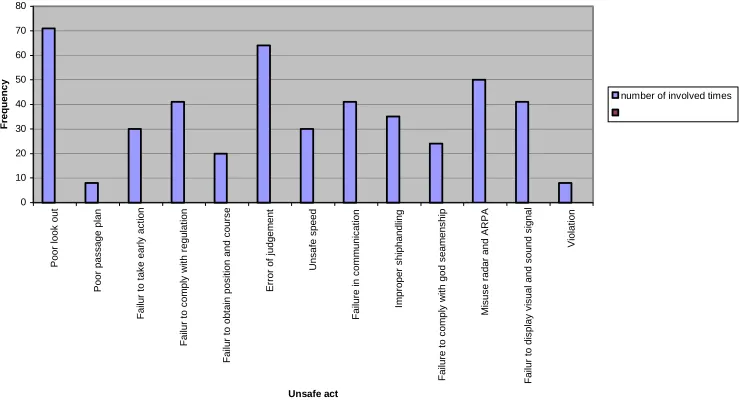
Figure 4.1 Unsafe acts found in written reports 44
Figure 4.2 Underlying human element involved in collision 49
Figure 4.3 External factors involved in collision 51
Figure 4.4 relationship between collision and time of day 53
Figure 4.5(a) Background of respondents (nationality) 58
Figure 4.5(b) Background of respondents (age) 59
Figure 4.5(c) Background of respondents (Occupation) 60
Figure 4.5(d) Background of respondents (Education) 60
Figure 4.5(e) Background of respondents (sea experience) 61
Figure 4.5(f) Background of respondents (competence level) 61
Figure 4.5(g) Background of respondents (experience of collision/CQS) 62
Figure 4.6 Membership Grade of Human Elements Involved in Collision
Accidents
65
Figure 4.7 Comparison of the View on HE Involved between Nationalities 66
Figure 4.8 Comparison of the Views on HE Involvement between Different
Occupations
67
Figure 4.9 Comparison of Views on HE Involvement between Different
Education Levels
68
Figure 4.10 Comparison of Views on HE Involvement between Different
Sea Experiences
68
Figure 4.11 Comparison of Views on Human Element Involvement between
Different Competence Levels
69
Figure 4.12 Comparison of Views on Human Element Involvement between
the Collision/Close-Quarters Situation Experience
70
Figure 5.1 Respondents' View on Assumed Measures 87
Figure 5.2 Comparison between the Views on Human Error Reduction
Measure Based on Nationalities
88
Figure 5.3 Comparison between the Views of the Respondents on Human
Error Reduction Measures Based on Occupation
89
Figure 5.4 Comparison between Views of Respondents on Human Error
Reduction Measures Based on Education Level
Figure 5.5 Comparison between the Views of the Respondents on Human Error Reduction Measures Based on Competence Level
90
Figure 5.6 Comparison between the Views of the Respondents on Human
Error Reduction Based on Sea Experience
91
Figure 5.7 Comparisons between the Views on Assumed Measures Based
on the Experience of Collision/Close-Quarters Situation
LIST OF ABBREVIATIONS
APPA Automatic Radar Plotting Aids
BRM Bridge Resource Management
CASMAIN marine casualty database
CM chief mate
COLREGS the International Regulations for Preventing Collisions at Sea
CQS close-quarters situation
ETA expected time of arrival
FSA Formal Safety Assessment
GMDSS Global Maritime Distress and Safety System
HEART human error analysis and reduction techniques
HE Human Element
HKMP Hong Kong Marine Department
HOE Human and organizational error
ILO the International Labors Organization
IMO the International Maritime Organization
ISM International Safety Management
JMAIAJ Marine Accident Inquiry Agency of Japan
JMRI Maritime Research Institute of Japan
MAO Maritime Administration Officer
MIIUA Maritime incident Investigation unit of Australia
NM Navigation mate
PG post graduate
Ro-Ro Roll-on---Roll-off
SBAI Swedish Board of Accident Investigation
SHEL Software, Hardware, Environment and Live-ware
SSC staff of shipping company
STCW Standards of Training, Certification and Watchkeeping
NZTAIC Transportation Accident Investigation Commission of New Zealand
TSBC Transportation Safety Board of Canada
UK MAIB Maritime Accident Investigation Branch of UK
USCG the United States Coast Guard
CHAPTER 1
Introduction
1.1 . Background
According to maritime accident statistics, the collision is one of the most significant
casualties occurring at sea (IMO, 1997; Lloyd’s Register of shipping, 1997, p.16).
Collision avoidance has been a hot topic in the maritime industry since the 19th century.
The work on collision avoidance has mainly focused on three areas: establishing
regulations and strengthening traffic control; improving and enhancing the technical
level of seafarers; studying and promoting collision avoidance automation (Zhao, Wu &
Wang, 1992). Examples of the achievements resulting from these efforts are: the
adoption of the International Regulations for Preventing Collisions at Sea; the
establishment of a vessel traffic management system; the use of radar and ARPR.
However, accidents, including collisions, still occur at a high rate every year; even when
competent navigators are controlling the ship (Gray, 1996,4; IMO, 1997). So, what is
still the matter?
It is the human element that plays a main part in maritime accidents. Research into the
maritime casualty area reveals that 96% of all collisions were attributable to the human
element (MAIB, 1991, p.4; UK P&I Club, 1999; Grime, 1996, p.260). Kuo’s (1998,
p.108)’s study concluded that 60% of all accidents are directly caused by human error,
while a further 30% accidents have the human element as indirect contributory cause.
The human element as involved in maritime casualties, including collisions, has
attracted much concern from all parties in the maritime industry. Researchers from
on this matter. The International Maritime Organization (IMO), as an
inter-governmental organization, has played an active and leading role in human element
research work. It coordinates and harmonizes the research activities among member
States.
Research on the human element covers quite a wide scope. The major emphases of these
research include: the classification of human and organization errors; the systematic
survey of factors influencing crew performance; data gathering and analysis relating to
human factors; method of improving man-ship interface; system failures; the
management of human element; and quality and reliability of human element (Kuo,
1998, p.109; Moore & Bea, 1995, p.184; Williams, 1994; Eriksson & Mejia, 2000, p.8;
IMO, 1997).
Research on the human element as involved in collisions has a long history. Indeed,
research on the human element in collisions at sea may be traced back to the collection
of statistics of accidents at sea in the mid 18th century (Smeaton, Morton, & Dineley,
1996, p.260). The achievement of these accident statistics is the outcome of the
International Rules of the Road at Sea which is still the basis of the current International
Regulations for Preventing Collisions at Sea (Cockcroft & Lameijer, 1996, xiv).
However, the intensive study of the human element involved in collisions was started at
the end of the 1980s when IMO shifted its attention to the human element in maritime
casualties.
The research in this field mainly focused on three aspects: the investigation of collision
causes (Drager, Kristiansen, Karlsen & Wrencke, 1981, p.22; Cahill, 1997); risk analysis
(Hinsch, 1995, p.389; Wennink, 1992, p.80); and watch keeper collision avoidance
behaviour (MSA, 1995; James, 1994, p.259; Zhao, Price, Wilson & Tan, 1995, p.425;
acts in collisions have been roughly identified; collision risk incorporating human
factors has been estimated quantitatively; navigators’ customary behavior in collision
avoidance has been mathematically modeled. This progress has made a great
contribution to collision avoidance and promoted safety at sea.
However, very little is known about the human element and the reasons why mistakes
are made (O’Neil, 1996, p.4). Poor look out, failure to comply with regulations and
fatigue are causes leading to collisions (Smeaton, Moreton & Dineley, 1996, p.260;
Cahill, 1997, p.229). But, what caused the fatigue? Why is a navigator negligent when
on look out? These questions need to be answered. Only when the underlying human
elements leading to the unsafe acts in collisions are identified, can proper
countermeasures against these errors be made.
1.2. Objectives
• Identify the human elements involved in collisions at sea.
• Identify the measures for reducing the impact of the human element in collisions
at sea.
1.3. Methodology
The method used in this dissertation consists of the following steps:
• Constructing a classification for collecting and storing the data of human
elements involved in collisions at sea.
• Gathering data of human elements involved from various sources especially from
current written accident reports.
• Establishing a mathematic model for data analysis.
• Analyzing the information from written accident reports and questionnaires.
• Identifying the human element involved in marine collisions.
• Identifying the measures for reducing the human element involvement on the
basis of identified human element and perspectives of related parties.
1.4. Dissertation
structure
Chapter 1 provides the background and problem definition for the research. Seven steps
of methodology describing the scope of the dissertation are defined.
Chapter 2 provides the definitions for the terms “human element” and “maritime
system”; there is an attempt to clarify the difference between such phrases as “human
element”, “human factor”, and “human error”. The human elements frequently observed
in marine collisions are also presented on the basis of the current maritime accident
statistics reports.
Chapter 3 proposes a classification for storing the human elements involved picked up
from written accident reports. Some currently used classifications are reviewed.
Chapter 4 analyses the information and data gathered from written accident reports and
questionnaires. Some most significant human elements involved in collisions are
identified or confirmed.
Chapter 5 reviews the existing measures for human element reduction, and analyses the
measures proposed by respondents of questionnaires. Based on this analysis, some
Chapter 6 is a conclusion for the whole dissertation.
Referred literature and written accident reports, blank questionnaires, and original data
CHAPTER 2
Human Elements in Collision at Sea
What does “human element” mean? When a glance is thrown on a piece of literature or
document dealing with the safety and casualty, phrases such as “human element”,
“human factor” and “human error” will get into your sight. Even in the same paper,
these terms are often used alternatively. The mixed use of these phrases leads to the
reader’s confusion on their meaning. For the purpose of this dissertation, a better
understanding of the terms “human element”, “human factor”, and “human error” is
needed.
Chapter 2 is devoted to defining and clarifying the meaning of “human element” in
maritime systems. Based on the comparison of their meaning and the application scope,
definitions for “human element”, “human factors”, “human errors” are proposed
respectively. The components of human element implicated in maritime systems are
explored. Human errors frequently observed in ship collisions are roughly examined
based on the casualty statistics. Finally, based on the proposed maritime system, the
scope of the human element to be discussed in this dissertation is defined.
2.1. Defining the human element, human factor and human error
The phrases “human element”, “human factor”, and “human error” are increasingly used
in literature in particular when it is associated with human performance and safety.
Some writers use them alternatively without any differentiation in the same paper. They
mean the same thing, human failure, with any of these three terms. Indeed, they have
2.1.1. Human error
The term “human error” has a longer history than the other two phrases. It can be traced
back to 1931 when it had its birth with Heinrich (Petersen, 1996,xiii). It was introduced
as a “people problem” into the causation sequences. Since then, human error has been
recognized as a basic cause behind all accidents and incidents. What does “ human
error” mean? Peters (1966) defined it from three aspects:
In theory, … human error consists of any significant deviation from a
preciously established, required or expected standard of human performance.
In practice, term may have any one of several specific meanings depending
upon the nature of contractual agreement, the unique requirements of a
particular program, the customary error classification procedures… and the
emotional connotations involved with the use of a term which might be
incorrectly perceived as possibly placing the blame on individuals or their
immediate supervision.
In the reality of situation where arguments of precisely what is or is not a
human error are of less importance that what can be done to prevent them.
J. Reason (1990; 1997,61) defined “human error” as “the failure of planned action to
achieve their desired ends –with out the intervention of some unforeseeable event.”
Rothblum (1996) described the human error as “ an incorrect decision, an improperly
performed action or an improper lack of action /inaction”.
“A departure from acceptable or desirable practice on the part of an
individual or group of individuals that can result in unacceptable or
undesirable results.”
Whichever of these definitions you prefer, they all convey such an impression that
“human error” is the failure of planned human performance which can result in
unacceptable or undesirable results. The focus is lighted on the failure of human actions.
2.1.2. Human factor
Comparing with the term “human error”, human factor is a neutral phrase. It may have
several meanings depending on the area it applies to. It may be used as a discipline under
the title “ergonomics”; thus, it means “the scientific study of man in his working
environment ” as defined by Stockbridge (1975). In other case, it may means “human
engineering” when talking about man-machine interface in the application of computers
(Kuo, 1993, p.639).
In the context of the safety of maritime systems, “human factors” covers “a wide range of
elements involves in the interaction between individuals and their working environment
(Feyer & William, 1998, p.56.9), the phrases “human factors” means (UK Health and
Safety Executive, 1989):
The perceptual, mental and physical capabilities of people and the interaction
of individuals with job and working environments, the influence of equipment
and system design on human performance, and, above all, the organizational
Kuo (1993) pointed out “the term ‘human factors’ is concerned with the interfacing of a
set of personal capabilities and characteristics with a combination of hardware, software,
working environment and operational culture in the effective performance of a task”
Both the above-quoted definitions cover the human beings’ capabilities, jobs and working
environment, the effects of system designs on human performance and organizational
characteristics. The later one even treats the above-mentioned factors into two distinct
groups. Gordon (1998,p.97) quoted Wilpert’s “human factors” definition as
“organizational group and individual factors”. Apparently, the term “human error” only
shows human factors’ negative sides.
2.1.3. Human element
Comparatively speaking, the term “human element” is much “younger” than the term
“human error” and “human factor”. It was not frequently used until the end of the 1980s,
when a research report, submitted by the UK government (Marine Directorate of
Department of Transportation, 1991) to IMO, claims that “the human element was found
to be present in over 90 percent collisions and groundings, and in over 75 of contacts and
fires/explosions”.
The UK report (Marine Directorate of department of Transportation, 1991) questioned the
use of the term “human error” such as 80-90 percent of all accidents are caused by
“human error” as misleading. It was not accurate. They thought that since human beings
were popularly treated as just one system component amongst many others, and “human
error” thus was an example of component failure. “Human factor” and “human element”
were better alternatives. They stated further that both “human element” and “human
factor” “can be used quite flexibly without necessarily imputing any sense of failure or
Here, some important information is conveyed. First, human beings are treated as a
component of a system. In this system, there are still some other components. So the term
“human element” may be used to refer to human beings’ functions and performances in
the system. Second, “human error” is only an example of human elements’ failure in the
system. Third, “human element” has the similar meaning to “human factor”.
IMO (1997a) interpreted the meaning of the term “human element” as “a complex
multidimensional issue that affects maritime safety and marine environmental protection”;
it “involves the entire spectrum of human activities performed by ship’s crew,
shore-based management, regulatory bodies, recognized organizations, shipyards, legislator,
and other relevant parties”.
Based on the discussion above, it could be concluded that the terms “human error”,
human factor” and “human element” sometimes may be used to refer to the same issues
associated with maritime safety. They have different meaning more or less but “human
element” emphasizes more on the “function of human being as a “component” of a
system. When discussing the issues of maritime system, it is better to use “human
element”. “Human error” is only one dimension of “human element”: human failure. To
decrease its occurrence possibility is the aim of consideration of human element matters.
2.2. Human elements in maritime systems
As mentioned above, human element is a component of a system. For the task of
exploring the impacts of human elements involved in ship collisions, it is necessary to
2.2.1. Maritime system
A system may be defined as “an organizational array of components designed to
accomplish a particular objectives according to plan”(Clench, 1995,p.195). The system
approach can offer a framework within which the human element may be put in context
(Drager et al, 1981, p.23; Gu, 1992, p.5; Rothblum, 1996,).
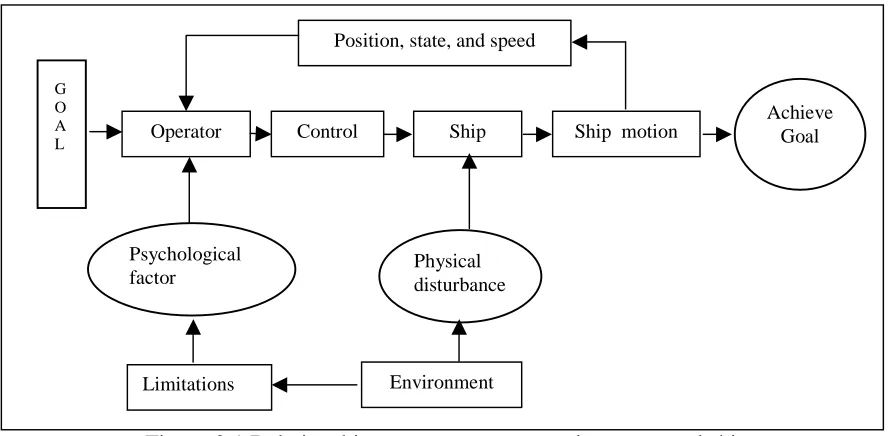
Gu (1992, p.5) established a maritime safety system with three subsystems: operator, ship
and environment. The relationships among the three subsystems are shown in Figure 2.
Apparently, this system is structured from the point of view of the ship operator.
Figure 2.1 Relationship among operator, environment and ship
Source: (Gu, 1993)
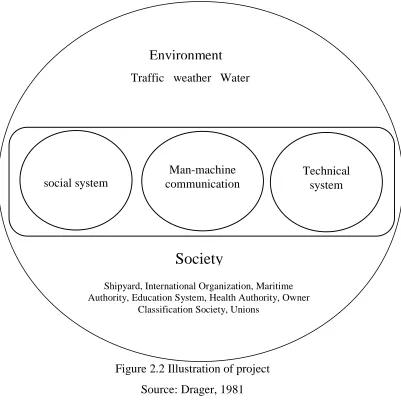
Drager’s (1981, p.23) system also consists of three subsystems: ship, society and
environment. In this system, ship refers to the following components: technical
equipment and system, crew organization on board ship, and man machine
communication. The subsystem of a society covers a very wide scope including owners,
Operator Control Ship Ship motion
Position, state, and speed
Environment Limitations
Physical disturbance
G O A L
Achieve Goal
shipbuilders, maritime administrators, education, health authorities, and classification
society. (See Figure 2.2.)
Figure 2.2 Illustration of project
Source: Drager, 1981
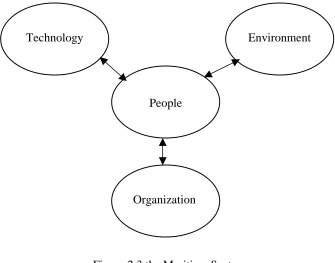
Rothblum (1996) stated that the maritime system is a people system (as shown in Figure.
2.3). People interact with technology, the environment and organizational factors. In this
system people include the ship’s crew, pilots, dockworkers, vessel traffic service
operators and others. Environment includes weather environment, physical work
environment and the regulatory and economic climates. Technology refers to the design social system
Man-machine communication
Technical system
Society
Environment
Traffic weather Water
Shipyard, International Organization, Maritime Authority, Education System, Health Authority, Owner
of the ship and the equipment of the ship that may have some kind of impact on people’s
performance. Organization refers to crew organization and company policies.
Each of these system structures has its characteristics. Some of them cover a wider scope,
but people (operator, man), ship, and environment are common components they contain.
2.2.2. Human elements involved
In the maritime system established by Rothblum (1996), people related human elements
include knowledge, skill, abilities, memory, motivation and alertness; the effects of
technology on people include perception, decision-making, and performance. The effects
of the environment on people include physical and mental performance, fatigue,
risk-taking; the organization on people includes fatigue, knowledge & skill, work practices,
teamwork, and risk-taking. Among all these factors, the three largest problems were
fatigue, inadequate technology knowledge, and inadequate communication and
coordination between pilot and bridge crew (USCG, 1995).
Clench (1995) identified 9 kinds of human elements in the maritime system: training,
work load, fatigue, manning, selection, language, management, knowledge, and
automation. These elements are further grouped into four categories: competency,
organization and methods, design, and communication.
Kuo (1993, p.640) incorporated the following human elements into safety systems:
personal capabilities including both intellectual capabilities and physical capabilities; the
influence of personal characteristics (such as personality, response to stress, attitude and
leadership and teamwork qualities) on performance; the influence of hardware, software,
and the working environment on human beings’ performance; and the impact of the
Figure 2.3 the Maritime System
Source: Rothblum, 1996
Clearly, the human elements commonly identified in maritime system by these
researchers are people abilities and limitations, the influences of environment, hardware,
software, and organization on people.
2.3. Frequently observed human element in ship collisions
What are the most frequently observed human elements present in collision? As a start of
this research, some statistical data are quoted as the following: People
Environment Technology
After an indepth analysis on twelve selected collisions, the Marine Directorate of the
Department of Transports (1991) reported that the following human elements or human
errors are frequently present:
Carelessness/ overconfidence 7
Lack of attention 6
Communication failure 5
Lack of knowledge 3
Excessive speed in poor visibility 3
Sheer interaction between ships 2
Steering failure 2
Dragger et al (1981) analysed the collision accidents involving Norwegian ships for the
period 1970-1978. The results revealed that external conditions and “navigational error”
are of high significance in collision accidents. For vessels above 1599tgr, the result of the
statistics is:
External conditions 26.8%
Technical failure 6.6%
Inadequate navigational factors 4.1%
Navigational error 17.1%
Non-compliance 6.8%
Other ship 38.5%
The Transportation Accident Investigation Commission (TAIC) of New Zealand’s (2000)
statistical overview on accidents that happened during 1998-1999 demonstrates that the
largest single human factors which was a cause of the accidents was error of judgement.
The following is a list, which shows the occurring frequency of each kinds of causing
Error of judgement
Lack of knowledge
Improper watch-keeping
Failure to comply with regulation
Ship handling
Failure to obtain ships position and course
Drug & alcohol
Misconduct or negligence
Physiological
Overloading
Fatigue
Adverse weather
Adverse current
Mechanical failure
Inadequate maintenance
Other
90
71
53
22
15
13
9
8
4
3
1
56
6
26
12
37
The Australia Marine Incident Investigation Unit (MIIU) (1996) analysed 8 collision
cases and got the present frequency of human factors as the following:
Poor or no lookout
Poor passage plan
Change of watch
Incorrect lights
Unqualified person
Rough weather
No radar reflectors
8
1
1
1
2
1
The Japan Marine Accident Inquiry Agency (JMAIA, 1999) made a review on collision
cases from 1994 to 1998 and found that 12 human elements were frequently present in
collisions:
Improper lookout 410
Non-compliance with
Steering and sailing rules
194
Failure to sound signals 89
Improper commercial & sequence of Duties 71
Improper selection of speed 45
Improper reporting or hand over 36
Failure to post lights and /or shapes 30
Dozing off 22
Improper ship handling 9
Improper ship operational control 6
Insufficient consideration to weather 30
Failure to check ships position 1
Based on the above quoted statistical data from various sources, a brief conclusion on
human elements in collisions may be made. The most frequently observed human errors
are
• Improper or poor lookout
• Non-compliance with COLREGS
• Error of judgement
• Lack of knowledge
• Unsafe speed in restricted visibility
It is necessary to point out that most of those revealed human elements are unsafe acts
committed by front-line crews. For the purpose of reducing their future occurrence, the
underlying contributors to collision behind those unsafe acts are needed to be explored.
2.4. Proposing structure of maritime safety systems and application of
“human element”
2.4.1. Structure of maritime safety system
As mentioned above, each of the quoted structures of maritime systems has its scope of
application. For the purpose of identifying human elements in collisions, a new maritime
system structure is proposed as shown in Figure. 2.4.
In establishing the structure of a maritime system, the components such as operator, ship
environment and society are considered. Accident occurrence has also been included into
the system structure. If safe measures or defences are broken, the ship will proceed into
an accident.
Operator mainly refers to crewmembers, pilots, and even VTS operators who directly
conn the ship.
Society mainly includes the ship owner, the shipbuilder, the administrator, the
classification society, and the international organization. Organizational culture is
included in this category.
Environment refers to the external climate and traffic situation such as adverse weather
Figure 2.4 Maritime System
The ship itself is also a subsystem; it includes the ship equipment, ship hull, ship
maintenance, ship manoeuvrability, and also the operating environment it provides to the
operator.
2.4.2. Application of “human element”
Taking into account of the characteristic of marine collision, the human element to be
explored in this dissertation mainly focuses on the unsafe acts of operators, and the
underlying contributors such as the operators’ personality that have a deep influence on
the operator’s performance. The external elements including the environment, the society
and ship itself that have a direct contact with operators will also be deemed as one aspects
of the human element. The detail of these human elements will be discussed in chapter
3-classification.
Achieve goal or Accident society
environment
operator
ship
2.5. Summary
The light of this Chapter is thrown on defining the term “human element”, “human
factors” and “human errors”, exploring frequently observed human elements in collisions,
and proposing the structure of a maritime system, for the purpose of setting the scope of
“human element” to be studied in the following chapters.
The meaning of the term “human element” covers a wider scope than the term “human
error”. “Human element” represents a component of maritime system while “human
error” is only an example of human failure in the system.
Frequently observed human element present in collisions are poor lookout, error of
judgement, non-compliance of regulations, selection of unsafe speed and lack of
knowledge. Strictly speaking, most of these revealed human elements by accident
investigation report can only be called “unsafe act” of front-line operators. To reduce the
future occurrence of those unsafe acts, underlying contributors to collisions should be
explored.
The proposed structure of a maritime system mainly consists of operators, ship society,
and external environment. Based on this maritime, the human element to be studied in the
dissertation will limited to the unsafe acts, navigators personal characteristics, and the
external influencing factors from society, natural environment and ship’s own operating
CHAPTER 3
Classification of Human Elements in Collisions at Sea
The focus of this chapter is to develop a classification framework for systematically identifying and characterizing human elements involved in collisions at sea. For this purpose, various human element classifications used in different accident reports and databases will be reviewed. Some literature about human elements will be studied and references will be made to IMO documents about human element investigations. Based on this study and analysis, a practical and compatible classification for identifying the human elements involved in collision will be proposed.
3.1. Existing marine collision related human element classification
The human element classification is commonly used in marine casualty database and, accident reports, and casualty statistical reports. For the purpose of this Chapter, the human element classification used in casualty database and casualty statistical reports will be reviewed.
3.1.1. Human element classification used in marine casualty database
Two typical human element classifications are introduced in this section: MAIB Human element classification and CASMAIN human error class.
3.1.1.1 MAIB Human Element Classification for Marine Accidents
which have similar natures. Some elements such as communication, training, skill and knowledge appear in different categories repeatedly, but they have different concerns in different subcategories. Take “communication” for example, it may mean the communication between the company and crew, the communication between external bodies and crew, the communication between crew and crew, the communication between external bodies and the company and so on.
Table 3.1 MAIB Human Factors Classification Summary External Bodies Liaison
a. Non compliance
b. Communication
c. Equipment design-manufacturer
d. Training, skills, knowledge
e. Working environment/workplace
f. Incorrect installation/defective
Equipment
Crew factor
a. Communication
b. Management and supervision Inadequate
c. Allocation of responsibility
Inappropriate
d. Procedures inadequate
e. Manning (rotation / watches)
f. Training
g. Discipline crew/passengers
h. Unsafe working practice
Working environment
Performance affected by:
a. Noise
b. Vibration
c. Temperature
d. Humidity
e. Visual environment/visibility
f. Ship movement weather effects
g. Poor housekeeping
h. Layout unsuitable for task
i. Accommodation
Company &Organization
a. Company standing orders inadequate
insufficient, conflicting etc.
b. Manufacture’s instructions
c. Communication
d. Pressures- organizational
e. Inadequate resources
f. Training, skill, knowledge
Equipment
a. Equipment misuse
b. Equipment not available as needed c. Equipment poorly designed for
operational use
d. Equipment badly maintained
e. Personnel unfamiliar with equipment/not trained in use
f. Automation means crew not trained
in use of manual alternatives
Individual
a. Communication b. Competence & skill
c. Training/inexperience, knowledge d. Violates procedures
e. Health drugs/alcohol medical condition
f. Domestic issues
g. Fatigue and vigilance h. Perceptual abilities
i. Poor decision making/ information use j. Perception of risk
k. Workload
3.1.1.2 CASMAIN human error classification
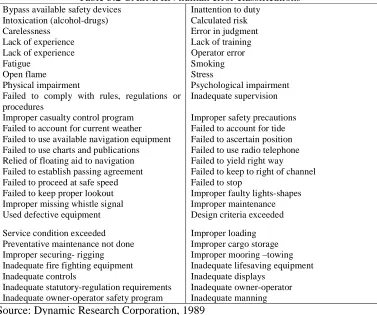
Table 3.2 CASMAIN human error classifications
Bypass available safety devices Inattention to duty
Intoxication (alcohol-drugs) Calculated risk
Carelessness Error in judgment
Lack of experience Lack of training
Lack of experience Operator error
Fatigue Smoking
Open flame Stress
Physical impairment Psychological impairment
Failed to comply with rules, regulations or procedures
Inadequate supervision
Improper casualty control program Improper safety precautions
Failed to account for current weather Failed to account for tide
Failed to use available navigation equipment Failed to ascertain position
Failed to use charts and publications Failed to use radio telephone
Relied of floating aid to navigation Failed to yield right way
Failed to establish passing agreement Failed to keep to right of channel
Failed to proceed at safe speed Failed to stop
Failed to keep proper lookout Improper faulty lights-shapes
Improper missing whistle signal Improper maintenance
Used defective equipment Design criteria exceeded
Service condition exceeded Improper loading
Preventative maintenance not done Improper cargo storage
Improper securing- rigging Improper mooring –towing
Inadequate fire fighting equipment Inadequate lifesaving equipment
Inadequate controls Inadequate displays
Inadequate statutory-regulation requirements Inadequate owner-operator
Inadequate owner-operator safety program Inadequate manning
Source: Dynamic Research Corporation, 1989
fixed object, dike, lock, bridge, dock, pier, and dam etc. The Cause category provides the reasons for each nature(event) of accident. Table 3.2 shows the Cause category called “the human and organizational error classification” used in the CASMAIN.
3.1.2. Human element classification used in marine casualty statistical reports
There are a lot of kinds of marine casualty statistical reports that have mentioned more or less about human elements. In this section, only the human element classifications used in TAIC’s maritime statistical overview and JMAIA’s statistical reports are reviewed for they introduce the human elements in a more systematic way.
Table 3.3 New Zealand TAIC’s Classification of Factors Involved in Marine Accidents
Human factors Environment factors Technical factors • Error of judgement
• Lack of knowledge
• Improper watch keeping or lookout
• Failure to comply with regulation
• Ship handling
• Failure to obtain ship’sposition or course
• Other
• Drugs and alcohol
• Misconduct or negligence
• Physiological overloading
• Fatigue
• Adverse weather
• Submerged object
• Adverse current
• Other
• Debris
• Navigation hazard
• Ice
• Lighting
• Mechanical failure
• Other
• Inadequate Maintenance
• Electrical failure
• Wear and tear
• Structural failure
• Corrosion
• Steering failure
• Inadequate stability
• Insufficient fuel
• Improper welding
• Inadequate firefighting/lifes saving
equipment
3.1.2.1 TAIC Maritime Statistical Overview
New Zealand Maritime Accident Investigation Commission (MAIC) classified the Causes of accidents into three main types: Human, Technical and Environmental (Maritime Safety Authority of New Zealand, 2000). Under the heading of human factors, about eleven human elements are listed; most of them are direct causes of collisions at sea.
3.1.2.2 JMRI and JMAIA ’s classification of Causes of Marine Accidents
The Maritime Research Institute of Japan (JMRI) identified 26 kinds of accident causes and classified them into eight major division (Nagatsuka, Seiji, 1993,) such as sub-standard ship operation control, sub-standard ship-handling, non-compliance with navigation rules, lack of due attention to weather conditions, imperfections of equipment and instruments, improper handling of machinery and tools, inadequate operation by seamen, and force majeure as shown in Table 3.6. Obviously, most of these divisions are connected with the human element except force majeure. The Marine Accidents Inquiry Agency of Japan’s (JMAIA) accident statistical report (1999) did not make any kind of sub-division, but put all these phrases in the same column with some phraseology adjustment and thus make the phrase more like those used by seaman (See table 3.4).
3.1.3 Comments
seamanlike words than that in databases. So it is widely accepted by those work in front-line.
Table 3.4 MAIA’s Classification of Causes of Marine Accident
Major division Sub-division
Sub-standard ship operation control
Inadequate ship operation control; Improper preparations for departure;
Improper selection of waterway and non-stability of the ship’s course
Sub-standard shiphandling
Inadequate shiphandling ;
Non –confirmation of the ship’s position Less alertness to lookout; dozing
Non-compliance with navigation rules
Not carrying lights and shapes; Failure to blow sound signals;
Non-compliance with Law for the Prevention of Collisions at Sea; Regulations, and Mode of Navigation
Lack of due attention to weather condition
Lack of due attention to weather and sea phenomena; Inadequate anchorage and mooring;
Inadequate measures for storm
Imperfections of equipment and instruments
Imperfections of the structures of hulls and engines, and of the materials used; improper maintenance and handling of steering equipment and instruments
Improper handling of machinery and tools
Improper maintenance, inspection and handling of main engines; Improper maintenance, inspection and handling of auxiliary engines; Improper inspection and handling of fuel oil and lubrication oil; Improper inspection and handling of electric equipment
Inadequate operation by seamen
Non-compliance with seaman’s ordinary duties and procedures; Inadequate on-deck and cargo work;
Improper loading of passengers, cargo, etc.;
Inadequate command and supervision over the services of seamen; Inadequate reporting and transfer of business;
Improper handling of fire
Force majeure Force majeure, etc.
Source:JAMIA.(1998).
However, as reviewed, there are still some common drawbacks lying in those widely used casualty and accident databases and reports in terms of human elements classification. In Marton’s and Purtell’s (1990) words to make a comment on this issue:
(2) No standardized, hierarchically organized, concept or format for identifying human factor casualty data to identify and correlate direct error causes to the underlying and contributing factors that shape the behaviours responsible for error and collision events.
3.2 Some theoretical researches results on human element classification
For developing a suitable classification framework that maybe used in identifying the human elements in marine collision, it is necessary to view the researcher’s works on human failures and errors. This may give some help and inspiration.
3.2.1. Reason’s classification
Reason (1990,1993) classifies human failures into types and tokens. As shown in Figure 3.1, failure types are further subdivided into source failure types and unsafe act tokens. Failure types are found at the management level and failure tokens are founded at the front line crew level.
Figure 3.1 The basic elements of safety information system Source: Reason, 1993
CONDITION TOKENS
PRECURSORS
UNSAFE ACT TOKENS
ACCIDENTS & INCIDENTS SOURCE
FAILURE TYPES
FUNCTION FAILURE TYPES
INTERFACE BETWEEN
ORGANIZATION AND
Unsafe acts are violations and results of motivation, individual and management attitudes and cultures, which are founded at higher levels in the organization (Reason, 1990). Unsafe act tokens are categorized as slips, lapses, mistakes and violations (Reason, 1996, p.18).
The next level in Reason’s safety information system scheme is the condition tokens. Condition tokens are psychological and situational precursors to accident scenarios. They are elements which contribute to unsafe acts such as working environments, training, design, hardware, maintenance, communication and the like (Reason, 1996, p.18). The root causes of each of these condition tokens are found in critical underlying contributing errors.
Functional failure types are made at the line management level. It can be categorized into: inadequacies in operating procedures and conditions; system defects and inadequate defences; communication failures; design failures; and poor maintenances.
Source failure types are decisions made at the strategic level of the organization; this can be directed at top-level management commitments to safety competence in addressing problems or lack of cognisance of the nature of the problem.
3.2.2. Moore and Bea’s classification
Commitment to safety is determined by the level of commitment of available resources and cognisance of potential problems to the safety of the operational system from top-level managers to front-line operating crews.
Resources pertain to money and expertise used to heighten operational safety.
Human-system interface encompasses failures and shortcomings of human actions resulting from inaccurate or insufficient information or from an inaccurate or insufficient response of control systems and control system display.
Knowledge/experience/training pertains to human or organizational failures and shortfalls resulting from insufficient or improper knowledge, experience, or training of the system under normal or extreme operating conditions.
Maintenance refers to the impact on ship operations as a result of improper, insufficient or a failure to conduct adequate maintenance, which is important to the normal and emergency operating systems.
Physical/mental lapses, slips and mistakes pertain to physical or mental lapses, attention failures, memory failures and rule based mistakes, which cause or contribute to fail or inadequately manned functions or performances under normal or extreme operating conditions.
Violations refer to intended unsafe acts as routine and exceptional violations or acts of sabotage.
Job design encompasses the inappropriate match of personnel characteristics with job or inadequate job descriptions.
Regulating/policing refers to the insufficient, inaccurate regulatory and policy making system or failure of organizations and regulatory bodies in continually maintaining or monitoring the integrity and reliability of the operating system.
Operating policy pertains to organizational policies and procedures from top level to front-line management, which are conducive to the implementation of safety of the operating system.
Communication/information refers to the incorrect, incomplete, or failure of the transfer of information between individuals, organizations, regulators, and systems.
Manning embodies the inadequate manning in terms of number or expertise of individuals (Moore &Bea, 1993, p.3-10).
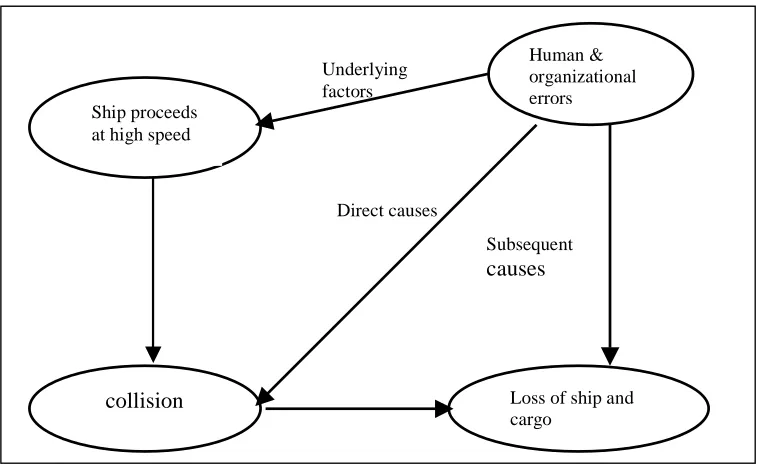
Figure 3.2 Accident event dependencies on HOE factors for ship collision
To examine the effects of external operating environments on error events and causes at the various stages in an accident sequences, Moore and Bea (1993, p.3-14) make a distinction between operating conditions (man-made or environmental) and error causes. The operating conditions are further differentiated into external and operational factors. Operational factors are specific to the operating environment. The external operating environment may contribute to events, decisions, actions or human errors. Vibration, noise, air quality, vessel traffic and smoke are classified into operational factors. External factors pertain to the external environment such as temperature, fog, rain, snow, wind, waves, time of day, ice and so on.
3.2.3. SHEL Model
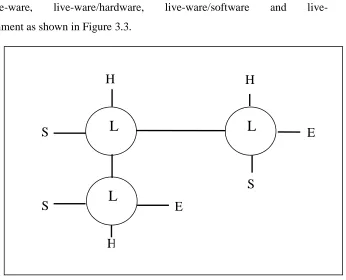
The SHEL model was developed by Edward and modified by Hawkins (1987). It consists of four components: Software, Hardware, Environment and Live-ware. Furthermore, each two of these four components forms four interfaces between them:
Underlying factors
Direct causes
Subsequent
causes
Human & organizational errors
Ship proceeds at high speed
ware/ware, ware/hardware, ware/software and live-ware/environment as shown in Figure 3.3.
Figure 3.3 SHEL Model Source: Hawkins, 1987
The most valuable and flexible component placed at the centre of the SHEL model is the live-ware, the human element (Schroeder, 2001). This component includes factors relating to the individuals under consideration: physical, physiological, psychological and psychosocial. Physical factors are those that limit the capacity of the individual to fulfil the designated tasks. Apart from the physical characteristics such as height, age, sex and strength of a person, sensory limitations such as needs for glasses or hearing aids are also included in this category. Physiological factors refer to the factors that could affect the individual’s physiological abilities. Health, lifestyle, fatigue, duty, consumption of alcohol/drug and incapacitation are listed in this column. Psychological factors are those factors concerned with the individual’s Mind and thoughts. They include perceptions, attention information processing capacity and attitude towards specific tasks. Other aspects affecting the psyche of a
L
L
L
H
S S
E S
H H
person such as personality, knowledge, training, planning of operation, confidence, and emotional status are also included in this category. Psychosocial factors result from the individual’s social situation. Personal problems such as mental pressure, interpersonal conflict, personal loss, financial problems, significant lifestyle changes, cultural differences and family pressure are usually taken as psychosocial factors; they may restrict capacities of a person in a crisis situation. (Schroeder, 2001).
Around the central live-ware, there are hardware, software, and environment. Hardware refers to the equipment part used in a transportation system. It includes displays, controls, and ergonomic aspects of workstations. Software is the non-physical part of the system including organizational policies, procedures manuals, checklist layout, charts, and advisories and computers programs. Environment includes the internal and external climate, temperature, visibility, vibration, noise and other similar factors, which constitute the conditions within which people are working. Sometimes the broad political and economic constraints under which the particular ship operates are included in this element. The regulatory climate is a part of the environment in as much as its climate affects communications, decision-making, control and coordination. The persons around the individual under consideration are dealt with as peripheral live-ware. It talks about human-human interactions. This may include factors such as management, supervision, crew interaction and communication, and labour relations (Schroeder, 2001).
coordination), passengers(for example: behaviour, briefing, knowledge of ships, and procedure), labour relation (for example: employee/employer management, and industrial action), worker-management relations (for example: hierarchy, and Bridge Team Management), pressures (for instance: mental pressure, morale, and peer pressure), and regulatory agency ( for instance: regulation, standard, implementation, inspection, monitoring, audit, and support ).
Live-ware/hardware refers to human-machine interaction. Design limitation in workstation configuration, instrument and workspace can affect the performance of the system and the individual; factors relating to the person to machine interface are included in this category.
Live-ware/software refers to the factors relating to the person to system interface. It mainly focuses on the information transfer between the human and supporting systems. These factors usually include written information (for instance: manuals, checklist, publication, regulations, charts and publications, instruction, and standards), computers software and automation extent of the system. Regulatory requirements such as qualification, certification, medical certificate, license are also belong to this column.
The first focus of the SHEL model is on the individual and his abilities and condition. His interactions other than at work are also here. The second focus is on the different interfaces that can have an effect on overall performance of the individual.
3.3. The human element classification recommended by IMO
For the systematic investigation of human factors in marine casualty thus to determine accident causes, identify contributing factors and draw lessons, the 21st IMO general assembly adopted resolution A.884 (21)(IMO, 2000a) which amends resolution A.849 (20)(IMO, 1997 November 27) by adding the Guidelines for the Investigation of Human Factors in Marine Casualties and Incidents and designated it as Appendix 2 of the Code. Both the SHEL model and Reason’s Hybrid model are recommended by these guidelines as tools for collecting and storing human elements in marine accidents.
Apparently, the SHEL model has provided a highly organized place to store information regarding unsafe situations (Landsburg et al, 1999, p.21) and human elements. The model can be used as a basis for determining the causes and probabilities, for it has taken into consideration of all the important work system elements and the interrelationships between the work system elements and has focused on the factors which influence the human performance by relating all peripheral elements to central human elements.
the SHEL model, into a framework surrounding an occurrence template, based on the Reason (1990) model. Causal factors are thereby identified.
The classification model, such as the SHEL and Hybrid model recommended by IMO provides a good backbone standard taxonomy, but when it is applied to the actual accident investigation and causation analysis, there are still some further work needed to be done. Some terms used in the model are not included in the vocabulary of the average mariners on a daily basis, which brings about the difficulties for common mariners’ use.
3.4. Classification of human elements in marine collisions
The classification used in this dissertation is established on the basis of the SHEL and Hybrid model. References to some research reports (Moore and Bea, 1993; Rothlum, 1996; Reason, 1996) and accident reports (MAIB, 1999,2000; TAIC, 2000; MIIU, 1996; MAIA, 1999) have also been made. The scope of human elements to be involved in the classification has been defined in chapter 2.
3.4.1. Consideration in establishing the human element classification
First of all, the goal of the classification should be considered. The main objective here is to systematically identify collision related human elements and analyse the accident causation. The classification must be complete enough for collecting and storing the relevant element data.
Third, the complexity of the classification should be weighted against the preferences of the user. Standard vocabulary of interpretation should be used thus it could be easily understood and grasped by professional mariners and investigators who used to be mariners.
Fourth, the compatibility of the classification should be considered. The classification should be such a taxonomy that could be adopted and at the same time permit sharing and storing of data not only for collision accident but also for other maritime accidents.
Finally, for further development, the classification model recommended by IMO should be put in a priority position.
3.4.2. Structure of the classification
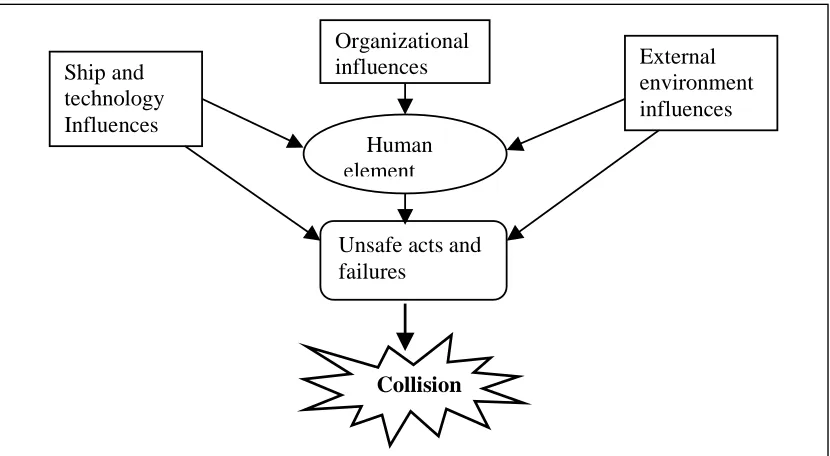
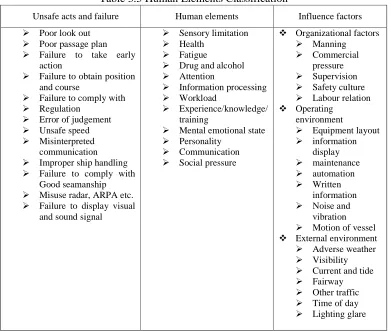
The classification consists of three areas: unsafe acts and failure, underlying human elements, and influence factors and conditions. Figure 3.4 demonstrates the structure of the classification. Table 3.5 gives the human elements involved in the classification in detail.
Unsafe acts and failure refers to errors committed by front-line watch keepers, crews, pilots and the like that directly lead to the occurrence of collision. Based on analysis results of collision accident reports (see appendix A), the following failures and unsafe acts that frequently occurred and lead to collisions are included into the following classification:
• Poor lookout: includes no lookout and improper lookout because of dozing off, lack of experience or change of watch.
• Poor passage plan: this item may refer to improper preparation for departure, lack of knowledge of the fairway and passage.
• Failure to obtain ships position and course: deviate from its own road without awareness.
• Failed to comply with regulations: violate the requirements of COLREG, non-compliance with the rule for the prevention of collision at sea;
• Error of judgement: failure in judging the meeting situation and circumstances and take an improper action based on this error judgement.
• Unsafe speed: select an extreme speed that is too fast or too low under the current circumstances.
• Improper ship handling: handle the vessel in improperly because of lack of skill of ship handling and knowledge of ship manoeuvrability and thus lead to collision.
• Failure to compliance with seaman’s ordinary practice: no attention has been paid to good seamanship.
• Misinterpreted communication: misunderstanding between crew and pilot, ship and shore, ship and ship, crew and crew.
• Failure in using radar and ARPA: defective inspection, maintenance, handling and interpreting electronic navigation and collision aids, especially misinterpreting the information given by radar and ARPA.
• Failure to post lights or shapes: failure to blow sound signals.
• Violation: acts of sabotage.
Figure 3.4 Structure of human element classification for collision analysis
• Physical factors: sensory limitation, including visual, hearing, touching and smelling limitation.
• Physiological factors: fatigue, including sleep and duty; health including life style; drug and alcohol;
• Psychological factors: attitudes, attention, judgement, workload, experience/knowledge/training, mental/emotional state, personality (such as withdraw, aggressive, show off), confidence (such as over confidence);
• Psychosocial factors: pressure from social and family, crew interaction.
External factors which may have a positive or negative influences on crews’ performance daily are listed in the right column of Table 3.5, They are categorized into three areas: organizational factors, operating environment, and external environment.
Collision
Human element Ship and
technology Influences
Organizational
influences External environment influences