World Maritime University
The Maritime Commons: Digital Repository of the World
Maritime University
World Maritime University Dissertations
Dissertations
2000
Establishment of a formal maritime safety
administration in Guatemala
Pablo Arturo Martin Nowell Maldonado
World Maritime UniversityFollow this and additional works at:
http://commons.wmu.se/all_dissertations
Part of the
Public Administration Commons
This Dissertation is brought to you courtesy of Maritime Commons. Open Access items may be downloaded for non-commercial, fair use academic purposes. No items may be hosted on another server or web site without express written permission from the World Maritime University. For more
Recommended Citation
Nowell Maldonado, Pablo Arturo Martin, "Establishment of a formal maritime safety administration in Guatemala" (2000).World Maritime University Dissertations. 331.
WORLD MARITIME UNIVERSITY
Malmö, Sweden
ESTABLISHMENT OF A FORMAL MARITIME
SAFETY ADMINISTRATION IN GUATEMALA
By
PABLO ARTURO MARTIN NOWELL MALDONADO
Guatemala, C.A.
A dissertation submitted to the World Maritime University in partial
fulfillment of the requirements for the award of the degree of
MASTER OF SCIENCE
in
MARITIME SAFETY AND ENVIRONMENTAL PROTECTION
(NAUTICAL)
2000
DECLARATION
I certify that all material in this dissertation which is not my own work has been identified and that no material is included for which a degree has been previously conferred upon me.
The contents of this dissertation reflect my personal views and are not necessarily endorsed by the University.
Signature
Date: August 21, 2000
Supervised by:
Lieutenant Commander Max Mejia
Lecturer, Maritime Safety and Environmental Protection World Maritime Administration
Assessed by:
Mr. Richard Hodgson
Associate Professor, Maritime Safety and Environmental Protection World Maritime University
Co-assessed by:
Commander Ivan Valenzuela Bosne Maritime Governor, Castro
ACKNOWLEDGEMENTS
The author would like to thank the Guatemalan Ministry of Defence and the Navy
for providing him the opportunity to study at the World Maritime University in Malmö, Sweden for this fruitful two year-period.
Grateful thanks to my Supervisor Max Mejia of the MSEP Department and to Lecturer Deborah Sam of the Intensive English Language Programme who read this work and made valuable contributions.
Grateful thanks to Mr. Bruce Browne Academic Register, for helping me to come to the WMU, thank you again for believing in me.
Grateful thanks to all resident professors, lecturers and visiting professors as well as to the staff of the University from whom the author acquired very useful knowledge, co-operation and permanent support.
He would like to thank also the maritime administrations of the Nordic countries,
the United Kingdom and the Netherlands as well as to all Organisations that have been involve in his instruction for their great support and collaboration during the Field Training.
Grateful thanks to the Swedish Government and Malmö City Authorities for having been our host during this two-year period in Sweden.
The author would like to thank his mother Jena, his wife Beverly, his daughter
Monika, his sisters Mirian Graciela, Ana Maria, Teresa Lourdes and Edna Ruth
for their understanding and permanent support and being the source of inspiration during his studies and during the preparation of his project.
ABSTRACT
Title of Thesis: Establishment of a Formal Maritime Safety Administration in Guatemala
Degree: MSc
This thesis is a study of the present situation of the informal maritime safety administration in Guatemala and why is it important to establish a formal one.
In order to do this, in Chapter Two some aspects were taken into consideration to establish the necessity of the creation of the Guatemalan Maritime Administration. In this section the geographical location of the country was described to prove that Guatemala is a maritime country. In addition the economic, the abundance living and nonliving marine natural resources aspects and regional conflicting claims to maritime jurisdiction were touched upon to affirm that the country has significant interest in maritime affairs and that its economy depends a great deal on maritime activities.
However, in order to implement the Guatemalan Maritime Safety Administration, three very successful maritime safety administrations were used as examples in the Third Chapter. They are the maritime administrations of Chile, the United States of America, and Sweden.
Additionally in Chapter Four the author will propose the mission, organisation and duties of the Guatemalan Formal Maritime Safety Administration, base on the geographical, economical, natural resources, geopolitical factors and the comparison of the three maritime safety administrations mention above.
The final Chapter discusses the final conclusion and proposes recommendations for the implementation of the Guatemalan Maritime Safety Administration.
TABLE OF CONTENTS
Declaration ii
Acknowledgements iii
Abstract iv
Table of Contents v
List of Tables viii
List of Figures ix
List of Abbreviations xi
1 Introduction 1
2 Guatemala's Maritime Situation 5
2.1 General aspects 5
2.1.1 Guatemala's geographic location 6
2.1.2 Guatemala's maritime economy 6
2.1.3 Guatemala's natural resources (living & non-living) 11 2.1.4 Current geopolitical situation of Guatemala 13 2.2 Present situation of the agencies that manage the maritime
sector 15
2.2.1 The Ministry of Defence (within it the Navy) 16 2.2.2 The Ministry of Communication, Transport and Public Works 18
2.2.3 The Ministry of Finance 19
2.2.4 The Ministry of Energy and Mines 20
2.2.5 The Ministry of Health and Social Wealth 20
2.2.6 The Ministry of Interior 20
2.2.6.1 The General Directorate of Costumes 20 2.2.6.2 The General Directorate of Emigration 21
2.2.7 The Ministry of Foreign Affairs 21
2.2.8 The Ministry of Agriculture 21
2.2.8.1 The General Directorate of Fisheries 22 2.2.8.2 The General Directorate of Quarantine 22
2.2.9 The Guatemalan Railroad (FEGUA) 22
2.2.10 The National Commission for Protecting the Environment
(CONAMA) 22
2.3 Analysis of the present situation 23
3 Examples of successful models of maritime safety administration in South America, North America and Europe 26
3.1 The Chilean General Directorate of the Maritime Territory and
The Merchant Marine (DIRECTEMAR) 28
3.1 1 General aspects 28
3.1.2 Mission 31
3.1.4 Ambits of action 33
3.1.4.1 Maritime Safety 34
3.1.4.2 Protection and safety of the human life at sea 37 3.1.4.3 Preservation & Protection of the maritime environment 38 3.1.4.4 Maritime Control, Security and Discipline 39 3.1.4.5 National merchant marine, including fishing,
tourist/ recreation activities 40
3.1.4.6 Maritime representation of the Chilean state. 41
3.1.4.7 Maritime Interest 41
3.1.4.8 Naval Operative Support 42
3.2 The North American Model, The United States Coast Guard
(USCG). 43
3.2.1 General aspects: 44
3.2.2 Mission 47
3.2.3 Dependency 47
3.2.4 Ambits of action 48
3.3 The European Model, The Sweden Maritime Administration
(SMA) 49
3.3.1 General aspects: 49
3.3.2 Mission: 53
3.3.3 Dependency: 53
3.3.4 Ambits of action 54
3.4 Analysis: 54
4 Guatemala's model of a maritime safety administration 60
4.1 Guatemalan Maritime Safety Administration 61
4.2 Structural Organisation of the GMSA 61
4.3 Duties and Obligations of the GMSA 62
4.4 Functional Description of the GMSA 63
4.4.1 General Director of the GMSA 63
4.4.2 Deputy Director of the GMSA 64
4.4.3 Legal Adviser 64
4.4.4 International Maritime Organisation (IMO) Permanent
Representative 64
4.4.5 International Affairs 65
4.4.6 General Secretariat 65
4.4.7 Harbour Master Department 66
4.4.8 Maritime Safety Department 67
4.4.8.1 Flag/Port Sate Control Section 68 4.4.8.2 Casualty Investigation Section 70 4.4.8.3 Fishing and Recreational Craft Section 71
4.4.8.4 Ship Register Section 71
4.4.8.5 STCW and Crew Matters Section 72
4.4.8.6 National Search and Rescue Co-ordination 74 4.4.9 Administrative & Finance Department 75
4.4.9.1 General Services Section 75
4.4.9.2 Finance and Logistic Section 75
4.4.9.3 Informatic Section 76
4.4.10 Marine Environmental Department 77
4.4.10.1 Contingency Planning Section 78
4.4.10.2 Marine Resources Section 79
4.4.10.3 Hydrographic and Oceonographic Section 79
5 Conclusions and Recommendations 81
Reference 87
Appendices
Appendix A Guatemalan Ports 95
Appendix B Lake and Fluvial Traffic in Guatemala 102
Appendix C Guatemala's Living and None Living Natural Resources 106
Appendix D Geopolitical Situation of Guatemala 114
Appendix E Laws, Acts, Decree, Rules and International Conventions
use in Guatemala by the Maritime Authority 119
Appendix F Guatemala's Naval Force Maritime Mission 120
Appendix G List of Chile's National and International Regime for
Maritime Matters 123
LIST OF TABLES
Table 1 DIRECTEMAR, USCG, SMA & Guatemalan Navy Ambits
of Action 55
Table 2 Structural Organisation of DIRECTEMAR, USCG, SMA and
Guatemalan Navy 57
Table A1 Year 1999 Statistics of Type of Vessels that visit Guatemala's Ports 99 Table A2 Year 1999 Statistics of the Guatemalan Port Cargo 100 Table A3 Movement of Containers/TUE's for the Year 1996 to 1999 in
LIST OF FIGURES
Figure 1 Guatemalan's Geographical Location 7
Figure 2 Guatemala's Development of the Ports in the Atlantic Coast 10 Figure 3 Guatemala's Development of the Ports in the Pacific Coast 10 Figure 4 Existing Guatemalan In-formal Maritime Safety Administration 16
Figure 5 Chile's Geographical Position 28
Figure 6 Chile's Maritime Jurisdiction 28
Figure 7 Chile’s General Directorate of the Maritime Territory and the
Merchant Marine (DIRECTEMAR) Organisation 29
Figure 8 Chile's DIRECTEMAR Governors Offices 30
Figure. 9 Chile's DIRECTEMAR Organisational Chart 32
Figure 10 Maritime Safety Ambit of Action 34
Figure 11 Protection and safety of the human life at sea Ambit of Action 37 Figure 12 Preservation and Protection of the maritime environment Am. of Acti. 38 Figure 13 Maritime control, security and discipline Ambit of Action 39 Figure 14 Chile's merchant marine, fishing, tourist/ recreation activt. Am. of Act. 41
Figure 15 Maritime Interest Ambit of Action 41
Figure 16 Naval Operative Support Ambit of Action 42
Figure17 The United States of America Geographical Location 44 Figure 18 United States Coast Guard (USCG) Modern Organisation 45
Figure 19 USCG Atlantic and Pacific Areas 46
Figure 20 USCG District Commands and Shore Facilities 46
Figure 21 Sweden Geographical. Location 49
Figure 22 Sweden Maritime Jurisdiction 49
Figure 23 The Swedish Maritime Administration (SMA) Organisation 51
Figure 24 Regional Organisation of the SMA 52
Figure 25 Guatemalan Maritime Safety Administration 61 Figure 26 Organisation of the Guatemalan Maritime Safety Administration 62 Figure A1 Chart of Port Santo Tomas de Castilla and Port Puerto Barrios 96
Figure A2 Chart of Port of Champerico 97
Figure C1 Hydrothermol vents Sides in Guatemala 107
Figure C2 Rich Fishing Areas, Pacific/Atlantic Coast of Guatemala 108
Figure C3 Polymetalic Sulphides and Cobalt Cruts in Guatemala Area 109
Figure C4 Methane Hydrates Area in Guatemla 110
Figure C5 Bioprospecting And Access to the Generic Resources 111
Figure C6 Area with Oil and Gas Resources in the Atlantic Ocean 113
Figure D1 Central American, Caribbean and Mexico Maritime Boundaries 115
LIST OF ABBREVIATIONS
BD Icebreaking DepartmentI
CA Central America
CIF Coast Insurance and Freight
CONAMA Guatemalan National Commission for the Environment CONSORCIO RRI-HPC-LUFTHANSA-GOPA in association with BCEOM-T
RANSROUTE-SOFRERAIL-DIFROC
CZ Contiguous Zone
DFA Department of Finance and Administration
DIRECTEMAR Chilean GeneralDirectorate of the Maritime Territory and The Merchant Marine
EEZ Exclusive Economic Zone
FEGUA Guatemalan Railroad Company
FOB Free on Board
GMSA Guatemalan Maritime Safety Authority
HD Hydrographic Department
IALA International Association of Light House Authority ILO International Labour Organisation
IMO International Maritime Organisation
ISM International Safety and Management Code MANRAD United States of America Maritime Administration
MARPOL International Convention for the Prevention of Pollution from Ships, 1973, as modified by the Protocol of 1978
MOU Memorandum of Understanding
MSI Maritime Safety Inspectorate
MTD Maritime Traffic Department
SAR Search and Rescue
SCG Swedish Coast Guard
SMA Swedish Maritime Authority
STCW/78 International Convention for Standard Training Certificate and Watchkeeping 1978
STCW/95 International Convention for Standard Training Certificate and Watchkeeping 1995
TD Technical Department
TM Metric Tonnage
TS Territorial Sea
UNCLOS United Nations Convention Law of the Sea
USA United States of America
USCG United States Coast Guard
USD United States Dollars
USN United States Navy
CHAPTER 1 INTRODUCTION
After the Mayan civilisation mysteriously disappeared, descendent tribes appeared making the Guatemalan society multicultural and multilingual. The Mayan civilisation and culture was mainly oriented to agriculture and did not pay attention to the sea. Today, Guatemala's society is turning its back to the sea because of this historic precedent.
Unfortunately the country was involved in one of the longest civil wars in the history of the world, ending only in December of 1997 when the peace treaty was signed. During this bitter war the government was usually military for strategic reasons. The Guatemalan civil war really happened because of the exterior political influence of the cold war. This long, tiring and useless conflict created a division between the Guatemalan society both civilian and military and almost collapsed its economy. However in the peace treaty it was stated that the government would be managed by civilians and that the military should go back to its constitutional and other duties that the government normally orders. Years before the peace treaty was signed the military prepared its personnel for this peacetime situation, unfortunately in the civilian part this did not happen. Lamentable for the country, even today groups exist within government and non-governmental organisation that subscribe to the mentality that the military should not create or be involved in any new agencies created, even if is for the betterment of the country.
only one ocean on which to do commerce like its neighbours Belize and El Salvador. Guatemala has four land/sea neighbouring countries (Mexico, Belize, Honduras, El Salvador). The national maritime jurisdiction of Guatemala is one and a half more then its territory. This commercial advantage can last or can be limited if the government keeps disregarding the importance of the maritime activities in the country. The reason could be that it has not signed any sea boundary treaties with its neighbours, who could at any moment start making maritime claims, which takes away maritime jurisdiction from Guatemala, like the present case with Belize. Also recently with Honduras, in the newspapers the news sad (Guatemala Prensa Libre 2000 and Honduras La Prensa 2000) by the Congress of Guatemala that this act by Honduras was done unilaterally in their favour, the Honduran government responded that this Decree did not damage the interest of Guatemala. This is why it is of great importance to create an agency that can advise the government in maritime matters.
Guatemala presently has different Ministries that deal in an informal way with the safety, security and protection of maritime activities. They are the Ministries of Defence, Exterior, Interior, Communication, Agriculture, Energy and Mines and others. Chapter Two will also describe the present situation of the Guatemalan maritime authorities. In the opinion of the author Guatemala should implement two new agencies. These agencies are the maritime administration that would deal with the economic policy of maritime shipping matters. The other is the maritime safety administration that would deal with safety, security and the protection of human life, the damage to property and the prevention and protection of marine environment and for ending the economy. These two agencies are very well separated in the Constitution of the Republic of Guatemala in the sense that the economic part should be done by the civilian part of the government and the safety, security and protection of the environment by the military part.
organisation and is well known in the international arena (IMO) as one of the leaders in promoting new regulations for the safety of human life and damage to property as well as for the protection of the environment.
In Chapter four the author will indicate what Guatemala needs to implement in order to accomplish the creation of the model of a Maritime Safety Administration that applies better to Guatemala. The author will present the organisation that the maritime safety administration in Guatemala shall have.
CHAPTER TWO
GUATEMALA'S MARITIME SITUATION
2.1 General aspects
Throughout time the maritime navigation has resulted as the most convenient mode for the transport of merchandise, for the simple difference of its freight costs, the easiest way to transport big cargo masses and the natural freedom of its routes, without depending on roads or railroad tracks and what its maintenance implies.
The invention of mechanical propulsion navigation came to revolutionize shipping at the same time that the world's merchant fleet increased. Today many new modern technological advances have occurred. You will think that with all of these advances the maritime industry is perfectly safe; however statistics show that a significant increase in the number and frequencies of maritime accidents that give as a result the loss of life, damage to property and the pollution/contamination of the maritime environment. This obligates the countries of the world to work together as an international community to take regulatory actions through international conventions to protect human life, damage to property and to protect and preserve the maritime environment.
international community as a member of the International Maritime Organization. The States should take into account permissible means as well as all persons that possess the knowledge and abilities to manage the maritime matters.
In particular this chapter will illustrate Guatemala's maritime aspects like their geographic, economy, natural resources, geopolitics and the present maritime agencies involve in maritime matters. These aspects will establish Guatemala as a potential excellent maritime country. Therefore it should implement a maritime safety administration in charge of this matters for the better of the country's development in all of the above aspects mention.
2.1.1 Guatemala’s geographic location
The geographical configuration of Guatemala is extremely important because it confirms that the country is a maritime state, giving it the commercial advantage of exporting and importing its goods through two oceans, the Atlantic Ocean and the Pacific Ocean. Guatemala has a maritime jurisdiction, which is one and a half more area then it has in land territory. These matters alone are good enough reasons why Guatemala should have a maritime safety administration. Its co-ordinates are 15 30 North and 90 15 West, making Guatemala the westernmost nation in Central America with land boundaries divided as follows in Figure 1. Its border with North America is Mexico. To the east lies the border of Belize, Honduras and El Salvador, a narrow strip of land faces the Caribbean Sea, which possess an exclusive economic zone of 4,980 square nautical miles. Guatemala’s southern boundary is marked by the Pacific Ocean with an exclusive economic zone of 27,000 square nautical miles.
2.1.2 Guatemala's maritime economy
Figure 1 Guatemalan's Geographical Location
Source:The Times Atlas of the Ocean (1983)
Administration to develop a national and international commerce policy. Guatemala also needs to create a maritime safety administration to deal with the ambits of maritime safety that is the regulation of ports and vessels, vessel registration and control, crew certification and education, search and rescue operations and environmental protection.
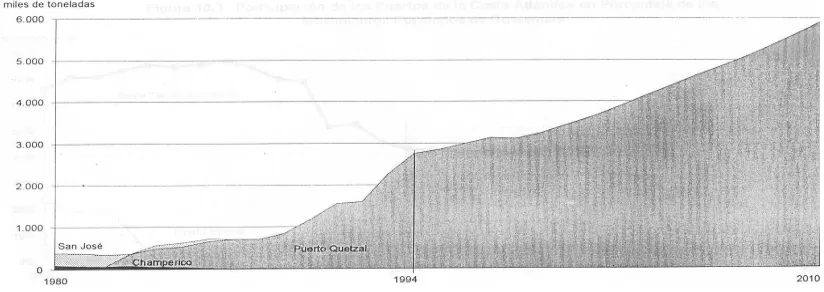
Having said this, the author will present why the above mention maritime activities are important for the economy of the country. First the commercial port activities in Guatemala are extremely important for its economy. The import and export of goods are done through the different Guatemalan ports located in the Atlantic Ocean (Port Santo Tomas de Castilla and Port Barrios) and the Pacific Ocean (Port Champerico, Port San Jose and Port Quetzal). These ports are de-centralised companies and are administered by different Ministries, creating jealousy and the fear of losing power between them. This does not allow the country to have a real national maritime economic port policy and strategy. However the government has made some effort to correct this by creating the National Port Commission which in charge of co-ordinating the national port commerce policy. Unfortunately this policy has not been created because this Commission is not working in a proper way resulting in a poor national management of the port commerce (for more details about Guatemalan ports see Appendix A).
vessels. These elements (ports/vessels/cargo) if they are not regulated, controlled and supervised, can cause accidents, causing severe damage to the docks in the ports, at the same time fires, explosions of dangerous cargo and oil spills. The end results are having an environment not safe or secure enough to avoid the loss of human life, damage to private property and pollution to the environment. These accidents have happened in the Guatemalan ports many times, resulting in a lot of calamities and this is damaging and de-stabilising to the national economy. Lets look at the following information to determining the quantity of ships and cargo handled by the national ports. At the same time this is a clear indication of the great danger that is there every day in the port areas, if Guatemala does not implement a maritime safety administration to regulate, control and supervise maritime activities. In 1999 for example the national ports handle more then one thousand seven hundred vessels, the majority of which were cargo, liquid, bulk, gas and passenger vessels. These vessels exported and imported more then one million metric tonnes of different cargo. It is important to show the statistic in the great increment of containers that have been handle in Guatemala from the year 1996 to the year 1999 (statistic see Appendix A).
Figure 2 Guatemala's Development of the Ports in the Atlantic Coast
Source: CONSORCIO (1997)
Figure 3 Guatemala's Development of the Ports in the Pacific Coast
Source: CONSORCIO (1997)
The author would like to add some important information in relation to Lake and Fluvial Traffic in Guatemala. At the national level it exists but is used more for tourism than for local transport of goods and passengers on board small vessels, boats or recreational crafts. The problem is that these activities are not regulated it all, provoking many incidents resulting in tragedy to human life, property and the environment. In relation to Guatemalan exterior commerce, lake and fluvial transport does not have any relevant importance. At the present time there is no important volume of traffic that can be taken into consideration (for a more detailed description of the problems of lake and fluvial traffic in Guatemala see Appendix B)
2.1.3 Guatemala's natural resources (living & non-living)
The natural resources in the maritime jurisdiction are important for Guatemala, because they are very rich. Guatemala is not taking advantage of this privilege for the better of its people and for the development of its economy. In regards to this matter it is important to first recognise that Guatemala’s economy is based on agriculture, mining, industry and manufacturing. This is due to the traditional negligence of the maritime opportunities by Guatemala as a whole. For example, one cannot forget that Guatemala’s inland waters, lagoons, and the bordering seas contain abundant supplies of marine life. This incredible natural resources that Guatemala posses in its marine jurisdiction are not been well manage and regulated. The present regulations are to weak and therefore allow others, not only some nationals but foreigners, to illegally and undiscriminatorily explore and exploit these resources and pollute the country's marine environment. This is another major reason why Guatemala shall implement the GMSA so it can advise the government and regulate, control and supervise these activities. The GMSA will also promote and provide the necessary advice to the government and the public in general to manage and develop these natural resources and in consequently develop the country's economy.
Pacific Ocean. In fact 40% of the world's harvest of finfish comes from it" (Pernetta, 1983). "Guatemala also has Hydrothermal vents which are very rich in minerals and mineral smoke with nutrients that give life" (Preston, 1999). (Jagota, 1999) indicates "that where the tectonic plates meet, Guatemala has very rich Polymetallic Sulphide and Cobalt Crust banks, which are extremely rich in gold, worth billions of dollars, and is also very rich in other minerals". This position is reinforced by (Mann, 1999) which also indicates that "the abundant on the sea-bed may constitute a major source of energy for the next century - or may destabilise the sea floor, causing land-slides and broken cables, and also emitting methane, a greenhouse gas ten times as effective as hydro dioxide". Guatemala is also very rich in oil and gas resources in its maritime jurisdiction. Recently a tremendous amount of these resources was discovered, approximately 7 million of tons annually could be exploitable (Kontorovich, Sam et al, 1999). Also natural gas resources are found along the coasts of Guatemala, Nicaragua and Honduras. The author will refer to Honduras later. These resources alone are enough to make Guatemala a very rich country, therefore potentially making it a developed country which can meet the social needs for its society. A GMSA could be in charge of making the necessary national surveys and scientific studies in order for the country to exploit these resources for the good of the economy.
the water by production in the region of maritime-coastal, lost of the coastal forest, pollution by toxic wastes and industrial emission and pollution by solid wastes.
Guatemala has unlimited possibilities to develop economically by taking advantage of its natural maritime resources which were described above. But due to the ignorance and lack of interest on the part of its people in general it can lose these resources if it does not implement a policy of sustainable development. Also because under UNCLOS Convention it is stipulated that each country shall limit its Continental Shelf with a hydrographic survey and scientific research of the area. According to UNCLOS if a country does not do this, another country can do it and make a legal claim over this area. It is of national importance that Guatemala implements its maritime safety administration so it can deal with these matters, for the good of the country's economy and as a whole.
2.1.4 Current geopolitical situation
For the past 39 years the Central American (CA) Region and Mexico have been involved in useless civil wars, occurring mainly because of the major conflicts that occurred between the super powers (cold war). The developing countries, especially in CA were a battle zone for these super powers. Once the hostility between the super powers decreased the countries in CA managed to put an end to these terrible conflicts by signing peace treaties. Mexico is the only neighbouring country that presently has small scale, but nevertheless an active civil war. This situation tremendously damaged the social conditions and economies of the CA countries, at the same time it directed away the attention of the normal management of the country at a national and international level by the government. One of these international matters, which the countries in CA have not paid attention, is the de-limitation of the maritime jurisdictional boundaries among them.
Nicaragua said that this took away from then 130,000 km2 of maritime jurisdiction in
the Atlantic Ocean. Also Honduras just on March 21 of this year in a Decree, which is much more favourable for them. Honduras declares with out any diplomacy intervention the maritime boundaries between them and Guatemala. In the Golf of Fonseca which is shared by Nicaragua, Honduras and El Salvador sometimes peace looks very fragile. At the moment none of the conflicts have escalated in a war situation, however the diplomatic intervention has not been the adequate or none it all. Guatemala has limit problems with its maritime boundaries with Mexico, Belize, El Salvador and Honduras that was mentioned above. However with Belize the problem is much worse (for more details see Appendix D).
Guatemala has four neighbouring countries as was specified above (see Figure 1), and at the present time Guatemala has not signed any maritime boundary treaties with its neighbours. The country has good relations in general with all neighbouring countries, with the exception of Belize, because Guatemala is claiming 12,272 km2
Guatemala must pay attention to the signing of maritime boundaries with its neighbouring countries. If the government does not take this matter more seriously, Guatemala is going to lose maritime jurisdiction over water which is very rich in living and no-living natural resources in the Pacific Ocean, and in the Atlantic Ocean even exist the possibility of losing its exit to the sea as well as the living and non-living natural resources.
2.2. Present situation of the agencies that manage the maritime sector
The Guatemalan situation is that all the activities that are executed in the coastal and maritime zones are under the control of different Ministries, which possess inside its organisation entities that have some relation with the Maritime Authority. In Guatemala, maritime matters have not had the priorities that they deserve and the concerned Ministries also have to deal with many other non-maritime matters due to the simple fact that these affect the common man on a day-to-day basis. For example, it is common in many countries to make the Ministry of Transport or Communications responsible for maritime matters. In such cases the ministry is naturally pre-occupied with matters pertaining to road transport or the telephone/wireless services, instead of focusing on maritime activities and matters. As a result Guatemala does not have a real control of maritime activities and does not have the proper legal bases to regulate maritime matters in its maritime jurisdiction.
Figure 4 Existing Guatemalan In-formal Maritime Safety Administration
Source: Nowell P. (1999)
2.2.1 The Ministry of Defence (Within it the Navy):
Within the organisation of the government, the Armed Forces are found located in the National Ministry of Defence reporting directly to the President of the Executive branch. The Constitutional President of the Republic, according to the present political constitution, has the functions of General Commander of the Armed Forces.
Also by what is specified in the “Political Constitution of the Republic of Guatemala”, the Armed Forces have received the name of “Guatemalan Army” and consist of three forces: land, air and sea. The Navy has a very clear concept of the importance of Guatemalan maritime jurisdiction. It handles maritime control and safety through the legal use of a series of constitutional articles, presidential decrees and regulations, congressional laws and decrees and ministerial decrees and regulations and international conventions. In order to execute its actions in the maritime jurisdiction it can guarantee the development of the country’s maritime interests, the most important being the following:
Port Quetzal Company Port San Jose Company Port Barrios Company (COBIGUA) Railroad Company FEGUA National Environmental Committe Executive Secretariet Committees Ministry of Foreign affairs
Army Air Force
Port Captain P. S.T. Castilla
Port Captain P. Barrios Port Captain Livingston Atlantic Naval Base Port Captain P. Champerico Port Captain P. San Jose
Port Captain P. Quetzal Pacific Naval Base Naval Officer/Sealords Education Merchant Marine & Fishing
Education Hydrographic & Oceonographic Department Naval Acadamy Navy Armed Forces Commander Chief of Staff Ministry of National Defence Port Champerico Comapany Ministry of Finance Port Santo T. de Castilla Company
National Port Commission Ministry of
Transport & Public work Ministry ofEnergy And Mines National Direction of Quarantine National Direction for Fishery Ministry of
Agriculture Minstry ofHealth
General Direction of Customs General Direction of Enmigration Ministry of Interior Executive Power
Article 142: Of the Constitution of the Republic of Guatemala: The state exercises full sovereignty over:
a. Its territory integrated by its soil, subsoil, interior waters, territorial sea, in the extension that is fixed by the law and in the aerial space that extends over the same.
b. The Contiguous zone of the adjacent sea to the territorial sea, for the exorcise of determine activities by the international law; and
c. The natural resources (living and non-living) of the maritime soil and subsoil and of the existing in the adjacent waters of the coast out side the territorial sea, which constitute the exclusive economic zone, in the extension promulgated by law, with compliance with international practice.
Article 244: The Guatemalan Army is an institution designated to maintain the independence, the sovereignty and the honour of Guatemala, the integrity of its territory, the internal and external peace and security.
Decree 20-76 of the Congress of the
Republic-Article7: In the Guatemalan delegations to the conferences that are related to maritime matters it will assist, in the quality of delegate, a qualified officer of the Naval Defence Force.
Article 8: The Armed Forces will be in-charge of guarding the rights of the Republic over its territorial sea and over its exclusive economic zone.
Decree of 21 of April of 1939, regulates the authority of the Port Captain of the Port, and the registration and certificates of vessel and crafts, Certificates of competence for Officers and Crews, Prevention of Pollution, and others matters related to maritime affairs.
Guarantees the promotion of the development of the Guatemalan maritime interests.
Comply and enforce the international maritime treaties and conventions sign and ratified by Guatemala.
Effectuate operations of fiscal control, immigration, and sanitary in the territorial sea, contiguous zone and exclusive economic zone.
Effectuate control of the restricted fishing periods and species in extinction in the territorial sea, contiguous zone and exclusive economic zone.
Effectuate the control of the contamination/pollution of the maritime environment.
The preservation of human life at sea.
Maritime administration.
Maritime security.
2.2.2 The Ministry of Communications, Transportation and Public Works The ports are autonomous state companies, decentralised, with their own judicial personality, is loosely tied to the executive power is through the Ministry of Transport. The ports count with the organisational structure that more likely tend to increased the efficiency of the activities carry out, through its head units like the Board of Directors, Directorate, Sub-Directorate, of administration units like the Internal Audit, Port Development, Secretary General, and Judicial Advisory, and of operational units like the Departments and Section that conform the company.
Each port's administrative management is responsible for the operation, maintenance and repair of the port, aids to navigation, docks, equipment for the operation of the port (own or lease to a private company.), docks, storage facilities (most owned by or leased to a private company.), tug boats (leased to a private company.), utilities for the ships; and the pilot service which is in concession to Naval Officers.
Transport. However, in reality this Commission does not function properly. This is due to the government's political un-willingness to give the corresponding backup and the necessary resources. At the same time, the different Boards and Directors of the National Port Companies do not accept or even try to work with this Commission in a more serious and professional manner, because of the mentality that they would then lose power over their port.
At this point it is important to point out that the ports are managed by civilians and not by military personnel. This is a law, written under the Political Constitution of the Republic, which indicates: "Article 131: The land terminals, airports and commercial maritime ports, are consider goods of common public used and as well as the transport services, are only subject to the jurisdiction of the civil authority".
It is externally important for the good of the country's economy that a maritime administration been created, so it can deal with the port and shipping police of the country. This administration should of course be created under the jurisdiction of civilians, since it is mandated by the Constitution of the Republic as mentioned above. However, the maritime safety administration should be under the jurisdiction of the Ministry of Defence as it was described above. The difference of a maritime administration and a maritime safety administration will be describe more specifically later in this chapter.
2.2.3 The Ministry of Finance
2.2.4 The Ministry of Energy and Mines
The Ministry of Energy and Mines is the one in-charge of the control and management of the licensing of exploration and exploitation of the non-living resources of the country, including both on land and sea resources also. The problem is that this Ministry does not have the adequate technical personnel to advise it in maritime matters. Therefore it is giving licences with out making the necessary scientific studies or surveys to protect and preserve the maritime natural resources.
2.2.5 The Ministry of Health and Social Wealth
Every time a ship docks in a Guatemalan port the Ministry of Health and Social Wealth designate a doctor to go on board together with the Port Captain to make the official inspection. This is done in order to check the physical and mental state of the crew and the possibility of any contagious disease. It relies on the assistance of the Port Captain to solve any problems on board.
2.2.6 The Ministry of the Interior
The Ministry of the Interior has under its responsibilities the General Directorate of Customs, which is in charge of the fiscal exports and imports of the country. Also it is responsible for the General Directorate of Immigration, which deals with illegal and legal immigrants of the state.
2.2.6.1 The General Directorate of Customs
The General Directorate of Customs is the agency in-charge of verifying that the taxes on importation and exportation of merchandise are paid, in land border station, the airports and the commercial ports, but it has delegated some responsibilities to the Navy in maritime matters as mentioned in the Custom's Code (Decree 20-64 of 1964).
leaving that do not complied with legal matters, give the necessary assistance of salvage to vessels in the coast, provide to Customs any observations to have a better service.
2.2.6.2 The General Directorate of Emigration
This controls the arrival and departure of emigrants by land, air and sea. The Port Captain in each Pacific Port is also the emigration authority. In the Atlantic Ports, at the present time, exists a representative of this agency that takes care of emigration matters. The Directorate of Emigration works very closely with the Navy when it comes to co-operation between the two organisations. The Navy has captured many illegal immigrants, mainly from China and Ecuador at the present time, which use the sea to try to reach the U.S.A., it works also together with this agency in relation to stowaways on board vessels.
2.2.7 The Ministry of Foreign Affairs
This Ministry is in charge of dealing with all international matters, especially with regards to treaties among other governments and international organisations. They are the ones that at the present time deal with maritime conventions, treaties and agreements. As it was mentioned before in Decree 20-76, the Navy is the agency that should represent the government when it comes to maritime matters. Nevertheless this Ministry is also involved, so a better co-operation should exist between these two organisations, which at the present time is not happening. International maritime conventions are being analysed and ratified by this Ministry, even though they do not count with technical personnel that have the necessary knowledge on these matters. Also the information is not passed on to the Navy, to the extreme that the Conventions are passed and the Navy does not know anything about it.
2.2.8 The Ministry of Agriculture
2.2.8.1 The General Directorate of Fisheries
The General Directorate of Fisheries controls fishing and fishing licences, but in order to enforce its policies and controls in the lakes, rivers and at sea, it delegates this responsibility to the Navy to accomplish its mission. This Directorate does not have the resources (equipment/personnel) to do the proper job and this is why the Navy provides them with the necessary co-operation.
2.2.8.2 The General Directorate of Quarantine
The General Directorate of Quarantine verifies that the goods that have been imported are not infected or contaminated. In the ports and sea, it also relies on the Navy to help them when they need it, since it does not count with the necessary resources (Ships, helicopters, vehicles, others.)
2.2.9 The Guatemalan Railroad (FEGUA)
FEGUA is a de-centralised agency that works directly under the Executive Power. which is in charge of the management of Port Barrios (leased to a company called COBIGUA) and Port San Jose; the last one has the same infrastructure conditions as Port Champerico. FEGUA its self is going through a very precarious time, as the railroad system in Guatemala is a total disaster at the present time.
2.2.10 The National Commission for Protecting the Environment (CONAMA) The law for the protection of the environment was passed in the Decree No. 68.86 of the Congress of the Republic. This law delegated this responsibility to CONAMA, in the following:
Chapter II, Article 20: It is created the National Commission for Protecting the Environment, is a governmental organisation that depends directly from the Presidency of the Republic, and its functions is to advise and co-ordinate all actions for the formulation and application of the national politics, for the protection and for the better of the environment, providing it through the corresponding Ministries, General Secretary of Economic Planing and decentralised agencies, autonomous, semi-autonomous, municipalities and the private sector of the country."
resources, knowledge and trained personnel to carry out maritime environmental activities. CONAMA depends on the Navy to manage the maritime environmental control/supervision of the navigable lakes and rivers or the coastal and sea activities.
2.3 Analysis of the present situation
Based on the information presented in this Chapter it can be said that the Republic of Guatemala is a maritime country since it has access to two oceans and it has commercial ports on both sides. Also it is a very rich country in natural marine resources, which can be lost if Guatemala does not establish its borders of maritime jurisdiction, with its neighbouring countries. Today in Guatemala a number of institutions deal with maritime matters; however these institutions do it in an informal way. Guatemala as a maritime country needs to restructure and organise its institutions so they are more oriented to deal with maritime activities in a more formal and progressive way.
The problem starts with the lack of political will and knowledge of the politicians that administer the country, and also the national agencies and private industry that are involve in maritime affairs do not have enough knowledge and equipment to handle these important situations. Therefore it is necessary to correct this problem, by centralising the maritime matters in the hands of the governmental entity that since the date of its foundation has executed this mission, even though it has done it with a maritime legislation limited in foundation. This would be the Ministry of Defence that, through the country’s Naval Force, has been much more active then others in handling the Guatemalan maritime safety administration.
early stages of development, can be said to have the advantage of creating pre-planned structures and functional approaches, provided that all concerned have proper understanding of the objectives, criteria and functions.
Vanchiswar P. S. (1996) differentiates the two as follows:
Maritime Administration: Are the functions that have to be assigned to it government’s overall maritime (development) policy and duly reflected in its maritime legislation. (Maritime Development policy = Shipping policy: It is stated mostly by economics, Shipping policy may be defined as a totality of economic, legal and administrative measures by which the state influences the position of its fleet in the national economy and in the international freight market.).within the framework of the
Maritime Safety Administration: Is the specialised executive arm of a maritime government, irrespective of whether it is a develop country or a developing country, to implement or enforce the regulatory (and allied) functions embodied in the national maritime legislation, especially those pertaining to registration of ships, maritime safety, marine personnel, maritime casualty investigations and protection of the marine environment.
Taking the above definitions into consideration it is the opinion of the author that in Guatemala a formal maritime safety administration should be created in the Naval Force under the Ministry of Defence, and also a separate maritime administration, under the Ministry of Transport. However, since the author is studying a Master's Degree in Maritime Safety and Environmental Protection, this paper will only deal with implementation of the maritime safety administration, taking as models the MSAs of Chile, the United States of America and Sweden; in order to come to a conclusion, the author will make a suggestion of how the maritime safety administration shall be implemented in Guatemala. Taking also into consideration the maritime safety administration that already exists in the country and what can be implemented based on the cultural, social, geographical, political and economic matters, as well as three examples of maritime safety administration.
countries one can say that the Chilean maritime administration, officially known as the General Directorate of the Maritime Territory and the Merchant Marine (DIRECTEMAR), is the one that has developed more at the national and international level in its maritime activities. The DIRECTEMAR works under the Ministry of Defence, specifically under the Chilean Navy.
In North America the United States of America has delegated the responsibility of promoting maritime safety to the United States Coast Guard (USCG). The USCG carries out its missions under a full military structure, but operates under the Ministry of Transport in peace times. However, in times of conflict it operates directly and fully under the Ministry of Defence as a specialised service within the U.S. Navy.
CHAPTER THREE
EXAMPLES OF SUCCESFULL MODELS OF MARITIME SAFETY ADMINISTRATION IN: SOUTH AMERICA, NORTH AMERICA AND EUROPE
This Chapter will present three typical models of maritime safety administrations, each alike in some ways and thus unique in other matters. A description of these administrations will be presented, mainly their general aspects, missions, dependency, organisation and ambits of action. These are important matters to understand, because they give a very good idea of how each country is managing its maritime safety administration. As a result of this detailed description of each administration, comparisons will be made between then. These administrations will be those of Chile, the U.S.A. and Sweden. They will be compared in order to come up with applicable conclusions and recommendations for the implementation of the formal Guatemalan Maritime Safety Administrations in Chapter Four.
Chile has been chosen as the first example because out of all the maritime countries in Latin America, it has been by history, tradition and trade a maritime country. This has given Chile the power to promote and develop its maritime activities to an exceptional potential, putting Chile in the leadership of Latin American countries in the way it manages its maritime economy and activities at a national level and at the international level in IMO/ILO.
document, from the author's point of viewed, will demonstrate that nothing is wrong with having a maritime safety administration under the Ministry of Defence.
The next administration that will be presented is the United States Coast Guard (USCG) which works under the Ministry of Transportation but is managed by a full military arrangement. The USCG is the leading maritime safety administration in the world with more then 200 years of maritime history. As a matter of fact, it is the only one that has major operations of its mission all over the world. Its capabilities in resources and personnel are enormous in order to cover and guard its huge maritime jurisdiction and international missions that it has to perform. In fact this unique administration in times of war passes under the Ministry of Defence. Comparing the way this agency works to how Guatemala can manage its maritime affairs, it looks very promising, but the problem is that Guatemala is a developing country and cannot afford the same luxury as the United States of America in having both a Navy and a Coast Guard for, jurisdictional, social reasons, economical and for maintaining the strategic balance of power in the region.
the best points of each and implement then in Chapter Four for Guatemala were applicable.
3.1 The Chilean General Directorate of the Maritime Territory and the Merchant Marine (DIRECTEMAR).
3.1 1 General aspects:
Due to its essential maritime geographical condition in the South American continent (see Figure 5), Chile uses, for its development and subsistence, as much use of maritime ways, exploration and exploitation of the maritime resources, as optimally possible on its jurisdiction (see Figure 6). When comparing the success of Chile's maritime economy, one can conclude from the information given in the previous chapter that Guatemala is limiting its economy by not doing the same development of its maritime resources and activities as Chile has so well.
Figure 5 Chile's Geographical Position Figure 6 Chile's Maritime Jurisdiction
Since the middle of the 19th century its original Navigation Law has governed the maritime authority in Chile. At the time it was created, responsibility for the registration of vessels was granted to the Commanding General of the Navy; who works under the Ministry of Defence (see Figure 7). In contrast to Chile, Guatemala, a Central American nation, does not have such a long maritime history due to historical reasons. Nevertheless, Guatemala implemented the "Decree of 21 of April of 1939" for the Port Captain regulations, which delegated the same responsibility as above to the Guatemalan Naval Force. Again, for historical reasons (cold war), the Navy did not have the government's political willingness or the support necessary to develop ship registration like Chile has done so well.
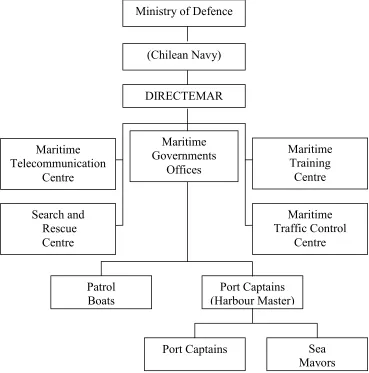
Figure 7 Chile’s DIRCTEMAR Organisation
Source: Böke R. (1993)
Maritime
Telecommunication
Centre
Ministry of Defence
(Chilean Navy)
DIRECTEMAR
Patrol
Boats
Port Captains
(Harbour Master)
Search and
Rescue
Centre
Maritime
Traffic Control
Centre
Maritime
Training
Centre
Maritime
Governments
Offices
Port Captains
Sea
The Maritime administration in a Chile has a de-centralised organisation. Its maritime jurisdictions are divided into 205 Maritime Municipalities, 56 Port Captains Office, 16 Maritime Governor Offices and the central headquarters is known as the General Directorate of the Maritime Territory and the Merchant Marine DIRECTEMAR (see Figure 8). Up to today DIRECTEMAR is responsible for the administration and control of the merchant marine of the country. As a matter of fact, there is some resembles in how both Chile and Guatemala has Port Captains in each port although Guatemala does not have a central headquarters. The lack of leadership has left maritime matters in Guatemala without guidelines or a clear policy to be followed. It is like a compass with out a heading. Chile on the other hand has well distributed its maritime authority in its national maritime jurisdiction with one central headquarters that puts a heading on the compass.
Figure 8 Chile's DIRECTEMAR Governors Offices
The DIRECTEMAR's activities have their legal basis in numerous laws, acts, degrees and international conventions dealing with the maritime area from navigation to fishing and from wrecks to carriage of cargo (list see Appendix G). In addition, when comparing Chile to Guatemala a clear disproportion of national regime and international conventions ratified by Guatemala exist (see Appendix E). At the present time, the national regime of Guatemala is too weak and the international conventions are not implemented it all. Guatemala needs to address this problem of the lack of legal regime in order to protect and develop its maritime interest and at the same time can motivate the development of the economy, as well as Chile has developed theirs.
3.1.2 Mission
For the purpose of this exercise, the functions of the national maritime authority, the DIRECTEMAR, is responsible for: “Safeguarding the safety of maritime navigation, fluvial and lake traffic; for the protection of human life in the sea, rivers and navigable lakes; for the goods and resources of the national maritime zone, its coasts and shores; as well as the protection of the national maritime interest. With the purpose of contributing to the development of the maritime power of the country” (http://www.directemar.cl.html).
In order for the DIRECTEMAR to accomplish its mission, it have a well-structured organisation (see Figure 9). When analysing Chile's DIRECTEMAR's mission with Guatemala, the Navy is similar but, the problem in Guatemala is that as it was mention before there is no formal maritime safety administration, given as a result no organisational chart like the one Chile has.
3.1.3 Dependency:
The DIRECTEMAR comes under the direct supervision of the Commandant in Chief of the Navy without prejudice to the autonomy to which the DIRECTEMAR is entitled in its decisions in aspects express and defined in its organic legislation.
Navy, in reference to equipment/material, and of the General Personnel Directorate of the Navy, in relation to its personnel. With reference to the national merchant marine, safety of human life at sea and control, security and discipline within the specific maritime jurisdiction of its Organic Law, DIRECTEMAR, enjoys autonomy in its decisions. When comparing the dependency of DIRECTEMAR in Chile with Guatemala, one has to remember that even though it does not have a formal maritime safety administration like Chile's, it does have, in an informal way, a maritime safety administration within the missions of the Guatemalan Navy. Guatemala can apply the same concept of dependency to a formal maritime safety administration like Chile has through it's Navy. All it needs is the governmental, political, and internal ministerial back-up, and as the result it will get a stronger legal regime to attend the maritime matters like Chile does.
3.1.4 Ambits of action
Valenzuela (1994) wrote that, in the accomplishment of its mission, the DIRECTEMAR fundamentally performs the following eight ambits of action:
Maritime safety
Protection and safety of human life at sea
Preservation and protection of the maritime environment
Maritime control, security and discipline
National merchant marine, including fishing, tourist and recreation activities
Maritime representation of the Chilean state
Maritime interests
Naval operative support"
3.1.4.1 Maritime safety
This ambit of action is considered by DIRECTEMAR at its most relevant, and it is because of this concept that the national maritime authority exists. Through the different services organised under it, the DIRECTEMAR promotes the safety of navigation, human life, port activities, maritime industries/infrastructures and merchant vessels; fishing boats and sport craft. With the final purpose of permitting the safe present of man at sea, minimised the impact over the maritime environment and to contribute to the effective and rational occupation. As well as avoiding any type of loss or damage. It is divided in the following way (see Figure 10):
Maritime Safety
Figure 10 Maritime Safety Ambit of Action
Source: Gracia L. (1999)
• Port and maritime personnel staff:
– Training (maritime personnel)
Training that is given by the DIRECTEMAR, results in qualified and trained officers and seamen for the merchant marine vessels and special vessels, under the umbrella of maritime international standards (STCW/95), in the Maritime Centre
Institute and the Naval Academy. DIRECTEMAR does this by demanding high standards of performance, creating an ideal professional for the maritime personnel. Its main purpose is to accomplish its efficient performance especially when it comes to safety aspects.
– Professional qualification
This is done by the DIRECTEMAR, by determining, maintaining and approving the general orientations of the study programs in the area of prevention of risk and maritime safety, which are derived the corresponding professional standards, even if these courses are thought by civilian public and private organisations. Therefore DIRECTEMAR can control the quality of knowledge professional studies of the personnel that work on board merchant ships, fishing ships, tourism/recreational ships and the rest of the personnel in maritime ports. Once seafarers have complied with the requirements asked by DIRECTEMAR, they can receive their certificates, licences and matriculations; which permits them to develop their respective maritime duties.
• Navigation
– Maritime traffic control
Chile has a computerised system that allows the administration to know the position and destination of all vessels at all times: in jurisdictional waters = vessels from all flags, in foreign waters = Chilean vessels, in total + - 11,000 vessels. It constitutes the basic function to support any activities which have to be done over any ship, for safe navigation, maritime search and rescue, maritime police or for the protection of the maritime environment. For its operation in real time, it has an online computerised system covering the whole country.
– Aids to navigation
system complies with the international norms recommended by the International Association of Light House Authority (IALA) and the I.M.O.
– Pilotage
This is the pilot service offer by DIRECTEMAR, involves providing highly experienced pilots of great experience to professionally advise the national and foreign merchant captains, in navigation through channels and in manoeuvres executed for the docking of vessels in the national ports.
– Maritime communications
DIRECTEMAR exercises technical and administrative control on the communication network for the private maritime industry network including shipping, fishing and sports; regarding the use of assign frequencies, procedures to follow, types of emission and fees for charge. It provides the service of public and official mail from and to the vessels in any part of the world. It divulges weather reports and information publishing the notice to mariners. It also supports, with communications, the Maritime Search and Rescue Service.
• Maritime ports and terminals
– Inspection and prevention of risks
As the highest maritime authority and in consequence with the Maritime Safety Policy, DIRECTEMAR carries out this technical service, for the prevention of accidents on board vessels, arriving in ports, industries, terminals, fishing, sports and other maritime activities. This task is of normative and executive character in its compliance with its resolutions. Some of the inspections and risk prevention done are with port workers, accidents of the personnel, commercial ports, specific and general docks, solid/liquid bulk terminals, sites/docks for fishing, sport craft and docks, and ramps.
– Survey and certificates
crew that work on board. Some of the inspections done are those for crew documentation, vessel hull inspection, structure and engine, safety appliances on board, the conditions of the cargo on board and the communication equipment.
3.1.4.2 Protection and safety of human life at sea.
This ambit concentrates all those activities done by the DIRECTEMAR for the rescue and saving of human life that is in danger at sea are on navigable lakes and rivers with its national jurisdiction. It also include security on the littoral beaches and bathing resorts (see Figure 11).
Protection and safety of the human life at sea
Figure 11 Protection and safety of the human life at sea Ambit of Action
Source: Gracia L. (1999)
• Maritime search and rescue
The rescue and protection of human life at sea, is obtained through adequate actions of “maritime search and rescue”. The DIRECTEMAR have its own or private resources, for reaching the location of the maritime calamity and for the saving of human life in peril. This service operates through five centre zones that have available adequate floating, air and land resources as well as maritime communication resources. Any maritime calamity or accident shall be analysed and evaluated, with the purpose of eliminating the causes that originated it and for perfecting their search and rescue procedures.
• Safety in beaches and bathing resort
A plan named “Civil Protection Plan for Beaches and Bathing Resources” is activated annually all along the littoral, from the 15 of December to the 15 of March. This plan's purpose is to provide protection and safety at the beaches and bathing resources during the summer time.
Maritime Search &
Rescue
3.1.4.3 Preservation and protection of the maritime environment.
For the purpose of contributing to the preservation of the maritime ecosystems. DIRECTEMAR, is oriented to keep vigil over the quality of the maritime environment at sea all along the coastal littoral, and at ports, bays, rivers and lakes; which are navigable in the country. It minimises its risk conditions, through the prevention, control and combat of contamination and pollution (see Figure 12).
Preservation and Protection of the maritime environment
Figure 12 Preservation and Protection of the maritime environment.
Source: Gracia L. (1999)
• Control and combating of contamination and polluting spills
The DIRECTEMAR grants this service; which consists of actions designated for the preservation of the environment from pollution and from spills of any kind of noxious substance to the maritime ecosystem. In the case of an existing spill, DIRECTEMAR will combat it and control it. For this operation, DIRECTEMAR has five principle centres all along the littoral of the country; it has qualified personnel and all the necessary equipment to confront any emergency. At the same time DIRECTEMAR has establish a National Contingency Plan, which have special personnel and equipment for the combating of any contamination.
• Evaluation of the impact to the environment
The DIRECTEMAR has established norms related to the evaluation of the impact on the environment. It is based on the Navigation Law, Title IX, which is the national principal legal body about the maritime environment. The Title IX is the superior maritime authority norm regarding contamination produced by the industries and coastal cities that spills its residues along the littoral. It is the minimum program of evaluation of the impact on the environment, established by the DIRECTEMAR Resolution (Ord. 12.600/500 of 21 August 1987). The Rules of Contamination
control/combat contamination polluting spills
Observation over the littoral
environment Evaluation of
recently approved and published in the D.O. No. 34419 of 18 November 1992, gives the power to the maritime authority the action to supervise, control and sanction any environmental pollution.
• Observation over the littoral environment
The Plan for Observation over the Littoral Environment was created in 1989 by the DIRECTEMAR. The objective of these plans is to know the base level of concentration of the principal contaminates which enter the sea in a chronic or persistent form. This plan allows the DIRECTEMAR to take effective preventive measures; besides permanently evaluated the state of contamination of the bodies in the water, under the jurisdiction of the maritime authority.
3.1.4.4 Maritime control, security and discipline.
The objective of the Maritime Control, Security and Discipline is to establish the order, security and discipline in those activities that are being done in the jurisdiction of the maritime authority with the purpose of contributing to its harmonic development, foment the maritime interest and to minimise the risks to the safety in Chile's jurisdictional maritime area.
At the same time, the maritime authority in its role of public authority in the maritime-ports ambit also considers the control and supervision of the fiscal goods and of the norms that regulates the development of maritime activities through the exercise of the Maritime Police. With the purpose of establishing and maintaining the order in its jurisdiction (see Figure 13).
Maritime control, security and discipline.
Figure 13 Maritime control, security and discipline Ambit of Action
Source: Gracia L. (1999) Maritime
Police
Supervis./Control Marit. Normative
and Activities Supervision and
• Maritime police
The Maritime Police is an essential instrument for accomplishing the mission of the DIRECTEMAR. The Maritime Police are in charge of safeguarding the national goods and resources within Chile's maritime jurisdiction. The Maritime Police also prevent contraband/smuggling, illegal traffic of drugs and emigrants, as well as maintaining the protection, control and supervision of property and human life at sea along the littoral and in the port areas. In regards to this ambit of action the Maritime Police work in coordination with the Customs, Emigration, Police and other governmental agencies involved in these matters.
• Supervision and control of the fiscal goods
Action oriented to guard the national goods and resources that are within maritime jurisdiction. It contemplates the administration of the fiscal goods and the super vigilance of fishing activities through coordination with other fiscal organizations.
• Supervision and control of the maritime normative and activities
It’s the exercise of the regulations of the Superior Maritime Authority. It's principal functions are:
Control and fiscal compliance of the maritime normative establish by the state of Chile
Control of the ideal maritime personnel, that carry maritime activities
Sustanciate administrative summaries in case of maritime accidents and catastrophes
Sanction faults of professional character, of order, safety and discipline, occurring in maritime duties and port duties, and impose fines when ever necessary