World Maritime University
The Maritime Commons: Digital Repository of the World
Maritime University
World Maritime University Dissertations
Dissertations
2000
Towards a better understanding and development
of the Colombian shipping management policies
Leonardo Chaves Rodriguez
World Maritime University
Follow this and additional works at:
http://commons.wmu.se/all_dissertations
Recommended Citation
Chaves Rodriguez, Leonardo, "Towards a better understanding and development of the Colombian shipping management policies" (2000).World Maritime University Dissertations. 103.
WORLD MARITIME UNIVERSITY
Malmö, Sweden
TOWARDS A BETTER UNDERSTANDING AND
DEVELOPMENT OF THE COLOMBIAN
SHIPPING MANAGEMENT POLICIES
By
LEONARDO CHAVES RODRIGUEZ
Colombia
A dissertation submitted to World Maritime University in partial fulfilment of the
requirements for the award of the degree of
MASTER OF SCIENCE
in
SHIPPING MANAGEMENT
Abstract
Title of the Dissertation: Towards a Better Understanding and Development of the
Colombian Shipping Management Policies.
Degree: MSc
The dissertation is a brief study in the usage of the past protectionism mechanism
practice in the Colombian shipping sector and the impact of the entrance of the open
and free market economy in this industrial sector.
According with this increasing expansion and development of the global shipping
market and the constant changes in the structure of the shipping activities; a brief look
and evaluation of the advantages and constraints of the different international shipping
management strategies, i.e. consortia, partnership, alliances, mergers and acquisitions
are present in order to apply their corporate benefits in the national shipping Industry.
The Explanation of other multiple benefits in the application of current shipping
environment strategies, i.e. Marketing, quality assurance, outsourcing, benchmarking,
logistics and multi-modal services, are part of the study in order to support and enhance
the corporate objectives of the national shipping companies.
Additionally, in the concluding chapters a development plan to maintain and developed
the fleet and a summary of the principal benefits in the application of the international
shipping strategies are presented with the aim of speed up the national shipping
industry and maintain the operation of the current national shipping companies involved
in the international seaborne trade.
KEYWORDS: Marketing, quality assurance, outsourcing, benchmarking, logistics,
Table of Contents
Declaration ... ii
Acknowledge ………. iii
Abstract ... iv
Table of contents ... v
List of tables ... viii
List of figures ... viii
List of abbreviations ... ix
1. Introduction... 1
2. Colombian Maritime Transport Framework 2.1. Shipping Industry Background in Colombia... 5
2.2. Fleet with national Flag.... 9
2.3. Maritime Shipping Products. ... 10
2.3.1. Why the need of a fleet? ... 11
2.4. The freight Market. ... 12
2.5. The Scrapping Market... 13
2.6. Labour Framework... 14
2.7. Shipping Protectionism Economic policy Protection Mechanisms... 16
Cargo reserve ... 16
Tax exemptions... 17
Collect Freight Payment... 18
Tributary exceptions.... 18
2.8. Shipping industry break down process... 19
2.9. Open Economy Policy... 21
3. Analysis of shipping environment in a global market. 3.1. Marketing... 23
3.1.1. Implications of CRM... 23
3.1.2. Key Features... 24
3.1.2.1.Data base Analysis... 24
3.1.2.2.Customer Driven Approach... 25
3.1.2.3.Customer Segmentation... 26
3.1.2.4.Information Technology... 27
3.1.3. Suggestions ... 29
3.1.4. CRM have to be focus on... 30
3.2. Quality and Safety shipping... 31
3.2.1. Quality Systems... 31
3.3. Safety... 31
4. International Management Strategies 4.1 Alliances, Partnership, Consortia, Mergers and Acquisitions... 34
4.1.1 Strategic alliances and partnership... 35
4.1.1.1.Partnerships... 36
4.1.2. Consortium ... 36
4.1.3. Mergers and Acquisitions... 37
4.1.3.1. Corporate Acquisitions... 39
4.2. Outsourcing ... 39
4.2.2. Outsourcing Benchmarking... 41
4.2.3. BPO (Business Process Outsourcing)... 44
5. Approach for shipping solutions in Colombia. 5.1. How to survive... 47
5.1.1. Multimodal / Intermodal Services... 48
5.1.2. Freight Forwarding Companies... 49
5.1.3. Shipping Companies... 51
5.1.4. Common Advantages and Disadvantages between Freight forwarders and Shipping Companies that wish to became MTO operators... 53
5.2. Logistic providers... 54
5.3. Development plan for the national fleet... 60
5.3.1 New and second hand acquisition... 60
5.3.2. Strategic analysis for ships acquisition... 61
5.3.3. Second hand acquisition... 64
5.4. How to finance the fleet... 67
5.5. How to apply Quality Systems... 70
List of Tables
Table 1 Buenaventura Port Exports ...6
Table 2 National Fleet ...9
Table 3 Exports during the period of 1975 to 1983 ...10
List of figures Figure 1 Colombian National Fleet ...7
Figure 2 Shipping Labour Sector ...15
Figure 3 Data Base Analysis ...24
Figure 4 Customer Driven Approach ...25
Figure 5 Segmentation By Contribution ... 26
Figure 6 Overview of an Automated Customer Relationship Management Environment ... 27
Figure 7 Implementation Process ...29
Figure 8 Strategic Alliances ... 34
Figure 9 Recent Maritime Mergers ... 38
Figure 10 New Buildings ... 60
Figure 11 BCG’S Growth Share matrix ... 62
Figure 12 Ansoff’s Product/Mission Matrix... 63
Figure 13 Porter Generic Strategies Strategic Advantage ... 63
Figure 14 Factors Related to the Vessel ... 64
Figure 15 Pros & Cons of Second –Hand Vessels ... 65
Figure 16 Second Hand Market Participants ... 66
Figure 17 Implementation Process plan ... 71
Figure 18 Organization Structure ... 74
Abbreviations
FMG Flota Mercante Gran Colombiana
NVOCC Non Vessel Operator Common Carrier
MTO MULTIMODAL TRANSPORT OPERATOR.
BPO BUSINESS PROCESS OUTSOURCING
ERP ENTERPRISE RESOURCE PROCESS
IT INFORMATION TECHNOLOGY
ALADI ASOCIACION LATINOAMERICANA DE INTEGRACION
JIT JUST IN TIME
B2B BUSINESS TO BUSINESS
IACS INTERNATIONAL ASSOCIATION OF CLASSIFICATION SOCIETIES
MARPOL MARINE POLLUTION (INTERNATIONAL CONVENTION)
SOLAS SAFETY OF LIFE AT SEA.(INTERNATIONAL CONVENTION)
DANE DEPARTAMNETO NACIONAL DE ESTADISTICA
Chapter One
Introduction
The maritime transport market is fundamental for the development of the foreign affairs
commerce policy in any country. Policy that is reflected the internal economic growth
and development of a nation.
National fleet aims are obtained through the total control in the transport of the goods
produced by the country and also through securing the frequency and continuity of the
imports and exports. Once the fleet is established the international power of negotiation,
control in the fluency of the cargo, freight competition and the participation of the
country in the international scenario became a fact, after that the national development
can be reached.
From the operational point of view national fleets should be capable of:
Providing and securing a frequency of the service to avoid interruptions and enhanced the availability of products;
Serving in all needed routes in time;
Supplying ships technically equipped to cope with the needs of the required transport;
Providing freight prices according with the international market to hold the cost of transport.
The proper exploitation of national fleets in the international maritime transport
contributes to the expansion and development of many other national industries and the
progress and economic health of the nation. Therefore, from an economical point of
the increment of the foreign currencies by saving and captive them;
a better balance of payments;
creation of employment on board ships and ashore facilities;
safe guarding the sovereignty of the nation in times of crisis by providing a fixed service with the autonomy of the country to transport goods. (Naval Reserve);
increasing the economic and political interaction with other countries;
speeding up the transference of technology and know how and
acquiring new markets.
According to these facts investments in shipping transport help to diversify the national
economy by the interaction and commitment of other sectors of the industry like
vendors and providers of equipment and materials, shipyards for construction,
maintenance and repair of ships, bank services, insurers, telecommunications,
brokering and many other markets linked with the shipping activities like ports and land
and inland transport.
Nowadays, with the globalisation process around the world and the appearance of the
free and fair market policy in almost all the sectors of the industry, most of the Latin
American shipping companies are facing a difficult period because an unequal
competition against foreign lines. Hence the massive bankruptcy and disappearance of
the national fleets is a trend in many Latin American nations.
In Colombia the shift from an over-protected stage to an open economy stage, has
caused big changes in shipping activities that ended with the bankruptcy of most of the
national shipping companies, a situation that can be seen in the obsolete and decadent
fleets.
On the other hand it is true that the open market period in general terms brings great
benefits for the customers, because the huge options to select a better and competitive
Some of the typical results and developments in the application of an open market
policy are shown in other continents like Europe, Asia and recently in Colombia.
Some clear examples of the benefits of the open economy are:
Better quality of the service.
More competitive market.
Lower freight rates.
More power of negotiation for the customers.
Multiplicity of chartering options.
Freedom to access the niche and potential markets.
Freedom of contracts.
And disappearance of the monopoly system
In the particular case of Colombia the lack of a proactive “open market thinking” and
awareness to the change from the national shipping industry, which permit the sector
growth through a totally new process, kill the economic and corporate objectives of the
companies leading to the fade and obsolescence of the current national fleets.
Nowadays, maritime transport is just one of the main stages of the logistic chain and
with the introduction of the logistic concept, the interaction of different types of transport
with other activities and services for the benefit of the shippers, consignees and carriers
is a fact. Thus more tight and close relations like partnerships, alliances and
joint-ventures are growing rapidly in the industry and the importance in offering a better
service that add value to the product/service, is what makes the difference in the total
process.
This link of more actors and sectors of the industry make vendors, suppliers and
consumers become more and more dependent on each other. However, the one who
provides most services for most of the products is maritime transport because the
attentions in the development of environmental, quality and management strategies are
the keys to success in the future of the shipping market market.
Under this picture it is understandable, why the operation of national fleets in
international shipping activities produces stability and development on the economy of a
country. According to this, the application and explanation of some international
strategies for the recuperation of the national fleets will be shown in the following
Chapter Two
Colombian Maritime Transport Framework
2.1 Shipping Industry background in Colombia.
Not until 1945 did Colombia begin to develop a national merchant fleet due to the
economic impact and repercussions from the lack of it during the Second World War.
The lack of a national fleet dedicated to international maritime transportation to mobilise
exports and imports from and to Colombia, lead to a total dependency and manipulation
by rich nations. These factors were seen in insurance costs and levels applicable to
freight rates. Therefore, not until the creation of a national fleet and the participation of it
in international conferences, were freight rates levels reduced.
Basically the creation of national fleets in Latin American countries responds to the
need to defend and develop the national economies. In fact during the coming years
after the foundation of a few fleets, regular transport was created. This guarantied to the
importers movements of any size and volume of goods by the substitution of foreign
fleets for national fleets. This reflects a clear reduction in expenses and a better
balance of payments for the countries due to the export of a transport service.
The procurement of a national fleet is of extreme importance mainly when they can
assure the continuity of production levels by providing resources not available in the
country as well as minimising the risk of accumulation of products for lack of
transportation due to difficult events like international crisis or war.
The shipping industry in Colombia during the first 25 years of development was
Colombiana de Navegacion Maritima, Lineas Agromar, Colombiana International de
Vapores and Navenal.
The first founded and most important company was Flota Mercante Grancolombiana
(FMG) which had 95 percent of the vessels in the country and its entrance in the
international market produced several impacts in the shipping relations with some
nations. Especially in the trade of products like coffee and machinery with the USA, due
to a break of the traditional monopoly system, performed by lines like Grace line Inc,
United Fruit Company, Lykes and the West Coast Line.
Other national shipping companies became active as well for instance Cia. Colombiana
de Navegacion Maritima; however, FMG became the bigger and more important private
company because of its voluminous movements.
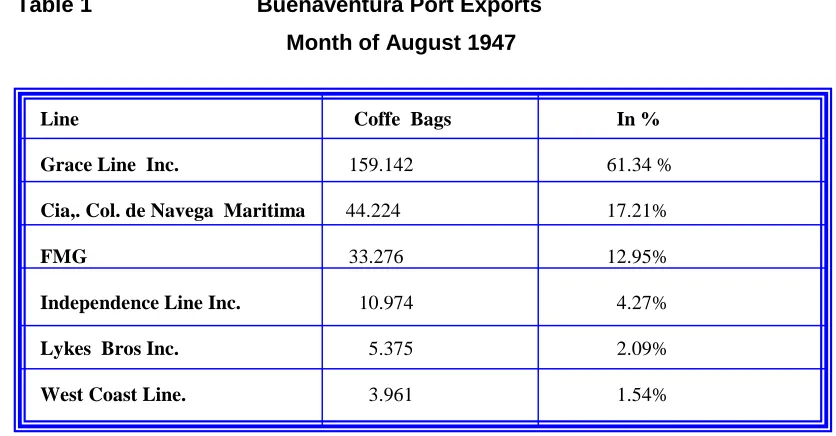
One of the products that reflected the active operation and participation of few national
fleets in the trade and competition with foreign fleets at that time was the coffee. (See
table I).
Table 1 Buenaventura Port Exports
Month of August 1947
Line Coffe Bags In %
Grace Line Inc. 159.142 61.34 %
Cia,. Col. de Navega Maritima 44.224 17.21%
FMG 33.276 12.95%
Independence Line Inc. 10.974 4.27%
Lykes Bros Inc. 5.375 2.09%
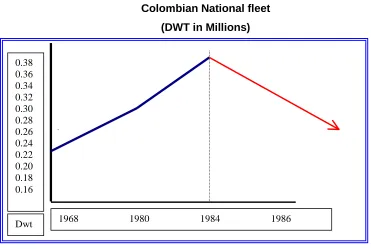
From 1968 to 1984 the merchant fleets from countries who were members of the
ALADI(1) grew approximately 200% over the world tendency (124%). In this period also
the Colombian merchant fleet grew to 78% DWT and many new companies
incorporated the national fleet. The total national fleet was integrated by Granelco with
6%, Interoceanica 2.40%, Maritimas Internacionales 1.40%, Ligracol 1.30%,
Transpetrol 0.53% and Maritimas San Andres with 0.33%.
During this period FMG remained the bigger one with 71.02 %, followed by Lineas
Agromar with 17% of the total DWT. It is also important to mention that the Colombian
fleet was only 2.8% of the total DWT of the South American fleets at that time.
The Colombian fleet during this time consisted basically of general cargo ships with
about 77% of the total fleet, 13% bulk carriers, 8 % oil tankers and 2% others.
Container ships were not used during this period because incorporation of them to the
fleets was relatively new. The average age of the ships until 1984 was 12.9 years. From
1984 and afterwards the fleet was reduced as shown in figure 1.
Colombian National fleet
(DWT in Millions)
1968 1980 1984 1986
0.38 0.36 0.34 0.32 0.30 0.28 0.26 0.24 0.22 0.20 0.18 0.16
The Colombian merchant fleet after this period started to loose participation in the
international trade in terms of DWT as well as many of the Latin American countries
due to different economical, technical and political factors inside and outside the
countries.
The shipping competition after 1986 was very hard and there were more than 30 foreign
shipping companies operating in Colombia through special contracts of association with
national owners, in which the foreign lines with this association enjoyed part of the
cargo reserve policy benefits. In this context FMG was contractually associated with
more than 26 foreign companies and Agromar lines with the other four.
According to this particular association of fleets and the unlimited option to charter
foreign flag ships by the national lines, the cargo reserve practice become of more
benefit for the foreign flag ships than for the national flag ships. Hence, the national
fleets only participated in 34% of the benefits of the cargo reserve and the associated
flags and the chartered ships of national owners participated in 66% of the cargo
reserve policy. (DIMAR (Direccion Maritima), DANE (National department of statistics)
1980.
These facts have created again a total dependency for the national owners to enjoy
some commercial benefits under the utilisation of associated ships and chartered ships
with a disastrous consequence of a not renovation and technical development of the
national fleet leading to a fast break down process and disappearance of most of the
national companies.
Actually the situation of the national shipping companies is almost devastating and the
outlook for the future is uncertain, thus most of the existing companies are still in
2.2. Fleet with national Flag
In 1997 the national fleet was composed basically of three Colombian companies as
follow:
Compania transportadora Colombia de graneles SA (Granelco) integrated by three Single-deckers with a total tonnage of 12,767 Dwt.
Interoceanica Ltd. integrated by one Ro-Ro ship and one Tween-decker with a total tonnage of 8,500 Dwt.
Lineas Agromar Ltda. integrated by four Tween-deckers with a total of tonnage of 52,410 Dwt.
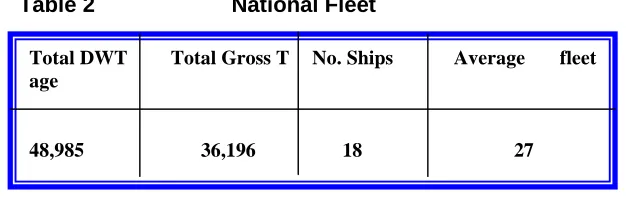
Nowadays after the bankruptcy of Lineas Agromar the fleet is composed of the
following: (Excluding open registers, and considering only ships over 300 DWT).
Table 2 shows the critical composition of the national fleet under Colombian flag.
Table 2 National Fleet
(Source: Fairplay January 2000)
The two biggest shipping companies, Flota Mercante Grancolombiana and Lineas
Agromar have been bankrupt in the last 5 years and the remaining companies like
Navesco, Granelco and Interoceanica Ltda are out of competition in the international
market.
Total DWT Total Gross T No. Ships Average fleet age
Colombia and other countries of the Andean community of nations like Bolivia, Ecuador
Peru and Venezuela have adhered to the decisions of the agreement of Cartagena
(Decision 314), related to the free access of the cargo transported by sea in order to
promote the development of the national fleets and boost the international trade under
the principles of reprocity. Under this agreement, the countries of the community have
access to the movement of cargoes within them and from and to third countries but of
course cabotage is reserved for the national fleets of each country.
This agreement is not absolute and therefore the reserve of some cargoes like
hydrocarbons and iron in Ecuador and some financing cargoes by the Eximbank in
Venezuela are not included.
On the other hand MERCOSUR is also working hard trying to eliminate all the bilateral
agreements and permit an open access to all the regional cargoes. However, in cases
in which the shipowners of the state parties of any bilateral agreement can not provide
a service, the mechanism of cargo freedom to third flag ships is available in order to
promote the trade and to not prejudice the economic development and production
activities of the countries.
2.3. Maritime Shipping Products
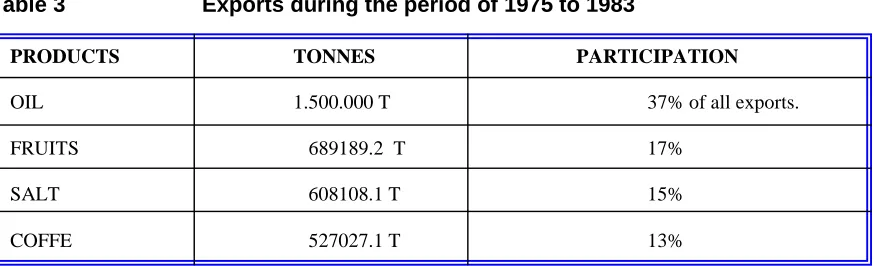
Colombia is basically able to export big volumes of bulk cargo like oil, coal and fuels
and some break-bulk cargo like the coffee and salt. (See Table 3).
Table 3 Exports during the period of 1975 to 1983
PRODUCTS TONNES PARTICIPATION
OIL 1.500.000 T 37% of all exports.
FRUITS 689189.2 T 17%
SALT 608108.1 T 15%
For the trade of these products maritime transport is essential, therefore, the main way
to participate in the international commerce is by the operation of a strong and
diversified fleet capable of moving different products and volumes to different
destinations.
Nowadays after the sale of Flota Mercante Grancolombiana (FMG) to Transportadora
Maritima Mexicana (TMM), (which is now owned by Canadian Pacific) and the
bankruptcy of Lineas Agromar Ltda, the second leading shipping company in Colombia,
the future of the exports and imports will depend on the foreign flags and very small
national companies like Navesco, which does not represent an important percentage in
the total imports and exports of the nation, therefore, facing the difficult situation of
surviving in a competitive market.
2.3.1. Why the need for a fleet ?
In Colombia different products are showing increased benefits to the national economy.
Coal brings opportunities and expectations for the future exports of the country. i.e.
Colombia ships almost 17 million tones/year. However according to the forecasted
expansion, it is estimated that Colombia will ship 30 million tones/year around the early
stage of the new century.
Crude oil also is expected to increase in the short run. In 1996 Colombia produced
649,000 barrels bpd. (Drewry Shipping Consultants), but now with the production of
other reserves like the Cipagua region the production per day may reach the 1 million
bpd in 2000.
Thus, if analysing the dry bulk and oil market, the hope to maintain a fleet is not an
utopia, on the opposite the good exploitation of these products in partnership with the
shipping sector by the support of cargo owners will be the solution to keep the national
Unfortunately, coffee prices have fallen in recent years; therefore, total exports are
below imports in value terms. Further Colombia’s retention plans to increase the prices
of the coffee failed and coffee is still showing diminishing returns.
Hence the concentration of shipping activities in these two markets by the development
of national fleets, a national tanker and dry bulk cargo fleets can be built to cope with
the transport of these products. However, the lack of experience and financial
capabilities to deal and go through these markets is the principal barriers in addition the
high competition and development of these sectors.
2.4. The freight market.
The freight rates in Colombia are controlled by maritime conferences and registered in
the maritime administration with a so called “freedom controlled system”. To control the
system the companies inside or not in the conferences, have to submit to the
administration the value of the tariff the overcharges and many other alterations of the
freight. This practice is basically to check and track when the shipping companies
operating on different routes and markets are not applying loyal practices.
This means that the companies can not charge freights over the limit registered (roof) in
the Maritime Administration or set unfair freights that do not reflect the real costs of
operation of the companies.
Actually the customers within the open market policy have negotiation power and can
bargain the freight getting some discounts depending of the negotiations in course
taking into account the ship volumes, routes, type of products and the long or short
relations with the shipping companies.
Some of the overcharges playing in the final freight and which modified the basic tariff
common applying according with the operation of the ship or the port like handling
operations and security matters.
2.5. The Scrapping Market
The scrapping market is well known as a “dirty industry” and is the only sector of the
maritime industry that is not regulated. Actually high quantities of toxic and several
environmental hazardous substances such PCB, heavy metals, hydrocarbons, ozone
depleting substances and asbestos are present in large quantities especially in older
vessels.
Nowadays most of the scrapping activities take place in the Indian sub-continent,
mainly in India, Bangladesh and Pakistan. Most of these countries became leaders in
ship scrapping activities just after a few nations like South Korea and Taiwan lost their
business because stricter environmental and safety regulations were imposed by their
national authorities.
On the one hand, fortunately in Colombia these activities are not well developed due to
the absence of national legislation and interests for the commercial benefits of these
activities. This is a consequence of the decadent panorama of the shipping sector, but
on the other hand this weak development can endanger the evolution of the scrapping
market in an unregulated nation, if looking at other developing countries like India and
Pakistan where low value, high labour intensity and duties under hazardous conditions,
occupational health and safety are the main characteristics.
A future development in the regulation of these activities by the IMO, ILO and the
national authorities will prevent foreign shipowners to change to countries where safety
and environmental regulations to this matter do not exist. Hence vast benefits can be
observed such as reduction of accidents and discharges of wasted emissions
2.6. Labour Framework
The effects on the crew size and employment
Not so far ago the maritime shipping industry was a big source of employment. One
part of the labour force was destined to operational activities carried on board the and
the other like in any other industry for the administrative operation of the company.
Nowadays crews are becoming smaller and smaller because of the automation of the
ships and the increment of information technology (IT) in the shipping industry.
Therefore fewer crew members and officers are needed for the operation of bigger and
specialised ships like VLCC tankers LNG and LPG carriers and big container ships;
hence, fewer personnel as well are needed to control the administrative operations of
the company ashore.
In Colombia with the disappearance of the national fleet many thousands of seafarers
became unemployed. If looking at figures from 1971 to 1975 around 2.100 seafarers
were employed only in Flota Mercante Grancolombiana (FMG). Afterwards the crews
were reduced from 52 to 36 crew members on board the ships, reducing the number of
ratings to only 1.100 in 1986.
Nowadays with the presence of many national and international regulations regarding
minimum safe manning standards and the increment of high tech ships the crews are
reduced to 26 and fewer ratings; therefore, the recession and crisis of the maritime
industry is found in different organisations and sectors such as merchant academies,
nautical schools, the maritime administration, cabotage activities and port facilities.
Basically in Colombia most of the officers and crew members who were dedicated to
international shipping are now employed in port operation activities and a few others in
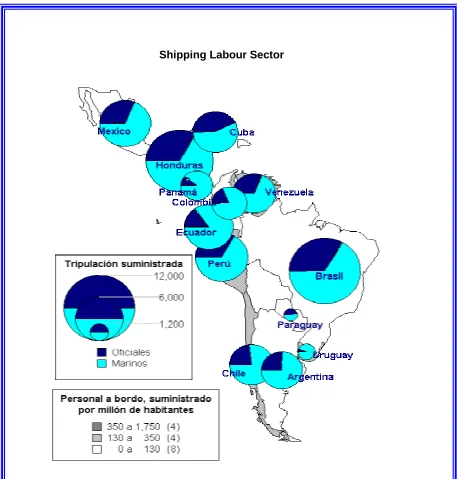
cabotage activities. In consequence this high supply of seafarers are able to work
decades and a few seafarers remain in the international shipping activities, almost in
the same poor conditions. (See figure 2.).
Shipping Labour Sector
Another small portion of the crews abandon the activity completely to join other sectors
of the industry and others with more luck join foreign shipping companies on board
ships and ashore facilities.
The academies and nautical schools have decreased the number of graduates so the
lack of interest and support from the government for international shipping activities
have become more remarkable. This last aspect can be seen in the slow process taken
from the state in the ratification and implementation of international regulations related
with seafarers, certification, working hours and educational standards, i.e. STCW and
some ILO regulations.
2.7. Shipping protectionism economic policy
Colombia as any other country interested in the protection and promotion of its
merchant fleet introduced a protecting mechanism to become free from the dominion
and dependency of foreign fleets. This was a result that was born from trade
interruptions, commercial autonomy and for the disconnection with industrialised
countries caused by the Second World War.
Protection Mechanisms.
Cargo reserve
Colombia as many of the Latin American countries members of the ALADI, appoint to
their own benefits a special reserve of cargo of 50% for their export and import traffic
and total control for cabotage traffic.
The direct beneficiaries of this cargo reserve were the Colombian shipowners, who
were supported in this matter by the employment of ships under different operation
operation of Colombian Flag ships (National Ships),
operation of foreign flag ships under Colombian ownership,
operation of foreign chartered and leased vessels as well national vessels by Colombian owners and
operation of foreign flagships associated with Colombian ship owners under a legal status.
The indirect beneficiaries of this mechanism were also foreign shipowners who
convened a legal association with Colombian shipowners under contractual relations.
It is worth mentioning that even under the application of this mechanism, for the period
of 1980 to 1986 only the national fleet and associated ships moved 29% of the
international seaborn trade of Colombia and 71 % was move by foreign flag ships
contracted by particulars. Nowadays the situation is worse because the huge changes
in the open economy policy and the free and fair competition with international shipping
companies.
The direct implication of this open market policy is the total capture of almost the entire
shipping industry by foreign shipping lines, due to the powerful infrastructure,
technology and know how.
Tax exemptions
The president of Colombia by Law Decree 10 of 1946, declared tax exemptions of rent,
patrimonial taxes and any tax for excess of utilities (income) in the capitals, on the
benefit of Flota Mercante Grancolombiana fleet, which at that time was working in
partnership with the republics of Venezuela and Ecuador.
There were also other exemptions on port dues, anchorage and special treatment in the
assignment of quays or berths for the attention of these vessels in all the ports of the
Agreements with foreign companies
The agreements with foreign companies in the distribution of cargoes and the
chartering of vessels under national flag for the commitment in the movement of
cargoes on certain routes, were a general practice that is still being used by countries of
the Andean community in order to compete with the biggest companies and to survive
in the competitive market.
In order to maintain a complete operation and employment of the national fleet, the
council of ministers declared that all the official shipping contracts, celebrated to supply
state assets, should use FOB clauses instead of CIF clauses. These was done in order
to maintain the level of the freights of the national fleet and to have a more attractive
business for the fleet.
On the other hand, the sales of coffee especially to the USA have had to be preferably
traded on Colombian flagships.
Collect Freight Payment
The Colombian shipping lines under this mechanism offer a very flexible and attractive
practice for the customers, in which they can pay the freight on destination. This
practice was called “collect system” and was contrary to the common practice of the
foreign shipping lines in which the “pre-paid” freight system was the norm.
Under these circumstances the national shipping lines acquired a special negotiation
power with the customers, giving an advantage position in terms of capital interest
savings and control of the payment in case of damage to the cargo.
Tributary exceptions
The benefits under these mechanisms assured the operation of ships in the
international shipping trade market by bringing a better health economy with a positive
In Colombia these were the basic mechanisms to speed up the development of the
national flags ships, but unfortunately this it was not a policy of promotion by special
subsidies and credits in terms of new acquisitions, buildings, renovation, transformation
and reparation of the vessels.
2.8. Shipping industry break down process
The break down process began from a series of shortcomings not only in the
management of the companies but also due to the legal gaps encountered in the
protectionism mechanism.
The implications of these legal gaps in practice, acted against the development of the
national fleet, because in many instances they just promote the economical
maximisation of the shipowners who encountered the economical activity more
attractive (corporate income), rather than the shipping activity as a whole, weighting it
as fundamental sector for the development of the country.
The protectionism regime of the “cargo reserve” in practice with its particular
exemptions not only benefits national shipowners but also foreign ones. An example of
this situation was that the cargo reserve mechanism was not applied in some situations,
as in the following:
if the nationals shipowners were not able to proportionate the service,
when the cargo was destined to the defence of the nation and
when the level of the freights affects the national economy
These situations in a general sense are correct for the self-benefit of the country but not
always for the sector. In other words, the trade of the country can not be sacrificed for
the lack of a public service. Therefore high utilisation of better equipped chartered and
irremediable stanch of the purchasing and renovation process of the national shipping
companies.
The lack of economical power from the state to subsidise the merchant fleet was other
factors that lead to the ship bankruptcy process. Hence only the cargo reserve system
was the mechanism introduced to balance the differences between the rich and the
poor countries in which the former have a strong support subsidies policy due to the
developed economy and services.
However, it is true that the subsidies are not a healthy policy and the tariffs of
transportation should be profitable in order to maintain the existence of the companies,
(which in most of the cases and under the difficult competing circumstances are not
easy to manage.).
To resume and reflect some of the implications of the bad management of the fleet and
the misunderstanding of the protectionism policy system by the shipowners, the
following results are presented from this analysis:
Inefficient and costly monopolies
High service and freight costs
No capacity of negotiation for the customer
High operational costs of the fleet
Inefficiency of the ships and the crews
Obsolete fleet
Frequent delays
Slow growing of the fleet
Administrative and technical limitations
Congestion due to technical and operational constraints
Extension of benefits to foreign flags (associated ships).
Permission of chartering activities for reserve cargo: this implicates no national reserve, no increment for the employment of nationals, increment of deficit in the
balance of transport; shipowners became mediators or brokers therefore not naval
reserve.
2.9. Open Economy Policy
Actually and after the open market period, the Colombian shipping lines were and still
are competing with foreign lines under disadvantaged conditions, i.e. Operating with
tariffs lower than the real cost and without subsidies from the government; therefore,
the deficit ha increased in the shipping sector with a clear disappearance of the fleet on
the international shipping market.
From the side of the shipping companies in the particular case of Colombia, the
following different factors produce weaknesses in the operation of the companies and
the disadvantaged position against foreign shipping flags:
Elimination of the reserve of cargo
Freedom of routes traffic and tariffs for foreign lines
Freedom to access cargo
Free competition between lines
Deregulation and liberalisation of the market
Strong and fast changes in the legal framework
Change of mentality
More offer of services from 30 services to 140 services
Strong presence of foreign shipping companies in the new scenario
Lack of management systems, infrastructure and prepared personnel able to deal with the new commercial environment
Lack of proactive policies
Lack of awareness
Resistance to the change
To conclude, according to these changes in the development of the Colombian shipping
industry it is necessary to introduce new strategies and analytical methods in order to
guarantee maintenance of a national shipping fleet and to assure economic
independence of the country in the international shipping market.
Chapter Three
International strategies
3. Analysis of shipping environment in a global market
3.1. Marketing
For a Colombian shipping company dedicated to the international seaborn trade
“transport of goods”, the application of a “Customer Relationship Management” (CRM)
marketing theory is a very important issue. It has to be taken into account in order to
maintain the company in direct contact with the customers, making the closest links and
better co-ordination with the benefit to remain competitive and efficient in the market.
3.1.1. Implications of CRM
The implications of applying the CRM in the Colombian shipping industry are wide
because it can guide the companies to gain new business and perform on potential
markets like the tanker and dry bulk markets, i.e. oil and coal products.
CRM also helps to focus more in what to do in a specific or current market by detecting
who needs the services and the products, i.e. The general cargo and container
markets.
Other direct implications of the CRM theory is the treatment with the customers who
should be seen as partners in order to satisfy their needs. Therefore the relationship
with them becomes more personal and the responsibilities and commitments between
each other become deeper. Special links and trustworthiness are the key to keep on
business; therefore, assignment of personnel to work directly with the customers or
settlement of special work groups to enhance the relation and connections with partners
3.1.2. Key Features
3.1.2.1.Data base Analysis
The data base analysis implies a wide series of activities like selecting, exploring, and
modeling large amounts of data also known as “Data Mining”, from which it is possible
to deduce possible and potential customers. This can also be understood as targeting
customers by an appropriate tool analysis.
The result of this process bring wealth and stability to the company because the
appropriate selection of demanding customers will lead to intensified our competition in
the future market.
The implementation process of the CRM theory in the Colombian shipping industry is
possible but some internal barriers can be found because the extensive time and costs.
Specially when concerning the data base analysis studies, investment in new computer
and soft systems and managerial support to determine who are the best providers of
income for the company, i.e. know how in research programs and financial capabilities
to acquire systems focusing on determining when to dedicate to core business or to
diversified and discover new markets or consider all combinations. (See figure 3.).
Figure 3 shows a cycle process in which the scoring model as a center provider stores
the customers data base of different types of markets or segments of one market. The
markets and segments after a previous selection done through management
campaigns and supported by an extraction tool system send the data to the database
which provide a continuos flow of information to the data mining and reporting system
called “Business Intelligence” that is where the selection of possible and potential
customers take place. The scoring model is fundamental when huge amounts of
segments are in the study.
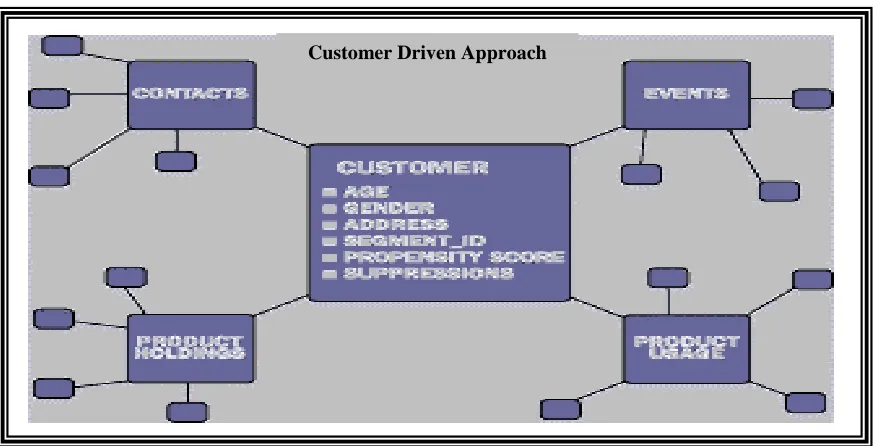
3.1.2.2. Customer Driven Approach
In reference to the product/service it should be applied in a market driven or customer
driven view. This means that a selection of activities should be appointed to one
specific sector of the market because all the markets can not be covered in all extend
with the same efficiency as if focusing on the ones which give more revenue. Therefore,
niche markets are of special attention for developing sectors in which competition with
developed shipping companies are not possible. This VIP practice can be seen as
discriminative. Also specialization and outsourcing of activities to cope with the new
needs of the global market like Just in time (JIT) services are part of this thinking that is
reflected in the globalisation process. (See Figure 4).
What the current graph is intended to demonstrate is that the key of the business is the
customer; therefore each facet of a relationship may be treated as an island of analysis,
but always linked centrally to the customer.
3.1.2.3. Customer Segmentation
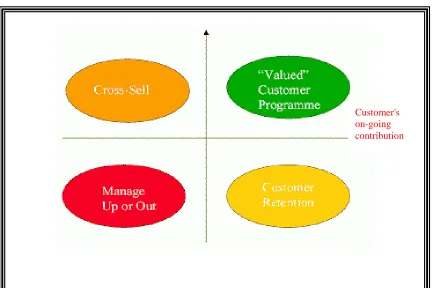
This selection can also implicate “Customer segmentation” which means divide the
market in small groups and segments that have special interest for the products or
services. This segmentation will enhance the total operation of the company by saving
resources and meet the requirements of the customers. This generates a high quality
service and improves the profitability of the company. (See Figure 5).
Segmentation by Contribution
Figure 5. Source: http://crm-forum.com/
The previous matrix is just one of the multiple examples in how to segment customers.
Some can be selected and introduced to the program by contribution, others by
revenue or by volumes and depending on the segment of the market and the price and
sensitivity of the product.
3.1.2.4. Information Technology
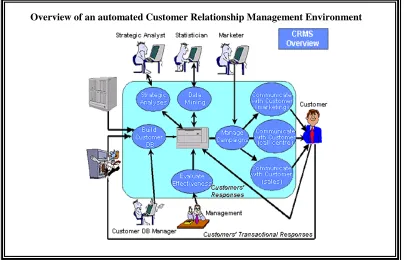
Of course Information Technology (IT) is part of the new implications and maybe one of
the most important activities.
The communication and promotion of information trough EDI and e-commerce media
as well IT systems applied to different services, are in many markets, what makes the
difference of the service and certainly the leading sector to growth. Therefore
appropriate investments in IT systems and acquisition of equipment and experts in the
field are more than necessary. This is one of the biggest barriers for the Colombian
shipping companies because of the lack of capital resources and adequate personnel
(Know How). Nowadays, IT has been updated very fast and prices have been going
down; hence, sometimes equipment is not a restriction, however huge investments
without advice end expertise became a very risky activity. (See Figure 6).
The application or utilisation of IT to support the data mining activities are of great
support and enable the company to target more accurately the potential markets and
customers. Some actions to be taken are:
• Establishment of a confident computer network system linking all the customers with the corporate actions, staff and developments of the company.
• Establish a Web site for the company with multiple customer services incorporated in the net is the trend.
• Intranet systems to record all actions of the company on board ships and ashore installations regarding type of cargo delivered quantities, receivers, damages,
claims delays etc.
• An establishment of a customer database to analyze current customer’s base on crosselling, up selling and lifestage procedures.
Computerised systems are very important because they give the possibility to manage
huge quantities of information in short time and link services with customers and
interested parties in the business.
The application of a CMR system to the national companies based on an international
business strategy will definitely give enormous benefits to the company by adding value
and cutting costs, hence, improving profitability.
The implications or results of a good CRM process in the national fleet can be
summarized as follows:
• Identification of niche markets
• Minimise operational and transit costs including time in port (turn around) by choosing better routes and efficient ports
• Maximize the return on invested capital
• Enhance the quality of the service for the customers, hence, improved customer satisfaction rates
• Minimize total cost including overhead or administrative costs
• Minimize cargo damage and claims
• Safety operations of the fleet
• Environmental friendly practices
• Better freights. (Low cost production/ service)
• Less imbalance of cargo
• Differentiation
• Increased margins and increasing win rates
3.1.3. Suggestions
In order to have an effective CRM system, first of all the company has to analyzed
which type of customer to approach. This means to understand the culture and the
behavior of the region where the targeted customers are living. Therefore, different
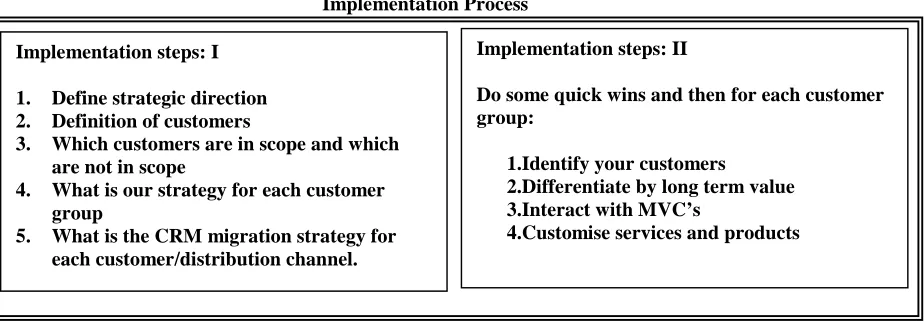
types of tools have to be used to determine the best options, i.e. Implementing Process
(See Figure 7.)
Implementation Process
Implementation steps: I
1. Define strategic direction 2. Definition of customers
3. Which customers are in scope and which are not in scope
4. What is our strategy for each customer group
5. What is the CRM migration strategy for each customer/distribution channel.
Implementation steps: II
Do some quick wins and then for each customer group:
1.Identify your customers
2.Differentiate by long term value 3.Interact with MVC’s
Some of the techniques that will be mention in the chapter five for the acquisition of
second hand a new vessels can be apply in this marketing phase to understand the
advantages or disadvantages and the barriers that the company will face in the different
markets
3.1.4. CRM has to focus on:
Segmentation of markets by ports, by products (type of cargo) and by traffic (regions)
including the analysis of other shipping lines inside the business to give a clear
understanding of the position in the market.
• In the case of the operation of the ports, the physical constraints and the equipment including feedering services, handling operations, cargo capacity, turn around, port
dues, berth availability, productivity and stability have to be analyzed.
• In relation with the market, traffic and location of ports, the comparison and data mining analysis against other shipping lines and services, should be done making
emphasis on the following:
Transit time, operational costs, running costs, capital costs, transit costs
conference systems
Economies of scale or cost per unit of cargo
Practices of different types of transhipment like: Scattering/feedering transhipment, Interline transhipment, switching transhipment, catch up
transshipment and by pass transshipment
Direct calls or feeder calls
Operational patterns like pendulum, double dipping, hube spoke, triangle, round the world, end to end and tramp land bridge.
Number of competitors, market shares and potential alliances.
application of this theory for the acquisition of new customers and the maintenance of
strength relations with them are of extreme relevance.
3.2. Quality and Safety shipping
3.2.1. Quality Systems
Quality system and standardisation are also part of the process and the implications of
their use are determinant in the capture of new markets or customers. Moreover, the
application of these quality systems, like the International Safety Management Code
(ISM), ISO 9000 or ISO 14001, reflects the health and the good performance of the
company in terms of transparent procedures to secure the production or operation of a
good product or service respectively.
In relation with the quality systems many reputable companies apply them to become
more marketable for business and commercial purposes. (Popularity in the global
market). Therefore, the differentiation between the service or product from one to
another company under these international standards is nowadays very narrow and
competition harder than before. Hence, the implications of a standard market is
reflected in the offer of more added value services to the customers like IT and logistic
packages in order to remain competitive and attractive for potential customers.
For a commercial point of view the training of strategic staff in quality standards like ISO
9000, ISM code, ISO 14001 to increase the quality performance and operations of the
company is vital to remain competitive.
3.3. Safety
In relation with the fleet, different elements integrated the safety operation of it. That is
• Safety of Life at Sea (SOLAS 74/78),
• International Convention on Marine Pollution (MARPOL 73/78) and the
• International Convention on Standards of Training, Certification and Watchkeeping for seafarers 95 (STCW 95).
As is known safety is a very wide topic in which ships and the human factor are entirely
involved. Therefore, the coverage of this issue will briefly focus on mention few possible
international strategies and procedures to avoid the and dangerous operations.
There are basically five different ways to avoid substandard ships, Michael D. Tusiani,
March 1993.
• First are the standards and regulations created by the nations in which a ship is registered.
• Second, is the classification society, which inspects the physical condition of ships and publicly reports their conclusions.
• Third, is the port or coast guard authority at load and discharge ports, who accept or reject ships calling there.
• Fourth, are the inspections and other acceptance procedures of the companies, who use the ships, or allow them to call at their terminals.
• Finally, and most important, are the standards and operating procedures of the individual shipowners and operators.
The last two of these five strategies are the ones which have more impact on
shipowners or operator companies and which have to be apply in accordance with the
International Safety Management Code (ISM). Chapter IX of SOLAS 74.
SOLAS makes mandatory the application of this safety management system under the
To summarize, the principal criteria of this safety management system (which can be
encountered in detail in the ISM Code) it is worth mentioning, that the Code intends to
ensure that shipping companies establish their own safety and environmental protection
policy regarding topics like:
• Defined procedures for normal shipboard operations
• Emergency response
• Reporting of non-conformities
• Internal audits
• Management reviews
• Levels of authority and
• Lines of communication I.e. Designated Person Ashore (DPA)
Safety and quality policies and procedures ensured not only the protection of human life
and green environmental practices, but also sound commercial and profitable
environment for the company.
The shipping environment in a global market is not only evolved inside the corporate
objectives of the companies, but also in the general management and operation of it.
Therefore, the explanation of the main global trends or international management
strategies for the development of the shipping industry, will be explained in the next
Chapter Four
4. International Management Strategies
4.1 Alliances, Partnership, Consortia, Mergers and Acquisitions
Due to the high competition, achievement on economies of scale, changes in
environmental factors and the increase of the customer’s demand patterns, many
shipping companies are seeking new ways of growth and expansion to remain
competitive in the market. Hence different schemes of co-operation have been taking
place in the last decades like alliances, mergers, consortia, partnerships and
acquisitions.
Agreements in slot-vessel sharing, co-operation to merge services in different routes,
exchange space, co-ordination in the frequency of the services, sharing of port and land
equipment, and other technical co-operations; are a just few of the different manners in
which the leading or top 10 shipping companies operated to lead the market in order to
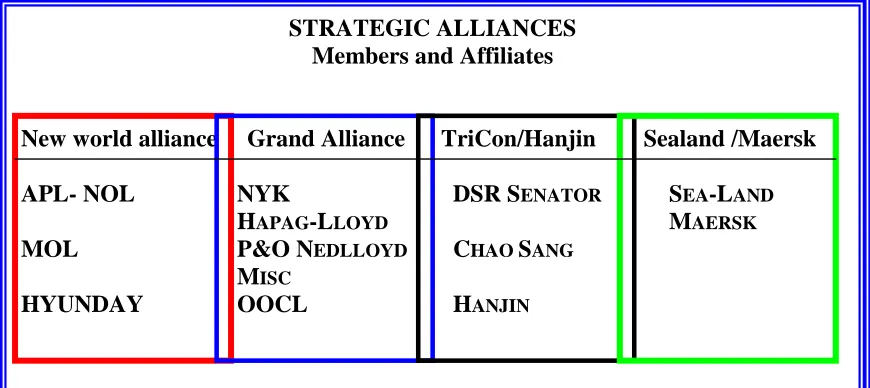
cut costs and prove a high quality service. (See Figure 8.)
STRATEGIC ALLIANCES
Members and Affiliates
New world alliance Grand Alliance TriCon/Hanjin Sealand /Maersk
APL- NOL
NYK
DSR SENATOR
SEA-LAND
HAPAG-LLOYD
MAERSK
MOL
P&O NEDLLOYD
CHAO SANG
MISC
HYUNDAY
OOCL
HANJIN
Unfortunately, for small shipping companies operated by developing shipping countries,
the scenario is uncertain and devastating. Bigger companies are absorbing smaller and
now with the trend of possible logistic alliances where manufacturers secure their
markets by commercial co-operation with bigger carriers, the future panorama is even
worse for the smaller. For the last only few niche players will remain in the market.
4.1.1 Strategic alliances and partnership.
The principal advantages obtained by the application of strategic alliances to the liner
carriers are:
• Consolidated cargo Volumes. (economies of scale)
• Increment in the service frequency
• Better employment of the assets by sharing of vessels, terminals, containers and port and land equipment
• Combination of financial and capital power for the acquisition and reposition of assets in the long run
• High quality services
• Costs reductions
• High market coverage
• Enlarge networks
• Door to door services
Disadvantages:
• Co-ordination of separated operations
• Creation of new goals for a new entity
• Find new competitors (if competition is good, quality is improved)
• Setting up new profits
• Mostly short term agreements. (but longer than consortia or partnership)
• No leader ship basis
• Inflexibility to manage the business alone
4.1.1.1. Partnerships
The “partnership” is not strategic at all compared with alliances, which are strategic in
nature. This is because in the alliances there is a direct support of the corporate
objectives in all operational levels and also because the entire organization has a
defined approach to business, which conducts the whole company.
Partnering is mainly to establish a long-term relationship with third parties like suppliers
of goods and services. This relationship is based on plans and programs to increase
efficiency, communication, service and decreased operational costs by sharing. In the
author’s personal opinion this will be the trend in the future
“A partnership is a tailored relationship based on mutual trust openness share risk and
rewards. “ (Maersk -Sealand Seminar March 2000).
4.1.2 Consortium
The consortium is small alliances that limit the services to specific routes; therefore, the
co-operation between them mainly are of two or three lines looking for the increment of
cargo factors in a few routes.
The arrangements in general terms vary from one consortia to another, i.e.
vessels/space sharing and slot chartering, ordination of sailing routes, common
co-ordination offices and co-operation for better space utilization.
Other features that boost this type of organization were the need for high investments in
The disadvantages of consortia are:
• Very rigid structure
• Slow decision making process
• little control of the ships by different shipowners.
Therefore alliances are a better example of co-operation in terms of market coverage
commitments and quality service.
4.1.3. Mergers and Acquisitions
According with the new economic changes and developments in the global market,
there may be many reasons for shipping companies to acquire or merge with other
groups or companies.
The goals could be in many cases almost comparable with the reason to create an
alliance or a partnership but the variants can be based mostly on the management
profile of the new integration and on the scale and corporate objectives of the new
business approach. Therefore the application of any strategy will depend on the
management capabilities, infrastructure, capital power and know how of the company
that wish to merge or acquire another.
The mergers and acquisitions throughout the economy is important when the
companies involved are not only seeking solutions that enable them to focus on their
core competencies, but also on solutions that provide them with greater flexibility for
moving assets and integrating new company units.
A few of the basic reasons to merge or acquire a company are:
• Strengthen the providers and distribution channels of the company,
• Integrate new technologies like IT and EDI services,
• Increase the competitive strength of the company,
• Acquire new business areas,
• Integrate sales of its products
• Create a high return on its shareholder investment (add earnings in the group).
By the application of this strategy, the companies will maintain a high and constant
growth, because the integration of new services/products to the portfolio of the
company. This constant growth will lead to further strength developments, acquiring the
advantages of the merge group, reflected in an enhanced production process by the
profitable use of new installations, personnel and equipment.
The capabilities and the potential of the company will reach new levels of development
by corporate synergies and economies of scale, not only in the production but also in
the sales and administration process.
The merge will endure the management of the company, in which several joint
resources will secure the future growth and opportunities for internal and external
expansion, leading a market penetration with flexibility, quality and product innovation.
(See Figure 9.).
RECENT MARITIME MERGERS
NEPTUNE
HAMBURG SUD CP SHIPSORIENT LINE
CROWLEY
LYKES
4.1.3.1. Corporate Acquisitions
The acquisition process requires an analytical and through procedure in which different
features of the market and the companies have to be analyzed. Estate, tax, business
and corporate plans are involved; therefore, clear strategies and systematic search
profiles procedures have to be undertaken to target the potential sellers. The legal
commercial, financial and the accountants department have to be aware of the possible
contracts to co-ordinate the future negotiations under well-developed investment and
appraisal methods (project management). Leading firms reducing expenses and costs
can outsource these activities which can be time consuming.
The recent “takeover” of Sealand by Maersk can be considered within this category.
4.2. Outsourcing
The outsourcing strategy is of great support for the companies interested in focusing on
a main field or segment of the shipping industry; therefore, the identification of the core
business of the company is fundamental and requires a clear definition of corporate
objectives and goals.
When a company uses to outsource activities, it means it is specialized in a main
activity, i.e. own equipment and personnel only for a specific purpose or business. Thus
it performs extra activities by hiring and contracting assets and know how for a limited
of time. Hence relying on the knowledge and capacity of the outsource company.
Outsource in many cases can be seen as a flexible business because the easy
adaptation of the current company to future changes, specially when high costs of
Outsourcing activities reduce costs and save time because the utilization and advice of
specialized agents, firms or suppliers that permit the company focus in the main
business.
A few examples of outsourcing strategies will be explained hereunder as possible
solutions to enhance competition in the future market.
4.2.1. Outsourcing supply chain management
Nowadays the changes in the way to perform business to business (B2B) and the high
utilization of electronic and Internet system speed up the application of outsourcing
strategies, which are of tremendous importance because the need to cut costs.
Nowadays, many organizations make big efforts to implement and outsource new
technologies like e-commerce because they are finding themselves short of skilled and
train staffs with experience at a time when deployment must be rapid. Hence It is clear
why many IT departments are aware from the pressure to maintain and update their
ERP (Enterprise Resource Process) environments while extending into e-Business
applications.
“The growth of B2B e-commerce could easily promote a common framework in the
supply chain between companies who use the same ASP (Application Service
Provider). Hence Asp’s could play a critical implementation role in the expansion of a
safe and managed environment for inter-company Internet transactions.”
(Price WaterhouseEcoopers May 2000).
The electronic era makes companies become more cash flow based than assets based
in order to maintain more liquidity (precious cash). Therefore companies invest more
managing skills to outsource relationships of suppliers and vendors (outsourcing
management).
“Management generally recognizes that there is a complex trade-off between in-house
production and purchasing the services from an efficient specialist in the open market,
thus cost benefit research to determine the correct path is now the preferred approach.”
(Outsourcing Journal, 2000).
In the case of liner shipping companies, ships will remain in-house. (with exemption
cases in tramp shipping, where the time and voyage charter options prevail). Because
the ships are the strategic assets that with up-date technology make the difference and
the quality of the service, supported by high IT systems ashore, plus few added value
services as part of the logistic chain.
However, other internal duties of the company like maintenance, repair and operating
office supplies can be outsourced in order to cut expenses by reducing personnel,
equipment, facilities and extra responsibilities, which reflects time and overhead
expenses.
Retraining of managers or acquisition of new trained personnel with better strategy
business approach are definitely the key to success in the future business. For
example, not only the supplies can be obtained for the internal use of the company, but
for the customers of the company due to the huge discounts, rebates, preferential
treatment and big volumes managed by the buying groups. All of this is also a big
benefit for the suppliers by less purchase orders.
4.2.2. Outsourcing benchmarking
When companies are involved in outsourcing activities the benchmarking procedures
Why use of benchmarking?
• Because it is important to know and set up the real pricing and service levels of both parties involved in the outsource contract, i.e. From one side the customers can
take the risk to deal with or not an outsource company according with the
benchmarked prices and services, while the supplier can understand the risk taken
by the customer when choosing their services.
• For the health of the long-term relationship.
• To guide the context of the contract negotiations.
• Because benchmarking is an economical method that permits assessing and weighting of the benefits of a contract relationship.
• Because it facilitates "fast tracking" or unique source considerations. This means clients can be outsourced rapidly through quick negotiations. However
“benchmarking data” is needed to avoid huge risks with catastrophic losses.
The benchmarking process can be tedious and time consuming because of the different
types of information needed; thus, honesty and transparency in the process are of a
relevant importance for both benefits.
As a general guide to success in this long process, some important steps are shown
briefly hereunder:
• Investigation
This stage is very important and is the one, which give the high and profitable benefits
in the near future, i.e. the current performance of a company may not be the optimum
and since the managers of it are not aware of the real performance, potential losses
can appear when an outsource activity comes into the operation of the company.
Therefore, knowledge of the company’s own IT activities, logistics, and capacity to