Bolton Business School: Examples of Research
Proposals Bolton Business School
2011
Research proposal: Jon Royle
Jon RoyleUniversity of Bolton, [email protected]
This Other is brought to you for free and open access by the Bolton Business School at UBIR: University of Bolton Institutional Repository. It has been accepted for inclusion in Bolton Business School: Examples of Research Proposals by an authorized administrator of UBIR: University of Bolton Institutional Repository. For more information, please [email protected].
Digital Commons Citation
1
PROGRAMME: MBA Part-Time
MODULE: Research Methods MBA4060
ASSIGNMENT No: 1
STUDENT NUMBER: 0606923
MARKING TUTOR: Peter Moran/Judith Myers
2
CONTENTS
PAGE
Chapter1 – Introduction………. 3
1.1 Organisational Context……….……..………. 3
1.2 Area Under Investigation ……….…………..……. 5
1.3 Strategic Importance Of The Area Under Investigation……… 6
1.4 Research Question and Objectives……… 7
Chapter 2 – Literature Review……….. 9
2.1 Change Management………. 9
2.2 Planned Approach……….. 9
2.3 Emergent Approach………... 12
2.4 TUPE Transfer……….. 14
2.5 Psychological and Social Effects of Transfers and Mergers.. 16
2.6 Staff Transitions……….. 18
2.7 Social Identity……….. 24
2.8 Developing a Conceptual Model………. 26
Chapter 3 – Methodology……….. 29
3.1 Research Philosophy……… 29
3.2 Positivism………. 31
3.3 Social Constructionism………. 32
3.4 Realism……….. 35
3.5 Philosophical Position……….. 36
3.6 Research Strategy……….. 37
3.7 Research Methodology………. 38
3.8 Validity……… 45
3.9 Reliability………... 46
3.10 Research Ethics...………. 48
Bibliography…..………. 51
3
CHAPTER 1
INTRODUCTION
1.1 Organisational Context
The author is Chief Executive of the Bridge Project, which is a registered charity and a company limited by guarantee, with an annual turnover of approximately £2 million. The organisation employs approximately 70 paid staff on a mix of permanent and temporary contracts and 30 volunteers.
The Bridge Project’s Mission Statement is “to assist those affected by addictive behaviours to make sustainable positive changes in their lives” (The Bridge Project 2009). This is achieved by providing a range of high quality integrated substance misuse treatment and harm reduction services, in partnership with relevant specialists, to adults, young people and their families.
The senior management team is composed of the Chief Executive who is responsible to the Board of Trustees for the management and administration of the Bridge Project within the strategic framework and policy objectives set by the Board, for the motivation, well-being and efficiency of staff and volunteers and for enabling the Board to fulfil its functions. The Chief Executive is assisted by: -
4
responsibility of four Team Managers who ensure that project's aims and objectives, activities and tasks, outputs and performance indicators are achieved in line with service specifications. Team Managers are supported and line managed by the Director of Operations.
• Director of Finance and Support Services, responsible for financial planning/monitoring and organisational support systems.
• Director of Human Resources, responsible for: -
Ensuring an adequate supply of suitably trained and experienced personnel to deliver the charity’s corporate aims and objectives;
Ensuring all staff and volunteers are systematically trained and developed to meet the business needs of the organisation;
Ensuring policies and procedures are in place and effectively implemented;
Enabling the charity to demonstrate the practice of equality of opportunity and fair and reasonable employment in all areas of the corporate business;
The promotion of healthy and safe working environments free from stress.
Appendix 1 shows the Bridge Project Organogram with the lines of accountability and responsibility.
5
in essence operating as a social business selling its services on a not for profit basis. Additional funds are generated through applications to charitable trusts and from donations.
1.2 Area Under Investigation
Traditionally Bridge has developed and acquired new business through the purchasing of its services by local commissioning bodies (e.g. Bradford and Airedale Teaching Primary Care Trust). Due to changes in legislation, the last five years have seen a significant change in the way services are commissioned, in particular the increasing use of competitive tendering. The main legislative requirements are the 2006 UK Public Contracts Regulations (HM Treasury 2006) that implement the 2004 EU Public Procurement Directives in the UK.
6
A result of competitive tendering is that public service contracts are now transferring between providers. This involves the transfer of staff to the new provider under Transfer of Undertakings (Protection of Employment) Regulations 2006 (TUPE) (Department for Business Innovation and Skills, 2009). The regulations are designed to protect the rights of employees in a transfer situation enabling them to enjoy the same terms and conditions, with continuity of employment, as formerly.
In April 2010 Bridge won a new contract to provide an Integrated Substance Misuse Service for Bradford South and West. The contract was formerly held by Ripple, a local charity that operated in the District for many years. 14 staff transferred to Bridge under TUPE and both the incoming and outgoing providers had obligatory responsibilities under TUPE. Overall, staff were relieved to transfer to Bridge, principally because the culture of the outgoing provider was perceived to be oppressive. However, some staff experienced difficulties integrating into Bridge, including concerns about location, structure and culture. The area to be investigated is the management of change during the TUPE process and the how effectively staff integrated into the organisation.
1.3 Strategic Importance Of The Area Under Investigation
7
1. Risk of reduced organisational performance – If staff do not integrate effectively this will adversely affect employee and organisational performance.
2. Risk of damage to Bridge’s reputation – If staff are unhappy about the transfer process, they are likely to submit complaints to service commissioners and this could affect the organisation’s ability to win new business.
3. Risk of long term damage to the organisation’s culture – If new employees lose confidence in Bridge during the transfer process, this may establish a paradigm based on mistrust and resentment towards management that may be difficult to change.
It is important that Bridge uses this opportunity to learn from the process, understand its effect on staff and make recommendations that can be used to integrate staff more effectively into the organisation in the future.
1.4 Research Question and Objectives
The research question is: How can Bridge improve its change management approach during the TUPE process to be more effective at integrating transferring staff into the organisation?
8
1. To investigate the issues/problems that emerge as a result of the TUPE transfer process that affect the sociocultural integration of staff into their new employer
2. To investigate the ability of Bridge to effectively manage the transition of staff into the organisation and achieve successful acculturation
9
CHAPTER 2
LITERATURE REVIEW
2.1 Change Management
There is a large body of literature on organisational change and many theories on the management of change. One area where there is a consensus, is the notion that change is more frequent, complex and unpredictable than ever before (Burnes 2009, Hayes 2007). Change can be subtle and gradual, or transformational and dramatic. It is also difficult to achieve and manage successfully; Burnes (2009) suggests from a review of the literature that over two-thirds of change projects eventually fail. Choosing the most appropriate approach to change based on the type of change being undertaken and the circumstances is therefore a key element (Bamford and Forrester 2003).
There is considerable disagreement within the literature regarding the most appropriate approach to managing change and most of the research is devoted to the private sector. It does appear though, that there are two main approaches: planned and emergent.
2.2 Planned Approach
10
series of pre-planned steps. Most of these theories are based on Lewin’s (1951) seminal (unfreeze, move, re-freeze) work.
Numerous multi-stage models of change are presented in the literature, including Bullock and Batten’s (1985) integrated four-phase model based on a review and synthesis of over 30 models of change. Carnall (2003) developed the Coping Cycle comprising five stages:
1. Denial. When faced with the need to change the first reaction by people or groups is to deny that there is a need for change.
2. Defence. People defend their past practices and behaviours and deny that new ways are suitable.
3. Discarding. When people realise that change will happen whether they like it or not they begin the process of discarding past behaviour that is no longer suitable.
4. Adaptation. Not only must those affected by change adapt, but new ways must also adapt to the existing people and circumstances.
5. Internalisation. People reach the stage where psychologically changes are no longer new but normal.
11
12
implementation of planned change. The key appears to be recognising the specific context of the change and judging the most relevant approach.
2.3 Emergent Approach
Critics of the planned change approach, tend to assemble under the banner of emergent change, although they are less clear on their agreement of an alternative. Emergent change does not see change as a singular event or linear process, but as a continuous, cumulative and unpredictable process (Weick and Quinn 1999). Central to this argument, is that in the modern business context planned, incremental approaches are unrealistic in a volatile and fast moving environment (Dawson, 2003; Wilson, 1992). Change has an emphasis on ‘bottom up’ rather than ‘top down’ control. Hayes (2007), claims the rationale for the emergent approach stems from cultural and political processes within organisations responding to the constraints and demands in the environment.
Kanter et al. (1992) believe transformational change can be achieved by a bold stroke (rapid change) or long march (gradual change over time) approach. They describe the ‘Big Three’ model for change: the internal and external forces that cause change, the types of changes these forces produce, and the activities required to manage the change process.
13
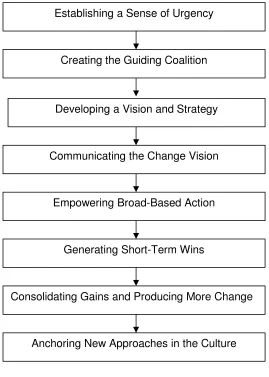
change efforts. The model, illustrated in Figure 1 advocates a top down approach, championing the concept of a shared vision and empowering people to act on the vision.
Figure 1: The Eight-Stage Process of Creating major Change
Kotter (1996, p.21) Establishing a Sense of Urgency
Creating the Guiding Coalition
Developing a Vision and Strategy
Communicating the Change Vision
Empowering Broad-Based Action
Generating Short-Term Wins
Consolidating Gains and Producing More Change
14
Throughout the process, Kotter argues that the impact of the quality of leadership is crucial and correct sequencing of the stages is relatively important. The broad stroke effect of breaking down organisational change into a series of steps has obvious limitations in its application to the multitude of potential changes scenarios and their specific contexts. Change depends heavily on situational variables and no one model has a universal application. Kotter takes a strategic approach that focuses on the internal organisation and places little emphasis on the external environment. He also fails to take into consideration the human dynamics of change and the intrinsic transition of the process.
2.4 TUPE Transfer
15
Cooke et al. (2004) argue that whilst TUPE Regulations are designed to protect employment rights, the nature of the employment relationship will change because the new employer will not be aware of all of the implicit agreements between the transferor employer and employee. This suggests, that whilst the formal contract between employee and employer will be protected, the ‘psychological contract’ i.e. the mutual beliefs, perceptions, and tacit understandings between an employer and an employee could be arbitrarily and secretly changed by either party (Guest 1998). It should be noted however, that the nature of the employment relationship will not always change for the worse and that although the transfer is mandatory in nature, aspects of the working environment may improve for the employee for example opportunities for promotion and training (Cooke et al. 2004).
16
aspects of TUPE transfer will therefore be largely similar to those involved in the merger and acquisition process.
2.5 Psychological and Social Effects of Transfers and Mergers
Cartwright and Cooper (1992) propose the reasons for the high failure rate of mergers cannot be explained in purely economic terms and that human factors need to be examined if we are to understand what goes wrong. Horwitz et al. (2002) agree and note that ignoring human resource and cultural issues will create long-term hidden costs. Seo and Hill (2005) contend that it is difficult to manage this type of large-scale change because of the impact on employees, such as turnover, stress, layoffs and illness.
17
18
the same alliance to the new firm. Therefore there may be an increase in turnover.
Transitions that involve job losses have been shown to create a range of undesirable consequences in the survivors. Brockner (1992) reports symptoms of distrust, job insecurity, reduced motivation and depression leading to decreased performance. Fugate et al. (2002) comment that as organisational commitment reduces, employees are less involved with the job and more inclined to seek alternative employment.
2.6 Staff Transitions
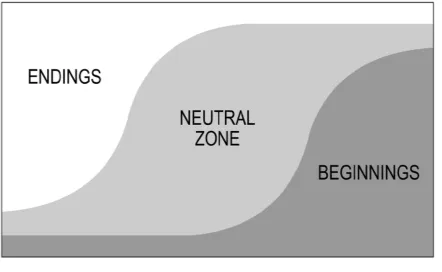
Bridges (2002) describes change as situational, for example the location, team role or policies and transition as the psychological process people go through to come to terms with the new situation. His three-phase model is similar to Lewin’s but gives deeper insight into the emotional and psychological effects:
1. The Ending: Letting go of the comfort and safety of the past and their old way of doing their jobs. During this phase people are dealing with loss and may experience anxiety, blame, fear and shock.
19
is a high degree of uncertainty and people experience anxiety and confusion.
3. The New Beginning: Accepting and operating effectively in the new changed environment. People experience integration and develop a new identity.
20
Figure 2: The Three Phases of Transition
Bridges (2002, p.70)
21
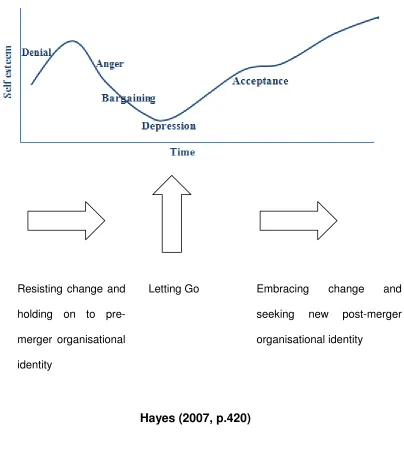
will be unable to move forward and embrace the new reality. For managers there is an important implication; that rather than treat emotions such as anger and depression as a problem, they should be acknowledged as a normal reaction to change or loss and mechanisms should be established to encourage the healthy expression of emotions and bring these processes to the surface.
Figure 3: Psychological Transition Phases
Resisting change and
holding on to
pre-merger organisational
identity
Letting Go Embracing change and
seeking new post-merger
organisational identity
22
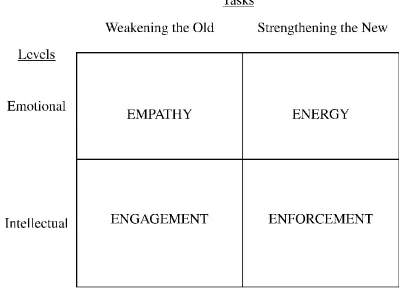
Marks (2007), presents a framework for facilitating adaptation to organisational transition (see Figure 4). He argues that transition presents an opportunity for both individual and organisational renewal but for that to happen employees must progress through a natural process of adaptation.
The framework consists of two tasks: weakening and ending forces that maintain the old position and strengthening forces that will lead to acceptance of the new. The tasks operate at two levels, emotional and intellectual and produce the four elements required for adaptation to the transition:
1. Empathy. Communicating to employees that management understand the situation is difficult and acknowledging and accepting their feelings.
2. Engagement. Getting employees to understand and support the need to end the old and accept the new.
3. Energy. Getting employees excited about the prospect of the new organisation and support them to move through the adaptation process. 4. Enforcement. Solidifying a new set of perceptions, expectations and
23
Figure 4:
Marks (2007)
24
Table 1.
Employee-level dynamics during the merger and acquisition process: management implications
Key Factor Why it’s important
Perceived management competence
Direct impact on employee’s identity with the newly consolidated company
Procedural justice Direct impact on the new established company and perceived employee support from the company
Cultural discontinuity Co-mingling companies with vastly different cultures has a negative effect on establishing a new identity for the new company
Employee identification Identifying with the new company improves job satisfaction and citizenship behaviours Perceived organisational
support
Leads directly to feelings of job satisfaction
Creasy et al. (2009)
2.7 Social Identity
25
previous organisation and develop negative perceptions of the new employer. This can generate serious conflict (Marks and Mirvis 2001). Where the transferring staff perceive the new organisation to have a higher status, they are more ready to set aside their old identity and embrace the new.
Van Dick et al. (2006) developed a model that aims to sustain organisational identification and increase job security during a merger. Firstly they argue that managers should aim for continuity in work routines, teams and communication channels. Secondly there should be clear and ongoing communication which also should consistently stress the positive elements of the new organisation. There is an important caveat to this, in that the communication must be genuine in that if it is used merely to manipulate the employees this can backfire and have serious consequences.
26
2.8 Developing a Conceptual Model
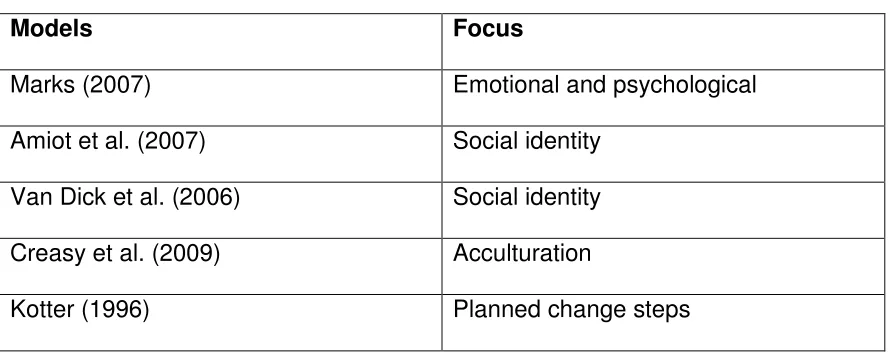
TUPE presents organisations with unique challenges, both in the way the change process is managed and facilitating the staff transition and integration. Whilst there are elements of planned change involved in the process, the highly prescriptive manner in which the transfer takes place, both through legislative requirements and because access to transferring employees is restricted by the outgoing employer means that no single model fits the context. In addition, the focus of this study is the transition of staff and their acculturation, together with the effectiveness of the change management process. This requires a combination of models that place different emphases on the steps to managing change and the emotional, social and cultural aspects of change and transition. For the purpose of developing a conceptual model, the author has combined relevant elements from a range of models, each with a different focus (see Table 2).
Table 2.
Models Focus
Marks (2007) Emotional and psychological Amiot et al. (2007) Social identity
Van Dick et al. (2006) Social identity Creasy et al. (2009) Acculturation
27
There are areas of similarities between the models and overlap which have been indicated. There are also aspects that do not fit the context of this study which have been omitted. Finally each model offers aspects of uniqueness to the final conceptual model that provides a comprehensive framework that will address the research objectives.
28
Figure 5.
Conceptual Model for TUPE Transfer
29
CHAPTER 3
METHODOLOGY
3.1 Research Philosophy
An understanding of research philosophy and methodology is essential so that the most appropriate design and methods can be applied to address the research objectives. Easterby-Smith et al. (2010) describe two ways of thinking about research philosophy as shown in table 3:
Table 3.
Epistemology Assumptions about the best ways of enquiring into the nature of the world Ontology Assumptions about the nature of reality Easterby-Smith et al. (2010) give three reasons why understanding research philosophy is useful:
1. It can help clarify research designs, including how it is gathered, interpreted and how this will provide answers to the research questions. 2. It will help clarify the limitations of specific approaches.
3. It can help the researcher understand designs outside their experience and adapt these according to the constraints of the subject.
30
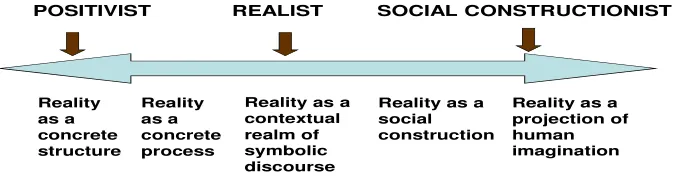
Figure 6. Continuum of ontological assumptions
POSITIVIST REALIST SOCIAL CONSTRUCTIONIST
Reality as a projection of human imagination Reality as a
social construction Reality as a
contextual realm of symbolic discourse Reality
as a concrete process Reality
as a concrete structure
Morgan. and Smircich (1980)
31
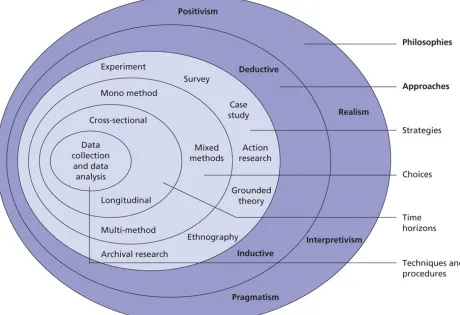
Figure 7. The research onion
Saunders et al. (2009)
3.2 Positivism
32
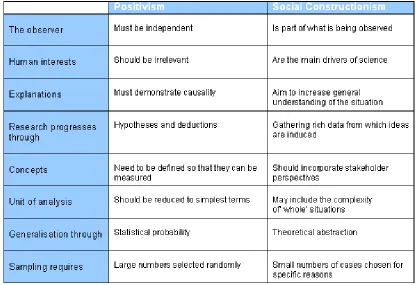
perspective suggests a certain value position (Saunders et al. 2009). Positivism seeks causal explanations and laws, reducing observations to hard facts with an emphasis on structured methodology to facilitate replication. Despite the attractiveness of this approach, history tells us that major scientific advancements are not the product of such logical and rational methods but from independent and creative thinking (Easterby-Smith et al. 2010).
3.3 Social Constructionism
Social constructionism is at the other end of the continuum of ontological assumptions to positivism. The social constructionist approach, assumes that reality is holistic and socially constructed, rather than objectively determined. This view developed out of the application of the positivist model in the social sciences in the last half of the twentieth century. According to this approach, the researcher should not simply gather facts, but rather appreciate the different meanings and understanding people place upon their own experiences and the reasons for these differences. The social constructionist philosophy aims to interpret and explain a phenomenon, rather than search for laws and external causes (Easterby-Smith et al. 2010). Analysis is therefore subjective, through sensation, reflection or intuition (Remenyi et al. 1998).
33
Table 4. Contrasting implications of positivism and social constructionism
(Easterby-Smith et al. 2010)
34
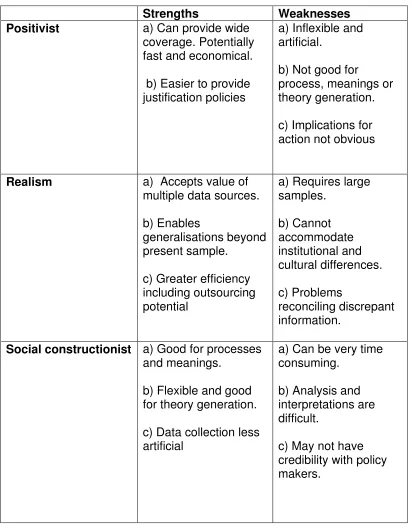
Table 5. Strengths and weaknesses of the different epistemologies
Strengths Weaknesses
Positivist a) Can provide wide coverage. Potentially fast and economical. b) Easier to provide justification policies
a) Inflexible and artificial.
b) Not good for
process, meanings or theory generation. c) Implications for action not obvious
Realism a) Accepts value of multiple data sources.
b) Enables
generalisations beyond present sample.
c) Greater efficiency including outsourcing potential
a) Requires large samples. b) Cannot accommodate institutional and cultural differences. c) Problems reconciling discrepant information.
Social constructionist a) Good for processes and meanings.
b) Flexible and good for theory generation. c) Data collection less artificial
a) Can be very time consuming.
b) Analysis and interpretations are difficult.
c) May not have credibility with policy makers.
35
3.4 Realism
The realist position is based on the assumption that reality is what the senses show us and that objects exist outside the human mind (Saunders et al. 2009).
To understand this philosophy the two forms of realism are contrasted below:
• Direct realism states that what we experience through our senses is the true nature of reality.
• Critical realism states that our senses only give us images of the world and that reality could be quite different, for example the senses can be deceived by an optical illusion.
Critical realism is a compromise between the extreme epistemological positions, recognising that social conditions can be physically observed but also that concepts are human constructions (Easterby-Smith et al. 2010).
From the realist perspective it can therefore be understood that gaining access to reality from one method can be problematic and that a number of approaches should be used when designing research. This technique is called triangulation.
36
Table 6. Methodological implications of different epistemologies
3.5 Philosophical Position
The aim of this research is to understand how Bridge can improve its change management approach during the TUPE process to be more effective at integrating transferring staff into the organisation.
37
3.6 Research Strategy
There are a range of research strategies including survey, case study, experimental, longitudinal, field work and action research. The research question and objectives will inform the choice of research strategy, data collection and analysis techniques and the timescale over which the research is undertaken (Saunders et al. 2009). A single case study design has been chosen as this generally focuses on a single or small number of organisations, events or individuals over time. The single case study tends to come from a social constructionist epistemology, with advocates for multiple cases fitting with the realist or positivist approach (Easterby-Smith et al. 2010).
Yin (2002) cited in Easterby-Smith et al. (2010) advocates the use of case study in social sciences but outlines the limitations, in particular the lack of scientific rigour, lack of generalisability and huge amounts of data produced which enables researchers to apply their own interpretations. He suggests therefore, that case studies should be clearly designed covering the main questions, unit of analysis and procedures for interpreting data.
38
exploratory research and can be a worthwhile way of exploring existing theory (Saunders et al. 2009).
3.7 Research Methodology
In social science research, the technique of triangulation can be used to overcome problems of bias and validity. In this context, it involves the use of multiple methods and measures of a phenomenon (Cox and Hassard 2005).
Whilst a social constructionist approach is used in this research study, it would be wrong to assume that this limits the research to qualitative methods of data collection (e.g. interviews, focus groups). Firstly because any of the research methods can produce quantitative (numbers) or qualitative (words) data and secondly because numbers can enrich the presentation of social constructionist research (Fisher et al.2010). In practice therefore, any of the research methods can be used in any of the approaches.
For the purpose of this study, three different techniques have been identified: self-completion questionnaires, semi-structured interviews and secondary data analysis.
Sample Size
39
Where it is manageable to collect data from the entire population it is not necessary to select a sample (Saunders et al. 2009). Stutely (2003) cited in Saunders et al. (2009) advises that where the population is less than 30 you should normally collect data from all cases to allow statistical analysis. A smaller population also enables:
• More time to design and pilot the means of collecting data.
• Collection of more detailed data.
• More time trying to obtain data from more difficult to reach cases.
The author’s intention is to interview and distribute questionnaires to the maximum number of employees possible where it is ethical and practical to do so.
40
Table 7. 1st January 2011 employment status of staff transferred to Bridge
Type of Employee
Employment Relationship/Status Self-Completion
Questionnaires Semi-Structured Interviews 1 Chief Executive
Redundant at 1st July 2010 for economic, technical and organisational reasons.
No No
1 Service Manager
Redundant at 1st July 2010 for economic, technical and organisational reasons.
No No
5 Drug Workers Employed by Bridge and in work throughout the transfer period
Yes Yes
2 Drug Workers Employed by Bridge but on
maternity leave throughout transfer period
Yes Yes
3
Administrators
Employed by Bridge and in work throughout the transfer period
Yes Yes
1 Drug Worker Employed by Bridge and in work throughout the transfer period. Redundant at 31st March 2011 for economic, technical and
organisational reasons.
Yes Yes
1 Administrator Employed by Bridge and in work throughout the transfer period. Obtained alternative employment and resigned from Bridge with effect from 7 January 2011.
Yes Yes
Secondary Data Analysis
41
Furthermore, there can be a high degree of reliability and validity as it is anonymous and there are no consequences for respondents providing truthful answers. However, the data may lack quality and not be specific to the context.
Saunders et al. (2009) describes three main sub-groups of secondary data: documentary data, survey-based data and data from multiple sources.
The author has access to the following sources of raw, documentary secondary data:
• Minutes of meetings and consultation events relating to the TUPE
process.
• Minutes of staff team meetings post transfer.
• Staff supervision notes, appraisal and exit interviews.
These sources will be used to provide qualitative data relevant to the research objectives.
Self-Completion Questionnaires
42
identified in Table 7 using the delivery and collection technique (Saunders et al. 2009). Time will be set aside for staff to complete the questionnaire during the working day and the Team Manager will arrange for their distribution and collection to encourage completion rates. Questionnaires will be designed to be anonymous and voluntary participation in the research will be emphasised.
Advantages of this method include time and cost efficiency, consistency in the way questions are asked and the anonymous approach reduces the effect of the interviewer’s presence leading to responses that the interviewee deems to be socially acceptable. Disadvantages include closed questions that limit depth of responses, lack of opportunity to qualify responses and inconsistency in the way questions are understood.
The questionnaire will be piloted with one administrator, one drug worker and one of the staff who was on maternity leave to allow modifications to the design.
Semi-Structured Interviews
Saunders et al. 2009 categorise interviews as structured, semi-structured or unstructured. Where the questions are either open ended or complex, structured interviews would be less appropriate (Easterby-Smith et al. 2010).
43
and allowance made for additional questions to explore the emerging issues. This technique offers a higher level of reassurance to the interviewee as it tends to be more personal and has a higher degree of confidentiality than structured interviews. It also offers the interviewer the opportunity to identify non-verbal clues such as tone of voice and facial expressions that can be used to develop secondary questions.
44 Secondary Data Analysis Reduced time and cost to complete + High quality recent data + Anonymity with truthful responses + More time for data analysis + Difficult to analyse due to volume and variety of data - Familiar with data + No control over data quality - Not specific enough to area of research - Lack of opportunity for more comprehensive replies. Difficult to make
forced choice answers mutually exclusive - No face to face contact. Lack of visual clues - Data may be uniformed - Self-Completion Questionnaires Low cost and time to complete + High quality recent data + Anonymity with truthful responses + Efficient method of data collection + High comparability of answers and easy to analyse + Familiar with data + Control over data quality. Closed questions can clarify meaning for respondents + Questions designed to ensure context specific + Lack of opportunity for more comprehensive replies. Difficult to make
forced choice answers mutually exclusive - No face to face contact. Lack of visual clues - Answers may be uniformed - Semi-Structured Interviews Some cost and high completion time - High quality recent data + Lack of anonymity with lack of truthful responses - Time consuming process for data collection - Difficult to analyse and compare answers due to varying structure of interviews - Familiar with data + Reduced control over data quality. Open questions and less structure - Questions designed to ensure context specific + Good opportunity to gain more comprehensive
replies. Improved flexibility to
answer questions freely
- Face to face contact. Ability to identify visual clues + Ability to clarify content and nature of questions with interviewee + Triangulation Achieved
YES YES YES YES YES YES YES YES YES YES YES
45
3.8 Validity
Saunders et al. (2009, pp. 603) define validity as:
1. ‘The extent to which data collection method or methods accurately measure what they were intended to measure.’
And:
2. ‘The extent to which research findings are really about what they profess to be about.’
This research is based on a single case study and only has internal validity to Bridge. It cannot be used to generalise for other organisations.
Robson (2002) cited in Saunders et al. (2009) provides a framework that can be used to evaluate the threats to validity. Relevant aspects of this framework are discussed below.
History
46
have done otherwise. However, for some employees reduced feelings of hostility towards Bridge may make them more objective in their evaluation of the transfer.
Mortality
The small size of the population under research means that any employees who drop out of the study may threaten validity. Efforts will be made to re-engage staff who leave Bridge employment for inclusion in the research. It is important to acknowledge the two managers that were made redundant who have been excluded for ethical reasons, may be a threat to validity. These individuals have grievances against Bridge and may have been able to offer important insights. Some secondary data, for example transcripts of group consultation events may offer valid data relating to these specific issues.
Maturation
Interviews and questionnaire completion will be taking place at least six months post transfer. The time lapse and events during the intervening period may affect employees recollection and perception of the transfer process.
3.9 Reliability
47
Robson (2002) cited in Saunders et al. (2009) describe four threats to reliability which are discussed below.
Subject or Participant Error
Employees’ views of how effectively Bridge managed the transfer process and their integration into the organisation, may be affected by the time of the week they are interviewed or complete the questionnaire. To offset the potential for this error, efforts will be made to arrange for the questionnaire to be completed and interviews conducted at a time when employees are not normally busy, for example during the middle of the week.
Subject or Participant Bias
One of the major threats to the reliability of the research is the author’s role as a senior manager and the effect this will have on employees’ openness and honesty. Employees participating in the research may feel particularly vulnerable, as it has already been identified in the literature review that staff transitions may cause feelings of job insecurity
48
Observer Error
To reduce observer error interviews will be recorded with the permission of the participant and will all be undertaken by the author.
Observer Bias
The author is aware that his own attitudes and values may cause bias and the results of the research may highlight aspects of the author’s performance as chief executive. This threat to reliability may be reduced by clarifying with the participant what they were trying to say, when there is any ambiguity to their responses.
3.10 Research Ethics
Research ethics relates to ‘the appropriateness of the researcher’s behavior in relation to the rights of those who become the subject of a research project, or who are affect by it’ (Saunders et al., 2009, pp. 600).
The research will comply with the University’s Code of Practice and Data Protection Act (1998).
49
In respect of participants involved in the research for the purpose of collecting primary data, informed consent will be obtained in all cases. Participants will be given comprehensive written information about participation, their rights and use of data. This will include their right to withdraw from the research at any time.
Confidentiality will adhered to at all times and all data will be anonymised. Care will also be taken to report the data in a manner that will be non-attributable to individuals. Individuals’ rights to privacy and respect will include aspects such as ensuring a confidential, secure environment for undertaking interviews and sensitivity to participants’ comfort and feelings when asking questions.
A rich source of secondary data will include staff records and data held by the organisation on former employees. Section 7 of the Data Protection Act (1998) gives an individual the right to be informed by someone using their personal data what data is held, the purposes for which it is held and to whom it may be disclosed. However, under Section 33 personal data processed only for research purposes is exempt, provided that:
1. Data is not processed to support measures or decisions with respect to individuals.
50
3. The results of the research or any resulting statistics are not published in a form which identifies individuals.
51
BIBLIOGRAPHY
1. Amiot, C. E., Terry, D. J. and Callan, V.J. (2007) Status, equity and social identification during an intergroup merger: A longitudinal study. British Journal of Social Psychology, 46(3) pp. 557 – 577
2. Balogun, J. and Hope-Hailey, V. (2008) Exploring Strategic Change. 3rd ed. London: Prentice Hall
3. Bamford, D.R. and Forrester, P.L. (2003) Managing planned and emergent change within an operations management environment.
International Journal of Operations & Production Management, 23(5) pp.546-564
4. Barnard, S. (2008) Developing organisational learning in the Ambulance Service: An evaluation of the North West Ambulance Service’s ability to
learn and develop knowledge from adverse incidents to improve
organisational performance. MBA. Bolton University
5. Bridges, W. (2002) Managing Transitions making the Most of Change. 3rd ed. Reading, MA: Addison-Wesley
6. Brockner, J. (1992) Managing the Effects of Layoffs on Survivors.
52
7. Bullock, R.J. and Batten, D. (1985) It’s just a phase we’re going through: a review and synthesis of OD phase analysis. Group and Organization Studies, 10(4) pp. 383-412
8. Burnes, B. (2009) Managing Change. 5th ed.London: Prentice Hall.
9. Burnes, B. (2004) Emergent change and planned change – competitors or allies? International Journal of Operations & Production Management,
24(9) pp.886-902
10. Carnall, C.A. (2003) Managing Change in Organizations. 4th Ed. London: Prentice Hall.
11. Cartwright, S. (2005) Mergers and Acquisitions: An Update and Appraisal. In: Hodgkinson, G.P and Ford, J.K. (Eds) International Review of Industrial and Organisational Psychology, 20, Chichester: JohnWiley and Sons, pp1-38
12. Cartwright, S. and Cooper, C.L. (1992) Mergers and Acquisitions: The Human Factor, Oxford, UK: Butterworth-Heinemann Ltd
53
http://www.cipd.co.uk/subjects/emplaw/tupe/tupe.htm?IsSrchRes=1[Acces
sed 3 December 2010]
14. Chattopadhyay, P., Glick, W.H. and Huber, G.P. (2001). Organizational
Actions in Response to Threats and Opportunities. Academy of
Management Journal, 44(5) pp.937-955.
15. Collins, D. 1998, Organisational Change — Sociological Perspectives, New York: Routledge
16. Cooke, F.L., Earnshaw, J. Marchington, M. And Rubery, J. (2004) For better and for worse: transfer of undertakings and the reshaping of employment relations. The International Journal of Human Resource Management, 15(2) pp. 276-294
17. Cox, J.W. and Hassard, J. (2005) Triangulation in Organizational Research: A Re-Presentation, Organization, 12(1) pp.109-133
18. Creasy, T., Stull, M. and Peck, S. (2009) Understanding employee-level dynamics within the merger and acquisition process. Journal of General Management, 35(2) pp. 21-42
54
20. Dawson, P. (2003) Reshaping Change: A Processual Perspective.
London: Routledge
21. Department for Business Innovation and Skills. (2009) Employment Rights on the Transfer of an Undertaking: A guide to the 2006 TUPE Regulations
for employees, employers and representatives [Online] Available from:
http://www.berr.gov.uk/files/file20761.pdf [Accessed 3 December 2010]
22. Easterby-Smith, M., Thorpe, R. and Jackson, P. (2010) Management Research. 3rd Ed. London: SAGE.
23. Fisher, C. Buglear, J. Lowry, D. Mutch, A and Tansley, C. (2010)
Researching and Writing a Dissertation: An Essential Guide for Business
Students. 3rd ed. Harlow: Pearson Education
24. Fletcher, C. (2009) TUPE Still Going Strong. Tolley's Employment Law Newsletter,14(10) pp.75-77.
55
26. Fugate, M., Kinicki, A.J., and Prussia, G.P. (2008). Employee coping with organizational change: An examination of alternative theoretical perspectives and models. Personnel Psychology, 61(1) pp.1-36.
27. Guest, D.E., (1998) Is the psychological contract worth taking seriously?
Journal of Organizational Behavior, 19(1) pp. 649-664
28. Hayes, J. (2007) The Theory and Practice of Change Management. 2nd ed. Hampshire: Palgrave Macmillan
29. Hirschman, A.O. (1970) Exit, Voice, and Loyalty: Responses to Decline in Firms, Organizations, and States. Cambridge, MA: Harvard University Press
30. HM Treasury (2006) The Public Contracts Regulations [Online] Available from:
http://www.legislation.gov.uk/uksi/2006/5/pdfs/uksi_20060005_en.pdf
[Accessed 3 December 2010]
56
culture in mergers and acquisitions. South African Journal of Business
Management, 33(1) pp. 1-10
32. Johnson, G. Scholes, K. And Whittington, R. (2008) Exploring Corporate Strategy. 8th ed. London: Prentice Hall
33. Kanter, R. M., Stein, B. A. and Jick, T.D. (1992) The Challenge of Organisational Change. New York:The Free Press
34. Kiefer, T. (2005) Feelingbad: antecedents and consequences of negative emotions in ongoing change. Journal of Organizational Behaviour, 26(8) pp875-897
35. Kotter, J.P. (1996) Leading Change. Boston: Harvard.
36. Kubler-Ross, E. and Kessler, D. (2005). On Grief and Grieving: Finding
the Meaning of Grief Through the Five Stages of Loss. New York: Scribner
37. Lancaster, G.A. (2005) Research Methods in Management: A Concise Introduction to Research in Management and Business Consultancy
Oxford:Elsevier Butterworth Heinemann
57
39. Lipponen, J. Olkkonen, M. E. and Moilanen, M. (2004) Perceived procedural justice and employees response to an organizational merger.
European Journal of Work and Organizational Psychology, 13(3) pp.391-413
40. Liu, Y. and Perrewe, P.L. (2005) Another look at the role of emotion in the organizational change: A process model. Human Resource Management Review. 15(4) pp.263-280
41. Marks, M.L. (2007) A framework for facilitating adaptation to organizational transition. Journal of Organizational Change Management, 20(5) pp.721–739
42. Marks, M. L. and Mirvis, P. H. (2001) Making mergers and acquisitions work: Strategic and psychological preparation. The Academy of Management Executive, 15(2) pp.80- 92.
58
44. Morgan, G. and Smircich, L. (1980) The case for qualitative researchThe Academy of Management Review, 5(4) pp. 491-500
45. Remenyi, D. Williams, B. Money, A. and Swartz, E. (1998) Doing Research in Business and Management. London: Sage Publications
46. Saunders, M. Lewis, P. and Thornhill, A. (2009) Research Methods for Business Students. 5th Ed. Harlow: Pearson Education.
47. Schweiger, D. And Denisi, A. (1991). Communication with Employees
Following a Merger: A Longitudinal Field Experiment. Academy of
Management Journal, 34(1) pp110-135.
59
49. Tajfel, H. and Turner, J. (1979). An Integrative Theory of Intergroup Conflict. In: Austin, W.G. and Worchel, S (Eds) The Social Psychology of Intergroup Relations, Monterey, CA: Brooks-Cole, pp. 94–109
50. The Bridge Project. (2009) Trustees' Annual Report and Financial Statements [Online]. Available from: < http://www.charity-commission.gov.uk/ScannedAccounts/Ends56/0000517356_ac_20090331
_e_c.pdf > [Accessed 25 November 2010]
51. Van Dick, R., Ullrich, J. and Tissington, P. A. (2006) Working under a black cloud: How to sustain organizational identification after a merger.
British Journal of Management, 17, pp. 69-79
52. Weick, K. E. and Quinn, R. E. (1999) Organizational change and development, Annual Review of Psychology, 50(1) pp.361-386
53. Wilson, D.C. (1992) A Strategy of Change: Concepts and Controversies in the Management of Change. London: Routledge
60
Board of Trustees:
Team Manager IMPACT
Administration and data collection Carer’s Service:
Stimulants Service
Young Person’s Service Women’s Clinic:
Men’s Clinic / Adult Services:
DIP
Dual Diagnosis
Hostel Liaison Worker
Volunteer Co-ordinator
Receptionist
Drugs Workers
ETE Workers
Gym
Needle Exchange
Benzodiazepine worker:
Team Manager Non-prescribing Team Manager Prescribing
Chief Executive
Director of Operations Director of Human Resources
Team Manager S&W
South and West Team:
(Admin / receptionist)