The Open Journal of Occupational Therapy
The Open Journal of Occupational Therapy
Volume 8
Issue 1 Winter 2020 Article 6
January 2020
Defining Mobile Tech Posture: Prevalence and Position Among
Defining Mobile Tech Posture: Prevalence and Position Among
Millennials
Millennials
Nathan Short
Huntington University - USA, [email protected]
Michelle Mays
Huntington University - USA, [email protected]
Alex Cool
Huntington University - USA, [email protected]
Ariana Delay
Huntington University - USA, [email protected]
Ali Lannom
Huntington University - USA, [email protected]
See next page for additional authors
Follow this and additional works at: https://scholarworks.wmich.edu/ojot
Part of the Occupational Therapy Commons
Recommended Citation Recommended Citation
Short, N., Mays, M., Cool, A., Delay, A., Lannom, A., O'Donnell, L., & Stuber, R. (2020). Defining Mobile Tech Posture: Prevalence and Position Among Millennials. The Open Journal of Occupational Therapy, 8(1), 1-10. https://doi.org/10.15453/2168-6408.1640
This document has been accepted for inclusion in The Open Journal of Occupational Therapy by the editors. Free, open access is provided by ScholarWorks at WMU. For more information, please contact
Background: Mobile technologies have revolutionized daily life, significantly impacting ADLs and IADLs, as well as use of the hand and upper extremity. The primary objectives of this study are to (a) provide a formal goniometric description of mobile tech posture and (b) examine the prevalence of this sub-optimal posture among a group of graduate students.
Method: This study used a cross-sectional study design. Comprehensive goniometric measurements of the neck and upper extremity were taken with participants (N = 46) using their mobile devices while texting or using the Internet. Handheld usage data from the iPhone Screen Time feature (iOS 12) was collected from a sample of healthy young adults.
Results: The participants spent an average of 143 min per day using mobile technology. Comprehensive goniometric measurements highlighted positions of clinical concern, including cervical spine flexion, scapular protraction, elbow flexion, and wrist ulnar deviation with thumb flexion.
Discussion: Findings aligned with prior research suggesting several hr per day of handheld mobile technology use among young adults. Mobile tech posture, as described by goniometric trends, includes several positions of concern for musculoskeletal imbalance or cumulative trauma disorders (e.g., cubital tunnel syndrome; De Quervain’s tenosynovitis). Further research is recommended to examine broader societal trends and impact on occupational performance.
Comments
The authors report that there are no potential conflicts of interest to disclose.
Keywords Keywords
technology, upper extremity, occupation
Cover Page Footnote Cover Page Footnote
Our sincere thanks for the extensive peer-review and editorial feedback to strengthen our manuscript.
Complete Author List Complete Author List
Nathan Short, Michelle Mays, Alex Cool, Ariana Delay, Ali Lannom, Laryn O'Donnell, and Ruth Stuber
Credentials Display
Nathan Short, OTD, CHT; Michelle Mays, OTD, CHT; Alex Cool; Ariana Delay; Ali Lannom; Laryn O'Donnell; Ruth Stuber
Copyright transfer agreements are not obtained by The Open Journal of Occupational Therapy (OJOT). Reprint permission for this Applied Research should be obtained from the
corresponding author(s). Click here to view our open access statement regarding user rights and distribution of this Applied Research.
DOI: 10.15453/2168-6408.1640
Information and Communication Technologies (ICT) are becoming increasingly integrated into modern daily life (Ciccarelli, Straker, Mathiassen, & Pollock, 2014). ICT includes various technological devices, such as cell phones, laptop computers, desktop computers, and tablets. Approximately 95% of adults in the United States own a cell phone and 73% own a computer (Pew Research Center, 2019).
Domestically, 83% of Americans are “mobile Internet” users, going online at least occasionally with a smartphone, tablet, or other device. Among the young adult demographic (18 to 29-year-olds), 40% report using mobile technology to go online “almost constantly” (Perrin & Kumar, 2019, para. 1). A recent Nielsen study found that U.S. adults also spend approximately 2.5 hrs per day using mobile technology in the form of smartphones and tablets (The Nielsen Company, 2018).
Instrumental activities of daily living (IADLs) are defined in the Occupational Therapy Practice Framework (OTPF) as “activities to support daily life within the home and community that often require more complex interactions than those used in ADLs” (American Occupational Therapy Association [AOTA], 2014, S19). Categories of IADLs include communication management, financial management, health management and maintenance, as well as shopping. Smartphone and tablet use is included under “communication management”; however, the integration of these devices into daily life has evolved far beyond simple communication into home management, gaming, banking, travel, and health and
lifestyle.
College students demonstrate the highest usage rates of technology, including mobile devices, laptops, and desktop computers, of any adult demographic in the United States (Smith, Rainie, & Zickuhr, 2011). The high rates of technology use among this demographic may not be without
consequence, as Dockrell, Bennett, and Culleton-Quinn (2015) found that musculoskeletal symptoms (MSS) were prevalent in 52.8% of college student laptop users with increasing prevalence with each additional year of college. Participants also reported their symptoms impacted occupational
performance, specifically work (18.3%) and leisure activities (23.6%) (Dockrell, Bennett, & Culleton-Quinn, 2015).Short-term symptoms have also been identified with more than 60% of students reporting low back discomfort and numbness in the neck region after using technology for an extended period (Hough & Nel, 2017).Erdinc (2011) found upper-extremity musculoskeletal discomfort was most prevalent in the neck, upper back, and lower back among laptop users.Portability of these devices increased unhealthy postures, leading to discomfort or injury (Gautam & Chacko, 2017).
While the portability of laptop computers may contribute to their use with sub-optimal posture (e.g., while lying in bed or sitting on a couch), laptops may also be used in ergonomically-designed workstations or, at the very least, a tabletop of appropriate height (Gautum & Chacko, 2017). In contrast, handheld mobile technologies are often held unsupported in space, requiring further physical adaptation and postural compromise on the part of the user. Gold et al. (2012) described general postural patterns when interacting specifically with handheld mobile technologies. The smaller size required accommodation of the neck and upper extremities to bring the device into the visual field with more precise fine motor movements of the hand and digits to interface (Gold et al., 2012).
Research has also identified a trend of handheld mobile device use and musculoskeletal
symptoms in the upper extremity among university students, faculty, and staff. A large majority of the sample (84%) reported symptoms with a specific association found between time spent browsing the Internet and pain in the base of the right thumb (Berolo, Wells, & Amick III, 2011). These findings support the premise that increased use of mobile technology may contribute to specific musculoskeletal symptoms, encouraging further examination of the physical demands on the upper extremity when
1 Short et al.: Mobile tech posture
interacting with handheld mobile technology. An examination of the static posture assumed when interacting with mobile devices may provide a foundation for further examination of physical demands as well as potential impact on occupational performance.
The term tech posture, or “tech neck”, is often used in articles related to ergonomics or
workstation design to describe general postural compromise and associated pain when using technology (Khalaf, 2019). The term is used to describe posture when interfacing with any type of technology, though posture at a workstation varies widely from posture when using mobile technology. For the purposes of this study, mobile tech posture, as a concept, indicates the position a person assumes to interface with a mobile device (i.e., smartphone or tablet) in a seated or standing position. While using a laptop or computer workstation are also on the spectrum of general “tech posture”, mobile tech posture is a more extreme variant, as it requires interaction with a small, handheld device unsupported by the surrounding environment in the form of a workstation or tabletop. As a result, the human body must further accommodate to the device, resulting in prolonged, awkward posturing of the head, neck, and upper quarter.
The literature describes general postural compromise of the upper body, including forward head and rounded shoulders, commonly present with prolonged sitting and fatigue of the upper body. Forward head refers to the head positioned anteriorly out of the frontal plane, or forward relative to the shoulders, with cervical-spine flexion. Rounded shoulders describe a position in which the scapulae are protracted and tilted anteriorly out of the frontal plane (Oatis, 2009). Colloquially referred to as slouched posture, this position is associated with musculoskeletal imbalance and symptoms, representing a physical limitation to occupational performance (Saunders, Astifidis, Burke, Higgins, & McClinton, 2016). The posture assumed when interacting with small, handheld technology may naturally involve forward head and rounded shoulders to some degree (Gold et al., 2012); however, the literature does not describe a specific, goniometric definition of mobile tech posture, providing the impetus for the current study. The primary objectives of this study are to (a) provide a formal goniometric description of mobile tech posture and (b) examine the prevalence of mobile technology use among a group of graduate students based on smartphone usage data.
Method Study Design
An observational, cross-sectional design was used to gain insight into the biomechanics of mobile tech posture and prevalence of time spent using mobile technology among a healthy sample of graduate students. Data collection included mobile device usage based on Screen Time (Apple, Inc) data and comprehensive goniometric measurements of the neck and upper extremity while using a handheld mobile device.
Sample
A convenience sample for the study consisted of graduate students enrolled in Huntington University’s Doctor of Occupational Therapy (OTD) program. The participants were required to be graduate level students between 20 and 40 years of age who use mobile technology in the form of a smartphone with no known musculoskeletal issues that would impact posture. The sample provided a relatively homogenous group of healthy young adults with a similar lifestyle regarding academic
demands related to technology use. While other lifestyle factors were variable among the sample and not addressed, the students spend equitable amounts of time in class with similar academic demands outside of class.
2 https://scholarworks.wmich.edu/ojot/vol8/iss1/6
Instruments
A data collection template was developed to capture demographic information, mobile device use, estimated time spent using laptop technology, as well as comprehensive range of motion
measurements of the neck and upper extremity. The template underwent multiple revisions based on expert analysis and critique from faculty and student researchers.
Procedure
After receiving university Institutional Review Board approval, the researchers recruited eligible participants through university email and class announcements. Eligible participants were incentivized with a $25 Amazon gift card drawing and door prizes, regardless of completion of the study. Informed consent forms stating the risks of participation were distributed before beginning the study. Each participant was assigned a number based on the order of arrival, which was recorded on his or her data collection template. Raw data were locked in a file cabinet in a faculty office and aggregate, anonymous data was compiled in a password protected Excel spreadsheet for use in writing the manuscript.
The participants completed the self-report portion in person in a quiet room designated for the study.Two researchers were on site to monitor and answer questions. Standardized written and visual instructions were given to the participants in the form of a packet. Only iPhones users with iOS 12, which includes the Screen Time features, were included in data collection regarding smartphone use. The Screen Time feature tracks all smartphone use, including Internet browsing, texting, and specific apps, allowing for standardized usage analysis among the participants. The participants were instructed torecord use of iPhone applications, as reported by Screen Time, that required both hands on the phone (e.g., texting, Internet browsing) while hands-free applications were excluded (e.g., music and video streaming applications) to more specifically quantify time spent in mobile tech posture.
Standardized mobile device use data was obtained only from participants using an iPhone with the Screen Time feature (N = 41). Five of the participants were non-iPhone users and were excluded from the mobile device use data portion of the study. In addition, the participants estimated hours per day they typically spend using laptop technology for classroom use and outside of scheduled class time (see Table 3).
Goniometry measurements were taken by a licensed occupational therapist who was also a certified hand therapist (CHT) with 10 years of clinical experience. The participants were seated on a standard chair of 18” in height with no armrests and asked to hold their mobile device as if they were texting or using the Internet, maintaining the position for the duration of goniometric measurement. The seated position was chosen as the study focused on upper extremity positioning, which was assumed to be minimally impacted by the position of the lower extremities, as the smartphone must still be held in the visual field with the hands positioned to interact with the device. The measurements were taken immediately after the participant began using the smartphone to capture the optimal posture with the assumption that posture may change with fatigue.
Goniometry measurements were taken using universal goniometers with clinically-accepted technique, aligning the goniometer directly on the joint when possible (e.g., digits) or lateral to the joint surface (e.g., elbow). To measure scapular protraction, a novel technique was used as described by Short, Mays, Ford, and Fahrney (2019) using motion of the acromion relative to the superior angle of the scapula as anatomical landmarks. Composite digital flexion was measured as distance from the
respective fingertip to the distal palmar crease.
3 Short et al.: Mobile tech posture
Results
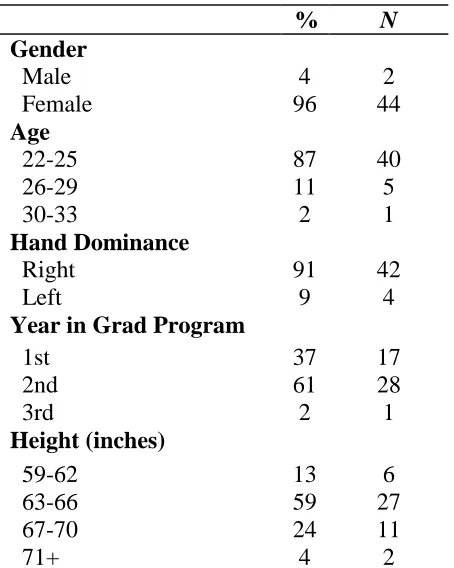
Percentage (%) and sample size (N) were used to describe sample demographics (see Table 1). The sample was largely female (96%), between 22 and 25 (87%) years of age, and predominantly right-handed (91%).
Table 1
Demographics
% N
Gender
Male 4 2
Female 96 44
Age
22-25 87 40
26-29 11 5
30-33 2 1
Hand Dominance
Right 91 42
Left 9 4
Year in Grad Program
1st 37 17
2nd 61 28
3rd 2 1
Height (inches)
59-62 13 6
63-66 59 27
67-70 24 11
71+ 4 2
Descriptive statistics were used to describe mean, range, and standard deviation for time spent in mobile tech posture (see Table 2). As various mobile devices recorded use in different increments (e.g., daily or weekly), the data were calculated to reflect average daily use in min for comparison.
Table 2
Time Spent Using Mobile Devices*
Mean Range (min-max) Stand Dev N
Minutes Per Day 143 33 - 379 70.4 41
Note. *Based on Screen Time data reflecting handheld mobile device use (i.e., texting, Internet browsing).
Table 3
Estimated Laptop Use Per Day
N = 46 1-5 hours 6-10 hours 11-15 hours 16+ hours
In Class 39% (18) 37% (17) 17% (8) 7% (3) Outside of Class 67% (31) 17% (8) 13% (6) 2% (1)
4 https://scholarworks.wmich.edu/ojot/vol8/iss1/6
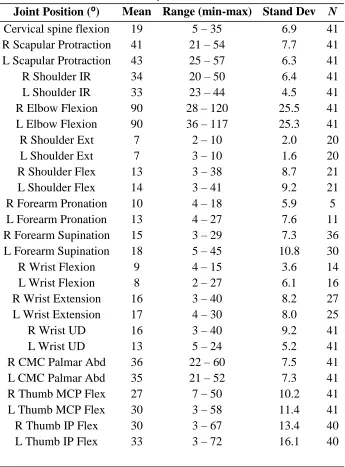
Descriptive statistics were also used to reflect the mean, range, and standard deviation of
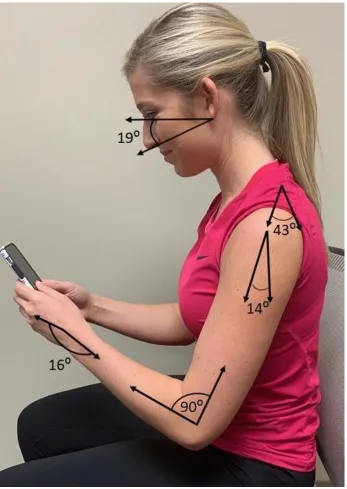
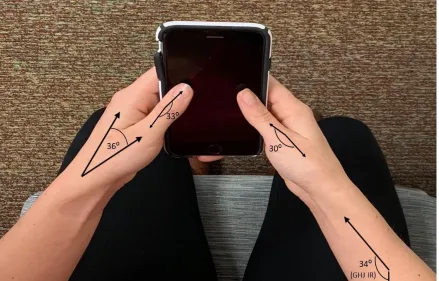
goniometric measurements of each respective joint (see Table 4). Digital flexion is described as distance from the fingertip to the distal palmar crease. Most positions assumed in tech posture were consistent for the entire sample. For example, all of the participants presented in some degree of scapular protraction, shoulder internal rotation, elbow flexion, and wrist ulnar deviation. However, there was some variance in other positions, including shoulder position in the sagittal plane (flexion or extension) and forearm rotation (pronation or supination). The table reflects the number of participants (N) for each specific joint angle for reference. In addition, Figures 1 and 2 provide a visual representation of mean angles at major joints in mobile tech posture. Where a discrepancy exists between right and left upper extremity angles, the larger of the two angles has been noted on the image.
Table 4
Mobile Tech Posture Goniometry
Joint Position (⁰) Mean Range (min-max) Stand Dev N
Cervical spine flexion 19 5 – 35 6.9 41 R Scapular Protraction 41 21 – 54 7.7 41 L Scapular Protraction 43 25 – 57 6.3 41 R Shoulder IR 34 20 – 50 6.4 41 L Shoulder IR 33 23 – 44 4.5 41 R Elbow Flexion 90 28 – 120 25.5 41 L Elbow Flexion 90 36 – 117 25.3 41 R Shoulder Ext 7 2 – 10 2.0 20 L Shoulder Ext 7 3 – 10 1.6 20 R Shoulder Flex 13 3 – 38 8.7 21 L Shoulder Flex 14 3 – 41 9.2 21 R Forearm Pronation 10 4 – 18 5.9 5 L Forearm Pronation 13 4 – 27 7.6 11 R Forearm Supination 15 3 – 29 7.3 36 L Forearm Supination 18 5 – 45 10.8 30 R Wrist Flexion 9 4 – 15 3.6 14 L Wrist Flexion 8 2 – 27 6.1 16 R Wrist Extension 16 3 – 40 8.2 27 L Wrist Extension 17 4 – 30 8.0 25 R Wrist UD 16 3 – 40 9.2 41 L Wrist UD 13 5 – 24 5.2 41 R CMC Palmar Abd 36 22 – 60 7.5 41 L CMC Palmar Abd 35 21 – 52 7.3 41 R Thumb MCP Flex 27 7 – 50 10.2 41 L Thumb MCP Flex 30 3 – 58 11.4 41 R Thumb IP Flex 30 3 – 67 13.4 40 L Thumb IP Flex 33 3 – 72 16.1 40
5 Short et al.: Mobile tech posture
Digital Position (cm from fingertip to distal palmar crease)
R Index Flexion 7.5 5 – 10 1.0 41 L Index Flexion 7.0 5.5 - 9 0.9 41 R Middle Flexion 7.5 6 – 9 .72 41 L Middle Flexion 7.0 5.5 – 9 .82 41 R Ring Flexion 7.0 5 – 8.5 .82 41 L Ring Flexion 6.5 4 – 9 1.0 41 R Small Flexion* 5.5 3.5 – 7 .86 41 L Small Flexion 5.5 2.5 – 8 .99 41
Note. *70% (N = 29) participants rested bottom edge of phone on small finger, accounting for increased small finger flexion relative to other fingers.
Figure 1. Tech Posture: Profile view.
6 https://scholarworks.wmich.edu/ojot/vol8/iss1/6
Figure 2. Tech Posture: Superior view
Discussion
Mobile technology has rapidly become ubiquitous in modern life with 95% of U.S. adults owning a cellular device and spending more than 2.5 hrs per day using smartphone or tablet technology (Pew Research Center, 2019; The Nielsen Company, 2018). The findings of the current study align with and reinforce this statistic with the sample of graduate students averaging 143 min per day (2 hrs, 23 min) using mobile technology according to Screen Time data. This represents a significant proportion of waking hours spent interacting with handheld mobile technology and potential impact on the habits, roles, and routines of the individual. The majority of the sample also reported an additional 1 to 10 hrs of combined laptop use both in and outside of class while other participants reported up to more than 16 hrs per day. While specific laptop posture was not addressed by the study, this ancillary data highlights the extent of technology use beyond handheld mobile devices and suggests an opportunity for further study.
The prevalence of mobile technology use and physical posture required for user interface highlight the need for further examination of the musculoskeletal impact of this trend on the human body and on occupational performance. Unlike a computer workstation, often customized to the individual, mobile technology presents a unique challenge with the individual forced to adapt to the environment, as opposed to the environment adapting to the individual, a core concept of ergonomic design (Haruko Ha, Page, & Wietlisbach, 2018).
The second objective of this study was to provide a goniometric description of mobile tech posture, as opposed to laptop or desktop computer use, as a basis for further analysis. Comprehensive goniometric measurements of the neck and upper extremity were taken with participants in mobile tech posture to provide a more specific biomechanical definition. The findings support prior research that provided gross descriptions of upper body position while interacting with mobile technology (Gold et
7 Short et al.: Mobile tech posture
al., 2012) with more specific mean angles presented for each joint of the neck and upper extremity. In general terms, mobile tech posture consists of neck flexion, scapular protraction, and elbow flexion in the proximal upper extremity (see Figure 1). The wrist is positioned in slight extension and ulnar deviation while the thumb is in palmar abduction at the CMC joint with flexion of the thumb MCP and IP to interface with the monitor (see Figure 2). The digits are in gentle flexion, often with the device resting on the radial aspect of the small (5th) finger.
Some joints presented in near-neutral positions for certain motions, limiting musculoskeletal impact with prolonged posturing. For example, the shoulder demonstrated a small range in the sagittal plane, typically presenting in slight flexion or extension. However, other mean joint angles raise musculoskeletal concerns, including cervical spine flexion (19⁰), scapular protraction (R 41⁰; L 43⁰), shoulder internal rotation (R 34⁰; L 33⁰), elbow flexion (90⁰), and wrist ulnar deviation (R 16⁰; L 13⁰), coupled with thumb palmar abduction (R 36⁰; L 35⁰), flexion at the MCP (R 27⁰; L 30⁰), and IP joint (R 30⁰; L 33⁰).
Consensus regarding optimal posture describes alignment of the ear lobe and acromion process in the frontal plane, maintaining a neutral head and neck (Oatis, 2009). The moderate cervical spine flexion may elongate dorsal extensors (e.g., splenius, semispinalis) while shortening the anterior flexors (e.g., longus, sternocleidomastoid), contributing to muscular imbalance and associated stiffness and discomfort. The predominant scapular protraction also contributes to shortening of the anterior
pectoralis minor with elongation and potential weakness of the scapular stabilizers over time. Interfacing with a small, handheld device also involves the hands coming to midline, requiring glenohumeral joint internal rotation, placing the subscapularis muscle in a shortened position as well. This generally slouched position may contribute to specific pathologies, including sub-acromial impingement, rotator cuff tendinitis, or thoracic outlet syndrome, representing significant physical barriers to occupational performance (Saunders et al., 2016).
Studies have shown decreased cross-sectional area of both the cubital tunnel and ulnar nerve with the elbow flexed, indicating an increased risk for ulnar neuropathy in this position (Gelberman et al., 1998). Considerable elbow flexion is required to bring a handheld device close enough to the head to read the monitor. The sample presented with 90⁰ elbow flexion while seated, which may increase when using mobile technology in a supine position, as when texting in bed, and experiencd numbness of the ring and small fingers. Often transient symptoms subside with extension of the elbow; however, research supports that prolonged elbow flexion potentially lead to pathological cubital tunnel syndrome.
Ulnar deviation coupled with CMC abduction, MCP flexion, and IP flexion elongate the
abductor pollicis longus (APL) and extensor pollicis brevis (EBP). Already under a degree of positional strain, repetitive texting or swiping generates further tension and friction in the first dorsal compartment, increasing the risk of tenosynovitis (De Quervain’s), colloquially known as “texting thumb”. This positional disposition appears to support prior findings of association between mobile device use and thumb pain (Berolo et al., 2011). The symptoms associated with these various cumulative trauma disorders may include pain and discomfort, all of which may broadly impact ADLS and IADLs (Saunders et al., 2016).
Confirming prevalence of use and providing a specific biomechanical description of mobile tech posture, the results of this study highlight the need for further examination of the musculoskeletal impact of mobile technology integration on occupation. An understanding of holistic activity analysis with an
8 https://scholarworks.wmich.edu/ojot/vol8/iss1/6
appreciation for habits, roles, and routines provides occupational therapists with a unique perspective for evaluation and intervention regarding this trend. Intervention may involve preventative strategies,
environmental modification, equipment adaptation, and orthopedic interventions (e.g., physical agent modalities, orthotics) as preparatory methods to promote occupational performance. While it may be difficult to modify posture associated with small, handheld devices, prevention may take the form of awareness of duration spent using mobile technology or stretching to counteract positional
musculoskeletal imbalance. Perhaps solutions will take the form of additional technologies to encourage balance and prevention. New smartphone features, such as Screen Time, not only monitor use but allow for administrative limits on specific apps and scheduled down time to take a break from technology completely. Occupational therapists and other rehabilitative professionals have a key role to play in addressing this trend, which demonstrates the potential for broad impact on daily life and occupation.
Limitations
Several limitations may have impacted the findings of this study. First, the goniometric measurements were taken in a lab setting in only the seated position, whereas smartphone technology may be used in various body positions in the free-living environment. This may impact the position of the head and upper extremity to some degree, though the smartphone dimensions remain consistent with the device held in the visual field, suggesting consistency of upper extremity position to some degree. Furthermore, there may have been slight variation in the size of the smartphone among the participants, which may have had a minor impact to joint angles of the wrist and digits. The study used a convenience sample of predominantly female young adults from the same graduate program, limiting
generalizability. There is also some inherent subjectivity in goniometry, and a new technique was used to measure scapular protraction, which has not been empirically tested.
Conclusion
The results of this descriptive study align with prior research findings regarding the prevalence of mobile technology use among a group of graduate students. In addition, specific goniometric measurements describe joint angles, identifying potential musculoskeletal risks and providing an operational biomechanical description of mobile tech posture for further analysis. Further research is recommended to confirm angular joint position with mobile device use, examine specific related symptomologies, and broaden information about the impact on occupational performance.
Nathan Short, OTD, CHT, is an associate professor of occupational therapy at Huntington University.
Michelle Mays, OTD, CHT, is a visiting professor of occupational therapy at Huntington University.
Alex Cool is a doctoral occupational therapy (OTD) student at Huntington University.
Ariana Delay is a doctoral occupational therapy (OTD) student at Huntington University.
Ali Lannom is a doctoral occupational therapy (OTD) student at Huntington University.
Laryn O’Donnell is a doctoral occupational therapy (OTD) student at Huntington University.
Ruth Stuber is a doctoral occupational therapy (OTD) student at Huntington University.
References
American Occupational Therapy Association. (2014). Occupational therapy practice framework:
Domain and process (3rd ed.). American Journal
of Occupational Therapy, 68(Suppl. 1), S1-S48.
https://doi.org/10.5014/ajot.2014.68s1 Berolo, S., Wells, R. P., & Amick III, B. C. (2011).
Musculoskeletal symptoms among mobile hand-held device users and their relationship to device
use: A preliminary study in a Canadian
university population. Applied Ergonomics,
42(2), 371-378.
https://doi.org/10.1016/j.apergo.2010.08.010
Ciccarelli, M., Straker, L., Mathiassen, S. E., & Pollock, C. (2014). Posture variation among office workers when using different information and communication technologies at work and away
9 Short et al.: Mobile tech posture
from work. Ergonomics, 57(11), 1678-1686.
https://doi.org/10.1080/00140139.2014.945493
Dockrell, S., Bennett, K., & Culleton-Quinn, E. (2015). Computer use and musculoskeletal symptoms among undergraduate university students.
Computers & Education, 85, 102-109.
https://doi.org/10.1016/j.compedu.2015.02.001 Erdinc, O. (2011). Upper extremity musculoskeletal
discomfort among occupational notebook personal computer users: Work interference, associations with risk factors and the use of notebook computer stand and docking station.
Work, 39(4), 455-463.
Gautam, D., & Chacko, N. (2017). Impact of laptop usage on symptoms leading to musculoskeletal
disorders. Journal of Applied and Natural
Science, 9(3), 1687-1690.
https://doi.org/10.31018/jans.v9i3.1422
Gelberman, R. H., Yamaguchi, K., Hollstien, S. B., Winn, S. S., Heidenreich Jr, F. P., Bindra, R. R., . . . Silva, M. J. (1998). Changes in interstitial pressure and cross-sectional area of the cubital tunnel and of the ulnar nerve with flexion of the elbow. An experimental study in human
cadavera. The Journal of Bone & Joint
Surgery, 80(4), 492-501.
https://doi.org/10.2106/00004623-199804000-00005
Gold, J. E., Driban, J. B., Thomas, N., Chakravarty, T., Channell, V., & Komaroff, E. (2012). Postures, typing strategies, and gender differences in mobile device usage: An observational study.
Applied Ergonomics, 43(2), 408-412.
https://doi.org/10.1016/j.apergo.2011.06.015
Haruko Ha, D., Page, J. J., & Wietlisbach, C. M. (2018). Work evaluation and work programs. In H. M.
Pendleton & W. Schultz-Krohn (Eds.), Pedretti’s
occupational therapy: Practice skills for physical dysfunction (8th ed., pp. 337-371). St. Louis, MO: Elsevier Health Sciences.
Hough, P. A., & Nel, M. (2017). Postural risks and musculoskeletal discomfort of three preferred
positions during laptop use amongst students.
South African Journal of Occupational Therapy,
47(1).
https://doi.org/10.17159/2310-3833/2017/v47n1a2
Khalaf, T. (2019). How can I prevent tech neck?
Retrieved from
https://health.usnews.com/health- care/for-better/articles/2019-02-13/how-can-i-prevent-tech-neck
The Nielsen Company. (2018). Time flies: U.S. adults now spend nearly half a day interacting with media. Retrieved from
https://www.nielsen.com/us/en/insights/article/2 018/time-flies-us-adults-now-spend-nearly-half-a-day-interacting-with-media/
Oatis, C. A. (2009). Kinesiology: The mechanics and
pathomechanics of human movement (2nd ed.). Philadelphia, PA: Lippincott Williams & Wilkins.
Perrin, A., & Kumar, M. (2019). About three-in-ten U.S. adults say they are ‘almost constantly’ online. Retrieved from
https://www.pewresearch.org/fact- tank/2019/07/25/americans-going-online-almost-constantly/
Pew Research Center. (2019). Mobile fact sheet.
Retrieved from
http://www.pewinternet.org/fact-sheet/mobile/
Saunders, R. J., Astifidis, R. P., Burke, S. L., Higgins, J.
P., & McClinton, M. A. (2016). Hand and upper
extremity rehabilitation: A practical guide (4th
ed.). St. Louis, MO: Elsevier.
Short, N., Mays, M., Ford, R., & Fahrney, E. (2019). Proposed method for goniometric measurement
of scapular protraction and retraction. Journal of
Hand Therapy.
https://doi.org/10.1016/j.jht.2019.02.002
Smith, A., Rainie, L., & Zickuhr, K. (2011). College students and technology. Retrieved from
https://www.pewinternet.org/2011/07/19/college -students-and-technology/
10 https://scholarworks.wmich.edu/ojot/vol8/iss1/6