B
iological andC
hemicalS
ciencesInternational Journal of Pharmaceutical, Biological and Chemical Sciences (IJPBCS) | OCT-DEC 2012 | VOLUME 1 | ISSUE 3 | 01 - 06
www.ijpbcs.net
Review
A
rticle
Pa
ge
1
PROCESS ANALYTICAL TECHNOLOGY- Innovative pharmaceutical development
Ch. Vamsi Anil Krishna, SK.ShajeeyaAmren, A. Viswanath*, P.Srinivasa Babu
Vignan Pharmacy College, Vadlamudi, Guntur-522213 A.P
*Corresponding Author Email: [email protected]
INTRODUCTION:
Process analytical technology1 (PAT) will encourage the voluntary development and implementation of
innovative pharmaceutical development,
manufacturing, and quality assurance. The scientific, risk-based framework outlined in process analytical technology or PAT, is intended to support innovative and efficiency in pharmaceutical development, manufacturing, and quality assurance. The framework is founded on process understanding to facilitate innovation and risk-based regulatory decisions by industry and the agency. The framework has two components: (a) a set of scientific principles and tools supporting innovation. (b)a strategy for regulatory implementation that will accommodate innovation. The regulatory implementation strategy includes creation of a PAT team approach to chemistry manufacturing and control (CMC) review and current good manufacturing practice (CGMP) inspections as well as joint training and certification of PAT review and inspection staff.
Conventional pharmaceutical manufacturing is
generally accomplished using batch processing with laboratory testing conducted on collected samples to evaluate quality. This conventional approach has been successful in providing quality pharmaceuticals to the public. However, today significant opportunities exist
for improving pharmaceutical development,
manufacturing, and quality assurance through
innovation in product process development, process analysis, and process control.
The pharmaceutical industry generally has been hesitant to introduce innovative systems into the manufacturing sector for a number of reasons. One reason often cited is regulatory uncertainty, which may result from the perception that existing regulatory system is rigid and unfavorable to the introduction of innovative systems. For example, many manufacturing procedures are treated as being frozen and many process changes are managed through regulatory submissions. In addition, other scientific and technical issues have been raised as possible reasons for this hesitancy.
Pharmaceuticals continue to have an increasingly
prominent role in health care. Therefore
pharmaceutical manufacturing will need to employ innovation, cutting edge scientific and engineering knowledge, along with the best principles of quality management to respond to the challenges of new discoveries (e.g., novel drugs and nanotechnology) and ways of doing business (e.g., individualized therapy, genetically tailored treatment).
ABSTRACT:
Process Analytical Technology in pharmaceutical production checks the quality of the raw material attributes both physically and chemically, that too off-line, in-line or on-line. Process analytical technologies have been applied to manufacturing processes for decades. PAT is a system for design, analysis, and control of manufacturing processes, 1based on continuous monitoring/rapid measurements of critical quality and performance attributes of raw material, intermediates and products. PAT involves measurement science by using conventional process sensors such as pressure, temperature and probes. The PAT initiative was initially intended for traditional pharmaceutical manufacturers, but the FDA.s, PAT guidance now clearly states that it applies to all manufacturers of human and veterinary drug products. PAT involves shift from testing the quality to building quality into products by testing at several intermediate steps. It specifically requires that quantifiable, causal, and predictive relationships be established among the raw materials. There by decreasing the chances of contamination and cross contamination. It also saves a huge amount of time and money required for sampling and analysis of the products. Overall PAT paves a way for producing a quality product thus satisfying the customer needs and creating a good brand image for the organization. PAT that will encourage the voluntary development and implementation of innovative pharmaceutical development, manufacturing, and quality assurance as well as novel analyzer technologies.
KEYWORDS:
International Journal of Pharmaceutical, Biological and Chemical Sciences (IJPBCS) | OCT-DEC 2012 | VOLUME 1 | ISSUE 3 | 01-06 | www.ijpbcs.net
Pa
ge
2
PAT GOALS:
The USFDA launched a new initiative entitled “pharmaceutical CGMPs for the 21th century: a risk-based approach.” This initiative has several important goals, which ultimately will help to improve the American public’s access to quality health care services.
The goals are intended to ensure that:
The most up-to-date concept of risk management and quality systems approaches are incorporated into the manufacture of pharmaceuticals while maintaining product quality.
Manufacturers are encouraged to use the latest
scientific advances in pharmaceutical
manufacturing and technology.
The agency’s submission review and inspection programs operate in a coordinated and synergistic manner.
Regulations and manufacturing standards are applied consistently by the agency and the manufacturer.
Management of the agency’s risk-based approach
encourages innovation in the pharmaceutical manufacturing sector.
Agency resources are used effectively and
efficiently to address the most significant health risks.
The approach is based on science and engineering principles for assessing and mitigating risk related to poor product and process quality. The desired state of pharmaceutical manufacturing and regulation may be characterized as follows:
Product quality and performance are ensured through the design of effective and efficient manufacturing processes.
Product and process specifications are based on a mechanistic understanding of how formulation and process factors affect product performance.
Continuous “real time” quality assurance.
Relevant regulatory policies and procedures are tailored to accommodate most current level of scientific knowledge.
Risk-based regulatory approaches recognize, 1. The level of scientific understanding of how
formulation and manufacturing process factors affect product quality and performance.
2. The capability of process control strategies to prevent or mitigate the risk of producing a poor quality product.
PAT Frame work
Quality is built into pharmaceutical products through a comprehensive understanding of:
The intended therapeutic objectives, patient
population, route of administration,
pharmacological, toxicological, pharmacokinetics of a drug.
The chemical, physical, and biopharmaceutical characteristics of a drug.
Design of a product and selection of product components and packaging based on drug attributes.
The design of manufacturing processes using principles of engineering, material science, and quality assurance to ensure acceptable and reproducible product quality and performance throughout a product’s shelf life.
Effective innovation in development, manufacturing and quality assurance would be expected to better answer questions such as the following:
What are the mechanisms of degradation, drug release, and absorption?
What are the effects of product components on quality?
What sources of variability are critical?
How does the process manage variability?
A desire goal of the PAT framework is to design and
develop well understood processes that will
consistently ensure a predefined quality at the end of the manufacturing process. Gains in quality, safety and/or efficiency will vary depending on the process and the product, and are likely to come from:
Reducing production cycle times by using on, in-, and/or at-line measurements and controls.
Preventing rejects, scarps, and re-processing.
Real time release.
Increasing automation to improve operator safety and reduce human errors.
Improving energy and material use and increasing capacity.
International Journal of Pharmaceutical, Biological and Chemical Sciences (IJPBCS) | OCT-DEC 2012 | VOLUME 1 | ISSUE 3 | 01-06 | www.ijpbcs.net
Pa
ge
3
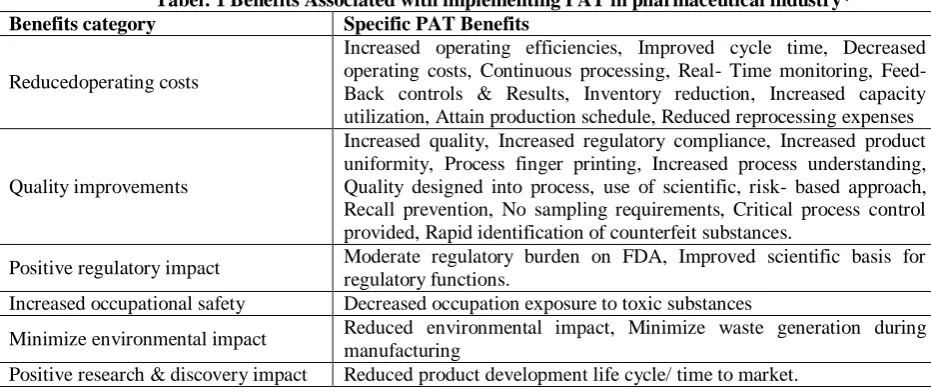
Tabel: 1 Benefits Associated with implementing PAT in pharmaceutical industry* Benefits category Specific PAT Benefits
Reducedoperating costs
Increased operating efficiencies, Improved cycle time, Decreased operating costs, Continuous processing, Real- Time monitoring, Feed-Back controls & Results, Inventory reduction, Increased capacity utilization, Attain production schedule, Reduced reprocessing expenses
Quality improvements
Increased quality, Increased regulatory compliance, Increased product uniformity, Process finger printing, Increased process understanding, Quality designed into process, use of scientific, risk- based approach, Recall prevention, No sampling requirements, Critical process control provided, Rapid identification of counterfeit substances.
Positive regulatory impact Moderate regulatory burden on FDA, Improved scientific basis for
regulatory functions.
Increased occupational safety Decreased occupation exposure to toxic substances
Minimize environmental impact Reduced environmental impact, Minimize waste generation during
manufacturing
Positive research & discovery impact Reduced product development life cycle/ time to market.
Process understanding
A process is generally considered well understood when
1. All critical sources of variability are identified and explained.
2. Variability is managed by the process; and, 3. Product quality attributes can be accurately and
reliably predicted over the design space established for materials used, process parameters, manufacturing, environmental, and conditions.
Structured product and process development on a small scale, using experimental design and on or in-line process analyzers to collect data in a real time can provide increased insight and understanding for
process development, optimization, scale-up,
technology transfer, and control. Process
understanding then continues in the production phase when other variables (e.g., environmental and supplier changes) may possibly be encountered. Therefore, continuous learning over the life cycle of a product is important.
PAT TOOLS:
Pharmaceutical manufacturing processes often consist of a series of unit operations, each intended to modulate certain properties of the materials being
processed. To ensure acceptable and reproducible modulation consideration should be given to the quality attributes of incoming materials and their process-ability for each unit operation.
There are many tools2 available that enable process
understanding for scientific, risk-managed
pharmaceutical development, manufacture and quality assurance. These tools, when used within a system, can provide effective and efficient means for acquiring information to facilitate process understanding, continuous improvement, and development of risk-mitigation strategies. In the PAT Framework, various tools are:
1. Multivariate tools for design, data acquisition and analysis
2. Process analyzers 3. Process control tools
4. Continuous improvement and knowledge
management tools
PAT Applications in the Chemical and Pharmaceutical industry
The concept of PAT has been applied in the Chemical and Pharmaceutical industry for several decades and has been subject of interest3, 4.
Table 2: PAT application in chemical industry*
Application Process ANALYZER Observation
Analysis of organic content of waste water
NMR Spectroscopy Less time & Cost effective method
Raw material identification and quality control
Near infrared (NIR) Spectroscopy Fast & cost effective method
Simultaneous monitoring of solute concentration and Polymorphic state of crystal
Raman spectroscopy &Attenuated total reflectance(ATR) and FTIR
Know how the rate of addition of reactant affects the Polymorphic state of crystal
Catalysis reaction involving
conversion of Acetone to Methyl isobutyl ketone(MIBK)
In-line NIR Affects productivity, selectivity,
International Journal of Pharmaceutical, Biological and Chemical Sciences (IJPBCS) | OCT-DEC 2012 | VOLUME 1 | ISSUE 3 | 01-06 | www.ijpbcs.net
Pa
ge
4
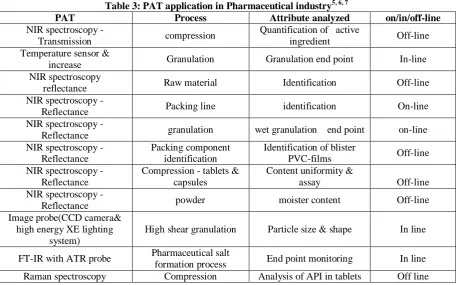
Table 3: PAT application in Pharmaceutical industry5, 6, 7
PAT Process Attribute analyzed on/in/off-line
NIR spectroscopy -
Transmission compression
Quantification of active
ingredient Off-line
Temperature sensor &
increase Granulation Granulation end point In-line
NIR spectroscopy
reflectance Raw material Identification Off-line
NIR spectroscopy
-Reflectance Packing line identification On-line
NIR spectroscopy
-Reflectance granulation wet granulation end point on-line
NIR spectroscopy -Reflectance
Packing component identification
Identification of blister
PVC-films Off-line
NIR spectroscopy -Reflectance
Compression - tablets & capsules
Content uniformity &
assay Off-line
NIR spectroscopy
-Reflectance powder moister content Off-line
Image probe(CCD camera& high energy XE lighting
system)
High shear granulation Particle size & shape In line
FT-IR with ATR probe Pharmaceutical salt
formation process End point monitoring In line
Raman spectroscopy Compression Analysis of API in tablets Off line
PROCESS ANALYZERS
Process analyzers8 measure the physical, chemical and biological properties of materials. They collect both quantitative data and qualitative data. Data collection can be nondestructive, require minimal sample preparation, and have rapid or real time response when compared to traditional methods. Data integrity is necessary to ensure compliance with the U.S. FDA 21 CFR Part 11 which requires specific controls with respect to electronic signatures, security, and audit trail functionality.
PAT Guidance for industry categorizes process analyzers into four categories which are differentiated from one another based on the stage of process at which sample measurement occurs: at-line, on-line, in-line, and off-line of these four categories, on-line and in-line process analyzer have the greatest potential to reduce operating costs and improve quality; both minimize sample requirements and sample handling compared to their at-line and off-line counterparts. Clevett indicated that 80% to 90% of errors associated with analysis were associated with sample handling, either directly or indirectly. On-line & in-line process analyzers reduce sample retest and cycle times.
Near Infrared:
Particle size of a granulation, powdered blend or powdered pharmaceutical raw material is important in that it impacts physical properties such as powder flow, dissolution rate, compressibility and tablet hardness. Monitoring particle size and control of the manufacturing process prevents over-processing of the product .According to the literature, the most common process analyzer to be used in the determination of particle size of milled roller compacted powders,
granulations, liquids and raw materials is NIR. The NIR process analyzers have been evaluated on-line, in-line and off-in-line; results of these evaluations compare favorably to those of traditional methods such as sieve analysis, digital microscopy and particle size instrumentation.
The shape and spatial distribution of particles influence physical properties such as powder flow and filterability. Clarke used NIR microscopy off-line to determine spatial distribution and cluster size of
ingredients in granulation and compressed
pharmaceutical products. Clarke concluded that NIR microscopy was a useful tool in the determination of particle shape, particle distribution and cluster size of chemical components of the sample
Raman Spectroscopy: Raman spectroscopy is suitable for quantitative analysis of pharmaceutical product because of the relationship between signal intensity and API concentration. Raman spectroscopy has been evaluated for identification and quantification of active ingredients in granulation, compression, drug pellet and both off-line and at-line use .Raman spectroscopy has also been used to monitor hydration states of API as a method.
International Journal of Pharmaceutical, Biological and Chemical Sciences (IJPBCS) | OCT-DEC 2012 | VOLUME 1 | ISSUE 3 | 01-06 | www.ijpbcs.net
Pa
ge
5
using a monochromatic CCD camera. At-line analysis of granulation samples growth and granulation end point for the fluidized bed granulation process. The conclusion was that the imaging approach used provided rapid evaluation of granule particle size.
X-ray Diffraction: On-line application of x-ray powder diffraction was evaluated by Davis et al. for use in monitoring the transformation of the flufenamic acid. The on-line process analyzer was successful in monitoring the polymorphic transformation of the flufenamic acid. The results of this evaluation suggest that X-ray powder diffraction may be used as an on-line process analyzer to monitor granulation process and parameters such as granulation end time.
FT-IR process Analyzer: Process analyzers have been evaluated for API synthesis. Watson et al evaluated an in-line FT-IR process analyzer for the conversion of Buspirone hydroxylation to 6-hydroxylbuspirone. They recommended the use of the in-line FT-IR process analyzer to monitor and control the synthesis process since in this process ensures API quality and predicted the need for batch reprocessing.
Lin et al demonstrated the ability to real-time monitor a pharmaceutical salt formation process with FT-IR coupled with an ATR probe, a task which cannot be
accomplished with traditional analytical
instrumentation. Such as titration and HPLC. FT-IR ATR permitted differentiation between mono and bi-salts allowing for real-time determination of the synthesis endpoint. Other benefits were improved quality monitoring, higher yields, and end of method transfer between laboratories and FT-IR instruments, all of which contribute to improved efficiency.
Light- Induced Fluorescence: LIF technology is selective for fluorescent materials with in a drug formulation. LIF measures the emission wave length as a result of wave length excitation. LIF technology is a nondestructive. PAT tool for the analysis of powder mixing kinetics, blend homogeneity and tablet active ingredient content. Lai and Cooney proposed that LIF would be especially useful within the pharmaceutical industry because 60% of the two hundred main active ingredients fluoresce. Benefits of on-line LIF analysis
in blending include real-time blend kinetic results and reductions in errors due to thief sampling.
Process Control Tools: Process control tools monitor and actively manipulate a process to ensure control. Process analyzers can be integrated into a process parameters and product attributes in order to achieve desired in-process and finished quality specifications. Shah summarized those critical process parameters. Which could be monitored and controlled to ensure that in-process quality specifications areachieved. Watanoet al. evaluated process control tool for monitoring and controlling a high shear granulation phase. The processing conditions were varied to simulate normal manufacturing variation. The system accurately monitored and provided feedback during granulation, preventing excessive granule growth.
CONCLUSION:
The use of process analytical technology can provide huge benefits to pharmaceutical industry by increasing product quality while delivering superior asset utilization and financial value.
PAT provides better knowledge of raw materials by characterizing it both physically and chemically understanding of manufacturing parameters all of which is having the impact on the finished product quality. Combining together all of these results in a more robust process, better product, better process control and huge time saving which ultimately result in a good cost savings along with creation of a unique brand image for the organization.
REFERENCES:
1. Guidance for industry: PAT- A frame work for
innovative pharmaceutical development,
manufacturing and quality assurance.
2. Research J. Pharm and Tech 2(2) Apr-June-2009.
3. Anal.Bio anal chem, 384:1049-1053(2006).
4. Organic process Research& Development, 2005, 9,360-364.
5. Anal.Bio anal chem,DOI, 10.1007/s, 00216-010-3781x
6. AAPS pharmscitech , 7 (1) E1-E9. 7. Int. J. Pharm: 359; 25-34.
International Journal of Pharmaceutical, Biological and Chemical Sciences (IJPBCS) | OCT-DEC 2012 | VOLUME 1 | ISSUE 3 | 01-06 | www.ijpbcs.net
Pa
ge
17
*Corresponding author address:
*A. Viswanath