Medical Journal of the Islamic Republic of Iran (MJIRI)
Med J Islam Repub Iran. 2018(3 June);32.45. https://doi.org/10.14196/mjiri.32.45
Direct observation of procedural skills (DOPS) evaluation
method: Systematic review of evidence
Masoumeh Erfani Khanghahi*
1, Farbod Ebadi Fard Azar
2Received:
23 Jan 2017
Published:
3 June 2018
Abstract
Background:
Evaluation is one of the most important aspects of medical education. Thus, new methods of effective evaluation are
required in this area, and direct observation of procedural skills (DOPS) is one of these methods. This study was conducted to
systemat-ically review the evidence involved in this type of assessment to allow the effective use of this method.
Methods:
Data were collected searching such keywords as evaluation, assessment, medical education, and direct observation of
pro-cedural skills (DOPS) on Google Scholar, PubMed, Science Direct, SID, Medlib and Google and by searching unpublished sources
(Gray literature) and selected references (reference of reference).
Results:
Of 236 papers, 28 were studied. Satisfaction with DOPS method was found to be moderate. The major strengths of this
evaluation method are as follow: providing feedback to the participants and promoting independence and practical skills during
assess-ment. However, stressful evaluation, time limitation for participants, and bias between assessors are the main drawbacks of this method.
Positive impact of DOPS method on improving student performance has been noted in most studies. The results showed that the validity
and reliability of DOPS are relatively acceptable. Performance of participants using DOPS was relatively satisfactory. However, not
providing necessary trainings on how to take DOPS test, not providing essential feedback to participants, and insufficient time for the
test are the major drawbacks of the DOPS tests.
Conclusion:
According to the results of this study, DOPS tests can be applied as a valuable and effective evaluation method in medical
education. However, more attention should be paid to the quality of these tests.
Keywords:
Evaluation, Medical education, Directly observed procedural skills
Copyright© Iran University of Medical Sciences
Cite this article as
:Erfani Khanghahi M, Ebadi Fard Azar F. Direct observation of procedural skills (DOPS) evaluation method: Systematic review of evidence. Med J Islam Repub Iran. 2018(3 June);32:45. https://doi.org/10.14196/mjiri.32.45Introduction
It has been proven that a country’s cultural, social,
polit-ical, and economic success relies on a coherent and
dy-namic educational system. Only with such a system, a
county can keep pace with social and industrial
develop-ments and confirm a high position among successful global
countries. Education and training courses cannot help the
system in achieving its goals, as training should be in
ac-cordance with scientific principles and methods to meet the
needs involved. Otherwise, trainings will be fruitless and in
some cases they may even lead to the waste of capital in a
system (1-3).
One question that needs to be raised, however, is whether
the results of the training courses are in line with the set
goals or not. Most scholars have explicitly answered this
question: “A complete and comprehensive evaluation could
make us aware of the effectiveness of the training outcomes
and provide a feedback assessment.” (4, 5) Training
medi-cal students is one of the most important areas in education.
The goal of medical education is training physicians to
en-able them to address the essential needs of the society in
addition to passing written tests (6, 7). The written tests
merely examine the initial level of Miller’s Pyramid, which
is the assessment of clinical competence, thus, the actual
performance of students, which is similar to their future
______________________________Corresponding author:DrMasoumeh Erfani Khanghahi, [email protected]
1. Department of Educational Management, Faculty of Management and Accounting, Yadegar-e-Imam Khomeini (RAH), Shahre Rey Branch, Islamic Azad University, Tehran, Iran.
2. Health Promotion Research Center, Iran University of Medical Sciences, Tehran, Iran.
↑
What is “already known” in this topic:
Direct observation of procedural skills (DOPS) was acceptable
in 3 aspects as follows: (1) validity and reliability of DOPS, (2)
satisfaction with DOPS, and (3) comparing the use of DOPS and
mini- CEX with traditional methods.
→
What this article adds:
This study presented strengths and drawbacks of DOPS.
More-over, in this study training impacts of DOPS, performance of
participants using DOPS tests, and quality of conducting DOPS
tests were examined.
Direct observation of procedural skills evaluation method
professional status at the high levels of the pyramid, is not
assessed. On the other hand, the final evaluation cannot
as-sess the learners’ performance (8, 9). Hence, the teachers
tend to use formative assessment to become aware of the
students’ progress. This is an attempt to ensure high quality
in educational programs and is used to motivate students
towards what they need to learn. Consequently, education
will result in outcome-based education (8, 10). In recent
years, various evaluation methods have been used in
medi-cal education (11-15). One of the most important and
well-known of which is direct observation by students during the
practical skills. Direct observation of procedural skills
(DOPS) method is considered as one of the most
well-known models of this type of evaluation (16, 17). This
method was specifically designed to evaluate practical
skills and provide feedback; it requires direct observation
of an assistant during a procedure and coincides with
eval-uation in a written form.
This method is particularly useful
in evaluating the practical skills of the assistant objectively
and systematically (18). In this method, observation of the
assessor is documented in a checklist, and then the trainee
is provided with a feedback based on objective findings.
The number of tests varies depending on the basic skills
re-quired for learning, which may include up to 8 tests during
a period (19-21). The method gives the trainees an
oppor-tunity to receive constructive feedback and directs their
at-tention to the essential skills required to perform the
proce-dure on the grounds that the evaluation is aimed to improve
the performance and ask for a specific and on time feedback
(22). Reviewing the literature on modern methods of
eval-uation including DOPS indicates that despite a
considera-ble amount of studies based on these methods, the use of
modern methods of evaluation has not yet been taken in to
account efficiently. Thus, given the importance of medical
education and the effectiveness of new methods of
evalua-tion, further research and development of new methods of
evaluation is required. This paper was conducted to
system-atically review the studies on DOPS and provide useful
in-formation for the development and use of this evaluation
method in medical training.
Methods
Search strategy
This was a systematic review developed and
imple-mented in 2016. Data were collected searching such
key-words as evaluation, assessment, medical education,
valid-ity, reliabilvalid-ity, content validity ratio, content validity index,
direct observation of procedural skills, and DOPS in
Per-sian and English languages on Google scholar, PubMed,
Science Direct, and SID search engines and by searching
unpublished data (Gray literature) and selected references
(reference of reference). The validity and reliability of
DOPS were also examined in this study.
Inclusion and exclusion criteria
No time limitation was considered in searching for
pa-pers, and published papers only in Persian and English were
searched. Studies conducted on medical education were
in-cluded in this review, and exclusion criterion was the
con-current effect of DOPS with other evaluation methods.
Data extraction and quality assessment
To evaluate the quality of the extracted papers, 2
asses-sors evaluated them based on the checklists involved. First,
the titles of all papers were reviewed and the papers
incom-patible with the objectives of the study were excluded.
Sub-sequently, abstracts and full texts of papers were studied
and those that were least relevant to the objectives of the
study were identified and excluded.
After evaluations by the checklist, which were supervised
by the reviewing team, papers from our checklist included
the following information: (1) name of the first author, (2)
years of publication, (3) country, (4) participants, and (5)
findings. The selected papers were fully studied and
evalu-ated and the required results were extracted and
summa-rized based on the designed tables (extraction table).
End-NoteX5 software was used to organize the study and
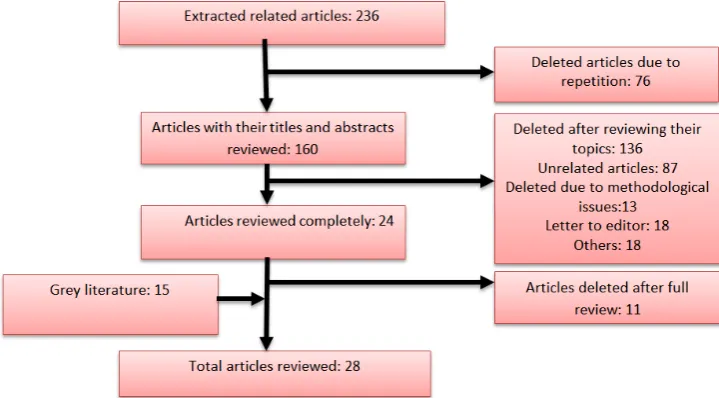
iden-tify the frequency cases (
Fig. 1
).
Results
The initial search result entailed 236 papers. Once
non-Fig. 1.Articles selection and search process
related papers and those shared in various databases were
excluded, 28 papers were selected. The results are
summa-rized in
Tables 1
through 6
. After classifying and analyzing
the results of the study, we presented the outcomes in the
following 7 areas: satisfaction with DOPS, strengths and
drawbacks of DOPS, impact of DOPS assessment,
reliabil-ity and validreliabil-ity of DOPS, performance of participants in
DOPS, and quality of holding evaluation sessions with
re-spect to DOPS.
Satisfaction with DOPS
The results of participants and assessors’ satisfaction
with DOPS were reported in 5 studies and indicated
mod-erate satisfaction with DOPS (
Table 1
).
Strengths and Drawbacks of DOPS
The perspectives of participants and assessors about
DOPS
test
were
reported
in
8
studies.
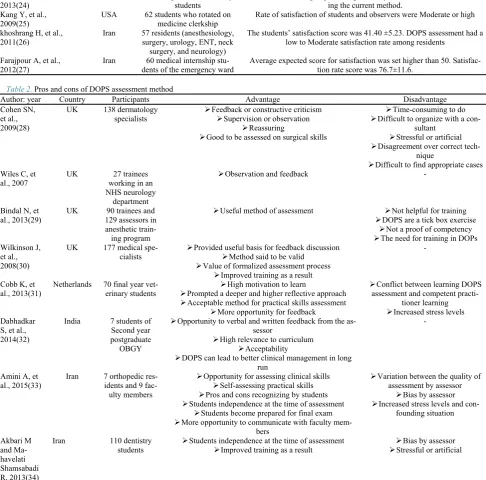
In the reviewed studies, 27 strengths and 16 drawbacks
were noted for this method of assessment (
Table 2
). The
major strengths of this evaluation method mentioned in the
studies included providing a feedback to participants,
pro-moting practical skills of participants, independence during
Table 1.Satisfactionof trainees and assessors from direct observation of procedural skills (DOPS) assessment method Findings Participants
Country Author: year
About 57% of participants were satisfied with performing DOPS evalua-tion. Minimum level of satisfaction was related to devoting time for each
procedure and noncompliance of patients with students. 70 orthopedic interns
Iran Asadi K, et al.,
2012(23)
Students in DOPS group were significantly more satisfied than those us-ing the current method.
67 undergraduate midwifery students
Iran Hoseini L, et al.,
2013(24)
Rate of satisfaction of students and observers were Moderate or high 62 students who rotated on
medicine clerkship USA
Kang Y, et al., 2009(25)
The students’ satisfaction score was 41.40 ±5.23. DOPS assessment had a low to Moderate satisfaction rate among residents
57 residents (anesthesiology, surgery, urology, ENT, neck
surgery, and neurology) Iran
khoshrang H, et al., 2011(26)
Average expected score for satisfaction was set higher than 50. Satisfac-tion rate score was 76.7±11.6.
60 medical internship stu-dents of the emergency ward Iran
Farajpour A, et al., 2012(27)
Table 2.Pros and cons of DOPS assessment method
Disadvantage Advantage
Participants Country
Author: year
Time-consuming to do Difficult to organize with a
con-sultant Stressful or artificial Disagreement over correct
tech-nique
Difficult to find appropriate cases Feedback or constructive criticism
Supervision or observation Reassuring
Good to be assessed on surgical skills 138 dermatology
specialists UK
Cohen SN, et al., 2009(28)
-Observation and feedback
27 trainees working in an NHS neurology
department UK
Wiles C, et al., 2007
Not helpful for training DOPS are a tick box exercise
Not a proof of competency The need for training in DOPs Useful method of assessment
90 trainees and 129 assessors in anesthetic
train-ing program UK
Bindal N, et al., 2013(29)
-Provided useful basis for feedback discussion
Method said to be valid Value of formalized assessment process
Improved training as a result 177 medical
spe-cialists UK
Wilkinson J, et al., 2008(30)
Conflict between learning DOPS assessment and competent
practi-tioner learning Increased stress levels High motivation to learn
Prompted a deeper and higher reflective approach Acceptable method for practical skills assessment
More opportunity for feedback 70 final year
vet-erinary students Netherlands
Cobb K, et al., 2013(31)
- Opportunity to verbal and written feedback from the
as-sessor
High relevance to curriculum Acceptability
DOPS can lead to better clinical management in long run
7 students of Second year postgraduate
OBGY India
Dabhadkar S, et al., 2014(32)
Variation between the quality of assessment by assessor
Bias by assessor Increased stress levels and
con-founding situation Opportunity for assessing clinical skills
Self-assessing practical skills Pros and cons recognizing by students Students independence at the time of assessment
Students become prepared for final exam More opportunity to communicate with faculty
mem-bers 7 orthopedic
res-idents and 9 fac-ulty members Iran
Amini A, et al., 2015(33)
Bias by assessor Stressful or artificial Students independence at the time of assessment
Improved training as a result 110 dentistry
students Iran
Akbari M and Ma-havelati Shamsabadi R, 2013(34)
Direct observation of procedural skills evaluation method
assessment, great relevance to the courses and skills
re-quired, acceptability of this approach by participants, and
its formative nature. However, the drawbacks are stressful
evaluation, time limitation, and bias between assessors, and
thus a great deal of coordination is required to employ the
method.
Training impacts of DOPS
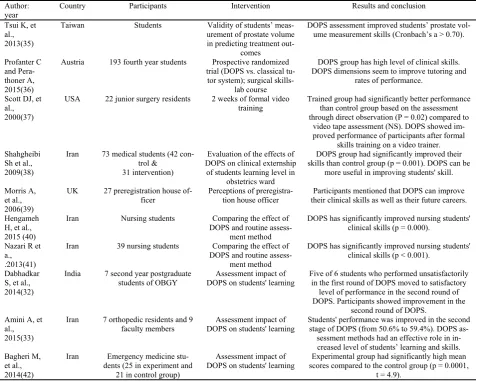
The impact of evaluation based on DOPS was reported in
10 papers (
Table 3
). In all studies, it was reported that
DOPS had a positive effect on the performance of students.
In studies that evaluated the effect of DOPS compared to
conventional methods, DOPS was found to be more
effec-tive than other methods. In addition, several studies have
shown that the performance of students improved after the
first stage of evaluation using DOPS.
Reliability and validity of DOPS
Reliability and validity of DOPS were assessed in 8
stud-ies (
Table 4
). Content validity index and content validity
ratio were used to determine the validity of DOPS, and the
results revealed that the validity of DOPS is relatively
ac-ceptable. In addition, the opinion of assessors and
partici-pants about the validity of DOPS was sought in several
studies. Most participants had confirmed the validity of
DOPS. To examine the reliability of DOPS, interclass
cor-relation coefficient, generalizability theory, and alpha
coef-ficient were applied. Moreover, reliability of DOPS was
confirmed in most studies. Feasibility of DOPS method was
studied in a few studies.
Table 3.Educational impact of DOPS assessment method
Results and conclusion Intervention
Participants Country
Author: year
DOPS assessment improved students’ prostate vol-ume measurement skills (Cronbach’s a > 0.70). Validity of students’
meas-urement of prostate volume in predicting treatment
out-comes Students
Taiwan Tsui K, et
al., 2013(35)
DOPS group has high level of clinical skills. DOPS dimensions seem to improve tutoring and
rates of performance. Prospective randomized
trial (DOPS vs. classical tu-tor system); surgical
skills-lab course 193 fourth year students
Austria Profanter C
and Pera-thoner A, 2015(36)
Trained group had significantly better performance than control group based on the assessment through direct observation (P = 0.02) compared to
video tape assessment (NS). DOPS showed im-proved performance of participants after formal
skills training on a video trainer. 2 weeks of formal video
training 22 junior surgery residents
USA Scott DJ, et
al., 2000(37)
DOPS group had significantly improved their skills than control group (p = 0.001). DOPS can be
more useful in improving students' skill. Evaluation of the effects of
DOPS on clinical externship of students learning level in
obstetrics ward 73 medical students (42
con-trol & 31 intervention) Iran
Shahgheibi Sh et al., 2009(38)
Participants mentioned that DOPS can improve their clinical skills as well as their future careers. Perceptions of
preregistra-tion house officer 27 preregistration house
of-ficer UK
Morris A, et al., 2006(39)
DOPS has significantly improved nursing students' clinical skills (p = 0.000).
Comparing the effect of DOPS and routine
assess-ment method Nursing students
Iran Hengameh
H, et al., 2015 (40)
DOPS has significantly improved nursing students' clinical skills (p < 0.001).
Comparing the effect of DOPS and routine
assess-ment method 39 nursing students
Iran Nazari R et
a., :2013(41)
Five of 6 students who performed unsatisfactorily in the first round of DOPS moved to satisfactory
level of performance in the second round of DOPS. Participants showed improvement in the
second round of DOPS. Assessment impact of
DOPS on students' learning 7 second year postgraduate
students of OBGY India
Dabhadkar S, et al., 2014(32)
Students' performance was improved in the second stage of DOPS (from 50.6% to 59.4%). DOPS
as-sessment methods had an effective role in in-creased level of students’ learning and skills. Assessment impact of
DOPS on students' learning 7 orthopedic residents and 9
faculty members Iran
Amini A, et al., 2015(33)
Experimental group had significantly high mean scores compared to the control group (p = 0.0001,
t = 4.9). Assessment impact of
DOPS on students' learning Emergency medicine
stu-dents (25 in experiment and 21 in control group) Iran
Bagheri M, et al., 2014(42)
Table 4.Validity, reliability, and feasibility of DOPS assessment method
Feasibility Reliability Validity Participants Country Author year -0.80 CVI:0.90 70 orthopedic interns
Iran Asadi K, et al.,
2012(23)
Mean time for observation in DOPS varied based on the
procedure. DOPS reliability can be
favorably compared with the mini-CEX and MSF. DOPS has low validity.
177 medical specialists UK
Wilkinson J, et al., 2008(30)
The mean time taken to com-plete assessments was 6 minutes and 35 seconds Inter-rater: ICC = 0.25
internal consistency: (r = 0.68, p < 0.001) ‘Total score’ correlating
with trainee experience (r = 0.51, p = 0.004) Trainees in
ultrasound-guided regional anes-thesia (30
video-rec-orded) Australia
Watson MJ, et al., 2014(43)
Performance of participants using DOPS test
Performance of participants was investigated by DOPS
test in 4 studies and was found to be satisfactory in 2
stud-ies, while participants did not have a good performance in
the other 2 studies (
Table 5
).
Quality of conducting DOPS test
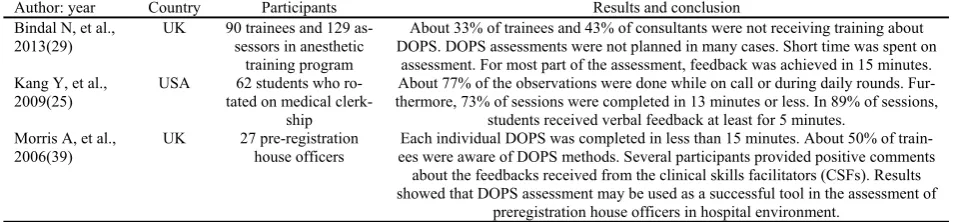
In 3 studies, the quality of conducting DOPS test was
in-vestigated from the perspective of both participants and
as-sessors (
Table 6
). Not providing the necessary trainings for
taking DOPS test, not being held at the scheduled time, not
providing necessary feedbacks to participants, and
insuffi-cient time for the test are the major weaknesses of
conduct-ing DOPS tests.
Discussion
Study results revealed that satisfaction level of DOPS is
moderate. The strengths of this evaluation method
men-tioned in the studies included providing feedback to
partic-ipants, promoting practical skills of particpartic-ipants, autonomy
during evaluation, great relevance to the courses and
re-quired skills, acceptability of this approach by participants,
and its formative nature. Some of the main weaknesses of
this method are as follow: being stressful, the time limit for
participants, bias/ dissimilarity of assessors, and requiring
a great deal of coordination. Studies comparing the effect
of DOPS and conventional methods revealed that DOPS is
more effective than other methods. Several studies
indi-cated that students’ performance after the first stage of
eval-uation with DOPS was improved in the second stage.
Fur-thermore, the results showed that the validity of DOPS is
relatively acceptable, while its reliability and validity have
been confirmed in most studies. Feasibility of DOPS
method was investigated in few studies. Participants’
per-formance who used DOPS was relatively satisfactory.
Table 4.Cntd
-Kappa
coeffi-cient:0.6 ICC: 0.5 CVR: 0.62
CVI:0.79 Nursing students
Iran Hengameh H, et
al., 2015 (40)
Scores of DOPS were highly corre-lated with assess-ment score of global
experts. G: 0.81
Most of the candidates (73.6%) and assessors (88.1%) pointed
out that DOPS assessment method was valid or very valid. 157 senior endoscopists —
111 candidates and 42 as-sessors UK
Barton JP, et al., 2012(44)
ICC:0.85 CVI: 0.95
Seven orthopedic residents and 9 faculty members Iran
Amini A, et al., 2015(33)
G coefficient:0.90 CVI: 0.9
kappa values: 0.8 Six anesthesia staff for
in-terviews, 10 anesthesiolo-gists for consensus survey,
and 31 anesthesia resi-dents. UK
Delfino AE, et al., 2013
Cronbach alpha co-efficient: 94 % Correlation for theoretical:
0.117;
correlation for clinical: 0.376 55 nursing students
Iran Sahebalzamani
M, et al., 2012
Alpha coefficient: 0.81 CVR: 0.75
CVI:0.50 44 midwifery students
Iran Kuhpayehzade J,
et al., 2014(45)
Table 5.Performance of trainees with direct observation of procedural skills (DOPS) assessment method
Results and conclusion Participants
Country Author: year
Results showed that 86.7% of the students in various fields of dentistry had good performance and 13.3 % of the students had weak perfor-mance. In conclusion, DOPS is a suitable tool for assessing practical
la-boratory performance of dental students. 54dental students
Iran Bazrafkan L and et
al., (46)-2009
Statistical association was not found between scores of DOPS assess-ment methods and trainees' skills. DOPS mean scores are not suitable to
predict lack of competence. 1646 trainees in a single UK
postgraduate deanery UK
Mitchell C, et al., 2011(47)
Six out of 7 students performed unsatisfactorily, and only one student had satisfactory performance.
Seven second year postgradu-ate students of OBGY India
Dabhadkar S, et al., 2014(32)
According to the results, students had almost good performances (mean of good performance = 50.6%).
Seven orthopedic residents and 9 faculty members Iran
Amini A, et al., 2015(33)
Table 6.Implementation quality of DOPS assessment method
Results and conclusion Participants
Country Author: year
About 33% of trainees and 43% of consultants were not receiving training about DOPS. DOPS assessments were not planned in many cases. Short time was spent on
assessment. For most part of the assessment, feedback was achieved in 15 minutes. 90 trainees and 129
as-sessors in anesthetic training program UK
Bindal N, et al., 2013(29)
About 77% of the observations were done while on call or during daily rounds. Fur-thermore, 73% of sessions were completed in 13 minutes or less. In 89% of sessions,
students received verbal feedback at least for 5 minutes. 62 students who
ro-tated on medical clerk-ship USA
Kang Y, et al., 2009(25)
Each individual DOPS was completed in less than 15 minutes. About 50% of train-ees were aware of DOPS methods. Several participants provided positive comments
about the feedbacks received from the clinical skills facilitators (CSFs). Results showed that DOPS assessment may be used as a successful tool in the assessment of
preregistration house officers in hospital environment. 27 pre-registration
house officers UK
Morris A, et al., 2006(39)
Direct observation of procedural skills evaluation method
However, not providing the necessary trainings on how to
take DOPS test, not being held at the scheduled time, not
providing necessary feedbacks to participants and
insuffi-cient time for the test are the major weaknesses of the
DOPS tests. Improving clinical skills and autonomy during
the evaluation are the strengths of the method noted by
par-ticipants in the reviewed articles. A study conducted by
Naeem has also recognized DOPS tests as an effective tool
to improve clinical skills (48). Some other studies have also
mentioned this issue (31, 49-51). However, Bindal et al.
study in the UK showed that DOPS tests cannot be used as
a useful educational tool in improving practical skills (29).
This could be due to the drawbacks of conducting DOPS
tests, which were pointed out in the study by Bindal et al.
According to them, the quality of conducting the tests was
poor. Biased approaches towards participants and the
stressfulness of the tests are the major weaknesses
high-lighted by previous studies (52-54). Thus, paying proper
at-tention to the reliability of assessors, using selected
multi-ple assessors for all participants, and videotaping can play
a key role in addressing the problems involved in
conduct-ing this type of evaluation. Results of the studies conducted
on the validity and reliability of DOPS tests have indicated
an appropriate degree of validity and reliability. These
find-ings are consistent with most studies undertaken in this
field. Wilkinson et al. investigated the validity of DOPS
tests from the perspective of the professionals and the result
was good. Moorthy et al. also confirmed the validity of
such tests in the field of surgery (55). Bould et al. reported
that the validity of the tests in the field of anesthesiology is
high (54). In addition, Weller et al. found that the reliability
of these tests is high (56). Other studies have also reported
an acceptable reliability (12, 57). Despite the good results
of validity and reliability reported in studies, some
re-sources have suggested conducting further studies on
valid-ity and reliabilvalid-ity factors (58, 59). Because few studies have
been conducted on the feasibility of this method, further
studies
are
required
in
this
area.
Study results revealed that the satisfaction level of DOPS
tests is fairly acceptable. Likewise, a study conducted by
Shahid Hassan on surgery residents at the University of
Malaysia indicated a satisfactory result with DOPS tests
(60). Yoon Kang et al. at Weill Cornell Medical College
suggested that the satisfaction level of students and
profes-sors was medium and high, respectively (25). The results of
some reviewed studies showed that the satisfaction level of
professors/assessors is higher than that of
students/partici-pants. This is consistent with the results of Harpreet
Ka-poor’s study in India conducted on interns and professors
of department of ophthalmology (61). One of the causes of
dissatisfaction in conducting DOPS tests was insufficient
time devoted to perform each skill. In many studies, this
factor has been one of the main causes of student
dissatis-faction (25, 55, and 62). Thus, it is recommended to review
the procedure of the tests and devote more time to
educa-tional groups to perform each skill. Also, the results
indi-cated that DOPS tests had a significant impact on
improv-ing student learnimprov-ing. The results of Holomboe et al. study
on medical students showed that those students who were
evaluated by DOPS had a high skill level (63). Chen et al.
also suggested that DOPS tests in senior medical students
have contributed to the increase of self-report, skill
upgrad-ing, as well as self-confidence (64). In a study in Taiwan,
Tsui et al. stated that this type of test has a significant role
in upgrading the skills and empowering medical students
(35). As a result, it seems that in addition to being applied
as a suitable method for evaluation purposes, DOPS can be
used as an educational tool to educate and empower
stu-dents. The study results revealed that the performance of
participants who used DOPS was relatively satisfactory.
Not providing the necessary trainings for taking DOPS test,
not being held at the scheduled time, not providing
neces-sary feedbacks to participants, and insufficient time for the
test were the major drawbacks of DOPS tests.
One possible reason for the relatively good grades of
par-ticipants on DOPS tests can be the motivation created by
the tests. Another possible reason might be the easy
ap-proaches by assessors during the tests because the tests rely
on instructor’s evaluation method and their point of view.
One of the limitations of this study was that the searches
were limited to articles published in English and Persian
languages. Also, many articles were excluded due to low
quality.
Conclusion
Considering the high position of evaluation in medical
education, an effective and appropriate method of
evalua-tion is essential in this field. The results of this study
re-vealed that DOPS tests can be used as an effective and
ef-ficient evaluation method to assess medical students
be-cause of their appropriate validity and reliability, positive
impact on learning, high satisfaction level of students, and
other advantages. However, special attention needs to be
devoted to the quality of these tests.
Conflict of Interests
The authors declare that they have no competing interests.
References
1. American Education System – Education System in United States of America – USA Education System". Indobase.com. Retrieved 2010-04-14.
2.UNESCO, Education For All Monitoring Report 2008, Net Enrollment Rate in primary education.
3.UNICEF (United Nations Children’s Fund). 2009. All children everywhere: A strategy for basic education and gender equality. 4.Special Education. Oxford: Elsevier Science and Technology. 2004. 5.Staff. Evaluation Purpose". designshop - lessons in effective teaching.
Learning Technologies at Virginia Tech. 2011.
6.White R, Ewan CH. Clinical teaching in nursing. London: Chapman and hall; 1995.
7.Ghojazadeh M, Aghaei MH, Naghavi-Behzad M, Piri R, Hazrati H, Azami-Aghdas S. Using Concept Maps for Nursing Education in Iran: ASystematic Review. Res Dev Med Educ. 2014;3(1):67-72. 8.Vergis A, Hardy K. Principles of Assessment: A Primer for Medical
Educators in the Clinical Years. Inet. J. Med. Educ. 2010;1(1). 9.U.S. Department of Health and Human Services. Physical Activity
Evaluation Handbook. Atlanta, GA: Centers for Disease Control and
Prevention, 2002.
www.cdc.gov/nccdphp/dnpa/physical/handbook/pdf/ handbook.pdf 10.Committee on Standards for Educational Evaluation. The Student
Evaluation Standards: How to Improve Evaluations of Students. Newbury Park, CA: Corwin Press. 2003.
11.Kadagad P, Kotrashetti S. Portfolio: a comprehensive method of
assessment for postgraduates in oral and maxillofacial surgery. J Maxillofac Oral Surg. 2013;12(1):80-4.
12.Al-Naami M. Reliability, validity and feasibility of the Objective structured clinical examination in assessing clinical skills of final year surgical clerkship. Saudi Med J. 2008;29(12):1802-7.
13.Maylett T. 360-Degree Feedback Revisited: The transition from development to appraisal. Compens. Benefits Rev. 2009;41(5):52-9. 14.Robinson B. The CIPP approach to evaluation, COLLIT Project. 2002. 15.Jabbari H, Bakhshian F, Alizadeh M, Alikhah H, Naghavi Behzad M. Lecture-based versus problem-based learning methods in public health course for medical students. RDME. 2012;1:31-5.
16.Ohn J, Norcini D. Assessment methods in medical education. Teaching and Teacher Education. 2007;23:239-50.
17.Richard K, Reznick ME, MacRae H. Teaching surgical skills –changes in wind N Engl J Med. 2006;355:2664-9.
18.Moorthy K, Munz Y, Sarker S, Darzi A. Objective assessment of technical skills in surgery. BMJ. 2003;327(7422):1032-7.
19.Sahebalzamani M, Farahani H, JahantighM.[Validity and reliability ofdirect observation of procedural skills in evaluating the clinical skills of nursing students of Zahedan nursing and midwifery school]. Zahedan. J. Res. Med. Sci. 2012; 14(2): 76-81.
20.Amin Z, Chong Y, Khoo H. Direct observation of procedural skills(chapter16). In: Amin Z, Chong Y, Khoo H. Practical guid to medical student. 1sted. Singapore: World Scientific Printers CO; 2006: 71-4.
21.Wilkinson JR, Crossley JG, Wragg A, Mills P, Cowan G ,Wade W. Implementing workplace-based assessment across the medical specialties in the united Kingdom. Med Educ. 2008; 42(4): 364-373. . 22.Norcini JJ, Mackinley DW. Assessment methods in medical education.
Teach Teacher Educ 2007; 23(3): 239-50.
23.Asadi K, Mirbolook AR, Haghighi M, Sedighinejad A, Naderi nabi B, Abedi s, et al. Evaluation of Satisfaction Level of Orthopedic Interns from Direct Observation of procedural Skills Assessment (DOPS) Res. Med. Educ. 2012;4(2):17-23.
24.Hoseini LB, Mazloum SR, Jafarnejad F, Foroughipour M. Comparison of midwifery students’ satisfaction with direct observation of procedural skills and current methods in evaluation of procedural skills in Mashhad Nursing and Midwifery School. Iran J Nurs Midwifery Res. 2013;18(2):94-100.
25.Kang Y, Bardes C, Gerber L, Storey-Johnson C. Pilot of Direct Observation of Clinical Skills (DOCS) in a Medicine Clerkship: Feasibility and Relationship to Clinical Performance Measures. Med Educ Online. 2009;14(9):1-8.
26.khoshrang H. Assistants specialized perspectives on evaluation method of practical skills observations (DOPS) in Guilan University of Medical Sciences. J. Res. Med. Educ. 2011;2(2):40-4. 27.Farajpour A, Amini M ,Pishbin E, Arshadi H, Sanjarmusavi N, Yousefi J, et al. Teachers’ and Students’ Satisfaction with DOPS Examination in Islamic Azad University of Mashhad, a Study in Year 2012 Iran J Med Edu. 2014;14(2):165-73.
28.Cohen SN, Farrant PB, Taibjee SM. Assessing the assessments: U.K. dermatology trainees' views of the workplace assessment tools. Br. J. Dermatol. 2009;161(1):34-9.
29.Bindal N, Goodyear H, Bindal T, Wall D. DOPS assessment: a study to evaluate the experience and opinions oftrainees and assessors. Med Teach. 2013;35(6):1230-4.
30.Wilkinson J, Crolley J, Wragg A. Implemnting workplace-based assessment across the medical specialities in the united Kingdon. Med Educ. 2008;42(4):364-73.
31.Cobb K, Brown G, Jaarsma D, Hammond R. The educational impact of assessment: a comparison of DOPS and MCQs. Med Teach. 2013;35(11):1598-15607.
32.Dabhadkar S, Wagh G, Panchanadikar T, Mehendale S, Saoji V. To evaluate Direct Observation of Procedural Skills in OBGY. NJIRM. 2014;5(3):92-7.
33.Amini A, Shirzad F, Mohseni M, Sadeghpour A, Elmi A. Designing Direct Observation of Procedural Skills (DOPS) Test for Selective Skills of Orthopedic Residents and Evaluating Its Effects from Their Points of View. Res Dev Med Educ. 2015;4(2):1452-7.
34.Akbari M, Mahavelati Shamsabadi R. Direct Observation of Procedural Skills (DOPS) in Restorative Dentistry: Advantages and Disadvantages in Student's Point of View Iran J Med Edu. 2013;13(3):212-20.
35.Tsui K, Liu C, Lui J, Lee S, Tan R, ChangP. Direct observation of procedural skills to improve validity of students' measurement of
prostate volume in predicting treatment outcomes. Urol Sci. 2013; 24(3):84-8.
36.Profanter C, Perathoner A. DOPS (Direct Observation of Procedural Skills (in undergraduate lab: Does it work? Analysis of skills-performance and curricular side effects. GMS J. Med. Educ. 2015;32(4).
37.Scott DJ, Rege RV, Bergen PC, Guo WA, Laycock R, Tesfay ST, et al. Measuring operative performance after laparoscopic skills training: edited videotape versus direct observation. j. laparoendosc. adv. surg. tech. a. 2000;10(4):183-90.
38.Shahgheibi S, Pooladi A, BahramRezaie M, Farhadifar F, Khatibi R. Evaluation of the Effects of Direct Observation of Procedural Skills (DOPS) on Clinical Externship Students’ Learning Level in Obstetrics Ward of Kurdistan University of Medical Sciences. J. Med. Educ. 2009;13(1,2):29-33.
39.Morris A, Hewitt J, Roberts CM. Practical experience of using directly observed procedures, mini clinical evaluation examinations, and peer observation in pre-registration house officer (FY1) trainees. Postgrad. Med. J. 2006;82(966):285-8.
40.Hengameh H, Afsaneh R ,Morteza K, Hosein M, Marjan SM, Abbas E. The Effect of Applying Direct Observation of Procedural Skills (DOPS) on Nursing Students' Clinical Skills: A Randomized Clinical Trial. Glob. J. Health Sci. 2015;7(7 Spec No):17-21.
41.Nazari R, Hajihosseini F, Sharifnia H, Hojjati H. The effect of formative evaluation using “direct observation of procedural skills” (DOPS) method on the extent of learning practical skills among nursing students in the ICU. IJNMR. 2013;18(4):290-3.
42.Bagheri M, Sadeghnezhad M, Sayyadee T, Hajiabadi F. The Effect of Direct Observation of Procedural Skills (DOPS) Evaluation Method on Learning Clinical Skills among Emergency Medicine Students Iran J Med Edu. 2014;13(12):1073-81.
43.Watson MJ, Wong DM, Kluger R, Chuan A, Herrick MD, Ng I, et al. Psychometric evaluation of a direct observation of procedural skills assessment tool for ultrasound-guided regional anaesthesia. Anaesthesia. 2014;69(6):604-12.
44.Barton JR, Corbett S, van der Vleuten CP. The validity and reliability of a Direct Observation of Procedural Skills assessment tool: assessing colonoscopic skills of senior endoscopists. Gastrointestinal endoscopy. 2012;75(3):591-7.
45.Kuhpayehzade J, Hemmati A, Baradaran H, Mirhosseini F, Sarvieh M. Validity and Reliability of Direct Observation of Procedural Skills in Evaluating Clinical Skills of midwifery Students of Kashan Nursing and Midwifery School. JSUMS .٥٤-١٤٥:(١)٢١;٢٠١٤ .
46.Bazrafkan L, Shokrpour N, Torabi K. Comparison of the Assessment of Dental Students. J. Med. Educ. 2009;13(1,2):16-23.
47.Mitchell C, Bhat S, Herbert A, Baker P. Workplace-based assessments of junior doctors: do scores predict training difficulties? Med Educ. 2011;45(12):1190-8.
48.Naeem N. Validity, reliability, feasibility, acceptability and educational impact of direct observation of procedural skills (DOPS). J Coll Physicians Surg Pak. 2013;23(1):77-82.
49.Nicol D, MacFarlane-Dick D. Formative assessment and self-regulated learning: A model and seven principles of good feedback practice. Stud Higher Educ. 2006;31:199-218.
50.Swanwick T. Understanding medical education: Evidence, theory and practice. Wiley-Blackwell; Oxford: 2010.
51.Norcini J, Burch V. Review Workplace-based assessment as an educational tool: AMEE Guide No. 31. Med Teach. 2007;29(9):855-71.
52.De Oliveria Filho G. The construction of learning curves for basicskills in anaesthetic procedures :An application for the cumulative sum method. Anesth Analg. 2002;95:411-6.
53.Beard JD, Jolly BC, Newble DI, Thomas WEG, Donnelly J, Southgates LJ. Assessing the technical skills of surgical trainees. Br J Surg. 2005; 92(6): 778-82.
54.Bould M, Crabtee N, Naik V. Assessment of procedural skills in anesthesia. Br J Anaesth. 2009;103(4):472-83.
55.Moorthy K, Munz Y, Sarker S, Darzi A. Objective assessment of technical skills in surgery. BMJ. 2003;327(7422):1032-7.
56.Weller J, Jolly B, Misur M. Mini-clinical evaluation exercise in anaesthasia training. Br J Anaesth. 2009;102(5):633-41.
57.Tudiver F, Rose D, Banks B, Pfortmiller D. Reliability and validity testing of an evidence-based medicin OSCE station. Fam Med. 2009;41(2):89-91.
58.Review of work-based assessment methods. CIPHER. Australia:
Direct observation of procedural skills evaluation method
USYD; 2007: 11-17.
59.Turnbull J, Gray J, MacFadyen J. Improving in-training evaluation programs. J Gen Intern Med. 1998;13:317-23.
60.Hassan S. Faculty Development: DOPS as Workplace-Based Assessment. J. Med. Educ. 2011;3(1):32-43.
61.Kapoor H, Tekian A, Mennin S. Structuring an internship programme for enhanced learning. Med Educ. 2010;44(5):501-2.
62.Davies H, Archer J, Southgate L, Norcini J. Initial evaluation of the first year of the Foundation Assessment Programme. Med Educ. 2009;43:74-81.
63.Holmboe E, Hawkins R, Huot S. Effects of training in direct observation of medical residenrs clinical competence: a randomized trial. Ann Intern Med. 2004;140(11):8781-4.
64.Chen W, Liao S, Tsai C, Huang C, Lin C, Tsai C. Clinical Skills in Final-year Medical Students: The Relationship between Self-reported Confidence and Direct Observation by Faculty or Residents. Ann Acad Med Singapore. 2008;37(1):3-8.