Iran University of Medical Sciences
____________________________________________________________________________________________________________________ 1. PhD Candidate, Department of Occupational Therapy, University of Social Welfare and Rehabilitation Sciences, Tehran, Iran. [email protected]
2. (Corresponding author) Associate Professor, Iranian Research Center on Aging, Pediatrics Neurorehabilitation Research Center, Department
of Occupational Therapy, University of Social Welfare and Rehabilitation Sciences, Tehran, Iran. [email protected]
3. Associate Professor, Disaster Rehabilitation Research Center, School of Nursing, University of Social Welfare and Rehabilitation Science, Tehran, Iran. [email protected]
4. Assistant Professor, School of Nursing, University of Social Welfare and Rehabilitation Sciences, Tehran, Iran. [email protected]
Experiences of occupational therapy students in the first
field-work education: a qualitative study
Mehdi Rezaee1, Mehdi Rassafiani2, Hamidreza Khankeh3, Mohammad Ali Hosseini4
Received:19 November 2013 Accepted:18 January 2014 Published:11 October 2014
Abstract
Background: Fieldwork education is a core part of all occupational therapy curriculums around the world to enable the students meet minimum competencies required for their professional life. Student experience is a valuable source to explore the nature of fieldwork training and plan more efficient curriculums in the future. This study aimed to explore the students' experiences in the first fieldwork education.
Methods: Data were collected through a focus group and series of semi-structured interviews with 16 occupa-tional therapy students who had passed the first semester of fieldwork education at three occupaoccupa-tional therapy departments in Iran. The interviews were transcribed line by line and analyzed according to inductive content analysis.
Results: Following the analysis of the data, three main themes were identified including the importance of supervisors’ management, deficits in the current curriculum and challenges in the educational environment. Each theme included different categories to show students’ concerns and challenges in the first fieldwork educa-tion experience and their suggeseduca-tions for more efficient trainings.
Conclusion: The research argues that several combined key factors determine the nature and utility of occupa-tional therapy (OT) fieldwork experiences of the students. However, further studies are needed to clarify the experiences of the supervisors, department managers and others involved in the fieldwork education.
Keywords: Clinical education, Occupational tTherapy student, Professional education, Qualitative research. Cite this article as:Rezaee M, Rassafiani M, Khankeh H, Hosseini M. A. Experiences of occupational therapy students in the first field-work education: a qualitative study.Med J Islam Repub Iran2014 (11 October). Vol. 28:110.
Introduction
Fieldwork education is a crucial part of all occupational therapy education pro-grams, which provides opportunities for professional development and competency acquisition (1, 2). It aims to engage stu-dents in clinical practice to obtain specific knowledge and skills required to be quali-fied in professional activities and treatment of patients (3). Fieldwork education serves as a bridge between theoretical education and clinical settings (4), which provides the students with an opportunity to reflect their perception of coursework through the
ap-plication of their knowledge in a controlled clinical setting (5); and additionally, it inte-grates their theoretical knowledge with the application of the skills at higher levels of performance (6). The unique characteristics of fieldwork education environment pro-vide conditions, under which the student may learn and develop various skills. Such skills can be grouped into two categories: practical skills such as techniques required to treat patients and personal skills, by which the students may develop profes-sional behavior (7). During fieldwork edu-cation, students may develop
solving capabilities, improve their clinical reasoning (8, 9) and be encouraged to apply them in interventions (10). Furthermore, fieldwork education may influence choos-ing a practice area by the student after graduation (1, 11).
Transition from a classroom learning en-vironment to a clinical setting may be stressful and is of utmost importance from the viewpoint of the students (12-14). Such stress may generally decrease the students’ efficiency in the clinic, or may cause them to feel that they have less control over the environment; and therefore, they may show inappropriate adaptive reactions. Stress is caused by several factors, which should be identified. Some authors maintain that it is necessary to appropriately guide the stu-dents during the fieldwork education to de-crease their stress and prepare them to enter the clinic and adapt to the environment (1, 12, 15). On the other hand, the establish-ment of a successful clinical experience requires contributions and collaborations between the universities and clinical set-tings (16). Hence, it is important to deal with problems and issues that may arise in the fieldwork context and it is also of prime importance to understand the experiences of all involved.
Among the authors who explored the fieldwork education experiences in occupa-tional therapy, Kautzmann compared the perception of the objectives of level I fieldwork education (the clinical observa-tion course) by the faculty members, in-structors and students and recommended the instructors to improve the integration of coursework with clinical interventions, and he also suggested the supervisors to adopt better methods for providing feedback to the students (17).
By comparing real fieldwork education environments with ideal environments as perceived by the students and supervisors, Meyers concluded that each provided a dif-ferent list for making the environments ide-al (18). In exploring the objectives of level I fieldwork education among the students, supervisors and faculty members,
Swine-heart and Meyers found that the relation-ship and/or lack of relationrelation-ship among the-se components depend on the differences in their perception of the objectives (19).
In a qualitative study, Tompson and Ryan investigated the influences of field-work education on students. In their study, they achieved four major themes: thera-pists, environment, clients and time. They believed that during the initial days of the clinical experience, particularly in the first fieldwork settings, the therapists and the environment had the highest influence on the students, followed by clients and time, respectively (20). In studying the attitudes of the students and supervisors in the first fieldwork education, Mulholland and Der-dall found that the students believed that the supervisors needed more knowledge of the fieldwork education and that they should be prepared before the students en-ter the setting. Furthermore, the students expressed that they needed more academic preparation before entering the clinic and the objectives and expectations of the fieldwork education needed to be elaborat-ed for them (21).
Occupational therapy (a four- year educa-tion) is relatively young in Iran. In Iran OT was established in 1971; however, the Ira-nian occupational therapy curriculum was not approved by the World Federation of Occupational Therapists (WFOT) until 2006 (22). According to this curriculum, students are required to pass at least 1000 hours of fieldwork education in their third and forth years. After passing the theoreti-cal courses related to each fieldwork educa-tion and observaeduca-tion course, the students begin fieldwork from their fifth semester. The observation course aims to prepare the students to enter the fieldwork environ-ment. In this course, students are expected to gain the knowledge of assessments and communication skills through the observa-tion of senior students. The students firstly pass fieldwork education in mental health in children and adults, and then in pediat-rics and adult physical dysfunction. Every four or five students are placed in a clinical
setting supervised by experienced full-time master occupational therapists. Fieldwork education courses are offered in different settings related to Iran universities such as hospitals and day centers (23).
Fieldwork education experience, as a sub-jective phenomenon, depends on academic and socio-cultural background. Culture has a significant role in forming a variety of definitions and meanings (24). The present research is of significant value since no study has been conducted on the fieldwork education of occupational therapy in Iran. Previous studies have indicated that initial fieldwork experiences are particularly im-portant; thus, the current study focuses on the students’ first fieldwork. This study could provide a clear picture of students’ experiences and define further research pri-orities in this context. Moreover, the pre-sent study aims to reveal concepts related to characteristics of fieldwork education with respect to social and educational con-ditions in occupational therapy education environments.
Methods
Research design
This was a qualitative study using content analysis. Content analysis is a systematic research method for description and elabo-ration of a phenomenon (25). Depending on the research question, if there is not enough knowledge about a phenomenon, the induc-tive content analysis is recommended (26). As fieldwork education is an unknown phenomenon in our culture, we used
induc-tive content analysis in this study.
Participants
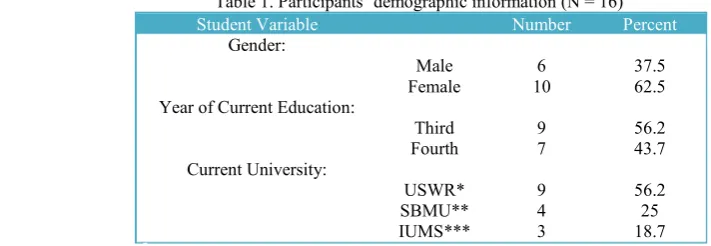
The study population included the under-graduate occupational therapy students who directly experienced the first fieldwork ed-ucation. The selection of the participants was determined using a purposeful sam-pling method based on firsthand experience and willingness to participation. A flyer that indicated the aim and method of the study was distributed in universities in Teh-ran. Those students who were ready to par-ticipate have been called to arrange a time for an interview. Sixteen students in their sixth or eighth semesters participated in this study (ten females and six males aged 21-24 years with a mean of 22.31 years) from three universities in Tehran including Sha-hid Beheshti University of Medical Scienc-es, Tehran University of Medical Sciences and University of Social Welfare and Re-habilitation Sciences (Table 1). Sampling ended when data saturation was achieved (i.e., continuation of the interview and data collection did not yield any new data or codes). Universities in this study are the first three universities providing occupa-tional therapy courses in Iran (22).
Data collection
Data were collected through semi-structured in depth interviews, following a focus group. Ten students were inter-viewed; and to interpret the primary results, one focus group was conducted with six students. The duration of interviews was Table 1. Participants’ demographic information (N = 16)
Student Variable Number Percent
Gender:
Male 6 37.5
Female 10 62.5
Year of Current Education:
Third 9 56.2
Fourth 7 43.7
Current University:
USWR* 9 56.2
SBMU** 4 25
IUMS*** 3 18.7
* University of Social Welfare And Rehabilitation Sciences ** Shahid Beheshti University of Medical Sciences *** Iran University of Medical Sciences
between 26 and 45 minutes (Mean: 30.25), and it was 62 minutes for the focus group. After obtaining an informed consent from the participants, we asked them to provide us with a convenient time and place for the interview. All the interviews and the focus group were carried out at the universities. The interview guide included a list of gen-eral questions used as a tool for initiating the interviews. The participants were asked to openly answer the questions based on their experiences. Several questions were asked such as “How was your experience in the first fieldwork education?", "What problems did you encounter in the first fieldwork education?”, and “What are the advantages and disadvantages of the first fieldwork education?". The questions were designed generally as a guide for the inter-view, which entailed open and interpretive answers, and the participants’ answers di-rected the process of the interviews and questions. The interviews were recorded by a digital voice recorder and were subse-quently transcribed verbatim.
Data analysis
The interviews were analyzed using qualitative content analysis (27). The pro-cess of qualitative content analysis often begins during the early stages of data col-lection. This early involvement in the anal-ysis phase helps moving back and forth be-tween the concept development and data collection and may also help to direct sub-sequent data collection towards the sources that are more useful for addressing the re-search questions (28). The content of the interview was read by the first author for several times; then all sentences were in-vestigated, the meaning units were marked in the text and the condensed meaning units and primary codes were extracted. The codes were categorized based on the simi-larities and differences and sorted into sub-categories and sub-categories, and finally the underlying meanings were interpreted as themes. In this study, 670 codes, 11 catego-ries and 3 themes were obtained.
Ethical considerations
This study was approved by the Ethics Committee of University of Social Welfare and Rehabilitation Sciences. To ensure au-tonomy, the aim of the study was explained and an informed consent form was signed by all the participants; in addition, permis-sion was obtained to record and use the da-ta without mentioning any names. At the end of each interview, the participants were guaranteed confidentiality and were en-sured that the recorded voices would be deleted after transcription. Data collection and coding phases were performed confi-dentially. The participants could withdraw at each phase of the study.
Trustworthiness
Credibility and consistency were con-firmed through several methods, including the allocation of enough time for data col-lection, rapport with the participants and conducting the interviews in an appropriate place, which was chosen by the participants and use of a focus group to achieve triangu-lation. Furthermore, the extracted meaning units and codes were returned to the partic-ipants to be checked. Moreover, the mean-ing units, codes, sub-categories and catego-ries were provided and were peer checked by those colleagues familiar with both fieldwork and qualitative research. The ob-tained results were continuously discussed by the authors. Prolonged engagement with the participants enabled the researcher to gain their trust and obtain more detailed and valid information (29).
Results
In this study, the importance of the super-visors’ management, deficits in the current curriculum and challenges in educational environment were extracted as the main factors influencing the first fieldwork edu-cation experiences of occupational therapy students. Table 2 demonstrates themes, cat-egories and some related codes.
A) Importance of Supervisor’s Manage-ment
- Importance of the First Sessions
All participants emphasized the im-portance of the first sessions. They experi-enced feelings such as anxiety, distraction and fear. Students also indicated the im-portance of the role of supervisors in con-trolling these feelings. Students thought that supervisors’ behavior, introductions and explanations were very important in overcoming anxious feelings. The follow-ing is an example of a positive experience in this regard, which has been stated by one of the participants:
“I think it is fearful to do any job for the first time because you have no experience. The clinic caused the same feeling in me; what should I do with a patient with delu-sion, How should I treat him/her, What if the patient is treated severely? I was really afraid, but when I saw that the supervisor takes it easy and the difficult patients are not as aggressive as I read in the books, I got used to it." (Participant 5)
On the contrary, some students indicated they needed further explanations prior to
visiting the clients due to the lack of practi-cal experience. One student said:
"… It did not know how to talk to the pa-tient or how to evaluate his/her condition in the first session. However, the supervisors neither provided us with any information nor gave us any explanations on how to talk to or treat the patient in the first ses-sion; and all of the sudden they told us take care of this patient, he/she is yours." (Par-ticipant 2)
- Experience of Relationship and Com-munication with the Supervisor
In this category, some participants expe-rienced good and intimate communication while others did not. This highlights the significance of the students’ relationship with their supervisors, and whether or not the supervisor exercises a top-down attitude in managing the students, or whether he/she develops excessive closeness with the stu-dents. One student described her experience about excessive closeness as follows:
“In my opinion, it is best for the supervi-sors to develop managed closeness with their students because this closeness may Table 2. Themes, Categories and Some Extracted Codes
Themes Categories Codes
Importance of
super-visor’s management --Importance of the first sessionsExperience of relationship and communi-cation with supervisor
-Need for supervision and appropriate feedback
-Challenges in documentation and report-ing
-Lecture as educational strategy -Variation in evaluation of the student's
performance
- Fear and unpreparedness feelings of the student at the beginning of clinical practice - Negative effect of excessive closeness between
the supervisor and the student
- Absence or limited availability of the supervi-sor while the student's clinical practice - Leaving the student alone in clinic and no
su-pervision by the supervisor
- Lack of a definite scientific method for clinical reporting
- Evaluating the lectures as non-scientific by the student
- Unclear process for evaluation of the student's clinical practice
Deficits in current
curriculum --Gap between coursework and fieldworkLess effective clinical observation course -Curriculum planning
-Theoretical subjects learned during coursework does not work in clinical practice
-Poor organization in providing clinical observa-tion course
-Large gap between coursework and fieldwork in curriculum
-Inappropriateness of beginning the clinic from semester six
Challenges in
educa-tional environment --Staff as influential factorsNon- educational characteristics of clini-cal settings and physiclini-cal structure
-Students are required to be further respected by the staff
-Limited numbers of facilities in clinic -Low space of clinic for working with patient
cause the relationship to change to another form of closeness such as one existing among two friends and this may cause many problems in different occasions." (Participant 1)
Another participant, speaking about the top down attitude of the supervisor said:
“Although the supervisors’ level is higher than the students’, it would be better for them not to put too much emphasis on this status difference when communicating with the students. I mean they should provide feedback and communicate with the stu-dents friendlily." (Participant 6)
- Need for Supervision and Appropriate Feedback
For the supervision and provision of fieldwork education, the participants had different experiences from continuous su-pervision and appropriate support to limited supervision and feedback. The variation in experiences can be seen in the following quotes:
"… Our clinic supervisor neither inter-fered in our practice nor stood by us. I mean, we had to experience everything by ourselves. At first, it was very difficult for me as my knowledge of clinical practice was not sufficient enough."(Participant 3)
"… I think we were not assessed thor-oughly during the semester by our supervi-sors. For instance, the supervisor never asked us if we were doing well or not."(Participant 8)
Some participants stated the feedback given by the supervisors in the presence of the patients and their family had a negative effect on their professional role. One stu-dent said:
"The most important thing which I no-ticed in this clinic which made me think was that the weaknesses and mistakes of the students should not be mentioned in the presence of the patients and their fami-lies because it causes distrust in the pa-tients and their families …. Because fami-lies already have serious doubts in the abil-ities of the students due to their lack of ex-perience, so when the supervisor provides
feedback to the students not considering this matter, the problem gets even worse." (Participant 1)
The necessity of collaboration of the su-pervisors with the students in performing the interventions for the first patient and the continuous attendance of the supervisors in the clinic were among the subjects stated in the interviews. One student described her needs as follows:
"It would be good if the supervisors stand by the students from the very first day and visit the patients together; for ex-ample, it is better if the supervisors teach the items instead of attending to the points every now and then; they should have con-tinuous presence at the clinic. For example, they should visit the patients and perform therapeutic techniques on them simultane-ously." (Participant 6)
- Challenges in Documentation and Re-porting
Experiences of the participants in this category included such issues as the lack of formal reporting format, no clear guidance for students, repetition of the reports and ignorance of documentation. One student’s comment was as follows:
"The material our supervisor required was lectures and a series of assignments, in which we wrote our objectives and plans. One disadvantage of this approach was that the supervisor only read the material and commented that the plan needed to be more complete and comprehensive, but I really had no idea how to improve it. I liked to have a hint or clue"(Participant 3)
- Lecture as an Educational Strategy All participants emphasized the im-portance of lectures and the need for group involvement. They emphasized the need for the lectures to be both scientific and practi-cal and mentioned that the timetabling of the lectures had to be sufficiently flexible to accommodate their needs. Finally, the students also highlighted the need for suffi-cient resources for lectures. One participant said:
"I think the lectures are not scientific. For example, if a lecture was about aggressive-ness and defiance, as an occupational ther-apist, I wanted to understand more than what I could find in the internet from the parents of a disobedient child." (Participant 3)
- Variation in the Evaluation of the Stu-dents’ Performance
Negative attitude towards the pre-clinic exam, the preference of written or oral ex-am by some participants and the tendency to be evaluated only by the clinical supervi-sor are among the issues stated by the par-ticipants. One student commented on the attendance of other instructors during the evaluation as follows:
"In the pediatric mental clinic, there was an instructor who never attended the clinic with us and it made the situation more dif-ficult. He did not even know what to ask, he asked more theoretical questions. We had to take the same exams we had already passed, except for the questions asked by our supervisor, which were good. Other instructors asked theoretical questions be-cause they did not have seen our work or had never seen our cases." (Participant 7)
B) Deficits in the Current Curriculum
- The Gap between Coursework and Fieldwork
Ineffectiveness, inapplicability and insuf-ficiency of coursework, the gap between coursework and fieldwork needs and the necessity of content revision and course-work timetable were among the most im-portant items stated by the participants in the interviews. The following quote illus-trates this matter:
"Our coursework should not be just theo-retical; we should also have practical work. For example, we passed sociology which was more like a high school course. If you ask me now, I can’t remember the content at all. Some courses such as mental retardation, psychiatry and the like were good, but some others were really useless and impractical." (Participant 3)
- Ineffective Clinical Observation Course Clinical observation is a course passed by occupational therapy students before be-ginning of the first clinic. The objective of this course is to familiarize the students with fieldwork environment and to prepare them for the fieldwork. The participants expressed their experience of this course, stating such issues as ineffectiveness, inac-tiveness and ignorance of students, being disregarded by the supervisors and the ne-cessity of revision of the clinical observa-tion course with respect to the timetable and method of execution. One student said:
"In the observation course, we just ob-served the situation.… I remember that I observed the senior students, who did not have any practical knowledge themselves and their practice might have not been cor-rect or accurate; therefore, I may have learned their mistakes …." (Participant 10)
- Inappropriate Administration of the Curriculum
The relatively late start of the clinic fieldwork, non-congruent programs in dif-ferent fieldwork education settings, the lim-ited time for the intervention on the activi-ties of daily living and an inappropriate se-lection of inexperienced supervisors for the first clinic are among the important issues falling in this sub-category. One of the stu-dents commented on the fieldwork educa-tion onset as follows:
" The clinic work starts at the 5thsemester which is very late because it has little inter-val with the 4th semester, and the students remember many things and can review them easily and there will be less pressure in the final semesters, but we are now un-der a lot of pressure." (Participant 7)
Considering the importance of the super-visors’ role in the first fieldwork education, some participants were interested in ac-companying a determined and experienced supervisor in the first clinic. One of the students confirmed:
"I want my supervisor to be experienced enough to have something to offer. Be-cause occupational therapy has some
lems due to its nature, so in the first en-counter, I prefer to have a supervisor who knows his/her field well enough to maneu-ver comfortably and with confidence in the field." (Participant 2)
C) Challenges in the Educational Envi-ronment
- Staff as an Influential Factor
The most important experiences of the participants were overlaps between the practices of the occupational therapists working in the setting without a positive attitude towards OT, inappropriate referral of patients, being disregarded by the staff and ignorance of occupational therapy in the treatment team were more experienced in the centers outside of the faculties like hospitals. One of the students stated his ex-perience about the referral of the patients:
"Sometimes, a patient had no referral at all; then, the matron would say to us not to take the him/her to the occupational thera-py ward, because it may cause a mess in the ward. However, the nurses, for their convenience and because they could not satisfy the patients’ needs and are unable to keep them happy would tell us to take them to the occupational therapy ward (Participant 4)
Another participant, speaking about teamwork said: “There is no teamwork. No one cares about teamwork and everyone ignores occupational therapy. For example, a nurse is perhaps more valued than an oc-cupational therapist in the mental health ward, and the physicians do not value oc-cupational therapy and this makes the pa-tients to be ignorant as well." (Participant 2)
- Non- Educational Characteristics of Clinical Settings and Physical Structure
The deficiency of devices and equip-ments, low number and variety of patients in centers, difference in training methods between the centers inside and outside of the faculty, lack of screening and inappro-priate referral of the patients are among the most important issues stated by the
partic-ipants. One of the participants reported clinical conditions as follows:
“There were very few facilities, and the devices were very plain and primitive. By such devices, we could not provide the pa-tients with appropriate activities or treat-ments they needed." (Participant 2)
Discussion
The results of this study indicated that the students encountered some issues in rela-tion to the supervisor, curriculum and edu-cational environment in their first attend-ance in the fieldwork training. They experi-enced feelings of fear and unpreparedness at the beginning of the fieldwork education. Previous studies have shown that the be-ginning of fieldwork education and transfer of the students from the coursework to clin-ical environments is stressful (12-14). However, in this study, the students be-lieved that awareness of the plans and ex-pectations, evaluation and intervention strategies used by the supervisor, review of the related coursework, familiarity with clinical environment and communication considerations including guidance and col-laboration by the supervisor may help them control such feelings at the beginning of the fieldwork. Since the first fieldwork of the students is in pediatrics or in adult mental health, the most stated problems were relat-ed to mental health centers. Prior studies have indicated that mental health centers cause specific issues (20, 30) and more fear in the students, and the students do not have positive attitudes towards the patients with psychiatric disorders (30-32). Howev-er, it has been suggested that the supervi-sor, as a model, can play the most im-portant role in decreasing the students’ stress (13). It is, therefore, necessary to consider special needs of these settings in the curriculum of occupational therapy for further preparation of both students and su-pervisors.
The role of the supervisors and their communication with the students in the clinics is of prime importance and could positively influence the fieldwork
tion process to such an extent to provide a proper support to the students and decrease their fear (20). In this context, the findings indicate the concerns of some participants about the inappropriate communication be-tween the supervisors and the students, a communication that could vary from a hier-archical attitude to excessive closeness. All participants, however, believed in the ne-cessity of establishing a friendly and close relationship between the supervisors and students.
Findings of previous studies have indicat-ed that supervision plays the most im-portant role in fieldwork education (1, 33). Kautzman showed that the students seek professional growth in clinical practice and prefer to receive feedback in relation to their performance in all contexts (17). In addition, Sheerer suggested that feedback is a very valuable resource from the students’ viewpoint, especially when it is positive and face-to-face (34). Findings of our study also indicated that the students wanted ap-propriate support and continuous attend-ance of the supervisors during clinical prac-tice and believed that the feedback might be given by the supervisors directly or indi-rectly depending on the patients’ problem, bearing in mind the fact that the method of giving feedback did not jeopardize their credibility in the eyes of the patients or their families.
Since the students encounter the profes-sional role of the occupational therapy in clinical settings for the first time in their first clinical experience, the participants stressed the necessity of recruiting deter-mined and experienced supervisors in the first clinic. This demand may be due to the difference between novice and experienced supervisors with respect to supervision and training methods. In their study, Christie et al. found that novice supervisors are inflex-ible and address needs of the students less, but experienced supervisors are more flexi-ble, which seems to make them to be more self-confident and pay more attention to the students (15). Although the aim of the fieldwork education process is to make the
students independent in clinical practice and promote their professional prepared-ness, our findings are indicative of the dif-ference between the supervisors in the method of education and establishment of independence. Therefore, in some clinics the supervisors gradually establish inde-pendence and in some cases, the students have an experience of being free with lim-ited supervision and collaboration, which forces them to move more rapidly towards independence. This difference between the attitudes of different supervisors can be as-sociated with their preparedness for the fieldwork education. In another qualitative study, the students stated that the supervi-sors needed more knowledge of the field-work education and had to acquire the nec-essary preparation skills before beginning of the clinic (21, 33).
Documentation and reporting are among the duties assigned to the students in occu-pational therapy clinics. The findings in this context revealed low motivation of the students to do such assignments. They rec-ognized such reasons as lack of an estab-lished scientific method, ignorance of re-ports by occupational therapists and other staff, duplication of the reports and in some cases the supervisors’ lack of interest in reporting.
Lecture presentations can enhance the students' knowledge and their readiness for practice in clinics. The experiences of the students indicated that they emphasized the necessity and importance of lectures, but they believed that the lectures should be diverse, practical and organized in groups. The limited access of the students to the resources and not determining the resources by the supervisors were among the prob-lems stated by some participants. The find-ing of our study about the problem of hav-ing access to the resources was highlighted by the students in the study conducted by Mulholland and Derdall (21).
This study also indicated that there was no clear-cut structure for the evaluation of the students’ performance in the clinics; and written, oral, collective and individual
forms of evaluation were seen in the clin-ics. The students had different preferences in this regard, but they all mentioned it in the evaluation. The students’ functional as-pects should be considered more than the theoretical aspects and the pre-clinic exam; and the method of evaluation should be de-termined from the very first day. It seems that the lack of a specific conductive plan has produced diverse ways to evaluate the students.
According to the approved curriculum of occupational therapy at undergraduate lev-el, all students should pass the theoretical courses before the beginning of the field-work education. From the viewpoint of the students, the long interval between the coursework and clinical practice caused them to forget many concepts. As believed by the students, some theoretical courses were not applicable and the arrangement of the courses in the educational semesters should be revised. Some studies indicated that the students need preparation before entering the clinic (21) and pre-fieldwork preparation may ensure a successful clini-cal practice experience for OT students (30).
Among the pre-clinic courses, the clini-cal observation course is presented with the aim of preparation of the students for the presence in the clinic and beginning the fieldwork education, but the students stated that this course was not effective and did not meet their needs. In their opinion, this is due to the inappropriate organization of this course, which has made its sessions low in number. The students have an inac-tive role during clinical observation, and the supervisors have little supervision on the students and underestimate this course. The experience of the students about inac-tiveness is a finding that is consistent with the experiences of American students in the 1980s as suggested in the studies of Kau-tzman (17) and Shalik (35).
Some categories explained in this study were related to the planning of occupational therapy departments. The participants be-lieved that the start of the fieldwork clinics
from the sixth semester was inappropriate, and it imposed excessive pressure on them during their last semesters. They also indi-cated that the rules of clinics were unclear and inexperienced and newly-graduated supervisors were recruited in some clinics. In general, the lack of a well-structured fieldwork education plan is a drawback of occupational therapy departments.
The experience of the students in the clin-ical settings outside of the faculty indicated that the presence of other occupational therapists in the environment might have both positive and negative effects on the fieldwork education process. Furthermore, the negative attitude of other staff towards occupational therapy services made the students witness inappropriate referrals of patients to occupational therapy and igno-rance of occupational therapy in the treat-ment team. Positive attitude can be en-hanced by further interactions between the occupational therapists working in these settings with other professionals. Physical characteristics of educational environments also influenced the experiences of the par-ticipants as they complained about absence of facilities and lack of space, dispropor-tionate number of students and size of the clinics and low number of patients; they also believed that the presence of the pa-tients with various diagnoses in the centers might have positive effect on fieldwork ed-ucation.
Generally, the findings of this study could help the instructors to improve the integra-tion of course work with fieldwork educa-tion. Also, it can help the supervisors to provide feedback to the students using more appropriate methods. In addition, the findings of this study could benefit educa-tional programs and it may also help de-partment managers and fieldwork coordina-tors to select experienced and skillful su-pervisors for the first fieldwork education and provide practical guidelines for the su-pervisors. However, further investigations are necessary to explore the experiences of managers, coordinators and other involved parties in the fieldwork education process.
This study was conducted only on the stu-dents of three occupational therapy depart-ments in Tehran. Therefore, the results of this study may not be generalized to stu-dents of other majors or other occupational therapy departments.
Conclusion
The results of this study indicate that the research participants did not have satisfying experiences during their first fieldwork en-counter. Furthermore, the findings clarified three main areas as the most important fac-tors of students’ experience: the importance of supervisors, the fieldwork environment and the curriculum. The researchers rec-ommend educational planning authorities to consider the implications of these three key areas, while addressing the feedback and comments of the students. Further research is suggested to explore each of the study’s key themes, and examine the relationships between them. Moreover, further investiga-tion is needed to capture the experiences of the supervisors, department managers and other parties involved in the occupational therapy fieldwork. Furthermore, it is note-worthy to mention that a grounded theory approach may be valuable in identifying factors, which underlie fieldwork dynam-ics.
Acknowledgments
We wish to acknowledge the occupational therapy students who willingly participated in this study. This article was based on the first author’s PhD dissertation at the Uni-versity of Social Welfare and Rehabilita-tion Sciences. The support of the Universi-ty is kindly appreciated.
References
1. Christie B.A, Joyce P.C, and Moeller P.L. Fieldwork experience, Part1: impact on practice preference. The American Journal of Occupational Therapy, 1985a. 39(10): p. 671-674.
2. Gaiptman B. and Anthony A. Contracting in fieldwork education: The model of self-directed learning. Canadian Journal of Occupational Therapy, 1989. 56(1): p. 10-14.
3. Henderson A, et al. Students’ perception of the psycho-social clinical learning environment: an evaluation of placement models. Nurse Education Today, 2006. 26(7): p. 564-571.
4. Cohn E.S, and Crist P. Back to the future: new approaches to fieldwork education. The American journal of occupational therapy.: official publication of the American Occupational Therapy Association, 1995. 49(2): p. 103.
5. Kramer P, and Stern K. Approaches to improving student performance on fieldwork. American Journal of Occupational Therapy, 1995. 49(2): p. 156-159.
6. Hays C. Statement: Purpose and Value of Occupationalı Therapy Fieldwork Educationı. American Journal of Occupational Therapy, 1996. 50(10): p. 845.
7. Missiuna C, Polatajko H, and M. Ernest-Conibear, Skill acquisition during fieldwork placements in occupational therapy. Canadian Journal of Occupational Therapy. , 1992. 59(1): p. 28-39.
8. Cohn E.S. Fieldwork education:professional socialisation, in Willard and Spackman's occupational therapy,H. Hopkins, L. and H. Smith, D., Editors. 1993, Philadelphia:lippincott.
9. McKay E.A, and Ryan S. Clinical reasoning through story telling: examining a student's case story on a fieldwork placement. British Journal of Occupational Therapy, 1995. 58(6): p. 234-238.
10. Cohn E.S. Fieldwork education: Shaping a foundation for clinical reasoning. The American Journal of Occupational Therapy, 1989. 43(4): p. 240-244.
11. Crowe M.J, and Mackenzie L. The influence of fieldwork on the preferred future practice areas of final year occupational therapy students. Australian Occupational Therapy Journal, 2002. 49(1): p. 25-36.
12. Greenstein L.R. Student Anxiety Toward Level II Fieldwork. The American Journal of Occupational Therapy, 1983. 37(2): p. 89-95.
13. Mitchell M.M, and Kampfe C.M. Coping strategies used by occupational therapy students during fieldwork: An exploratory study. The American Journal of Occupational Therapy, 1990. 44(6): p. 543-550.
14. Mitchell M.M, and Kampfe C.M. Student coping strategies and perceptions of fieldwork. The American Journal of Occupational Therapy, 1993. 47(6): p. 535-540.
15. Christie B.A, Joyce P.C, and Moeller P.L. Fieldwork experience, Part 2: The supervisor’s dilemma. The American Journal of Occupational Therapy, 1985b. 39(10): p. 675-681.
16. Snow T, and Mitchell M.M. Administrative patterns in curriculum-clinic interactions. The American Journal of Occupational Therapy, 1982. 36(4): p. 251-256.
17. Kautzmann L.N. Perceptions of the purpose of
Level I fieldwork. The American Journal of Occupational Therapy, 1987. 41(9): p. 595-600.
18. Meyers S.K. Program evaluations of occupational therapy Level II fieldwork environments: A naturalistic inquiry. Occupational Therapy Journal of Research, 1989. 9(6): p. 347-361.
19. Swinehart S, and Meyers S.K. Level I fieldwork: Creating a positive experience. The American Journal of Occupational Therapy, 1993. 47(1): p. 68-73.
20. Tompson M, and Ryan A. Influences on students during their early fieldwork placements. Canadian Journal of Occupational Therapy, 1996. 63(3): p. 173-182.
21. Mulholland S, and Derdall M. An early fieldwork experience: student and preceptor perspectives. Canadian Journal of Occupational Therapy, 2007. 74(3): p. 161-171.
22. Rassafiani M, and Zeinali R. Occupational therapy in Iran. Therapies and Therapeutic Technology, 2007.
23. Fallahpour M. A review on occupational therapy in Iran. Iranian Rehabilitation Journal, 2004. 2(2): p. 5-8.
24. Iwama M.K. Meaning and inclusion: Revisiting culture in occupational therapy. Australian Occupational Therapy Journal, 2004. 51(1): p. 1-2.
25. Downe-Wamboldt B. Content analysis: method, applications, and issues. Health care for women international, 1992. 13(3): p. 313-321.
26. Elo S, and Kyngäs H. The qualitative content analysis process. Journal of Advanced Nursing, 2008. 62(1): p. 107-115.
27. Graneheim U.H, and Lundman B. Qualitative content analysis in nursing research: concepts,
procedures and measures to achieve
trustworthiness. Nurse Education Today, 2004. 24(2): p. 105-112.
28. Zhang Y, and Wildemuth B.M. Qualitative analysis of content. Applications of social research methods to questions in information and library science, 2009: p. 308-319.
29. Krefting L. Rigor in qualitative research: The assessment of trustworthiness. The American Journal of Occupational Therapy, 1991. 45(3): p. 214-222.
30. Chiang H.-Y.A, et al. An Investigation of the Satisfaction and Perception of Fieldwork Experiences Among Occupational Therapy Students. Hong Kong Journal of Occupational Therapy, 2012. 22(1): p. 9-16.
31. Beltran R.O, et al. The effect of first year mental health fieldwork on attitudes of occupational therapy students towards people with mental illness. Australian Occupational Therapy Journal, 2007. 54(1): p. 42-48.
32. Penny N.H, Kasar J, and Sinay T. Student attitudes toward persons with mental illness: The influence of course work and Level I fieldwork. American Journal of Occupational Therapy; American Journal of Occupational Therapy, 2001. 55(2): p. 217-220.
33. Li-Tsang C.W.P, et al. An Explorative Study of an Emerging Practice Clinical Education Programme for Occupational Therapy Students. Hong Kong Journal of Occupational Therapy, 2009. 19(2): p. 44-49.
34. Scheerer C.R. Perceptions of effective professional behavior feedback: Occupational therapy student voices. The American Journal of Occupational Therapy, 2003. 57(2): p. 205-214.
35. Shalik L.D. The level I fieldwork process. The American Journal of Occupational Therapy, 1990. 44(8): p. 700-707.