ISSN :2394-2231 http://www.ijctjournal.org Page 12
Analysis of Performance in Four Non-Preemptive Priority
Fuzzy Queues by Centroid of Centroids Ranking Method
R. Ramesh
1, S. Kumara Ghuru
21(Department of Mathematics, Arignar Anna Government Arts College, Musiri Tamilnadu, India.) 2( Department of Mathematics, Chikkanna Government Arts College, Tirupur Tamilnadu, India.)
---
*******************
---Abstract
:Ranking techniques are very noteworthy in the fuzzy numbers system for defuzzification. Many authors have already proposed various types of techniques to find out the performance of fuzzy queues. In this paper, we are going to deal with a new methodology namely centroid of centroids ranking method to find out the performance measures of non-preemptive priority fuzzy queues with 4-priorities. It is possible to convert from fuzzy environment to crisp environment by our proposed ranking method in order to analyze the performance measures of fuzzy queues. Finally, the effectiveness and the accurate values of our proposed method have been successfully solved by an example.
Keywords- Fuzzy sets, Fuzzy numbers, Centroid of centroids ranking, Non-preemptive priority fuzzy queues, Performance measures.
---
*******************
---I. INTRODUCTION
Now-a-days, in real life circumstances, we face a lot of priority based problems in the queueing environment such as ATM points, Medical shops, Reservation centers, Ration shops,
Hospitals, Making calls in
Telecommunications, etc…, . Stress the importance of time management is the ultimate aim of the researcher. At this juncture, queueing models take a very
prominent role. The basic
preliminaries[1],[2],[3] and models of queueing are very essential for our research purpose. In our day to day life situation, most of the time we apply the Fuzzy logic and applications[4],[6]. Occasionally, we apply the priorities[5] in the queueing situations. In some situations the priorities are accepted immediately and in some other situations it takes too much of time. These
performances can also be measured by fuzzy logic[7].
Generally, the class 1 customers (with priority) and class 2 customers
(Without priority) are serviced by same server. But the cost measures are entirely different for these customers[8],[9]. In this day to day situation, the preemptive priority based customers are mostly considered as special class 1 customers. This is an added advantage of the above mentioned customers. But the non-preemptive priority based customers[10] are always normal in consideration. However, in general, these customers are far better than the class 2 customers.
ISSN :2394-2231 http://www.ijctjournal.org Page 13
between centroid and the original points[12],[13], circumcenter of centroids[14], and centroid of centroids ranking techniques[15].
We can also use the centroid of centroids[20] ranking technique to measure the performance of non-preemptive priority fuzzy queueing models. This is a very easy method to compute the actual crisp values of the queueing models.
II. PRELIMINARIES
Fuzzy Set: A Fuzzy Set
A~ = {(x,
A~(x)); x Є U}is concluded by amembership function
A~mapping fromelements of a universe of discourse U to the unit interval [0,1].
(i,e)
A~: U →[0,1] is a mapping called thedegree of membership function of the fuzzy set A~ and
A~(x)is called the membershipvalue of x Є U in the fuzzy set A~.
Triangular Fuzzy Number: A Triangular
Fuzzy Number A~(x) is represented by A~(
1
a ,a2,a3;1) with the membership function
otherwise
a x a a a
a x
a x
a x a a a
a x
x A
, 0
, , 1
,
) (
3 2
3 2
3
2
2 1
1 2
1
~
Trapezoidal Fuzzy Number: A
Trapezoidal Fuzzy Number A~(x) is represented by A~(a1,a2,a3,a4;1) with the membership function
otherwise
a x a a a
a x
a x a
a x a a a
a x
x A
, 0
, , 1
,
) (
4 3
4 3
4
3 2
2 1
1 2
1
~
III.NON-PREEMPTIVE PRIORITY
FUZZY QUEUES
Let us consider the Kth priority customers arrive at single channel queue in respect of a Poisson process with the fuzzy rate
~k,(k =1,2,3,…,r ) and that they are waiting for service in FIFO discipline with the service time as an exponential distribution with fuzzy rate~ . On a FIFO served within their respective priorities. Let the service distribution for the Kth priority be exponentially with mean 1/~k unit that begins service and completes its service before another item is admitted, regardless
of priorities. We begin with
k k k
(1 ≤ k ˂ r) , ( 0 0, )
1
r
k
i i
k .The
system is stationary for r= ρ< 1. Let )
(
~ u
,~(v) denote the membership functions of ~ , ~ . Then we have the
following fuzzy sets:
u u u U
i ( , ( ))
~
~
ISSN :2394-2231 http://www.ijctjournal.org Page 14
v v vV
( , ( ))
~ ~
, where U,V are thecrisp universal sets of the arrival , service rates respectively. Let f(u,v) denote the system characteristic of interest. Since u,v are fuzzy numbers. f(u,v) is also a fuzzy number. Without loss of generality let us take the performance measures of Non-Preemptive of 4-Priority Queues. We use the queuing theory concepts under the
steady-state conditions
k k k
<1,
The Expected Queue Size
Lq =
ri i i
r k k k i r i i q L 1 1 1 1 ) ( ) 1 )( 1 (
and by using little’s formula ,
The waiting time in queue Wq =
r i i q iw 1 ) ( , where ) 1 )( 1 ( 1 1 ) ( i i r k k k i q w
Here we consider a system of single server with 4-priority queues (ie. The arrival rates
i
~, i=1,2,3,4).Using the concept of FM/FM/1/L queue with 4-priority queues can be reduced to M/M/1 queue with equal service rates. (ie) ~1=~2=~3=
~4 =~ ,Now ~1=
1 1 ~ ~
,~2=
2 2 ~ ~
,~3=
3 3 ~ ~
and 4 ~ = 4 4 ~ ~
Since ~ =~1+~2+~3+~4,
~ = ~1+~2+
~3+
~4~ = ~ ~ ~ ~ ~ 4 3 2
1
Also ) 1 )( 1 ( ~ ~ ~ ~ ~ 1 4 3 2 1 ) ( i i i q w
and(i)
q L ) 1 )( 1 ( ~ ) ~ ~ ~ ~ ( 1 4 3 2 1 i i i
From which we deduce that
) 1 (
q
w =
1 ~ ~ ~
) 2 ( qw =
) ~ ~ )( ~ ~ 1 ( ~ 1 2
1
) 3 ( qw =
) ~ ~ ~ )( ~ ~ ~ 1 ( ~ 2 1 3 2
1
) 4 ( qw =
) ~ ~ )( ~ ~ ~ 1 ( ~ 3 2
1
) ~ 1 ( ~ ~ 1 1 ) 1 ( q L ) ~ 1 )( ~ ~ 1 ( ~ ~ 1 2 1 2 ) 2 ( q L ) ~ ~ 1 )( ~ ~ ~ 1 ( ~ ~ 2 1 3 2 1 3 ) 3 (
q L ) ~ 1 )( ~ ~ ~ 1 ( ~ ~ 3 2 1 4 ) 4 (
q LIV.CENTROID Of CENTROIDS
ISSN :2394-2231 http://www.ijctjournal.org Page 15
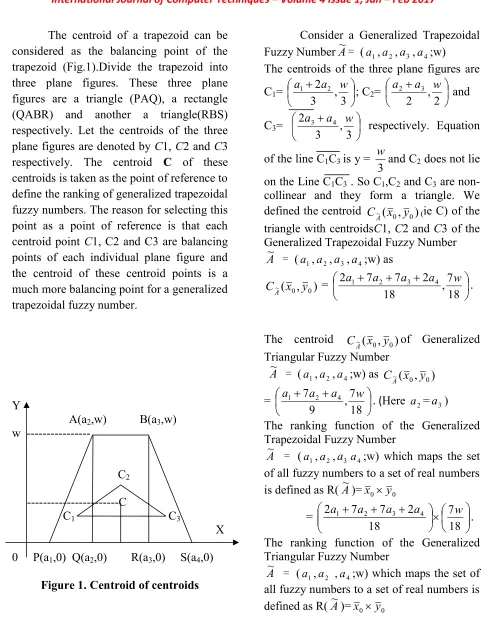
The centroid of a trapezoid can be considered as the balancing point of the trapezoid (Fig.1).Divide the trapezoid into three plane figures. These three plane figures are a triangle (PAQ), a rectangle (QABR) and another a triangle(RBS) respectively. Let the centroids of the three plane figures are denoted by C1, C2 and C3 respectively. The centroid C of these centroids is taken as the point of reference to define the ranking of generalized trapezoidal fuzzy numbers. The reason for selecting this point as a point of reference is that each centroid point C1, C2 and C3 are balancing points of each individual plane figure and the centroid of these centroid points is a much more balancing point for a generalized trapezoidal fuzzy number.
Y
A(a2,w) B(a3,w)
w ---
C2
---C
C1 C3
X
0 P(a1,0) Q(a2,0) R(a3,0) S(a4,0)
Figure 1. Centroid of centroids
Consider a Generalized Trapezoidal Fuzzy NumberA~= (a1,a2,a3,a4;w) The centroids of the three plane figures are
C1=
3 , 3
2 2
1 a w
a
; C2=
2 , 2
3 2 a w
a
and
C3=
3 , 3 2a3 a4 w
respectively. Equation
of the line C1C3 is y =
3 w
and C2 does not lie
on the Line C1C3 . So C1,C2 and C3 are
non-collinear and they form a triangle. We defined the centroid C~(x0,y0)
A (ie C) of the
triangle with centroidsC1, C2 and C3 of the Generalized Trapezoidal Fuzzy Number
A~ = (a1,a2,a3,a4;w) as
) ,
( 0 0
~ x y
CA =
18 7 , 18
2 7 7
2a1 a2 a3 a4 w .
The centroid C~A(x0,y0)of Generalized Triangular Fuzzy Number
A~ = (a1,a2,a4;w) as C~A(x0,y0)
=
18 7 , 9
7 2 4
1 a a w
a
. (Here a2=a3)
The ranking function of the Generalized Trapezoidal Fuzzy Number
A~ = (a1,a2,a3 a4;w) which maps the set
of all fuzzy numbers to a set of real numbers is defined as R(A~)=x0y0
=
18 7 18
2 7 7
2a1 a2 a3 a4 w
.
The ranking function of the Generalized Triangular Fuzzy Number
ISSN :2394-2231 http://www.ijctjournal.org Page 16
=
18 7 9
7 2 4
1 a a w
a
.
V. NUMERICAL EXAMPLE
Let us imagine a critical situation takes place in Chennai Thulasi Medical Pharmacy Store where some of the customers are awaiting to get the medicines and to pay the bills. In this particular situation, every person is in an urgency to get the prescribed medicines. Suddenly some of the customers want to get the medicines especially for ICU patients. When the shop keeper allows (non-preemptive priority only) the persons who are in urgency to get the medicines, the situation is very critical to handle it. At this juncture, we should calculate the average waiting time and average queue length with four priorities. Moreover, we should analyse how the waiting time and queue length have been extended in this situation in our day to day life.
A: For Trapezoidal fuzzy number
Consider the arrival rates of 1st2nd 3rd and 4th priority units are 1
~
= [1,2,4,5:1],
2
~
=[2,3,5,6:1],~3=[3,4,6,7:1],
4
~
= [4,5,7,8:1] and the same service rate ~ = [22,23,25,26:1] per hour respectively .Now the membership function of the trapezoidal fuzzy number [1,2,4,5:1] is
otherwise x x
x x x
x
, 0
5 4
, ) 5 4 (
) 5 (
4 2
, 1
2 1
, ) 1 2 (
) 1 (
) (
~
And similarly we can proceed for all remaining trapezoidal arrival rates in this same way.
Now we calculate Ranking by applying centroid of centroids ranking method.
R(~1) = R(1,2,4,5:1)
=
18 7 18
) 5 ( 2 ) 4 ( 7 ) 2 ( 7 ) 1 ( 2
= 1.16
R(~2) = R(2,3,5,6:1)
=
18 7 18
) 6 ( 2 ) 5 ( 7 ) 3 ( 7 ) 2 ( 2
= 1.55
R( 3
~
) = R(3,4,6,7:1)
=
18 7 18
) 7 ( 2 ) 6 ( 7 ) 4 ( 7 ) 3 ( 2
= 1.94
R(~4) = R(4,5,7,8:1)
=
18 7 18
) 8 ( 2 ) 7 ( 7 ) 5 ( 7 ) 4 ( 2
= 2.46
R(~ ) = R(22,23,25,26:1)
=
18 7 18
) 26 ( 2 ) 25 ( 7 ) 23 ( 7 ) 22 ( 2
ISSN :2394-2231 http://www.ijctjournal.org Page 17
= 9.33
And R(
~ ) = 7.11 , R(~1) = 0.12 ,R(~2) = 0.17 , R(~3) = 0.2, R(
~4) = 0.26,R(~ ) = 0.76
From queuing theory formulas
Average waiting time of units of 1st priority in the queue is
) 1 (
q
w =
1 ~ ~ ~
= 0.093
Average waiting time of units of 2nd priority in the queue is
) 2 (
q
w =
) ~ ~ )( ~ ~ 1 ( ~ 1 2
1
= 0.13
Average waiting time of units of 3rd priority in the queue is
) 3 ( q w = ) ~ ~ ~ )( ~ ~ ~ 1 ( ~ 2 1 3 2
1
= 0.22
Average waiting time of units of 4th priority in the queue is
) 4 ( q w = ) ~ ~ )( ~ ~ ~ 1 ( ~ 3 2
1
= 0.67
Average queue length of 1st priority is
) ~ 1 ( ~ ~ 1 1 ) 1 ( q
L = 0.1
Average queue length of 2nd priority is
) ~ 1 )( ~ ~ 1 ( ~ ~ 1 2 1 2 ) 2 ( q
L = 0.2
Average queue length of 3rd priority is
) ~ ~ 1 )( ~ ~ ~ 1 ( ~ ~ 2 1 3 2 1 3 ) 3 (
qL = 0.4
Average queue length of 4th priority is
) ~ 1 )( ~ ~ ~ 1 ( ~ ~ 3 2 1 4 ) 4 (
qL = 1.6
B: For Triangular fuzzy number
Consider the arrival rates of 1st2nd 3rd and 4th priority units are 1
~
= [1,4,5:1],
2
~
= [2,5,6:1], 3
~
= [3,6,7:1],
~4= [4,7,8:1] and the same service rate ~ = [22,25,26:1] per hour respectively .Now the membership function of the trapezoidal fuzzy number [1,4,5:1] is
otherwise x x x x x x , 0 5 4 , ) 5 4 ( ) 5 ( 4 , 1 4 1 , ) 1 4 ( ) 1 ( ) ( ~
And similarly we can proceed for all remaining triangular arrival rates in this same way.
Now we calculate Ranking by applying centroid of centroids ranking method .
R( 1
~
) = R(1,4,5:1)
= 18 7 9 5 ) 4 ( 7 2 = 1.47 R( 2 ~
ISSN :2394-2231 http://www.ijctjournal.org Page 18 = 18 7 9 6 ) 5 ( 7 2 = 1.85
R(~3) = R(3,6,7:1)
= 18 7 9 7 ) 6 ( 7 3 = 2.24 R( 4 ~
) = R(4,7,8:1)
= 18 7 9 8 ) 7 ( 7 4 = 2.63
R(~ ) = R(22,25,26:1)
= 18 7 9 26 ) 25 ( 7 22 = 9.63
And R(
~ ) = 8.19 , R(~1) = 0.152 ,R(~2) = 0.192 , R(
~3) = 0.232 ,R(
~4) = 0.273 R(~ ) = 0.85 From queuing theory formulasAverage waiting time of units of 1st priority in the queue is
) 1 (
q
w =
1 ~ ~ ~
= 0.1
Average waiting time of units of 2nd priority in the queue is
) 2 (
q
w =
) ~ ~ )( ~ ~ 1 ( ~ 1 2
1
= 0.16
Average waiting time of units of 3rd priority in the queue is
) 3 ( q w = ) ~ ~ ~ )( ~ ~ ~ 1 ( ~ 2 1 3 2
1
= 0.32
Average waiting time of units of 4th priority in the queue is
) 4 ( q w = ) ~ ~ )( ~ ~ ~ 1 ( ~ 3 2
1
= 1.39
Average queue length of 1st priority is
) ~ 1 ( ~ ~ 1 1 ) 1 ( q
L = 0.15
Average queue length of 2nd priority is
) ~ 1 )( ~ ~ 1 ( ~ ~ 1 2 1 2 ) 2 ( q
L = 0.29
Average queue length of 3rd priority is
) ~ ~ 1 )( ~ ~ ~ 1 ( ~ ~ 2 1 3 2 1 3 ) 3 (
qL = 0.71
Average queue length of 4th priority is
) ~ 1 )( ~ ~ ~ 1 ( ~ ~ 3 2 1 4 ) 4 (
qL = 3.83
VI. CONCLUSION
In this paper, we have analysed the new methodology for finding the performance measures of Non-Preemptive Priority Fuzzy Queues. We may use this methodology for various Fuzzy Queues instead of using the existing methods. This methodology not only gives the crisp values but also gives more accuracy than the other values. This methodology will be useful and helpful to all the researchers and inventors in the days to come.
ISSN :2394-2231 http://www.ijctjournal.org Page 19
[1] . Bose. S , An Introduction to Queueing systems, Kluvar Academic / Plenum Publishers, New Yark – 2008.
[2]. Cooper. R , Introduction to Queueing Theory , 3rd Edition, CEE Press, Washington,1990.
[3] . Janos . S , Basic Queueing Theory , Globe Edit Publishers , Omniscriptum GMBH , Germany 2016.
[4] . Klir . G . J and Yuvan .B , Fuzzy Sets and Fuzzy Logic Theory and Applications , Prentice Hall of India 2005.
[5] . Pekoz . E . A , Optimal Policies for Multi-Server Non-Preemptive Priority Queues , Queueing Systems , 2002 , 42(1) , 91 – 101.
[6] . Zadeh . L.A , Fuzzy sets as a basis for a theory of possibility, fuzzy sets and systems, 1978 , Vol:1, 3-28.
[7] . Pardo . M . J ,and Fluente . D . De . La , Optimizing a Priority Discipline Queueing Model using Fuzzy Set Theory , Computers and Mathematics With Applications ,2007, 54; 267 – 281.
[8] . Ritha . W and Lilly . R , Fuzzy Queues With Priority Discipline , Applied Mathematical Sciences , 2010 , vol-4, no: 12 , 575 – 582.
[9] . Ramesh . R and Kumaraghuru . S , Priority Disciplined Queueing Models With Fuzzy Parameters , Journal of
Mathematical and Computer Science , 2014 , 4 , no: 3 , 594 – 602.
[10] . Devaraj . J and Jayalakshmi . D , A Fuzzy Approach to Non-Preemptive Priority Queues, International Journal of Mathematical Archive , 2012 , 3 July , 2704-2712 .
[11]. Palpandi . B and Geetharamani . G , Computing Performance Measures of Fuzzy Non-Preemptive Priority Queues Using Robust Ranking Technique , Applied Mathematical Sciences, 2013 , Vol. 7, no: 102, 5095 – 5102.
[12]. Chu.T. C & Tsao. C.T, Ranking Fuzzy Numbers with an Area Between the Centroid Point and Original Point, Computers and Mathematics with Applications , 2002 , vol 43, no :1-2, 111 – 117.
[13].Wang .Y. J and Lee. H. S , The Revised Method of Ranking Fuzzy Numbers with an Area Between the Centroid and Original Points ,Computers and
Mathematics with Applications , vol 55, No : 9 , 2033 – 2042.
ISSN :2394-2231 http://www.ijctjournal.org Page 20
[16].Dat . L.Q , Yu .V.F & Chou . S.Y , An Improved Ranking Method for Fuzzy Numbers Based on the Centoid Index , International Journal of Fuzzy Systems , 2012, September, vol 14,no 3 413 – 419. [17]. Parandin . N and Araghi . M.A.F , Ranking of Fuzzy Numbers by Distance Method , Journal of Applied
Mathematics,2008 ,winter vol 15 no :19, 47 – 55.
[18]. Allaviranloo . T , Jahantigh . M.A and Hajighasemi . S , A New Distance Measure and Ranking Method for
Generalized Trapezoidal Fuzzy Numbers, Mathematical Problems in Engineering , 2013 , vol 2013 , Id 623757 , 6 pages. [19].Azman . F.N & Abdullah . L , Ranking Fuzzy Numbers by Centroid Method , Malaysian Journal of Fundamental and Applied Sciences,2012,vol 8,no:3, 117-121.
[20]. Rao . P.P.B & Shankar . N.R Ranking Generalized FuzzyNumbers using Area, Mode, Spreads and Weights,
International Journal of Applied Science and Engineering, 2012. 10, 1: 41-57.