Assessment of Palatal Rugae Patterns among Different Age Groups OMPJ
Assessment of Palatal Rugae Patterns among Different
Age Groups: An Institution-based Study
1Aravind P Mohan, 2Valappil T Beena, 3Sabu Paul, 4Manju M Stephen, 5Thomas K Johnson, 6Rohit Mohan
ABSTRACT
Introduction: Due to the distinctive anatomy of the human dentition, the teeth and palatal rugae of the oral cavity have a vital role in forensic dentistry. In certain situations, when teeth are missing due to trauma, palatal rugae have been used to help in recognition and matching of the individual. The palatine rugae pattern is unique for each human being and so can be used in identification. Age, sex, and even ethnic identity can be determined using rugoscopy.
Aim: To discover whether there are any specific rugal patterns pertaining to any age group, gender, and ethnicity, and whether these can be used to assess these parameters during forensic examination.
Materials and methods: Totally, 100 males and 100 females of Kerala origin and 12 non-Keralite males and females each were assessed in this study. Data from the right side and left side were collected separately.
Results: The results presented here provide data on the direc-tion, shape, length, unificadirec-tion, and number of rugae. Statistical Package for the Social Sciences software was used to analyze the results statistically.
Conclusion: On analysis, significant differences existed in the shape, length, number, and direction among the populations. However, unification of rugae was not found to be significant statistically.
Keywords: Age, Dental identification, Ethnicity, Forensic odon-tology, Gender, Palatal rugae.
How to cite this article: Mohan AP, Beena VT, Paul S, Stephen MM, Johnson TK, Mohan R. Assessment of Palatal Rugae Patterns among Different Age Groups: An Institution-based Study. Oral Maxillofac Pathol J 2018;9(2):51-57. Source of support: Nil
Conflict of interest: None
INTRODUCTION
Forensic science refers “to a group of scientific disciplines which are applied of their particular scientific area of
OMPJ
ORIGINAL RESEARCH 10.5005/jp-journals-10037-1130
1,5,6Senior Resident, 2Professor and Principal, 3,4Assistant
Professor
1-6Department of Oral Pathology and Microbiology, Government
Dental College, Kottayam, Kerala, India
Corresponding Author: Aravind P Mohan, Senior Resident Department of Oral Pathology and Microbiology, Government Dental College, Kottayam, Kerala, India, e-mail: u.aravindpmohan @gmail.com
expertise to law enforcement, criminal, civil, legal and judicial matters.”
Dr. Edmond Locard, the father of modern forensics, formulated the fundamental principle of forensic science, “Every contact leaves a trace.”1 Forensic odontology
deals with teeth and forensic stomatology deals with oral structures other than teeth.
Forensic odontology has three key applications: 1. Diagnosis, therapeutic assessments, and evaluation of
injuries to dentition, jaws, and soft tissues of the oral cavity;
2. The person’s identification, particularly, in criminal inquiries and/or mass catastrophes; and
3. Identification, analysis, and evaluation of bite marks that are seen in child abuse, sexual assaults, and in personal defense.2
Identification comprises a group of procedures to help individualize a person or a substance. However, identity cannot always be conclusively established by one particular method. Forensic dentistry or forensic odonto-stomatology is that “branch of forensic medicine which in the interest of justice deals with the proper handling and examination of evidence obtained from dental and oral structures and with the proper evaluation and presenta-tion of those findings.”
Forensic dentistry has become an integral part of forensic medicine over the past 100 years. The rationale behind forensic odontology is that “no two mouths are alike.”1 Assessment of rugae patterns come under the
stomatology part of forensic odonto-stomatology. Palatal rugae refer to “the ridges on the anterior part of the palatal mucosa, each side of the median palatal raphe and behind the incisive papilla.”
The rugae patterns are distinctive and individualistic, which can be used in identity fixation. The rugae have been associated with fingerprints and likewise display total individuality. Rugae are confined from injuries by their internal location in the oral cavity, and they are shielded from high temperature by the tongue and the buccal fat pads.
Even between twins, the patterns are analogous, but not identical.2 Rugae patterns vary among different
popu-lations.3,4 Variations can also be observed with increase in
age.3 Significant differences in rugal patterns can be seen
Kerala population.
This study is an effort to explore rugoscopy in a study population comprising patients of Kerala ethnicity report-ing to the Government Dental College, Kottayam, India. Furthermore, the palatal rugae patterns are compared among different age groups to asses any significant dif-ferences with respect to age, sex, and ethnicity, as these aspects could prove to be a valuable step and an adjuvant toward the identification of an individual.
MATERIALS AND METHODS
The study population was recruited between January 1, 2015 and June 31, 2016. The study groups with Kerala ethnicity were divided into five age groups as group I (11–20 years), group II (21–30 years), group III (31–40 years), group IV (41–50 years), and group V (51 years and above). Each group contained 40 samples, i.e., 20 males and 20 females using convenient sampling.
Twelve non-Keralites were available during the study period, who were above 11 years of age, and were taken as the control group. Patients with physical and mental disabilities, serious illnesses, especially posted for major surgeries, having cleft palate and cleft lip, those wearing prosthesis covering the rugae area, and those in which palatal rugae could not be assessed properly were excluded.
Length, direction, shape, unification, and number of rugae were assessed with respect to age, sex, and ethnic-ity. After ethical clearance from the Institutional Ethics Committee, informed consent was obtained from the patients in case of adults and assent was obtained in the children of the 11 to 15 age group.
Procedure
Alginate impressions of the maxillary arch were made, and casts were preserved for interpretation. The outline of rugae was marked out using 0.5 mm fine lead pencil. The rugae patterns were examined based on direction, shape, length, number, and unification.2,7 Data for the
right and left sides were analyzed separately. The casts procured were segregated into five groups, based on the age of patients and analyzed.
Shape Analysis
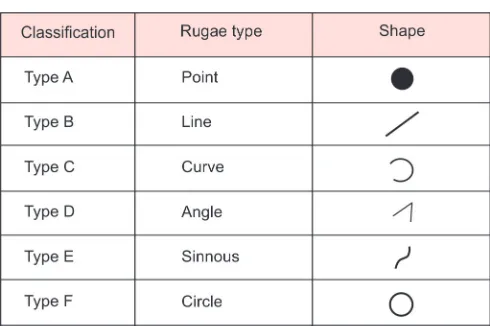
The palatine rugae shapes were assessed based on clas-sification by Trobo.2 Here, the rugae patterns are divided
into two types: (1) Simple rugae, classified as Types A, B, C, D, E, and F with well-defined rugae shapes (Fig. 1) and (2) composite rugae, categorized as type X, with a
polymorphism variety (these rugae are formed by the blending of two or more simple rugae). We have included a special type (not specified), NS, in the classification to sort out the rugae that cannot be included in any of above types.
Size Analysis
The size of each rugae was calculated using a digital Vernier caliper, and classified as primary, secondary, and fragmentary according to Lysell.2 The straight rugae were
calculated for the largest longitudinal length, while the circular, curved, sinuous, and angle shapes were calcu-lated by splitting the rugae at each curvature and then summing up the length at each curvature to make up the total length of rugae.
Number Analysis
The number of rugae was counted on the left and right sides separately for each person. The rugae sized less than 2 mm were not taken for the size and number analysis.
Analysis of Direction of the Rugae
The direction of the rugae was assessed by calculating the angle from the line joining its origin to the termina-tion and the line perpendicular to the median rugae. Forwardly directed rugae were associated with positive angles, backwardly directed rugae were associated with negative angles, and perpendicular rugae were associated with zero angles.
Analysis of Unification of Rugae
The fusion of rugae takes place when two rugae are connected at their origin or termination. Rugae were considered splitting, if two rugae had the same origin, but immediately branched out.
Assessment of Palatal Rugae Patterns among Different Age Groups OMPJ
Rugae with diverse origins, which are connected side-ways, were considered converging. After obtaining the impression, each cast was allotted a serial number, and it was identifiable by that number alone, so that information relating to age, sex, and ethnicity was not known to the observer at the time of measurement. The data collected were transferred to the Excel sheet for statistical analysis.
RESULTS AND DISCUSSION
Until date, the study of palatal rugae has not been exten-sive, and, hence, palatoscopy can be said to be in its infancy still in the field of forensic odontology. Thomas and Kotze have emphasized on the hurdles in examining, classifying, and interpreting the boundless and minuscule variations in palatal rugae and highlighted the require-ment for standardizing the methods for recording them. In this study, palatal rugae obtained from 224 individu-als (100 Keralite males, 100 Keralite females, 12 non-Keralite males, and 12 non-Keralite females) were analyzed.
Variations in Rugae Shape with respect to Age, Sex, and Ethnicity
The rugae shape is better suited for identification than the rugae length.4 Sinuous (type E) palatal rugae shape
is documented as the most prevalent, while the circular (type F) is the least prevalent rugae shape.8
However, our results show angular (type D) as the most prevalent shape and linear (type B) as the least prevalent shape (Graph 1). Rugae shapes were not similar on either sides and between the genders in the present study. On comparing each rugae shape among the differ-ent age groups and between males and females, highly significant variations (p < 0.05) were found in our study.
Change in the shape of at least one rugae, with advanc-ing age in all individuals, has already been documented.3
These findings suggest that different age groups in the Kerala subjects show differences in palatal rugae shapes, and this aspect could be helpful toward assessing the age of an unidentified individual after validation studies.
A statistically significant sex variance in the frequency of curved and straight rugae has already been reported among the Indians of Manipal, with a greater occurrence in females than in males.9 A higher incidence of the wavy
rugae among the males has also been reported in the same study. In our population, the angular patterns showed the highest frequencies in both genders.
A definite ethnic correlation could be noted in the rugae patterns in our study as well as other studies. Most of the Keralite subjects in the present study showed the angular pattern, while the non-Keralite population showed curved, sinuous, and angular shapes in equal frequencies. In the Bengaluru population, it was found that the curve form was the most common, suggesting their application in population differentiation.10 The
most common patterns in Australian aborigines and Caucasians were the wavy and the curved forms.3 They
reported a statistically significant relationship between the rugae patterns and ethnicity, with the straight pattern being more frequent in Caucasians, while the wavy pattern was more frequent in aborigines. The wavy pattern was the predominant rugae form in Nepalese subjects.11 In our study, a statistically significant (p < 0.05)
difference was found to exist on the left side (Graph 2). The reason for this significance could not be elucidated.
Variations in Rugae Length with respect to Age, Sex, and Ethnicity
The prevalent rugae lengths with respect to age, sex, and ethnicity are given in Tables 1 to 3. Rugae length increases with age in both genders.12,13 The fact that the maximum
Graph 1: Distribution of different rugae shapes on the left side
dimension of rugae in males and females was observed in the 41 to 50 age group (11.65 ± 1.41 mm) and in the 31 to 40 age group (11.2 mm) respectively, in our study, supports this view.
Once rugae development is complete, the probable alteration in palatal rugae takes place with respect to their length only. Their position remains the same throughout the life of an individual.13 In our study, bilateral
sym-metry in rugae length does not exist in both genders. A significant variance was found in our study on the left aspect of the palate, with respect to rugae length in both genders. However, a similar difference was lacking on the right side.
The maximum length of the rugae on the left side was observed in the 41 to 50 age group (10.33 mm) and the minimum length in the 11 to 20 age group (8.22 mm). The maximum length of rugae in Keralites and non-Keralites was 10.34 and 8.75 mm respectively. On comparing the mean rugae length between males and females, a signifi-cant difference existed (p < 0.05) on the left side, while no significant difference was found on the right side.
A significant difference was noted between Keralites and non-Keralites (p < 0.05) on comparing the mean rugae lengths on the right and left sides.
The mean rugae lengths on the right and left sides among all age groups were also found to be significant Table 3: Significance of rugae length with respect to ethnicity
n Mean Standard deviation Standard error
95% Confidence
interval for mean
Minimum Maximum Lower
bound Upper bound
Rugae length—right
(in millimeters) KeraliteNon-Keralite 20024 10.0383 2.194177.7333 1.30872 0.155150.26714 9.73237.1807 10.34428.2860 5.405.40 16.309.60
Total 224 9.7913 2.23235 0.14916 9.4974 10.0852 5.40 16.30
Rugae length—left
(in millimeters) KeraliteNon-Keralite 20024 9.5978.067 1.64022.0076 0.14200.3348 9.3177.374 8.7599.876 5.55.3 14.710.5
Total 224 9.433 2.0246 0.1353 9.166 9.699 5.3 14.7
n Mean Standard deviation Standard error Lower bound Upper bound Minimum Maximum
Rugae length—right
(in millimeters) 11–20 years21–30 years 4161 8.65739.2557 1.907231.20237 0.187780.24420 8.27788.7673 9.74429.0368 5.405.50 10.4013.70
31–40 years 42 10.5643 3.09073 0.47691 9.6011 11.5274 5.40 16.30
41–50 years 40 10.1300 2.28240 0.36088 9.4001 10.8599 5.60 14.30
50 years and above 40 10.6200 1.70237 0.26917 10.0756 11.1644 6.30 13.60
Total 224 9.7913 2.23235 0.14916 9.4974 10.0852 5.40 16.30
Rugae length—left
(in millimeters) 11–20 years21–30 years 4161 8.2299.480 1.93782.1279 0.33230.2481 7.5588.984 9.9778.901 5.55.3 12.514.7
31–40 years 42 9.426 1.9496 0.3008 8.819 10.034 5.9 13.0
41–50 years 40 10.338 1.9757 0.3124 9.706 10.969 5.6 14.5
50 years and above 40 9.695 1.6372 0.2589 9.171 10.219 6.2 13.3
Total 224 9.433 2.0246 0.1353 9.166 9.699 5.3 14.7
Table 2: Significance of rugae length with respect to gender
n Mean Standard deviation Standard error
95% Confidence
interval for mean
Minimum Maximum Lower
bound Upper bound
Rugae length—right
(in millimeters) MaleFemale 112112 9.85009.7326 2.223472.24964 0.212570.21010 9.42889.3163 10.148910.2712 5.605.40 15.2016.30
Total 224 9.7913 2.23235 0.14916 9.4974 10.0852 5.40 16.30
Rugae length—left
(in millimeters) MaleFemale 112112 9.7039.162 1.82872.1780 0.20580.1728 9.2958.820 9.50510.110 5.55.3 14.713.3
Assessment of Palatal Rugae Patterns among Different Age Groups OMPJ
(p < 0.05). We could not actually find the significance of rugae length on the left side.
Variations in Rugae Number with respect to Age, Sex, and Ethnicity
Rugae remain fairly stable in number except when there is trauma (loss of teeth or persistent pressure, which may modify the alignment) or at advanced age.14 Contrary to
this finding, our results show the maximum number of rugae in the 11-to-20 age group on both sides.
A highly significant (p < 0.05) difference existed in the prevalence of number of rugae among all the studied age groups (Graph 3). So, we safely hypothesize that a difference in rugae number occurs with age. Rugae count between both genders has been reported to be insignificant in many studies.6,15,16 In contrast, the number
of palatal rugae in the our study revealed a statistically significant difference (p < 0.05) between both genders in the Kerala population, with a higher incidence in females (Graph 4).
A similar difference in the number of rugae between both genders was reported in Tibetan and Mysorean populations.17 But, in contrast to our results, the rugae
number was greater in males in the study. No signifi-cant difference existed in the number of rugae between Keralites and non-Keralites.
Variations in Rugae Direction with respect to Age, Sex, and Ethnicity
In our study, the most common direction of rugae on the right side was observed to be backward (8.9%) in the 11 to 20 age group, perpendicular (10.7%) in the 21 to 30 age group, forward (10.3%) in the 31 to 40 age group, forward (8.9%) in the 41 to 50 age group, and perpendicu-lar (9.4%) in the 51 years and above age group.
The most prevalent direction of rugae on the left side was found to be forward in all the age groups. The prevalence of direction of rugae among all the study age groups showed significant (p < 0.05) difference (Graph 5). But, on comparing the prevalence of direction of rugae between males and females, no significant difference was observed. Similarly, significant results (p < 0.05) were seen in the direction of rugae between Keralite and non-Keralite population (Graph 6).
The most prevalent direction of rugae on the right side was forward (29.9%) and backward (29.9%) in Keralites and perpendicular (5.4%) in non-Keralites. The most preva-lent direction of rugae on the left side was forward (54.5%) in Keralites and perpendicular (5.4%) in non-Keralites.
Variations in Rugae Unification with respect to Age, Sex, and Ethnicity
No significant disparity was found in rugae unification patterns with respect to age, sex, and ethnicity.
Graph 3: Distribution of rugae number on the left side of the
palate in different age groups Graph 4: Distribution of rugae number on the left side of the palate in males and females
This was in concurrence with the findings made by Swetha18 but in contrast to observations made on Saudi
females, who had more converging rugae than males.19
The Trobo classification system, which is used for palatal rugae analysis in this study, exhibits some drawbacks in relation to detailing and accuracy. Most of the previous studies used the Thomas and Kotze classification and, hence, the results of those studies are not comparable with our study.
The rugae direction and unification variables have not been used in the Trobo classification. Hence, we found the assessments of rugae direction and unification dif-ficult. Since, direction and unification of each and every rugae is different in a study cast, we took only the most frequent type of direction and most frequent type of unification into consideration. More studies on differ-ent ethnic groups are required to prove a significance of these variables.
Conversely, it can also be assumed that these two variables are insignificant and cannot be taken into consideration for forensic identification. Though the sample size for Keralite population was adequate to sat-isfactorily assess the association between each variable used and the age and gender of the study sample, the non-Keralite sample size was not sufficient as compared with the Keralite sample size and could have resulted in a bias.
Significant changes were noticeable on the left side. However, further validation studies are required to understand its relevance. The definite correlation between rugae pattern and ethnicity and gender should be fol-lowed up using different ethnicities in a larger sample size. Overall, our study results suggest that analysis of palatal rugae can be a useful tool in the identification of an individual.
Graph 6: Distribution of rugae direction on the right side of the palate in Keralites and non-Keralites
number, direction, and unification were assessed with respect to age, sex, and ethnicity. Among these, rugae shape, length, and number show significant association both statistically and nonstatistically. Though the asso-ciation of rugae direction and unification with age, sex, and ethnicity was statistically significant, some amount of difficulty was experienced in their assessment. Hence, more studies have to be done on different ethnic groups and on a larger sample size to prove the same.
Conversely, it could also be assumed that these two variables, rugae direction and unification, are insignificant and cannot be taken into consideration for forensic identification. However, the uniqueness and overall constancy of palatal rugae imply their applica-tion as an adjuvant tool for forensic identificaapplica-tion in different groups. The importance of palatine rugae is highlighted by the fact that chemical injuries, trauma, and decomposition in victims of severe burns cannot affect the rugae forms, and the rugae can also be used for paternity tests.
It would be beneficial to conduct further studies with larger samples for palatal rugae analysis in all of the dif-ferent ethnic groups of the Indian population. Computer-assisted techniques of assessment will provide accurate results, which will prove to be a common method of analysis of palatal rugae in the near future.
REFERENCES
1. Singh K, Anandani C, Bhullar RK, Agrawal A, Chaudhary H, Thakral A. Teeth and their secrets—forensic dentistry. J Forensic Res 2012 Jan;3(1):141.
2. Bhateja S, Arora G. Analysis of palatal rugae for human iden-tification in Indian (Mathura) population. Indian J Dent Sci 2013 Sep;5(3):24-27.
3. Kapali S, Townsend G, Richards L, Parish T. Palatal rugae patterns in Australian aborigines and Caucasians. Aust Dent J 1997 Apr;42(2):129-133.
4. Nayak P, Acharya AB, Padmini AT, Kaveri H. Differences in the palatal rugae shape in two populations of India. Arch Oral Biol 2007 Oct;52(10):977-982.
5. Jibi PM, Gautam KK, Basappa N, Raju OS. Morphological pattern of palatal rugae in children of Davangere. J Forensic Sci 2011 Sep;56(5):1192-1197.
6. Saraf A, Bedia S, Indurkar A, Degwekar S, Bhowate R. Rugae patterns as an adjunct to sex differentiation in forensic iden-tification. J Forensic Odontostomatol 2011 Jul;29(1):14-19. 7. Shetty M, Premlatha K. Study of palatal rugae pattern among
the student population in Mangalore. J Indian Acad Forensic Med 2011 Apr-Jun;33(2):112-115.
Assessment of Palatal Rugae Patterns among Different Age Groups OMPJ
9. Manjunath S, Bakkannavar SM, Pradeep Kumar G, Bhat VJ, Prabhu N, Kamath A, Raghavendra Babu YP. Palatal rugae patterns among the Indians at Manipal, India. J Pharm Bio Med Sci 2012 Jul;20(10):1-5.
10. Indira AP, Gupta M, David MP. Palatal rugae patterns for establishing individuality. J Forensic Dent Sci 2012 Jul;4(1): 2-5.
11. Bajracharya D, Vaidya A, Thapa S, Shrestha S. Palatal rugae pattern in Nepalese subjects. Orthod J Nepal 2013 Dec;3(2): 36-39.
12. Lysell L. Plicae palatinae transversae and papilla incisive in man: a morphologic and genetic study. Acta Odontol Scand 1955;13(Suppl 18):5-137.
13. Simmons JD, Moore RN, Erickson LC. A Longitudinal study of anteroposterior growth changes in the palatine rugae. J Dent Res 1987 Sep;66(9):1512-1515.
14. Hauser G, Daponte A, Roberts MJ. Palatal rugae. J Anat 1989 Aug;165:237-249.
15. Bharath ST, Kumar GR, Dhanapal R, Saraswathi T. Sex deter-mination by discriminant function analysis of palatal rugae from a population of coastal Andhra. J Forensic Dent Sci 2011 Jul;3(2):58-62.
16. Surekha R, Anila K, Reddy VS, Hunasgi S, Ravikumar S, Ramesh N. Assessment of palatal rugae patterns in Manipuri and Kerala population. J Forensic Dent Sci 2012 Jul-Dec;4(2): 93-96.
17. Shetty SK, Kalia S, Patil K, Mahima VG. Palatal rugae patterns in Mysorean and Tibetan populations. Ind J Dent Res 2005 Apr-Jun;16(2):51-55.
18. Swetha S. Palatal rugae pattern in varied adult Indian population of males and females. J Pharm Sci Res 2015 Sep;7(9):736-739.