104
Antibacterial and Antioxidant study of Ocimum basilicum
Labiatae (sweet
basil)
Dinanath D Patil*, Dnyandeo K. Mhaske, Gurumeet C. Wadhawa
Department of Chemistry and Research Centre, R.B.N.B. College, Shrirampur,
Maharashtra, India
*Corresponding author: [email protected]
m
ABSTRACT:
Ethanol, methanol, and hexane extracts from Ocimum basilicum Labiatae (sweet basil)
were investigated for their in vitro antimicrobial properties. a disk-diffusion and
minimal inhibition concentration (MIC) method .Both the hexane and ethanol extracts,
but not the ethanol extracts, inhibited three isolates out studied. All three extract of O.
basilicum were different in terms of their antibacterial activities. The hexane extract
showed a stronger and broader spectrum of antibacterial activity,
study was also carried out to evaluate the in-vitro antioxidant activities of ethanol
,chcl3 and cc4 extract of Ocimum species namely Ocimum basilicum This was achieved
by screening the two plant extracts at varying concentrations (10-50ìg/ml)using DPPH
radical scavenging activity, reducing power assay, hydroxyl radical scavenging activity
and nitric oxide radical scavenging activity. The results were analyzed statistically
which showed that ethanol extract Ocimum basilicum had more antioxidant activity
than standard antioxidant.
Keywords: Antibacterial, Antioxidant, Ocimum basilicum, DPPH,Labiatae (sweet basil).
INTRODUCTION:
The flowers are white, labiate (like lips) are in six blossom, pedicled (part of the flower
still attached to the stem), almost sessile (still directly attached), axillary (grown from an
axil), false whorls. The calyx (usually green outer whorl) is bilabiate (having two lips),
and the corolla (the part of a flower that consists of the separate or fused petals) is
4-lobed. The lower lip is simple with four stamens laying on it.
The entire plant grows from 8 - 20 inches (20 - 50 cm) high, erect and sometimes
bushy. It has a downy feel from the base up. The leaves are ovate or oblong, very
lightly toothed, shinny, with deep vein markings. They are long petioled (slender stem),
acuminate (tapering to a slender point), irregularly dentate (having teeth or pointed
105
likely not be forgotten One of my favorite uses (and no this isn't a suggestion) is to drink
a cup of tea in the evening; 1 teaspoon per cup of water. I do this because of its high
content of magnesium and potassium. Magnesium draws water out of the body and
into the bowels, potassium helps with muscle cramps (something I have because of my
MS). It is said to stimulate digestion, is used for the feeling of being too full and
flatulence, is said to kill intestinal parasites, and used as a diuretic. Personally, I just
like the way it tastes. It is rich in a variety of important nutrients, most notably vitamin
A, vitamin C, calcium, and phosphorus. It is also a source of iron, potassium, and
magnesium. It is thought to have significant health effects, particularly in improving
the health of the cardiovascular system. Used for strong eyesight and healthy skin and
hair. It also contains high concentrations of carotenoids like beta carotene, and these
substances are converted to vitamin A within the body. Beta carotene offers even more
benefits than vitamin A alone, and it is known to be a powerful antioxidant. Free
radicals are potentially important in a number of ailment states that can have severe
effects on the cardiovascular system, either through lipid per oxidation or
vasoconstriction 1.
Damage to cells caused by free radicals is believed to play a central role in the aging
process and in disease progression. Antioxidants are our first line of defense against
free radical damage, and are critical for maintaining optimum health and wellbeing. The
need for antioxidants becomes even more critical with increased exposure to free
radicals. Pollution, cigarette smoke, drugs, illness, stress, and even exercise can
increase free radical exposure. Because so many factors can contribute to oxidative
stress, individual assessment of susceptibility becomes important. Many experts believe
that the Recommended Dietary Allowance (RDA) for specific antioxidants may be
inadequate and, in some instances, the need may be several times the RDA.
MATERIALS AND METHODS:
Plant Material:
The plant materials used in this study, Ocimum basilicum Labiatae roots, seed and
leaves of were collected from the field in Khandala Tal. Shrirampur, Dist Ahmednagar
identified by Dr. A. K. Mohite, R.B.N.B College, Shrirampur, Maharashtra, India. A
voucher specimen of the collected sample (voucher sample no 234) was deposited in our
106
Preparation of various extract of Ocimum basilicumLabiatae
In present study we use dry stem of the plant collected from western ghat region
Maharashtra. Dried stems are cut into small pieces these pieces are then grinded. The
grinded sample is dark brown in color with a special smell.
This powder stirred in non-polar solvent i. e. CCl4, for 1/2 hour & then it is refluxed for
1/2 hour this is performed for extraction of non-polar component from powder. After
extraction the CCl4 layer is distilled to recover solvent & to get a brown colored liquid
fraction which shows single spot on thin layer chromatography.
The residue of CCl4 extraction is used for further study. This residue is mixed with
CHCl3 & stirred for 1/2 hour & then refluxed for 1 hour. After filtration the filtrate is
distilled to get CHCl3 Fraction which is Red-brown colored liquid.
Then the Residue of CHCl3 is used for extraction with Ethyl acetate stirred well &
refluxed for 1 hour then filtered. Filtrate is then distilled & fraction of Ethyl acetate is
collected it shows no spot on TLC plate. Conclusion is that no organic compound is
present.
The Ethyl acetate residue is further mixed with methanol & stirred for 1/2 hr &
refluxed for 1hr. Then it is filtered & filtrate is distilled out. Methanol fraction is yellow
brown in color & show single spot On TLC plate.
The remaining residue also have smell & it is observed that residue is insect repellant.
DPPH Scavenging Test: Quantitative measurement of radical scavenging property was
carried out in a universal bottle. The reaction mixture contained 50 µL of test samples
(or 80% MeOH as blank) and 5 mL of a 0.004% (w/v) solution of DPPH in methanol.
Different known antioxidants, vitamin E, and butylatedhydroxytoluene (BHT, Sigma)
were used for comparison or as a positive control. Discoloration was measured at 517
nm after incubation for 30 min. Measurements was taken at least in triplicate. DPPH
radical’s concentration was calculated using the following equation: DPPH scavenging
effect (%) = [(Ao – A1) / Ao] ×100; Where Ao was the absorbance of the control and A1
was the absorbance in the presence of the sample. The actual decrease in absorption
induced by the test compounds was compared with the positive controls. The mean OD
517 results of DPPH scavenging activity were recorded.
Antimicrobial Activity:
The agar diffusion method [11] was used to evaluate the antimicrobial activity. Bacteria
were cultured overnight at 37 o C in Mueller Hinton 10 µl Broth (MHB, Oxoid) and fungi
at 28 o C for 72h in Potato Dextrose Broth (PDB, Oxide) and used as inoculums. A final
107
spore/ml of fungi spread on Mueller Hinton Agar (MHA) and Potato Dextrose Agar (PDA)
medium respectively.
The disc (6 mm in diameter) was impregnated with 10 µl of 75 µl/ml, 50 µl/ml, 25
µl/ml, 10 µl/ml and 5 µl/ml of each extracts and for each organism placed on seeded
agar. Ciprofloxacin and Fluconazole (75µl/ml, 50µl/ml, 25µl/ml, 10µl/ml and 5µl/ml)
were used as positive control bacteria and fungi respectively. The test plates were
incubated at 37 o C for 24h for bacteria and at 28 o C for 72h for fungi depending on the
incubation time required for a visible growth.
MIC values were also studied for microorganisms by turbid metric method, which were
determined as sensitive to the extracts in cup plate method. MIC was defined as the
lowest concentration of extract that inhibit visible growth.
RESULTS AND DISCUSSION:
There is a strong need for effective antioxidants from natural sources as alternatives to
synthetic antioxidant in order to prevent the free radicals implicated diseases which can
have serious effects on the cardiovascular system, either through lipid per oxidation or
vasoconstriction
The extracts and essential oils of many plants have been investigated for their
antioxidant activity 5-7. Secondary metabolites such as polyphenols are not required for
plant development and growth, but are involved in plant communication and defence
8-9. Polyphenols interact with pathogens, herbivores, and other plants; they protect from
ultraviolet radiation and oxidants, repel or poison predators and attract beneficial
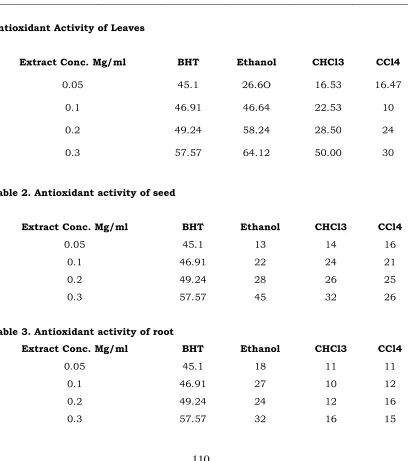
insects or microbes 10-11. Therefore, in this study, the antioxidant properties of the
methanol extracts of leaves and stems of plant like of re examined for DPPH radical
scavenging activity according to the method described and the results of the screening
are shown in table 1 & table 2 as comparable with known antioxidant BHT. In terms of
antioxidant activity, all the extracts investigated exhibited a rather high degree of
activity (more than 40%). In particular, leaves (ethanol extract) of Ocimum basilicum
displayed the highest activities as antioxidant activity as removal of the stable radical
DPPH and the lowest activity were found in CCl4 extract of stem. As expected, the
overall activity of the raw extracts was lower than that of commercial antioxidant BHT,
the reference antioxidant.
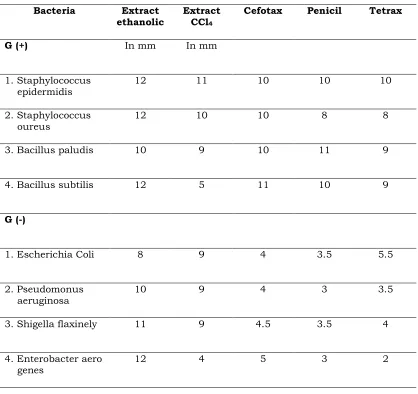
The results of Antimicrobial activity were done for all the five, pet ether, chloroform,
acetone, and methanol and aqueous extracts. During antimicrobial study methanolic
extracts showed maximum zone of inhibition against almost all organisms in cup plate
108
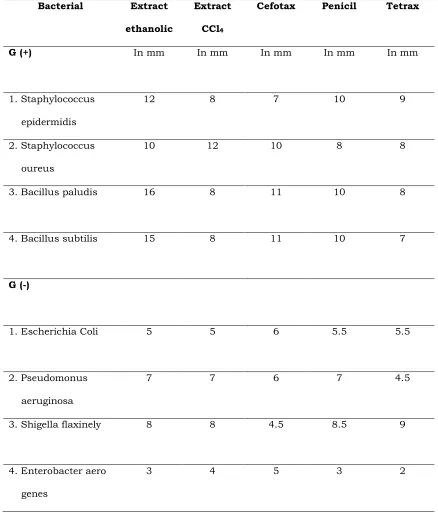
The methanolic extract from roots of Ocimum basilicum Labiatae showed a good
inhibition against all the bacterial Strains tested (MIC between 10& 80 ug/ml). The
gram (+) bacteria were sensitive with gram (-) bacteria and some common fungi.
Table 1. Antibacterial activity of methanolic extract from extract from Rhizome of
Valeriana wallichii
Bacterial Extract
ethanolic
Extract
CCl4
Cefotax Penicil Tetrax
G (+) In mm In mm In mm In mm In mm
1. Staphylococcus
epidermidis
12 8 7 10 9
2. Staphylococcus
oureus
10 12 10 8 8
3. Bacillus paludis 16 8 11 10 8
4. Bacillus subtilis 15 8 11 10 7
G (-)
1. Escherichia Coli 5 5 6 5.5 5.5
2. Pseudomonus
aeruginosa
7 7 6 7 4.5
3. Shigella flaxinely 8 8 4.5 8.5 9
4. Enterobacter aero
genes
109
Table 1 (i). Antifungal Activity of Ethanilic Extract From Extract From Ocimum
BasilicumLabiatae
Fungus Extract
ethanolic
Extract
CCl4
Cefotax Penicil Tetrax
1. Candida albicans 5 7 7 5 9
2. Aspergillus
fumigatus
6 9 5 7 4
3. Aspergillus niger 4 12 10 8 9
Table 1 (ii). Antibacterial Activity of Methanolic Extract From Root Of Ocimum
BasilicumLabiatae
Bacteria Extract
ethanolic
Extract CCl4
Cefotax Penicil Tetrax
G (+) In mm In mm
1. Staphylococcus epidermidis
12 11 10 10 10
2. Staphylococcus oureus
12 10 10 8 8
3. Bacillus paludis 10 9 10 11 9
4. Bacillus subtilis 12 5 11 10 9
G (-)
1. Escherichia Coli 8 9 4 3.5 5.5
2. Pseudomonus aeruginosa
10 9 4 3 3.5
3. Shigella flaxinely 11 9 4.5 3.5 4
4. Enterobacter aero genes
110
Table 1 (iii). Antifungal activity of methanolic extract from root of delonix regia
plant
Fungus Extract
mthanolic
Extract
CCl4
Cefotax Penicil Tetrax
1. Candida albicans 13 5 7 5 4
2. Aspergillus
fumigatus
10 9 5 6 4
3. Aspergillus niger 11 8 6 4 5
Antioxidant Activity of Leaves
Extract Conc. Mg/ml BHT Ethanol CHCl3 CCl4
0.05 45.1 26.6O 16.53 16.47
0.1 46.91 46.64 22.53 10
0.2 49.24 58.24 28.50 24
0.3 57.57 64.12 50.00 30
Table 2. Antioxidant activity of seed
Extract Conc. Mg/ml BHT Ethanol CHCl3 CCl4
0.05 45.1 13 14 16
0.1 46.91 22 24 21
0.2 49.24 28 26 25
0.3 57.57 45 32 26
Table 3. Antioxidant activity of root
Extract Conc. Mg/ml BHT Ethanol CHCl3 CCl4
0.05 45.1 18 11 11
0.1 46.91 27 10 12
0.2 49.24 24 12 16
111
ACKNOWLEDGEMENT:
We are grateful the Principal, R.B.N.B., College, Shrirampur for providing laboratory
facilities and Nikhil Analytical & Research Laboratory, Sangali for their technical
assistance)
REFERENCES:
1. Parr, A.; Bolwell, G. P. Phenols in the plant and in man: The potential for possible
nutritional enhancement of the diet by modifying the phenols content or profile. J.
Sci. Food Agric. 2000, 80,985–1012.
2. Basile, A.; Ferrara, L.; Del Pozzo, M.; Mele, G.; Sorbo, S.; Bassi, P.; Montesano, D.
Antibacterial and antioxidant activities of ethanol extract from Paullinia cupana
Mart. J. Ethnopharmacol.2005, 102, 32-36.
3. Lorenzi, H.; Matos, F. J. A. Plantas medicinais no Brasil: nativas e exóticas.
InstitutoPlantarum: São Paulo, 2002; pp 544-546.
4. Coelho, L. P.; Reis, P. A.; Castro, F. L.; Gayer, C. R. M.; Lopes, C. S.; Silva, M. C. C.;
Sabino, K.C. C.; Todeschini, A. R.; Coelho, M. G. P. Antinociceptive properties of
ethanolic extract andfractions of Pterodon pubescens Benth. seeds. J.
Ethnopharmacol. 2005, 98, 109-119.
5. Brito, A. R. M. S.; Brito, A. A. S. Forty years of Brazilian medicinal plant research. J.
Ethnopharmacol. 1993, 39, 53-67.
6. Duarte, I. D. G.; Ferreira-Alves, D. L.; Veloso, D. P.; Nakamura-Craig, M. Evidence
of the involvement of biogenic amines in the antinociceptive effect of a vouacapan
extracted from Pterodon polygalaeflorus Benth. J. Ethonopharmacol. 1996, 55,
13-18.
7. Finkel, T.; Holbrook, N. J. Oxidants, oxidative stress and the biology of ageing.
Nature 2000, 408,239-247.
8. Halliwell, B. The antioxidant paradox. The Lancet 2000, 355, 1179- 1180.
9. Pietta, P. Flavonoids as antioxidant. J. Nat. Prod. 2000, 63, 1035- 1042.
10.Visioli, F.; Keaney Jr, J. F.; Halliwell, B. Antioxidants and cardiovascular disease;
panaceas ortonics for tired sheep? Cardiovasc. Res. 2000, 47, 409-418.
11.Husain, S. R.; Cillard, J.; Cillard, P. Hydroxyl radical scavenging activity of
flavonoids. Phytochemistry 1987, 26, 2489-2497.
12.London, Her Majesty’s Stationery Office British pharmacopoeia, 1988.
13.Morazzoni P, Bombardelli E. Valeriana officinalis: traditional use and recent
evaluation of activity. Fitoterapia, 1995, 66:99–112.
112
15.Bisset NG. Max Wichtl’s herbal drugs & phytopharmaceuticals. Boca Raton, FL,
CRC, Press, 1994.
16.Farnsworth, NR. ed. NAPRALERT database. Chicago, University of Illinois at
Chicago, IL, March 15, 1995 production (an on-line database available directly
through the University of Illinois at Chicago or through the Scientific and Technical
Network (STN) of Chemical Abstracts Services).
17.Bruneton J. Pharmacology, phytochemistry, medicinal plants. Paris, Lavoisier 1995.
18.Jackson BP, Snowden DW. Atlas of microscopy of medicinal plants, culinary herbs