Advances in Radio Science, 3, 259–263, 2005 SRef-ID: 1684-9973/ars/2005-3-259
© Copernicus GmbH 2005
Advances in
Radio Science
Turbo Equalization Of Nonlinear ISI-channels Using High Rate
FEC Codes
M. Siegrist, T. Schorr, A. Dittrich, W. Sauer-Greff, and R. Urbansky
University of Kaiserslautern, Communications Engineering, Erwin-Schr¨odinger-Strae, 67653 Kaiserslautern, Germany
Abstract. Turbo equalization is a widely known method
to cope with low signal to noise ratio (SNR) channels cor-rupted by linear intersymbol interference (ISI) (Berrou and Galvieux, 1993; Hagenauer et al., 1997). Recently in this workshop it was reported that also for nonlinear channels a remarkable turbo decoding gain can be achieved (Siegrist et al., 2001). However, the classical turbo equalization relies on code rates at 1/3 up to 1/2 which makes it quite unattrac-tive for high rate data transmission. Considering the potential of iterative equalization and decoding, we obtain a consider-able turbo decoding gain also for high rate codes of less than 7% redundancy by using punctured convolutional codes and block codes.
1 Introduction
As linear ISI can be regarded as a special convolutional code, it may be considered as part of a serially concatenated cod-ing scheme. Therefore the concept of iterative equalization and decoding, which is denoted as “turbo equalization”, can be applied. Due to the iterative decoding process, the degra-dation caused by linear ISI can be reduced remarkably or even compensated almost completely (Berrou and Galvieux, 1993; Hagenauer et al., 1997). Furthermore, the performance of the FEC encoded system can be enhanced without an in-crease in complexity by using an additional ISI channel pre-coder (Koetter et al., 2004).
Many communication systems are corrupted by nonlinear ISI like e.g. high rate optical data transmission. Non-linearity and ISI are due to propagation effects along the fiber de-scribed by the vectorial nonlinear Schroedinger equation and due to the use of photo diodes as signal detectors with square law characteristic.
In general, nonlinear ISI can be described by a finite state nonlinear channel model approximating the received signal after the electrical detection where state tables with con-ditional probabilities are used, enabling the application of turbo equalization to nonlinear ISI (Siegrist et al., 2001; Sauer-Greff et al., 2001).
Correspondence to: M. Siegrist ([email protected])
In this paper, we refer to the transmission of digital data over nonlinear channels with constraint length L. Besides the specification of the turbo equalizer, we focus on high data and code rate transmission. In order to increase the code rate with respect to the classical iterative equalization and decod-ing approach, we first apply punctured convolutional codes with a code rate of 0.933. The possibility of changing the code rate simply by modifying the puncturing scheme could be seen as an advantage of punctured convolutional codes. However, as it is expected from theory, suitable block codes of the same code rate require less SNR for the same bit error ratio (BER). Therefore we also consider a turbo scheme in-cluding a block code. Whereas for punctured convolutional codes equalizer and decoder make use of the same maximum a posteriori probability (APP) symbol-by-symbol detecting algorithm, the APP decoder for block codes requires a differ-ent approach.
In the following sections we give a short description of the nonlinear channel model based on noiseless, state depen-dent signal chips as introduced in Siegrist et al. (2001) and present the investigated systems for punctured convolutional and block codes. Simulation results outline the achievable decoding gain by using appropriate turbo equalization.
2 Model of nonlinear channels
For nonlinear channels and additive Gaussian noise the ana-log front-end that utilizes the nonlinear channel model con-sists of a bank of filters matched to theqL+1chips (Benedetto et al., 1987; Sauer-Greff et al., 2001), which can be reduced to a minimum effort front-end including a noise limiting low-pass filter with “square root Nyquist” characteristic and a sampler at the symbol rate. However, this leads to a non-recoverable degradation which in return is small compared to the ideal case (Haunstein et al., 2004).
Assuming stationary or slowly time varying channels, also a probability based nonlinear channel model can be derived, which in contrast is not restricted to signal independent addi-tive Gaussian noise (Siegrist et al., 2001).
260 M. Siegrist et al.: Turbo equalization of nonlinear ISI-channels
TURBO EQUALIZATION OF NONLINEAR
ISI-CHANNELS USING HIGH RATE FEC CODES
M. Siegrist
+, T. Schorr
+, A. Dittrich
+, W. Sauer-Greff
+, R. Urbansky
++
University of Kaiserslautern, Communications Engineering, 67653 Kaiserslautern, Germany
email:
[email protected]
Abstract: Turbo equalization is a widely known method to
cope with low signal to noise ratio (SNR) channels cor-rupted by linear intersymbol interference (ISI) [1,2]. Recently in this workshop it was reported that also for nonlinear channels a remarkable turbo decoding gain can be achieved [3]. However, the classical turbo equali-zation relies on code rates at 1/3 up to 1/2 which makes it quite unattractive for high rate data transmission. Con-sidering the potential of iterative equalization and decod-ing, we obtain a considerable turbo decoding gain also for high rate codes of less than 7% redundancy by using punctured convolutional codes and block codes.
1. INTRODUCTION
As linear ISI can be regarded as a special
convo-lutional code, it may be considered as part of a
seri-ally concatenated coding scheme. Therefore the
concept of iterative equalization and decoding,
which is denoted as “turbo equalization”, can be
applied. Due to the iterative decoding process, the
degradation caused by linear ISI can be reduced
remarkably or even compensated almost completely
[1, 2]. Furthermore, the performance of the FEC
encoded system can be enhanced without an
in-crease in complexity by using an additional ISI
channel precoder [3].
Many communication systems are corrupted by
nonlinear ISI like e.g. high rate optical data
trans-mission. Non-linearity and ISI are due to
propaga-tion effects along the fiber described by the vectorial
nonlinear Schroedinger equation and due to the use
of photo diodes as signal detectors with square law
characteristic.
In general, nonlinear ISI can be described by a
finite state nonlinear channel model approximating
the received signal after the electrical detection
where state tables with conditional probabilities are
used, enabling the application of turbo equalization
to nonlinear ISI [3, 5].
In this paper, we refer to the transmission of
digi-tal data over nonlinear channels with constraint
length
L. Besides the specification of the turbo
equalizer, we focus on high data and code rate
transmission. In order to increase the code rate with
respect to the classical iterative equalization and
decoding approach, we first apply punctured
convo-lutional codes with a code rate of 0.933. The
possi-bility of changing the code rate simply by modifying
the puncturing scheme could be seen as an
advan-tage of punctured convolutional codes. However, as
it is expected from theory, suitable block codes of
the same code rate require less SNR for the same bit
error ratio (BER). Therefore we also consider a
turbo scheme including a block code. Whereas for
punctured convolutional codes equalizer and
de-coder make use of the same maximum a posteriori
probability (APP) symbol-by-symbol detecting
algo-rithm, the APP decoder for block codes requires a
different approach.
In the following sections we give a short
de-scription of the nonlinear channel model based on
noiseless, state dependent signal chips as introduced
in [3] and present the investigated systems for
punc-tured convolutional and block codes. Simulation
results outline the achievable decoding gain by
us-ing appropriate turbo equalization.
2. MODEL OF NONLINEAR CHANNELS
For nonlinear channels and additive Gaussian
noise the analog front-end that utilizes the nonlinear
channel model consists of a bank of filters matched
to the
L1q+
chips [5, 6], which can be reduced to a
minimum effort front-end including a noise limiting
lowpass filter with “square root Nyquist”
character-istic and a sampler at the symbol rate. However, this
leads to a non-recoverable degradation which in
return is small compared to the ideal case [7].
0 5 1 0 1 5 2 0 2 5 3 0 3 5
- 2 - 1 . 5 - 1 - 0 . 5 0 0 . 5 1 1 . 5 2
N o n l i n e a r C h a n n e l : P M D 8
S a m p l i n g P h a s e φ
Amplitude
Fig. 1. Eye diagram of nonlinear channel
Assuming stationary or slowly time varying
channels, also a probability based nonlinear channel
model can be derived, which in contrast is not
re-Fig. 1. Eye diagram of nonlinear channel.stricted to signal independent additive Gaussian noise [3].
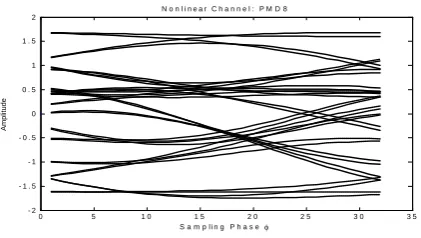
The eye diagram of the nonlinear channel shows that the eye is closed at all times, Fig. 1. Without loss of generality the simulations are based on the channel values at sampling phase φ=10 / 32.
3. CONVOLUTIONAL CODE TURBO EQUALIZATION
The performance of the serially concatenated punctured convolutional code (SCPCC) turbo scheme in the presence of nonlinear ISI channels is investigated. The channel effects are modeled as mentioned in section 2. An arbitrary bit sequence is encoded by a recursive systematic convolutional (RSC) encoder with code rate 1
2, punctured and
transmitted over the nonlinear channel.
The equalizer (Max-Log APP) using a Bahl-Cocke-Jelinek-Raviv (BCJR) algorithm then deter-mines the state transition probabilities referring to the channel output r( )i
µ
% by using the conditional probabilities
(
( )i ,)
P rµ =r% eµ sµ [3, 5, 8]. The derived extrinsic soft information is handed over to the code decoder that consists of a puncturing/ depuncturing and a Max-Log APP decoder part in case of convo-lutional code decoding, Fig 2.
Equalizer BCJR Deinterleaver 1 − ∏ Decoder BCJR Interleaver 1 ∏ Turbo-Decoding ( ) ( ) a
L e ,
ˆ ( )
D i ext
L e LDext( )eˆ
( )
* ˆ E ext L e r % Depunct. Puncturing 1..0..1 1000001 ( ) ( ) a L e ˆ ( ) D L a Code-DecoderFig. 2. SCPCC Turbo Decoder. Channel equalizer and decoder are fed with log-likelihood
ratios Lext as extrinsic information.
Equalizer and decoder refer to the received val-ues and additional soft valval-ues as in conventional SCC systems. The decoder assumes a log likelihood ratio (LLR) of zero for all punctured bits and refers to the received extrinsic information for all other bits. Since the RSC code with G1=238 and G2=358 is systematic, puncturing can be done just by cancel-ing an appropriate number of code bits. Assumcancel-ing uniform puncturing and a code rate of 0.933 only the first code word consisting of one information and one code bit is transmitted completely. The
succeed-ing 13 code words are transmitted only by half, i.e. only the information bits are sent [9].
A nonlinear optical channel is examined by transmitting 65025 coded bits with code rate of 0.933 over the channel with memory M=5. Having the technical implementation in mind, pseudo ran-dom as well as block interleavers with the size of 65025 bits have been used.
The simulation results of the nonlinear channel with a fixed sampling phase and additive Gaussian noise are presented in Fig. 3. It can be seen that the interleaver structure has a remarkable influence on the results. The degradation between an AWGN channel and the nonlinear channel with a pseudo random interleaver is only 0.5dB after the sixth it-eration at a BER of 5
10− . Consequently, even in nonlinear systems SCPCC turbo equalization deliv-ers a remarkable decoding gain.
0 1 2 3 4 5 6 7 8 9
10-7 10-6 10-5 10-4 10-3 10-2 10-1 100
Channel: PMD8, φ =10, R=0.933
E
b/N0/dB
BER
w/o ISI, BlockInt 0. It. 1. It. 6. It. 0. It., RandInt
4. BLOCK CODE SOFT DECODING
Puncturing of convolutional codes to achieve the desired code rates higher than 0.9 results in codes with low performance. A better alternative for these code rates are block codes, e.g. Bose-Chaudhuri-Hocquenghem (BCH) codes, which show a good performance at high code rates using hard decision decoding, like Bounded-Minimum-Distance (BMD) decoding. One drawback of BMD decoding is the restriction to correct less errors than half the designed distance of the code. The designed distance of a BCH-code often remains below the minimum distance, especially at lower code rates.
Another drawback that has to be circumvented is the lack of soft-out information of a BMD de-coder, because it is essential in a turbo decoding scheme. Therefore, another decoder has to be found. It is known, that, like convolutional codes, block codes can be represented by a trellis diagram [10]. Using this representation, it is possible to apply the
Fig. 3. SCPCC-Turbo-Equalization of a nonlinear optical channel.
Fig. 2. SCPCC Turbo Decoder. Channel equalizer and decoder are
fed with log-likelihood ratiosLextas extrinsic information.
3 Convolutional code turbo equalization
The performance of the serially concatenated punctured con-volutional code (SCPCC) turbo scheme in the presence of nonlinear ISI channels is investigated. The channel effects are modeled as mentioned in Sect. 2. An arbitrary bit se-quence is encoded by a recursive systematic convolutional (RSC) encoder with code rate1/2, punctured and transmitted over the nonlinear channel.
The equalizer (Max-Log APP) using a Bahl-Cocke-Jelinek-Raviv (BCJR) algorithm then determines the state transition probabilities referring to the channel output r˜µ(i) by using the conditional probabilities P rµ= ˜r(i)
eµ,sµ (Siegrist et al., 2001; Sauer-Greff et al., 2001; Bahl et al., 1972). The derived extrinsic soft information is handed over to the code decoder that consists of a puncturing/ depunctur-ing and a Max-Log APP decoder part in case of convolutional code decoding, Fig. 2.
Equalizer and decoder refer to the received values and ad-ditional soft values as in conventional SCC systems. The decoder assumes a log likelihood ratio (LLR) of zero for all punctured bits and refers to the received extrinsic informa-tion for all other bits. Since the RSC code with G1=238 andG2=358 is systematic, puncturing can be done just by canceling an appropriate number of code bits. Assuming uniform puncturing and a code rate of 0.933 only the first code word consisting of one information and one code bit is transmitted completely. The succeeding 13 code words are
stricted to signal independent additive Gaussian
noise [3].
The eye diagram of the nonlinear channel
shows that the eye is closed at all times, Fig. 1.
Without loss of generality the simulations are based
on the channel values at sampling phase
φ =10 / 32.
3. CONVOLUTIONAL CODE TURBO
EQUALIZATION
The performance of the serially concatenated
punctured convolutional code (SCPCC) turbo
scheme in the presence of nonlinear ISI channels is
investigated. The channel effects are modeled as
mentioned in section 2. An arbitrary bit sequence is
encoded by a recursive systematic convolutional
(RSC) encoder with code rate
12
, punctured and
transmitted over the nonlinear channel.
The equalizer (Max-Log APP) using a
Bahl-Cocke-Jelinek-Raviv (BCJR) algorithm then
deter-mines the state transition probabilities referring to
the channel output
( )ir%µ
by using the conditional
probabilities
(
( )i ,)
P rµ =r% eµ sµ
[3, 5, 8]. The derived
extrinsic soft information is handed over to the code
decoder that consists of a puncturing/ depuncturing
and a Max-Log APP decoder part in case of
convo-lutional code decoding, Fig 2.
Equalizer BCJR Deinterleaver 1 − ∏ Decoder BCJR Interleaver 1 ∏ Turbo-Decoding ( ) ( ) a
L e , ˆ ( )
D i ext
L e LDext( )eˆ
( )
* ˆ E ext L e r % Depunct. Puncturing 1..0..1 1000001 ( ) ( ) a L e ˆ ( ) D L a Code-DecoderFig. 2. SCPCC Turbo Decoder. Channel equalizer
and decoder are fed with log-likelihood
ratios
Lextas extrinsic information.
Equalizer and decoder refer to the received
val-ues and additional soft valval-ues as in conventional
SCC systems. The decoder assumes a log likelihood
ratio (LLR) of zero for all punctured bits and refers
to the received extrinsic information for all other
bits. Since the RSC code with
G1=238and
G2=358is systematic, puncturing can be done just by
cancel-ing an appropriate number of code bits. Assumcancel-ing
uniform puncturing and a code rate of 0.933 only the
first code word consisting of one information and
one code bit is transmitted completely. The
succeed-ing 13 code words are transmitted only by half, i.e.
only the information bits are sent [9].
A nonlinear optical channel is examined by
transmitting 65025 coded bits with code rate of
0.933 over the channel with memory
M
=5. Having
the technical implementation in mind, pseudo
ran-dom as well as block interleavers with the size of
65025 bits have been used.
The simulation results of the nonlinear channel
with a fixed sampling phase and additive Gaussian
noise are presented in Fig. 3. It can be seen that the
interleaver structure has a remarkable influence on
the results. The degradation between an AWGN
channel and the nonlinear channel with a pseudo
random interleaver is only 0.5dB after the sixth
it-eration at a BER of
10−5. Consequently, even in
nonlinear systems SCPCC turbo equalization
deliv-ers a remarkable decoding gain.
0 1 2 3 4 5 6 7 8 9
10-7 10-6 10-5 10-4 10-3 10-2 10-1 100
Channel: PMD8, φ =10, R=0.933
Eb/N0/dB
BER
w/o ISI, BlockInt 0. It. 1. It. 6. It. 0. It., RandInt
4. BLOCK CODE SOFT DECODING
Puncturing of convolutional codes to achieve
the desired code rates higher than 0.9 results in
codes with low performance. A better alternative for
these code rates are block codes, e.g.
Bose-Chaudhuri-Hocquenghem (BCH) codes, which show
a good performance at high code rates using hard
decision decoding, like
Bounded-Minimum-Distance (BMD) decoding. One drawback of BMD
decoding is the restriction to correct less errors than
half the designed distance of the code. The designed
distance of a BCH-code often remains below the
minimum distance, especially at lower code rates.
Another drawback that has to be circumvented
is the lack of soft-out information of a BMD
de-coder, because it is essential in a turbo decoding
scheme. Therefore, another decoder has to be found.
It is known, that, like convolutional codes, block
codes can be represented by a trellis diagram [10].
Using this representation, it is possible to apply the
Fig. 3. SCPCC-Turbo-Equalization of a
nonlinear optical channel
.
Fig. 3. SCPCC-Turbo-Equalization of a nonlinear optical channel.
transmitted only by half, i.e. only the information bits are sent (Haccoun and B´egin, 1989).
A nonlinear optical channel is examined by transmitting 65 025 coded bits with code rate of 0.933 over the channel with memoryM=5. Having the technical implementation in mind, pseudo random as well as block interleavers with the size of 65 025 bits have been used.
The simulation results of the nonlinear channel with a fixed sampling phase and additive Gaussian noise are pre-sented in Fig. 3. It can be seen that the interleaver structure has a remarkable influence on the results. The degradation between an AWGN channel and the nonlinear channel with a pseudo random interleaver is only 0.5 dB after the sixth it-eration at a BER of 10−5. Consequently, even in nonlinear systems SCPCC turbo equalization delivers a remarkable de-coding gain.
4 Block code soft decoding
Puncturing of convolutional codes to achieve the desired code rates higher than 0.9 results in codes with low perfor-mance. A better alternative for these code rates are block codes, e.g. Bose-Chaudhuri-Hocquenghem (BCH) codes, which show a good performance at high code rates using hard decision decoding, like Bounded-Minimum-Distance (BMD) decoding. One drawback of BMD decoding is the re-striction to correct less errors than half the designed distance of the code. The designed distance of a BCH-code often re-mains below the minimum distance, especially at lower code rates.
M. Siegrist et al.: Turbo equalization of nonlinear ISI-channels 261 soft-in information and to deliver soft-out information.
Un-fortunately, this approach demands a prohibitive high com-plexity decoder, because, e.g., a BCH(255,239) code has a trellis with 216=65 536 states. Another proposal is to use the dual code for soft-out decoding (Hagenauer et al., 1996), which leads to less, but still quite high effort.
A reduced complexity approach is the modified Chase de-coder (Chase, 1972), also known from the decoding of block turbo codes (Pyndiah et al., 1994), as a sub-optimum soft-out decoding method. The Chase algorithm is a list decoding algorithm operating on a code word list. Consider a linear block code with parameters (n, k,δ)and a transmission of bi-nary symbols –1, +1 over a AWGN channel with standard de-viationσ. For a transmitted code worde=(e0, ..., el, ..., en) the received sequencer=(r0, ..., rl, ..., rn)is given by
r =e+w, (1)
where w=(w0, ..., wl, ..., wn) are uncorrelated Gaussian noise samples. The optimum decision considering maximum likelihood (ML) decoding is the code word that fulfills the condition
d=ciwith r−c
i 2
≤ r−c
l 2
,∀l∈h1,2ki, (2) withci=(c0i, ..., cil, ..., cin)being a code word of the consid-ered block code. At high SNR, the ML code wordd is lo-cated in a sphere of radius(δ−1)around the received hard decision wordy=(y0, ..., yl, ..., yn), with yl=sgn(rl). I.e., only the code words within this sphere have to be consid-ered in order to find the ML code word. To further reduce the complexity, we take into account only the most probable code words, which are assumed to be given by the positions of the p= bδ/2c least reliable symbols inr. Test patterns
tq are created by toggling the bits of ann-dimensional all-one vector to “–1” at the least reliable positions, starting at the least reliable position with an increasing number of “–1”. Feeding all test sequenceszq, achieved by component-wise multiplication ofy andtq, into an algebraic BMD decoder using e.g. the Berlekamp-Massey-Algorithm (BMA), a set of valid codewordscqis delivered. The optimum decisiondcan be found by applying Eq. (2) to all code wordscq. The relia-bility measure is given by log-likelihood ratio (LLR) (Berrou et al., 1993)
L (yi)=ln
Prej = +1|rj Prej = −1|rj
! =
2
σ2
rj, (3)
where the least reliable positionsj are the positions with smallestrj
. For each bit of the hard decision decoder out-putd, a soft decision in terms of an LLR value has to be found. The LLR value ofdj is given by
L (di)=ln
Prej = +1|r Prej = −1|r
!
. (4)
Introducing the setsSj+1 as the set of all code wordscq
equal to +1 at positionj and theSj−1as the set of all code
decoder decision for the hard decision bit j. It re-sults in a valid LLR value with SNR dependent magnitude, which might be less accurate than that delivered by (5).
5. RESULTS OF BLOCK TURBO EQUALIZATION
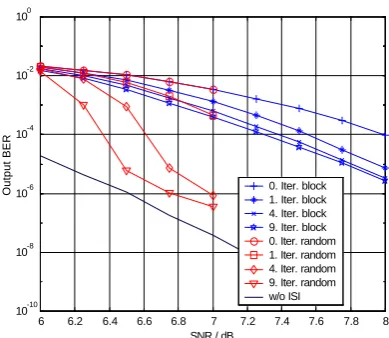
Figure 4 shows simulation results using the same channel as investigated with SCPCC Turbo Equalization. A BCH(255,239)-code with a code rate r=0.937 was applied to a block of length N=65025. It compares block turbo equalization with block interleaver, random interleaver and ISI-free transmission.
6 6.2 6.4 6.6 6.8 7 7.2 7.4 7.6 7.8 8
10-10 10-8 10-6 10-4 10-2 100
SNR / dB
Output BER 0. Iter. block
1. Iter. block 4. Iter. block 9. Iter. block 0. Iter. random 1. Iter. random 4. Iter. random 9. Iter. random w/o ISI
As already mentioned the ISI-free transmission using block codes shows a performance gain versus convolutional codes of 1.5dB at BER=10-6. Obvi-ously, the usage of simple block interleaving does not lead to high iteration gains. It remains a gap of 1.6dB between the 9. iteration and the ISI free transmission at BER=10-5. As assumed, a random interleaver gives a performance improvement in terms of higher iteration gains. It is possible to ap-proach the ISI - free bound up to 0.25dB at BER = 10-6.
6. PRECODING
The overall properties of the concatenated scheme are strongly dependent on the properties of the component codes. So it might be reasonable that an IIR system as inner code could be advantageous compared to the FIR structure in the case of an ISI channel. As a given channel can not be changed, one way to generate an IIR structure is to apply a recur-sive precoder in the binary domain. In conjunction with the FIR channel this results in an IIR system (cf. Fig. 5).
Encoder ∏1
T
T
T
T
T
0
( )
z
hµ ϕ Precoder
FIR channel
Encoder ∏1
T
T
T
T
0
( )
z
hµ ϕ IIR channel a)
b)
Fig. 5: Usage of a precoder with approaches for a) implementation and b) modeling.
Figure 5 shows how this scheme a) would be im-plemented and b) has to be interpreted. The APP detector at the receiver side only has to consider the change of the channel model. It can be easily seen that there is no increase in complexity, since the number of states remains unchanged compared to the system without precoder.
Figure 6 illustrates the performance results of Block Turbo Equalization with precoder compared with the results without precoder. Again, a block length of N=32640 with the same outer BCH code is used.
Fig. 6: Block Turbo Equalization with and without precoder.
Obviously at high SNR the system with precoder delivers an additional gain, which can be explained by an increased minimum distance of the concate-nated scheme due to the inner IIR code. It is possible to cut the no ISI bound at 6.75dB. At low SNR the performance of the precoder system is inferior. Here, the effect has to be considered that single channel errors lead to double bit errors. Note that the region where the precoder shows superior results is at low output BERs.
The application of the precoder in the case of convo-lutional coding leads to similar results, except that Fig. 4: Block Turbo Equalization of a nonlinear
optical channel.
6 6.2 6.4 6.6 6.8 7 7.2 7.4 7.6 7.8 8 10-10
10-8 10-6 10-4 10-2 100
SNR / dB
Output BER
0. Iter. w/o prec. 1. Iter. w/o prec. 4. Iter. w/o prec. 9. Iter. w/o prec. 0. Iter. precoder 1. Iter. precoder 4. Iter. precoder 9. Iter. precoder w/o ISI
Fig. 4. Block Turbo Equalization of a nonlinear optical channel.
wordscqequal to –1 at positionj, numerator and denomina-tor of Eq. (4) can be rewritten as sums, resulting in
L (di)=ln
P
cq∈S+1
j
p{r|e=cq|}
P
cq∈S−1
j
p{r|e=cq|}
. (5)
A further simplification of Eq. (5) is to consider only the code word in Sj+1and S−j1, respectively, closest to the re-ceived sequencer. This eliminates the sums in the numer-ator and denominnumer-ator of Eq. (5), avoiding the summation of probabilities given in the logarithmic domain. Obviously (5) delivers LLR values only for positionsj for which bothSj+1
andSj−1are non-empty sets. This is not the case for all posi-tionsj, if only a finite sphere around the received sequence is considered. One method to overcome this problem is to in-crease the number of test patternstqby increasing the num-berpof observed least reliable symbols. Hence, more valid code words around the received sequence are obtained, how-ever, requiring a higher decoding effort. Because of this high complexity another solution is chosen. For allj with empty
Sj+1orSj−1a fixed reliability is given with an absolute value
β, and we obtain:
L (di)=β·dj. (6)
An equation to calculate a nearly optimumβ is given by
β ≈ln Pr
dj =ej
Pr
dj 6=ej !
, (7)
where Pr
dj=ej is the probability of a correct decoder de-cision for the hard dede-cision bitj. It results in a valid LLR value with SNR dependent magnitude, which might be less accurate than that delivered by Eq. (5).
5 Results of block turbo equalization
262 M. Siegrist et al.: Turbo equalization of nonlinear ISI-channels decoder decision for the hard decision bit j. It
re-sults in a valid LLR value with SNR dependent magnitude, which might be less accurate than that delivered by (5).
5. RESULTS OF BLOCK TURBO EQUALIZATION
Figure 4 shows simulation results using the same channel as investigated with SCPCC Turbo Equalization. A BCH(255,239)-code with a code rate r=0.937 was applied to a block of length N=65025. It compares block turbo equalization with block interleaver, random interleaver and ISI-free transmission.
6 6.2 6.4 6.6 6.8 7 7.2 7.4 7.6 7.8 8
10-10 10-8 10-6 10-4 10-2 100
SNR / dB
Output BER 0. Iter. block
1. Iter. block 4. Iter. block 9. Iter. block 0. Iter. random 1. Iter. random 4. Iter. random 9. Iter. random w/o ISI
As already mentioned the ISI-free transmission using block codes shows a performance gain versus convolutional codes of 1.5dB at BER=10-6. Obvi-ously, the usage of simple block interleaving does not lead to high iteration gains. It remains a gap of 1.6dB between the 9. iteration and the ISI free transmission at BER=10-5. As assumed, a random interleaver gives a performance improvement in terms of higher iteration gains. It is possible to ap-proach the ISI - free bound up to 0.25dB at BER = 10-6.
6. PRECODING
The overall properties of the concatenated scheme are strongly dependent on the properties of the component codes. So it might be reasonable that an IIR system as inner code could be advantageous compared to the FIR structure in the case of an ISI channel. As a given channel can not be changed, one way to generate an IIR structure is to apply a recur-sive precoder in the binary domain. In conjunction with the FIR channel this results in an IIR system (cf. Fig. 5).
Encoder ∏1
T
T
T
T
T
0
( )
z
hµϕ Precoder
FIR channel
Encoder ∏1
T
T
T
T
0
( )
z
hµ ϕ IIR channel a)
b)
Fig. 5: Usage of a precoder with approaches for a) implementation and b) modeling.
Figure 5 shows how this scheme a) would be im-plemented and b) has to be interpreted. The APP detector at the receiver side only has to consider the change of the channel model. It can be easily seen that there is no increase in complexity, since the number of states remains unchanged compared to the system without precoder.
Figure 6 illustrates the performance results of Block Turbo Equalization with precoder compared with the results without precoder. Again, a block length of N=32640 with the same outer BCH code is used.
Fig. 6: Block Turbo Equalization with and without precoder.
Obviously at high SNR the system with precoder delivers an additional gain, which can be explained by an increased minimum distance of the concate-nated scheme due to the inner IIR code. It is possible to cut the no ISI bound at 6.75dB. At low SNR the performance of the precoder system is inferior. Here, the effect has to be considered that single channel errors lead to double bit errors. Note that the region where the precoder shows superior results is at low output BERs.
The application of the precoder in the case of convo-lutional coding leads to similar results, except that Fig. 4: Block Turbo Equalization of a nonlinear
optical channel.
6 6.2 6.4 6.6 6.8 7 7.2 7.4 7.6 7.8 8 10-10 10-8 10-6 10-4 10-2 100
SNR / dB
Output BER
0. Iter. w/o prec. 1. Iter. w/o prec. 4. Iter. w/o prec. 9. Iter. w/o prec. 0. Iter. precoder 1. Iter. precoder 4. Iter. precoder 9. Iter. precoder w/o ISI
Fig. 5. Usage of a precoder with approaches for (a) implementation and (b) modeling.
decoder decision for the hard decision bit
j. It
re-sults in a valid LLR value with SNR dependent
magnitude, which might be less accurate than that
delivered by (5).
5. RESULTS OF BLOCK TURBO
EQUALIZATION
Figure 4 shows simulation results using the
same channel as investigated with SCPCC Turbo
Equalization. A BCH(255,239)-code with a code
rate
r
=0.937 was applied to a block of length
N
=65025. It compares block turbo equalization with
block interleaver, random interleaver and ISI-free
transmission.
6 6.2 6.4 6.6 6.8 7 7.2 7.4 7.6 7.8 8 10-10 10-8 10-6 10-4 10-2 100
SNR / dB
Output BER 0. Iter. block
1. Iter. block 4. Iter. block 9. Iter. block 0. Iter. random 1. Iter. random 4. Iter. random 9. Iter. random w/o ISI
As already mentioned the ISI-free transmission
using block codes shows a performance gain versus
convolutional codes of 1.5dB at BER=10
-6.
Obvi-ously, the usage of simple block interleaving does
not lead to high iteration gains. It remains a gap of
1.6dB between the 9. iteration and the ISI free
transmission at BER=10
-5. As assumed, a random
interleaver gives a performance improvement in
terms of higher iteration gains. It is possible to
ap-proach the ISI - free bound up to 0.25dB at BER =
10
-6.
6. PRECODING
The overall properties of the concatenated
scheme are strongly dependent on the properties of
the component codes. So it might be reasonable that
an IIR system as inner code could be advantageous
compared to the FIR structure in the case of an ISI
channel. As a given channel can not be changed, one
way to generate an IIR structure is to apply a
recur-sive precoder in the binary domain. In conjunction
with the FIR channel this results in an IIR system
(cf. Fig. 5).
Encoder
1
∏
T
T
T
T
T
0
( )
z
h
µϕ
PrecoderFIR channel
Encoder ∏1
T
T
T
T
0
( )
zh
µϕ
IIR channel a) b)Fig. 5: Usage of a precoder with approaches for
a) implementation and b) modeling.
Figure 5 shows how this scheme a) would be
im-plemented and b) has to be interpreted. The APP
detector at the receiver side only has to consider the
change of the channel model. It can be easily seen
that there is no increase in complexity, since the
number of states remains unchanged compared to
the system without precoder.
Figure 6 illustrates the performance results of Block
Turbo Equalization with precoder compared with
the results without precoder. Again, a block length
of
N
=32640 with the same outer BCH code is used.
Fig. 6: Block Turbo Equalization with and
without precoder.
Obviously at high SNR the system with precoder
delivers an additional gain, which can be explained
by an increased minimum distance of the
concate-nated scheme due to the inner IIR code. It is possible
to cut the no ISI bound at 6.75dB. At low SNR the
performance of the precoder system is inferior.
Here, the effect has to be considered that single
channel errors lead to double bit errors. Note that
the region where the precoder shows superior results
is at low output BERs.
The application of the precoder in the case of
convo-lutional coding leads to similar results, except that
Fig. 4: Block Turbo Equalization of a nonlinear
optical channel.
6 6.2 6.4 6.6 6.8 7 7.2 7.4 7.6 7.8 8
10-10 10-8 10-6 10-4 10-2 100
SNR / dB
Output BER
0. Iter. w/o prec. 1. Iter. w/o prec. 4. Iter. w/o prec. 9. Iter. w/o prec. 0. Iter. precoder 1. Iter. precoder 4. Iter. precoder 9. Iter. precoder w/o ISI
Fig. 6. Block Turbo Equalization with and without precoder.
BCH(255,239)-code with a code rater=0.937 was applied to a block of lengthN=65 025. It compares block turbo equal-ization with block interleaver, random interleaver and ISI-free transmission.
As already mentioned the ISI-free transmission using block codes shows a performance gain versus convolutional codes of 1.5 dB at BER=10−6. Obviously, the usage of sim-ple block interleaving does not lead to high iteration gains. It remains a gap of 1.6 dB between the 9. iteration and the ISI free transmission at BER=10−5. As assumed, a ran-dom interleaver gives a performance improvement in terms of higher iteration gains. It is possible to approach the ISI-free bound up to 0.25 dB at BER=10−6.
6 Precoding
The overall properties of the concatenated scheme are strongly dependent on the properties of the component codes. So it might be reasonable that an IIR system as inner code could be advantageous compared to the FIR structure in the case of an ISI channel. As a given channel can not be
the loss at low SNR is smaller. Figure 7 illustrates
the performance results of SCPCC Turbo
Equaliza-tion of the punctured RSC code with and without
precoder.
0 1 2 3 4 5 6 7 8 9 10
10-7 10-6 10-5 10-4 10-3 10-2 10-1 100
Eb/N0/dB
Output BER
w/o ISI, R=0.933, 65025 0. It.
1. It. 6. It.
R=0.933, 65025 precoder
Fig. 7: SCPCC Turbo Equalization with
and without precoder
7. CONCLUSIONS
We have shown that „Turbo Equalization”,
which is well investigated for linear channels and
for low code rates
≤
0.5, can also achieve high
itera-tion gains using high rate outer codes on nonlinear
channels. This allows for applications in fiber
opti-cal transmission, where high code rates are required
due to the challenges in high-speed systems.
The performance simulations of punctured
con-volutional codes and block codes with a code rate of
0.933 for a nonlinear ISI channel have shown that
even for strongly punctured convolutional codes a
remarkable decoding gain can be achieved. A
feasi-ble concept has been presented for iterative
equali-zation of suitable block codes, which have superior
performance compared to punctured convolutional
codes. Considering the interleaver design, a
trade-off between feasibility and performance has to be
found, regarding the large gains achieved by the
usage of random interleavers.
Finally, without increasing the receiver
com-plexity, a precoding scheme in conjunction with
iterative equalization has been presented, which
allows for additional performance gain.
REFERENCES
[1] C. Berrou, A. Galvieux, P. Thitimajshima:
“Near Shannon limit error-correcting coding
and decoding: Turbo Codes (1)”,
Proc. IEEE
Int. Conf. On Communications
, Geneva,
Swit-zerland, pp. 1064-1070, 1993.
[2] J. Hagenauer, G. Bauch, H. Khorram: “Iterative
Equalization and Decoding in Mobile
Commu-nications Systems”,
Proc. EPMC ’97
, pp.
307-312, 1997.
[3] M. Siegrist, A. Dittrich, W. Sauer-Greff, R.
Urbansky: “Iterative Equalization for Nonlinear
Channels with Intersymbol Interference
”, Proc.
IEEE Signal Processing ‘2001
, Poznan, Poland,
pp. 95-98, 2001.
[4] R. Koetter, A. C. Singer, M. Tüchler: “Turbo
Equalization; An iterative equalization and
de-coding technique for coded data transmission”,
IEEE Signal Processing Magazine
, pp. 67-80,
Jan. 2004.
[5] W. Sauer-Greff, A. Dittrich, H. Haunstein, M.
Lorang, K. Sticht, R. Urbansky: “Adaptive
Viterbi Equalizers for Nonlinear Channels”,
Proc. German U.R.S.I. Conference
Kleinheubach, Germany, pp.215-222, 2001.
[6] S. Benedetto, E. Biglieri, V. Castellani:
Digital
Transmission Theory
, Prentice Hall, 1987.
[7] H. F. Haunstein, W. Sauer-Greff, A. Dittrich,
K. Sticht, R. Urbansky: “Principles for
Elec-tronic Equalization of Polarization-Mode
Dis-persion”,
IEEE Journal of Lightwave
Technol-ogy
, vol. JLT-22, pp 1169-1182, 2004
[8] L. R. Bahl, J. Cocke, F. Jelinek, J. Raviv:
“Op-timal decoding of linear codes for minimizing
symbol error rate”,
Abstracts, Int. Symp.
In-form. Theory,
Asilomar, USA, p. 90, 1972.
[9] D. Haccoun, G. Bégin: “High-Rate Punctured
Convolutional Codes for Viterbi and Sequential
Decoding”,
IEEE Trans. on Comm.
, vol.
COM-37, pp. 1113-1125, 1989.
[10] J.K. Wolf: “Efficient maximum likelihood
de-coding of linear block codes using a trellis”,
IEEE Trans. Inform. Theory
, vol. IT-24, pp.
76-80, Jan. 1978.
[11] J. Hagenauer, P. Höher: “A Viterbi algorithm
with soft-decision outputs and its applications“,
Proc. IEEE Globecom,
Dallas, USA, pp.
1680-1686, 1989.
[12] J. Hagenauer, E. Offer, L. Papke: “Iterative
decoding of binary block and convolutional
codes“,
IEEE Trans. Inform. Theory
, vol.
IT-42, pp. 429-445, 1996.
[13] D. Chase: “A class of algorithms for decoding
block codes with channel measurement
infor-mation“,
IEEE Trans. Inform. Theory
, vol.
IT-18, pp. 170-182, 1972.
[14] R. Pyndiah, A. Glavieux, A. Picart, S. Jacq:
“Near optimum decoding of product codes”,
Proc. IEEE Globecom
, San Francisco, USA,
pp. 339-343, 1994.
Fig. 7. SCPCC Turbo Equalization with and without precoder.changed, one way to generate an IIR structure is to apply a recursive precoder in the binary domain. In conjunction with the FIR channel this results in an IIR system (cf. Fig. 5).
Figure 5 shows how this scheme (a) would be imple-mented and (b) has to be interpreted. The APP detector at the receiver side only has to consider the change of the chan-nel model. It can be easily seen that there is no increase in complexity, since the number of states remains unchanged compared to the system without precoder.
Figure 6 illustrates the performance results of Block Turbo Equalization with precoder compared with the results with-out precoder. Again, a block length ofN=32 640 with the same outer BCH code is used.
Obviously at high SNR the system with precoder delivers an additional gain, which can be explained by an increased minimum distance of the concatenated scheme due to the in-ner IIR code. It is possible to cut the no ISI bound at 6.75 dB. At low SNR the performance of the precoder system is infe-rior. Here, the effect has to be considered that single channel errors lead to double bit errors. Note that the region where the precoder shows superior results is at low output BERs.
The application of the precoder in the case of convolu-tional coding leads to similar results, except that the loss at low SNR is smaller. Figure 7 illustrates the performance re-sults of SCPCC Turbo Equalization of the punctured RSC code with and without precoder.
7 Conclusions
We have shown that “Turbo Equalization”, which is well in-vestigated for linear channels and for low code rates≤0.5, can also achieve high iteration gains using high rate outer codes on nonlinear channels. This allows for applications in fiber optical transmission, where high code rates are required due to the challenges in high-speed systems.
M. Siegrist et al.: Turbo equalization of nonlinear ISI-channels 263 be achieved. A feasible concept has been presented for
iterative equalization of suitable block codes, which have superior performance compared to punctured convolutional codes. Considering the interleaver design, a trade-off be-tween feasibility and performance has to be found, regarding the large gains achieved by the usage of random interleavers. Finally, without increasing the receiver complexity, a pre-coding scheme in conjunction with iterative equalization has been presented, which allows for additional performance gain.
References
Bahl, L. R., Cocke, J., Jelinek, F., and Raviv, J.: Optimal decoding of linear codes for minimizing symbol error rate, Abstracts, Int. Symp. Inform. Theory, Asilomar, USA, 90, 1972.
Benedetto, S., Biglieri, E., and Castellani, V.: Digital Transmission Theory, Prentice Hall, 1987.
Berrou, C., Galvieux, A., and Thitimajshima, P.: Near Shannon limit error-correcting coding and decoding: Turbo Codes (1), Proc. IEEE Int. Conf. On Communications, Geneva, Switzer-land, 1064–1070, 1993.
Chase, D.: A class of algorithms for decoding block codes with channel measurement information, IEEE Trans. Inform. Theory, vol. IT-18, 170–182, 1972.
Haccoun, D. and B´egin, G.: High-Rate Punctured Convolutional Codes for Viterbi and Sequential Decoding, IEEE Trans. on Comm., vol. COM-37, 1113–1125, 1989.
Hagenauer, J. and H¨oher, P. : A Viterbi algorithm with soft-decision outputs and its applications, Proc. IEEE Globecom, Dallas, USA, 1680–1686, 1989.
Hagenauer, J., Offer, E., and Papke, L.: Iterative decoding of binary block and convolutional codes, IEEE Trans. Inform. Theory, vol. IT-42, 429–445, 1996.
Hagenauer, J., Bauch, G., and Khorram, H.: Iterative Equalization and Decoding in Mobile Communications Systems, Proc. EPMC ’97, 307–312, 1997.
Haunstein, H. F., Sauer-Greff, W., Dittrich, A., Sticht, K., and Urbansky, R.: Principles for Electronic Equalization of Polarization-Mode Dispersion, IEEE Journal of Lightwave Tech-nology, vol. JLT-22, 1169–1182, 2004.
Koetter, R., Singer, A. C., and T¨uchler, M.: Turbo Equalization: An iterative equalization and decoding technique for coded data transmission, IEEE Signal Processing Magazine, 67–80, Jan. 2004.
Pyndiah, R., Glavieux, A., Picart, A., and Jacq, S.: Near optimum decoding of product codes, Proc. IEEE Globecom, San Fran-cisco, USA, 339–343, 1994.
Sauer-Greff, W., Dittrich, A., Haunstein, H., Lorang, M., Sticht, K.,and Urbansky, R.: Adaptive Viterbi Equalizers for Nonlin-ear Channels, Proc. German U.R.S.I. Conference Kleinheubach, Germany, 215–222, 2001.
Siegrist, M., Dittrich, A., Sauer-Greff, W., and Urbansky, R.: Iter-ative Equalization for Nonlinear Channels with Intersymbol In-terference, Proc. IEEE Signal Processing ‘2001, Poznan, Poland, 95–98, 2001.