Ann. Geophys., 26, 929–940, 2008 www.ann-geophys.net/26/929/2008/ © European Geosciences Union 2008
Annales
Geophysicae
Cluster observations on the thin current sheet in the magnetotail
C. L. Cai1,2, I. Dandouras1, H. R`eme1, J. B. Cao2, G. C. Zhou2, and G. K. Parks3
1Centre d’Etude Spatiale des Rayonnements, Centre National de la Recherche Scientifique/Universit´e Paul Sabatier, Toulouse 31028, France
2State Key Laboratory of Space Weather, Center for Space Science and Applied Research, Beijing 100080, China 3Space Sciences Laboratory, University of California, Berkeley, CA, 94720, USA
Received: 8 May 2007 – Revised: 19 February 2008 – Accepted: 3 March 2008 – Published: 13 May 2008
Abstract. A magnetotail event on 15 September 2001 is an-alyzed, during which the Cluster spacecraft observed both embedding and bifurcation of the Thin Current Sheet (TCS). It is indicated that the ion anisotropy and nongyrotropy are responsible for those new equilibrium features that represent deviations from the conventional Harris model. Measure-ments show that an embedded proton TCS manifests a pres-sure anisotropy withp||>p⊥, simultaneously associated with a density embedding; while a bifurcated oxygen ion TCS ex-hibits a pressure anisotropy mainly withp||<p⊥ and non-grotropy, except at the edges wherep||>p⊥is the necessary marginal firehose stability condition. The local flapping mo-tion of the TCS was observed, and some particular features such as the solitary wave-like behavior and the kink motion in the plane perpendicular to the Sun-Earth direction were revealed. The present investigation intimates the complex-ity of equilibria of the magnetotail current sheet and declares the crucial role played by the ion kinetics in the dynamics of TCSs.
Keywords. Magnetospheric physics (Magnetotail; Plasma sheet) – Space plasma physics (Nonlinear phenomena)
1 Introduction
The understanding of the dynamics of the magnetotail cur-rent sheet is important to many space phenomena. The con-ventional current sheet model is based on the Harris equi-librium, which has the well-known tanh-type magnetic field profile and the bell-shaped density and current profile, that is, current and plasma densities have a simple profile with a sin-gle peak in the center of the sheet where the magnetic field has a minimum (Harris, 1962). The Harris equilibrium is in good agreement with the observations of the thick,
quiet-Correspondence to: C. L. Cai
time current sheet (Fairfield, 1979; Thompson et al., 2005). However, TCSs, whose thicknesses are on the order of the ion gyroradius or inertial length, were reported recently by mumerous studies (Sergeev et al., 1993; Hoshino et al., 1996; Runov et al., 2003a, 2005; Sergeev et al., 2003). Behaviors of TCS deviated significantly from Harris’s equilibrium. Ob-servations revealed that in some instances, TCSs have a man-ifestation of embedding, which means that TCSs with rather large current densities are embedded into a much thicker cur-rent sheet, and the thicker curcur-rent sheet is usually in accord with a Harris equilibrium. In some other cases, TCSs have a bifurcated structure, that is, TCSs commonly have a double-peak, sometime multi-double-peak, current profile, and the current density has a minimum at the center of the sheet. TCSs are frequently occurring phenomena in the magnetotail and hence raise a question about the interpretation of their forma-tion and evoluforma-tion (Asano et al., 2005).
930 C. L. Cai et al.: Cluster observations on the thin current sheet in the magnetotail
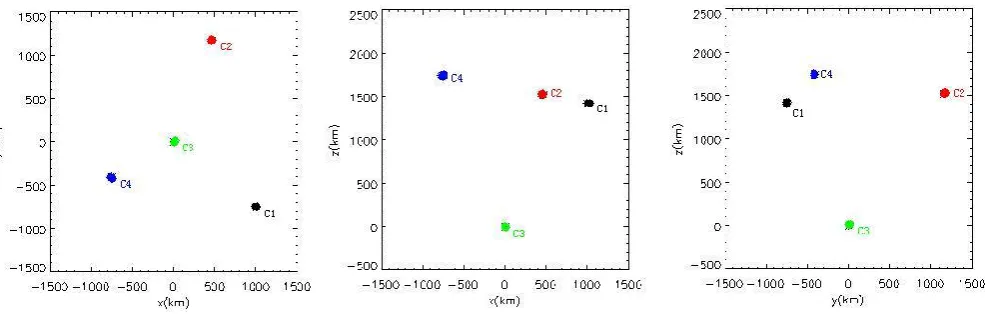
Fig. 1. The configuration of Cluster tetrahedron in the time interval 04:40–05:10 UT on 15 September 2001.
motion may strongly differ from Larmor rotation, i.e. the par-ticle dynamics does not obey the conventional guiding center theory, when its gyroradius becomes comparable to either the current sheet thickness or the curvature radius of the mag-netic field. Behavior of these nonadiabatic ions is known as the Speiser motion (Speiser, 1965). Nonadiabatic ions play an important role in the current sheet dynamics, and their ki-netics in the TCS have been investigated intensely (Delcourt et al., 2004, 2006; Birn et al., 2004b). Moreover, when the current sheet is thin enough to obey some appropriate con-ditions, an integral of motion, the so-called quasi-adiabatic sheet invariant can be introduced (Sonnerup, 1971). Re-cently, a stationary state Vlasov theory involving the quasi-adiabatic sheet invariant was proposed to describe the TCS (Sitnov et al., 2000, 2003, 2006). Choosing the distribution of counterstreaming beams in the outer part of the sheet, the numerical results show that a bifurcated current sheet appears in the case of ion anisotropy withT⊥>T||; while in the op-posite case a single-peak current sheet embedded in a thicker Harris current sheet appears.
In addition, TCS is frequently found in association with rapid, large-amplitude magnetic variations, namely a flap-ping motion indicates rapid crossings through an up-down oscillating current sheet (Sergeev et al., 2003; Runov et al., 2003a, 2005). The flapping motion was identified to be a kink-like wave propagating in the current sheet direction. Statistical investigations revealed its particular propagating features. The propagating speeds are in the range of sev-eral tens of km/s up to 200 km/s. The propagating direc-tion is flankward, that is, dawnward in the dawn sector and duskward in the dusk sector (Sergeev et al., 2004; Zhang et al., 2005). As pointed out, the wave properties do not match any local excitation mechanism previously discussed so far in the literature (Zhu et al., 1996; Daughton, 1999, 2002, 2003; Lapenta et al., 2002). It raises another question to understand the dynamics of TCSs.
Here, TCS dynamics is reported from observations dur-ing the Cluster spacecraft crossdur-ing of the magnetotail on 15
September 2001. First, an overview of the entire event, in-cluding the spacecraft configuration and characteristic pa-rameters, is presented. Then various manifestations of TCSs in association with their ion anisotropy and nongyrotropy, as well as their flapping motion are analyzed. Finally, a discus-sion and summary are given.
2 Observations
2.1 Overview
In the time interval 00:00–06:00 UT on 15 September 2001, the IMFBzwas mainly northward, turned southward shortly
at about 03:20 UT and during 04:30–05:00 UT, and again shortly southward at about 05:30 UT (The solar wind param-eters come from the ACE data and aren’t shown here). The solar wind velocity had no apparent change. A substorm was observed during 00:00–00:50 UT, which the AL index was up to−700 nT and then decreased to zero. The geomag-netic activity started again at 03:40 UT. During the interval of 03:30–06:30 UT, several auroral activations were regis-tered by two geostationary satellites, GOES 8 and GOES 10 (Voronkov et al., 2006).
The configuration of Cluster tetrahedron in the period 04:40–05:10 UT is shown in Fig. 1. The characteristic scale of the tetrahedron is 1700 km. It is worth to noticing that in the x-z plane, C3 is southmost and the other three satellites have small distances among them in the z-direction; all four satellites are in the dusk sector and in the y-z plane C2 is out-ermost. Characteristic parameters of the background plasma and fields in this event areTH=2 keV,TO=20 keV,B0=30 nT and ni=0.5 cm−3, where TH andTO are the temperatures
of proton and oxygen ions, respectively,B0is the magnetic field in the periphery of the plasma sheet andni is the
to-tal ion density. Thus, we have approximatelyρH=220 km,
ρO=2500 km andc/ωpi=320 km, whereρH andρO are the
C. L. Cai et al.: Cluster observations on the thin current sheet in the magnetotail 931
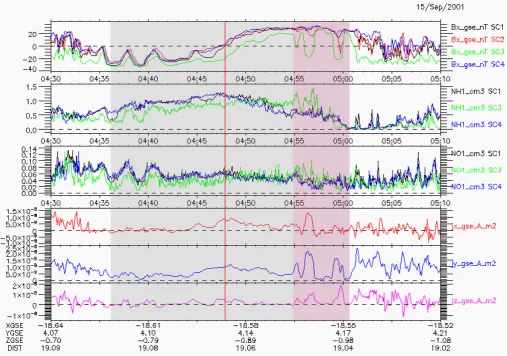
Fig. 2. Overview of the Harris-like current sheet. (a)Bxfor four satellites. (b) and (c) are the proton and oxygen ion densities, respectively. (d–f) are the current density components.
c/ωpi is the ion inertial length. The characteristic scale of
the Cluster tetrahedron is comparable to the oxygen ion gy-roradius and is almost five times the ion inertial length.
Figure 2 shows the components of magnetic field from the FGM experiment and the proton and oxygen ion densities from the CIS-CODIF instrument (Balogh et al., 2001; R`eme et al., 2001). As represented by the whole shading region in the interval 04:36–05:01 UT in Fig. 2, all four satellites recorded a bell-shaped plasma density and current profiles, whose peaks are corresponding to the minimum of the mag-netic field. Hence it is indicated that a Harris-like current sheet was encountered. C1, C2 and C4 crossed almost simul-taneously the central line at 04:48 UT, as labeled by a vertical line, due to a global flapping motion of the bulk current sheet. A little later C3 crossed the central line at 04:50 UT. How-ever, compared to the Harris-like equilibrium with a larger thickness, in the interior of the thick sheet, as shown by the narrow red shading, distinct manifestations of localized thin current equilibrium are encountered. Approximately in the interval 04:55–04:59 UT, a thin proton dominating the
Fig. 3. The scattering plot of the current density together with the
[image:3.595.311.542.479.648.2]932 C. L. Cai et al.: Cluster observations on the thin current sheet in the magnetotail
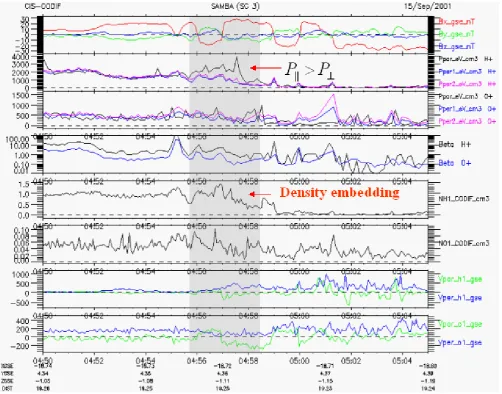
Fig. 4. 3-D momenta of proton and oxygen ions from C3. (a) the components of magnetic field. (b) and (c) are the pressure components. (d) is the beta value. (e) and (f) are the densities. (g) and (h) are bulk velocities.
current sheet which was embedded into the southern part of the thick sheet was observed by C3. In addition, nearly in the time interval 04:58–05:00 UT, a bifurcated thin oxygen ion current located in the northern part of the thick sheet was ob-served by C1 and C4. Here, it is worth noticing that a plasma depletion layer was subsequently generated inside the plasma sheet. It can be seen that in the second panel in Fig. 2, C3 at 04:59:00 and C1 and C4 at about 05:00:20, all of them observed a density decrease nearly to zero till 05:05:20. 2.2 TCS embedding
The embedding feature of the proton dominated TCS was revealed in the scattering plot of the y-component of the cur-rent density (the total curcur-rent density profile is similar to its y-component), together with the proton density versusBx.
As shown in Fig. 3, the red stars represent the proton density,
and the black squares denote the current density in the y-direction (it is the average current density inside the satellite tetrahedron and is multiplied by a factor 108, the units of cur-rent and ion density are A/m2and cm−3, respectively). The green curve describes a fitting of the thick Harris-like current sheet, and the blue one depicts a fitting of the thin current sheet. It can be seen that the two current profiles are distinct, where the peak of the green curve is contained by the peak of blue curve. The ion density profile has a width that is roughly equal to that of the wider current profile. Hence the situation here is just the manifestation of the TCS embedding, which means that a thin current sheet with large current density is embedded into the southern part of a wider current sheet.
C. L. Cai et al.: Cluster observations on the thin current sheet in the magnetotail 933
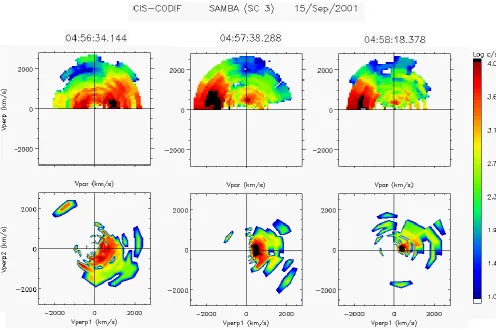
Fig. 5. Distribution functions of protons in theV||−V⊥coordinates from C3 in the embedded TCS.
pressure. Simultaneously, the oxygen ion pressure was also nearly isotropic with negligible fluctuations. Figure 5 shows selected proton distribution functions at the beginning, the middle and the end of this period. All of them exhibited an apparent field-aligned beam distribution. It is worth noticing that although a strong pressure anisotropy existed here, it still didn’t achievep||/p⊥>1+2/β⊥, which is the critical condi-tion for exciting the firehose instability (Hasegawa, 1975). As pointed out by comparing the current distribution in the outer and in the center of the sheet, the current carried by a field-aligned beam satisfying the marginal firehose stability condition has a strong tendency to become thin, till a non-adiabatic current layer is formed (Eastwood, 1972; Cowley, 1978). Namely, when there is pressure anisotropy caused by field-aligned beams with p||>p⊥, the current sheet should become an embedded nonadiabatic thin layer, in which an equilibrium is achieved when the magnetic tension is bal-anced by the finite inertia of ions with meandering Speiser motion. Here it is also worth noticing that the proton pressure is just only anisotropic and that no apparent nongyrotropy was detected. This seems to be contradictory since the ion motion should be nongyrotropic inside the TCS (Sitnov et al., 2006). We infer that ions are strongly nongyrotropic
only in the center of the TCS but slightly nongyrotropic in the more outer part of the TCS. In the present situation, the satellite didn’t stay close to the center of the TCS except for several rapid crossings of the central line, due to the flap-ping motion that will be shown in the following. It can also be seen from the fact that in panel (d) in Fig. 4, in this pe-riod, βH was moderate and no more than 1, while it was
over 10 when the satellite was closer to the central line. This can explain why no apparent pressure nongyrotropy was ob-served. Apart from the current embedding, a plasma density embedding was also recorded. A proton density embedding is exhibited in panel (e) in Fig. 4, while the oxygen ion den-sity hasn’t this manifestation. Although the concrete mech-anism of density embedding isn’t clear, there is an apparent correlation between the density embedding and the pressure anisotropy withp||>p⊥.
2.3 TCS bifurcation
934 C. L. Cai et al.: Cluster observations on the thin current sheet in the magnetotail
Fig. 6. 3-D momenta of proton and oxygen ions from C1. (a) the components of magnetic field. (b) and (c) are the pressure components. (d) is the beta value. (e) and (f) are the densities. (g) and (h) are bulk velocities.
04:57:45–05:00:25 UT, both the energy spectrogram and the pitch angle profile (they aren’t shown here) reveal that a localized self-consistent current sheet equilibrium of oxy-gen ions was observed by C1 and C4, although in this very thin sheet the current contribution from oxygen ions is mi-nor. We notice that due to the bulk excursion of the thicker Harris-like sheet (it is the up-down motion of the entire plasma sheet and is not the local flapping motion of the TCS observed by C3), the time difference of encounter of the above-mentioned plasma depletion layer by C3 and C1 (at 04:59:05 and 05:00:25 UT, respectively), which have a dis-tance of 1400 km in the z-direction between them, is about 80 s; hence, the shift in velocity of the plasma sheet is about 17 km/s. The duration of the crossing of the oxygen TCS is about 150 s, thus the estimation of the thickness of the oxygen TCS is about 2500 km. This is approximately one oxygen ion gyroradius and eleven times the proton
gyrora-dius. Hence, the localized oxygen ion current equilibrium is an extra-thin current sheet (Sitnov et al., 2006).
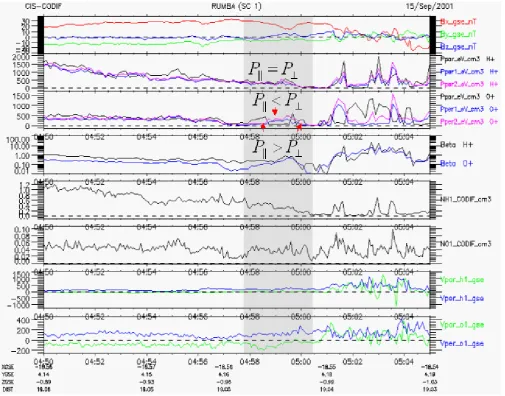
In the time interval 04:57:45–05:00:25 UT, as shown by the shading in Fig. 6, C1 measured an oxygen ion pressure anisotropy withp||<p⊥and nongyrotropyp⊥16=p⊥2in the center of TCS, however in two edges the pressure isp||>p⊥ and nearly gyrotropic. The proton pressure in this time inter-val is isotropic at a surprising level. As mentioned above, the ion motion is the non-adiabatic, meandering Speiser motion in the TCS. Moreover, when the current sheet is thin enough to obeyLρ0(B0/Bn)2(whereρ0is the particle gyroradius andB0andBnare the magnetic field at the outer part of the
C. L. Cai et al.: Cluster observations on the thin current sheet in the magnetotail 935
Fig. 7. Distribution functions of oxygen ions in theV||−V⊥coordinates from C1 in the bifurcated TCS.
becomes approximately adiabatic or “quasi-adiabatic” along the normal direction of the sheet, and the so-called quasi-adiabatic sheet invariant can be introduced (Sonnerup, 1971). As a consequence, the major motion of particles in the center of the TCS will be in the perpendicular direction. Figure 7 shows the oxygen ion distributions selected in the center of the thin sheet. It states the fact that the oxygen ion motion in the perpendicular direction is dominant. Combined with the necessary marginal firehose stability condition at the edge, it is exactly the particular observational feature in the present situation, that is, an oxygen ion pressure anisotropy with
p||<p⊥ and nongyrotropy in the center of the TCS, but a gyrotropic pressure anisotropy withp||>p⊥at edges. More-over, non-adiabatic particles belonging to different classes with distinct dynamics in the phase space have different cur-rent carrying capabilities (Chen et al., 1986; Chen, 1992; Buchner et al., 1989; Burkhart et al., 1991; Zelenyi et al., 2002). The scattering of particle adiabatic invariant will re-sult in the variation of the population of non-adiabatic parti-cle and accordingly the current bifurcation. A detailed anal-ysis on the particle kinetics will be presented elsewhere.
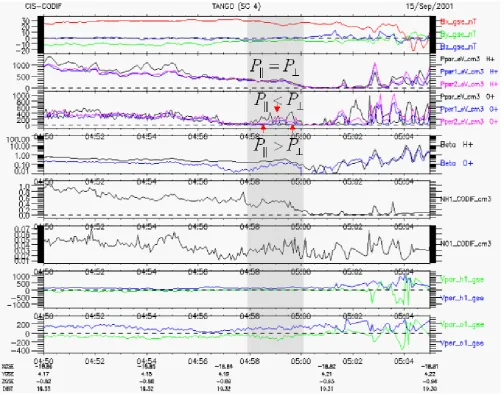
In the time interval 04:58:00–05:00:05 UT, C4 recorded very similar features concerning the oxygen ion TCS as C1, as shown in Fig. 8. The characteristics of oxygen ion dis-tribution functions in the center of TCS are also like that observed by C1, as shown in Fig. 9. We notice here that the distance between C1 and C4 in the Sun-Earth direction
is the largest distance of the Cluster tetrahedron along the field line and that the distance in the normal direction be-tween them is very small. The similarity of measurements between C1 and C4 imply that the variance in the Sun-Earth direction is negligible, that is, the TCS can be described qual-itatively by a one-dimension model. Also, absolute values of the plasma pressures recorded by C1 and C4 are nearly equal. This means that there is no pressure gradient in the field line direction. However, the pressure gradient is the necessary condition for TCS models with the isotropic pressure, in the case that the normal component of magnetic field is nonzero. 2.4 Flapping motion
TCS is frequently found in association with rapid large-amplitude magnetic variations, namely a flapping motion indicating rapid crossings through the up-down oscillating current sheet. During the period of 04:55–05:02 UT, four rapid large-amplitude Bx variations were observed by C3,
as labeled by the shadings in Fig. 10. Their peaks were at 04:55:10, 04:56:30, 04:59:35 and 05:01:30 UT, respectively. TheBxvariations were also apparently recorded, but weaker,
in phase by C2; while C1 measured in phase the perceptible
Bx variations only at the third and fourth oscillations, and
936 C. L. Cai et al.: Cluster observations on the thin current sheet in the magnetotail
Fig. 8. 3-D momenta of proton and oxygen ions from C4. (a) the components of magnetic field. (b) and (c) are the pressure components. (d) is the beta value. (e) and (f) are the densities. (g) and (h) are bulk velocities.
2003a, 2005). Utilizing the time difference of the peak of magnetic variations between C3 and C2, we can estimate its phase speed to be 120 km/s, 50 km/s, 30 km/s and 40 km/s corresponding to four oscillations, respectively. The peri-ods of the four oscillations are 70 s, 190 s and 125 s, respec-tively: one value is missing. The wavelength is approxi-mately 0.8∼1.5RE. The propagating speed estimated here is
in accord with the previous statistical investigations, that is, in the range of several tens km/s up to 200 km/s (Sergeev et al., 2004; Zhang et al., 2005). Moreover, the present event re-veals explicitly the solitary wave feature of the flapping mo-tion. For the first and fourth oscillations, the flapping ampli-tude is smaller than that of the second and third oscillations. Recalling that the period and phase speed have also a similar feature, it is apparent that the behavior of flapping motion re-sembles a solitary wave modulated both on its amplitude and frequency.
Due to the localized large-amplitude kink motion, the cur-rent would have a circular flow in the y-z plane. This point can also be seen in the simulation work (Sitnov et al., 2006). Via the current density and its components shown from pan-els (d) to (g) in Fig. 10, circular flows corresponding to the second and third oscillations can be discovered. As labeled by a solid vertical line, at each circular flow, the peak ofjzis
not corresponding to the peak ofjyandjx, but
correspond-ing to the edge of them. It is just about the manifestation of the current circular flow. At that time, the current sheet is tilted. As shown on panels (b) and (c), for the second and third oscillations, C3 and C2 recorded large-amplitudeByor
Bz variations, reflecting the localized current sheet
C. L. Cai et al.: Cluster observations on the thin current sheet in the magnetotail 937
Fig. 9. Distribution functions of oxygen ions in theV||−V⊥coordinates from C4 in the bifurcated TCS.
3 Discussion
It is worth pointing out that although recently many obser-vational investigations on TCS in the magnetotail were re-ported, few of them involved the particle kinetics. The ob-servations presented here reveal the crucial role played by the ion kinetics in the dynamics of TCS. Particles in the re-gion with a strong magnetic field gradient have totally dif-ferent properties of motion in contrast to magnetic momen-tum adiabatic kinetics. The interaction of these nonadiabatic particles with the current sheet achieves eventually a self-consistent TCS equilibrium. These equilibria manifest dis-tinct behaviors from the Harris equilibrium, and in associa-tion with their intrinsic particle anisotropy and nongyrotropy. They are qualitatively in a good agreement with the conclu-sions given by these theoretical models considered into the so-called quasi-adiabatic sheet invariant (Sitnov et al., 2000, 2003, 2006).
The origin of TCS is unclear by now, although often re-ferred to as the fast flow caused by the magnetic reconnection or substorm (Runov et al., 2003b; Asano et al., 2005). Here, the proton TCS was most likely due to field-aligned proton beams. But the source of these beams is also indistinct. Dur-ing the present event, a substorm onset around 04:55 UT had been claimed (Voronkov et al., 2006). However, any obvious explosive plasma flow was absent in the beginning of the oc-currence of the proton TCS. In panels (g) and (h) in Fig. 4, we
notice that till 04:57:00 UT, no perceptible bulk proton flow was observed. A modest parallel flow was recorded once dur-ing the central line crossdur-ing at 04:57 UT. From 04:57:30 UT a modest perpendicular flow was observed. Likewise, in this period a modest oxygen ion flow was observed to be no more than 200 km/s. Similar measurements can also be found in Figs. 6 and 8. TCS observations without any fast plasma flow have also been reported in previous investigations (Sergeev et al., 2003; Asano et al., 2005).
938 C. L. Cai et al.: Cluster observations on the thin current sheet in the magnetotail
Fig. 10. Components of magnetic field for four satellites and the current density. Four large-amplitude magnetic variations due to flapping
motion are labeled by the shadows.
(Daughton, 1999, 2002, 2003; Lapenta et al., 2002). Mean-while, at 04:54:24 UT, before the ignition of TCS flapping, the first singular peak of proton pressure without any per-ceptible magnetic perturbation was recorded. It implies that the disturbance is a kinetic pressure pulse nearby the TCS at that time and will spread with the sound speed. When the fluctuation couples to the potentially excited low hybrid drift instability mentioned above, it might eventually evolve into a solitary wave modulated both on its amplitude and quency via nonlinear interactions. Flapping motion is fre-quently not only associated with the TCS but also accompa-nied with the magnetic reconnection, both of them occurring in small scale. It also reflects, on the other hand, the mean-ingful role played by the low hybrid drift instability, which is easier to develop in TCSs than in thick sheets. Hence obser-vations presented here also give insight into the generation mechanism of the TCS flapping motion.
4 Conclusion
During the Cluster spacecraft crossing of the magnetotail on 15 September 2001, both TCS embedding and bifurca-tion were recorded in one single event, due to the Cluster unique capabilities of spatial resolution on small scale. The intrinsic properties of nonadiabatic particle dynamics in the TCS are emphasized. It is indicated that the ion anisotropy and nongyrotropy are responsible for those new equilibrium features deviated from the conventional Harris model. An embedded proton TCS manifests a pressure anisotropy with
C. L. Cai et al.: Cluster observations on the thin current sheet in the magnetotail 939 motion is coming from a localized kinetic pressure pulse.
The present investigation intimates the complexity of man-ifestations of magnetotail current sheet and displays the im-portant role played by the ion kinetics in the self-consistent TCS equilibrium.
Acknowledgements. This work is supported by the National Natural Science Foundation of China (NSFC) under Grant No. 40574067, 40523006 and the National Basic Research Program of China 2006CB806305 and the French National Space Agency (CNES). C. L. Cai acknowledges the French Embassy in China for his gov-ernment scholarship.
Topical Editor I. A. Daglis thanks two anonymous referees for their help in evaluating this paper.
References
Asano, Y., Nakamura, R., Baumjohann, W., Runov, A., Voros, Z., Volwerk, M., Zhang, T. L., Balogh, A., Klecker, B., and R`eme, H.: How typical are atypical current sheets?, Geophys. Res. Lett., 32, L03108, doi:10.1029/2004GL021834, 2005.
Balogh, A., Carr, C. M., Acu˜na, M. H., et al.: The Cluster Magnetic Field Investigation: overview of in-flight performance and initial results, Ann. Geophys., 19, 1207–1217, 2001,
http://www.ann-geophys.net/19/1207/2001/.
Birn, J., Schindler, K., and Hesse, M.: Thin electron current sheets and their relation to auroral potentials, J. Geophys. Res., 109, A02217, doi:10.1029/2003JA010303, 2004a.
Birn, J., Thomsen, M. F., and Hesse, M.: Acceleration of oxygen ions in the dynamic magnetotail, Ann. Geophys., 22, 1305–1315, 2004b,
http://www.ann-geophys.net/22/1305/2004/.
Buchner, J. and Zelenyi, L. M.: Regular and chaotic charged parti-cle motion in magnetotaillike field reversals: 1. Basic theory, J. Geophys. Res., 94, 11 821–11 842, 1989.
Burkhart, G. R. and Chen, J.: Differential Memory in the Earth’s magnetotail, J. Geophys. Res., 96, 14 033–14 049, 1991. Camporeale, E. and Lapenta, G.: Model of bifurcated current sheets
in the Earth’s magnetotail: Equilibrium and stability, J. Geophys. Res., 110, A07206, doi:10.1029/2004JA010779, 2005.
Chen, J. and Palmadesso, P. J.: Chaos and Nonlinear Dynamics of Single-Particle Orbits in a Magnetotail-Like Magnetic Field, J. Geophys. Res., 91, 1499–1508, 1986.
Chen, J.: Nonlinear dynamics of charged particles in the magneto-tail, J. Geophys. Res., 97, 15 011–15 050, 1992.
Cowley, S. W. H.: The effect of pressure anisotropy on the equilib-rium structure of magnetic current sheets, Planet. Space Sci., 26, 1037–1061, 1978.
Daughton, W.: The unstable eigenmodes of a neutral sheet, Phys. Plasm., 6, 1329–1343, 1999.
Daughton, W.: Nonlinear dynamics of thin current sheets, Phys. Plasmas, 9, 3668–3678, 2002.
Daughton, W.: Electromagnetic properties of the lower-hybrid drift instability in a thin current sheet, Phys. Plasmas, 10, 3103–3119, 2003.
Delcourt, D. C., Malova, H. V., and Zelenyi, L. M.: Dynamics of charged particles in bifurcated current sheets: The k 1 regime, J. Geophys. Res., 109, A01222, doi:10.1029/2003JA010167, 2004.
Delcourt, D. C., Malova, H. V., and Zelenyi, L. M.: Quasi-adiabaticity in bifurcated current sheets, Geophys. Res. Lett., 33, L06106, doi:10.1029/2005GL025463, 2006.
Eastwood, J. W.: Consistency of fields and particle motion in the “Speiser” model of the current sheet, Planet. Space Sci., 20, 1555–1568, 1972.
Fairfield, D. H.: On the average configuration of the geomagnetic tail, J. Geophys. Res., 84, 1950–1958, 1979.
Genot, V., Mottez, F., Fruit, G., Louarn, P., Sauvaud, J.-A., and Balogh, A.: Bifurcated current sheet: Model and Cluster obser-vations, Planet Space Sci., 53, 229–235, 2005.
Harris, E. G.: On a plasma sheath separating regions of oppositely directed magnetic fields, Nuovo Cimento, 23, 115–121, 1962. Hasegawa, A.: Plasma instabilities and nonlinear effect,
Spring-Verlag, New York, 1975.
Hoshino, M., Nishida, A., Mukai, T., Saito, Y., Yamamoto, T., and Kokubun, S.: Structure of plasma sheet in magnetotail: Double-peaked electric current sheet, J. Geophys. Res., 101, 24 775– 24 786, 1996.
Lapenta, G. and Brackbill, J. U.: Nonlinear evolution of the lower hybrid drift instability: Current sheet thinning and kinking, Phys. Plasmas, 9, 1544–1554, 2002.
Mottez, F.: Exact nonlinear analytic Vlasov-Maxwell tangential equilibria with arbitrary density and temperature profiles, Phys. Plasm., 10, 2501–2508, 2003.
R`eme, H., Aoustin, C., Bosqued, J. M., et al.: First multispacecraft ion measurements in and near the Earth’s magnetosphere with the identical Cluster ion spectrometry (CIS) experiment, Ann. Geophys., 19, 1303–1354, 2001,
http://www.ann-geophys.net/19/1303/2001/.
Runov, A., Nakamura, R., Baumjohann, W., Zhang, T. L., Vol-werk, M., and Eichelberger, H.-U.: Cluster observations of a bifurcated current sheet, Geophys. Res. Lett., 30(2), 1036, doi:10.1029/2002GL016136, 2003a.
Runov, A., Nakamura, R., Baumjohann, W., Treumann, R. A., et al.: Current sheet structure near magnetic X-line observed by Cluster, Geophys. Res. Lett., 30(11), 1579, doi:10.1029/2002GL016730, 2003b.
Runov, A., Sergeev, V. A., Baumjohann, W., et al.: Electric cur-rent and magnetic field geometry in flapping magnetotail curcur-rent sheets, Ann. Geophys., 23, 1391–1403, 2005,
http://www.ann-geophys.net/23/1391/2005/.
Schindler, K. and Birn, J.: Models of two-dimensional embed-ded thin current sheets from Vlasov theory, J. Geophys. Res., 107(A8), 1193, doi:10.1029/2001JA000304, 2002.
Sergeev, V. A., Mitchell, D. G., Russell, C. T., and Williams, D. J.: Structure of the tail plasma/current sheet at 11 Re and its changes in the course of a substorm, J. Geophys. Res., 98, 17 345–17 365, 1993.
Sergeev, V., Runov, A., Baumjohann, W., Nakamura, R., Zhang, T. L., Volwerk, M., Balogh, A., R`eme, H., Sauvaud, J. A., Andr’e, M., and Klecker, B.: Current sheet flapping motions and structure observed by Cluster, Geophys. Res. Lett., 30(6), 1327, doi:10.1029/2002GL016500, 2003.
940 C. L. Cai et al.: Cluster observations on the thin current sheet in the magnetotail S.: Thin current sheet embedded within a thicker plasma sheet:
Self-consistent kinetic theory, J. Geophys. Res., 105, 13 029, doi:2001JA000287, 2000.
Sitnov, M. I., Guzdar, P. N., and Swisdak, M.: A model of the bifurcated current sheet, Geophys. Res. Lett., 30(13), 1712, doi:10.1029/2003GL017218, 2003.
Sitnov, M. I., Swisdak, M., Guzdar, P. N., and Runov, A.: Structure and dynamics of a new class of thin current sheets, J. Geophys. Res., 111, A08204, doi:10.1029/2005JA011517, 2006.
Sonnerup, B. U. O.: Adiabatic particle orbits in a magnetic null sheet, J. Geophys. Res., 76, 8211–8222, 1971.
Speiser, T. W.: Particle Trajectories in Model Current Sheets; 1. Analytical Solutions, J. Geophys. Res., 70, 4219–4226, 1965. Thompson, S. M., Kivelson, M. G., Khurana, K. K., McPherron,
R. L., Weygand, J. M., Balogh, A., R`eme, H., and Kistler, L. M.: Dynamic Harris current sheet thickness from Cluster current den-sity and plasma measurements, J. Geophys. Res., 110, A02212, doi:10.1029/2004JA010714, 2005.
Voronkov, I., Runov, A., Koustov, A., Kabin, K., Meurant, M., Donovan, E., Bryant, C., and Spanswick, E.: Features of magnetosphere-ionosphere coupling during breakups and sub-storm onsets inferred from multi-instrument alignment, Int. Conf. Substorms-8, 319, 2006.
Zelenyi, L., Delcourt, D., Malova, H., Sharma, A., Popov, V., and Bykov, A.: Forced current sheets in the Earth’s magnetotail: Their role and evolution due to nonadiabatic particle scattering, Adv. Space. Res., 30, 1629–1638, 2002.
Zhang, T. L., Nakamura, R., Volwerk, M., Runov, A., Baumjohann, W., Eichelberger, H. U., Carr, C., Balogh, A., Sergeev, V., Shi, J. K., and Fornacon, K.-H.: Double Star/Cluster observation of neutral sheet oscillations on 5 August 2004, Ann. Geophys., 23, 2909–2914, 2005,
http://www.ann-geophys.net/23/2909/2005/.