Volume 2, Issue 2, February 2013
ISSN 2319 - 4847
Volume 2, Issue 2, February 2013
Page 49
A
BSTRACTIn this paper, a two-step communication protocol combined with MIMO (Multiple Input Multiple Output) and network coding is proposed. A three nodes network with two transceiver antennas on relay node is taken. In transmitting phase ZF (Zero-forcing) and MMSE (Minimum Mean Square) detecting techniques are used. In relay node forwarding network coding and Alamouti scheme are exploited together. Theoretical and simulative analyses prove that BER (Bit Error Rate) MMSE in transmitting phase is better than ZF and in relay forwarding MIMO alamouti outperforms the PNC (Physical-layer-network coding).
Keywords: MIMO (Multiple Input Multiple Output), ZF (Zero Forcing), MMSE (Minimum Mean Square) BER (Bit Error Rate) PNC (Physical-layer-network coding), SISO (Single Input Single Output).
1.
I
NTRODUCTIONNetwork coding helps conveying more information by broadcasting mixed information from an intermediate network node to the receiver nodes, where interference can be canceled by appropriately altering the transmit information as in [1]. In MIMO transmission, multiple antennas are put at both the transmitter and the receiver to improve communication performance. MIMO technology has attracted attention in wireless communication, because it offer significant increase in data throughput and link range without additional bandwidth or transmit power. It achieves this by higher spectral efficiency (more bits per second per hertz of bandwidth) and link reliability or diversity (reduced fading). Because of these properties, MIMO is an important part of modern wireless communication standards. A technique known as Altamonte STC (Space Time Coding) is employed at the transmitter with two antennas. STC allows the transmitter to transmit signals (information) both in time and space, meaning the information is transmitted by two antennas at two different times consecutively. By combining network coding and MIMO technology into relay network, system can benefit throughput improvement from network doing as well as spatial multiplexing, and more reliable transmission from spatial diversity [2-5]. In this paper, a two-way relay network with combined MIMO and network coding is presented. The paper is organized as follows: Section II describes the system model of a three nodes relay network with two transceiver antenna at the relay. Section III is devoted to source node transmission. Section IV presented relay node forwarding. Finally, in sections V and VI simulation results and conclusion are presented.
2.
SYSTEM
MODEL
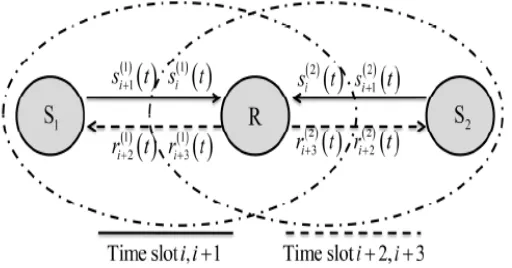
Our system model is based on the canonical two-way network shown in Fig.1. Source nodes, N1 and N2, out of
eachother’s communication range, have messages to exchange. They communicate through a relay node R that is within the range of both N1 and N2. We assume that the transmission is organized in consecutive time slots enumerated
by i. The source nodes use a single transceiver antenna each. The difference of our system compared to the classical model is that relay node R has two transceiver antennas instead of one. Since the signals originating at N1 and N2 are
mutually independent from each other and are locally displaced, and since R has two transceiver antennas, the system can be seen as a 22 virtual MIMO system with spatial diversity scheme.
3.
SOURCE
NODE
TRANSMISSION
Let us denote the signal transmitted by the source node N1in the ith time slot by si(1)(t) and the signal transmitted by the
source node N1in the (i+1)th time slot by s(i+1)(1)(t). Similarly, the signals transmitted by the source node N2 in the ith
and the (i +1)th time slots shall be denoted b si (2)(t) and s(i + 1)(2)(t), respectively. Let us assume that the transmit signals
Performance Analysis of MIMO Network
Coding with SISO Physical-Layer Network
Coding
Alpana Sahu1, Rajveer Mittal2
1,2
Volume 2, Issue 2, February 2013
Page 50
si(1)(t), s(i + 1)(1)(t), si(2)(t) and s(i + 1)(2)(t) are Binary phase shift keying (BPSK) modulated signals, each comprising single
bit. Let Eb denote the bit energy and Tb shall be the bit duration. Now, let bi(1) be the data vector, representing the data,
transmitted by the source node N1 in the time slot i using bi(1) Є {-1,+1} and correspondingly, let bi(2) denote the data
vector at source node N2 in the same time.[7-10]
Figure 1: Three Nodes Relay Network with Two-Step transmission Slot i. The transmit signals hence given by
Si(1)(t) = bi(1)p(t) (1)
and
Si(2)(t) = bi(2)p(t) (2)
in the time slot i when using he BPSK impulse
else
T
t
for
T
E
t
p
b b
0
,
0
1
2
)
(
(3)The relay node R receives these signals via its two transceiver antennas. Let hi(1,1)(t)denote the channel impulse response between the first source node N1 and the first antenna of the relay node R in the time slot i . Furthermore, let
hi(1,2)(t) denote the channel impulse response between the first source node and the second antenna of the relay node R
in the time slot i . Similarly, hi(2,1)(t) and hi(2,2)(t) represent the channel impulse responses between the second source
node N2 and the first as well as the second antenna of the relay node R. In this case, the channel impulse responses
approximately represent single path channels with negligible time variance; rather, inter-time slot time variations can occur. Hence, the general complex-valued numbers hi(1,1)(t), hi(1,2)(t), hi(2,1)(t) and hi(2,2)(t) can be used to represent the
channel impulse responses. We will take into account that hi(1,1)(t), hi(1,2)(t), hi(2,1)(t) and hi(2,2)(t) represent
Rayleigh-flat-fading channels with variance σ2 equal to 1 with the additive white Gaussian noise signals ni(1)(t) and ni(2)(t) at the
first and the second antenna of R in the time slot i and each having double-sided spectral noise power density N0/2.
3.1 Numerical Analysis
Let us assume that e(1)R,i(t) and e(2)R,i(t) being the received signals at the first and the second antenna of R in the
time slot i, the communication system is given by
eR,i(1)(t) = hi(1,1) Si(1)(t) + hi(2,1) Si(2)(t) + ni(1)(t) (4)
eR,i(2)(t) = hi(1,2) Si(1)(t) + hi(2,2) Si(2)(t) + ni(2)(t) (5)
Equations (4) and (5) can be represented in matrix form as
(t)
n
(t)
n
(t)
s
(t)
s
(t)
e
(t)
e
(2) i
(1) i (2)
i (1) i ) 2 , 2 ( ) 2 , 1 (
) 1 , 2 ( ) 1 , 1 (
(2) i R,
(1) i R,
i i
i i
h
h
h
h
(6)
Similarly,e(1)R,(i+1)(t)ande(2)R,(i+1)(t) being the received signals at the first and the second antenna of R in the time slot
i+1.The relay node R determines the information contained in the received signals, yielding the detected versions bi(1)
and bi(2) of bi(1) and bi(2). Different detection techniques, for example Zero-forcing (ZF) based V-BLAST as in [4] or its
Minimum mean square error (MMSE) as explained in [5] could be used.
3.2 MIMO ZF receiver
In this section, we will try to improve the bit error rate performance by trying out Successive Interference Cancellation (SIC). We will assume that channel is a flat fading Rayleigh multipath channel and the modulation is BPSK. Equations (4) and (5) can be represented in matrix form as shown in equation (6).
Equivalently,
Volume 2, Issue 2, February 2013
ISSN 2319 - 4847
Volume 2, Issue 2, February 2013
Page 51
where
s = bpin this b Є {1,+1}and p = 1 = BPSK impulse power. Now, equation (7) can also be written as
e = hb + n (8) To solve for b, the Zero-Forcing (ZF) in [4] linear detector for meeting the constraint is given by
W = (hHh)-1hH (9)
Where H = Hermitian Transpose. To do the Successive Interference Cancellation (SIC), the receiver needs to perform the following:
Using the ZF equalization approach described above, the receiver can obtain an estimate of the two transmitted symbols b(1) and b(2)
2) ( (1)
b
~
b
~
(hHh)-1hH
(2) (1)
e
e
(10)
3.3 BER for ZF receiver
Till now we have seen that h is used to represent the channel impulse response and is called Rayleigh Random Variable. It is a identical distributed Gaussian random variable with mean 0 and variance σ2. The magnitude ׀h׀ has a probability density function
2 2
2
2
)
(
h
e
h
h
p
(11)e = hb + n (12) where e is the received symbol, h is complex scaling factor corresponding to Rayleigh multipath channel b is the transmitted symbol (taking values +1’s and -1’s) and n is the Additive White Gaussian Noise (AWGN)
Assumptions:
1. The channel is flat fading; In simple terms, it means that the multipath channel has only one tap. So, the convolution operation reduces to a simple multiplication.
2. The channel is randomly varying in time; meaning each transmitted symbol gets multiplied by a randomly varying complex number. Since modeling is a Rayleigh channel, the real and imaginary parts are Gaussian distributed having mean 0 and variance 1/2.
3. The noise has the Gaussian probability density function with
2 2
2 ) (
2
2
)
(
n
e
h
n
p
(13)with µ=0 and σ2 =N0/2 .
4. The channel h is known at the receiver. Equalization is performed at the receiver by dividing the received symbol e by the apriori known as h i.e.
n
b
h
n
hb
h
e
e
~
~
(14) Where,n
~
=n/hIn the BER computation in AWGN, the probability of error for transmission of either +1 or -1 is computed by integrating the tail of the Gaussian probability density function for a given value of bit energy to noise ratio Eb/No The
bit error rate is,
)
(
2
1
0
N
E
erfc
p
bb
(15)However, in the presence of channel h, the effective bit energy to noise ratio is ׀h2׀Eb/No. So, the bit error probability for
a given value of h is,
)
(
2
1
)
(
2
1
2
erfc
N
E
h
erfc
p
o b
b
(16)Where, γ = ׀h׀2Eb/No . To find the error probability over all random values of ׀h2׀, one must evaluate the conditional
probability density function P (b׀h)over the probability density function of γ.
Probability density functions of γ :
From chi-square random variable, we know that if ׀h׀ is a Rayleigh distributed random variable, then ׀h׀2 is chi-square distributed with two degrees of freedom. Since ׀h׀2is chi square distributed, γ is also chi square distributed. The
Volume 2, Issue 2, February 2013
Page 52
o b N E
o b
e
N
E
P
)
//
1
(
(17)Error probability: the error probability is,
p
d
erfc
P
b(
)
(
)
2
1
0
(18)This equation reduces to 4 / 1
/
1
/
1
o b
o b b
N
E
N
E
P
(19)
or
4 / 1
1
1
b b b
P
(20)
3.4 MIMO MMSE receiver
In this section, we extend the concept of successive interference cancellation to the MMSE equalization in [5] and simulate the performance. We will assume that the channel is a flat fading Rayleigh multipath channel and the modulation is BPSK. In the first time slot i.e. i, the received signal on the first receive antenna is shown in equation (4) and the received signal on the second receive antenna is given in equation (5). For convenience, the equations (4) and (5) can be represented in matrix notation as given by equation (6).
Equivalently,
e = hs + n (21) where,
s = bpin this b Є {-1, +1} and p=1=BPSK impulse power. Now, equation (21) can also be written as
e = hb + n (22) The Minimum Mean Square Error (MMSE) approach tries to find a coefficient which minimizes the criterion,
E = {[We –b][We-b]H} (23) Solving,
W =[hHh + NoI]-1 (24)
Using the Minimum Mean Square Error (MMSE) equalization, the receiver can obtain an estimate of the two transmitted symbols b(1) and b(2) i.e.
2) ( (1)
b
~
b
~
(hHh+NoI)-1hH
(2) (1)
e
e
(25)
3.5 RELAY NODE FORWARDING
The decode-and-forward (DF) forwarding scheme is deployed in the second step i.e in relay node forwarding. The relay
node R re-encodes and re-modulates the received signals
b
~
i(1)and~
b
i(2), the detected version of bi(1) and bi(2) forwardsthem to source nodes. In this section, network coding and space-time block coding (STBC), like e.g. the Alamouti scheme [3] and [6] are exploited together to get coding multiplexing and spatial diversity gain. Network coding will improve network throughput, and STBC will help overcome channel fading [11-15]. In order to validate this paradigm, a simple network coding scheme will be applied, first. Let ri+2(1)(t) and ri+2(2)(t) represent the signals transmitted over
the first and the second antenna of the relay node R, respectively, in the time slot (i+2) to both the source nodes N1 and
N2. The network coding scheme is given by the bit-wise multiplication of the signals received in the ith and the (i+1)th
time slots according to the following rule:
ri+2(1)(t)=
b
(
1
)
~
i(2) i
b
~
.P(t) (26)
ri+2(2)(t)=
) 1 ( 1) (i
b
~
(2) 1) (i
b
~
.P(t) (27)
Similarly, Let ri+3(1) (t) and ri+3(2) (t) represent the signals transmitted over the first and the second antenna of the relay
node R, respectively, in the time slot (i + 3) to both the source nodes N1 and N2 and are given by
ri+3(1)(t)=
b
~
(i+1)(1)
b
~
Volume 2, Issue 2, February 2013
ISSN 2319 - 4847
Volume 2, Issue 2, February 2013
Page 53
ri+3(2)(t)=
b
~
i(1)
b
~
i(2).P(t) (29)
After network coding, the Alamouti scheme is applied with the formats ri+2(2)(t)= -( ri+3(1)(t))* (30)
ri+2(2)(t)= ( ri+2(1)(t))* (31)
The signal received at the source node N1 in the time slot (i+2) and (i+3) is given by
(t)
e
(1)N,(i2) = h(i+2)(1,1) r(i+2)(1)(t) + h(i+2)(1,2) r(i+2)(2)(t)+ n(i+2)(1)(t) (32)(t)
e
(1)N,(i3) = h(i+3)(1,1) r(i+3)(1)(t) + h(i+3)(1,2) r(i+3)(2)(t)+ n(i+3)(1)(t) (33)On applying Alamouti scheme in equation (33) from equations (30) and (31) we get
(t)
e
(1)N,(i3) = -h(i+3)(1,1) (r(i+2)(1)(t))* + h(i+3)(1,2) (r(i+3)(2)(t))*+ n(i+3)(1)(t) (34)On rearranging the terms we get
(t)
e
(1)N,(i3) = h(i+3)(1,2) (r(i+3)(2)(t))* - h(i+3)(1,1) (r(i+2)(1)(t))* + n(i+3)(1)(t) (35)Now, equations (32) and (35) can be represented in matrix form as
(t)
n
(t)
n
(t)
r
(t)
r
)
(
)
(
(t)
e
(t)
e
(2) 3) (i (1) 2) (i (2) 2) (i (1) 2) (i * ) 2 , 1 ( ) 2 ( * ) 2 , 1 ( ) 3 ( ) 2 , 1 ( ) 2 ( ) 1 , 1 ( ) 2 ( 3) (i N, (1) 2) (i N, (1) i i i ih
h
h
h
(36)Similarly, the signals received at the source node N2 in the time slots (i+2) and (i+3) can be represented in matrix form
as
(t)
n
(t)
n
(t)
r
(t)
r
)
(
)
(
(t)
e
(t)
e
(2) 3) (i (2) 2) (i (2) 2) (i (1) 2) (i * ) 1 , 2 ( ) 3 ( * ) 2 , 2 ( ) 3 ( ) 2 , 2 ( ) 2 ( ) 1 , 2 ( ) 2 ( 3) (i N, (2) 2) (i N, (2) i i i ih
h
h
h
(37)Now the source nodes N1 and N2 detect
(1) 2) (i
b
~
and
(1) 3) (i
b
~
, then estimate the combined signal using Maximum
likelihood (ML) decision rule. The corresponding bit error probability of this 21 MISO system [7], is given by
Pe,Alam =
b b b b
2
3
2
2
1
1
2
1
(38)Volume 2, Issue 2, February 2013
Page 54
5.
SIMULATION RESULTS
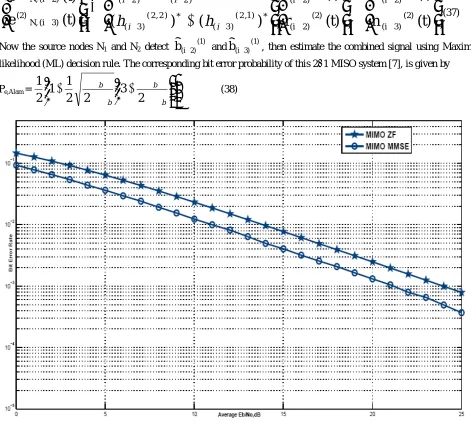
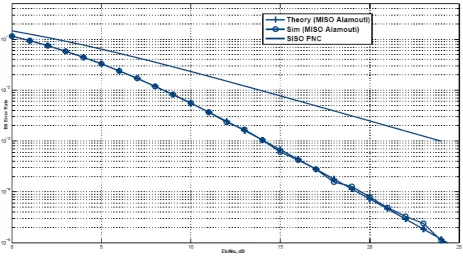
In this paper, we compare the performance of the physical layer network coding (PNC) with the newly proposed Multiple Input Multiple Output Network Coding Scheme. Both schemes use BPSK, Rayleigh-flat-fading channel model is assumed between each antenna pair in the system. Fig.2 and Fig.3 provides a comparison of the overall bit error performance obtained in the three nodes relay network. In the source node transmission of the MIMO network coding scheme, two different spatial multiplexing receivers, ZF and MMSE are deployed at the relay node R. The BER comparison of both is shown in Fig.2. In the relay node forwarding of MIMO network coding scheme (BER comparison with PNC shown in Fig.3), the source node N1 or N2 applies Maximum Likelihood (ML) symbol detector
followed by a binary exclusive or (XOR) operation to extract BPSK signals from the other. At last we found that MIMO network coding outperforms the PNC.
Figure 3: BER for BPSK modulation with 21 MISO Alamouti and PNC (Reyleigh Channel)
6.
CONCLUSION
In this paper, a new two-way protocol with combination of MIMO and network coding has been proposed. The benefits of MIMO network coding come from two transreceiver antennas at the relay node R, where both code multiplexing and spatial diversity gains can be jointly exploited. Theoretical and simulative performance analyses show that MIMO network coding protocol with MMSE detection at the transmitting phase outperforms PNC schemes and provides more robust and efficient transmission.
R
EFERENCES[1] S. Zhang, S.C. Liew, and P.P. Lam, “Physical layer network coding”, IEEE Trans. On Networking.
[2] S.M. Alamouti, “A Simple transmit diversity technique for wireless communication”, IEEE J. Sel. Areas Commun., vol. 16, pp.1451-1458, October 1998.
[3] E. Fasolo, F. Rossetto, and M. Zorzi, “Network Coding meets MIMO”, Network Coding, Theory and Applications, 2008. Fourth Workshop on (NetCod 2008), pp. 1-6, January 2008.
[4] M. Kiessling, and J. Speidel, “Analytical performance of MIMO zeroforcing receivers in correlated Rayleigh fading environments”, Signal Processing Advances in Wireless Communications, 2003. SPAWC 2003. 4th IEEE Workshop on., pp. 383-387, June 2003.
[5] M. Kiessling, and J. Speidel, “Analytical performance of MIMO MMSE receivers in correlated Rayleigh Fading Environment”, Vehicular Technology Conference, 2003. VTC 2003-Fall., vol. 3, pp. 1738-1742, October 2003. [6] D. Gesbert, M. Shafi, D. Shiue, P.J. Smith and A. Nagueb, “From theory to practice: An overview MIMO Space
Time Coded Wireless Systems”, IEEE J-SEC, vol. 21, no.3, pp. 281-302, March 2003.
Volume 2, Issue 2, February 2013
ISSN 2319 - 4847
Volume 2, Issue 2, February 2013
Page 55
[8] Y. Wu, P.A. Chou, S.Y. Kung, “Information exchange in wireless networks with network coding and physical-layer broadcast”, in Proc. 39th Annual Conf. Inform. Sci. and Systems (CISS), 2005.
[9] S. Zhang, and S.C. Liew, “Capacity of Two-Way Relay Channel”, the 3rd Beijing-Hong Kong Doctoral Forum, 2008.
[10] A. Vardy, and Y. Be’ery, “Maximum likelihood soft-decision decoding of BCH codes.” IEEE Trans. Inform. theory, Vol.40, pp. 546-554, Mar. 1994.
[11] N. shulman and M.feder, “Random Coding Techniques for non-random codes,” IEEE Trans. Inform. theory, Vol.45, no.6, pp. 2101-2104, september 1999.
[12] C. Schnurr, T.J. Oechtering, and S. Stanczak, “On Coding for the broadcast phase in the two way relay channel”, in Proc. Conference on Information Sciences and Systems (CISS’07), March 2007.
[13] L. Ekroot and S. Dolinear, “A decoding of block codes”, IEEE Trans. Commun., vol. 50, No.9, pp. 1052-1056, Sep. 1996.
[14] M.O. Hasna and M.S. Alouini, “Enc-to-end performance of transmission systems with relay over Rayleigh-fading channels”, IEEE Trans. Wireless Commun., Vol.2, No.6, pp. 1126-1131, Nov. 2003.
[15] P. Larsson, N. Johansoon, and K. E. Sunell, “Coded bi-directional ralaying”, in Proc. IEEE Int. Veh. Tech. Conf. (VTC), Melbourne, Australia, May 2006, pp.851-855.
AUTHOR
Alpana Sahu received her B.Tech degree in Electronics and communication engineering from Vira college of Engineering, UP.Technical University, India in 2004, M.Tech. degree in Signal Processing from, Netaji Subhas Institute of Technology, Delhi University, Delhi, India in 2011. Currently, she is working as an Assistant professor in Electronics and communication Engineering Department with the Maharaja Agrasen Institute of Technology, Rohini, Delhi under GGSIP University, Delhi, India. Her research interests include power quality, network coding in physical layer and signal processing.