Volume 3, Issue 2, February 2014
Page 303
ABSTRACT
We present a cloud resource procurement approach based on queue to allow the selection of a cloud vendor who matches the requirement of the cloud users by their dynamic pricing and QoS. Different cloud users may have different requirements of the resources they use. They should select the cloud vendors based on their requirements. In this paper, we propose that multiple cloud users with different QoS and cost enter the cloud to procure their resources. The cloud broker prioritize them according to their cost and QoS. The cloud users then form the prioritized Queue(FIFO) themselves based on the priority given by the cloud broker starting from the highest priority to the lowest priority. The cloud users are then procured with the resources that match their requirements by the cloud vendors using fuzzy logic. Cloud auditor(Third Party Auditor) uses HLA(Homomorphic Linear Authenticator) to provide security to the data avoiding data access from cloud broker.
Keywords: Queue (FIFO), Dynamic Pricing, Resources, QoS, Priority, Fuzzy Logic, Homomorphic Linear Authenticator
(HLA).
1. INTRODUCTION
Cloud computing is very popular domain for providing services over the internet. The companies that offer the cloud services include Amazon, Google, IBM etc. The primary objective of cloud computing is that it provides the computer resources on demand. i.e., it provides the resources on payment. The resources provided may include SaaS (Software as a Service), HaaS (Hardware as a Service), PaaS (Platform as a Service), Storage etc.
Consider the following terms:
A cloud user is a person who uses the cloud resources.
A cloud vendor is an organization that provides the cloud resources.
A cloud broker is an intermediate between the cloud user and the vendor that directs the user to the vendor. A cloud auditor manages the work of the user and provides security to the data provided by the cloud user.
At present, the Cloud vendors follow a fixed pricing (pay as you go) basis to procure their resources. This method does not support the cloud users but provides gain only to the vendors. So, we go for dynamic pricing of the resources based on the cost and QoS factors.
Consider an example, suppose if a cloud user is procuring a resource (eg. Software) from the appropriate cloud vendor which will be available for usage for a particular period of time say (1 month). The user pays for the software as fixed by the vendor. If the user completes his/her task within 1 week, then the software is in no use for the remaining days. Hence, resource and the amount paid by the user for the particular period of time gets wasted. In order to overcome this difficulty, it is necessary to implement dynamic pricing. Here the user specifies the QoS and cost of the resources he desires to use. The cloud vendor who matches the user’s requirements will provide the resources to the user.
In this work, we propose the following:
Every user of the cloud may have different requirements of their resources. The requirements that we consider here are cost and QoS. The requirements from different users are first collected and given to the cloud auditor. The cloud auditor packs the requirements of the cloud users along with the Homomorphic Linear Authenticator (HLA) and sends it to the cloud broker. Homomorphic Linear Authenticator is an algorithm used to secure the data sent by the cloud users from unauthorized access by the cloud broker. The cloud broker does priority scheduling by giving priority to the user’s requirements based on the cost and QoS. The user who requests for standand resources with high QoS and low cost is given high priority. The remaining users are prioritized in this manner. The users then form the Queue(FIFO) based on
QUEUE BASED RESOURCE
PROCUREMENT BY FUZZY LOGIC QOS
DYNAMIC SOURCE ROUTING
G.Geetharamni 1 and M.Padma 2
1
Assistant Professor, Department of Mathematics, BIT Campus, Anna University::Chennai,
Thiruchirapalli, Tamil Nadu, India.
2
Research Scholar, Department of Computer Science and Engg, BIT Campus, Anna University::Chennai,
Volume 3, Issue 2, February 2014
Page 304
the priority starting from the highest to the lowest priority. The users then enter into the procurement process one by one in the FIFO order. The user checks for the resources they need based on the cost and QoS from the vendor using fuzzy logic i.e., if one cloud vendor has the user required resources, then it will provide the resources. Otherwise, the user is directed to another cloud vendor.
It has a great advantage that this form of procuring resources gives benefits to both the users and the vendors. Because of he user will be easily satisfied by getting their desied resources. The vendors are also paid according to their provision. The problem with this idea is that as it uses the Queue based concept, the users have to get their resources in the FIFO (First In First Out) manner. So, the user with lowest priority has to wait for a long time to get his/her resources. This results in the wastage of time for the users.
2. RELATED WORK
Shrisha Rao [1] In this paper presented cloud resource procurement model that leads to the selection of the appropriate cloud vendor and also implements dynamic pricing. There are three mechanisms namely DSIC, BIC, OPT. C-DSIC is dominant strategy incentive compatible and is a low-bid Vickrey auction. C-BIC is Bayesian incentive compatible and is budget balanced. C-OPT is both Bayesian incentive compatible and also individual rational. In C-DSIC and C-BIC, the ratio of cost and QoS is calculated. The cloud vendor with the lowest ratio of cost and QoS is declared as the winner. In C-OPT, the cloud vendor is assigned a virtual cost. The vendor with the least virtual cost is declared the winner. This experiment indicates that the resource procurement cost decreases with the increase in the number of cloud vendors. A procurement module is designed which automates the choice of the appropriate cloud vendor among the various offerings and also implements dynamic pricing.
Bernardetta Addis. et.al [2] provided various services such as computing and storage capacity. The problem of offering services is that the cloud should provide continuous services and dynamically adapt the cloud platform. This paper proposes that the resources are allocated for virtual cloud platforms. The services should satisfy the performance and minimize the energy costs. It presents a scalable distributed hierarchical framework based on a mixed-integer non-linear optimization of resource management acting as multiple time-scales. Several experiments with wide variety of configurations determine the efficiency and effectiveness of this approach.
Shucheng Yu. et.al [3] reported convenient access to massive data storage and application services. It provides economical savings to data owners and users. But the benefits are not fully realized because the private data of the data owners may be exposed and handled by the cloud providers. This paper proposes the secure access of the privacy-assured searchable cloud data services and to design efficient search schemes for encrypted cloud data storage. It presents a general methodology called searchable encryption techniques which allows encrypted data to be searched by the users without leaking information about the data itself and user queries. Three functionalities of search operations are discussed: supporting result ranking, similarity search and search over structured data. The privacy-assured searchable encryption schemes are based on recent symmetric key encryption techniques.
Vinu Prasad et.al [4] presented resources to various users. It also provides multiple resources for a single user or several users simultaneously. In this paper, we propose that multiple resources are procured from several cloud vendors participating in the bidding operation. This is done by dynamic pricing of the resources. The multiple resources are to be procured from several cloud vendors by auction, so it turns to combinatorial auction. The user’s request are preprocessed, the auction is analyzed and a set of vendors are declared for the auction based on the Combinatorial Auction Branch on Bids (CABOB) model. Simulations with prices procured from several cloud vendor’s datasets show its effectiveness in multiple resource procurement in cloud computing. Each cloud user has resource requirements. The users perform auctions for procuring resources (which are also called procurement auctions). Cloud vendors offer resources, but with varying costs and quality metrics. The goal of the cloud user is to minimize the total cost of procuring resources without compromising quality of service. In order to minimize the procurement cost, it is necessary for the cloud user to know the real costs of cloud vendors. A user announces its specifications for desired resources and quality of service to all cloud vendors, with the broker acting as a middleman. The cloud vendors decide whether to participate in the auction based on the user information, and submit their bids to the broker. The broker aggregates the bidding information and selects the appropriate cloud vendor. Cloud vendors are rational and intelligent. Cloud vendor checks whether the user requested resources are available on that virtual machine. If not, they allocate the next virtual machine.
3. Proposed QUEUE BASED RESOURCE
3.1 QoS and Cost Initialization:
Volume 3, Issue 2, February 2014
Page 305
(Platform as a Service), Storage etc. These requirements are managed entirely by the cloud user.
3.2 Homomorphic Linear Authentication:
The cloud auditor is a person who collects all the requirements of several users and provides security to the data passed by the cloud users. Here, Homomorphic Linear Authenticator (HLA) algorithm is used for security purpose. The data that the user sends should be protected from unauthorized access or hacking by third party members such as the cloud broker. So, HLA is used. HLA is an algorithm used to secure the data and access the data without leaking the information about the data by the third parties. The cloud auditor performs this job and sends the data to the cloud broker along with the Homomorphic Linear Authenticator.
3.3 Prioritization:
The cloud broker acts as a middleware between the user and the vendors and directs the cloud user to the appropriate vendor. The user’s requirements with the Homomorphic Linear Authenticator is passed to the cloud broker. The broker gives the priority to the users based on their requirements i.e., the user with the high QoS and low cost is given high priority. The next user with high QoS and low cost is given second priority and so on. Priority Scheduling is performed in this case. The users then form the Queue based on the given priority starting with the highest priority. They are then directed to the cloud vendors in the FIFO manner.
3.4 Fuzzy Logic:
The cloud vendor is an organization or a group of organizations that provide the cloud services to the users. The users enter into the selection process in the Queue (FIFO) manner. The selection of appropriate vendors is done by using fuzzy logic i.e., the cloud vendors that satisfy the user’s requirements provides the resources. If the required resources is not available in the current platform, then the users are directed to another vendor or machine.
4. UPPER BOUND DELAY ESTIMATION
In this paper the cloud Ethernet and loud network is used as an example of the NCS cloud network. The Ethernet cloud networks are nowadays also more and more used in control applications and, in this context, it is important to understand the behaviour of the cloud network in order to be able to control the cloud network performance, such as delays (Georges
et al., 2004).
Next, the procedure of obtaining the upper bound delay over the cloud network will be explained in more detail. How to obtain a maximum delay for crossing a single Ethernet switch will be explained in Section 2.1, and the procedure of obtaining end-to-end delays in the cloud network, based on the delays over the switches, will be given in Section 2.2. The communication cloud network upper bound delay estimation algorithm presented in this paper applies ideas from cloud network calculus theory (see Cruz, 1991; Le Boudec and Thiran, 2001; Jasperneite et al., 2002). For more details of the algorithm, see Georges et al. (2005). The communication cloud network is represented as a cloud network of interconnected switches, and each switch is modelled as a combination of the basic components: multiplexers, demultiplexers and FIFO queues, see Fig. 1.
4.1 Maximum delay for crossing the Ethernet switch
To obtain the upper bound delay for crossing a single Ethernet switch, the upper bound delays over the basic components should first be determined. In this section we will show how to obtain the upper bound delay for the FIFO multiplexer, FIFO queue, and demultiplexer basic components. The upper bound delay over the switch is then the sum of the upper bound delays over the basic components:
output queue mux
switch D D D
D (1)
The traffic arriving at the switch, both periodic and aperiodic, is modelled as a “leaky bucket controller”. That is, the data will arrive at the switch only if the level of the amount of data in the buffer of the switch is less than the maximum buffer size and the data leaves the switch at a constant rate.
Upper bound delay over a FIFO multiplexer. The first step in calculating the delay over a multiplexer is to determine the arrival curves of the traffic coming to the component and the service curves provided by the component. With the assumption that the traffic follows the leaky bucket controller, these curves are affine and have the form of:
t t
b() (2)
Volume 3, Issue 2, February 2014
Page 306
The next step is to determine the upper bound backlog in the multiplexer. The backlog is the number of bits accumulated in the component, and it is a measure of congestion over the component. For the arrival and service curves in Fig. 2, the upper bound backlog occurs at time t and can be calculated from
t C C L t b t
b1() 2( / 2) out (3)
Where b1 and b2 are the arrival curves of stream 1 and 2 at time t, L is the maximum length of the frames, C2is the capacity of the import port 2, and Cout is the capacity of the output link.
When the upper bound backlog over the component is known, the upper bound delay over the multiplexer component is then obtained by dividing the maximum backlog value by the capacity of the output link of the multiplexer.
The procedure can be summarized as follows:
In a FIFO m-inputs multiplexer, the delay for any incoming bit from the stream i is upper-bounded by:
Fig. 1. Model of a 2 port-switch in a full duplex mode based on shared memory and a cut-through management.
Fig. 2. Arrival and service curves and backlog evolution inside the two-input FIFO multiplexer.
Fig. 3. Burstiness along acloudEthernet cloud network.
k mux k out i
mux B
C
D , min ,
1
(4)
Where Bmux,kis an upper-boundof the backlog in the bursty periods uk.
For k = i (i.e. bi is bigger than bk), the bursty period is defined by uii/(Cii) and the backlog is upper-bounded by :
m
i z z
out i i z z i z z i
mux u C C
C L u B
; 1
, (5)
Where i is the burstiness of the stream i, i is the average rate of arrival of the data of stream i, Li is the maximum length of the frames of stream i and Ciis the capacity of the import port i.
For ki (i.e. bi is smaller than bk) such that 1km, we have uk k/(Ckk)Lk/Ck and
k
i i i m
k z z
out k k z z k z z i
mux L
C L C C u C L u
B
; 1
, (6)
Volume 3, Issue 2, February 2014
Page 307
in in in
out in
out queue
C C C C
D
1 (7)
Upper bound delay over a demultiplexer. The demultiplexer has one input link and two or more output links. Its function is to split the streams that arrive at the input ports and to route them to the appropriate output ports. In Ethernet, this consists of reading the destination address at the start of the frame and selecting the output port associated with its destination in the forwarding table. Due to the Spanning Tree Protocol, only one path is activated to go from one point to another. Therefore it is assumed that the routing step is instantaneously achieved. Thus the demultiplexer does not generate delays.
4.2. Maximum end-to-end delays for crossing a cloud Ethernet and cloud network
The upper-bounded delay equations for crossing a switch were proposed in the previous section. In the equations, the maximum delay value D depends on the leaky bucket parameters: the maximum amount of traffic that can arrive in a burst and the upper bound of the average rate of the traffic flow . In order to calculate the maximum delay over the cloud network, it is necessary that the envelope
,
is known at every point in the cloud network. However, as shown in Fig. 3, only the initial arrival curve values
0 0
,
are usually known, and the values for other arrival curves should be determined. To calculate all the arrival curve values the following equations can be used:
in out
in in
out D
(8)
For example, for the arrival curve
1,1
in Fig. 3 the envelope after the first switch is:
1,1
0 0 ,0
switch D (9)
Now it possible to summarize the procedure of obtaining the maximum end-to-end delays in a cloud Ethernet cloud network. The algorithm is the following:
1.Identify all streams on each station and determine the initial leaky bucket values.
2.Identify the route of each stream. In thecloudEthernet cloud networks, the paths are determined by the spanning tree protocol.
3.On each switch, formulate the output burstiness equations for all streams. 4.Define the equation systems of form or an1bn2...znmn
5.Solve the burstiness values.
6.Determine the end-to-end delay in the cloud network from the equation
i o i h i i D
(10)
where h is the number of crossed switch.
5. DELAY COMPENSATION USING THE UPPER BOUND DELAY ESTIMATE
In the NCS environment the main goal of the control system is to maintain Quality of Performance (QoP) of the control system regardless of the delays in the cloud network. The system should be robust and be able to compensate the delay induced by the cloud network. Prior to presenting the delay compensation strategies it is important to state the following assumptions about the process and the cloud network:
1. In the cloud network all control and measurement information is sent in a single packet.
Volume 3, Issue 2, February 2014
Page 308
Zero-Order Hold
Sensor Network Delay
Sampler P(s)
Process C(z)
Controller
Actuator Network Del ay
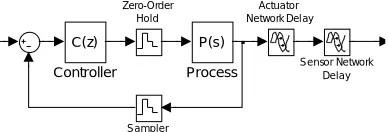
Fig. 5. The equivalent Smith predictor compensation scheme in case the delay is commutative
2. The process is assumed to be fast. The sampling time necessary to capture all relevant process dynamics is significantly smaller than the cloud network induced delay. (If the sampling time necessary to capture all process dynamics is larger than the cloud network induced delay, then the delay will have a similar effect on QoP of the control system as a small additional measurement error.
3. No packet losses occur in the communication cloud network.
In the following sections the two delay compensation strategies will be presented. First, the compensation strategy based on the Smith predictor will be introduced, and next the robust control theory based approach will be presented. In order to facilitate understanding, the synthesis of both is done in continuous time. For implementation the obtained controllers should be discretized. If assumption (2) above holds, the results for the discrete case will be similar.
5.1 Smith predictor based approach
The delay compensation scheme of the Smith predictor is shown in Fig. 4. In the figure, minor feedback loops have been introduced around the conventional controller.
In order to see how the scheme works, let us proceed to analyze the time-delay compensator assuming that there are no model errors in the scheme (process model and a time delay are known exactly) and that the time delays are commutative. This means that the delayed process measurement and the delayed process output estimate are equivalent, *
delayed delayed y
y . Then observe that the signal reaching the controller is a corrected error signal given by:
* *
delayed non delayed delayed
cry y y
(11)
or *
delayed non cry
(12)
That is the error signal that reaches the controller is calculated on the basis of the non-delayed estimate of the process output. Implying, as a result, that the block diagram in Fig. 4 is equivalent to that shown in Fig. 5. The net result of introducing minor loops is therefore to eliminate the time delay factor from the feedback loop where it causes stability problems, and move it outside the loop where it has no effect on closed-loop stability.
The scheme works well as long as the process model and the time delay are known. In the case of modeling errors, the performance of the Smith predictor decreases. In addition, the Smith predictor scheme is designed for constant time delays and therefore may not perform as well for systems with time delays that significantly vary over time.
To increase the robustness of the Smith predictor so that it is more suitable for the NCS environment where time delay varies, we use the following delay estimate obtained on the basis of the upper-bound delay value. This delay estimate was originally proposed by Wang, et al., (1994) to represent uncertain delays in the H framework in the design of robust
controllers.
In continuous time, the delay can be approximated by:
465 . 3 / ) (
1
) (
1
2 1
2 1
s UBD UBD
s UBD UBD
es (13)
Where describes uncertainty, and UBD is the upper bound delay.
5.2 Robust control theory based approach
The robust control approach is used as a second delay compensation strategy. The main idea is the following: first, the cloud network-induced delays are represented in the frequency domain as an uncertainty around the nominal plant. Next, using the robust control methods (H-synthesis, D/K iteration etc.) a controller is generated that enables maintenance of
Volume 3, Issue 2, February 2014
Page 309
Compared to the Smith predictor based approach, the benefits of this approach are the following. The robust control approach is based on the worst case uncertainty, thus no information is needed about the distribution of the delay. In addition, the uncertainties about the process, as well as about the cloud network, can be handled using the same methodology. For the process the uncertainty about a gain, time constant, pole and zero location, and for the cloud network uncertainty induced by the cloud network delay, jitter and the effect of missing values, can be handled using the same methodology.
Representing the cloud network induced delay. The cloud network delay can be represented as a multiplicative uncertainty around the plant:
(14) 1 ) ( )); ( ) ( 1 )( ( ) ( 1 I jw s s w s G s
Gp I I
Where wI is a weight used to describe the delay uncertainty. The weight can be obtained by finding the smallest radius
) (w
lI that includes all possible plants:
(15) ) /( ; 2 ) /( ; 1 ) ( 1 max ) ( ) ( ) ( max ) ( 2 1 2 1 ) 2 1 ( 2 1 2 1 UBD UBD w UBD UBD w e w l e e jw G jw G e jw G e w l s UBD UBD I s UBD s UBD P G s UBD s UBD P G I
And choosing the weight wI such that
w jw l jw
wI( ) I( ); (16)
For example in this case the following weight can be chosen:
465 . 3 / ) ( 1 ) ( ) ( 2 1 2 1 s UBD UBD s UBD UBD s wI
(17)
Controller synthesis. For a SISO case the controller synthesis problem can be solved in a relatively straightforward manner, since the SISO case with one complex multiplicative perturbation the Robust Performance (RP) problem can be approximated as a weighted mixed sensitivity problem where the condition is slightly strengthened:
Overload traffic 0 1 1 2 1 3 1 4 1 6 1 1 0 2 1 5 0 3 0 6 0 5 0 4 Controller Real-time process Overload traffic Ethernet Switch Overload traffic 0 1 1 2 1 3 1 4 1 6 1 1 0 2 1 5 0 3 0 6 0 5 0 4 Controller Real-time process Overload traffic Ethernet Switch
Fig. 6. The structure of the cloud network
2 1
max 2 2
T w S w T w S w I P I P
(18)
Where wP is a weight for the sensitivity function S (usually an approximator of an integrator), and T is the
complementary sensitivity function.
For a MIMO case (or for a SISO with additive uncertainties) the use of a more complicated technique such as synthesis is required.
6. SIMULATION RESULTS AND DISCUSSIONS
In the simulations, the cloud network of a real time process, a controller, and two overload traffic stations connected over a full duplex Ethernet switch, were used. The structure of the system is shown in Fig. 6.
To calculate the upper bound delay, the initial leaky bucket values of each stream were first identified. 6 are messages sent periodically. The traffic sent from the process to the controller is given by 0()
1 t
b , and the traffic from the controller
to the process by 0()
2 t
Volume 3, Issue 2, February 2014
Page 310
and UBD2. We consider also background traffic (b30(t),b40(t),b50(t),b60(t)) from the stations to the process and to the
controller in order to overload the cloud network:
t t t b t b t b b t t t b t b 305200 1526 ) ( ) ( ) ( 7200 72 ) ( ) ( 3 0 3 0 6 0 5 0 4 0 3 1 0 1 0 2 0 1 (19)
Next, the route of each stream was identified and the output equations were formulated. After solving the values the end-to-end upper bound delay for streams 1 and 2 are:
ms UBD
UBD 3.5
1 0 1 2 1 2 1 (20)
In evaluating the effects of the cloud network on the control system performance, the following model of a real time process and a nominal controller were used (time in ms):
5
0.2
2 ) ( s s sP (21)
4529 . 0 , 5508 . 0 , )
( P I
I
P K K
s K s K s C
The controller parameters were obtained by minimizing the integral of the square errors (ISE) for the system with the cloud network delay in an actuator and sensor paths of 1 ms.
First, the delay compensation strategy based on the Smith predictor presented in Fig. 4 was used. The model was assumed to be known, and the cloud network delay in a sensor and in actuator sides were assumed to vary randomly between zero and the upper delay value estimate. Equation 13 was used for both the measurement delay estimate and the control signal delay estimate.
Next, the delay compensation strategy based on the robust control approach was implemented by solving the mixed sensitivity problem in Equation 18. Equation 17 was used as a weighting function for the complementary sensitivity function T. As a weighting function wP for the sensitivity function S the following approximation of the integrator was implemented: A s M s s w B B P / )
( (22)
Where B is the bandwidth where control is effective, M is the desired maximum peak of wb, and A is a small number
used to avoid numerical problems. The H optimal controller for this mixed sensitivity problem was found using the
Matlab Robust control toolbox.
The simulation results are presented in Fig. 8. Four graphs are shown: the system performance under a nominal controller (Equation 21) when the cloud network delay is negligible, the system performance under a nominal controller when there is no delay compensation, the system performance when the Smith predictor is introduced, and the system performance under a robust controller. From the figure it can be concluded that the nominal system becomes unstable when the delay increases. The stability of the feedback control loop can, however, be regained even when a delay compensation strategy such as the Smith predictor is implemented. The performance of the control system can be improved by using the more advanced delay compensation/toleration procedure.
7. Conclusion and Future Work
Cloud computing provides several resources for the users. Currently, the resources are procured using fixed pricing. It may satisfy only the cloud vendors not the users. So, dynamic pricing will be implemented in the near future that satisfy both the cloud users and the vendors where the pricing changes dynamically based on the usage of the resources.
References
[1] “A Mechanism Design Approach to Resource Procurement in Cloud Computing” by Abhinandan S. Prasad and Shrisha Rao in 2013.
Volume 3, Issue 2, February 2014
Page 311
Danilo Ardagna, Barbara Panicucci, Mark Squillante, Li Zhang in January 2013.
[3] “Towards Privacy-Assured and Searchable Cloud Data Storage Services” by Ming Li, Shucheng Yu, Kui Ren, Wenjing Lou, Y. Thomas Hou in July/August 2013.
[4] “A Combinatorial Auction Mechanism for Multiple Resource Procurement in Cloud Computing” by Vinu Prasad G, Abhinandan S Prasad and Shrisha Rao in 2012.
[5] “PACK – Prediction-Based Cloud Bandwidth and Cost Reduction System” by Eyal Zohar, Israel Cidon and Osnat Mokryn in 2013.
[6] “Strategic Bidding for Cloud Resources under Dynamic Pricing Schemes” by K. Sowmya, R.P. Sundarraj in 2012.
[7] “Application-Aware Local-Global Source De-duplication for Cloud Backup Services of Personal Storage” by Yinjin Fu, Hong Jiang, Nong Xiao, Lei Tian, Fang Liu, Lei Xu in2013.
[8] “Improving Accessing Efficiency of Cloud Storage Using De-duplication and Feedback Schemes” by Tin-Yu Wu, Jeng-Shyang Pan, Chia-Fan Lin in 2013.
AUTHOR
M.Padma received her M.E. degree in Computer Science and Engineering and currently pursuing Ph.D in Anna University Chennai. She is working as a Teaching Faculty in Department of Information Technology, Anna University Tiruchirappalli. Her areas of interest are Security in Cloud Computing, Networks and Information SecurityTaro Denshi received the B.S. and M.S. degrees in Electrical Engineering from Shibaura Institute of Technology in 1997 and 1999, respectively. During 1997-1999, he stayed in Communications Research Laboratory (CRL), Ministry of Posts and Telecommunications of Japan to study digital beam forming antennas, mobile satellite communication systems, and wireless access cloud network using stratospheric platforms. He now with DDI Tokyo Pocket Telephone, Inc.
Dr.G.Geetharamani received her Ph.D in Mathematics from Gandhigram University, Dindugul. And her areas of interest are Inventory Control, Fuzzy Queuing System, Neural Networks and Cloud Computing. She has published 20 International Journals and guiding 10 research scholars.