Impact Factor: 5.515
SPC based Software Reliability
using Modified Genetic Algorithm:
Inflection S-shaped Model
Dr. R.Satyaprasad, G. Bharathi, Dr. G.Krishna Mohan
Associate Professor, Dept. of CSE, Acharya Nagarjuna University. Research Scholar, Rayalaseema University.
Professor, Dept. of CSE, KL University.
Abstract— In order to assess software reliability, many software reliability growth models
(SRGMs) have been proposed in the past 40 years. In principle, two widely used methods for
the parameter estimation of SRGMs are the maximum likelihood estimation (MLE) and the
least squares estimation (LSE). However, the approach of these two estimations may impose
some restrictions on SRGMs, such as the existence of derivatives from formulated models or
the needs for complex calculation. In this paper, we propose a modified genetic algorithm
(MGA) to assess the reliability of software considering the Time domain software failure data
and SPC using Inflection S-shaped model which is NonHomogenous Poisson Process
(NHPP) based. Experiments based on real software failure data are performed, and the results
show that the proposed genetic algorithm is more effective and faster than traditional
algorithms.
Keywords - Software reliability, Inflection S-shaped model, Time domain data, Mean
Value Function, Modified Genetic Algorithm, NHPP.
I. INTRODUCTION.
Software reliability assessment is important to evaluate the quality of software system, since
it is one of the most important attribute of software. One of the most difficult problems of
software industry is to ship a reliable product. Therefore it is necessary to have accurate and
Impact Factor: 5.515 Reliability Growth Models (SRGMs) have been proposed in estimating reliability growth of
software products. SRGMs can be used to depict the behaviour of observed software failures
characterized by either times of failures (i.e Time domain data) or by the number of failures
at fixed times (i.e Interval domain data) (Lyu, 1996).
The parameters of SRGMs are generally unknown and have to be estimated based on
collected failure data. Two of the most popular estimation techniques are Maximum
Likelihood Estimation (MLE) and Least Squares Estimation (LSE) (Goel, 1985; Ohba, 1984).
In fact, MLE and LSE involve the property of probability theory and statistical analysis.
Thus, this may impose some restrictions on the parameter estimation of SRGMs (Costa et al., 2007; Minohara and Tohma, 1995) such as the continuity, the unimodality, the existence of
derivatives from formulated models, the complex likelihood function, etc. The method of
MLE estimation by solving a set of simultaneous equations and is better in deriving
confidence intervals. The method of LSE minimizes the sum of squares of the deviations
between what we actually observe and what we expect. Nevertheless, LSE is suitable for
fitting data from small to medium sample sizes (Wood, 1996), while MLE is considered to be
better statistical estimator for large sample sizes. In particular, when the formulated model of
SRGMs is complicated or the sample size of failure data is large, these two estimation
techniques may not be effective to find out the optimal solutions and generally require to be
solved numerically. Hence, the more effective and applicable approaches for the parameter
estimation of SRGMs may be necessary.
In recent years, the Genetic Algorithms (GAs) has gained popularity in solving the
optimization problem of scientific fields (Goldberg, 1989 ; Mitchell, 1998). Because, the
parameter estimation can be reformulated as a searching process within the domain of all the
feasible solutions (Harman and Jones, 2001; Jiang, 2006), it may be attractive to introduce
GA into the process of software reliability modeling (Dai et al., 2003). Therefore, in this paper we will propose a modified genetic algorithm (MGA) to estimate the parameter of the
SRGMs. We will attempt to modify GA‟s operators with weighted bit mutation and a
rebuilding mechanism to improve the performance and efficiency of estimations. Finally, the
applicability of proposed MGA, the result of parameter estimation and the reliability with
Impact Factor: 5.515 The rest of this paper is organized as follows. Section 2 surveys NHPP based SRGMs and in
specific Inflection S-shaped Model along with the past researches of GAs in software
engineering areas. In Section 3, an effective MGA is proposed to solve the parameter
estimation of reliability models. Then, the experimental results based on two failure data are
presented and discussed in Section 4. Finally, some conclusions are given in Section 5.
II. LITERATURE SURVEY.
A. NHPP model.
The Non-Homogenous Poisson Process (NHPP) based software reliability growth models
(SRGMs) are proved to be quite successful in practical software reliability engineering (Musa
et al., 1987). The main issue in the NHPP model is to determine an appropriate mean value
function to denote the expected number of failures experienced up to a certain time point.
Model parameters can be estimated by using Modified Genetic Algorithm (MGA). Various
NHPP SRGMs have been built upon various assumptions. Many of the SRGMs assume that
each time a failure occurs, the fault that caused it can be immediately removed and no new
faults are introduced. Which is usually called perfect debugging. Imperfect debugging models
have proposed a relaxation of the above assumption (Pham, 1993).
A fault is a statement in a program which causes one or more failures. Software Reliability
Growth is defined by the mathematical relationship that exists between the time span of
testing a program and the cumulative number of errors discovered. After failure detection, we
find a fault and define a fix for the fault. The exponential software reliability growth models
are designed to describe the failure detection process.
Let
N t t
, 0
be the cumulative number of software failures by time „t‟. m(t) is the mean value function, representing the expected number of software failures by time „t‟.
t is the failure intensity function, which is proportional to the residual fault content. Thus
1 bt
m t a e and
t dm t
dt . where „a‟ denotes the initial number of faults
contained in a program and „b‟ represents the fault detection rate. In software reliability, the
Impact Factor: 5.515 likelihood technique can be used to evaluate the unknown parameters. This paper deals with
the application of Inflection S-shaped model on application test data collected from literature,
which is of Time domain data (i.e ungrouped).
SRGMs are a statistical interpolation of defect detection data by mathematical functions.
They have been grouped into two classes of models-Concave and S-shaped. The only way to
verify and validate the software is by testing. This involves running the software and
checking for unexpected behaviour of the software output (kapur, 2009). SRGMs are used to
estimate the reliability of a software product. In literature, we have several SRGMs
developed to monitor the reliability growth during the testing phase of the software
development. Software reliability is defined as the probability of failure-free software
operation for specified period of time „t‟ in a specified environment.
B. Inflection S-shaped model
Software reliability growth models(SRGM‟s) are useful to assess the reliability for
quality management and testing-progress control of software development. They have been
grouped into two classes of models concave and S-shaped. The most important thing about
both models is that they have the same asymptotic behavior, i.e., the defect detection rate
decreases as the number of defects detected (and repaired) increases, and the total number of
defects detected asymptotically approaches a finite value. The inflection S-shaped model was
proposed by Ohba in 1984. This model assumes that the fault detection rate increases
throughout a test period. The model has a parameter, called the inflection rate, that indicates
the ratio of detectable faults to the total number of faults in the target software. True,
sustained exponential growth cannot exist in the real world. Eventually all exponential,
amplifying processes will uncover underlying stabilizing processes that act as limits to
growth. The shift from exponential to asymptotic growth is known as sigmoidal, or S-shaped,
growth.
Ohba models the dependency of faults by postulating the following assumptions:
• Some of the faults are not detectable before some other faults are removed.
Impact Factor: 5.515 • Failure rate of each detectable fault is constant and identical.
• All faults can be removed.
Assuming [Ohba 1984b]:
1 bt
b b t
e
This model is characterized by the following mean value function:
bt
bt e
e a t
m
1
1 ) (
where „b‟ is the failure detection rate, and „ ‟ is the inflection factor. The failure intensity
function is given as:
21 ( )
1 bt
bt
abe t
e
.
III. MIDIFIED GENETIC ALGORITHM.
Genetic Algorithm (GA) has been popularly used to solve various optimization problems. GA
has advantages of easy implementation with large search space and rapid convergence on
good quality solutions. It does not impose restrictions on the continuity, the existence of
derivatives, and the unimodality of evaluation functions. Traditional GA has several steps for
searching process:
chromosome representation;
GA simulates the initial population of parametric solution represented as chromosomes. Each
chromosome is encoded as string of bits. Since the parameters of SRGMs are usually real
numbers, we proposed an IEEE floating-point standard to encode chromosomes.
Impact Factor: 5.515 fitness function:
least squares estimation (LSE)
Where, MSE is a measure to compare the differences between actual values and
estimators.
Selection scheme: The selection scheme is to select the candidate chromosomes from the
current population based on their fitness values. Our goal is to maximize fitness function
for finding the best parameters. With these fitness values, we can further adopt roulette
wheel selection and uniform crossover to choose candidate chromosomes. The roulette
wheel selection does not guarantee that the fittest chromosome will always be selected for
generating offspring in searching process. This may spend more numbers of generations
on finding a solution. Thus, we propose a rebuilding mechanism. Among each generation,
one best chromosome is kept at the end of the population to avoid disappearance from the
selection scheme. This mechanism does not violate GA‟s original purpose. If the next
generation produces a much more suitable chromosome, the previous kept chromosome
will be replaced.
Crossover operator: Two chromosomes are chosen from the population and are
exchanged in part with each other in order to improve their fitness value. The uniform
crossover is one of the simplest form (Goldberg, 1989). The crossover may happen at
different bits with a probability called crossover rate, P. This rate typically ranges from
0.5 to 0.8 from GA literatures (Jiang, 2007). It is decide to adopt uniform crossover in our
experiments.
Mutation operator: We found that some bits are less efficient during bit mutation based
on IEEE floating-point format. If we mutate at sign bit, the whole string will be changed
from a plus to a minus. Because the estimated parameters are usually a positive real
number, this mutation may be useless. Similarly, if we mutate at a very high exponential
bit or at a very low fractional bit, the whole string will respectively be 2±128 times the
Impact Factor: 5.515 negligible. Sensitivity analysis on different bit mutations will be investigated. Depending
on this analytic result, we further provide a weighted bit mutation.
Stopping criteria: The searching process will iteratively evolve parametric solutions
until the maximal generations equal to 10000 trials or the best fitness function does not
change in the past 1000 trials.
A. Algorithm for parameter estimation
In this section, we show how to modify the traditional GA to estimate the parameters of
SRGMs. The detailed algorithm of MGA is shown below. It is noted that all the proposed
mechanisms of MGA are built by using Java programming language.
1. Initialize a population of chromosomes randomly
2. FOR (Iteration i=1; i<=Maximum generation && termination condition=FALSE;
i=i+1)
a. Calculate fitness for all individual chromosomes
b. Reproduce offspring by roulette selection
c. Choose two chromosomes from the population in order and randomize a
probability p
d. IF p < Crossover rate THEN
i. Generate two offsprings by recombining two chromosomes.
ENDIF
e. Choose a chromosome from the population in order and randomize a
probability q
f. IF q < Mutation rate THEN
i. mutate the chosen chromosome at a weighted bit position
ENDIF
g. Keep the fittest parent in the end of population
h. Check termination condition
3. ENDFOR
Impact Factor: 5.515 IV. ILLUSTRATING THE MGA.
A. Data Analysis.
There are two common types of failure data: time-domain and interval-domain. Some
software reliability models can handle both types of data. The time domain approach involves
recording the individual times at which failure occurred. The interval domain approach is
characterized by counting the number of failures occurring during a fixed period (e.g., test
session, hour, week, day). The collected data is the Time Between Failures. Based on the
failure data collected from the literature, we used cumulative failures data for software
reliability using Inflection S-shaped model.
B. Distribution of Time between failures
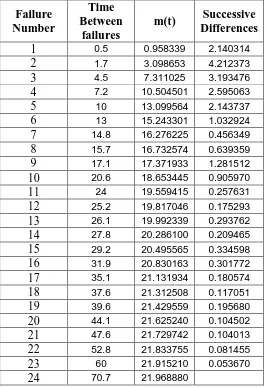
Based on the inter failure data given in Table 2 and 3, we compute the software failures
process through Mean Value Control chart. We used cumulative time between failures data
for software reliability monitoring using Inflection S-shaped model. The use of cumulative
quality is a different and new approach, which is of particular advantage in reliability.
„a‟ and „
b‟ are Maximum Likely hood Estimates of parameters and the values can be
computed using iterative method for the given cumulative time between failures data. Using
„a‟ and „b‟ values we can computem t( ).
Assuming an acceptable probability of false alarm of 0.27%, the control limits can be
obtained as (Xie, 2002):
1
0.99865 1 1 bt bt U e e T
1
0.5 1 1 bt bt C e e T
1
0.00135 11
bt bt L e e T
Impact Factor: 5.515 and 2 . A point below the control limit m t( )L indicates an alarming signal. A point above the control limit m t( )U indicates better quality. If the points are falling within the control limits, it indicates the software process is in stable condition. The values of control limit s are as
follows.
TABLE I. Estimated parameters and control limits
Data Set Parameters Control limits
a B UCL CL LCL
DS1 84.963130 0.039024 84.848429 42.481564 0.114700
DS2 22.000137 0.093427 21.970437 11.000068 0.029700
TABLE II. DS1 - Successive differences of mean value function
Failure Number
Time Between
failures m(t)
Successive Differences
1 5.5 15.775220 4.596044
2 7.33 20.371264 6.358231
3 10.08 26.729496 54.455937
4 80.97 81.185432 0.537410
5 84.91 81.722843 1.432892
6 99.89 83.155735 0.228695
7 103.36 83.384430 0.508112
8 113.32 83.892542 0.384027
9 124.71 84.276569 0.370446
10 144.59 84.647015 0.083036
11 152.4 84.730052 0.101226
12 167 84.831278 0.047378
13 178.41 84.878656 0.044134
14 197.35 84.922790 0.037185
15 262.65 84.959975 0.000005
16 262.69 84.959980 0.003127
17 388.36 84.963107 0.000022
18 471.05 84.963129 0.000000
19 471.51 84.963129 0.000001
20 503.12 84.963130 0.000000
21 632.43 84.963130 0.000000
Impact Factor: 5.515
TABLE III. DS2 - Successive differences of mean value function
Failure Number
Time Between
failures
m(t) Successive Differences
1 0.5 0.958339 2.140314
2 1.7 3.098653 4.212373
3 4.5 7.311025 3.193476
4 7.2 10.504501 2.595063
5 10 13.099564 2.143737
6 13 15.243301 1.032924
7 14.8 16.276225 0.456349
8 15.7 16.732574 0.639359
9 17.1 17.371933 1.281512
10 20.6 18.653445 0.905970
11 24 19.559415 0.257631
12 25.2 19.817046 0.175293
13 26.1 19.992339 0.293762
14 27.8 20.286100 0.209465
15 29.2 20.495565 0.334598
16 31.9 20.830163 0.301772
17 35.1 21.131934 0.180574
18 37.6 21.312508 0.117051
19 39.6 21.429559 0.195680
20 44.1 21.625240 0.104502
21 47.6 21.729742 0.104013
22 52.8 21.833755 0.081455
23 60 21.915210 0.053670
Impact Factor: 5.515
Figure: 1 Failure control chart – DS1
Figure: 2 Failure control chart – DS2
V. CONCLUSION.
A number of estimates of software quality are based on the parameter estimates of SRGMs.
Therefore, the quality estimates can be derived based the quality estimates of parameters.
UCL=84.848429 CL=42.481564 LCL=0.114700 0.000000 0.000001 0.000010 0.000100 0.001000 0.010000 0.100000 1.000000 10.000000 100.000000
1 2 3 4 5 6 7 8 9 10 11 12 13 14 15 16 17 18 19 20 21
Me a n Va lu e Su c c e s s iv e D iff e re n c e s Failure Number
Failure Control Chart
UCL 21.970437
CL 11.000068
LCL 0.029700
0.010000 0.100000 1.000000 10.000000 100.000000
1 2 3 4 5 6 7 8 9 10 11 12 13 14 15 16 17 18 19 20 21 22 23
Me a n Va lu e Su c c e s s iv e D iffe re n c e s Failure Number
Impact Factor: 5.515 Inorder to estimate the Software reliability, a robust method of estimating parameter is
employed on Interval domain software failure data. The results of software reliability over the
two failure data sets with Inflection S-shaped model are presented in table II and Table III.
REFERENCES
[1] Costa, E. O., de Souza, G. A.., Pozo, A. T. R and Vergilio, S. R. (2007). "Exploring
Genetic Programming and Boosting Techniques to Model Software Reliability," IEEE
Transactions on Reliability, vol.56, no. 3, pp. 422-434.
[2] Dai, Y. S. Poh, K. L and Yang, B. (2003). "Optimal Testing-Resource Allocation
with Genetic Algorithm for Modular Software Systems," Journal of Systems and
Software, vol. 66, no. 1, pp. 47-55.
[3] Goel, A. L. (1985). "Software Reliability Models: Assumptions, Limitations, and
Applicability," IEEE Transactions on Software Engineering, vol. 11, no. 12, pp.
1411-1423.
[4] Goldberg, D.E. Genetic Algorithms in Search, Optimization, and Machine Learning,
Addison-Wesley, 1989.
[5] Jiang, H. Y. (2006). "Can the Genetic Algorithm Be a Good Tool for Software
Engineering Searching Problems?," Proceedings of the 30th IEEE International
Computer Software and Applications Conference (COMPSAC 2006), pp. 362-366,
Chicago, USA.
[6] Kapur, P.K., Sunil kumar, K., Prashant, J. Ompal, S. (2009). “Incorporating concept
of two types of imperfect debugging for developing flexible software reliability
growth model in distributed development environment”, Journal of Technology and
Engineering sciences, Vol.1, No.1; Jan-Jun.
[7] Lyu, M. R. Handbook of Software Reliability Engineering, McGraw-Hill, 1996.
[8] M. Harman and B. F. Jones, "Search-Based Software Engineering," Information and
Software Technology, vol. 43, no. 14, pp. 833-839, 2001.
[9] Minohara, T and Tohma, Y. (1995). "Parameter Estimation of Hyper-Geometric
Impact Factor: 5.515 of the 6th IEEE International Symposium on Software Reliability Engineering
(ISSRE 1995), pp. 324-329, Toulouse, France.
[10] Mitchell, M. An Introduction to Genetic Algorithms, The MIT Press, 1998.
[11] Musa, J.D., Iannino, A., Okumoto, k., 1987. “Software Reliability:
Measurement Prediction Application”. McGraw-Hill, New York.
[12] Ohba, M. (1984). "Software Reliability Analysis Models," IBM Journal of
Research and Development, vol. 28, no. 4, pp. 428-443.
[13] Pham. H., 1993. “Software reliability assessment: Imperfect debugging and
multiple failure types in software development”. EG&G-RAAM10737; Idaho
National Engineering Laboratory.
[14] Wood, A. (1996). "Predicting Software Reliability," IEEE Computer, vol. 29,
no. 11, pp. 69-77.
[15] Xie, M., Goh. T.N., Ranjan.P., “Some effective control chart procedures for
reliability monitoring” -Reliability engineering and System Safety 77 143 -150¸ 2002.
Authors Profile:
Dr. R. Satya Prasad received Ph.D. degree in Computer Science in the faculty of Engineering in 2007 from Acharya Nagarjuna University, Andhra Pradesh. He received gold medal from Acharya Nagarjuna University for his outstanding performance in Masters Degree. He is currently working as Associate Professor in the Department of Computer Science & Engineering, Acharya Nagarjuna University. His current research is focused on Software Engineering. He has published 100 papers in National & International Journals.