Oxidative Desulfurization of Sour Gas Condensate and
Optimization of Parameters with Response Surface
Methodology
M. Alibolandi
1, M. Ghaedian
2*, A. Shafeghat
2, S. J. Royaee
2,
J. T. Darian
11Faculty of Chemical Engineering, Tarbiat Modares University, Tehran, Islamic Republic of Iran 2
Petroleum Refining Technology Development Division, Research Institute of Petroleum Industry, Tehran, Islamic Republic of Iran
Received: 14 August 2018 / Revised: 30 April 2019 / Accepted: 14 December 2019
Abstract
Reducing environmental pollution via elimination of sulfur compounds from gas
condensate was the aim of this research. Whereby oxidative desulfurization from gas
condensate with 3200 ppm initial sulfur was accomplished by hydrogen peroxide
(30%wt) as oxidant and formic acid as catalyst. The sulfones after generation in the
oxidation step were extracted through a method of liquid-liquid extraction by acetone as
a polar solvent. The effects of variables: coefficient of oxidant to sulfur molar ratio
(O/S), temperature (T), and coefficient of catalyst to oxidant molar ratio (C/O) were
investigated. The experiments were designed with response surface methodology based
on central composite design (CCD). The results of experiments demonstrated that none
of these variables (O/S, T, and C/O) have any interaction, and among these variables,
O/S plays a significant role with the most influence on desulfurization and C/O and T
are of the second and third primary of importance, respectively. In addition, 86%
desulfurization was obtained in the optimum conditions.
Keywords: Oxidative desulfurization (ODS); Gas condensate; Hydrogen peroxide; Formic acid; CCD.
*
Corresponding author: Tel: +98214825 2124; Fax: +982144739738; Email: [email protected]
Introduction
One of the crucial issues in these days is environmental pollution and the importance of environmental preservation is evident for everyone. A major portion of contaminants is devoted to transition fuels, which the reason is the existence of some harmful ingredients like sulfur and it’s derivations in these fuels.
Combustion fuels such as gasoline and diesel cause generation and emission of sulfur oxides. Whereby numerous consequences will be created, for instance: air
pollution and acid rains, demolition of buildings, poisoning of lakes and distraction of forests in the effect of acid rains. In addition, deactivation of catalysts used in oil refining and petrochemical industry, corrosion of tanks and reactors, etc., all are damages of sulfur compounds in crude oil and its products [1, 2]. Therefore, in different parts of the world, including USA, Europe, Japan, and China, the laws were laid down for allowed limited sulfur in transformation fuels [3].
some of the most important of them are Hydrodesulfurization (HDS), Extraction, Adsorption desulfurization, Biodesulfurization, and Oxidative Desulfurization (ODS) [3-5]. HDS is the most common process in desulfurization which is highly effective for eliminating sulfur components like thiols, sulfides, and disulfides, but this method requires more difficult operating conditions for thiophene and thiophene derivatives because of a structure with double bond [3, 6]. The minimum reactivity is related to dibenzothiophene with methyl groups in 4 and 6 positions. These two are tough sulfur compounds which make deep hydrodesulfurization too hard [7].
ODS process as a main alternative desulfurization method is done in lower temperature and pressure in comparison to HDS and has the ability of oxidation and separation of tough sulfur compounds such as thiophenic compounds and its derivatives that HDS eliminates them slightly [8]. This process includes two parts: converting sulfur to sulfone by oxidation and separation of produced sulfones. In oxidation step, which is mostly done with catalyst, sulfur compounds are oxidized and are converted to sulfones and in next step, these sulfones are separated from fuel by liquid-liquid extraction with a polar solvent because of the increase of their polarity [8]. Other methods such as adsorption and thermal decomposition can be used in sulfone separation from fuel [3, 9].
In the previous researches, different oxidants and catalysts have been used in ODS process [9, 10]. According to the phase of oxidant (liquid or gaseous), reactional systems can be divided into two groups. In the first group with gaseous oxidant, the following researches can be considered; molecular oxygen-FePC(NO2)4 [11], air-MoO3/SiO2 [12], molecular
oxygen-cobalt(ii) acetate-aldehyde [13], air-Tert Butyl hydroperoxide-aldehyde [14], ozone-TiO2-MCM-41
[15], and ozone-Co3O4-γ-AL2O3[16]. For the reactional
systems with liquid phase, some of the common oxidants and catalysts are: hydrogen peroxide-MoO3
-WO3/AL2O3 [1], hydrogen peroxide-acetic acid [17],
hydrogen peroxide-Polyoxometalate [18], hydrogen peroxide-Na2WO4/ZSM5 [19], hydrogen
peroxide-tungstate catalyst [20], Tert Butyl hydroperoxide-Fe–
MoO3/Al2O3 [21] and Tert Butyl
hydroperoxide-Mo/Siral1 [10]. In addition, in some researches, more than one type of oxidant was used in ODS which the usage of hydrogen peroxide with ozone by Zhao et al. [22] and by Behin et al. [23] are examples of that.
During the oxidation, the polarity of sulfur is raised by converting to sulfone. Thereby the created sulfones will have more polarity than hydrocarbon bulk. In the following, these sulfones can be extracted by a solvent or a mixture of solvents, and then the solvent is recovered by distillation. Some of the useful solvents in ODS are Acetone, Methanol, Acetonitrile, Ionic Liquid, N-Methyl-pyrrolidone (NMP) and Dimethylformamide (DMF) [8, 24].
In this study, in order to desulfurization from Sour
gas condensate with 3200 ppm sulfur compound, hydrogen peroxide, formic acid, and acetone were applied as an oxidant, catalyst and polar solvent, respectively. Possessing more active oxygen, high oxidation potential (Table 1), being clean in terms of reaction (water production as a byproduct), having safety in storage and in the oxidation reaction, etc., are the rational reasons for opting hydrogen peroxide as the oxidant [1,26,27,28]. Formic acid and acetone were chosen based on the previous researches which had an appropriate function [17]. The investigation of gas condensate as real fuel was done seldom in literature, and this study with CCD method provides valuable information for ODS.
Materials and Methods
MaterialsSour gas condensate was provided from gas refinery of Iran South Pars. Hydrogen peroxide (30%wt), formic acid and acetone purchased from Merck Company were used as oxidant agent, catalyst and the extraction solvent, respectively.
Analysis
The sulfur content of feed and product were measured by Analytik Jena EA 5000 equipment that follows ASTM D5453 standard.
Oxidative desulfurization method
For the reaction of hydrogen peroxide with sulfur compound and converting sulfur to sulfone, for
one-Table 1.Oxidation potential of some of the common oxidant’s in ODS process [22, 25] Oxidant Oxidation Potential (V)
Hydroxyl radical 2.86 Oxygen atom 2.42
Ozone 2.07
mole sulfur, two-moles hydrogen peroxide is required. Also, for each mole hydrogen peroxide, one-mole formic acid is needed [8, 29]. Mechanism of reaction is according to the following [3, 29]:
At first in the reaction between hydrogen peroxide and formic acid, peroxy acid and water (byproduct) are produced (Eq.1)
Then in the reaction of peroxy acid and sulfur compounds, sulfoxide is produced and peroxy acid is returned to formic acid (Eq.2)
Finally, sulfoxide is converted to the sulfone by another peroxy acid molecule (Eq.3)
H O + CH O → CH O + H O (1)
CH O + RS → RSO + CH O (2)
CH O + RSO → RSO + CH O (3)
For experimenting, after weighing and pouring the feed in a glass reactor, oxidant and catalyst were determined. In the following, formic acid was introduced into the reactor. Then with adding hydrogen peroxide to the feed, the stirring started, and the reaction was begun. The temperature of reaction was provided using a warm bath. A -15◦C condenser was joined to
the reactor for condensing and returning light component vapored. After elapsing reaction time by turning off the stirrer, the reactants became two phases. After organic phase separation (gas condensate containing sulfone), extraction with acetone was done. To complete sulfone extraction from the feed, two times extraction was done and in any step, volume ratio of solvent to feed was 2:1. Eventually, for separation of remaining acetone from the feed, water wash was done.
Experimental design
Response Surface Methodology, which was introduced by Box and Wilson for the first time, is a statistical and mathematical collection used for development, improvement, and optimization of processes that the desired response is influenced by some variables. The aim of this methodology is describing the correlation between response and independent variables by mathematical model and response optimization. This method specifies the impact of independent variables on process individually or in the combination of other variables [30, 31]. In this research for the design of experiments, Central Composite Design (CCD) method was used. Effective variables after the selection were normalized and each of the coded variables is in range of -1 to +1 and Factorial Points with -1 and +1, Central Point with 0
and Axial Points with +α and -α are identified.
Statistical software makes optimal layouts according to
the special criteria which the user considers. After scheme selection, model correlation and its coefficients are estimated. In Response Surface Methodology, the used model generally is a second order equation as follows [31, 32].
Ym= β0+ ∑ β x + ∑ β x + ∑ β x x +ε (4)
Where, Ym, xi, k, andε represent predicted response,
independent variables, the number of independent variables and residual value, respectively [31].
Due to the literature review, effective variables in this system are oxidant to sulfur molar ratio (O/S), catalyst to oxidant molar ratio (C/O) and temperature (T) according to Celsius [3,17,33].
Base on the oxidation of sulfur with hydrogen peroxide reaction equation, for oxidizing each mole of a sulfur component to the corresponding sulfone, two-moles of hydrogen peroxide are required (Eqs 1, 2 and 3). But oxidant consumption raises because of other components in the real fuel (such as nitrogen, aromatics etc.) and oxidant is in competitive reactions for oxidizing of the sulfur component or other non-sulfur
components [7, 8, 34]. That’s why this parameter was
investigated in the range of 1 to 3 times the stoichiometric coefficient [17].
In the reaction between formic acid and hydrogen peroxide (Eq. 1), for each mole of hydrogen peroxide, one-mole formic acid is required. This acidic catalyst in reaction with oxidant gets one oxygen atom and changes to peroxy acid. Then generated peroxy acid in the reaction with a sulfur component losses its oxygen atom and with converting sulfur to the sulfoxide, returns to the initial catalyst (Eq 2 and 3). Amounts in the range of 0.5 to 2 times the stoichiometry coefficient were used in these experiments [3, 17]. In this system, another effective parameter was the temperature which its effects in the range of 40◦C to 70 ◦C was investigated.
The upper line of this limitation was selected based on light components evaporation in feed and hydrogen peroxide decomposition [3, 17, 28]. All the experiments were done in 45 minutes. This time was selected as the best time according to the initial tests and the presented results by Ghaedian et al. [17].
The number of experiments can be calculated according to Eq. (5):
N = 2 + 2k + C (5)
Where k is the number of independent variables, and Cpis the number of repetitions in central point [30].
Design of experiment was done by Design Expert7
software and α2 was chosen 1.41. Table 2 represent
2
different levels of operational variables.
The number of independent variables and repetitions in central point were 3 and 4, respectively. Therefore, the number of experiments became 18 (Eq 5).
Results and Discussion
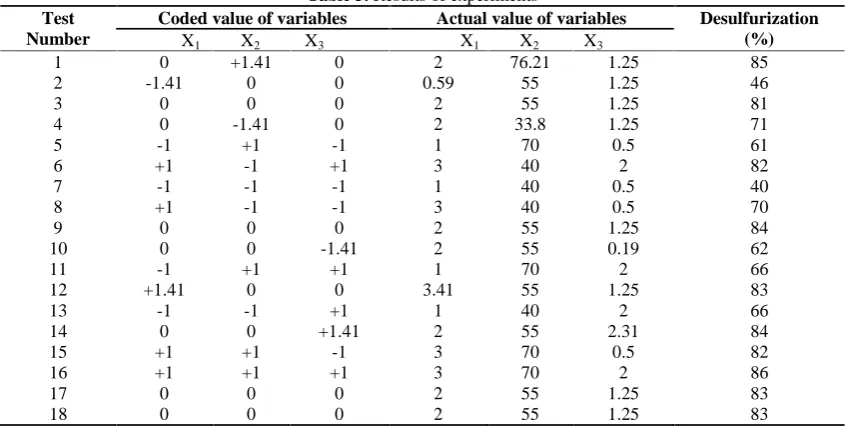
Table 3. presents the results of experiments, and in this table X1, X2, and X3 are coefficient of oxidant to
sulfur molar ratio, temperature, and coefficient of catalyst to oxidant molar ratio.
For presenting a statistical model based on experimental results (Table 3) and Analysis of variance, due to the three reasons, the use of transformation functions are needed:
Stabilizing of response Variance
Getting close the response distribution to the normal distribution
Improving the fitting experimental data [32] For these reasons, power function with lambda 1.79 (that it was the best lambda in Box-Cox Curve Figure 1) was selected for response transforming. Figure 2 is Studentized Residuals vs. Normal Probability, and Figure 3 is Studentized Residuals vs. Predicted. Table 4 shows the effect of power transformation function on some important parameters.
Figure 2, which is a Normal plot of Residuals, must be liner. This figure has been converted from S shape (2-B) to normal liner state (2-A) by the use of power transformation function [32]. In general, Figure 3, which is Studentized Residuals vs. Predicted, must be in funnel [32] that the use of power transformation function has helped it to be in this shape (3-A in comparison whit 3-B). According to Table 4, amounts of R2, Radj2, and Rpred2 rose because of power
transformation function and also the parameter of Lack of Fit significantly increased.
Based on the experimental results (Table 3), a quadratic model was presented for predicting Y response (%Desulfurization) according to operating variables. After removing some of the inefficient variables with a backward method, the modified statistical model and the modified analysis of variance table were obtained like following.
Y . = 2679.94 + 569.34 + 236.13 +
321.01 − 156.53 − 392.95 − 85.18 −
210.99 (6)
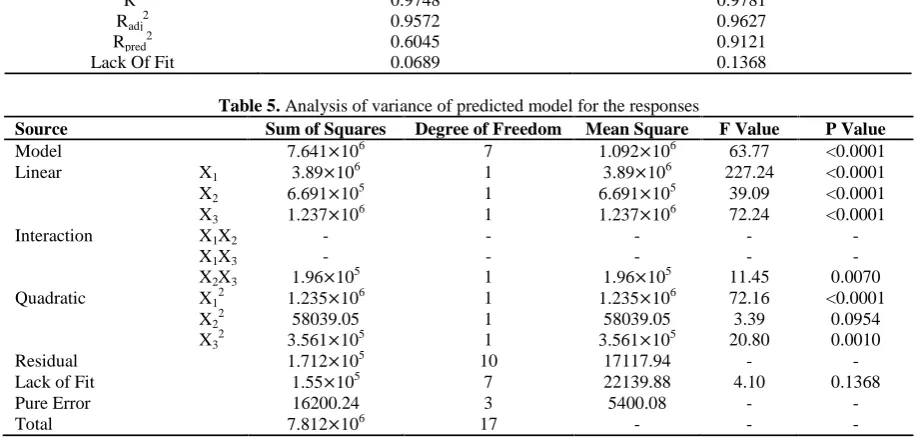
Analysis of variance (ANOVA) for the above statistical model is in Table 5 which confirms the statistical model with high signification.
Table 2. The level of variables in CCD Parameters Low axial
(-α)
Low factorial (-1)
Center point (0)
High factorial (+1)
High axial (+α)
X1, O/S 0.58 1 2 3 3.41
X2, T 33.8 40 55 70 76.2
X3, C/O 0.19 0.5 1.25 2 2.31
Table 3. Results of experiments Test
Number
Coded value of variables Actual value of variables Desulfurization (%)
X1 X2 X3 X1 X2 X3
1 0 +1.41 0 2 76.21 1.25 85
2 -1.41 0 0 0.59 55 1.25 46
3 0 0 0 2 55 1.25 81
4 0 -1.41 0 2 33.8 1.25 71
5 -1 +1 -1 1 70 0.5 61
6 +1 -1 +1 3 40 2 82
7 -1 -1 -1 1 40 0.5 40
8 +1 -1 -1 3 40 0.5 70
9 0 0 0 2 55 1.25 84
10 0 0 -1.41 2 55 0.19 62
11 -1 +1 +1 1 70 2 66
12 +1.41 0 0 3.41 55 1.25 83
13 -1 -1 +1 1 40 2 66
14 0 0 +1.41 2 55 2.31 84
15 +1 +1 -1 3 70 0.5 82
16 +1 +1 +1 3 70 2 86
17 0 0 0 2 55 1.25 83
Verification Curve is used for confirming the statistical model (Fig. 4). This figure compares the amount of experimental desulfurization with the predicted desulfurization in the statistical model. If the points are randomly scattered along the 45 degrees line, the prediction is closer to experimental results. Groups
of points above or under the line show areas of over or under prediction [32]. Figure 4 indicates an acceptable fitting of experimental results.
According to Table 5, highly significant of the represented model, not significant of lack of fit, R2 =
0.9762, Radj 2
= 0.9595, Rpred 2
= 0.9048 and verification
Figure 1. Box-Cox Plot for Power Transforms
Figure 2. Normal Probability Vs Studentized Residuals, with power transformation function (A) and without this function (B)
curve, they all confirm the represented model.
Effect of the coefficient of oxidant to sulfur molar ratio
Figure 5 indicates the result of coefficient of O/S molar ratio on desulfurization in the range of 1 to 3 while C/O = 1.25 and T = 55◦C. This figure shows that
desulfurization was 64.2% at the beginning of the range and with the increase of O/S molar ratio, the desulfurization raised. After reaching to the maximum of desulfurization (85.7%) in O/S = 2.71, with the raising in O/S molar ratio by O/S=3, desulfurization decreased nominally and approached to 85.2%. This
variable in the high concentration has a lower impact on desulfurization, like the results presented by Li et al. [26]. The reason for this event is that H2O2in the high
concentration is between two competitive reactions; sulfur oxidation and decomposition of oxidant. Therefore some of H2O2 is decomposed and does not
participate in oxidation reaction [26]. On the other hand, at higher concentrations, the concentration of water will increase, and this phenomenon leads to the decline of desulfurization [27].
Effect of temperature
The temperature is the other effective variable in
Table 4. Effect of power transformation function on R2, Radj 2
, Rpred 2
and Lack of Fit
Without transformation function With transformation function
R2 0.9748 0.9781
Radj2 0.9572 0.9627
Rpred 2
0.6045 0.9121
Lack Of Fit 0.0689 0.1368
Table 5. Analysis of variance of predicted model for the responses
Source Sum of Squares Degree of Freedom Mean Square F Value P Value
Model 7.641×10⁶ 7 1.092×10⁶ 63.77 <0.0001 Linear X1 3.89×10⁶ 1 3.89×10⁶ 227.24 <0.0001
X2 6.691×10⁵ 1 6.691×10⁵ 39.09 <0.0001
X3 1.237×10⁶ 1 1.237×10⁶ 72.24 <0.0001
Interaction X1X2 - - - -
-X1X3 - - - -
-X2X3 1.96×10⁵ 1 1.96×10⁵ 11.45 0.0070
Quadratic X12 1.235×10⁶ 1 1.235×10⁶ 72.16 <0.0001
X2 2
58039.05 1 58039.05 3.39 0.0954 X32 3.561×10⁵ 1 3.561×10⁵ 20.80 0.0010
Residual 1.712×10⁵ 10 17117.94 -
-Lack of Fit 1.55×10⁵ 7 22139.88 4.10 0.1368
Pure Error 16200.24 3 5400.08 -
-Total 7.812×10⁶ 17 - -
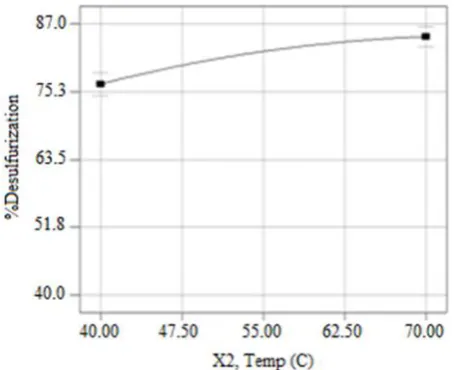
ODS and its influence is shown in Figure 6. Two other variables in this figure are at the central levels (O/S=2 and C/O=1.25). In T=40◦C desulfurization was 76.6%
and raised to 84.8% in T=70 ◦C. The rise of 8% in
desulfurization from the beginning by the end of the investigated temperature, shows this parameter has the lowest impact on desulfurization in comparison to effects of molar ratios of O/S and C/O. This factor plays a positive role in the enhancement of the rate of oxidation reaction and these results are confirmed by consequences of Imtiaz’s et al. [1, 29, 35].
As it is shown in Figure 6, the slope of the desulfurization curve is decreased by the rise of temperature and goes toward zero. This reduction is because of hydrogen peroxide decomposition with the rise of temperature which occurs in reaction media. The rate of hydrogen peroxide decomposition climbs after
50 ◦C [28]. For preventing the increase in hydrogen
peroxide consumption in reaction, doing the reaction must be avoided in the temperatures over 50◦C [28].
Effect of the coefficient of catalyst to oxidant molar ratio
According to the analysis of variance (Table 5), the latest effective variable is the coefficient of molar C/O ratio. Figure 7 indicates the growth of desulfurization with C/O raising (two other variables are in central level O/S=2 and T=55◦C). Although the increase of C/O has
a positive influence on the desulfurization, C/O raising is accompanied by figure's slope reduction and this slope has become zero from C/O=1.75 to C/O=2. This is an indication of the ineffectiveness of C/O raise after 1.25 on desulfurization. This amount is more than the stoichiometric ratio for the reaction of formic acid with
Figure 5. Effect of coefficient of oxidant to sulfur molar ratio on desulfurization
hydrogen peroxide and is justifiable based on the being an incomplete reaction. Another reason for oxidant and catalyst consumption more than their stoichiometric coefficient is that some of the oxidant and catalyst are used for oxidation of non-sulfur component in feed [7, 8, 34].
Interaction of coefficient of catalyst to oxidant molar ratio and temperature on desulfurization
According to the analysis of variance for variables interaction (O/S-C/O, O/S-T, and C/O-T), just C/O-T affects desulfurization; therefore just this interaction was investigated.
Figure 8 shows the simultaneous effects of temperature and coefficient of catalyst to oxidant molar ratio on desulfurization in the form of contour and 3-D figures. In these figures, oxidant to sulfur molar ratio is at the central level (O/S=2). Based on the contour figure, when X2is low, the growth of X3in the range of
0.5 to 2 continually increases the desulfurization by about 17%. In the amounts more than 47.5 for X2and
while X2is constant, the rise of X3has a dual effect on
the response. At the first X3 raises desulfurization and
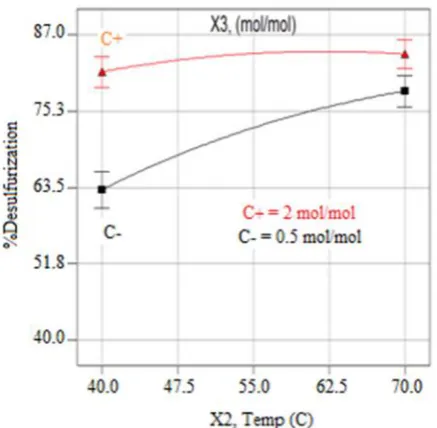
then decreases it. But this reduction is insignificant. Consequently, because in all constant amounts for each variable, the rise of other variable grows desulfurization, these two variables in the mentioned ranges don't have interaction with each other. Likewise, Figure 9 confirms the lack of interaction in these two variables, because of failure in collide of two lines with each together.
Also based on Figure 8, in 40◦C, raising C/O ratio
has a significant effect on desulfurization but in 70◦C
with increasing C/O ratio, desulfurization is increased by lower intensity. With the growth of temperature, hydrogen peroxide decomposition increases and as a result, the oxidant concentration decreases in reaction media and peroxy acid generation declines [36]. Also
Figure 7. Effect of coefficient of catalyst to oxidant molar ratio on desulfurization
generated peroxy acid is unstable in high temperature, and decomposition of some of the peroxy acids in 70◦C
contributes to decreasing the impact of C/O ratio raising on desulfurization [28].
Optimization of parameters
The optimization of parameters was done with the aim of maximum desulfurization. The optimized conditions are represented in Table 6.
To validation of predicted response by the statistical model, 95% confident interval was presented for this response, which the lower limit of this range is 84.72% and the upper limit is 89.06% desulfurization. After experimenting in the optimized conditions, 86% desulfurization was obtained (reduction of the sulfur component in gas condensate from 3200 ppm to 450 ppm) which is in the 95% confident interval.
In addition, after the oxidation and separation of the organic phase and aqueous phase, the sulfur of the oxidized feed (without any extraction with solvent) was measured and observed that 672 ppm sulfur component exists in the product after oxidation and before extraction. The comparison of this amount with the final sample which after oxidation and extraction, its desulfurization was 86%, indicates 79% of desulfurization is related to oxidation and separation of the organic and the aqueous phase and 7% remaining desulfurization is sulfone extraction with the solvent. As it is mentioned in literature [3], the oxidation reaction is
done in the aqueous phase and interface of organic and aqueous phase [29].
Therefore, the generated sulfones are at the interface that during the separation of two phases in this experiment, 79% of generated sulfones were separated from gas condensate along with the aqueous phase.
Conclusions
In this study, oxidative desulfurization of gas condensate was done with hydrogen peroxide (30%wt) as an oxidant and formic acid as a catalyst and the following results were obtained:
1. Effective variables in this system were oxidant to sulfur molar ratio, temperature and catalyst to oxidant molar ratio which the maximum desulfurization (86%) was obtained in O/S=2.65, T=50◦C,and C/O=1.87.
2. Statistical design of experiments was done by CCD method and analysis of results showed there is no significant interaction between operational variables. Although based on the Table 5 temperature and coefficient of catalyst to oxidant molar ratio have interaction, this interaction is negligible and can be ignored. Therefore the lack of interaction in this system is valid.
3. In this study, 86% desulfurization was achieved, which 79% of this desulfurization could be done just with the oxidation step and without extraction by the solvent.
Figure 9. Interaction of coefficient of catalyst to oxidant molar ratio and temperature on desulfurization
Table 6. Optimized conditions for desulfurization Molar ratio
O/S
Temperature (◦C)
Molar ratio C/O
Desulfurization (%)
desirability
References
1. Shen Y., Lu X., Ma X., He J., Zhang D., Zhan H. and Xia Q. Oxidative Desulfurization of Thiophene Derivatives with H2O2 in the Presence of Catalysts Based on MoO3/Al2O3 under Mild Conditions. Kinet. Catal. 58(1): 28-33 (2017).
2. Safa M. A., Majren R. A., Shamary T. A., Park J. and Ma X. Removal of sulfone compounds formed in oxidative desulfurization of middle distillate. Fuel. 194: 123-128 (2017).
3. Ismagilov Z., Yashnik S., Kerzhentsev M., Parmon V., Bourane A., Shahrani F. M. A., Hajji A. A. and Koseoglu O. R. Oxidative Desulfurization of Hydrocarbon Fuels. CATAL. REV.53(3): 199-255(2011).
4. Boshagh F., Mokhtarani B. and Mortaheb H. R. Effect of electrokinetics on biodesulfurization of the model oil byRhodococcus erythropolis PTCC1767 and Bacillus subtilis DSMZ 3256. Hazard. Mater. 280: 781–787 (2014).
5. Farzin Nejad N., Shams E., Adibi M., Miran Beigi A. A. and Torkestani S. K. Desulfurization From Model of Gasoline by Extraction With Synthesized [BF4]
-and [PF6]
-based Ionic Liquids. Pet. Sci. Technol. 30(15): 1619-1628 (2012).
6. Zarrabi M., Entezari M. H. and Goharshadi E. K. Photocatalytic oxidative desulfurization of dibenzothiophene by C/TiO2@MCM-41 nanoparticles under visible light and mild conditions. RSC Advances.
5(44): 4652–34662 (2015).
7. Qian E. W. Development of Novel Nonhydrogenation Desulfurization Process _Oxidative Desulfurization of Distillate. J. Jpn. Petrol. Inst. 51(1): 14-31(2008). 8. Campos-Martin J.M., Capel-Sanchez M.C., Perez-Presas
P. and Fierro J.L.G. Oxidative processes of desulfurization of liquid Fuels.J. Chem. Technol. Biotechnol., 85(7):
879-890(2010).
9. Pysh’yev S. Application of non-catalytic oxidative desulphurization process for obtaining diesel fuels with improved lubricity. Chem. Chem. Technol. 6(2): 229-235 (2012).
10. Prasad V.V.D.N., Jeong K. E., Chae H. J., Kim C. U. and Jeong S. Y. Oxidative desulfurization of 4,6-dimethyl dibenzothiophene and light cycle oil over supported molybdenum oxide catalysts. Catal. Commun. 9(10): 1966-1969 (2008).
11. Zhou X., Li J., Wang X., Jin K. and Ma W. Oxidative desulfurization of dibenzothiophene based on molecular oxygen and iron phthalocyanine.Fuel Process. Technol.,
90(2): 317-323 (2009).
12. Sundararaman R. and Song C. Catalytic Oxidative Desulfurization of Diesel Fuels Using Air in a Two-Step Approach. Ind. Eng. Chem. Res. 53(5): 1890-1899 (2014). 13. Dumont V., Oliviero L., Mauge´ F. and Houalla M. Oxidation of dibenzothiophene by a metal–oxygen–
aldehyde system. Catal. Today. 130(1): 195-198 (2008). 14. Guo W., Wang C., Lin P. and Lu X. Oxidative
desulfurization of diesel with TBHP/isobutyl aldehyde/air oxidation system. Appl. Energy. 88(1): 175-179 (2011). 15. Ma C., Dai B., Liu P., Zhou N., Shi A., Ban L. and Chen
H. Deep oxidative desulfurization of model fuel using ozone generated by dielectric barrier discharge plasma
combined with ionic liquid extraction. J. Ind. Eng. Chem.
20(5): 2769-2774 (2014).
16. Ma C., Chen D., Liu F., Sun X., Xiao F. and Dai B. Oxidative desulfurization of a model fuel using ozone oxidation generated by dielectric barrier discharge plasma combined with Co3O4/g-Al2O3 catalysis. RSC Advances.
5(117): 96945-96952 (2015).
17. Ghaedian M., Bazmi M., Shafeghat A., Mohammadi A. K., Rabiei Z. and Naderi F. An investigation on oxidative desulfurization of gas condensate. Pet. Coal. 55(4): 361-365 (2013).
18. Trakarnpruk W. and Rujiraworawut K. Oxidative desulfurization of Gas oil by polyoxometalates catalysts.
Fuel Process. Technol.90(3): 411-414 (2009).
19. Moradi G. R., Rafiee E., Sahraei S. and Jabari A. Deep Oxidative Desulfurization of Thiophenic Model Oil/Natural Gas Condensate Over Tungsten/Molybdenum Oxides Using H2O2as Oxidant. ZAAC. 642(7): 566-571
(2016).
20.Karimi B. and Khorasani M. Selectivity Adjustment of SBA-15 Based Tungstate Catalyst in Oxidation of Sulfides by Incorporating a Hydrophobic Organic Group inside the Mesochannels. ACS Catal. 3(7): 1657-1664 (2013). 21. Wan Abdullah W. N., Wan Abu Bakar W. A., Ali R. and
Embong Z. Oxidative desulfurization of commercial diesel catalyzed by tert-butyl hydroperoxide polymolybdate on alumina: optimization by Box-Behnken design.
Clean. Technol. Envir.17(2): 433-441 (2015).
22. Wang J., Zhao D. and Li K. Oxidative Desulfurization of Dibenzothiophene Using Ozone and Hydrogen Peroxide in Ionic Liquid. Energy Fuels. 24(4): 2527-2529 (2010). 23. Behin J. and Farhadian N. Multi-objective optimization of
oxidative desulfurization in a sono-photochemical airlift reactor. Ultrason. Sonochem. 38: 50-61 (2017).
24.Betiha M. A., Rabie A. M., Ahmed H. S., Abdelrahman A. A. and Shahat M. F. E. Oxidative desulfurization using graphene and its composites for fuel containing thiophene and its derivatives: An update review. Egypt. J. Pet. (2017).
25. Wang L. K., Hung Y. T., Lo H. H. and Yapijakis C. Handbook of Industrial and Hazardous Wastes Treatment. Marcel Dekker, Inc., New York, 1489 p. (2006).
26. Wang Y., Li G., Wang X. and Jin C. Oxidative Desulphurization of 4,6-Dimethyldibenzothiophene with Hydrogen Peroxide over Ti-HMS. Energy Fuels. 21(3): 1415-1419 (2007).
27. Banisharif F., Dehghani M. R. and Campos-Martin J. M. Oxidative desulfurization of diesel using vanadiumsubstituted dawson-type emulsion catalysts.
Energy Fuels. 31(5): 5419-5427 (2017).
28. Akbari A., Omidkhah M. R. and Towfighi Darian J. Optimization of operating conditions in oxidation of dibenzothiophene in the light hydrocarbon model. Chem.
Ind. Chem. Eng. Q. 20(3): 315-323 (2014).
29. Imtiaz A., Waqas A. and Muhammad I. Desulfurization of liquid fuels using air-assisted performic acid oxidation and emulsion catalyst. Chinese J. Catal. 34(10): 1839-1847 (2013).
Talanta. 76(5): 965-977 (2008).
31. Mäkelä M. Experimental design and response surface methodology in energy applications: A tutorial review. Energy Convers. Manage. 151: 630-640 (2017).
32. Montgomery D. C. Design and analysis of experiments. John Wiley & Sons, Inc., United States, 659 p. (2005). 33. Safa M. A. and Ma X. Oxidation kinetics of
dibenzothiophenes using cumene hydroperoxide as an oxidant over MoO3/Al2O3 catalyst. Fuel. 171: 238-246
(2016).
34. Sundararaman R., Ma X. and Song C. Oxidative Desulfurization of Jet and Diesel Fuels Using
Hydroperoxide Generated in Situ by Catalytic Air Oxidation. Ind. Eng. Chem. Res. 49(12): 5561-5568 (2010).
35. Tang N., Zhao X., Jiang Z. and Li C. Oxidation of dibenzothiophene using oxygen and a vanadophosphate catalyst for ultra-deep desulfurization of diesels. Chinese
J. Catal. 35(9): 1433-1437 (2014).
36. Zhang W., Xiao J., Wang X., Miao G., Ye F. and Li Z. Oxidative Desulfurization Using in Situ-Generated Peroxides in Diesel by Light Irradiation. Chem. Eng. J.
![Table 1. Oxidation potential of some of the common oxidant’s in ODS process [22, 25]](https://thumb-us.123doks.com/thumbv2/123dok_us/13515.2001267/2.595.162.437.110.177/table-oxidation-potential-common-oxidant-s-ods-process.webp)