6
II
February 2018
M. Tech Research Scholar, Department of Structural Engineering, Merchant Institute of Technology, Piludara, Mehsana, Gujarat – 384380, India
2
Assistant Professor, Department of Civil Engineering, Government Engineering College, Katpur, Patan, Gujarat – 384265, India
Abstract: Concrete is widely used in construction due to structural stability and strength. Concrete containing mineral admixture such as silica fume, GGBS, fly ash, copper slag etc. Among all mineral admixture silica fume given best performance in mechanical and durability properties of concrete. Fibers produced as a by-product from industrial processes. Addition of fibers acts as "secondary reinforcement" in concrete. Silica fume is used as cement replacement material at specific percentage by weight of cement it enhance the effectiveness of added fibers on the properties of concrete. Addition of these fibers into concrete mass can dramatically increases the mechanical and durability properties of concrete. This paper presents the effect of partial replacement of silica fume with fibers had also positive effect on the performance of concrete.
Keywords: Cement, Silica fume, Steel fiber, Polypropylene fiber, Mechanical properties, Durability properties
I. INTRODUCTION
Concrete is the artificial stone, which is mainly made up of cement, fine aggregate, coarse aggregate and water.Concrete is the most widely used construction material in India with annual consumption exceeding 100 million cubic meter. Conventional concrete possesses low tensile strength, poor resistance and low ductility. Now a day, various investigations and study has been presently going on to prepare a durable concrete by the addition of different types of materials in concrete.
The inclusion of mineral admixture such as silica fume, GGBS, fly ash, copper slag etc. Silica fume is ultrafine powder collected as a by-product of the silicon and ferrosilicon. Silica fume is highly reactive pozzolanic material, used in relatively small amounts to produce high strength concrete.
Number of researchers have shown the effectiveness of using fibrous materials to improve the properties of a concrete. The development of fiber reinforced concrete establish a notable revolution in their modern technology. Many researchers has been extensively investigate using single type of fiber as reinforcement in a concrete. However, single type of fiber improves the properties of concrete in a limited range. On the contrary composite fiber reinforced concrete consist of two or more different types of fibers are mixed in a common matrix.
Many fiber have used in concrete and widely available for commercial application such as asbestos, carbon, glass, metallic, polypropylene etc. In which steel fiber have an excellent ductility, toughness, durability as compared to other fibers.
Polypropylene fibers are also compatible with all concrete and possesses the low modulus of elasticity, lower fire resistance, resistance to acids. Polypropylene fiber used as small amount in fiber reinforced concrete which is decrease the unit weight of concrete and improve the crack prevention. In this paper the effect of partial replacement of silica fume with composite fiber. The literature being reviewed is given under.
II. LITERATUREREVIEW
Fig. 1. Compressive strength versus different design mixes (P. Vinothini, 2016)
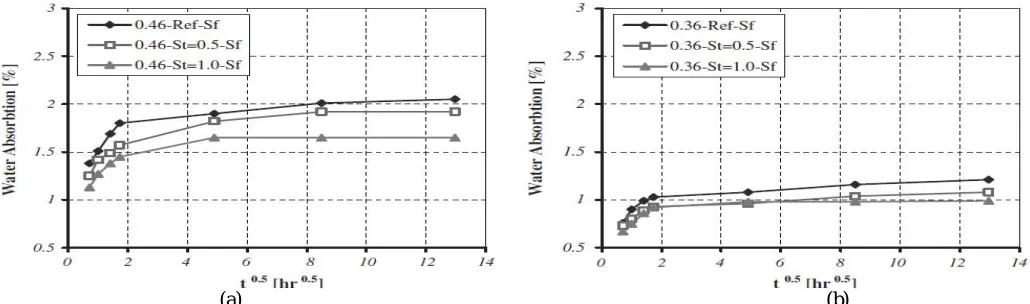
B. [2] Mahmoud Nili, Vahid Afroughsabet, 2011 investigated “Property assessment of steel fiber reinforced concrete made with silica fume.”A parametric study was conducted to investigate when silica fume was used as a cement replacement, it enhanced the effectiveness of added steel fiber on the properties of concrete. It was concluded that the inclusion of steel fiber in silica fume specimens led to the highest long-term compressive strength and the lowest resistivity. Investigated an improvement in the dynamic frequency and a decrease in water absorption were attained in 1% steel fiber silica fume combination. It was further found that Incorporation of 1.0% steel fiber and silica fume in the mixtures led to a decrease in the water absorption.
[image:3.612.78.542.318.502.2](a) (b)
Fig.2. Compressive strength versus fiber volume fractions with the silica fume (a) 0.36 water/cement ratio (b) 0.46 water/cement ratio (Mahmoud and Vahid, 2011,a,b)
(a) (b)
[image:3.612.57.572.550.702.2]strength of high-strength concrete in comparison with that of MP fibers. It was concluded that the optimum percentage of composite fibers is obtained as consisting of 0.9% MP fibers and 0.1% PP fibers, which gives 18% improvement in the tensile strength in relation to the plain concrete. It was further found that concrete containing the combination of 0.2% PP fibers and 10% silica fume gives the lowest water absorption.
(a) (b)
Fig: 4. Splitting tensile strength for (a) Concrete containing silica fume (b) Fiber reinforced concrete containing silica fume (Saber and Mahdi, 2017, a, b)
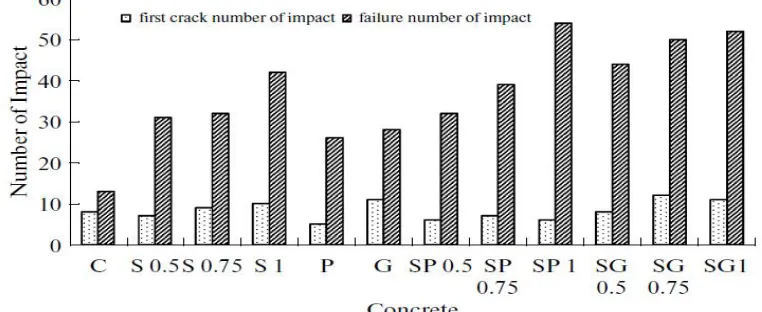
D.[4] Mahmoud Nili, V. Afroughsabet, 2009 investigated “The effects of silica fume and polypropylene fibers on the impact resistance and mechanical properties of concrete.” It was shows that adding fiber to concrete increases the energy absorption capacity of concrete and provides a more ductile structure. It was concluded that increase of polypropylene fiber in the mixtures from 0.2% to 0.5%, generally increased the compressive strength. They was also investigated that an increased in compressive strength up to 30% at the age of 91 days. It was concluded that Splitting tensile and flexural strength of 0.5% polypropylene fiber and 8% silica fume concrete was enhanced 21 considerably.
(a) (b)
Fig. 5. (a) Average flexural tensile strength versus different volume fraction of fiber content (b)Relationship between flexural and splitting tensile strength for fiber reinforced UHPC (Piotr, Danuta, 2017, a,b)
F. [6] Somasekharaiah, Mahesh Sajjan, Vinay Kumar , Syed Shah, 2016 investigated “Experimental investigation on strength characteristics of composite fibre high-performance concrete with combination of three mineral admixtures.” Based on investigation using 15% of mineral admixture, there is an increase of compressive strength by 7.86% when compared to plains HPC mix. It was found that 22.5% mineral admixture there is a decrease in flexural strength by 2.08% when compared with plain HPC mix. They was also concluded that maximum cement can be replaced by 15% (5% each mineral admixture) to achieve maximum compressive strength, split tensile strength & flexural strength for 7 and 28 days.
G. [7] Prasanya, Vignesh, Gurulakshmi, Boomapriya, 2016 investigated “Effects of fiber and silica fume characteristics on mechanical properties of high strength concrete.”It was observed that cement replacement by silica fume the compressive strength is increased as the percentage of silica fume and polypropylene fiber is increased. It was concluded that the optimum percentage of silica fume replacement with cement is 10% and the addition of polypropylene fiber is 0.1%. A parametric study was conducted to investigate the Rebound hammer test results and UPV test results are nearby equal to the compressive strength test result while testing under CTM.
[image:5.612.52.569.73.249.2] [image:5.612.116.497.562.718.2]K2O - 0.15-1.02
CaO 63.95 -
C3S 51.46 -
C2S 22.00 -
C3A 6.42 -
C4AF 10.35 -
Physical properties
Specific gravity 3.1 2.21
[image:6.612.82.528.104.563.2]Specific surface (cm2/gr) 3000 14000
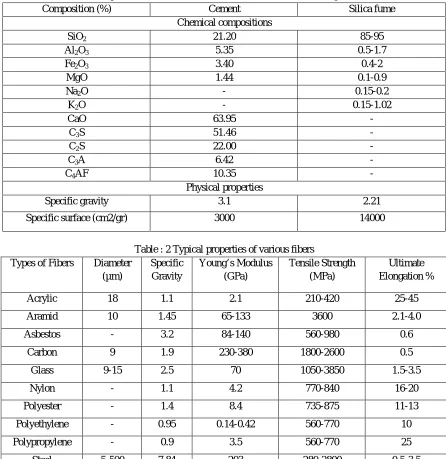
Table : 2 Typical properties of various fibers Types of Fibers Diameter
(µm) Specific Gravity Young’s Modulus (GPa) Tensile Strength (MPa) Ultimate Elongation %
Acrylic 18 1.1 2.1 210-420 25-45
Aramid 10 1.45 65-133 3600 2.1-4.0
Asbestos - 3.2 84-140 560-980 0.6
Carbon 9 1.9 230-380 1800-2600 0.5
Glass 9-15 2.5 70 1050-3850 1.5-3.5
Nylon - 1.1 4.2 770-840 16-20
Polyester - 1.4 8.4 735-875 11-13
Polyethylene - 0.95 0.14-0.42 560-770 10
Polypropylene - 0.9 3.5 560-770 25
Steel 5-500 7.84 203 280-2800 0.5-3.5
IV.CONCLUSION
A. From the various researches it is observed that the partial replacement of silica fume with composite fiber have significant effect on mechanical and durability properties of concrete.
B. It was concluded that maximum cement can be replaced by 15% to achieve maximum compressive strength, split tensile strength & flexural strength at 7 and 28 days.
C. Silica fume is ultrafine powder which is fill up the micro pores, voids of cementitious composites matrix enhance the properties of hardened concrete.
D. It was observed that partial replacement of cement with mineral admixture like silica fume in concrete mixes would lead to considerable savings in consumption of cement and gainful utilization of silica fume.
F. It is reported that an increase in the fiber content of both steel and polypropylene fiber reinforced concrete results in enhancements in mechanical and durability properties of the concrete.
G. The addition of steel fiber in concrete it was shown a significant improvement in split tensile strength, flexural strength and overall toughness compared to conventional reinforced concrete.
H. It was noticed that low volume fractions of Polypropylene fiber have a greater influence on the compressive strength of high-strength concrete as compared to conventional concrete.
I. It was observed that the workability of concrete is decrease with increase the content of different fibers in common matrix. J. A parametric study was shown that the use of silica fume with composite steel and polypropylene fibers in concrete results in a
significant decrease in the water absorption of concrete.
REFERENCES
[1] P. Vinothini, "Experimental investigation of high strength concrete using industrial byproduct and fibers," International Conference on current Research in Engineering Science and Tehnology, pp. 64-69, 2016.
[2] M. Nili and V. Afoughsabet, "Property assessment of steel fiber reinforced concrete made with silica fume," Construction and Building Materials Elsevier, vol. 28, no. 1, pp. 664-669, March 2012.
[3] S. Fallah and M. Nematzadeh, "Mechanical properties and durability of high-strength concrete containing macro-polymeric and polypropylene fibers with nano-silica and nano-silica fume," Construction and Building Materials Elsevier, vol. 132, no. 1, pp. 170-187, November 2017.
[4] M. Nili and V. Afroughsabet, "The effects of silica fume and polypropylene fibers on the impact resistance and mechanical properties of concrete," Construction and Building Materials Elsevier, vol. 24, no. 6, pp. 927-933, June 2010.
[5] S. Piotr and D. Hunek, "Property assessment of hybrid fiber reinforced ultra-high-performance concrete," International Journal of Civil Engineering Springer, pp. 1-14, 16 February 2017.
[6] H. M. Somasekharaiah, M. Sajjan, M. R. Vinay and F. H. Syed Shah, "Experimental investigation on strength characteristics of composite fibre high-performance concrete with combination of three mineral admixtures," International Research Journal of Engineering and Technology, vol. 3, no. 8, pp. 1920-1926, August 2016.
[7] D. Prasanya, S. Vignesh, R. Gurulakshmi and B. Boomapriya, "Effects of fiber and silica fume characteristics on mechanical properties of high strength concrete," International Research Journal of Engineering and Technology, vol. 3, no. 5, May 2016.
[8] Y. S. Taner, E. E. Cevdet and F. Findik, "Properties of hybrid fiber reinforced concrete under repeated impact loads," Russian Journal of Nondestructive Testing, vol. 46, no. 7, pp. 82-92, 16 March 2010.
[9] A. P. Wadekar and R. D. Pandit, "Study of different types fiber used in high strength fiber reinforced concrete," International Journal of Innovative Research in Advanced Engineering, vol. 1, no. 9, pp. 225-230, October 2014.
[10] H. M. Somasekharaiah, Adanagouda and K. S. Basavaraj, "Experimental investigation on strength characteristics of silica fume based high performance concrete with steel fiber and polypropylene fiber," International Journal of Research in Engineering and Technology, vol. 4, no. 10, pp. 329-334, October 2015. [11] P. E. Goud and K. S. Praveen, "Experimental comparative study on the mechanical properties of hooked end steel, crimped steel and glass fiber reinforced
concrete," International Journal of Engineering Trends and Technology, vol. 21, no. 5, pp. 252-256, March 2015.
[12] V. Afroughsabet and T. Ozbakkaloglu, "Mechanical and durability properties of high strength concrete containing steel and polypropylene fibers," Construction and Building Materials Elsevier, vol. 94, no. 1, pp. 73-82, June 2015.
[13] M. G. Pathan and A. Swarup, "A Review on Steel Fiber Reinforced Concrete," International Conference on Advance Studies in Engineering and Sciences, 2 December 2017.
[14] M. I. Khan, Y. M. Abbas and G. Fares, "Review of high and ultrahigh performance cementitious composites incorporating various combinations of fibers and ultrafines," Engineering Sciences Elsevier, vol. 29, pp. 339-347, March 2017.
[15] A. Sarah and P. Nivin, "Influence of Steel Fibers on the Properties of Concrete: A Review," International Academy of Science Engineering and Technology, vol. 5, no. 6, pp. 17-24, November 2016.
[16] S. Sharda, M. Singh and S. Singh, "A review on Properties of Fiber Reinforced Cement-based materials," Journal of Mechanical and Civil Engineering, vol. 13, no. 5, pp. 104-112, October 2016.
[17] A. Ranyal and J. Kamboj, "Effect of Addition of Different Type of Steel Fibres on the Mechanical Aspects of Concrete – A Review," International Journal of Civil Engineering and Technology, vol. 7, no. 5, pp. 33-42, October 2016.
[18] M. Nili and V. Afroughsabet, "Combined effect of silica fume and steel fibers on the impact resistance and mechanical properties of concrete," International Journal of Impact Engineering Elsevier, vol. 37, no. 8, pp. 879-886, August 2010.
[19] S. H. Park, D. J. Kim , G. S. Ryu and K. T. Koh, "Tensile behavior of Ultra High Performance Hybrid Fiber Reinforced Concrete," Cement and Concrete Composites Elsevier, vol. 34, no. 2, pp. 172-184, February 2012.