7339
APPLICATION OF FITNESS SWITCHING GENETIC
ALGORITHM FOR SOLVING 0-1 KNAPSACK PROBLEM
1KIM JUN WOO
1Associate Professor, Dong-A University, Department of Industrial and Management Systems Engineering,
South Korea
E-mail: 1[email protected]
ABSTRACT
Fitness switching genetic algorithm is a sort of genetic algorithm, which was initially developed for solving combinatorial optimization problems with rare feasible solutions. Compared to previous genetic algorithms, fitness switching genetic algorithm has three distinguishing procedures including fitness switching, fitness leveling and simple local search, which enable the infeasible solutions to be included within the population. Consequently, fitness switching genetic algorithm can effectively explore the search space of given problem by utilizing infeasible solutions, even if it is difficult to find arbitrary feasible solutions. On the contrary, 0-1 knapsack problem is a well-known combinatorial optimization problem that typically has many feasible solutions, and this paper aims to apply fitness switching genetic algorithm to solve this problem in order to investigate applicability of the algorithm. To this end, fitness switching, fitness leveling and simple local search procedures are tailored to 0-1 knapsack problem, and a revised algorithm structure is proposed. Consequently, this paper demonstrates that combinatorial optimization problems with many feasible solutions also can be solved by applying fitness switching genetic algorithm. Especially, fitness switching genetic algorithm is easy to implement in that it does not require repair or penalization procedures for handling infeasible solutions.
Keywords: 0-1 Knapsack Problem, Genetic Algorithm, Combinatorial Optimization, Metaheuristics,
Operations Research
1. INTRODUCTION
0-1 knapsack problem (KP) is a classical combinatorial optimization problem, which is characterized by n items with non-negative weight
i
w s and value vi s (i = 1, 2, …, n), and its
objective is to find the optimal set of items that maximizes total value under total weight constraint [1][2][3]. Moreover, this paper assumes wi 1 and
1
i
v for all i = 1, 2, …, n, for convenience.
Typically, 0-1 knapsack problem is formulated as an integer programming model as follows:
Max. Total Value = 1
n
i i i
v x
Subject to 1
n
i i i
w x t
(1)} 1 , 0 {
i
x ,
where t denotes pre-specified upper bound of total
weight. The optimal solution of 0-1 KP can be obtained by applying exact methods such as branch and bound [4], however, approximate methods such as genetic algorithm (GA) [5] and tabu search (TS) [6] can be more effective when n is large, due to
NP-hardness of the problem [7][8].
It is straightforward that the feasibility of a solution of KP is dependent on its total weight, and a solution of KP is feasible if and only if its total weight is smaller than or equal to t. In general, arbitrary feasible solutions of given KP can be identified easily. Moreover, even if a solution is infeasible, it is not difficult to convert it into a feasible one by deleting some items included within the solution. Therefore, conventional population-based search methods, such as GA, for solving KP typically utilize the populations which consist of feasible solutions.
7340 problems with rare feasible solutions, and it allows the infeasible solutions to be included in population [9][10]. In this context, this paper has two main objectives: (i) To refine FSWGA to deal with combinatorial optimization problems with many feasible solutions. (ii) To investigate the applicability of FSWGA to a wide range of combinatorial optimization problems.
The remainder of this paper is organized as follows: Section 2 introduces the key concepts and features of FSWGA, which is refined to solve 0-1 KP in Section 3. The experiment results obtained by applying the refined FSWGA to 0-1 KP are reported in Section 4. Finally, Section 5 contains some concluding remarks and future research topics.
2. RESEARCH BACKGROUNDS
GA is a sort of stochastic search procedure proposed by Holland [5], and it has been successfully applied to a wide range of combinatorial optimization problems during past decades [11][12]. Typically, GA maintains a population of solutions for given problem and explores the search space by applying three genetic operators, selection, crossover and mutation [13]. Since there are many feasible solutions within the search space of general combinatorial optimization problems, conventional GAs generally utilize populations of feasible solutions. Moreover, the infeasible solutions generated during search procedure can be dealt with by applying two approaches, repair and penalization [11]. Note that repair procedure is used to convert an infeasible solution into a feasible one [14][15], while the role of penalization is to decrease the fitness value of infeasible solution [16][17][18]. However, designing repair or penalization procedures can be non-trivial task for some problems. Furthermore, such conventional GAs cannot deal with combinatorial optimization problems with rare feasible solutions effectively.
On the contrary, FSWGA is developed to solve combinatorial optimization problems with rare feasible solutions, such as maze-type shortest path problem (M-SPP) [9][10]. M-SPP is a variant of classical shortest path problem (SPP), which is associated with maze-type network with many dead-ends. Since it is not easy to find arbitrary feasible paths for such networks, FSWGA allows infeasible solutions to be included within population and provides three distinguishing procedures, fitness switching, fitness leveling and simple local search. Among them, the most
important procedure is fitness switching, which is used to compute the fitness values of feasible and infeasible solutions in different manners. Let’s assume that the fitness value of a solution s is
( )
fitness s if it is feasible, while the solution has
fitness value fitness s( ) if it is infeasible. Fitness switching procedure of FSWGA suggests that
( )
fitness s should be inversely proportional to
( )
fitness s as follows:
1 ( )
( )
fitness s K
fitness s
(2)
Note that the term K = 1 for the initial
version of FSWGA, developed to solve M-SPP. It is straightforward that fitness switching operation should satisfy
( ) ( )
fitness s fitness s . (3)
However, too large difference between ( )
fitness s and fitness s( ) can impose high
selection pressure on infeasible solutions. Therefore, FSWGA maintains appropriate selection pressure by applying fitness leveling procedure, which is used to modify the initial fitness values of both feasible and infeasible solutions.
Inherently, the infeasible solutions cannot be the optimal solution for given problem, even though FSWGA allows them to be included within population. Hence, simple local search procedure of FSWGA is used to slightly modify the infeasible solutions in population in hopes that they would be converted into better solutions. In this paper, fitness switching, fitness leveling and simple local search procedures of FSWGA are refined to solve classical 0-1 KP.
3. FITNESS SWITCHING GENETIC
ALGORITHM FOR SOLVING 0-1
KNAPSACK PROBLEM
3.1 Encoding Scheme and Initialization
This paper adopts binary string representation, which is the most widely used encoding scheme for representing solutions for combinatorial optimization problems such as KP. Hence, a solution for KP with n items is
represented as a binary string with n genes, [ x1
2
x … xn ], where xis are binary variables and xi
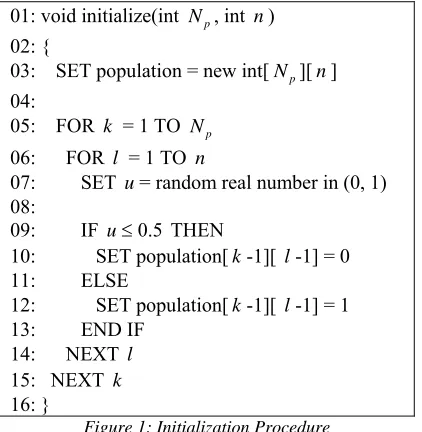
7341 included within a solution. Moreover, a solution of initial population can be easily created by using randomly generated xi s. This initialization
procedure is summarized in Figure 1, where Np
[image:3.612.91.302.193.409.2]denotes population size. Note that no repair procedure is applied to the initial solutions in Figure 1.
01: void initialize(int Np, int n)
02: {
03: SET population = new int[Np][n]
04:
05: FOR k = 1 TO Np
06: FOR l = 1 TO n
07: SET u= random real number in (0, 1)
08:
09: IF u0.5 THEN
10: SET population[k-1][ l-1] = 0
11: ELSE
12: SET population[k-1][ l-1] = 1
13: END IF 14: NEXT l
15: NEXT k
16: }
Figure 1: Initialization Procedure
3.2 Fitness Switching for 0-1 Knapsack Problem
Typically, fitness s( ) for KP is computed by using total value of the items included in solution s as follows:
1 ( ) n i i
i
fitness s v x
, (4)if s satisfies
1
n
i i i
w x t
, (5)where t is pre-specified upper bound of total
weight. A solution is infeasible for given KP if it does not satisfy (5), and its fitness value should be computed in different manner. Moreover, the fitness function for infeasible solution, fitness s( ) should have following features: First, an infeasible solution sb is worse than any feasible solution sa,
even if it has larger total value. Thus, fitness s( )b cannot exceed fitness s( )a . Second, quality of infeasible solution should be appropriately
measured. For example, let E s( ) denote excess weight of a solution s as follows:
1
1
0 , if ( )
, otherwise
n
i i i
n
i i i
w x t E s
w x t
(6)If 0E s( )b E s( )c , both sb and sc are infeasible,
however, sb is probably better than sc in that sb
has smaller excess weight and it can be converted into feasible solution more easily. In other words,
( )b
fitness s should be larger than fitness s( )c .
Thirdly, fitness s( ) has to satisfy
( ) 0
fitness s , (7)
for every infeasible solution. In addition, designing a penalization procedure which has all of those three features can be a non-trivial task.
In this context, this paper proposes three types of fitness s( ) including
1
1 1 ( ) n
i i i
fitness s
v x
, (8)2
1 1 ( ) n
i i i
fitness s
w x
, (9)and
3
1 1 ( ) n
i i i
fitness s
v x
. (10)Note that
2 3 1
0 1, (11)
where i is the correlation coefficient between
( )
fitness s and fitness si( ) . Moreover, fitness
7342 have any explicit threshold for solutions. Hence, this paper proposes alternative fitness functions
2( )
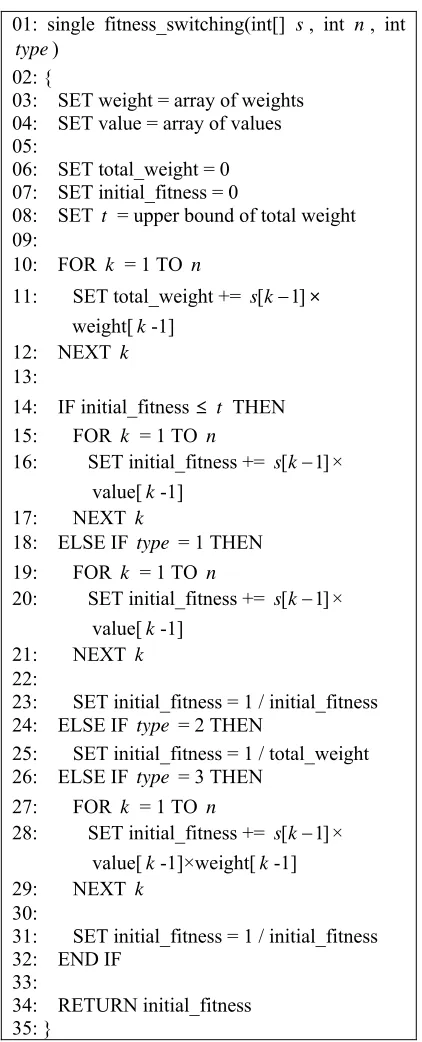
fitness s and fitness s3( ), where total weight of solution s is considered. The fitness switching
procedure for KP proposed in this paper is summarized in Figure 2.
01: single fitness_switching(int[] s, int n, int
type)
02: {
03: SET weight = array of weights 04: SET value = array of values 05:
06: SET total_weight = 0 07: SET initial_fitness = 0
08: SET t = upper bound of total weight
09:
10: FOR k = 1 TO n
11: SET total_weight += s k[ 1]× weight[k-1]
12: NEXT k
13:
14: IF initial_fitness ≤t THEN
15: FOR k = 1 TO n
16: SET initial_fitness += s k[ 1]× value[k-1]
17: NEXT k
18: ELSE IF type = 1 THEN
19: FOR k = 1 TO n
20: SET initial_fitness += s k[ 1]× value[k-1]
21: NEXT k
22:
23: SET initial_fitness = 1 / initial_fitness 24: ELSE IF type = 2 THEN
25: SET initial_fitness = 1 / total_weight 26: ELSE IF type = 3 THEN
27: FOR k = 1 TO n
28: SET initial_fitness += s k[ 1]× value[k-1]×weight[k-1]
29: NEXT k
30:
31: SET initial_fitness = 1 / initial_fitness 32: END IF
33:
[image:4.612.90.301.174.695.2]34: RETURN initial_fitness 35: }
Figure 2: Fitness Switching Procedure
3.3 Fitness Leveling for 0-1 Knapsack Problem
One important limitation of fitness switching procedure described in previous section is that a feasible solution can have extremely large fitness value, while infeasible ones have relatively small fitness values when vi, wi 1. Moreover,
this disparity in fitness values brings about high selection pressure, which can lead to premature convergence to local optima.
In order to avoid this problem, FSWGA uses fitness leveling procedure to obtain adjusted fitness values,
'( )
( ) min ( )
1
max ( ) min ( )
s F
s F s F
fitness s
fitness s fitness s L
fitness s fitness s
(12)
and
( ) '( ) (1 )
max ( )
s I
fitness s fitness s
fitness s
, (13)
where F and I denote the sets of feasible and
infeasible solutions within population, respectively, and FI = population. In addition, factor L is
used to prioritize feasible solutions over infeasible ones, and L1. Note that the selection pressure of FSWGA is directly proportional to factor L.
The role of factor is used to slightly decrease the fitness values of infeasible solutions, and 0 1 so that the adjusted fitness values
'( )
fitness s and fitness'( )s satisfy
0 fitness'( ) 1s fitness'( )s L. (14)
The fitness leveling procedure proposed in this paper is summarized in Figure 3.
3.4 Simple Local Search for 0-1 Knapsack Problem
The fitness leveling procedure helps the competitive infeasible solutions to survive in selection phase of GA. However, the infeasible solutions are not suitable for given problem, inherently. Therefore, FSWGA uses simple local search procedure to slightly modify the infeasible solutions in hopes that they would be converted into better infeasible solutions or feasible solutions.
7343 chosen item from an infeasible solution, and this procedure is summarized in Figure 4.
01: single fitness_leveling(int[] s , single
initial_fitness, single L, single )
02: {
03: SET max_feasible_fitness = maximum fitness value of feasible solutions 04: SET min_feasible_fitness = minimum fitness value of feasible solutions 05: SET max_infeasible_fitness = maximum fitness value of infeasible solutions 06:
07: SET adjusted_fitness = 0 08:
09: IF initial_fitness < 0 THEN 10: SET adjusted_fitness = (1 – )
×initial_fitness/max_infeasible_fitness 11: ELSE
12: SET adjusted_fitness
= 1 + L×(initial_fitness – min_feasible_
fitness)/(max_feasible_fitness – min_ feasible_fitness)
13: END IF 14:
[image:5.612.89.298.122.655.2]15: RETURN adjusted_fitness 16: }
Figure 3: Fitness Leveling Procedure
01: single simple_local_search(int[]s, int n, int
type)
02: {
03: SET cur_item_set =
04:
05: FOR k = 1 TO n
06: IF s[k1] = 1 THEN
07: ADD k1 to cur_item_set 08: END IF
09: NEXT k
10:
11: SET del_item = a randomly chosen element of cur_item_set 12:
13: SET s[del_item] = 0
14:
15: RETURN fitness_switching(s,n,type)
[image:5.612.90.298.430.668.2]14: }
Figure 4: Simple Local Search Procedure
Note that simple local search procedure calls fitness switching procedure after an infeasible solution is slightly modified. That is, the fitness
value of the solution is also modified after simple local search procedure is done.
3.5 Selection, Crossover and Mutation
FSWGA for solving KP proposed in this paper is based on the common standard GA (SGA) framework, which uses selection, crossover and mutation operators in order to generate new population from current one. Moreover, this paper uses conventional genetic operators widely used in GAs for various combinatorial optimization problems.
Selection operator is used to generate a mating pool, a set of solutions selected from current population, where mating pool and population have identical size and one solution in current population can be selected two or more times. In this paper, well-known roulette wheel method is used, which indicates that an individual solution sk in current
population is selected with a probability proportional to its own fitness value,
1
fitness of
fitness of
p
k N
i i
s
s
. (15)
The role of crossover operator is to recombine the genes of two solutions in mating pool, parents, in order to generate two new solutions, offspring. This paper uses uniform crossover, which is known as a more exploratory approach than traditional single-point or two-point crossover approaches. For example, let xp i1, and
2,
p i
x denote the ith genes of parent 1 (father) and
parent 2 (mother), respectively. Then, the uniform crossover suggests that xo i1, xp i1, and xo2,i xp2,i
with a probability of 0.5, and xo i1, xp2,i and
2, 1,
o i p i
x x with a probability of 0.5, where xo i1,
and xo2,i denote the ith genes of offspring1 and
offspring2, respectively.
The mutation operator is used to randomly modify the offspring with small probability, and it helps to maintain the diversity of solutions within population and avoid the premature convergence to local optima. In this paper, common bit flip mutation operator is used, where value of each gene is changed from 1 to 0 and vice versa with small probability.
7344 population. The evaluation phase of FSWGA is described in next section. In addition, note that the new population obtained in this manner can contain a number of infeasible solutions but no additional repair or penalization procedures are used in this paper.
3.6 Evaluation
[image:6.612.315.521.293.641.2]In the original version of FSWGA, fitness leveling procedure is applied to selection phase of GA, while fitness switching and simple local search procedures are incorporated into evaluation phase. On the contrary, all of those procedures are applied to evaluation phase in this paper, as shown in Figure 5. In other words, FSWGA can be implemented with existing selection, crossover and mutation operators, if evaluation phase is appropriately designed.
Figure 5: Overall Structure of FSWGA
The objective of evaluation phase is to compute the fitness values of the solutions within current population, and the evaluation phase of FSWGA proposed in this paper is summarized in Figure 6.
At first, fitness switching procedure is used to compute initial fitness values. If a solution in current population is feasible, its initial fitness value, computed by (4), will be larger than 1, while an infeasible solution has initial fitness value smaller than 1, which is computed by (8)~(10).
Next, simple local search procedure is applied to the solutions with initial fitness values
smaller than 1, in order to convert them into better solutions by slight modifications. Moreover, their fitness values are also modified, and the modified fitness values are larger than the initial fitness values. If an infeasible solution is converted into a feasible solution, its modified fitness value will be larger than 1. On the contrary, if the modified solution is still infeasible, its modified fitness value cannot exceed 1.
Finally, fitness leveling procedure is applied to both feasible and infeasible solutions within current population in order to maintain appropriate selection pressure, which is directly proportional to factor L . Consequently, each
solution in current population will have adjusted fitness value, which is used by next selection operator.
01: void evaluation(int type, single L, single )
02: {
03: SET n = number of items
04: SET Np = population size
05: SET fitness = new single[Np]
06: SET population = current population 07:
08: FOR k = 1 TO Np // Fitness switching
09: SET fitness[k1] = fitness_switching( population[k1],n,type)
10: NEXT k
11:
12: FOR k = 1 TO Np //Simple local search
13: IF fitness[k1] < 1 THEN
14: SET fitness[k1] = simple_local_ search(population[k1],n,type)
15: END IF 16: NEXT k
17:
18: FOR k = 1 TO Np //Fitness leveling
19: SET fitness[k1] = fitness_leveling( population[k1], fitness[k1],L,)
20: NEXT k
21: }
Figure 6: Evaluation Phase
Note that fitness leveling procedure has to be applied after fitness switching and simple local procedures have been done, since it utilizes
max
s F ( )
fitness s , min
s F fitness ( )s
and max
s I
[image:6.612.100.292.325.557.2]7345
4. EXPERIMENT RESULTS
In order to investigate the performance of FSWGA for KP, three versions of FSWGAs with
1( )
fitness s , fitness s2( ) and fitness s3( ) had been applied to a KP with 50 items, listed in Table 1, with varying upper bound of total weight t. For
each case, 10 repetitions of experiments had been performed under population size Np = 50,
crossover rate = 0.8, mutation rate = 0.01, maximum iteration number = 500, L = 2 and =
[image:7.612.322.513.86.289.2]0.1. Moreover, elitism policy for preserving the 5 best solutions within each generation was applied.
Table 1: Knapsack Problem With 50 Items Item
ID Weight Value Item ID Weight Value
1 39 66 26 33 45
2 19 60 27 35 16
3 34 21 28 38 130
4 13 139 29 35 58
5 15 65 30 13 37
6 17 95 31 27 116
7 31 6 32 20 64
8 12 91 33 14 43
9 21 12 34 14 108
10 24 85 35 13 75
11 23 12 36 23 121
12 11 53 37 35 67
13 40 99 38 25 60
14 32 48 39 33 33
15 36 96 40 34 48
16 38 81 41 23 98
17 20 70 42 15 91
18 13 122 43 24 102
19 28 83 44 39 120
20 17 129 45 23 61
21 26 54 46 28 58
22 36 31 47 23 119
23 33 52 48 20 122
24 29 96 49 32 71
25 17 57 50 28 64
Note that this KP is rather hard to solve in that item values and item weights are not strongly correlated, as shown in Figure 7. On the contrary, the item values have weak inverse correlation with item weights, and the correlation coefficient between them is about -0.2. In this paper, three upper bound values listed in Table 2 are considered, where Optimal-Total-Value is the total value of optimal solution, and MS-Excel Solver failed to find the optimal solution when t = 500.
[image:7.612.89.302.281.583.2]Figure 7: Item Value Versus Item Weight
Table 2: Upper Bound Of Total Weight
ID Upper bound of total weight (
t) Optimal-Total-Value 1 200 (Low) 1282 2 500 (Moderate) 2373 3 1000 (High) 3465
The experiment results are summarized in Table 3~Table 5, where Best-Total-Value is the total value of the best solution identified by each version of FSWGA. Moreover, success rate is the proportion of experiments where the optimal solution is identified.
In Table 3~Table 5, we can get following observations: Firstly, fitness s2( ) shows superior performances to the others in that it produces the highest average Best-Total-Value, the smallest standard deviation of Best-Total-Value and the highest success rate in all cases. Since fitness s2( ) is inversely proportional to total weight, a solution
s is infeasible if fitness s2( ) 1 . In other words,
2( )
fitness s evaluates the fitness of a solution most
appropriately. Meanwhile, fitness s1( ) is inversely proportional to total value, which is generally proportional to total weight. However, as mentioned earlier, item values and item weights of given KP are not strongly correlated, and
1( )
fitness s sometimes produce wrong fitness
values. For example, let’s consider two infeasible solution, s1 and s2. If s1 has smaller total value
and larger total weight, it is straightforward that s1
is worse infeasible solution than s2. Nevertheless,
1( )1
[image:7.612.323.512.308.378.2]7346 total value. Similarly, fitness s3( ) produces wrong fitness values more often, and this indicates that
( )
fitness s for a given problem should be carefully
chosen.
Secondly, the performance of FSWGA is significantly affected by the upper bound of total weight t. Especially, the three versions of FSWGA
performs badly when t = 500, as shown in Table 4.
Of course, other solution methods also have difficulties in solving highly complex combinatorial optimization problems, and this indicates that FSWGA can be further revised to deal with such complexities.
Nevertheless, we can see that all FSWGAs have identified optimal or nearly optimal solutions in almost experiments, and this suggests that the search strategy of FSWGA can be used to solve combinatorial optimization problems with many feasible solutions, such as KP.
Table 3: Best-Total-Values For Low Upper Bound Of Total Weight ( t = 200)
1( )
fitness s fitness s2( )
3( )
[image:8.612.315.521.258.424.2]fitness s Average 1280.2 1281.4 1275.2 Max. 1282 1282 1282 Min. 1276 1276 1256 Std.Dev. 2.75 1.80 9.47 Success rate 70% 90% 50%
Table 4: Best-Total-Values For Moderate Upper Bound Of Total Weight ( t = 500)
1( )
fitness s fitness s2( )
3( )
fitness s Average 2363.7 2370.4 2362.7 Max. 2373 2373 2373 Min. 2341 2360 2344 Std.Dev. 9.72 3.85 10.21 Success rate 10% 40% 10%
Table 5: Best-Total-Values For High Upper Bound Of Total Weight ( t = 1000)
1( )
fitness s fitness s2( )
3( )
fitness s Average 3460.9 3462.8 3459.8 Max. 3465 3465 3465 Min. 3451 3460 3453 Std.Dev. 4.64 2.27 3.25 Success rate 40% 50% 10%
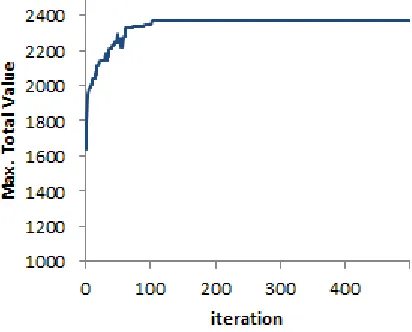
Figure 8 shows changes in the maximum total value during search procedure of a single experiment with FSWGA based on fitness s2( ) and
t = 500. Since the maximum total value is
consistently increased, we can conclude that FSWGA is useful to explore the search space of KP.
Similarly, Figure 9 shows changes in infeasible ratio, the proportion of infeasible solutions within population, during search procedure of same experiment. In Figure 9, the infeasible ratios of first two populations are 90.0% and 66.0%, respectively. However, the infeasible ratio is rapidly decreased, and later populations have quite lower infeasible ratios. What is important is that such infeasible solutions are not “destroyed” by repair procedure, and they are dealt with by the three operations of FSWGA, instead of penalization procedure, which requires careful configuration.
Figure 8: An Example Of Change In Maximum Total Value During Search Procedure
Figure 9: An Example Of Change In Infeasible Ratio During Search Procedure
[image:8.612.318.519.458.629.2]7347 cases, FSWGA has two objectives, one is to find any feasible solutions and the other is to choose the optimal solution among feasible ones. On the contrary, FSWGA in this paper can focus on the second objective, since it is very easy to find arbitrary feasible solutions for given KP.
5. CONCLUSIONS
The most important benefit of FSWGA is that it can be applied to solve combinatorial optimization problems with rare feasible solutions. In addition, FSWGA can be easily designed and implemented in that it does not require any problem-dependent repair or penalization procedures, however, this additional benefit of FSWGA was not appropriately investigated in previous literature.
In this context, this paper develops refined FSWGAs and applies them to solve one of well-known combinatorial optimization problem with many feasible solutions, classical 0-1 KP. The experiment results demonstrate that the search strategy of FSWGA is also useful even if given problem has many feasible solutions. In addition, this paper suggests that the fitness switching procedure is the most important element of FSWGA, and fitness s( ) must be carefully chosen.
Thus, the author plans to apply FSWGA to a wider range of combinatorial optimization problems develop more effective fitness switching procedures in future.
ACKNOWLEDGEMENTS
This work was supported by the National Research Foundation of Korea(NRF) grant funded by the Korea government(Ministry of Science, ICT & Future Planning) (NRF-2017R1C1B1008650).
REFRENCES:
[1] D. Zou, L. Gao, S. Li, and J. Wu, “Solving 0-1 Knapsack Problem by a Novel Global Harmony Search Algorithm”, Applied Soft Computing,
Vol.11, No.2, 2011, pp.1556-1564.
[2] A.J. Umbarkar, and M.S. Joshi, “0/1 Knapsack Problem using Diversity based Population Genetic Algorithm”, International Journal of Intelligent Systems and Applications, Vol.6,
No.10, 2014, pp.34-40.
[3] K.K. Bhattacharjee, and S.P. Sarmah, “Shuffled Frog Leaping Algorithm and Its Application to 0/1 Knapsack Problem”, Applied Soft Computing, Vol.19, 2014, pp.252-263.
[4] S. Martello, D. Pisinger, and P. Toth, “New Trends in Exact Algorithms for the 0-1 Knapsack Problem”, European Journal of Operational Research, Vol.123, No.2, 2000,
pp.325-332.
[5] J.H. Holland, Adaptation in Natural and Artificial Systems, University of Michigan Press,
Michigan, 1975.
[6] F. Glover, “Tabu Search: A Tutorial”, Interfaces,
Vol.20, No.4, 1990, pp.74-94.
[7] D. Pisinger, “Where Are the Hard Knapsack Problems?”, Computers and Operations Research, Vol.32, No.9, 2005, pp.2271-2284.
[8] J.W. Kim, “Performance Comparison of Neighborhood Structures of Tabu Search Algorithms for Sequencing Problems”,
Advanced Science Letters, Vol.23, No.10, 2017,
pp.10423-10426.
[9] J.W. Kim, and S.K. Kim, “Fitness Switching Genetic Algorithm for Solving Combinatorial Optimization Problems with Rare Feasible Solutions”, Journal of Supercomputing, Vol.72,
No.9, 2016, pp.3549-3571.
[10] J.W. Kim, and S.K. Kim, “Genetic Algorithms for Solving Shortest Path Problem in Maze-type Network with Precedence Constraints”,
Wireless Personal Communications,
forthcoming.
[11] J.W. Kim, “Candidate Order based Genetic Algorithm (COGA) for Constrained Sequencing Problems”, International Journal of Industrial Engineering: Theory, Applications and Practice,
Vol.23, No.1, 2016, pp.1-12.
[12] M. Kumar, M. Husian, N. Upreti, and D. Gupta, “Genetic Algorithm: Review and Application”,
International Journal of Information Technology and Knowledge Management, Vol.2,
No.2, 2010, pp.451-454.
[13] Z. Michalewicz, Genetic Algorithm+Data Structures=Evolution Programs, Springer
Science and Business Media, Heidelberg, 2013. [14] P. Chootinan, and A. Chen, “Constraint
Handling in Genetic Algorithms using a Gradient-based Repair Method”, Computers and Operations Research, Vol.33, No.8, 2006,
pp.2263-2281.
[15] S. Salcedo-Sanz, “A Survey of Repair Methods Used as Constraint Handling Techniques in Evolutionary Algorithms”, Computer Science Review, Vol.3, No.3, 2009, pp.175-192.
7348 Problems”, INFORMS Journal on Computing,
Vol.8, No.2, 1996, pp.173-182.
[17] Ö, Yeniay, “Penalty Function Methods for Constrained Optimization with Genetic Algorithms”, Mathematical and Computational Applications, Vol.10, No.1, 2005, pp.45-56.