RELEVANCE FEEDBACK BAYESIAN NETWORK IMAGE
RETRIEVAL BASED ON SIFT- MODIFIED LBP BOF
1B. SATISH,2SUPREETHI K. P.
1Kamala Institute of Technology and Science, Huzurabad, Telangana, Computer Science and Engineering
2JNTUH College of Engineering, Hyderabad, Telangana, Computer Science and Engineering
E-mail: 1[email protected],2[email protected]
ABSTRACT
The interest on content based image retrieval studies and researches has increased in the last decades as there is a need to maintain huge visual and multimedia databases in all computer applications. The retrieval of images from the datasets rely on the analysis of automatically- derived feature attributes such as color, texture and shape. Generally visual attributes of each feature data are smaller in size, it requires a descriptor for organizing and searching the relevant information or content from it. Scale Invariant Feature Transform (SIFT) and Local Binary Pattern (LBP) are the frequently used efficient visual descriptor helps in improving the retrieval of image even in case of noisy backgrounds. In this system, a Relevance Feedback Bayesian network is introduced in SIFT- modified LBP descriptor to improve the accuracy of image retrieval with the representation of neighbor pixel discrimination. It works on the basis of distribution of several viewpoints in the Bag of features (BoF) and provides better image retrieval.
Keywords: Bag of features (BoF), Content-based image retrieval (CBIR), Local Binary Pattern (LBP), modified LBP (mLBP), Scale Invariant Feature Transform (SIFT).
1. INTRODUCTION
Content-based image retrieval (CBIR) is a technique to search for the most visually similar objects to a given query object from a large video/image database. CBIR systems extract visual features from the images automatically. Similarities between two images are measured in terms of the differences between the corresponding features. There are three different levels to extract feature such as Low-level features, Mid-level features and High-level features [1]. Low-level features such as colors, textures, and shapes have been used to describe the image content [2, 3]. The main idea is to extract low-level features from the images and measure the degree of similarity between them to find the most similar ones in terms of visual contents. There are advantages and disadvantages of using these low-level features on CBIR systems. Color features have high computational efficiency and are invariant to rotation and scale. However, they do not consider the image content and spatial distribution of colors. Texture features can describe spatial variations in pixel intensities and the surface characteristics of an object. But texture segmentation still remains a difficult problem to meet human perception [4]. Shape-based features
are relatively consistent with the intuitive feeling but lacking perfect mathematical foundations to deal with the target deformation. Therefore, only using low-level visual features can hardly describe the semantic concepts of images.
Based on their advantages, Helkklla et al. [6] recently proposed a novel region descriptor by combining SIFT and LBP features. A significant limitation of the original LBP operator is its small spatial support area. Features calculated in a local 3×3 neighborhood cannot capture large-scale structures that may be the dominant features of some textures. This limitation will overcome with help of multi-scale modified LBP (mLBP). In this proposal, we propose SIFT-modified LBP [7] using Relevance Feedback Bayesian Network to improve neighbor pixel discrimination.
2. LITERATURE REVIEW
Juan C. Caiced et al [8] presented a systematic evaluation of different representations obtained from the bag of features approach to classify histopathology images. In addition, the obtained image descriptors were processed using two kernel functions for Support Vector Machine classifiers. The main advantage of their approach is adaptiveness to the particular contents of the image collection. The adaptiveness was obtained with an automated codebook construction based on structure of the histopathology images, which exhibit homogeneous tissues and the representative visual patterns among the whole collection tends to be uniform. The performed experiments allow analyzing the impact of different strategies in the final classification result.
Qianni Zhang and Ebroul Izquierdo [9] presented a Bayesian network-based framework for object-centered image retrieval. In their method, first the images are decomposed into blocks to enable a real object-centered analysis. Subsequently, by using Multi-Objective Optimization on a group of key representative image blocks, an optimal similarity metric per semantic concept is obtained. Then they used Bayesian inference to map the retrieval from block level back to image level. The results, though largely depending on the choice of representative blocks in the first stage, showed definite improvements by the Bayesian inference step.
C. Schulze and M. Liwicki [10] presented an optimized combination of matching parameters which outperformed the standard values. They observed that two major parameters, i.e., distmax and ratiomax seem to have similar outcomes on different datasets of diverse nature for the application of scene retrieval. In this way, this research paper showed that there is an almost
global setting for these two parameters for local feature matching. The outcomes of this work can also be applied to other tasks like video analysis and object retrieval.
S. R. Dubey et al. [11] proposed a new method of local image feature description based on the patterns extracted from the multiple filtered images. The whole process was structured as follows: First, the images were filtered with the bag of filters (BoF) and then local binary pattern (LBP) was computed over each filtered image and finally concatenated to find out the single BoF-LBP descriptor. The local information enriched in the filtered images improved the discriminative ability of the final descriptor. Content based image retrieval (CBIR) experiments were performed to observe the effectiveness of the proposed approach and compared with the recent state-of-the-art methods. The experiments were conducted over four benchmark databases having natural and texture images such as Corel-1k, Corel-10k, MIT-VisTex and STex-512S. The experimental results confirmed that the introduced approach was able to improve the retrieval performance of the CBIR system.
3. PROPOSED METHODOLOGY
In this paper, we design two local semantic descriptors the SIFT and the mLBP descriptor. The new features obtained do not rely on the image segmentation method and are able to automatically detect interest points and regions within an image. We make use of standard image database WANG to perform this experiment. The proposed integration model is based on the bag-of features (BoF) representations. Features that are computed for each image are combined to form high-dimensional descriptors. These descriptors are clustered into several key points which are referred to as visual words. Each image is then represented by a distribution on the visual words. Given a query image, we are able to find a list of similar images ranked by similarity scores based on visual word distributions. The Bayesian relevance feed-back network will consider the results obtained by retrieving and then it classifies the result.
3.1 Pre-processing
filtering techniques [12]. The proposed system makes use of Gaussian filter and a smoothing operator that convert noisy image into noiseless image. The Gaussian function given in the below eq (1),
2 2 2
2 2
2
1
)
,
(
Y X
e
Y
X
G
(1)Using noiseless image
G
(
X
,
Y
)
feature extraction process is conducted and obtained features are then translated to visual words, by applying bag-of-features (BoF) model.3.2. Bag-of-Features (BoF) Model using Content-Based Image Retrieval (CBIR)
The proposed model is based on bag-of-feature (BoF) model which utilizes CBIR technique, mainly designed for visual description. CBIR using Scale Invariant Feature Transform (SIFT) demonstrates the discriminative power and solving vision problems like object recognition and image classification [13] [14]. The SIFT extracts mid-level features to recognize classes of objects. In addition, modified LBP mainly used as a texture feature descriptor, which provides a better performance in object recognition. The integration of SIFT-mLBP exploited to capture the characteristics of an object in the images.
Our contribution to compute all the SIFT and mLBP visual descriptors in an image independently and link them directly at the image level. After, SIFT-mLBP features measuring the similarity by using Euclidean Distance and indexing the retrieval image. Proposed System has two phases namely Training and testing. Calculation BoF is trained with corresponding target label, while testing query image will compare with existing database features.
3.2.1 Scale Invariant Feature Transform (SIFT)
SIFT extracts visual features from query image and that features computed to high-dimensional descriptors clustered into several viewpoints. Wherein each image is demonstrated by visual words.
The feature extraction procedure of SIFT can be described as follows
Step1: Construct the Difference of Gaussians (DOG) scale space as mentioned in (2),
x,y,
Gx,y,k
Gx,y,
Ix,y Lx,y,k
Lx,y,
D
(2)
Where
22 2
2 ) (
2
2
1
,
,
y x
e
y
x
G
,from eq (1).
x
y
I
,
is the original image and
x
,
y
,
G
x
,
y
,
I
x
,
y
.
L
where L (x, y,σ) is the scale space of an image, built by convolving the image I (x, y) with the Gaussian Kernel G (x, y, σ) and
k
is the sample space.Step2: Get the key points
We get the key points at the scale space extreme in the difference of Gaussian function (2) convolved with the image.
Step3:Assign an orientation and gradient modulus to each key point
The magnitude and orientation of gradient of image patch
I
x
,
y
at a particular scale is mentioned in Equation (3) and (4)
x
,
y
L
x
,1
y
L
x
,1
y
2
L
x
,
y
1
L
x
,
y
1
2m
(3)
y
x
L
y
x
L
y
x
L
y
x
L
y
x
,1
,1
1
,
1
,
tan
,
1
(4)
Step4:Construct the descriptor of SIFT features
window is used to assign a weight to the magnitude of each sample point. A key point descriptor is created by first computing the gradient magnitude and orientation at each image sample point in a region around the key point location. These are weighted by a Gaussian window, indicated by the overlaid circle. These samples are then accumulated into orientation histograms summarizing the contents over 4x4 sub-regions. This feature vector is stored as a visual feature in BoF. mLBP will calculate and stored in BoF as a texture feature.
3.2.2 Modified Local Binary Patterns (mLBP)
LBP is a non-parametric operator which describes the local contrast and local spatial structure of an image [15]. This operator is well recognized due to its high severability and discriminative power for texture analyzing and classification. However, LBP does not provide very good discrimination, and computation complexity. To solve these problem a uniformity measure U, which corresponds to the number of spatial transitions (bitwise 0/1 changes) in the “pattern” is defined. It is shown in the equation (5) below
) ( ) ( | ) ( ) ( | )
( , 1 2 m b m1 b
X m b a b Y
X g g g g g g g g
LBP
U
(5)
A uniformity pattern amount is less than
T
U
as grouped into uniform patterns and uniformity pattern amount is more thanU
T as grouped into non-uniform patterns, which is computed by using following eq (6), elsewhere p U LBP ifU g g
LBP m b XY T
X m T Y X 1 ) ( ) ( , 1 , (6)
Where,
g
m andg
b represent respectively the gray level value of the central pixel and the gray level value of the neighborhood pixels and adopt the notation(
P
,
Q
)
,P
corresponds to the number of pixels in the neighborhood andQ
represents the circle of radius.Compute the uniform pattern
LBP
XT,Y of each pixel.(
g
1
g
b)
States difference of pixel values in terms of distance. Here, distance measure will split in to two form [16].Dist
p
g
1
g
b.b
Represents center point of selected block.p
Disp
is as follows,p p p p p p p
Dist
m
and
Dist
sign
s
where
m
s
Dist
)
(
*
(7)This Equation (7) is update in equation (5) and we got, visual word of frequency vector that is shown in equation (8),
]
,...
,
[
Xu1,Y Xu,2Y Xu,nYi
mLBP
mLBP
mLBP
mLBP
(8)
After calculating feature vectors of the query image need to measures the similarity from the database. Euclidean distance used to measure the similarity distance in the following eqn. (9)
2 / 1
1
|
(
)
(
)
|
2
)
(
S
X
R
X
E
ni (9)
Here,
S
(
X
)
[
s
1,
s
2,...,
s
n]
be thefeature vector of database image and
]
,...,
,
[
)
(
X
r
1r
2r
nR
be the feature vector ofquery image. The result of the distance calculation exploited for indexing retrieval image./ In addition, retrieval process includes user’s relevance feedback to modify the retrieval to produce results that are more relevant perceptually. Bayesian network explored as a relevant image adoption model, which utilized probabilistic measure to represent the relationships among the objects.
3.3. Bayesian Relevance Feedback Network
Let
S
be the set of all images in the database, andr
is one of them and assume thatr
is a random vector. The joint probability distribution over the complete set of variables expressed as shown in (10)))
(
|
(
)
,...
,
(
)
(
1 21 i i
n
i
n
S
x
Sa
x
x
x
x
S
X
S
(10)The weight of a link from the feature vector node to the relevant image node represented by
s
(
o
k|
r
j)
is hard to obtain directly. However, it is calculated using Bayes’ rule, which is shown in (11),)
(
)
(
)
|
(
)
|
(
j k k j jk
s
r
o
s
o
r
s
r
o
s
(11)Here,
s
(
r
j)
ands
(
o
k)
are prior beliefvalues of the component
r
j and the relevant imageo
k. The following equation utilized to represent the relevant image.}
,....,
2
,1
),
|
(
)
(
{
b
o
k
s
o
kr
k
m
(12)The above equation (12) assessed the probabilistic ranking of the relevant image. The following equation (13) shown that relevant image set,
{
o
1,
o
2,...,
o
l},
b
(
o
k)
Q
(13)Where τ is a constant threshold, which estimated by the training process.
Q
Represents to retrieved relevant image with highest predictive densities from the database. Moreover, the proposed system results are evaluated with Block based LBP, BoF SIFT, Patch based SIFT-LBP, and Image based SIFT-LBP in terms of Average retrieval precision (ARP). The following performance function helps to evaluate the accuracy.3.4 Performance Measures
The performance measured by using precision and recall (P-R), which is mentioned in eq (14) and eq (15)
)
(
)
(
IR
N
RIR
N
precision
(14)Where
N
(RIR
)
the number of relevant images is retrieved andN
(IR
)
is the total number of images retrieved.)
(
)
(
ID
N
RIR
N
recall
(15)Where
N
(ID
)
is the total number of images in the database.In the training process, SIFT and LBP features are extracted from each image in the database, and then be integrated for constructing the SIFT-LBP descriptors. Once the descriptors are obtained, the codebook is generated by the integrated SIFT-LBP descriptors. Each image is mapped to the codebook in order to obtain its BoF histogram. In the retrieval process we input a query image, by comparing its BoF histogram and other BoF histograms in the database; we can obtain a ranked set of most similar images based on Equation (16).
ni i i
b
a
B
A
d
1
min
,
1
)
,
(
(16)The quantitative measure we use is average precision is defined by the following eq (17):
M jj
i
M
i
P
1,
1
(17)Where
0
1
)
,
(
i
j
,id
(
i
)
id
(
j
)
or other wiserespectively. M is the original size of the category that image i is from. This value is the percentage of images belonging to the category of image i in the first M retrieved images. The invariant feature descriptor SIFT cannot be improved after the certain level and it does not give any kind of improvement in efficiency. So, here the local descriptor LBP is combined with SIFT for the significant improvement in efficiency. Generally, LBP divides the image into various distinct blocks (n n), to differentiate the foreground texture feature. But the differentiation of the image is inadequate. Hence, the background of the image is further split by using sub-space blocks. Sub-block leads to computational complexity, but it gradually increases the efficiency of LBP. The sub-space blocks are denoted as mLBP. The limitations mentioned in the literature reviews are overcome by mLBP.
4. EXPERIMENTAL SETUP
The proposed system is implemented in JAVA Platform. To establish the validity of the proposed method, it is tested on WANG database of 100 images. All images of this dataset are divided into 10 categories, for example Butterfly, Rose, Sunrise, Mountain, Sea, Globe, Apple, Pattern, Sailing boat, Sports car. Each category contains 100 images each. The efficacy of the proposed system is evaluated on the basis of standard parameter, i.e., precision and recall.
In our experiments, we test a benchmark image dataset WANG that comprises 100 images
from 10 categories. The images are with the size of either 256 × 384 or 384 × 256.
4.1 Experimental Results
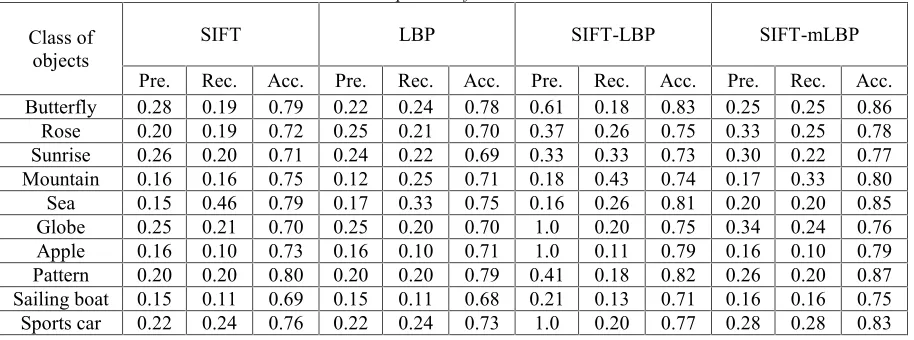
A schematic illustration of the experiment is shown in table. 1. For example, if the query image is a flower, if 7 of the first 10 (there are 10 flower images in the training set) retrieved images belong to the category of flowers, then the retrieval precision is 0.7.
[image:6.612.85.542.542.712.2]First, we study the influence of the codebook size on retrieval performance of the system. We choose the size of codebooks from {5, 10, 15, 20, and 25}. The performance is shown in Fig. 1. As we can see from the results, the best size is 20 for this data set. The detailed results of using two integration methods for each of the 10 categories are shown in Table 1.
Table 1: Comparison of the ARP values
Class of
objects SIFT LBP SIFT-LBP SIFT-mLBP
Pre. Rec. Acc. Pre. Rec. Acc. Pre. Rec. Acc. Pre. Rec. Acc. Butterfly 0.28 0.19 0.79 0.22 0.24 0.78 0.61 0.18 0.83 0.25 0.25 0.86
Rose 0.20 0.19 0.72 0.25 0.21 0.70 0.37 0.26 0.75 0.33 0.25 0.78
Sunrise 0.26 0.20 0.71 0.24 0.22 0.69 0.33 0.33 0.73 0.30 0.22 0.77 Mountain 0.16 0.16 0.75 0.12 0.25 0.71 0.18 0.43 0.74 0.17 0.33 0.80
Sea 0.15 0.46 0.79 0.17 0.33 0.75 0.16 0.26 0.81 0.20 0.20 0.85
Globe 0.25 0.21 0.70 0.25 0.20 0.70 1.0 0.20 0.75 0.34 0.24 0.76
Apple 0.16 0.10 0.73 0.16 0.10 0.71 1.0 0.11 0.79 0.16 0.10 0.79
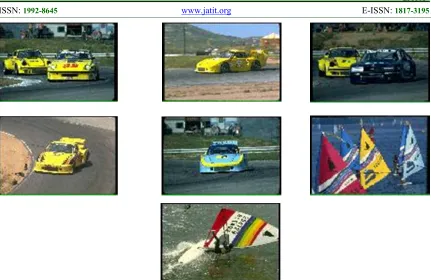
In above fig. 7 features of same color object is given, in which 5 cars and 2 sailing boat are visible. The proposed system using feedback should detect the irrelevant images and ask for user’s feedback so that the system’s efficacy is enhanced.
Here, a common real world data is taken as an input for image retrieval process. Basically image retrieval features are calculated on the basis of color, size, texture and their appearance. mLPB and SIFT are the two mid- level method used to calculate features.
1. Accuracy is more in our proposed system when compare to existing methodology, it works better (up to 4%) in terms of accuracy. However, it needs improvement in precision of the image accessing. Even though the system is provided with enough number of iteration, precision is lost when the large size object is taken as an input. Similar types of images will affect precision rate. A figure 1 show the query image is belongs to car but in retrieval process our algorithm retrieved boat images. It shows modified LBP need to be improved in terms of texture classification.
2. Different set of database images degrades system precision rate due to low level feature
selection like color and texture. If the same subset of features present in the object of an image, the accuracy and performance is more. The problem occurs only if the different sets of features are found on the image. Here Animals are general category; in this animals are classified as animal it’s not identified as what is the type of animal, when the physical and color features are same.
3. In the existing systems, the accuracy of retrieval is the problem experienced due to the change of neighboring pixel and number of iterations found. But in our proposed method though iteration and selection of neighbor pixel size is more, the accuracy is still improved to produce better results. Here, WANG Database has high accuracy and low precision results. It indicates numbers of retrieved images are more than actual retrieved images.
[image:7.612.92.523.71.351.2]4. The resemblance of the same features in an object is an issue that the retrieval of image might take all the possibilities of images, which produce complex nature to the system. For eg. If the database containing 1000 same features is used, a particular feature retrieval process will take all the 900 images from it, which is an issue. To solve these issues, proposed system requires different distance
measure algorithms like L1 Norm, L2 Norm, Jaccard distance, cosine distance etc.
5. Using relevance feedback Bayesian network for image retrieval, the feedback process in the evaluation is carried out as follows. Given a query example from the test set, one different test image of the same category as the query is used in each round of feedback iteration as the positive example for updating the Gaussian parameters. Once it is achieved, the features are classified using the relevance feedback Bayesian network. The average precision is used to quantify the performance. Feedback network provides relevant information in every success full iteration, this will leads our algorithms work efficiently.
6.
The semantic gap in relevance feedback is reduced by mLBP, due to its discriminative power and computational simplicity in monotonic illumination change. Compared with traditional LBP the discriminative power and computational simplicity of mLBP provides a better study. The combination of LBP and SIFT (local and invariant descriptor) is ineffective in semantic gap reduction. Here, the combination of mLBP and SIFT act as a hybrid invariant descriptor, that significantly reduce the semantic gap and increase the performance of relevance feedback.
5. CONCLUSION
In this paper, we proposed a feature integration framework for image retrieval based on the SIFT and modified LBP using BoF model. Integration of SIFT and mLBP feature descriptors and then using relevance feedback Bayesian is proposed. We have focused on the problem of improving the effectiveness in utilizing the relevant images given by user’s feedback. We propose an approach using Bayesian network as the relevant image adoption model to find the ideal objects. The computational complexity of basic LBP is high and does not provide very good discrimination capabilities, which is overcome by modified LBP. Moreover, the features extracted using this, is invariant to rotation, texture etc. The future scope of this study is to include the learning method in feature descriptors, to limit the comparison ofARP
values.
REFRENCES:
[1] T. M. Deserno, S. Antani and R. Long, “Ontology of gaps in content-based image retrieval”, Journal of digital imaging, Vol. 22, No. 2, pp.202-215, 2009.
[2] O. A. Vatamanu, M. Frandes, M. Ionescu and S. Apostol, “Content-Based Image Retrieval using Local Binary Pattern, Intensity Histogram and Color Coherence Vector”,Proceedings of In E-Health and Bioengineering Conference (EHB), pp. 1-6, 2013.
[3] S. A. Bakar, M. S. Hitam and W.N.J.H.W. Yussof, “Content-Based Image Retrieval using SIFT for binary and greyscale images”,
Proceedings of IEEE International Conference in Signal and Image Processing Applications (ICSIPA), pp. 83-88, 2013.
[4] G. A. Montazer and D. Giveki, “Content based image retrieval system using clustered scale invariant feature transforms”, Optik-International Journal for Light and Electron Optics, Vol. 126, No. 18, pp.1695-1699, 2015. [5] G. H. Liu and J. Y. Yang, “Content-based
image retrieval using color difference histogram”, Journal on Pattern Recognition, Vol. 46, No. 1, pp.188-198, 2013.
[6] M. Heikkilä, M. Pietikäinen and C. Schmid, “Description of interest regions with local binary patterns”, Pattern recognition, Vol. 42, No. 3, pp.425-436, 2009.
[7] Abraham Varghese, T. Manesh, Kannan Balakrishnan and Jincy S. George “Level Based Anomaly Detection of Brain MR Images Using Modified Local Binary Pattern” Springer International Publishing Switzerland, Vol. 384, pp. 485-495, 2016.
[8] J. C. Caicedo, A. Cruz and F. A. Gonzalez, 2009, July. “Histopathology image classification using bag of features and kernel functions”, Proceedings of Artificial Intelligence in Medicine in Europe, Vol. 5651, pp. 126-135, 2009.
[9] Zhang, Q. and Izquierdo, E, “A bayesian network approach to multi-feature based image retrieval”, International Conference on Semantic and Digital Media Technologies,
Springer Berlin Heidelberg,Vol. 4306, pp. 138-147, 2006.
[11] Dubey, S.R., Singh, S.K. and Singh, R.K., 2015, December. Boosting local binary pattern with bag-of-filters for content based image retrieval”,
Proceedings of Electrical Computer and Electronics (UPCON), pp. 1-6, 2015.
[12] Jenni, Kommineni, and Satria Mandala. "Pre-processing image database for efficient Content Based Image Retrieval", Advances in Computing, Communications and Informatics, International Conference on. IEEE, pp. 968 – 972, 2014.
[13] Rohini Ashok Bhadane, Prof. Vidya R. Khapli, “CBIR Framework based on Bag-of-Features (BoF) and Super Vector Coding (SVC)”,
International Journal of Innovative Research in Computer and Communication Engineering,
Vol. 4, Issue 6, June 2016.
[14] Jing Yu , Zengchang Qin, Tao Wan, Xi Zhang, "Feature integration analysis of bag-of-features model for image retrieval." Journal on Neurocomputing,Vol. 120, pp. 355-364, 2013. [15] Takala, Valtteri, Timo Ahonen, and Matti
Pietikäinen. "Block-based methods for image retrieval using local binary patterns."
Scandinavian Conference on Image Analysis. Springer Berlin Heidelberg, Vol. 3540, pp. 882-891, 2005.
[16] O’Connor, Brian, and Kaushik Roy. "Facial Recognition using Modified Local Binary Pattern and Random Forest"International
Journal of Artificial Intelligence &