ISSN: 1992-8645 www.jatit.org E-ISSN: 1817-3195
37
ENABLING SECURE DATA TRANSACTION IN BIO
MEDICAL ENGINEERING USING CCART APPROACH
1
A. VELMURUGAN, 2T. RAVI
1
Research scholar, Department of Computer Science and Engineering, Sathyabama University,
Chennai, India.
2
Professor, Department of Computer Science and Engineering, Madanapallee Institute of Technology and Science,
Andhra Pradesh, India.
ABSTRACT
Biomedical engineering, application is growing day by day. Major work carried by it is to manufacture the medical equipment based on the data of patient produced by professionals. The issue faced is the privacy and confidentiality of patient details that are transferred from professionals. In addition, other important factor is to retrieve the data from the database is other challenging process. This paper considers these issues and proposes a method by transacting the data with security in order to provide privacy. CART approach is implemented to retrieve the required data from the database in an efficient way. It works by searching the content in tree structure which saves the searching time and classification supports effective data (required) from such a huge database. This overcomes the misprocessing of data that are done by manual it leads to loss in time and cost for manufacturing the equipment. The proposed work retrieves the exact data in effective and efficient manner.
Keywords:Data transaction, privacy, CART, Security and confidentiality.
1.INTRODUCTION
Biomedical engineering is a process of
integrating biology and medicine with
engineering to solve the issues related to living beings. The biomedical engineers require strong knowledge in traditional engineering discipline, such as electrical, chemical engineering, or mechanical and increasingly, materials science. This is transparently utilized in areas such as healthcare, from analysis and scrutiny for treatment and recovery, and has invited in public conscience by the way of propagation of
implantable medical devices, such as
pacemakers and artificial hips, to more enhanced technologies such as stem cell engineering and the 3-D printing of biological organs. The Biomedical engineering process has principles issue and remedy techniques are focused as researching areas.
The application of biomedical
technology is increasing due to the growth of bioinformatics and information technology. With the growth of biomedical technology it also raises the biomedical database [1]. This creates demand and difficulty for data mining in bio
medical field. Here the challenge faced is transactions of data require confidentiality and privacy. Data mining is a method of discovering knowledge from a huge database and the goal is to detect the hidden and valuable information. In other hand, data mining algorithm does not depend on any predefined classes or prototype and the training examples while classifying the classes can produce the optimal quality as output that’s the proposed method will fit to biomedical engineering for better result. A major difficultly for information retrieval in the life science domain is fighting with its complex and inconsistent terminology.
The main process in bio medical
engineering is designing the equipment
ISSN: 1992-8645 www.jatit.org E-ISSN: 1817-3195
38 Therefore security in the transaction is provided by implementing cryptographic method that provide key in transacting the record.
The factor that focuses is how to bridge the gap among two fields, such as data mining and bio informatics, for successive data mining in biomedical data. An optimized analysis support for efficient and effective bio-medical data analysis and result of some research works may boost efficient bio-medical data scrutiny and outcome of some research problems that create path for advance developments of potential data mining tools for bio data analysis.
Because of their nature of high
dimensionality, enlarge volume, difficult,
various types of data, hierarchical, time-dynamic and requirement for extremely high accuracy therefore biomedical data proposes the certain challenges to bioinformatics. The biomedical applications enhance in the field epidemiology, bioinformatics, and bio surveillance has received attention and challenges to researchers have tried to incorporate data mining in the medical domain.
An efficient retrieval of data from the database is another major problem therefore an optimized algorithm is deployed to retrieve the required data from a huge database. An additional care must need in retrieving the specified data. If any fault is takes place it will cause an enormous loss of time, data, working and cost for construction of equipment. Therefore exact data retrieval overcomes the issues mentioned above for this optimized algorithm is proposed in this paper. Related papers with respect to the issues faced are discussed in section II. The implementation of proposed system is discussed briefly and the method is described in section III. Results and conclusion are discussed in section IV.
Key objective for proposed system:
Biomedical database are sensitive data and it need confidentiality and security in transaction of data between sources to destination. Implementing efficient data retrieval in addition with providing security avoids the cost, time, manual work in case if any mismatch fault occurs in retrieving information from a
huge database. To overcome mentioned
disadvantages proposed method implements a cryptographic method for security and optimal data mining algorithm.
This research work completely focuses on enabling privacy for patient reports during transaction between doctors and bio medical engineers. This is achieved clearly through double step security. The related works regarding the proposed work are discussed in section 2. Implementation of projected method is explained clearly in section 3. Results obtained are discussed in section 4 briefly by comparing it with existing available techniques and finally the intention of the proposed work is concluded.
2. LITERATURE SURVEY
In this section, papers are discussed according to the issues faced by the patients regarding their medical records and few efficient methods to overcome those problems. Data mining is the process of extracting knowledge from database with statistics and optimal retrieval algorithm. The functions of data mining is enhancing day by day, therefore mining information from a huge database is a difficult task [1]. The accuracy of information extraction
is improved by discovering predictive
relationships between different fragments of mined data; data-mining algorithms are used. However, textual dissimilarity due to mistakes, abbreviations, and other sources can prevent the productive discovery and consumption of hard-matching procedures. In textual data recent approaches of soft clustering can exploit predictive relationships. This work discusses an approach by means of soft clustering data mining algorithm to enhance the accuracy of biomedical text extraction.
The innovatory alteration in data mining and bio-informatics, it is very valuable to use data mining techniques to estimate and observe bio-medical records [2]. Based on the various characteristics the bio-databases are framed with the patient affected by diabetes like: Genetic category, Disease type, country, food habits. This work first extracts the correlated, valuable, valid and actionable data from bio
databases. Bio databases is frequently
ISSN: 1992-8645 www.jatit.org E-ISSN: 1817-3195
39 and it expand new data mining methods for scalable and effective bio-data analysis.
The biomedical invention process allows scientists to generate novel hypothesis to identify the most serious questions is the main mission for text and data mining is truly influence [3]. The invention of 3-way genetic communications and to the examination of genetic data in the condition of electronic medical records (EMRs), as well as an integrative approach combine data from genetic (SNP) and transcriptomic (microarray) sources for clinical prediction was discussed in this work. The involvement of text mining in the field of biomedical database with genetic interaction method was discussed in this work.
Biomedical informatics (BMI) is the knowledge underlying acquisition, maintenance, retrieval, collecting, manipulating, and analyzing the biomedical knowledge and information to improve medical data analysis, problem solving, and decision making, motivated by efforts in the direction of growth in medical domain [4]. A comprehensive framework will be created which encompasses of numerous data mining methods
and assess meaningful information from
biomedical data. In bio medical, data mining field is applied to analyze the characteristics, identify patterns of interest, for diagnosing and predicting patient’s health.
Automated data gathered with data mining together performs automated decisions. Discrimination can be direct or indirect. Direct discernment utilizes sensitive data for decision making. Indirect discrimination makes decisions on the basis of non-sensitive data [5]. Along with security and privacy, proper discrimination performs vital role in allowing for legal as well as moral point of vision of data mining. This work focuses to develop new preprocessing discrimination prevention methodology which consists of different types of data transformation methods. With the help of that direct discernment, indirect discernment or together of them at the same time get prevented.
For construction the final conclusion there are two phases in which first step include identification of categories and makes clusters of entities whatever it may be, straight indirectly discriminated for making decision. In second step with the support of clustering, conversion of data in definite way such that removes all discrimination. Practical use of healthcare
database systems, Conclusion creation and management equipment like data mining can enormously contribute to increase accuracy in conclusion building in healthcare. Transforming massive, difficult and heterogeneous healthcare data into knowledge can help in monitoring price and preserving high worth of patient care.
Data mining techniques such as grouping, classification, regression, association
rule mining, CART (Classification and
Regression Tree) are broadly utilized in healthcare domain. Data mining algorithms, when appropriately used, are capable of enhancing the property of calculation, diagnosis and disease classification [6].
Due to the rapid growth of medical data, it has become indispensable to use data mining techniques to help decision support and predication systems in the field of Healthcare. The medical mining yields required business intelligence to support well informed diagnosis and decisions. This paper has provided the summary of data mining techniques used for medical data mining besides the diseases they classified. It also throws light into the importance of locally frequent patterns and the mining techniques used for the purpose. From the analysis a conclusion is made for implementation of proposed system.
Issues identified from existing method:
Textual dissimilarity due to mistakes, abbreviations, and other sources can prevent the productive discovery and
consumption of hard-matching
procedures. This leads to mismatching the record of patient and makes the whole work waste.
Extraction of exact medicine for disease analysis and it needs a crucial decision making process.
3 way genetic communications is used in order to provide security in data extraction from a huge database.
3. IMPLEMENTATION
ISSN: 1992-8645 www.jatit.org E-ISSN: 1817-3195
40 generated in these sector is confidentiality and privacy of user details hence this focuses on
secure data transaction between the
professionals.
Objective:
The motivation of this proposed work is constructed by clearly analyzing the issues in bio medical data mining concept. There is no privacy regarding patient record transaction between source and destination.
Mining works are not that much efficient in retrieving exact patient record details this cause the engineer to retrieve wrong record and work on it may cause loss of effort, time and cost.
Most of the available works are concentrating in extraction of patient record in efficient way and it does not concern regarding privacy and security issues of patient record transaction.
3.1 Two-Step Verification:
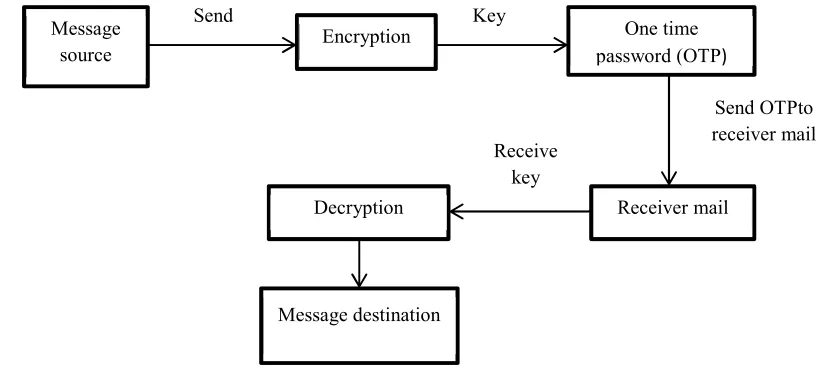
The medical data is transmitted from doctor professionals to engineering professionals in this cryptographic method have been implemented for secure transaction. In order to provide better security one of the emerging double step encryption is followed. Initially the record is encrypted with a key and transmitted from source to destination. In addition to it one time password is also implemented therefore this increases secure and privacy.
Fig 1: Message cryptographic method
From the medical data received the professional’s searches the appropriate remedy from already details available in the database is selected. Therefore the data is retrieved from the database should be done in an effective way by
an effective algorithm CART. Proposed
algorithm is described briefly as follows,
3.2 CART Algorithm:
CART analysis is carried out in a tree-building method that is differing from traditional data analysis methods. From the analysis, CART has been identified to be effective for making decision rules which perform as well or better than rules developed using more basic
approaches. With advantage, CART is
frequently able to uncover complex interactions between predictors which may be hard or difficult using fundamental
multivariate techniques. It is now possible to perform a CART analysis with a basic knowledge of each of the several procedures involved in its procedure. Classification tree methods such as CART are proper method to produce a prediction law from a set of observations described in terms of a vector of application and a response value. The goal is to describe a general prediction rule which can be used to assign a response value to the situations solely on the origins of their predictor (explanatory) variables. CART can be implements either as a classification tree or as a regressive tree based on whether the response variable is categorical or continuous. Tree based approaches are not depends on any stringent expectations. These methods can handle large number of variables, are resilient to outliers, non-parametric, more flexible, can handle categorical variables, though computationally more intensive.
Decision Trees are usually utilized in data mining with the objective of creating a model that predicts the value of an objective (or dependent variable) depends on the values of several input (or independent variables). The CART or Classification &Regression Trees methodology is used. Classification tree is defined as where the target variable is categorical and the tree is consumed to detect the class within the target variable would likely fall into. Where the Regression tree is discussed as the target variable is continuous and tree is used to predict its value.
The construction of tree is implemented using condition procedures, commonly tree structure support quick search of required data from a huge database in addition extracting the required data exactly is another important factor is done by following mathematical steps. If the condition is true then moves the search in left direction otherwise move it to right side of search. The CONDITION is stated as “attribute Xi <= C” for successive attributes.
Step 1: The basic key is to select a fragment at each node so that the data in each subset (child node) is “purer” than the information in the parent node. CART evaluates the impurity of the data in the nodes of a split with an impurity measure i(t).
Step 2: If a split sat node t sends a proportion pL
ISSN: 1992-8645 www.jatit.org E-ISSN: 1817-3195
41
corresponding proportion pR of data to its right
child node tR, the decrease in impurity of split
Sat node tis defined as
∆i(s,t) = i(t) – pLi(tL) – pRi(tR)
……….(1)
= impurity in node t
– weighted average of impurities in nodes tL and
tR
Step 3: A CART tree is raises, beginning from its root node (i.e., the entire training data set) t=1, by searching for a split s* among the set of all available candidates S that give the largest decrease in impurity
Δi(s*,1) =maxΔs∊S i(s,1)
……….(2)
Then node t=1 is split in two nodes t=2 and t=3 using split s*
Step 4: The above split searching process is repeated for each child node.
Step 5: The tree growing process is stopped when all the stopping criteria are met.
The tree is constructed based on the above steps therefore well-structured result has been obtained from the implementation. Based on record received from doctor professionals data diagnosis is done and required result is obtained by dint of CART.
Working of proposed system:
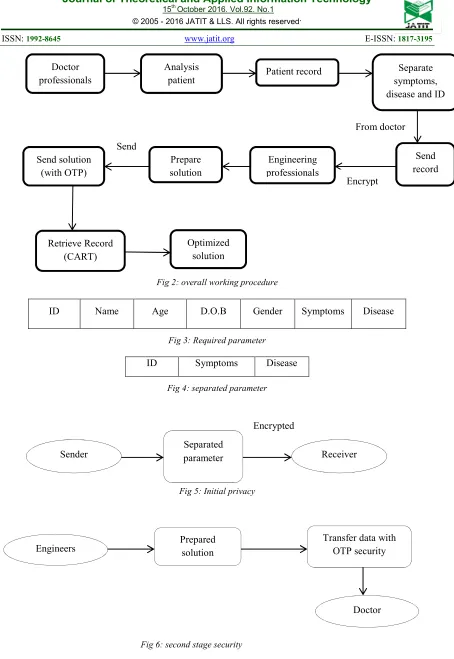
An algorithmic step of proposed method has been described briefly above. Now it’s working in bio medical engineering is explained below. Initially, secure issues are taken into consideration and processed in a way to avoid security and privacy issues among the patient. Symptoms and disease of users are analyzed clearly by the professional and database is maintained.
Fig 2: overall working procedure
Initially the default record collected by doctor contains ID, Name, age, gender, and date of birth, symptoms and disease. Where the complete health detail of the patient is collected and maintained clearly.
Fig 3: Required parameter
For each record a unique ID will be assigned and separated in the format as ID,
symptoms and disease. The first step of privacy is initiated here. This providesa way that the engineering professional does not know the patient detail that is suffering from the disease.
Fig 4: separated parameter
Fig 4 details alone transmitted from the doctor database to engineering professionals in encrypted form. Therefore receiver decrypts it and collects the separated parameter and start the work according to the condition of the patient.
Fig 5: Initial privacy
The engineers receive the separated parameter and design the equipment or suggest solution according to disease and transfer the solution to doctor through security system OTP. Therefore solution to the particular patient record will be retrieved through a mail based decryption method.
Fig 6: second stage security
Finally the doctor retrieves the data using CART for exact identification of user. If any mismatch is done then whole work, cost, time everything is waste and it may cause an issue to the life of patient. Therefore each parameter is checked for exact identification of patient and there solution to it.
4. RESULT AND DISCUSSION
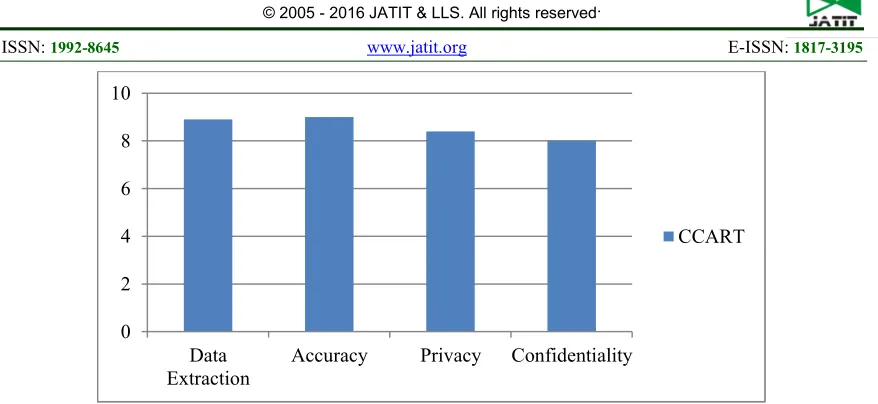
The implementation shows that proposed method have achieved better result and goal of the work is achieved. The issues have been taken into consideration and overcome using the
proposed approach. In existing methods
treatment procedures were concentrated and privacy issues are not concentrated. The proposed system works in all aspects and output shows better results.
Fig 7: Result of proposed method in various parameters
Proposed method is compared with existing available methods using various parameters and the result is shown below. From the parameters it shown that proposed method generates better results.
Fig 8: Result compared with existing methods
CONCLUSION:
ISSN: 1992-8645 www.jatit.org E-ISSN: 1817-3195
42 sets and their result searches are growing the security and exact retrieval is issues must concentrate to add an additional advantage to the results. Therefore the proposed method achieves
in obtaining better results in addition
overcoming the issues that were taken
throughout the work. CCART methods provide security in data transaction and implemented exact retrieval of patient for treatment. Finally implementation shows better result when compared to existing methods. In future the work can be extended by encrypting the whole document in order to provide privacy this may create critical issues in encryption and decryption among source and destination.
REFERENCE:
[1] Sumit Vashishta and Dr. Yogendra Kumar Jain, (2011)“Efficient Retrieval of Text for
Biomedical Domain using Data Mining
Algorithm” (IJACSA) International Journal of
Advanced Computer Science and Applications,
Vol. 2, No. 4.
[2] Hemalatha T., Gowthami B.G., Divya Sri A., Sindhuri Ch., SriDivya Y., BhanuVidhyaKiran
B., (2012) “Intelligent Data Mining in
AutonomousHeterogeneous Distributed Bio
Databases” (IJCSIT) International Journal of
Computer Science and Information Technologies,
Vol. 3 (2), 3778-3781.
[3]Graciela Gonzalez, Kevin Bretonnel Cohen, Maricel Kann G., Casey Greene S., Robert Leaman, Udo Hahn, Nigam shah and Jieping ye, (2012) “Text And Data Mining For Biomedical Discovery”.
[4] Madasamy B., Dr.Jebamalar Tamilselvi J., (2013) “General Framework for Biomedical
Knowledge With Data Mining Techniques”
International Journal of Computer Trends and
Technology (IJCTT) – volume 4 Issue 5–May
ISSN: 2231.
[5] Ms Nikhita B Ugale, Prof Deshpande S.D., (2016) “Prevention for Direct and Indirect
Discrimination in Data Mining” (IJCSIT)
International Journal of Computer Science and Information Technologies, Vol. 7 (2) , 960-963. [6] Shameem Fathima A., Mani megalai D. and Nisar Hundewale , (2011) “A Review of Data Mining Classification Techniques Applied for Diagnosis and Prognosis of the
Arbovirus-Dengue” IJCSI International Journal of
Computer Science Issues, Vol. 8, Issue 6, No 3. [7] Chitra R., and Seenivasagam V., (2013) “Review Of Heart Disease Prediction System Using Data Mining And Hybrid Intelligent
Techniques” ICTACT Journal On Soft
Computing, July, Volume: 03, Issue: 04.
[8] Jiban Pal k., (2011) “Usefulness and applications of data mining in extraction
information from different perspectives” Annals
of Library and Information Studies Vol.58,
March, pp.7-16.
[9] Mohammed Abdul Khaleel, Sateesh Kumar Pradham and Dash G.N., (2013) “A Survey of Data Mining Techniques on Medical Data for
Finding Locally Frequent Diseases” International
Journal of Advanced Research in Computer
Science and Software Engineering Volume 3,
Issue 8.
[10] Radhika, (2008) “Topics in Biomedical Informatics Data Mining and its applications and
[image:6.612.117.526.541.725.2]usage in medicine” Spring.
Fig 1: Message cryptographic method Message
source Encryption
One time password (OTP)
Receiver mail Decryption
Send Key
Send OTPto receiver mail Receive
key
ISSN: 1992-8645 www.jatit.org E-ISSN: 1817-3195
[image:7.612.89.543.43.702.2]43
Fig 2: overall working procedure
ID Name Age D.O.B Gender Symptoms Disease
Fig 3: Required parameter
ID Symptoms Disease
Fig 4: separated parameter
Fig 5: Initial privacy
Fig 6: second stage security Doctor
professionals
Analysis
patient Patient record
Separate symptoms, disease and ID
Engineering professionals
Send record Prepare
solution Send solution
(with OTP)
Retrieve Record (CART)
Optimized solution
From doctor
Encrypt Send
Sender Receiver
Separated parameter
Encrypted
Engineers Prepared solution
Transfer data with OTP security
ISSN: 1992-8645 www.jatit.org E-ISSN: 1817-3195
[image:8.612.90.529.58.260.2]44
Fig 7: Result of proposed method in various parameters
Fig 8: Result compared with existing methods 0
2 4 6 8 10
Data Extraction
Accuracy Privacy Confidentiality
CCART
0 1 2 3 4 5 6 7 8 9 10
Genetic Algorithm
Fuzzy Sets SVM CCART
Security
Data extraction
[image:8.612.121.490.295.483.2]