6
I
January 2018
A Hybrid BPSO-ST Swarm Intelligence Approach
for Resolving Economic Load Dispatch Problem in
Power System
Atinder pal Singh1, Harkamal Deep Singh2
1,2
Department of Electrical Engineering, GGS college of modern technology (Kharar,Pb)Punjab Technical University, Jalandhar, India
Abstract: Economic load dispatch provides optimization method which divides demand of the power among online generators economically by satisfying different constraints. ELD can concluded as scheduling of committed generating units by meeting up the demands of the consumers while reducing operational cost to the utilities with satisfying equality and inequality constraints. In this work several optimization algorithm have discussed such as Genetic Algorithm, Lambda Optimization Algorithm and Particle Swarm Optimization. These optimization algorithms can be used as per the requirement of the system. A hybrid mechanism i.e. BPSO-ST (Binary Particle Swarm Optimization-State Transition) algorithm for ELD is developed in this study. Resultant graph in the result and discussion section shows that BPSO-ST is better in terms of total power output generation and total generation cost and total Power Loss in comparison to the POS, Lambda and GA optimization algorithm.
Keywords: Economic Load Dispatch, BPSO, State Transition, Power Generation, Transmission Loss, Total cost. I. INTRODUCTION
II. PROBLEMFORMULATION
Electrical power industry restructuring has created highly vibrant and competitive market that altered many aspects of the power industry. Economic Load Dispatch (ELD) is one of the important optimization problems in power systems that have the objective of dividing the power demand among the online generators economically while satisfying various constraints. Economic load dispatch problem is the sub problem of optimal power flow (OPF). The economic load dispatch is defined as the process of allocating generation levels to the generating units, so that the system load is supplied entirely and most economically. For the connection between the two systems it is important that the expenses should be minimized. To describe the production level, each unit in the system is defined, so that the total cost of the system is calculated. The expenses should be less. Economic load dispatch problem is the sub problem of optimal power flow (OPF). The main objective of ELD is to minimize the fuel cost while satisfying the load demand with transmission constraints. So main aim of ELD is to minimize the expense of the system.
III.PROPOSEDWORK
The objective of the Economic Dispatch Problems (EDPs) of electric power generation is to schedule the committed generating units outputs so as to meet the required load demand at minimum operating cost while satisfying all units and system equality and inequality constraints. The Economic Dispatch Problem is solved by specialized computer software which should honor the operational and system constraints of the available resources and corresponding transmission capabilities. Recently, global optimization approaches inspired by swarm intelligence and evolutionary computation approaches have proven to be a potential alternative for the optimization of difficult EDPs. In the proposed work the solution of economic load dispatch will be done by using the swarm intelligence approach mostly the work is done on basis of GA, ACO. PSO etc. out of which the better working is done by using the GA because the binary data is used for the solution which has much capability to provide the variation in the data. So inspired from that the proposed algorithm will work on the binary data based PSO with hybridization of state transition The proposed technique uses the BPSO in order to minimize the cost incurred on power generating and transmission. The methodology of proposed technique is implemented in following steps:
A. First step is to set power generator parameters. Every generator has its own parameters such amount of generated power, amount of total lost transmission etc. The parameters are generated on the basis of some equations.
B. After setting the power generator parameters the power requirement or demanded power of various units will be entered. C. Now generate random population. In BPSO the generation of random population is an important step.
D. Now calculate the cost incurred on generating the power by using cost characteristic equation. E. Now evaluate the minimum or maximum range of generated power from the above calculated cost. F. Number of iterations will execute in order to find the best fitness value.
G. Now apply proposed BPSO and state transition for optimizing the fitness value from obtained set of fitness value. H. Evaluate the final output and various parameters such as total generated power. Total power loss, total cost incurred.
Set Generator parameters
Enter demanded power
Generate Random population
Evaluate cost characteristic equation
Calculate initial fitness value Check for minimum or maximum range
Optimize fitness value with BPSO and
IV.RESULTSANDEXPERIMENTS
This section provides a overview to the results that are obtained after implementing the proposed work i.e. Hybridization of BPSO and ST optimization for ELD.Fig.2 depicts the power generation by 6 power plants in case of proposed work. The x axis in the graph shows the number of power plants and y axis calibrates the values corresponding to the power generation. The power generation varies from 0 to 200 MW. The power generation corresponding to P1 is observed to 14 MW, for P2 it is 91 MW, for P3 it is 99 MW, for P4 it is 145 MW, for P5 it is 181 MW and for P6 it is 185 MW.
Fig.2 Power Generation by 6 power plants
Fig.3 Cost of Power Plant
The fig.3 depicts the overall cost of proposed work with respect to the number of iterations in a power system. The major objective of ELD is to reduce the overall cost incurred on power generation system. The x axis in graph below shows the number of iterations that varies from 0 to 20 and y axis shows the cost in $/hour. As per the observation from the graph below, it can be said that the cost incurred on power generation in proposed work is getting lower as the number of iteration get increase.
P1 P2 P3 P4 P5 P6
0 50 100 150 200 250
P
o
w
e
r
(M
W
)
Power Plants
BPSO-ST Method
0 2 4 6 8 10 12 14 16 18 20
3.2 3.4 3.6 3.8 4 4.2 4.4 4.6 4.8 5
5.2x 10
4
C
o
s
t
($
/h
r)
Iteration
Fig.4 Fitness value achieved by proposed work
The graph in fig.4 shows the fitness value that is achieved in proposed work. The graph shows the fitness value with respect to the number of iterations in power generators. When the iteration number was 2 than the fitness value was 0.9682 which was quite high. At 20th iteration, the achieved fitness value was 0.6244. The proposed work finds the optimal solution continually, thus the decrement in the fitness value can be seen after each iteration. This is done to find out the optimal solution for power generation plant.
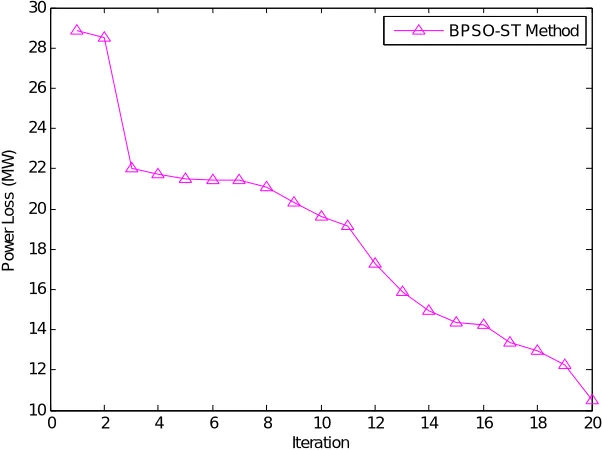
The graph in fig. 5shows the curve of power loss in power system with respect to the given number of iterations. There are total 20 iterations. On the basis of the graph drawn it can be concluded that the power loss in proposed work is 37.92 MW at the time of first iteration which is quite highest but it comes to the 12.97 MW at 20th iteration.
Fig. 5Power Loss in case of proposed work with respect to iterations
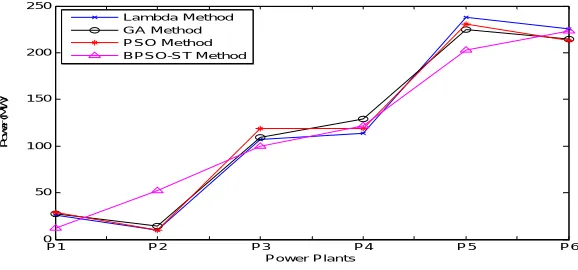
The graph in fig.6 shows the comparison of proposed work, Lambda Method, GA Method, PSO Method. The comparison is done on the basis of power generation in different power plants. The y axis calibrates the data in the terms of power that varies from 0 MW to 250 MW. The curve in blue color depicts the performance of the Lambda method, the curve in black color shows the performance of GA method, curve in red color shows the performance corresponding to the PSO method and curve in magenta color shows the performance of BPSO-ST method.
0 2 4 6 8 10 12 14 16 18 20
0.7 0.75 0.8 0.85 0.9 0.95 1
F
it
n
e
s
s
Iteration
BPSO-ST Method
0 2 4 6 8 10 12 14 16 18 20
10 12 14 16 18 20 22 24 26 28 30
P
o
w
e
r
L
o
s
s
(
M
W
)
Iteration
[image:5.612.152.453.392.617.2]Fig.6 Comparison of proposed and traditional optimization approaches
The graphs make it sure that the proposed work has best power generation in comparison to the traditional optimization techniques. The table I below comprised of the power generation by the all of the optimization technique in all power plants. On the basis of the values of the table I, it is concluded that the BPSO-ST is the optimization technique that optimizes the power generation to a better level in comparison to all of the techniques.
Table I
POWER GENERATION WITH RESPECT TO THE DIFFERENT POWER PLANTS
Power Plant Lambda Method GA Method PSO Method BPSO-ST Method
P1 28.81 28.81 28.81 14
P2 10 14.38 10 91
P3 109 109 119 99
P4 114 128.7 118.7 145
P5 238.1 224.5 230.8 181
P6 225.4 214.9 214.9 185
The graph in fig.7 shows the comparison of proposed and existing optimization techniques for optimizing the performance of the power generation systems. The comparison is done on the basis of the optimized power generated by the system. The graph depicts that the proposed work is more efficient to generate the optimized power generation system. The proposed work generates the 715 MW, Lambda system generates the 720 MW, GA method generates the 719 MW, and PSO generates the 719 MW. Thus it is proved that the more optimized power is generated by the BPSO-ST method. The table II depicts the values that are obtained from the graph below.
Fig.7 Comparison of optimization techniques with respect to the Power Generation
P1 P2 P3 P4 P5 P6
0 50 100 150 200 250 P o w e r (M W ) Power Plants Lambda Method GA Method PSO Method BPSO-ST Method 690 695 700 705 710 715 720 725 730 735 Different Method P o w e r (M W )
Total Power Ouput (MW )
Table II
POWER GENERATION
Techniques Value
BPSO-ST 717MW
PSO 719MW
GA 719MW
Lambda Optimization 720MW
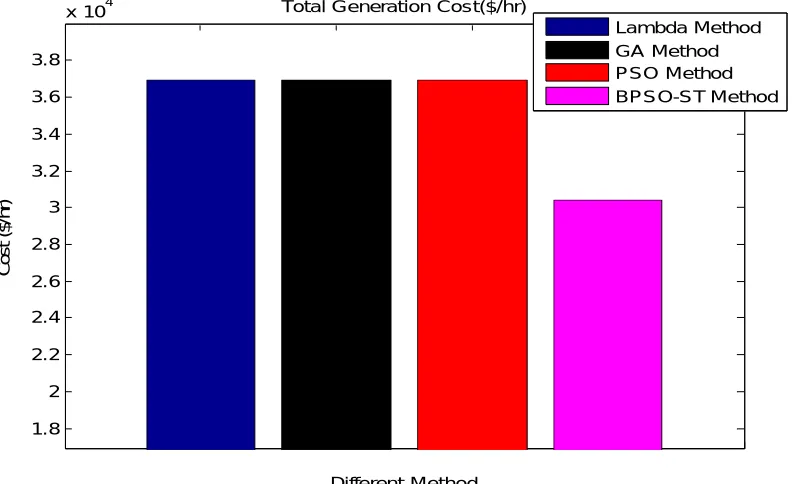
[image:7.612.112.510.262.504.2]The graph in fig. 8 shows the comparison of BPSO-ST method with rest of the considered optimization technique in the terms of total generation cost incurred on the system. The objective of the ELD system is to reduce the total power generation cost to make it more feasible for the customer. The graph below illustrates that the generation cost of BPSO-ST optimization technique is quite lower in comparison to the Lambda method, GA and PSO. The table III depicts the values of total generation cost of all the considered techniques
Fig. 8 Comparison of optimization techniques with respect to the Total Generation Cost
Table III TOTAL GENERATION COST
Techniques Cost($/hr)
BPSO-ST 36900
PSO 36900
GA 36900
Lambda Optimization 30400
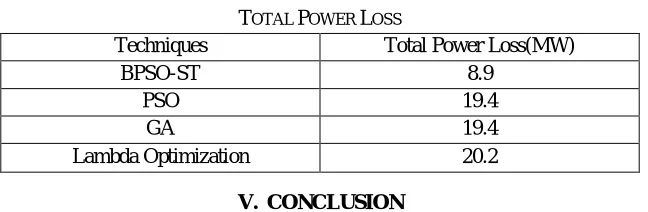
The comparison graph in fig.9 depicts the total power loss in BPSO-ST, PSO, GA and Lambda optimization techniques. The total power loss should be low always in a power generation system. The obtained total power loss in BPSO-ST is 8.9 MW and it is much lesser than 19.4 MW, GA 19.4 MW, 20.2 MW in PSO, GA and Lambda optimization respectively. Table IV shows the Total
1.8 2 2.2 2.4 2.6 2.8 3 3.2 3.4 3.6 3.8
x 104
Different Method
C
o
s
t
($
/h
r)
Total Generation Cost($/hr)
Fig. 9Comparison of optimization techniques with respect to the Total power loss
Table IV TOTAL POWER LOSS
Techniques Total Power Loss(MW)
BPSO-ST 8.9
PSO 19.4
GA 19.4
Lambda Optimization 20.2
V. CONCLUSION
Economic Load Dispatch is the process known for distributing load in such a way so that economic cost of the power system should be used less and requirement of the consumer fulfilled. Thus in this work different optimization algorithms have been studied which can be used to evaluate proper distribution of load over the power systems. Evaluation has been done between PSO, GA, Lambda optimization and proposed hybrid BPSO-ST which ensures that BPSO-ST outperforms among them. Several parameters such as total power output, total generation cost and total power loss have been discussed. These parameters conclude that BPSO-ST is efficient, effective and optimized than other optimization technique. As various optimization algorithms have been evaluated in this work where BPSO-ST declares as an efficient technique.
In future, more amendments can be done by collaborating the chaotic map search mechanism with present work in order to enhance the procedure of population generation. This will be an aid to consider multiple cases also.
VI.ACKNOWLEDGEMENT
I am lacking words to express my deep sense of gratitude and regard to my guide Mr. Harkamal Deep Singh (Assistant Professor, Department of Electrical Engineering, GGS College of Modern Technology, Kharar, (Punjab Technical University)) for providing me inspiration, encouragement, kind co-operation and esteemed guidance.
REFERENCES
[1]. Hardiansyah, Junaidi, Yohannes MS, Solving Economic Load Dispatch Problem Using Particle Swarm Optimization Technique, Intelligent Systems and Applications, Vol 12, pp 12-18, 2012,
[2]. Indrajit N. Trivedi ,Motilal Bhoye ,R. H. Bhesdadiya ,Pradeep Jangir ,Narottam Jangir ,Arvind Kumar, An emission constraint environment dispatch problem solution with microgrid using Whale Optimization Algorithm, IEEE, 2017
[3]. Anirban Dutta ,Snigdhajyoti Das ,Bhimsen Tudu ,Kamal K. Mandal, A novel improved algorithm using Cuckoo Search for Economic Load Dispatch, IEEE, IEEE International Conference onPower Electronics, Intelligent Control and Energy Systems (ICPEICES)2017,
[4]. S. Gautham ,J. Rajamohan, Economic Load Dispatch using Novel Bat Algorithm, IEEE, International Conference onPower Electronics, Intelligent Control and Energy Systems (ICPEICES), 2017
[5]. Uma Sharma ,Beaulah Moses, Analysis and optimization of economic load dispatch using soft computing techniques, IEEE, International Conference onElectrical, Electronics, and Optimization Techniques (ICEEOT),
[6]. Abhisek Mondal ,Deblina Maity ,Sumit Banerjee ,Chandan Kumar Chanda, Solving of economic load dispatch problem with generator constraints using ITLBO technique, IEEE, Students' Conference on: Electrical, Electronics and Computer Science (SCEECS), 2016,
0 5 10 15 20 25 P o w e r L o s s ( M W )
Total Power Lossse (MW)
Different Method
[7]. G Dwivedi Sandeepdhar ,Srikant Rout ,Hemanta Badhai ,Milan Swain ,Aniruddha Bhattacharya, Differential search algorithm for different economic dispatch problem, IEEE, International Conference onEnergy, Power and Environment: Towards Sustainable Growth (ICEPE),2016,
[8]. Deblina Maity ,Sumit Banerjee ,Chandan Kumar Chanda ,Sabyasachi Samanta, Implementation of quassi-oppositional TLBO technique on economic load dispatch problem considering various generator constraints, IEEE, 3rd International Conference onElectrical Energy Systems (ICEES), 2016,
[9]. Dipankar Santra ,Arindam Mondal ,Anirban Mukherjee ,Krishna Sarker, Hybrid PSO — ACO technique to solve economic load dispatch problem, IEEE, IEEE International Conference on: Research in Computational Intelligence and Communication Networks (ICRCICN), 2016,
[10].Pedro P. Vergara ,Ricardo Torquato ,Luiz C. P. da Silva, Towards a real-time Energy Management System for a Microgrid using a multi-objective genetic algorithm, IEEE, Power & Energy Society General Meeting, 2015,
[11].Kishan Bhushan Sahay ,Nimish Kumar ,M. M Tripathi, Implementation of different optimization techniques to solve ELD problem, IEEE, Power India International Conference (PIICON), 2015,
[12].Sunanda Hazra ,Provas Kumar Roy ,Anupam Sinha, An efficient evolutionary algorithm applied to economic load dispatch problem, IEEE, Third International Conference onComputer, Communication, Control and Information Technology (C3IT), 2015,
[13].Ming ASun ,Shaojie Cui ,Yaoqun Xu, Economic load dispatch of power systems based on hysteretic noisy chaotic neural network, IEEE, Workshop onAdvanced Research and Technology in Industry Applications (WARTIA), 2014,
[14].Parmvir Singh Bhullar, “Particle Swarm Optimization Based Economic Load Dispatch with Valve point Loading”, ijert, vol 4(5), Pp 1064-1071, 2015, [15].Bhagyashree Hosamani,”Analysis of Economic Load Dispatch using fuzzified PSO”, ijret, vol 3(3), Pp 237-241, 2014
[16].Nishant Chaturvedi,”A survey on Economic load Dispatch problem using Particle Swarm Optimization Technique”, ijetae, vol 4(3), Pp 188193, 2014, [17].Hamed Aliyari1, Reza Effatnejad, Ardavan Areyaei, 2014, “Economic load dispatch with the proposed GA algorithm for large scale system” , journal of energy
and natural resources, vol 3(1), Pp 1-5, 2014
[18].Nguyen Trung Thang, August, 2013, “Economic Emission Load Dispatch with Multiple Fuel Options Using Hopfield Lagrange Network”, ijast, vol 57, Pp 9-25, 2013
[19].Jaya Sharma, et al, February 2013, “Particle Swarm Optimization Approach For Economic Load Dispatch: A Review” , ijera, vol 3(1), pp 13-22, 2013 [20].Emmanuel Dartey Manteaw, Dr. Nicodemus Abungu Odero, December 2012, “Combined Economic and Emission Dispatch Solution Using ABC_PSO Hybrid
Algorithm with Valve Point Loading Effect”, ijsrp, vol 2(12), Pp 1-9, 2012
[21].K. Senthil M.E, 2010, “Combined Economic Emission Dispatch uses Evolutionary Programming Technique”, science direct, vol 19(6), Pp 1754-1762, 2012 [22].B. Shaw, S. Ghoshal, V. Mukherjee, and S. P. Ghoshal, 2011, “Solution of Economic Load Dispatch Problems by a Novel Seeker Optimization Algorithm”,
ijeei, vol 3(1), Pp 26-43, 2011
[23].Arijit Biswas, Sambarta Dasgupta, Bijaya K Panigrahi, V. Ravikumar Pandi, Swagatam Das, Ajith Abraham and Youakim Badr, “Economic Load Dispatch Using a Chemotactic Differential Evolution Algorithm”, springer, Pp 252-260, 2009