Design Of Content Based Image Retrieval
Technique(S)Based On Gabor Color Correlation
Feature
Anjali1 1
M. Tech StudentCSE Dept, BPSMV, KhanpurKalan, Haryana, India
Abstract:The enormous growth in the internet and multimedia technology has generated a huge amount of data in the form of
images, videos, and audio. This has created the demand of systems which can store and retrieve multimedia data like images in an effective and efficient manner. Content Based Image Retrieval (CBIR) is the searching, navigation and retrieval of images based on their visual content. Visual content of image include color, texture, shape and spatial location of objects depicted in the image. The low level features like color, texture and shape have limited capability for describing visual contents of an image. Therefore semantic gap is observed between visual interpretation and representation of images with low level features.
Keywords: CBIR, Database, Image retrieval, Color features
I. INTRODUCTION
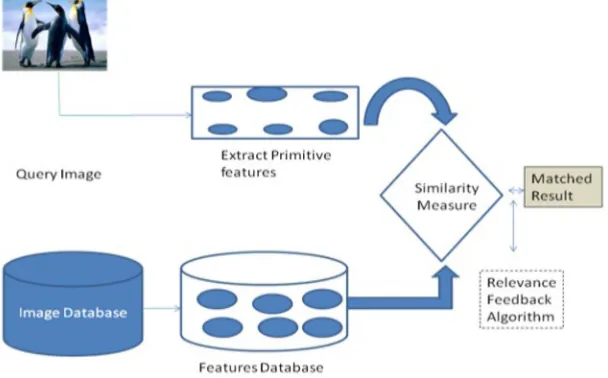
[image:2.612.154.458.411.600.2]A CBIR system uses visual contents of the images described in the form of low level features like color, texture, shape and spatial locations to represent the images in the databases. The system accesses similar images when a sample image or sketch is put as input to the system [1]. Querying in this way eliminates the need of describing the visual content of images in words and is close to human perception of visual data. Some of the representative CBIR systems are Query by Image Content (QBIC) [2].
Figure 1: Architecture of a typical CBIR system
facilitates the optimal searching of the image storage. Recently, user’s relevance feedback is also incorporated to further improve the retrieval process in order to produce perceptually and semantically more meaningful retrieval results.
II. COLORFEATURES
Color is the most generally used characteristics of an image. The perceived color at any pixel of an image is examined by combining three preliminary colors in appropriate part. The three dimensional color gives more discriminating data than the single dimensional gray level values. Before accessing color descriptor a proper color space must be determined first [4].
Generallyperformed color spaces for image access application are RGB, that represent by CIE L*a*b*, CIEL*u*v*, HSV and opponent color space [5]. There is no agreement over which color space is best but one of the desirable characteristic of color space for image retrieval task is its uniformity. Some generally performed color described are color moments, color histogram, color coherence vector and colorcorrelogram.
III. PROBLEMSTATEMENT
Size of database is increasing day by day. Due to large size, it is very difficult for any user to access necessary information in less time. This problem arises in every type of database. So we choose database of images. Our basic motive is to access the image once and then the similar image does not take time for extract from large image database.
IV.CONCEPTUALFRAMEWORK
V. PROPOSEDWORK
After study the existing work with some issues, we propose a new method which performs well as compared to existing. Some steps which we need to pass are as following:
A. Select an image from database.
B. Apply Gabor filter.
C. Extract features on color correlation basis and store in confusion matrix for further comparison.
D. Now apply the Euclidian distance measure formula.
E. Compare the features with images existing in database
F. Now we get near about all image that’s feature match with selected image
VI. RESULTANALYSIS
[image:4.612.169.455.136.381.2]Select scripts file ‘CBIR.m’ and run it on Matlab development environment.After complete execution we get a GUI window as showing.
Figure 2 a graphical user interface
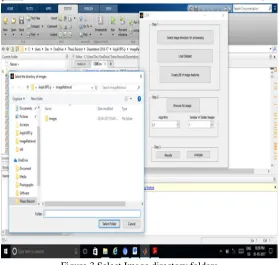
When we click on the top most button then a dialog box open and we select that folder from where directory created.
Figure 3 Select Image directory folders
[image:4.612.172.451.418.683.2]Figure 4 Load database form implementation.
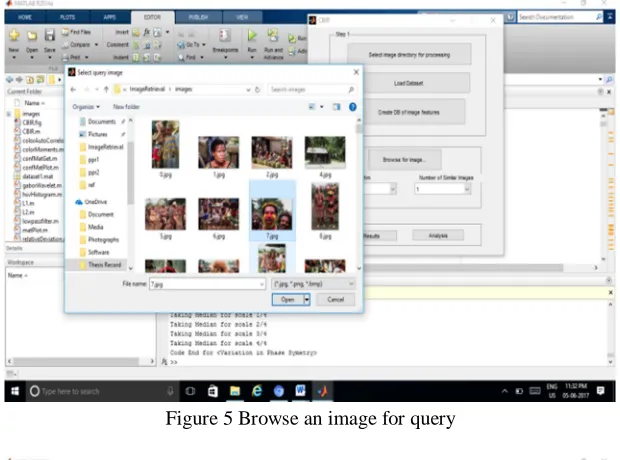
[image:5.612.155.465.394.701.2]Figure 7 Select how much similar images you want
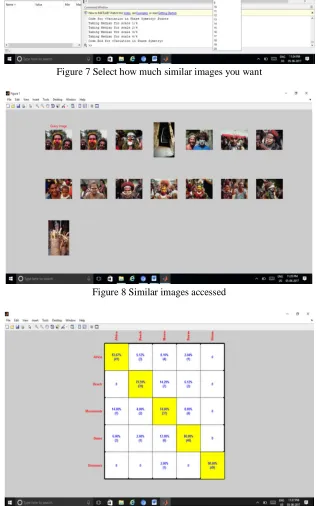
Figure 8 Similar images accessed
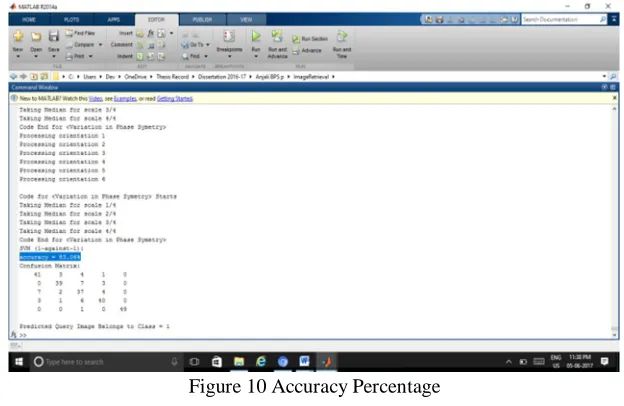
[image:6.612.153.469.500.720.2]Figure 10 Accuracy Percentage
VII. CONCLUSIONS
This technique is most helpful for all type images. As such, content-based image access can be executed after images have been divided using content characteristics. After this process, images can be matched color by color. Furthermore, since content is difficult to explain or examine, in a access system, clients are generally given examples to choose for retrieval, the example contents are usually homogeneous and correspond to different parts of images. Therefore, content access is very helpful for region-based access. In our future scope, content segmentation will be incorporated into our system to facilitate content-based retrieval. SVM can be used in future for further classification.
REFERENCES
[1] Ms.Pragati Ashok Deole, Prof. RushiLongadge, “Content Based Image Retrieval using Color Feature Extraction with KNN Classification”, International Journal of Computer Science and Mobile Computing, Vol.3 Issue.5, May- 2014
[2] K. Haridas, Dr. Antony SelvadossThanamani, “Well-Organized Content based Image Retrieval System in RGB Color Histogram, Tamura Texture and Gabor Feature”, International Journal of Advanced Research in Computer and Communication Engineering Vol. 3, Issue 10, October 2014.
[3] AmmarHuneiti, MaisaDaoud, “Content-Based Image Retrieval Using SOM and DWT” Journal of Software Engineering and Applications, 2015
[4] Mohammed Alkhawlani, Mohammed Elmogy, HazemElbakry, “Content-Based Image Retrieval using Local Features Descriptors and Bag-of-Visual Words”, International Journal of Advanced Computer Science and Applications, Vol. 6, No. 9, 2015