5
X
October 2017
Facilitate NH Department in Web Application
Using Cloud
Kirubakaran.K1, Mrs. Karthiyayini. R2
1
Student, Department of Computer Applications, Anna University, BIT Campus, Trichy, Tamilnadu, India
2
Assistant Professor, Department of Computer Applications, Anna University, BIT Campus, Trichy, Tamilnadu, India
Abstract: The scope of the development of web application for National Highway department is to provide an easy access to all the officers of the department and monitoring employees status. This avoids the transport efforts for the onsite review of the development of projects. This also makes the public aware of the working and efforts taken by the departmental officers in the development of proper means of transport facilities. The application helps to upload the video of the development of the projects periodically in the website and can be viewed by every citizen. Cloud computing is the recent technique used now-a-days for accessing voluminous amounts of data. This technique helps to store and retrieve the data in an efficient and secure manner. Thus, the Ease Use Web Application for NH Department aims in developing a user friendly and efficient website for the NH department of India using Cloud storage.
Keywords: web application; cloud storage; video uploading; NH department
I. INTRODUCTION
A. NH Department
A good road network is an essential infrastructure to determine the economic development of the country. This connects the remote areas, markets, schools and hospitals and helps in developing trade and investment. The NH Department of India is a network of highways that is managed and maintained by agencies of the Government of India. These highways measured over 165,000km as of December 2016, including over 1,000km of limited-access expressways (motorways). Out of 1,65,000km of national highways 26,200 plus km are at least lane with the remaining 50,000km 2 lane. As of Jun 2017, 23km per day has been achieved which is unprecedented in Indian History. In India, there are also Express Highways, known as Expressways, which are controlled-access highways. This is mostly 6-lane or above and is controlled by the use of slip roads (ramps) at the entrance and exit. The at-grade national highways do not have shoulder lanes. The NHAI, the National Highways Authority of India is the prime agency for building, upgrading and maintaining the national highways network. It operates under the Ministry of Road Transport and Highways. The National Highways Development Project (NHDP) is a major effort to expand and upgrade the network of highways. NHAI often uses a public-private partnership model for highway development, maintenance and toll-collection. Over 30,000km of new highways are planned or under construction as part of the NHDP, as of 2011. This includes over 2,600km of expressways under construction.The transportation system in Tamil Nadu coects all parts of the state. It provides a wide range of road network, linking urban centres, agricultural market-places and rural areas. There are 29 national highways in the state, covering a total distance of 5,006.14km. The state is also a terminus for the Golden Quadrilateral project. The state has a total road length of 167,000km, of which 60,628km are maintained by Highways Department. The major road junctions are Chennai, Vellore, Madurai, Trichy, Coimbatore, Salem, Tirunelveli, Tuticorin, Karur, Krishnagiri, Dindigul, Kanniyakumari. This is provided and maintained by Tamil Nadu State Transport Corporation and State Express Transport Corporation.
B. Web Application Development
As cloud computing is the newest term for the long-dreamed vision of computing utilities, according to NIST cloud computing means - “cloud computing is a model for enabling ubiquitous, convenient, on-demand network access to a shared pool of configurable computing resources that can be rapidly provisioned and released with minimal management effort or service provider interaction. This Cloud model is composed of five essential characteristics, three service models, and four Deployment models.” Cloud computing is the widely used modern technology in this computerized era. Cloud is a metaphor to describe web as a space where computing has been preinstalled and exist as a service; data, operating systems, applications, storage and processing power exist on the web ready to be shared. To users, cloud computing is a Pay-per-Use-On-Demand mode that can conveniently access shared IT resources through the Internet. Where the IT resources include network, server, storage, application, service and so on and they can be deployed with much quick and easy manner and least management and also interactions with service providers. The benefits of moving to cloud storage are flexibility, disaster recovery, unlimited storage, easy access of information, quick deployment, automatic software updates, increased collaboration, always available, work from anywhere, security, competitiveness and environment friendly.
II. LITERATURESURVEY
According to the paper “Cloud Computing – Research Issues, Challenges, Architecture, Platforms and Applications: A Survey” by Santosh Kumar and R. H. Goudar, The cloud service models are commonly divided Software as a Service (SaaS) helps the cloud consumers release their applications in a hosting environment, which can be accessed through networks from various clients by application users, Platform as a Service (PaaS) is a development platform supporting the full Software Lifecycle which allows cloud consumers to develop cloud services and applications directly on the PaaS cloud, Infrastructure as a Service (IaaS) makes the cloud consumers directly to use IT infrastructures provided in the IaaS cloud, Data as a Service (DaaS) is the delivery of virtualized storage on demand - data storage service. From the paper “A Survey on Cloud Computing” by Harshitha. K. Raj, the main characteristics of cloud computing are On-demand self-service a provision for computing capabilities and computer service such as network, email, applications and servers, broad network access to access all the business management solutions, resource pooling is the provider’s computing resource are pooled to serve multiple consumers using a multi-tenant model, with different physical and virtual resources dynamically assigned and reassigned according to the consumer demand, rapid elasticity by providing flexible and scalable to the needs of the consumer and cloud computing resource usage can be measured, controlled and automatically control to optimize resource use.Using the paper “Developing Web Applications” by Sabah Al-Fedaghi, one approach to developing service-oriented Web applications is to transform high-level business models to a composition language that implements business processes with Web services. Web applications require a comprehensive approach that embraces many aspects, including technical, organizational, and legal/philosophical dimensions. Conceptual modelling methods have been used to abstractly describe requirements for software development processes for the Web.Using the paper “Enterprise Content Management on Cloud” by T.Arulmozhi and N.Saranya, as organizations struggle to manage an ever-growing volume of unstructured business data, they need to develop a strategy for effective content management applications across the enterprise. A Cloud Enterprise Content Management (ECM) platform makes easy for the companies to overcome the high development and maintenance costs, administrative complexity, and barriers to adoption of traditional, deployed ECM software solutions. The emergence of cloud platforms as secure, stable, enterprise class solution providers mean that organizations can now deploy multiple ECM applications cost-effectively throughout the enterprise without adding new hardware, software resources. It becomes integral business processes and a valuable contributor to business success.
III.EXISTINGSYSTEM
The current website for NH department displays the present schemas and projects along with the details of the roads and department. This site is open to all the public. The public can view all the details in the website. But there is no any provision to view the progress of the ongoing projects.
Fig. 1 The Current Website of NH Department
IV.PROPOSEDSYSTEM
The proposed web application for the NH department is a web application which aims to overcome the current problems faced by the officials to check the progress of the constructing projects. It also aims to give a flexible solution via online submissions of the progress of the ongoing projects.Each road constructions have a separate portal in which the progress of their current work is updated frequently to the chief officer. The progress of the work is their submission like photos, videos which describe the status of the work to the chief officer. If the chief officer wants to discuss with the engineers, it is also done in the same portal. The public user can also know about the progress of the construction apart from the confidential information. The system also focuses on giving provision for the public to give their comments in the work of the construction.Only the authorized officials have the right to access the entire information about the road construction. This authorized officials are the higher officials who may act in the admin role to look after the entire website.
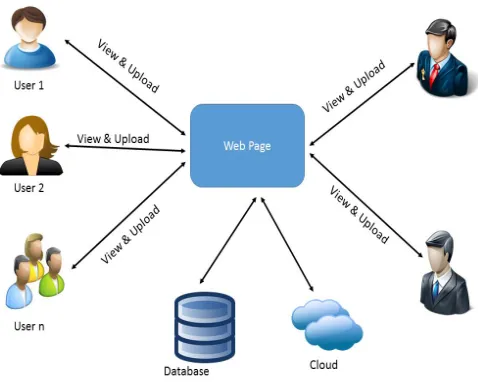
he proposed system architecture is explained below.
Fig. 2 The architecture of the Proposed System
The content like videos, images required for the website is in the cloud. It can be viewed by all the public users and the Admin and Engineers can upload the reports of the current project and view the same.
[image:4.612.177.416.431.622.2]Fig. 3 The MVC architecture layers of the proposed system
V. IMPLEMENTATION
The implementation of the web application is done in the following manner.
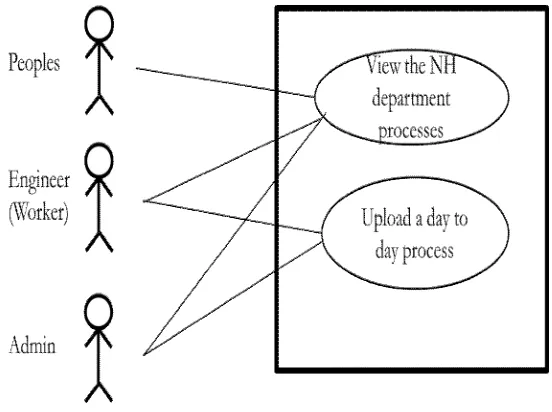
The hardware requirements are Processor - Basic Pentium IV 2.4GHz processor and all upgraded processors, Memory - 128MB RAM, Monitor - Screen resolution (full screen support) and Hard disk - 500MB of free space.he software requirements are Operating System-Windows XP and above, Front end - HTML & CSS, Back end -Cloud storage and MySQL along with PHP, Web Browser - any web browser.The modules are Login module and Video uploading module. The Login module is to check the user to upload the content based on the type of user whether Admin or Engineer. All public users can view and does not require any login. Video uploading module is to upload the video in cloud and store the details of the same in the servers’ database too.The Use case diagram is a graphic depiction of the interactions among the elements of a system. The use case diagram for the web application is,
Fig. 4 The Use Case diagram
[image:5.612.175.451.458.664.2]Fig. 5 The Activity diagram m
VI.RESULTS
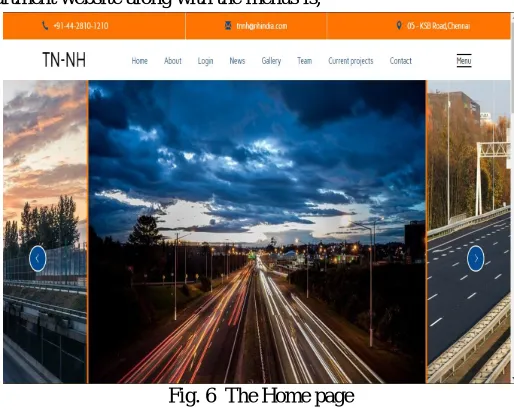
[image:6.612.176.433.350.555.2]The home page of the NH Department website along with the menus is,
Fig. 6 The Home page
The Login page which is used by the admin (Admin login) and Engineers (Engineer login) for uploading the videos, images and Public login page to give comments regarding the projects,
[image:6.612.151.461.605.723.2]Fig. 8 The Engineer page after Login
The web page to upload the video in cloud is,
Fig. 9 Uploading Video
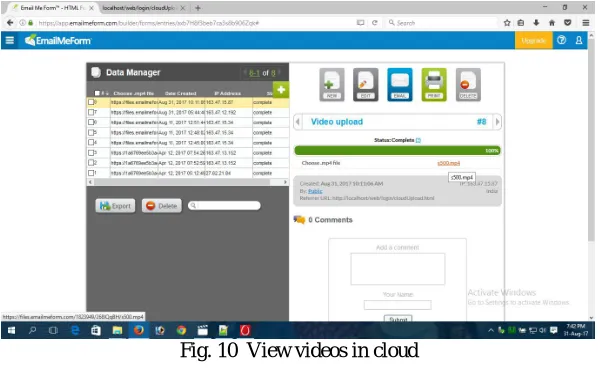
The page to view Upload videos,
Fig. 10 View videos in cloud
VII. CONCLUSION
The web application developed for NH department tries to overcome the current issues faced in monitoring the progress of the ongoing projects by uploading the images and videos of the projects in the website. This reduces the work load of the officials and also makes the public to know about the efforts and progress of the department in more user friendly way.
VIII. FUTUREWORK
[image:7.612.157.457.430.620.2]IX.ACKNOWLEDGMENT
I render my sincere and whole hearted thanks to Mrs.R.Karthiyayini, Assistant Professor, Department of Computer Applications, Anna University, BIT Campus, Trichy for her guidance and the support throughout the tenure of this work.
REFERENCES
[1] Avraham Leff, James T. Rayfield, “Web-Application Development Using the Model View Controller Design Pattern”. [2] Sabah Al-Fedaghi, “Developing Web Applications”, Apr., 2011.
[3] Santosh Kumar and R. H. Goudar, “Cloud Computing – Research Issues, Challenges, Architecture, Platforms and Applications: A Survey”, Dec., 2012. [4] Diptoneel Kayal, “CcMS: A Cloud Computing based Content Management System”, 2013.
[5] Maitanmi Olusola and Idowu Sunday, “Evaluation of Content Management Systems Performance”, Apr., 2013. [6] Harshitha. K. Raj, “A Survey on Cloud Computing”, Jul., 2014.
[7] T Arulmozhi and N Saranya, “Enterprise Content Management on Cloud”, January 2015.
[8] Sindhu Bharathi.A and et.al, “Implementing Content Management System in Cloud for e-Registration”, Sep., 2016. [9] The NH department Website [Online]. Available: http://nhai.gov.in/national-highways.htm.