Enhanced Frequency Resolution in Data Analysis
Luca Perotti, Daniel Vrinceanu, Daniel Bessis
Department of Physics, Texas Southern University,Houston, USA
Email: [email protected], [email protected], [email protected]
Received March 14, 2013; revised May 8, 2013; accepted July 9, 2013
Copyright © 2013 Luca Perotti etal. This is an open access article distributed under the Creative Commons Attribution License,
which permits unrestricted use, distribution, and reproduction in any medium, provided the original work is properly cited.
ABSTRACT
We present a numerical study of the resolution power of Padé Approximations to the Z-transform, compared to the Fou- rier transform. As signals are represented as isolated poles of the Padé Approximant to the Z-transform, resolution de- pends on the relative position of signal poles inthecomplexplanei.e. not only the difference in frequency (separation in angular position) but also the difference in the decay constant (separation in radial position) contributes to the reso- lution. The frequency resolution increase reported by other authors is therefore an upper limit: in the case of signals with different decay rates frequency resolution can be further increased.
Keywords: Frequency Resolution; Z-Transform; Padé Approximations
1. Introduction
It is known that Padé approximants to the Z-transform of a time series allow “super resolution” of signals in low noise: for instance, when the signal to noise ratio (SNR) is high enough (more than 105) we can resolve frequencies separated by 104 fmax
with less than 100 data po- ints: better than discrete Fourier Transform (DFT) in the same noise conditions. This property has been ob- served both by P. Barone [1,2] and D. Belkich [3].
2
10
Up to now no extensive study has been made of this remarkable property of Padé approximants, not only concerning the limits of super resolution but also of the implications of why it is so.
The key point we want to address in the present note is that resolution for Padé approximants is in the complex plane, not in frequency alone as is in the case of DFT. This allows not only even better frequency resolutions of those reported above, when the decay rates of neighbouring peaks are different, but also resolution of wide overlap- ping peaks.
Given a data series s s s0, ,1 2,,sN, its “Z-transform” is:
0 ; N i i iZ z s z
(1)DFT is clearly the “Z-transform” calculated on the roots of unity. This means that DFT has two intrinsic limitations.
1
N
1) There is a resolution limit, due to the time of
observation:
Let T be the total sampling time and N the number of sampled points; the time step will be T N; the maximum detectable frequency will therefore be
max 1 2 2
f N T and the frequency step (resolution)
1 1
f N T
.
Scaling to the unit circle where the roots of unity reside, fmax becomes 1 2 the frequency step is therefore
max . .
fU C f 2f 1N.
This is the well known Nyquist limit [4]. The Padé ap- proximation to the “Z-transform” is supperior to it through nonlinearity: because of its discreteness, the average den- sity of peaks is the same as for the DFT; but while the local density in DFT is the same as the average density, it can be very different when a Padé analysis is used, since its peaks are not bound to fall on the regular lattice of the roots of unity. This is the source of “super resolution” for constant amplitude signals reported in the papers men- tioned above.
2) Damped signals have a natural width on the unit circle.
The peak for a damped signal is a Lorentzian of the form
2 2 2 0 IF
(2)
where I is the height of the peak, is the decay factor and 2 f . The half height width is therefore
2
becomes 1 2 . The width is therefore
. . 2 max U C f
W W f where is the
dimensionless decay factor.
This means that, when using the Fourier Transform, increasing numerical resolution (sampling rate) beyond the natural linewidth of the signals involved is not much use in separating neighbouring peaks.
When using the Padé Approximant approach, things are very different: signals are represented by poles in the complex plane and all poles are by definition singulari- ties of Z(z) and therefore sharp. The basic point is that poles corresponding to damped signals are off the unit circle and are sharp only if we look at them in the complex plane; if we only look on the unit circle, as it is the case when using DFT, we do not see the singularity itself but the profile of its tail as the intersection of Z(z) with the unit circle.
This has two consequences:
1) as we are looking at the poles themselves, there are no tails of strong wide peaks that can hide nearby peaks.
2) Since what counts is the distance of neighbouring peaks inthe complexplane, damped signals can be even closer in frequency than reported above if their damping constants (radial positions) are different.
2. Summary of the Method
Given a data series s s s0, ,1 2,,sN
N N
, we build its generat- ing function, or “Z-transform” Equation 1 and construct its diagonal Padé Approximant, i.e. a rational function with the numerator and denominator having the same degree and whose Taylor expansion equals the Z-trans- form up to order . The aim is to try and predict the “Z-transform” for .
The choice of a diagonal rational approximation is the best for both signal and noise because of the following considerations.
For a finite ensemble of damped oscillators, the Z- transform tends, when the number of data points goes to infinity, to a
n n rational function in z, with n N 2 equal to twice the number of oscillators [5]. A diagonal Padé Approximant therefore has the right structure for the signal.For pure noise, the organization of poles and zeros in Froissart doublets [6-9] is again best approximated by a
n n rational function in z.Most data analysts stopped using Padé Approximants because of instabilities due to the fact that for a pure signal, singularities appear when one tries to construct a Padé Approximant of order higher than
n n . The prob- lem is conveniently solved by the presence of noise whose Froissart doublets act as additional “signals”.To numerically calculate poles and zeros of the Padé Approximant of the Z-transform of a finite time series, we build directly from the time series two tridiagonal Hilbert space operators, called J-Matrices, one for the
numerator and one for the denominator. The eigenvalues of these matrices readily provide the desired zeros and poles. Details of our method can be found in [5]. Knowl- edge of the positions of all poles and zeros also gives us the residues for all poles and therefore the amplitudes and phases of the signal oscillations.
3. Results and Sensitivity of the Method
When dealing with resolution, key parameters for both Padé Approximant and Fourier Transform are:
1) the angular distance of the two signal poles, i.e. the frequency difference scaled to the maximum detectable frequency: this is the resolution itself.
2) The radial position of the two signal poles, i.e. the decay factor ln of each of the signals.
3) The relative amplitude of the two signals.
4) The signal to noise ratio of the smaller of the two signals, or equivalently, its precision in number of digits.
5) The number of data points.
These are the factors that in practice can limit resolu- tion, which assuming infinite data precision and arbitrar- ily small noise has no limitation for Padé Approximants.
We now pass to look at a few cases that can help clarify how parameters 2, 3, 4 and 5 affect resolution.
3.1. Two Equal Peaks on the Unit Circle
As a first example, let us consider two peaks on the unit circle separated by along the circumference, i.e. two constant amplitude waves whose frequency dif- ference is 3 4 10 max 2 3
4 10 f . Using the DFT to resolve them we need a frequency step at least half the distance, i.e.
3 . . 4 10 2
fU C
3
10
N . , which means a number of data points Figure 1 shows what can be seen with N256 data points. By increasing N to (Figure 2) a de- cent resolution can be obtained.
8192
N
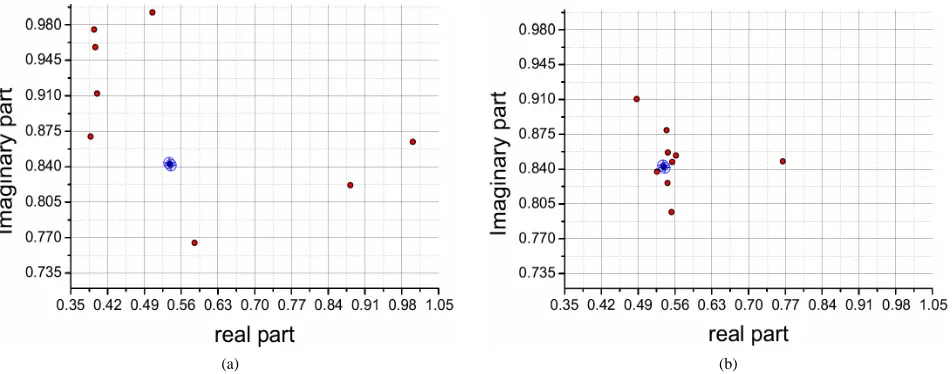
Assuming the noise average amplitude to be 10–5 times the amplitude of each of the two signals, and assuming the data to be in double precision, the diagonal Padé Approximant instead needs only 40 data points to resolve the two signals with reasonable accuracy; a reduction by two orders of magnitude. Figure 3 shows the positions and residues of the reconstructed signal poles for 8 different realizations of the noise: there is some spread in position and amplitude (pole residue) which completely disappears by doubling the number of data points, but the 16 poles are clearly grouped around the positions of the two input poles marked by large red dots. 8 zeros fall between the two groups of poles. The resolution transi- tion between 1 and 2 signals takes place as follows. For low only 8 poles with sizable residues are visible, one for each noise realization, clustered halfway between the positions of the two signal poles; Figure 4 shows the
Figure 1. FFT for a signal corresponding to two peaks on the unit circle distant using 256 data points. The noise average amplitude is 10−5 times the amplitude of
each of the two signals.
4 103
Figure 2. FFT for the same signal as in Figure 1 using 8192 data points.
case for . The noise doublets are spread around the unit circle away from the signal poles; we discussed this repulsion in [10]. By increasing , we see that 8 doublets, one for each data sequence, approach the signal poles, see Figure 5.
10
N
N
Close to the signal poles the doublets split while the central cluster of 8 poles also breaks up; finally the poles regroup in the two clusters visible in Figure 3 with the zeros halfway between them. Figure 6 shows this sequence of events. Already for all 16 poles are visible, even if the two clusters visible in Figure 3 are not yet fully formed: see Figure 7.
30
N
The case we have shown is that of equal phases of the two signals; for different phases the zeros are on the straight line perpendicular to the line connecting the two poles and crossing it halfway between the two poles. Figure 8 shows the case when the signal residues have
Figure 3. Residues of the poles of the Padé Approximant to the Z-transform of the same signal as in Figure 1 using 40 data points. Large red dots indicate the position of the signal poles.
Figure 4. Residues of the poles of the Padé Approximant to the Z-transform of the same signal as in Figure 1 using only 10 data points. Large red dots indicate the position of the signal poles.
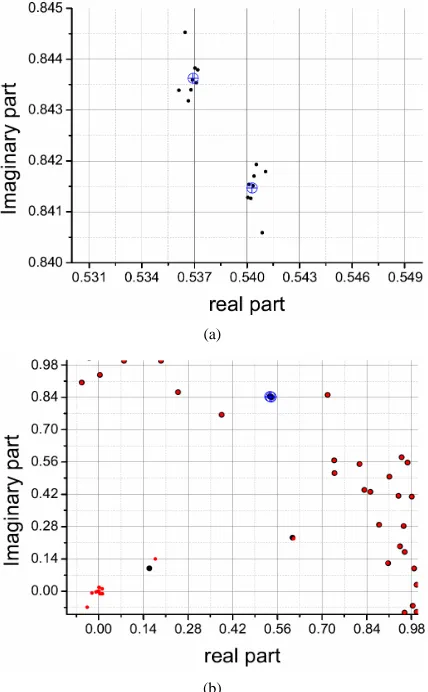
opposite sign: no zero is present near the signal poles as in Figure 8(a); all the zeros are clustered at the ori- gin as in Figure 8(b).
8
[image:4.595.62.538.84.271.2]
(a) (b)
Figure 5. Poles (black dots) and zeros (red dots) of the Padé Approximant to the Z-transform of the same signal as in Figure 1 using (a) 10 and (b) 20 data points. Crosses inscribed in circles indicate the position of the signal poles.
(a) (b)
(c) (d)
[image:4.595.60.538.308.709.2]Figure 7. Residues of the poles of the Padé Approximant to the Z-transform of the same signal as in Figure 1 using 30 data points. Large red dots indicate the position of the signal poles.
(a)
(b)
Figure 8. Poles (black dots) and zeros (red dots) of the Padé Approximant to the Z-transform of the same signal as in Figure 1 using 50 data points. Crosses inscribed in circles indicate the position of the signal poles; (a) shows the region close to the two poles and (b) a more extended area so that the zeros can be seen.
Figure 9. Poles (black dots) and zeros (red dots) of the Padé Approximant to the Z-transform of the same signal as in Figure 1 using 30 data points; the noise average amplitude is now reduced to 10−7 times the amplitude of each of the
two signals. Crosses inscribed in circles indicate the position of the signal poles.
and phase. In this case, we have early indications of a second pole since even with , we can see all the 16 poles: as in Figure 10.
10
N
3.2. Two Unequal Peaks on the Unit Circle
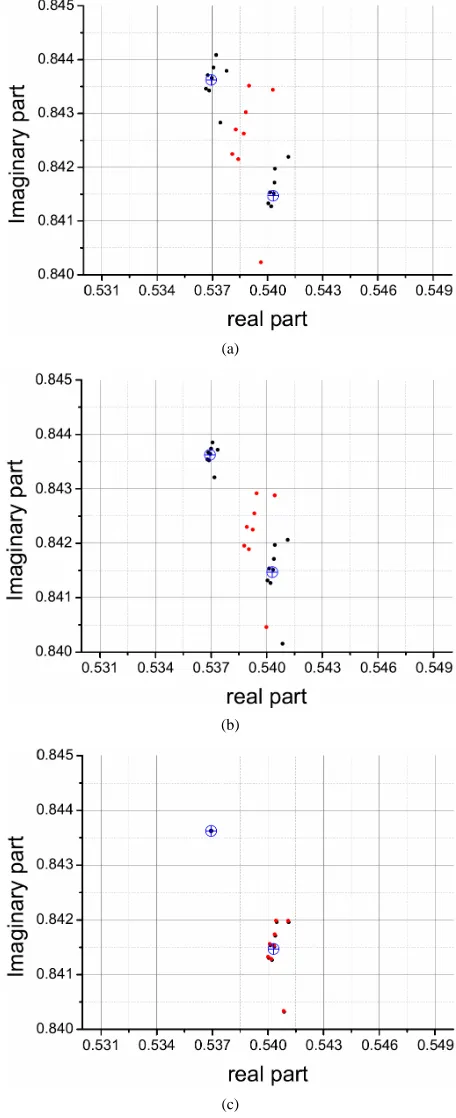
If the residues of the two poles are unequal, there is an obvious migration of the intervening zero from equidis- tant to the two poles toward the weaker of the two poles. When the signals also have different phases, the zero is on a circle of radius 2k 1k2 whose center lies on the line connecting the two poles at a distance
2
1k 1k2 from their middle point, where k is the ratio of the magnitudes of the two poles.
[image:5.595.66.279.85.257.2]Resolution in this case depends on the SNR of the smaller of the two signals only: increasing the residue of the larger of the two poles does not alter the spread of the poles of the weaker one.
Figure 11 shows an example where only the residue of larger of the two signals is increased while all the other parameters are kept fixed. We keep the same noise realization, so as to do not move the poles of the weaker of the two signals. Two effects are clearly visible: the re- duction of the spread of the poles of the stronger of the two signals and the migration of the zeros of toward the weaker of the two signals.
3.3. Two Equal Peaks off the Unit Circle
[image:5.595.66.280.320.666.2]Figure 10. Residues of the poles of the Padé Approximant to the Z-transform of the same signal as in Figure 9 using 10 data points. Large red dots indicate the position of the signal poles.
If it is possible to increase the sampling rate at will, then—for any given decay time—the signal poles can be moved as close as we want to the unit circle and we are back to the unit circle case.
If instead the sampling rate is limited, then—for any given distance between signal poles—we’ll have to search for the optimal number of data points as a func- tion not only of the SNR but also of the data poles distance from the unit circle.
Signal poles off the unit circle correspond to damped signals; again assuming constant noise amplitude (and data precision) each new point will have lower and lower precision. One might therefore expect (for a given noise level and data precision) the resolution to first increase and then decrease when increasing the number of data po- ints. We do not have evidence of this kind of behaviour.
What we instead see is:
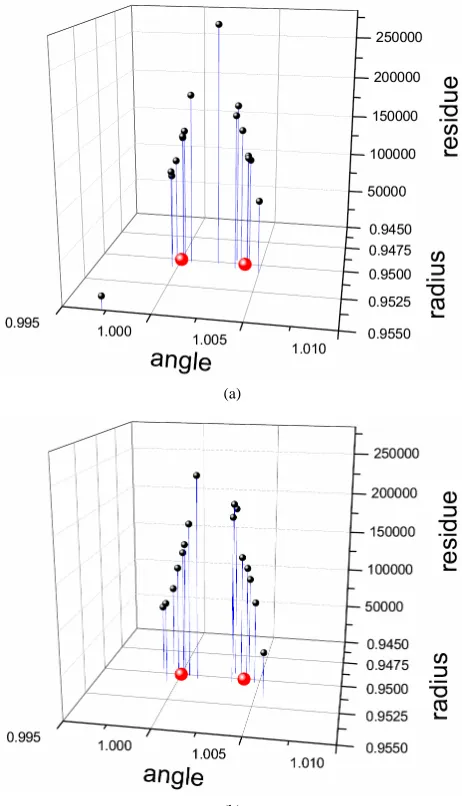
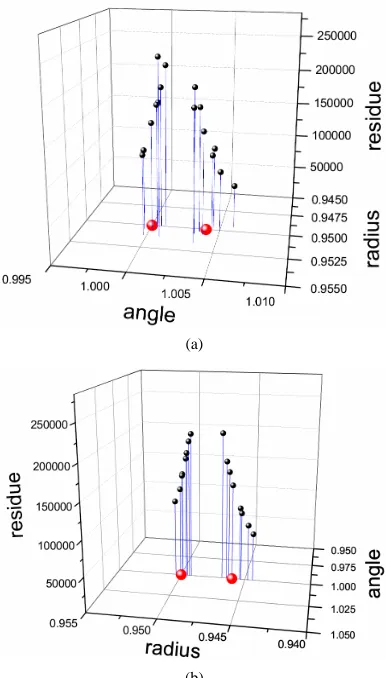
1) Compared to the unit circle case, a very slow resolu- tion increase with the number of points: for 5
noise 10 , two peaks, radial position 0.95, angle 1.0, and separation , not much difference is seen going from 100 (Figure 12(a)) to 200 (Figure 12(b)) data points.
3 4 10
2) A decrease of resolution when moving off the unit circle: in the case of two peaks, angle 1.0, and sepa- ration , going from the unit circle to a radial position
3 4 10
0.95
, noise has to be reduced from 5 10 to to get a comparable resolution with 300 data points: see Figure 13.
7
10
3) The relevant distance is not the frequency one, but the one in the complex plane. For example, for
, two peaks, radial position ρ = 0.950, angle φ = 1.000, separation , and N = 300, there is no relevant difference in the spread of the signal poles
5 noise 10
3 4 10
(a)
(b)
[image:6.595.308.536.87.646.2](c)
Figure 11. Poles (black dots) and zeros (red dots) of the Padé Approximant to the Z-transform of two signals on the unit circle distant using 50 data points. The noise average amplitude is 10−5 times the amplitude of the
residue of the weaker pole. (a) Equal residues; (b) Second pole twice as big as the first one; (c) Second pole 100 times bigger than the first one; Crosses inscribed in circles indicate the position of the signal poles.
(a)
[image:7.595.314.537.82.487.2](b)
Figure 12. Residues of the poles of the Padé Approximant to the Z-transform of the signal generated by 2 poles in (ρ, φ) = (0.950, 1.000) and (0.950, 1.004) with residues r = 105. Noise
amplitude is unitary. We use 8 data samples of (a) 100 and (b) 200 points each. Large red dots indicate the position of the signal poles.
between the case of two poles having the same radial position (decay rate) and different angles (frequencies), Figure 14(a) and the case where the two poles have different radial positions and the same angle, Figure 14(b).
3.4. Four Unequal Peaks
To show that the presence of more signals does not alter the above picture, we now present results for a tight cluster of 4 poles with different residues and decay rates.
Figure 15 shows poles and zeros for an example where the four signal poles are at (ρ, φ) = (0.95, 1.00), (0.90, 1.01), (0.85, 1.02), (0.80, 1.05) with residues
(a)
(b)
Figure 13. Residues of the poles of the Padé Approximant to the Z-transform of the signal generated by 2 poles in (a) (ρ,
φ) = (1.000, 1.000) and (1.000, 1.004) with residues r = 105
and in (b) (ρ, φ) = (0.950, 1.000) and (0.950, 1.004) with residues r = 107. Noise amplitude is unitary. We use 8 data
samples of 300 points each. Large red dots indicate the position of the signal poles.
5 5 5 10 ,10 ,10 , 2 10
r 5
respectively. Noise amplitude is unity. We use 8 samples of 300 points each. The picture is quite clear (large red dots indicate the positions of the signal poles): only one reconstructed pole appears to fall on the signal pole in the foreground (the one with the longer decay time); in effect it’s 8 poles superimposed, as they are almost identical. When we look at the posi- tion of poles and zeros (Figure 16), we see that again zeros appear between the signal poles, as the phases of the residues of the poles are equal.
[image:7.595.56.287.85.488.2](a)
[image:8.595.75.268.83.422.2](b)
Figure 14. Residues of the poles of the Padé Approximant to the Z-transform of the signal generated by 2 poles in (a) (ρ,
φ) = (0.950, 1.000) and (0.950, 1.004) and in (b) (ρ, φ) = (0.950, 1.000) and (0.946, 1.000) with residues . Noise amplitude is unitary. We use 8 data samples of 300 points each. Large red dots indicate the position of the signal poles.
r105
Figure 15. Residues of the poles of the Padé Approximant to the Z-transform of the signal generated by 4 poles in (ρ, φ) = (0.95, 1.00), (0.90, 1.01), (0.85, 1.02), (0.80, 1.05) with residues r = 105, 105, 105, 2 × 10⁵ respectively. Noise
[image:8.595.306.538.84.253.2]amplitude is unitary. We use 8 data samples of 300 points each. Large red dots indicate the position of the signal poles.
Figure 16. Poles (black dots) and zeros (red dots) of the Padé Approximant to the Z-transform of the same signal as in Figure 15. We use the 163 combinations of 4 or more of the 8 samples available, each consisting of 300 data points. Crosses inscribed in circles mark the positions of the signal poles.
from noise ones (which do not form clusters), we took advantage of the nonlinearity of the Padé Approximants and calculated them for a number of linear combinations of the available data sequences [10], as in Figure 16 where we used the 163 combinations of 4 or more of the 8 samples available.
None of this structure is visible in the DFT. Figure 17(a) shows the relevant section of the DFT over 256 points: the red lines mark the four signals but only a single wide peak is visible.
Extending the samples to 8192 points does not reveal any additional structure as can be seen in Figure 17(b): here the vertical scale is logarithmic and only the region around the center of the peak has been plotted to better check for the presence of structures.
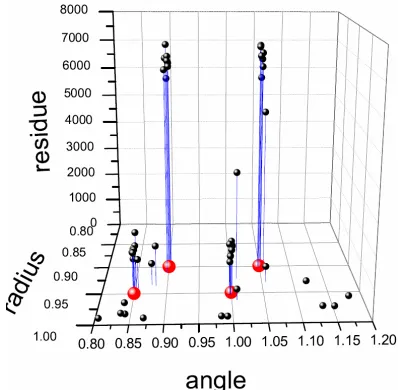
Figures 18 and 19 show a less extreme case where the average separation of the poles is increased so that the four signal poles are at (ρ, φ) = (0.95, 0.85), (0.90, 0.90), (0.95, 1.00), (0.90, 1.05) with residues r = 103, 5 × 10³, 103, 5 × 10³ respectively. Again, noise amplitude is uni- tary and we use 8 samples of 300 points each. The residue picture, Figure 18, is very clear.
Of course, the DFT performance is also somehow im- proved but only two of the four peaks are now clearly visible in Figure 19.
4. Conclusions
(a)
[image:9.595.314.531.85.256.2](b)
[image:9.595.66.278.86.428.2]Figure 17. FFT for the same signal as in Figure 15 using (a) 256 data points and (b) 8192 data points.
Figure 18. Residues of the poles of the Padé Approximant to the Z-transform of the signal generated by 4 poles in (ρ, φ) = (0.95, 0.85), (0.90, 0.90), (0.95, 1.00), (0.90, 1.05) with residues r = 103, 5 × 10³, 103, 5 × 10³ respectively. Noise
[image:9.595.71.270.470.665.2]amplitude is unitary. We use 8 samples of 300 points each. Large red dots indicate the position of the signal poles.
Figure 19. FFT for the same signal as in Figure 18 using 256 data points.
of noise, or equivalently of the number of significant digits of the input data.
In passing, let us note that super resolution is not unique to Padé approximants to the Z-transform: see e.g. [11] and references therein. The advantages of Padé ap- proximants are that 1) they only require knowledge that the spectrum is made up of a finite number of damped oscillators; 2) they are stable with respect to the presence of small amounts of noise [5,10].
5. Acknowledgements
We thank Professor Marcel Froissart, from College de France, for discussions and suggestions.
We thank Professor Carlos Handy, Head of the Phys- ics Department at Texas Southern University, for his support.
Special thanks to Professor Mario Diaz, Director of the Center for Gravitational Waves at the University of Texas at Brownsville: without his constant support this work would have never been possible.
This work has been supported by NASA through an award made to the Center for Gravitational Waves at the University of Texas at Brownsville.
REFERENCES
[1] P. Barone and R. March, “On the Super-Resolution Prop-
erties of Prony’s Method,” ZAMM: Zeitschrift Fur Ange-
wandte Mathematik Und Mechanik, Vol. 76, Suppl. 2, 1996, pp. 177-180.
[2] P. Barone and R. March, “Some Properties of the Asymp-
totic Location of Poles of Pade Approximants to Noisy
Rational Functions, Relevant for Modal Analysis,” IEEE
Transactions on Signal Processing, Vol. 46, No. 9, 1998,
pp. 2448-2457. doi:10.1109/78.709533
[3] D. Belkic and K. Belkic, “Optimized Molecular Imaging
nition in Radiation Oncology,” In: G. Garca Gomez-Te-
jedor and M. C. Fuss, Eds., Radiation Damage inBio-
molecular Systems, Springer Netherlands, Dordrecht, 2012, pp. 411-430.
[4] C. E. Shannon, “Communication in the Presence of Noise,”
Proceedings of IEEE, Vol. 86, No. 2, 1998, pp. 447-457. doi:10.1109/JPROC.1998.659497
[5] D. Bessis and L. Perotti, “Universal Analytic Properties
of Noise: Introducing the J-Matrix Formalism,” Journal
of Physics A, Vol. 42, No. 36, 2009, Article ID: 365202. doi:10.1088/1751-8113/42/36/365202
[6] J. Gilewicz and B. Truong-Van, “Froissart Doublets in
Padé Approximants and Noise,” Constructive Theory of Functions 1987, Bulgarian Academy of Sciences, Sofia, 1988, pp. 145-151.
[7] J.-D. Fournier, G. Mantica, A. Mezincescu and D. Bessis,
“Universal Statistical Behavior of the Complex Zeros of
Wiener Transfer Functions,” Europhysics Letters, Vol. 22,
No. 5, 1993, pp. 325-331. doi:10.1209/0295-5075/22/5/002
[8] J.-D. Fournier, G. Mantica, A. Mezincescu and D. Bessis,
“Statistical Properties of the Zeros of the Transfer Func- tions in Signal Processing,” In: D. Benest and C. Froe-
schle, Eds., ChaosandDiffusioninHamiltonianSystems,
Editions Frontières, Paris, 1995.
[9] D. Bessis, “Padé Approximations in Noise Filtering,”
Journal of Computational and Applied Mathematics, Vol. 66, No. 1-2, 1996, pp. 85-88.
doi:10.1016/0377-0427(95)00177-8
[10] L. Perotti, D. Vrinceanu and D. Bessis, “Beyond the Fou-
rier Transform: Signal Symmetry Breaking in the Com-
plex Plane,” IEEE Signal Processing Letters, Vol. 19, No.
12, 2012, pp. 865-867. doi:10.1109/LSP.2012.2224864
[11] V. F. Pisarenko, “The Retrieval of Harmonics from a
Covariance Function,” Geophysical Journal of the Royal