International Journal of Emerging Technology and Advanced Engineering
Website: www.ijetae.com (ISSN 2250-2459, ISO 9001:2008 Certified Journal, Volume 7, Issue 9, September 2017)
323
Touch-less Biometric Fingerprint Authentication
Anushri Chourasiya
1, Rakesh Pandey
21,2
Oriental Institute of Science & Technology, Bhopal, India
Abstract— In recent years, there is new technique which
has been introduced i.e. touch-less fingerprint authentication system which may replaces the biometric device or scanner which is considered as unhygienic as well as costly. As we know that authentication system possess by a combination of username and password and this combination may be hacked because anyone of your friends or relative may perform brute force attack by guessing your password which may related to your personal details. But fingerprint cannot be stolen or copied that is why fingerprint authentication is the best authentication system. Everyone has distinct fingerprint and no one can authenticate or unauthorized access without your existence. So, on having this feature biometric device or scanner has been introduced in past years and now it is to be replaced by the touch-less fingerprint authentication or recognition system. This recognition can be perform either by webcam or by hand held device i.e. mobile. Here the system which has been proposed in this paper is able to enhance your fingerprint image through camera’s features such as autofocus, conversion through 3D print to 2D or resolve the curved area to flat image through which features can be extracted and make authentication system more powerful and portable.
Keywords— Touch-less, Fingerprint, Mobile, Minutiae,
Authentication.
I. INTRODUCTION
[image:1.612.352.534.201.328.2]Biometric fingerprint authentication system suppose as best authentication system in the field of digital world. Each and every person has distinct fingerprint and it can’t be stolen or cannot access without your existence. To achieve fingerprint there is biometric devices are available. Touch-less fingerprint system has been introduced which reduces the cost of forming this kind of system without any biometric devices instead of that it uses mobile’s camera to acquire fingerprint images and process it for authentication.
Fig. 1.1 Acquiring Fingerprint image through mobile’s fingerprint scanner
Today almost every mobile phone has inbuilt devices for acquiring fingerprint image for authentication but the cost of this device is included with your mobile’s cost. But there are so many mobiles phones which have been using are still don’t have fingerprint scanner so, here authentication through this kind of scanner is not feasible for every user. Instead of that if we use mobile’s camera for authentication then every mobile phone has a camera feature and can be used for authentication system.
[image:1.612.344.546.467.611.2]International Journal of Emerging Technology and Advanced Engineering
Website: www.ijetae.com (ISSN 2250-2459, ISO 9001:2008 Certified Journal, Volume 7, Issue 9, September 2017)
324
II. PROBLEM STATEMENTS
[image:2.612.59.266.260.490.2]Existing system is not intelligent enough to sense whether the image which is acquiring is appropriate or not at real time. We need a system that increases the camera performance and took appropriate image of finger through which minutiae can be extracted with highest accuracy. But existing system are based on image processing, it enhances the image after acquisition. That is why these systems are lacking somewhere which is required to overcome.
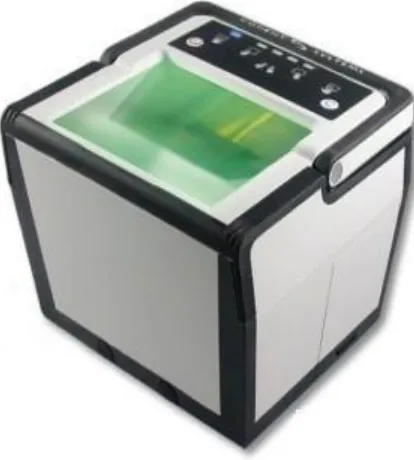
[image:2.612.335.562.261.648.2]Fig. 2.1 Biometric Fingerprint Scanner
Fig. 2.2 Present Touch-less Based Fingerprint Authentication
III. PROPOSED WORK
The system which has been introduced in this paper is based on touch-less fingerprint authentication for mobile based login. As we know that each mobile phone has a front and rear camera, what quality of camera it is does not matter because autofocus is feature which makes your photo more visible and sharper as compare to normal images. Here the system uses auto focus feature of your mobile camera along with flash light to get enhanced minutiae focused images with high quality.
Fig. 3.1 PIN Enrollment
[image:2.612.59.276.524.663.2]International Journal of Emerging Technology and Advanced Engineering
Website: www.ijetae.com (ISSN 2250-2459, ISO 9001:2008 Certified Journal, Volume 7, Issue 9, September 2017)
[image:3.612.55.282.139.517.2]325 Fig. 3.2 Fingerprint Enrollment
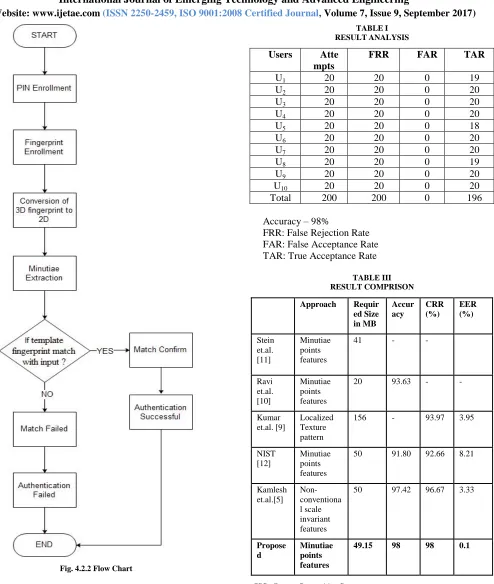
Once the enrollment of fingerprint has been done, now system becomes ready to use and verify fingerprint of authentic user. The proposed system captures clear focused fingerprint as similar as a biometric device does. 3D fingerprint convert into 2D HD print and minutiae features extracted accurately and FAR (False Acceptance Rate) is negligible.
IV. PROPOSED METHODOLOGY
The major minutiae features of fingerprint ridges are ridge ending, bifurcation, and short ridge (or dot). The ridge ending is the point at which a ridge terminates.
Bifurcations are points at which a single ridge splits into two ridges. Short ridges (or dots) are ridges which are significantly shorter than the average ridge length on the fingerprint. Minutiae and patterns are very important in the analysis of fingerprints since no two fingers have been shown to be identical.
Fig. 4.1 Minutiae Identification
Pattern based algorithms compare the basic fingerprint patterns (arch, whorl, and loop) between a previously stored template and a candidate fingerprint. This requires that the images can be aligned in the same orientation. To do this, the algorithm finds a central point in the fingerprint image and centers on that. In a pattern-based algorithm, the template contains the type, size, and orientation of patterns within the aligned fingerprint image. The candidate fingerprint image is graphically compared with the template to determine the degree to which they match.
[image:3.612.331.551.212.526.2]International Journal of Emerging Technology and Advanced Engineering
Website: www.ijetae.com (ISSN 2250-2459, ISO 9001:2008 Certified Journal, Volume 7, Issue 9, September 2017)
326
4.2 TLF Algorithm (Touch-Less Fingerprint Algorithm) -
1. Fi is an input fingerprint
2. mi is the minutiae & mi has four parameters mi = (xi, yi, θi,
ti)
where
xi, yi, - are coordinates of the minutiae point
θi- is minutiae direction
ti - is type of the minutiae point (ridge ending or ridge
bifurcation)
3. Calculate Crossing Number (CN) ; which is defined as half the sum of the differences between pairs of neighbouring pixels piand pi+1
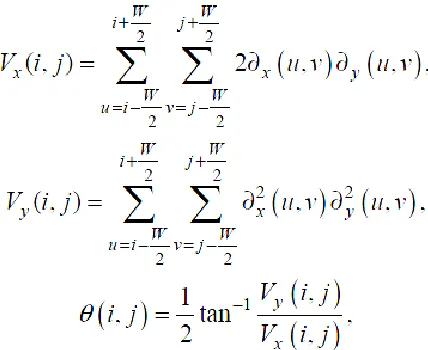
4. Calculate orientation estimation and the local orientation at pixel (i, j) can then be estimated using the following equations:
Where ; i , j - is the least square estimate of the local orientation at the block centered at pixel( i , j),
x , y - are the gradient magnitudes (the Sobel operator)
in the x and y directions. Further, orientation field need to be smoothed in a local neighbourhood using a Gaussian filter
5. Matching algorithm compares two minutiae sets: template T = {m1 , m2 ,..., mj }from reference fingerprint
and input= {m1 , m2 ,..., mi } from the query and returns
similarity score S (T , I )
n - is the number of minutiae points in I input set, m - is the number of transformation equal to the number of minutiae in T template set,
[image:4.612.58.272.374.549.2]It reflects the FRR (False Reject Rate) and FAR (False Accept Rate) and on the basis of that it return the result with score.
International Journal of Emerging Technology and Advanced Engineering
Website: www.ijetae.com (ISSN 2250-2459, ISO 9001:2008 Certified Journal, Volume 7, Issue 9, September 2017)
[image:5.612.72.566.116.700.2]327 Fig. 4.2.2 Flow Chart
TABLEI
RESULTANALYSIS
Users Atte
mpts
FRR FAR TAR
U1 20 20 0 19
U2 20 20 0 20
U3 20 20 0 20
U4 20 20 0 20
U5 20 20 0 18
U6 20 20 0 20
U7 20 20 0 20
U8 20 20 0 19
U9 20 20 0 20
U10 20 20 0 20
Total 200 200 0 196
Accuracy – 98%
[image:5.612.74.269.153.678.2]FRR: False Rejection Rate FAR: False Acceptance Rate TAR: True Acceptance Rate
TABLE III RESULT COMPRISON
Approach Requir
ed Size in MB Accur acy CRR (%) EER (%) Stein et.al. [11] Minutiae points features
41 - -
Ravi et.al. [10] Minutiae points features
20 93.63 - -
Kumar et.al. [9]
Localized Texture pattern
156 - 93.97 3.95
NIST [12]
Minutiae points features
50 91.80 92.66 8.21
Kamlesh et.al.[5] Non-conventiona l scale invariant features
50 97.42 96.67 3.33
Propose d
Minutiae points features
49.15 98 98 0.1
[image:5.612.323.566.414.693.2]International Journal of Emerging Technology and Advanced Engineering
Website: www.ijetae.com (ISSN 2250-2459, ISO 9001:2008 Certified Journal, Volume 7, Issue 9, September 2017)
328 Graph I Result Comparison for Database size
Graph II Result Comparison for Accuracy, CRR & EER
V. CONCLUSION &FUTURE SCOPE
The current proposed concept of touch-less fingerprint recognition or authentication system get enhanced by improving the real time vision of mobile camera in term of stabilization, autofocus, region of interest etc. The digital world requires cost effective and best security system which proposed system provides. As per the future scope of current proposed system of touch-less fingerprint authentication system gets applicable in future in different places such as online banking, mobile attendance, mobile phone security and many more.
REFERENCES
[1] Hareesh Ravi and SabarishKuduwaSivanath, ―A Novel Method for
Touch-Less Finger Print Authentication‖, IEEE Transaction, 2013.
[2] G.Vinoth Kumar, K.Prasanth, S.Govinth Raj and S.Sarathi,
―Fingerprint Based Authentication System with Keystroke Dynamics for Realistic User‖, IEEE Transaction, 2014.
[3] Anju Mohan1 and Prof. Shilpa P. Kodgire2, ―Touchless Fingerprint
recognition using MATLAB‖, IEEE Transaction, 2014.
[4] Ruggero DonidaLabati, ―Toward Unconstrained Fingerprint
Recognition:A Fully Touchless 3-D System Based on Two Views on the Move‖, IEEE Transaction, 2015.
[5] Kamlesh Tiwari and Phalguni Gupta, ―A Touch-less Fingerphoto
Recognition System for Mobile Hand-held Devices‖, IEEE Transaction, 2015.
[6] Marcin Piekarczyk and Marek R. Ogiela, ―On Using Palm and
Finger Movements as a Gesture-based Biometrics‖, IEEE Transaction, 2015.
[7] Marcin Piekarczyk and Marek R. Ogiela, ―Usability of the Fuzzy
Vault Scheme Applied to Predetermined Palm-based Gestures as a Secure Behavioral Lock‖, IEEE Transaction, 2015.
[8] Erol Ozan, ―Password-free Authentication for Social Networks‖,